词汇表

英语词汇词典 | 单词含义、定义和示例

verb
/ˈflætər/
为了获得好处而过分或虚伪地赞扬 (wèile huòdé hǎochù ér guòfèn huò xūwěi dì zànyáng)

to praise excessively or insincerely to gain favor

"He tried to flatter his boss to get a promotion."

"他试图讨好他的老板以获得晋升。" (Tā shìtú tǎohǎo tā de lǎobǎn yǐ huòdé jìnshēng.)
noun
/ˈflæt.ər.ər/
奉承者 (fèngchéng zhě)

a person who lavishes praise, often insincerely and in order to gain advantage

"The king was surrounded by flatterers who only told him what he wanted to hear."

"国王被奉承者围绕,他们只告诉他他想听的话。" (Guówáng bèi fèngchéng zhě wéirào, tāmen zhǐ gàosù tā tā xiǎng tīng de huà.)
noun
/ˈflæt.ər.i/
恭维 (gōngwéi)

excessive and insincere praise, given especially to further one's own interests

"His constant flattery made everyone suspicious of his true motives."

"他不断的恭维使大家怀疑他的真实动机。" (Tā bù duàn de gōngwéi shǐ dà jiā huái yí tā de zhēn shí dòng jī.)
noun
/ˈflætʃələns/
消化系统中的气体积聚 (xiaohua xitong zhong de qiti jiju)

the accumulation of gas in the digestive system; excessive gas in the stomach or intestines

"Eating beans can sometimes cause flatulence."

"吃豆子有时会引起腹胀。" (Chi douzi youshi hui yinqi fuzhang.)
verb
/flɔːnt/
炫耀 (xuànyào)

to show off something proudly, often to attract attention

"She likes to flaunt her new jewelry at parties."

"她喜欢在派对上炫耀她的新珠宝。" (Tā xǐhuān zài pàiduì shàng xuànyào tā de xīn zhūbǎo.)
flavor definition card — visual illustration of the meaning
noun
/ˈfleɪvər/
味道 (weidao)

The distinctive taste of a food or drink.

"This ice cream has a delicious mango flavor."

"这款冰淇淋有美味的芒果味。" (Zhè kuǎn bīngqílín yǒu měiwèi de mángguǒ wèi.)
noun
/ˈfleɪ.vər/
风味 (fengwei)

the distinctive taste of a food or drink; a particular quality or atmosphere

"The soup had a rich flavour of herbs and spices from the garden."

"汤里有来自花园的丰富香草和香料味。" (Tang li you laizi huayuan de fengfu xiangcao he xiangliao wei.)
noun
/flɔː/
缺陷 (quēxiàn)

a defect or imperfection in something

"The diamond had a small flaw that was barely visible."

"钻石有一个几乎看不见的小缺陷。" (Zuànshí yǒu yīgè jīhū kàn bù jiàn de xiǎo quēxiàn.)
adjective
/flɔːd/
有缺陷的 (you quexian de)

having a mistake or fault that reduces its value or quality

"The flawed design of the car led to a recall."

"汽车设计有缺陷,导致了召回。" (Qiche sheji you quexian, daozhi le zhaohui.)
adjective
/ˈflɔː.ləs/
完美的; 无缺陷 (flawless)

perfect; without any defects or faults; immaculate

"Her flawless performance earned her a standing ovation."

"她完美的表现为她赢得了全场起立的掌声。" (Ta wan mei de biao xian wei ta ying de le quan chang qi li de zhang sheng.)
noun
/flæks/
亚麻 (yama)

a plant whose fibers are used to make linen and whose seeds are edible

"Flax is often used in making linen fabrics."

"亚麻常用于制作亚麻织物。" (Yama chang yongyu zhizao yama zhiwu.)
verb
/fleɪ/
剥皮/严厉批评 (bāo pí/yánlì pīpíng)

to strip off the skin of something or criticize severely

"The chef flayed the fish before cooking it."

"厨师在烹饪前剥去了鱼的皮。" (Chúshī zài pēngrèn qián bāo qùle yú de pí.)
noun
/flɛk/
小斑点 (xiao bandian)

a small spot or mark, often of a different color

"There was a fleck of paint on the floor."

"地板上有一个小斑点。" (Diban shang you yige xiao bandian.)
noun
/ˈflɛkʃən/
弯曲 (wanqu)

The act of bending or the state of being bent, especially of a limb or joint.

"The doctor tested the patient's knee flection during the examination."
"医生在检查过程中测试了病人的膝盖弯曲。" (Yisheng zai jiancha guocheng zhong ceshi le bingren de xigai wanqu.)
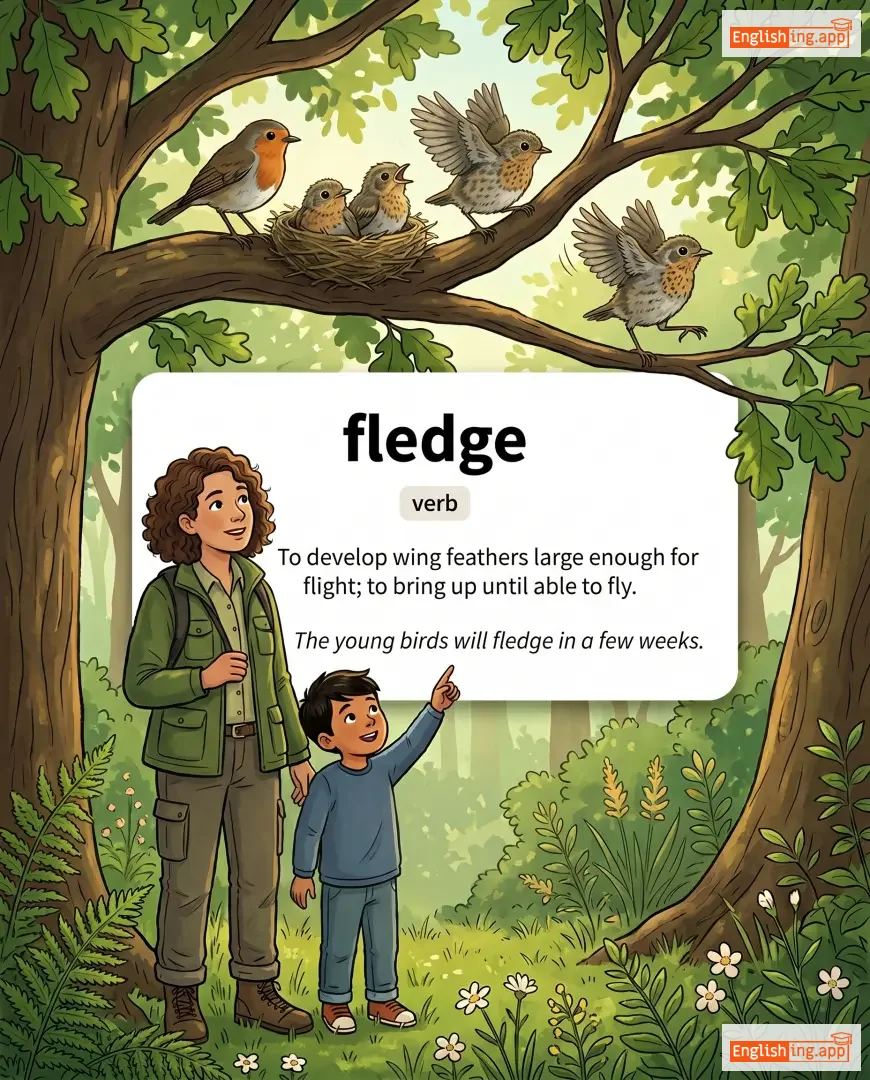
fledge definition card — visual illustration of the meaning
verb
/flɛdʒ/
飞翔 (feixiang)

To develop wing feathers large enough for flight; to bring up until able to fly.

"The young birds will fledge in a few weeks."

"年轻的鸟将在几周内学会飞行。" (Niánqīng de niǎo jiāng zài jǐ zhōu nèi xuéhuì fēixíng.)
noun
/ˈflɛdʒlɪŋ/
初生小鸟 (chusheng xiaoniao)

A young bird that has just developed its feathers and is learning to fly; a beginner.

"The fledgeling was trying hard to take its first flight."

"那只初生小鸟正在努力做第一次飞行。" (Na zhi chusheng xiaoniao zheng zai nuli zuo diyi ci feixing.)
fledgling definition card — visual illustration of the meaning
noun/adjective
/ˈflɛdʒlɪŋ/
新手 (xīnshǒu)

A young bird just learning to fly; also used for a person or organization that is inexperienced or new.

"The fledgling company is growing rapidly despite challenges."

"这家新兴公司尽管面临挑战,仍在快速增长。" (Zhe jia xinxing gongsi jin guan mianlin tiaozhan, reng zai kuaisu zengzhang.)
🏃‍♂️

flee (弗利)

verb
/fliː/
逃跑 (tao pao)

To run away from danger or a threatening situation.

"The villagers had to flee during the flood."

"村民们在洪水期间不得不逃离。" (Cunmin men zai hongshui qi jian bude bu taoli.)
noun/verb
/fliːs/

The woolly covering of a sheep; as a verb, to swindle or cheat someone.

"The farmer sheared the sheep’s fleece carefully."

noun
/fliːt/
舰队 (jiànduì)

a group of ships, vehicles, or aircraft operating together under one command

"The navy deployed its entire fleet for the exercise."

"海军为演习部署了整个舰队。" (Hǎijūn wèi yǎnxí bùshǔle zhěnggè jiànduì.)
fleeting definition card — visual illustration of the meaning
adjective
/ˈfliː.tɪŋ/
短暂的 (duǎnzhàn de)

lasting for a very short time

"She had a fleeting smile before she left."

"她在离开前露出了短暂的微笑。" (Tā zài líkāi qián lùchūle duǎnzhàn de wēixiào.)
noun
/flɛʃ/
(rou)

the soft substance consisting of muscle and fat that is found between the skin and bones of animals or humans

"The wound cut deep into the flesh of his arm."

"伤口深深地切入了他手臂的肉里。" (Shangkou shenshen de qieru le ta shoubi de rou li.)
flexibility definition card — visual illustration of the meaning
noun
/ˌflɛksəˈbɪləti/
灵活性 (línghuóxìng)

the ability to bend easily without breaking or to adapt to new situations

"Flexibility is essential for success in a changing work environment."

"在变化的工作环境中,灵活性对成功至关重要。" (zài biànhuà de gōngzuò huánjìng zhōng, línghuóxìng duì chénggōng zhìguān zhòngyào.)
adjective
/ˈfleks.ə.bəl/
灵活 (linghuo)

able to bend easily without breaking; adaptable to change

"Yoga helps to make the body more flexible."

"瑜伽有助于使身体更加灵活。" (Yújiā yǒuzhù yú shǐ shēntǐ gèngjiā línghuó.)
verb
/flɪk/
快速轻弹 (kuai su qing tan)

to move or cause to move with a sudden quick motion

"He flicked the switch to turn on the light."

"他迅速地按下开关以打开灯。" (Ta xunsu de anxia kaiguan yi dakaidian.)
verb
/ˈflɪk.ər/
闪烁 (shan shuo)

to shine unsteadily or waver between light and dark

"The candle flickered in the wind."

"蜡烛在风中闪烁。" (Làzhú zài fēng zhōng shǎnshuò.)
noun
/flaɪt/
航班 / 航班 (hangban / hangban)

the act of flying, typically through the air; or a scheduled trip by an aircraft

"Our flight to London was delayed due to bad weather."

"我们飞往伦敦的航班因恶劣天气而延误。" (Wo men fei wang Lundun de hangban yin e lie tianqi er yanwu.)
adjective
/ˈflaɪti/
不稳定 (bù wěn dìng)

unstable, impulsive, or easily distracted; lacking seriousness or stability

"She’s too flighty to stick with one job for long."

"她太不稳定了,无法在一份工作上呆太长时间。" (Tā tài bù wěn dìng le, wú fǎ zài yí fèn gōng zuò shàng dāi tài cháng shí jiān.)
adjective
/ˈflɪmzi/
脆弱的 (cui ruo de)

weak, fragile, or lacking in strength; not convincing

"The chair was too flimsy to support his weight."

"这把椅子太脆弱了,无法支撑他的重量。" (zhe ba yi zi tai cui ruo le, wu fa zhi cheng ta de zhong liang.)
verb
/flɪntʃ/
退缩 (tuìsuō)

to suddenly move back or away due to fear or pain

"He didn’t flinch when the doctor gave him the injection."

"他在医生给他打针时没有退缩。" (Tā zài yīshēng gěi tā dǎ zhēn shí méiyǒu tuìsuō.)
verb
/flɪp/
翻转 (fanzhuan)

to turn over quickly or suddenly; to toss lightly

"She flipped the pancake in the pan."

"她把煎饼在锅里翻了个面。" (Ta ba jianbing zai guo li fanle ge mian.)
noun
/ˈflɪpənsi/
轻率 (qīngshuài)

lack of seriousness; showing a disrespectful or trivial attitude

"His flippancy during the meeting offended his colleagues."

"他在会议中的轻率让同事们感到不悦。" (Tā zài huìyì zhōng de qīngshuài ràng tóngshìmen gǎndào bùyuè.)
adjective
/ˈflɪpənt/
轻浮的 (qīngfú de)

not showing a serious or respectful attitude

"His flippant remarks annoyed the teacher."

"他轻浮的言论惹怒了老师。" (Tā qīngfú de yánlùn rě nù le lǎoshī.)
😉

flirt

verb
/flɜːrt/

to behave as if you are attracted to someone, but not in a serious way

"She often flirts with her colleagues at work."

verb
/flɪt/
飞来飞去 (fei lai fei qu)

to move quickly and lightly from one place to another

"Butterflies flitted from flower to flower."

"蝴蝶在花间飞来飞去。" (hudie zai hua jian fei lai fei qu)
verb
/floʊt/
浮动 (fudong)

to rest or move on the surface of a liquid or in the air without sinking

"The boat began to float gently down the river."

"船开始轻轻漂浮在河面上。" (Chuan kaishi qingqing piaofu zai he mian shang.)
adjective, verb (present participle)
/ˈfloʊtɪŋ/
浮动 (fudong)

remaining on the surface of a liquid without sinking; moving lightly or freely

"The boat was floating gently on the calm lake."

"船在平静的湖面上轻轻浮动。" (Chuan zai pingjing de humian shang qingqing fudong.)
noun/verb
/flɑːk/
(qun)

a group of birds or animals; to gather or move in a crowd

"Tourists flocked to the beach during summer."

"游客们在夏天涌向海滩。" (Youkemeng zai xiatian yongxiang haitan.)
noun
/floʊ/
浮冰 (fu bing)

a large sheet of floating ice

"The polar bears rested on the ice floe."

"北极熊在浮冰上休息。" (Běijí xióng zài fú bīng shàng xiūxí.)
noun
/flʌd/
洪水 (hongshui)

a large amount of water covering land that is usually dry

"The flood destroyed several houses in the village."
"洪水摧毁了村里的几座房子。" (Hongshui cuihui le cunli de jizuo fangzi.)
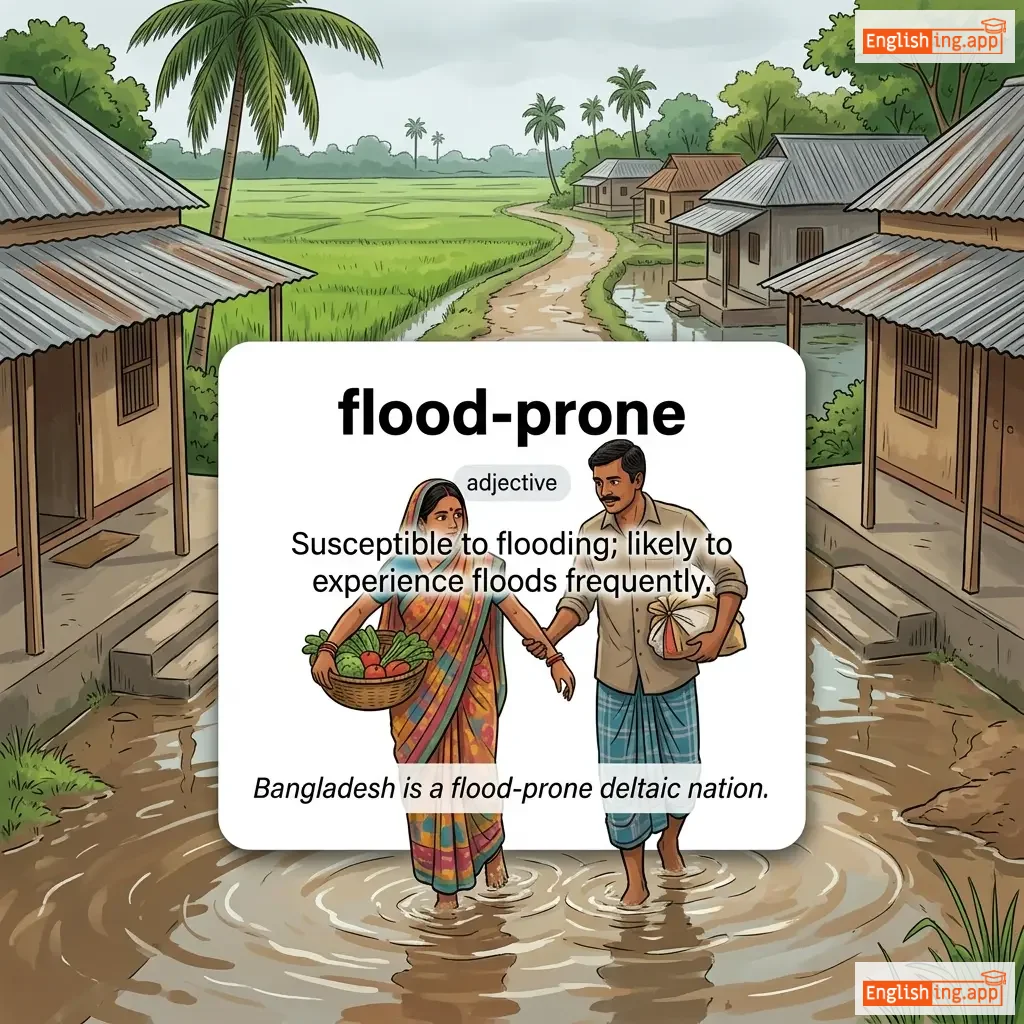
flood-prone definition card — visual illustration of the meaning
adjective
ˈflʌd proʊn
易受洪水影响 (yi shou hongshui yingxiang)

Susceptible to flooding; likely to experience floods frequently.

"Bangladesh is a flood-prone deltaic nation."

"孟加拉国是一个容易发生洪水的三角洲国家。" (Mengjialaguo shi yige rongyi fasheng hongshui de sanjiaozhou guojia.)
noun
/flɔːr/
地板 (diban)

the lower surface of a room, on which one may walk

"The floor was covered with a soft carpet."

"地板上铺着一块柔软的地毯。" (Diban shàng pūzhe yī kuài róuruǎn de dìtǎn.)
verb
/flɑp/
失败 (shibai)

to fall or move heavily and clumsily; to fail completely

"The new movie flopped at the box office."
"新电影在票房上失败了。" (Xin dianying zai piaofang shang shibai le.)
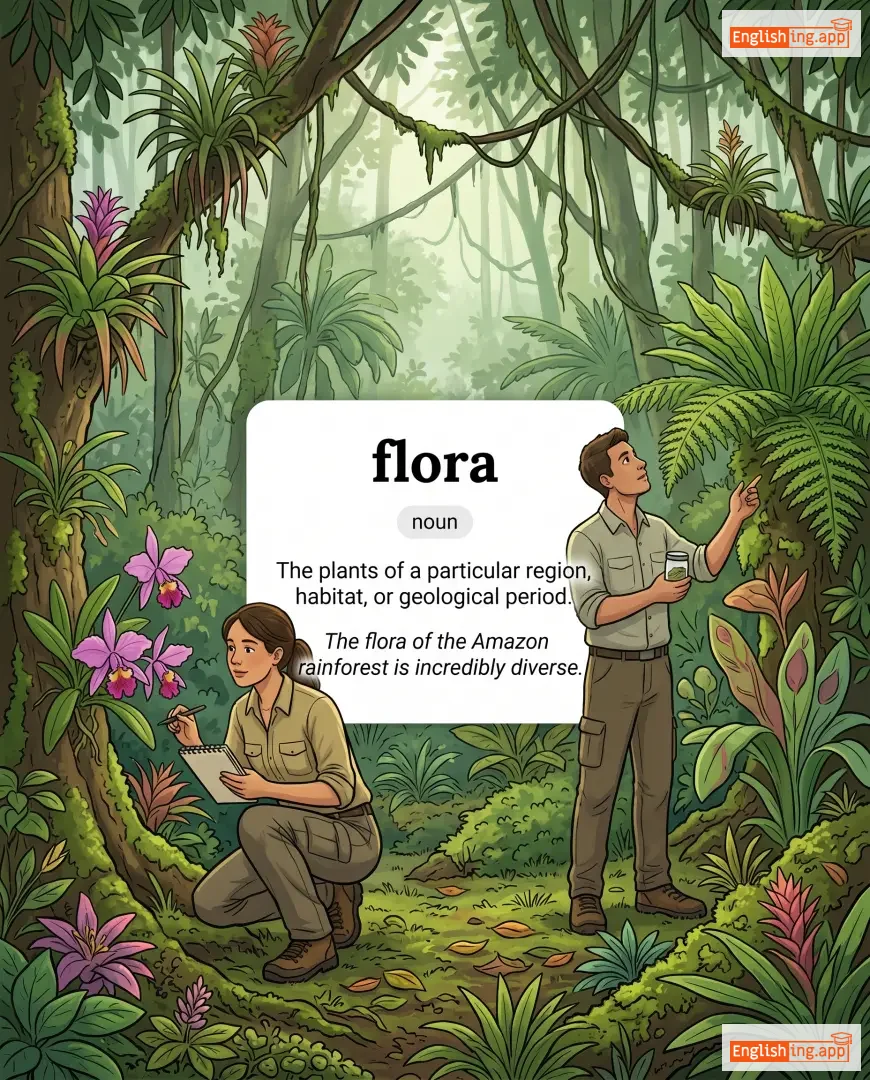
flora definition card — visual illustration of the meaning
noun
/ˈflɔːrə/
植物群 (zhíwù qún)

The plants of a particular region, habitat, or geological period.

"The flora of the Amazon rainforest is incredibly diverse."
"亚马逊雨林的植物群极其多样。" (Yàmǎxùn yǔlín de zhíwù qún jíqí duōyàng.)
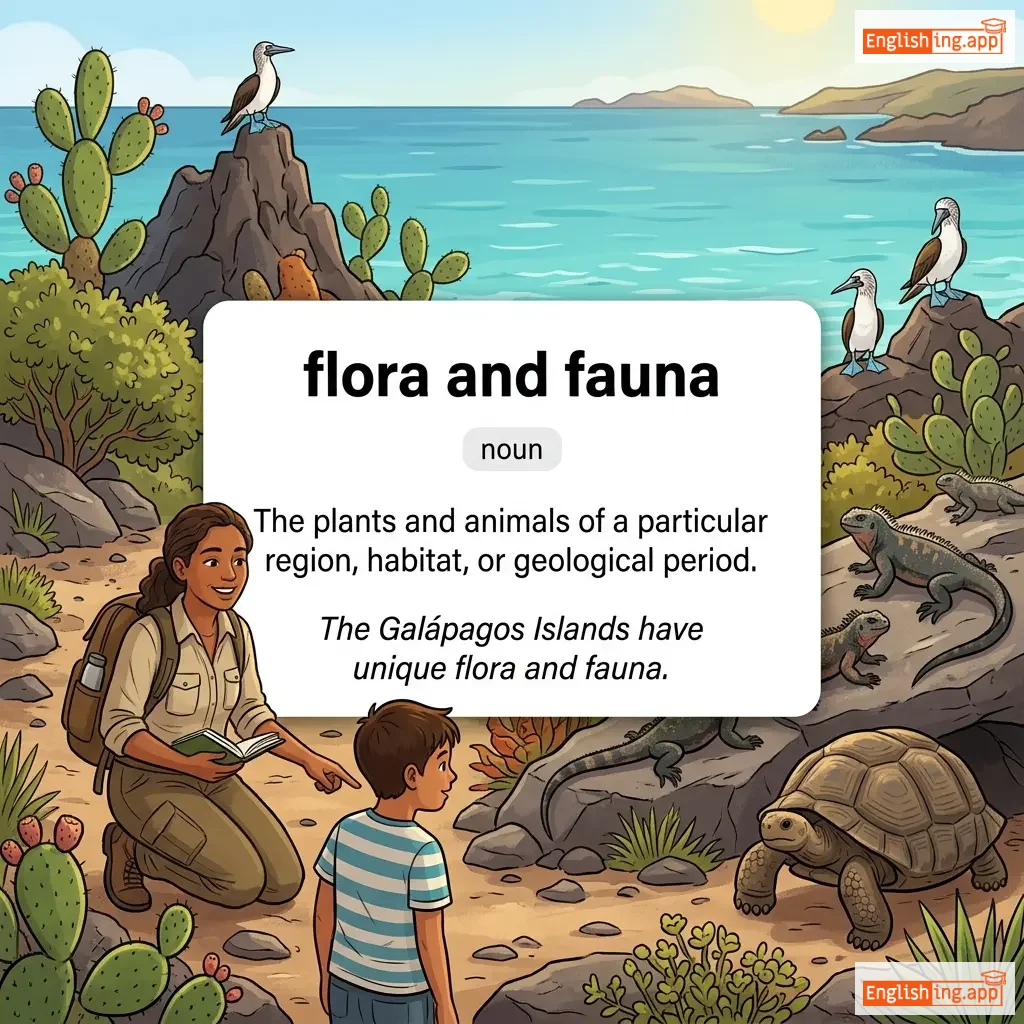
flora and fauna definition card — visual illustration of the meaning
noun
ˈflɔː.rə ænd ˈfɔː.nə
植物和动物 (zhíwù hé dòngwù)

The plants and animals of a particular region, habitat, or geological period.

"The Galápagos Islands have unique flora and fauna."

"加拉帕戈斯群岛拥有独特的植物和动物。" (Jiālāpágōs qúndǎo yǒngyǒu dútè de zhíwù hé dòngwù.)
adjective
/ˈflɔːrəl/
花卉的 (huāhuì de)

Relating to flowers or decorated with flowers.

"She wore a beautiful floral dress to the party."

"她穿着一件漂亮的花卉裙子去参加派对。" (Tā chuānzhuó yī jiàn piàoliang de huāhuì qúnzi qù cānjiā pàiduì.)
noun
/flɔːˈrɛsəns/
开花期 (kaī huā qī)

The process, state, or period of flowering.

"The garden reached its peak florescence in spring."

"花园在春天达到了它的盛开时期。" (Huāyuán zài chūntiān dádàole tā de shèng kāi shíqī.)
florid definition card — visual illustration of the meaning
adjective
/ˈflɒrɪd/
过度装饰的 / 红润 (guòdù zhuāngshì de / hóngrùn)

Having a red or flushed complexion; or excessively ornate and intricate.

"The speaker’s florid style made the lecture hard to follow."

"演讲者过度装饰的风格使得讲座难以理解。" (Yǎnjiǎng zhě guòdù zhuāngshì de fēnggé shǐdé jiǎngzuò nányǐ lǐjiě.)
noun
/ˈflɒrɪst/
花店老板 (huādiàn lǎobǎn)

A person who sells and arranges flowers.

"We bought a bouquet from the local florist."

"我们在当地的花店买了一个花束。" (Wǒmen zài dāngdì de huādiàn mǎile yīgè huāshù.)
noun
/fləˈtɪlə/
小型舰队 (xiǎo xíng jiànduì)

A small fleet of ships or boats operating together.

"A flotilla of fishing boats left the harbor at dawn."

"一支渔船的舰队在黎明时分离开港口。" (Yī zhī yúchuán de jiànduì zài límíng shí fēn líkāi gǎngkǒu.)