词汇表

英语词汇词典 | 单词含义、定义和示例

adjective
/ˌɪnsɪˈdɛntəl/
附带的 (fudai de)

happening as a minor part or in connection with something else

"Incidental expenses like snacks and tips were included in the bill."

"像零食和小费这样的附带费用被包含在账单中。" (Xiàng língshí hé xiǎofèi zhèyàng de fùdài fèiyòng bèi bāokuò zài zhàngdān zhōng.)
adverb
/ˌɪnsɪˈdɛntəli/
顺便 (shun bian)

by the way; used to introduce a remark not directly related to the main subject

"Incidentally, did you know that she studied in Paris?"

"顺便问一下,你知道她曾经在巴黎学习吗?" (Shun bian wen yi xia, ni zhi dao ta ceng jing zai Ba Li xue xi ma?)
verb
/ɪnˈsɪnəˌreɪt/
焚烧 (fén shāo)

to burn something completely until it is reduced to ashes

"The city decided to incinerate the medical waste for safety."

"城市决定为安全起见销毁医疗废物。" (Chéngshì juédìng wèi ānquán qǐjiàn xiāohuǐ yīliáo fèiwù.)
noun
/ɪnˈsɪpiəns/
开始 (kaishi)

the beginning or initial stage of something

"The project was still in its incipience when funding was approved."

"当资金获得批准时,项目仍处于其开始阶段。" (Dang zijin huode pizhun shi, xiangmu reng chu yu qi kaishi jieduan.)
adjective
/ɪnˈsɪpiənt/
初期的 (chūqī de)

in an initial stage; beginning to develop

"The incipient storm made the sky turn dark and heavy."

"初期的风暴使天空变得阴暗而沉重。" (Chūqī de fēngbào shǐ tiānkōng biàn dé yīn'àn ér chénzhòng.)
incisive definition card — visual illustration of the meaning
adjective
/ɪnˈsaɪsɪv/
尖锐 (jianrui)

clear, sharp, and direct in thought, speech, or style

"Her incisive analysis revealed the flaws in the plan."

"她尖锐的分析揭示了计划中的缺陷。" (Tā jiānruì de fēnxī jiēshìle jìhuà zhōng de quēxiàn.)
noun
/ɪnˈsaɪzər/
切牙 (qie ya)

a narrow-edged tooth at the front of the mouth, adapted for cutting

"The dentist noted that his upper left incisor was chipped."
"牙医注意到他的上左切牙裂开了。" (Ya yi zhuyi dao ta de shang zuo qie ya lie kai le.)
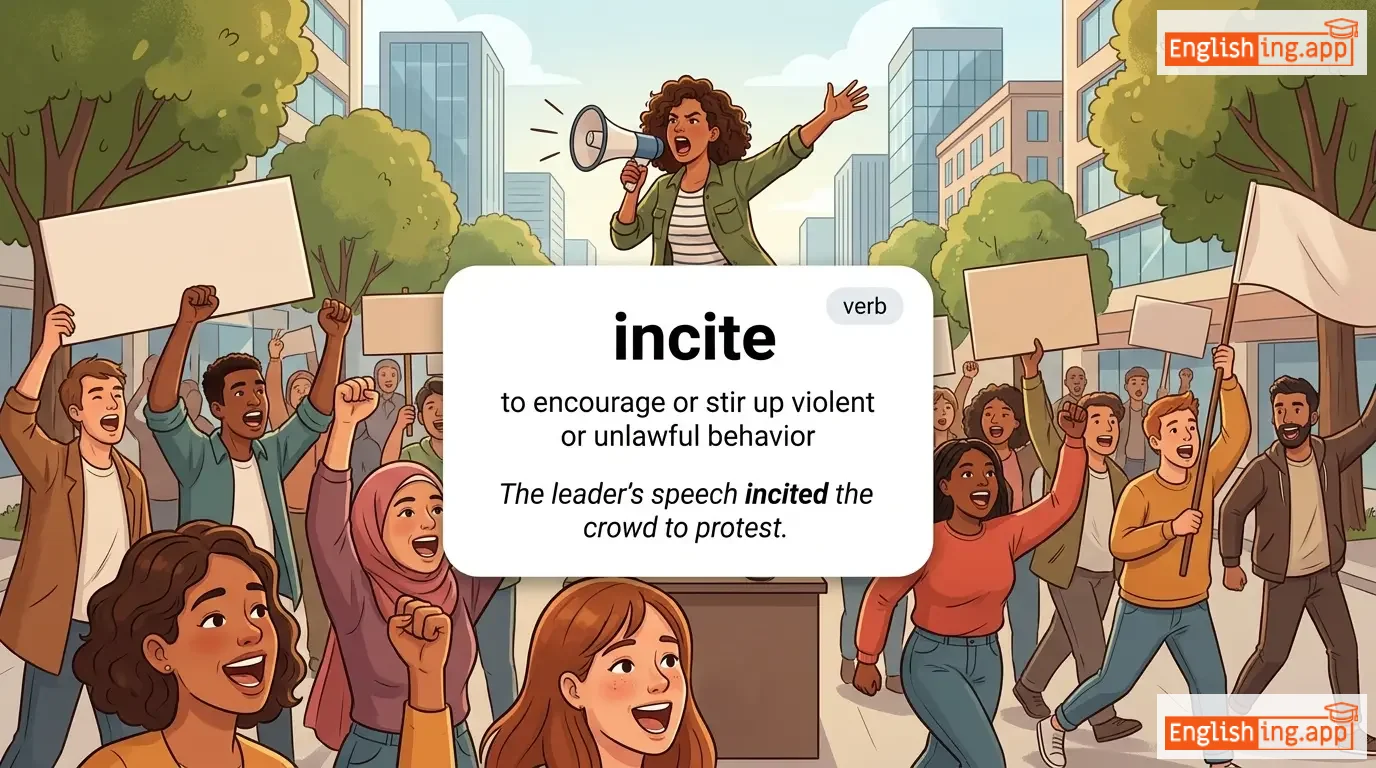
incite definition card — visual illustration of the meaning
verb
/ɪnˈsaɪt/
煽动 (shandong)

to encourage or stir up violent or unlawful behavior

"The leader's speech incited the crowd to protest."

"领导人的演讲煽动了人群进行抗议。" (Lingdaoren de yanjiang shandong le renqun jinxing kangyi.)
noun
/ɪnˈsaɪtmənt/
煽动 (shāndòng)

the action of provoking unlawful or violent behavior

"He was arrested for incitement to riot."

"他因煽动暴乱被逮捕。" (Tā yīn shāndòng bàoluàn bèi dàibǔ.)
adjective
/ɪnˈklɛmɛnt/
恶劣天气 (è liè tiān qì)

unpleasantly cold, wet, or stormy (usually weather)

"The match was canceled due to inclement weather."

"比赛因恶劣天气被取消了。" (Bǐ sài yīn è liè tiān qì bèi qǔ xiāo le.)
noun
/ˌɪnklɪˈneɪʃən/
倾向 (qīngxiàng)

A natural tendency or urge to act or feel in a particular way.

"She has an inclination towards helping others."

"她有帮助他人的倾向。" (Tā yǒu bāngzhù tārén de qīngxiàng.)
verb
/ɪnˈklaɪn/
倾向 (qīngxiàng)

to feel willing or favorably disposed toward something; to bend or tilt

"She is inclined to agree with the proposal."

"她倾向于同意这个提议。" (Tā qīngxiàng yú tóngyì zhège tíyì.)
adjective
/ɪnˈklaɪnd/
倾向的 (qingxiang de)

having a tendency or disposition toward something

"He is inclined to help those in need."

"他倾向于帮助有需要的人。" (Tā qīngxiàng yú bāngzhù yǒu xūyào de rén.)
include definition card — visual illustration of the meaning
verb
/ɪnˈkluːd/
包括 (bāo kuò)

to make something part of a whole or group

"The package includes free breakfast."

"该套餐包括免费早餐。" (gāi tàocān bāokuò miǎnfèi zǎocān.)
preposition
/ɪnˈkluːdɪŋ/
包括 (bao kuo)

used to show that someone or something is part of a larger group

"Many people attended the event, including students and teachers."

"许多人参加了这个活动,包括学生和教师。" (Xǔduō rén cānjiāle zhège huódòng, bāokuò xuéshēng hé jiàoshī.)
noun
/ɪnˈkluːʒən/
包容 (baorong)

the action or state of including or being included within a group or structure

"Diversity and inclusion are key values in modern workplaces."
"多样性和包容性是现代工作场所的关键价值观。" (Duōyàngxì hé bāoróng xì shì xiàndài gōngzuò chǎngsuǒ de guānjiàn jiàzhíguān.)
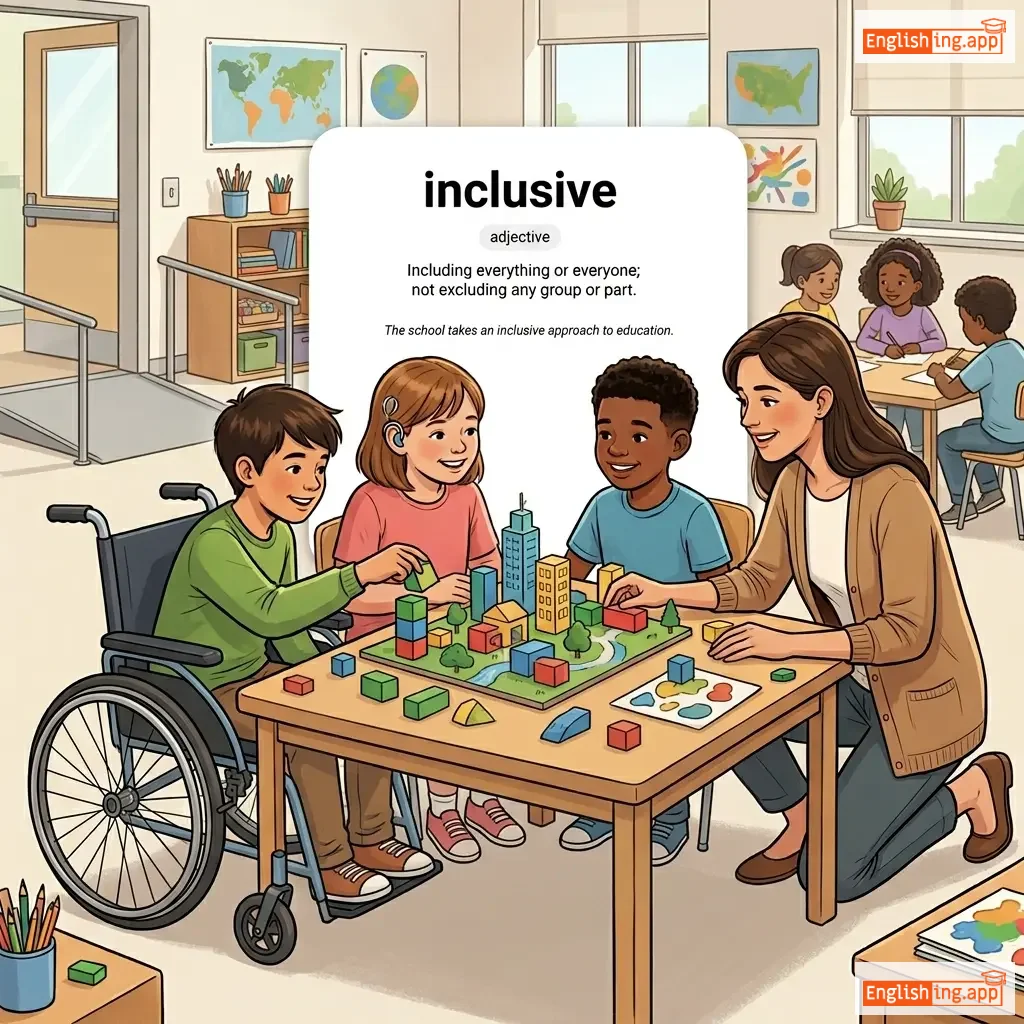
inclusive definition card — visual illustration of the meaning
adjective
/ɪnˈkluːsɪv/
包容的 (baorong de)

Including everything or everyone; not excluding any group or part.

"The school takes an inclusive approach to education."

"学校采用包容的教育方法。" (Xuexiao caiyong baorong de jiaoyu fangfa.)
adjective
/ˌɪnkoʊˈɜːrsəbl̩/
无法强迫的 (wúfǎ qiángpò de)

Not capable of being forced, compelled, or restrained.

"Her incoercible spirit inspired others to fight for justice."

"她那无法强迫的精神激励了其他人争取正义。" (Tā nà wúfǎ qiángpò de jīngshén jīlì le qítārén zhēngqǔ zhèngyì.)
adjective
/ɪnˈkɑːdʒɪtənt/
缺乏思考 (quē fá sī kǎo)

Lacking thought; inconsiderate or thoughtless.

"It was incogitant of him to make such a rude comment."

"他做出如此粗鲁的评论是缺乏思考的。" (Tā zuòchū rúcǐ cūlǔ de pínglùn shì quē fá sī kǎo de.)
adverb, adjective
/ˌɪnkɑːɡˈniːtoʊ/
匿名 (nìmíng)

In disguise or with one's identity concealed.

"The celebrity traveled incognito to avoid the paparazzi."

"名人为了避免狗仔队,匿名旅行。" (Míngrén wèile bìmiǎn gǒuzǎiduì, nìmíng lǚxíng.)
noun
/ˌɪnkoʊˈhɪrəns/
不一致 (bù yī zhì)

The quality of being unclear, confused, or lacking logical connection.

"His speech was full of incoherence and difficult to follow."

"他的演讲充满了不一致,难以跟随。" (Tā de yǎnjiǎng chōngmǎnle bù yīzhì, nán yǐ gēnsuí.)
adjective
/ˌɪnkəʊˈhɪərənt/
不连贯 (bu lianguan)

Not clear or easy to understand; lacking logical connection.

"His explanation was so incoherent that nobody could follow it."

"他的解释如此不连贯,以至于没有人能理解。" (Ta de jieshi ruci bu lianguan, yi zhi yu meiyou ren neng lijie.)
adjective
/ˌɪnkəmˈbʌstəbl/
不燃烧 (bu ranshao)

Not capable of catching fire or burning.

"This material is incombustible and safe for construction."

"这种材料是防火的,适合建筑使用。" (Zhè zhǒng cáiliào shì fánghuǒ de, shìhé jiànzhú shǐyòng.)
income definition card — visual illustration of the meaning
noun
/ˈɪnkʌm/
收入 (shōurù)

money received for work or through investments

"His monthly income is enough to support his family."

"他的月收入足以养家糊口。" (Tā de yuè shōurù zúyǐ yǎngjiā húkǒu.)
adjective
/ˌɪnkəˈməʊdiəs/
不舒服的 (bù shū fú de)

Uncomfortably small, cramped, or inconvenient.

"We had to stay in an incommodious room during the trip."

"我们在旅行期间不得不住在一个不舒服的房间里。" (Wǒmen zài lǚxíng qījiān bùdébù zhù zài yīgè bù shūfú de fángjiān lǐ.)
adjective
/ɪnˈkɒmp(ə)rəbl/
无可比拟 (wú kě bǐ nǐ)

Without an equal in quality or excellence; matchless.

"The view from the mountain was incomparable."

"山顶的景色无可比拟。" (Shāndǐng de jǐngsè wú kě bǐ nǐ.)
noun
/ˌɪnkəmˌpætəˈbɪlɪti/
不兼容性 (bu jian rong xing)

the state of being unable to exist or work together harmoniously; lack of compatibility

"The project failed because of incompatibility between the two software systems."

"由于两个软件系统之间的不兼容性,项目失败了。" (Youyu liang ge ruanjian xitong zhijian de bu jian rong xing xiangmu shibai le)
adjective
/ˌɪnkəmˈpætəbl/
不兼容 (bù jiānróng)

Not able to exist or work together without conflict.

"Their personalities were completely incompatible."

"他们的个性完全不兼容。" (Tāmen de gèxìng wánquán bù jiānróng.)
noun
/ɪnˈkɒmpɪtəns/
不称职 (bù chēng zhí)

Lack of ability, skill, or effectiveness in doing something.

"The project failed due to the manager’s incompetence."

"由于经理的不称职,项目失败了。" (Yóu yú jīnglǐ de bù chēng zhí, xiàngmù shī bài le.)
adjective
/ɪnˈkɒmpɪtənt/

Lacking the necessary ability or skills to do something successfully.

"He was fired because he was incompetent at his job."

adjective
/ˌɪnkəmˈpliːt/
不完整 (bù wánzhěng)

Not finished, lacking some parts or not whole.

"Her report was incomplete and needed further details."

"她的报告不完整,需要更多细节。" (Tā de bàogào bù wánzhěng, xūyào gèng duō xìjié.)
noun
/ˌɪnkəmˈpliːtnəs/
不完整性 (bu wanzheng xing)

the state of not being complete or whole; lack of necessary parts or fullness

"The incompleteness of the report caused delays in the project."

"报告的不完整性导致了项目延误。" (baogao de bu wanzheng xing daozhi le xiangmu yanwu)
adjective
/ˌɪnkɒmprɪˈhɛnsəbl/
难以理解的 (nanyi lijie de)

Impossible or very difficult to understand.

"The professor’s lecture was so fast it became incomprehensible."

"教授的讲座太快了,以至于变得难以理解。" (Jiaoshou de jiangzuo tai kuai le, yi zhi yu biande nanyi lijie.)
adjective
/ˌɪnkəmˈprɛsəbl/
不可压缩 (bù kě yā suō)

Not able to be pressed or squeezed into a smaller space.

"Liquids are generally considered incompressible."

"液体通常被认为是不可压缩的。" (yètǐ tōng cháng bèi rèn wéi shì bù kě yā suō de.)
adjective
/ˌɪnkənˈsiːvəbl̩/
难以想象 (nanyi xiangxiang)

Impossible to imagine or believe; beyond comprehension.

"It seemed inconceivable that she could finish the marathon after such little training."

"在如此少的训练之后,她能够完成马拉松,这简直难以想象。" (Zai ruci shao de xunlian zhihou, ta nenggou wancheng malasong, zhe jianzhi nanyi xiangxiang.)
adjective
/ˌɪnkənˈkluːsɪv/
不确定的 (bu que ding de)

Not leading to a definite result or decision.

"The investigation remained inconclusive due to a lack of evidence."

"由于缺乏证据,调查仍然是没有结果的。" (Yu wei que fa zheng ju, diao cha reng ran shi mei you jie guo de.)
adjective
/ɪnˈkɒŋɡruənt/
不一致的 (bù yīzhì de)

Not in harmony or keeping with the surroundings or other aspects.

"His casual outfit looked incongruent at the formal dinner."
"他穿的休闲装在正式晚宴上显得不一致。" (Tā chuān de xiūxián zhuāng zài zhèngshì wǎn yàn shàng xiǎndé bù yīzhì.)
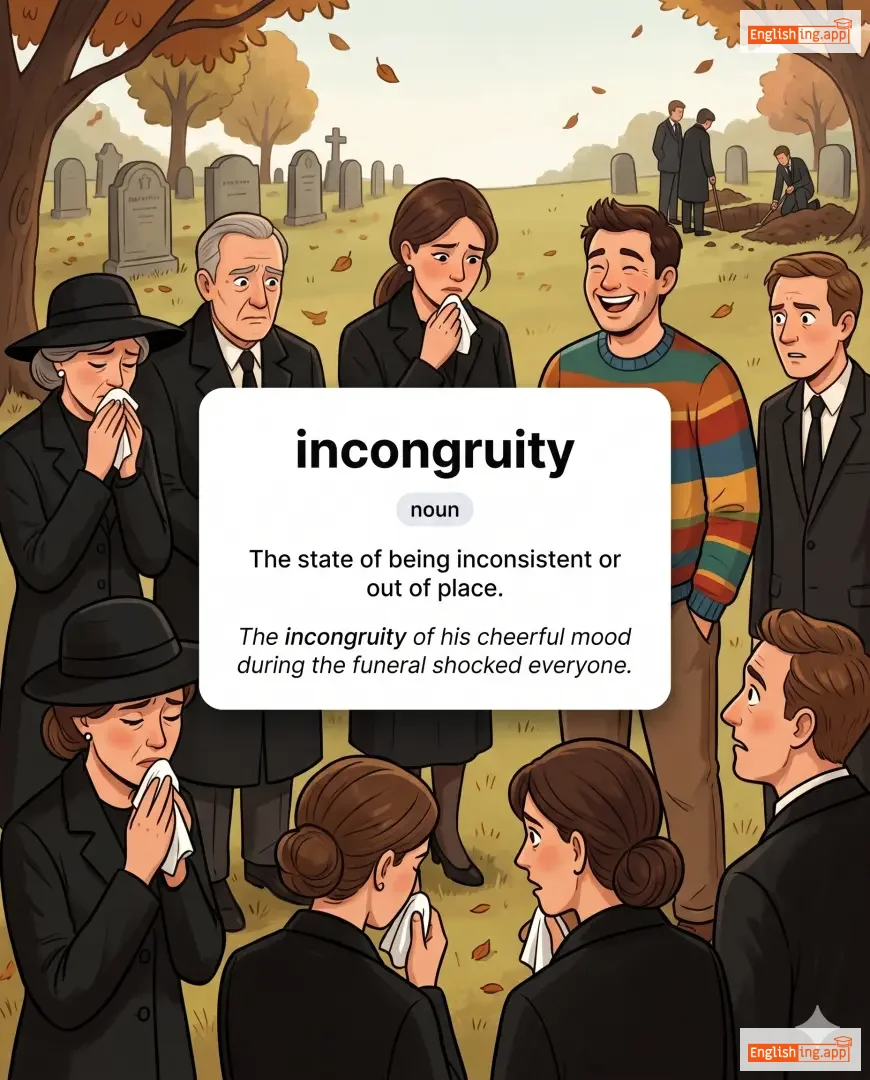
incongruity definition card — visual illustration of the meaning
noun
/ˌɪnkənˈɡruːəti/
不一致 (bù yīzhì)

The state of being inconsistent or out of place.

"The incongruity of his cheerful mood during the funeral shocked everyone."

"在葬礼上,他愉快的心情与情境的不一致让所有人都震惊了。" (Zài zànglǐ shàng, tā yúkuài de xīnqíng yǔ qíngjìng de bù yīzhì ràng suǒyǒu rén dōu zhènjīngle.)
adjective
/ɪnˈkɒŋɡruəs/
不一致 (bu yizhi)

Not fitting in with or suitable for the surroundings.

"His jokes were incongruous during the serious meeting."
"他的笑话在严肃的会议中显得不一致。" (Tā de xiàohuà zài yánsù de huìyì zhōng xiǎnde bù yīzhì.)
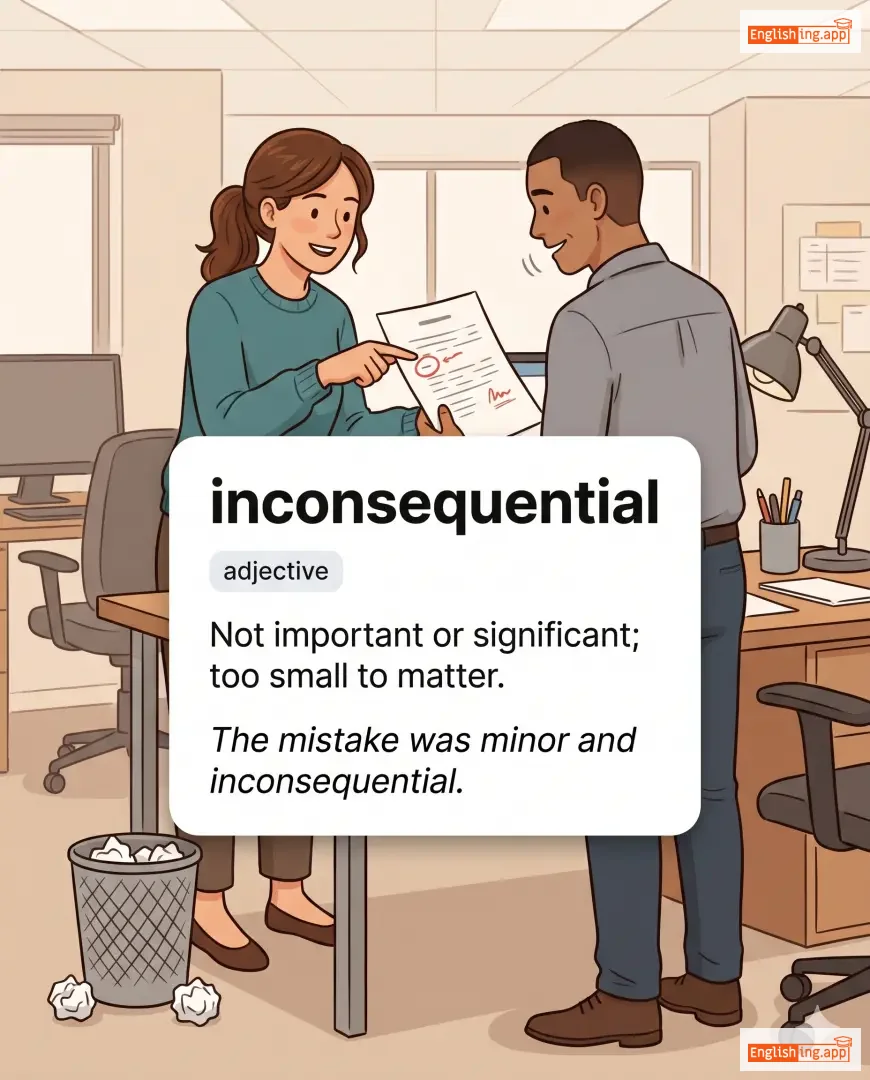
inconsequential definition card — visual illustration of the meaning
adjective
/ˌɪnˌkɒnsɪˈkwɛnʃəl/
微不足道 (wēi bù zú dào)

Not important or significant; too small to matter.

"The mistake was minor and inconsequential."

"这个错误是微不足道的。" (Zhège cuòwù shì wēi bù zú dào de.)
adjective
/ˌɪnkənˈsɪdərəbl/
微不足道 (weibu zhu dao)

Too small or unimportant to be worth considering.

"The donation was not inconsiderable, though smaller than expected."

"这笔捐款并不微不足道,尽管比预期的小。" (Zhe bi juan kuan bing bu wei bu zhu dao, jin guan bi yuqi de xiao.)
adjective
/ˌɪnkənˈsɪdərət/
不体贴 (bu tixie)

Thoughtless; showing a lack of concern for others.

"It was inconsiderate of him to play loud music late at night."

"他在深夜播放大声音乐,显得很不体贴。" (Ta zai shenya bofang dasheng yinyue, xiande hen bu tixie.)
noun
/ˌɪnkənˈsɪstənsi/
不一致 (bù yīzhì)

The quality of being contradictory, irregular, or not staying the same.

"There is an inconsistency between his words and actions."

"他的话语和行为之间存在不一致。" (Tā de huàyǔ hé xíngwéi zhījiān cúnzài bù yīzhì.)
adjective
/ˌɪnkənˈsɪstənt/
不一致 (bù yīzhì)

Not staying the same throughout; lacking harmony or regularity.

"His answers were inconsistent and confusing."

"他的回答不一致且令人困惑。" (Tā de huídá bù yīzhì qiě lìng rén kùnhuò.)
noun
/ɪnˈkɒnstənsi/
不稳定性 (bù wěndìng xìng)

The quality of changing frequently or being unreliable.

"The inconstancy of the weather makes planning difficult."

"天气的不稳定性使得规划变得困难。" (Tiānqì de bù wěndìng xìng shǐdé guīhuà biàndé kùnnán.)
adjective
/ɪnˈkɒnstənt/
不稳定的 (bù wěndìng de)

frequently changing; not consistent or dependable

"His inconstant moods made it difficult to work with him."

"他的情绪不稳定使得与他合作变得困难。" (Tā de qíngxù bù wěndìng shǐdé yǔ tā hézuò biàndé kùnnán.)
adjective
/ɪnˈkɒntɪnənt/
失禁 (shī jìn)

lacking control over urination or defecation; lacking self-restraint

"The patient was incontinent after surgery."

"病人在手术后失禁。" (Bìngrén zài shǒushù hòu shī jìn.)
adjective
/ˌɪnkɒntrəˈvɜːtəbl/
不可否认 (bù kě fǒu rèn)

impossible to deny or dispute; unquestionable

"The evidence was incontrovertible and proved his innocence."

"证据是不可否认的,并证明了他的清白。" (Zhèngjù shì bù kě fǒu rèn de, bìng zhèngmíngle tā de qīngbái.)
noun, verb
/ˌɪnkənˈviːniəns/
不便 (bubian)

trouble or difficulty caused to someone; to cause trouble or difficulty to someone

"We apologize for any inconvenience caused by the delay."

"对于延误造成的任何不便,我们深表歉意。" (Duiyu yanwu zaocheng de renhe bubian women shenbiao qianyi)
adjective
/ˌɪnkənˈviːniənt/
不方便 (bù fāngbiàn)

causing trouble, difficulties, or discomfort

"It was inconvenient for her to travel during the storm."

"暴风雨期间,她旅行不方便。" (bàofēngyǔ qījiān, tā lǚxíng bù fāngbiàn.)