Vocabulaires

Découvrez, apprenez et maîtrisez le vocabulaire anglais

adjective
/ˌɪnsɪˈdɛntəl/
incidentel (incidentel)

happening as a minor part or in connection with something else

"Incidental expenses like snacks and tips were included in the bill."

"Les dépenses incidentelles comme les collations et les pourboires ont été incluses dans la facture." (Les depenses incidentelles comme les collations et les pourboires ont ete incluses dans la facture.)
adverb
/ˌɪnsɪˈdɛntəli/
d'ailleurs (d'ailleurs)

by the way; used to introduce a remark not directly related to the main subject

"Incidentally, did you know that she studied in Paris?"

"D'ailleurs, savais-tu qu'elle avait étudié à Paris ?" (D'ailleurs, savais-tu qu'elle avait étudié à Paris ?)
verb
/ɪnˈsɪnəˌreɪt/
incinérer (incinerer)

to burn something completely until it is reduced to ashes

"The city decided to incinerate the medical waste for safety."

"La ville a décidé d'incinérer les déchets médicaux pour des raisons de sécurité." (La ville a decide d'incinérer les déchets médicaux pour des raisons de sécurité.)
noun
/ɪnˈsɪpiəns/
début (debut)

the beginning or initial stage of something

"The project was still in its incipience when funding was approved."

"Le projet en était encore à ses débuts lorsque le financement a été approuvé." (Le projet en était encore à ses débuts lorsque le financement a été approuvé.)
adjective
/ɪnˈsɪpiənt/
incipient (incipient)

in an initial stage; beginning to develop

"The incipient storm made the sky turn dark and heavy."

"La tempête incipiente a fait assombrir le ciel et le rendre lourd." (La tempête incipiente a fait assombrir le ciel et le rendre lourd.)
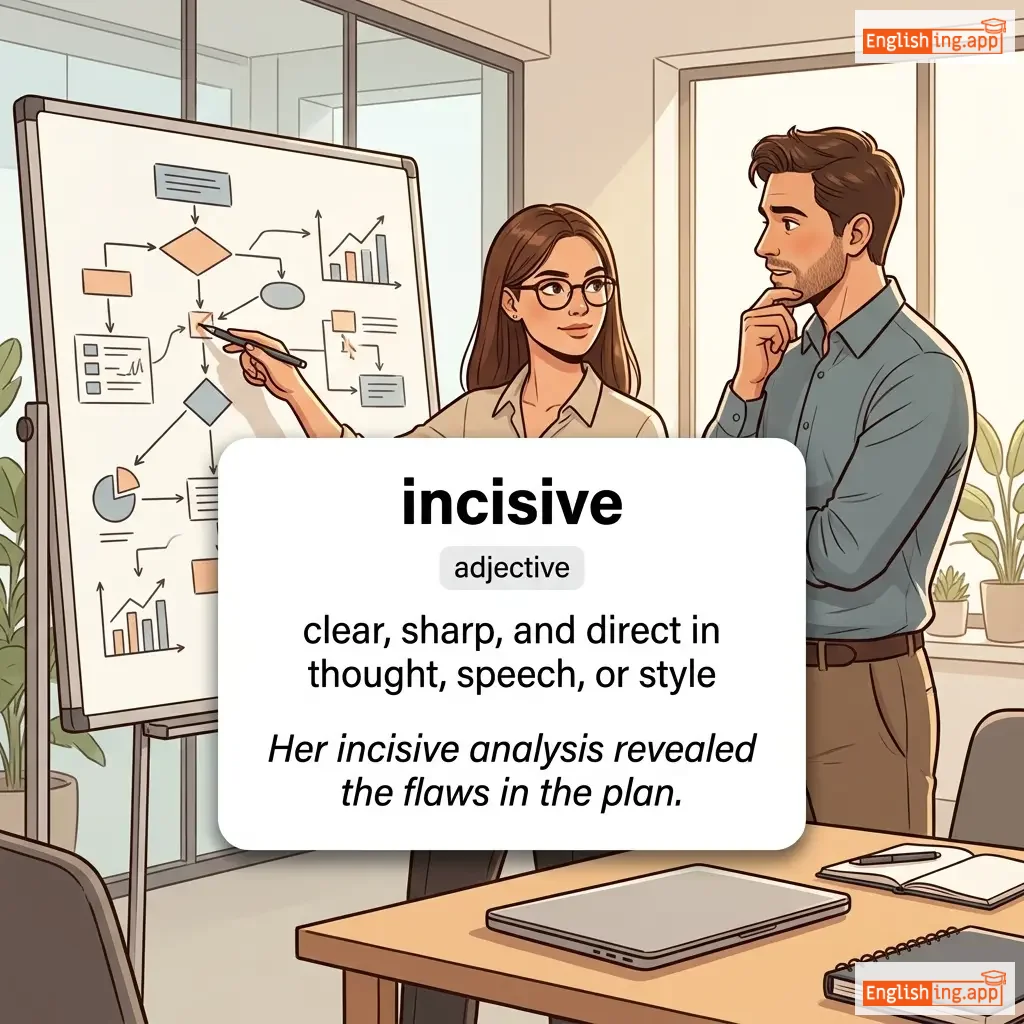
incisive definition card — visual illustration of the meaning
adjective
/ɪnˈsaɪsɪv/
perçant (perçant)

clear, sharp, and direct in thought, speech, or style

"Her incisive analysis revealed the flaws in the plan."

"Son analyse perçante a révélé les défauts du plan." (Son analyse perçante a révélé les défauts du plan.)
noun
/ɪnˈsaɪzər/
incisive (insisiv)

a narrow-edged tooth at the front of the mouth, adapted for cutting

"The dentist noted that his upper left incisor was chipped."

"Le dentiste a remarqué que son incisif supérieur gauche était fissuré." (Le dentiste a remarque que son incisif superieur gauche etait fissure.)
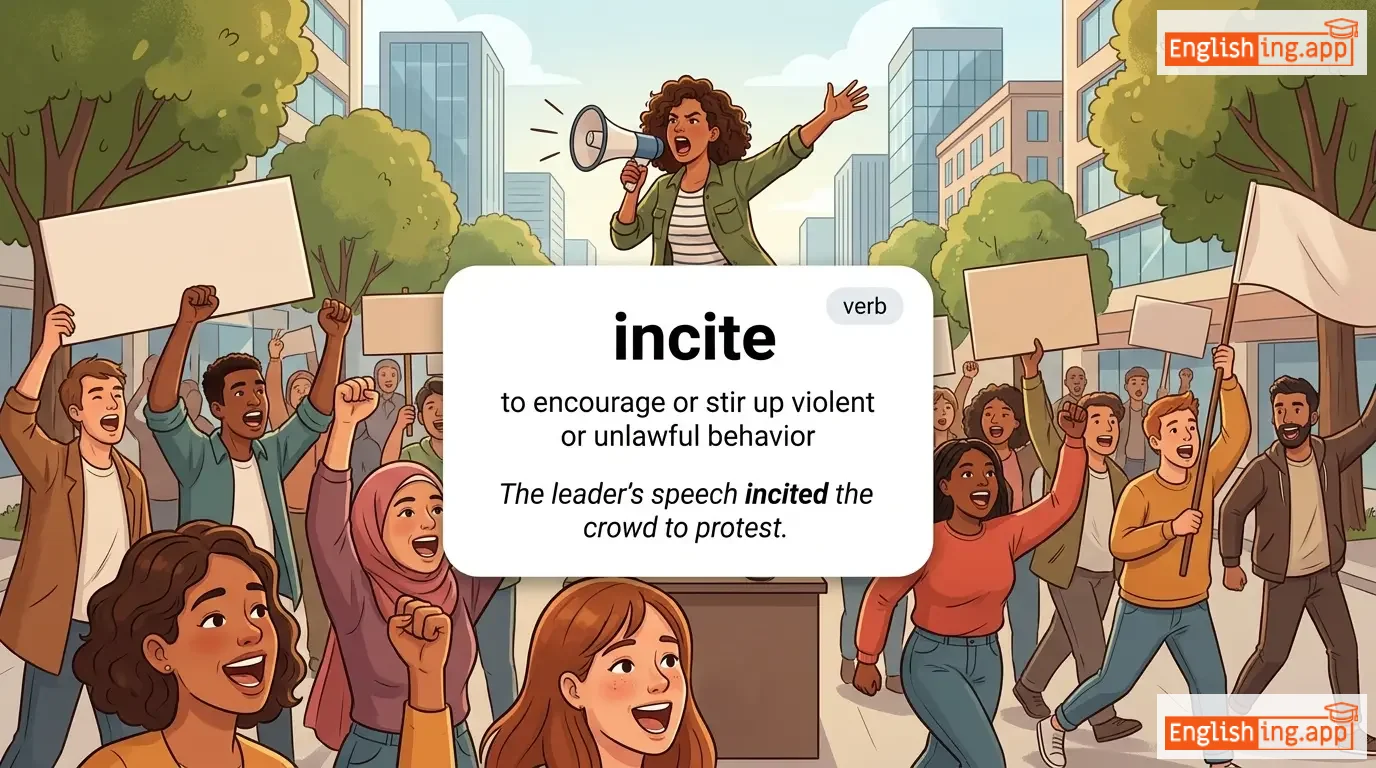
incite definition card — visual illustration of the meaning
verb
/ɪnˈsaɪt/
inciter (inciter)

to encourage or stir up violent or unlawful behavior

"The leader's speech incited the crowd to protest."

"Le discours du leader a incité la foule à protester." (Le discours du leader a incité la foule à protester.)
noun
/ɪnˈsaɪtmənt/
incitation (incitation)

the action of provoking unlawful or violent behavior

"He was arrested for incitement to riot."

"Il a été arrêté pour incitation à la violence." (Il a ete arrete pour incitation a la violence.)
adjective
/ɪnˈklɛmɛnt/
météo inclemente (meteo inclemente)

unpleasantly cold, wet, or stormy (usually weather)

"The match was canceled due to inclement weather."

"Le match a été annulé à cause du mauvais temps." (Le match a été annulé à cause du mauvais temps.)
noun
/ˌɪnklɪˈneɪʃən/
inclination (inclination)

A natural tendency or urge to act or feel in a particular way.

"She has an inclination towards helping others."

"Elle a une inclination à aider les autres." (Elle a une inclination à aider les autres.)
verb
/ɪnˈklaɪn/
s'incliner (s'incli-ner)

to feel willing or favorably disposed toward something; to bend or tilt

"She is inclined to agree with the proposal."

"Elle est inclinée à être d'accord avec la proposition." (Elle est incline a etre d'accord avec la proposition.)
adjective
/ɪnˈklaɪnd/
incliné (incline)

having a tendency or disposition toward something

"He is inclined to help those in need."

"Il est enclin à aider ceux qui sont dans le besoin." (Il est enclin à aider ceux qui sont dans le besoin.)
include definition card — visual illustration of the meaning
verb
/ɪnˈkluːd/
inclure (inclure)

to make something part of a whole or group

"The package includes free breakfast."

"Le paquet inclut le petit déjeuner gratuit." (Le paquet inclut le petit déjeuner gratuit.)
preposition
/ɪnˈkluːdɪŋ/
y compris (y compris)

used to show that someone or something is part of a larger group

"Many people attended the event, including students and teachers."

"Beaucoup de personnes ont assisté à l'événement, y compris des étudiants et des enseignants." (Beaucoup de personnes ont assisté à l'événement, y compris des étudiants et des enseignants.)
noun
/ɪnˈkluːʒən/
inclusion (inclusion)

the action or state of including or being included within a group or structure

"Diversity and inclusion are key values in modern workplaces."

"La diversité et l'inclusion sont des valeurs clés dans les lieux de travail modernes." (La diversité et l'inclusion sont des valeurs clés dans les lieux de travail modernes.)
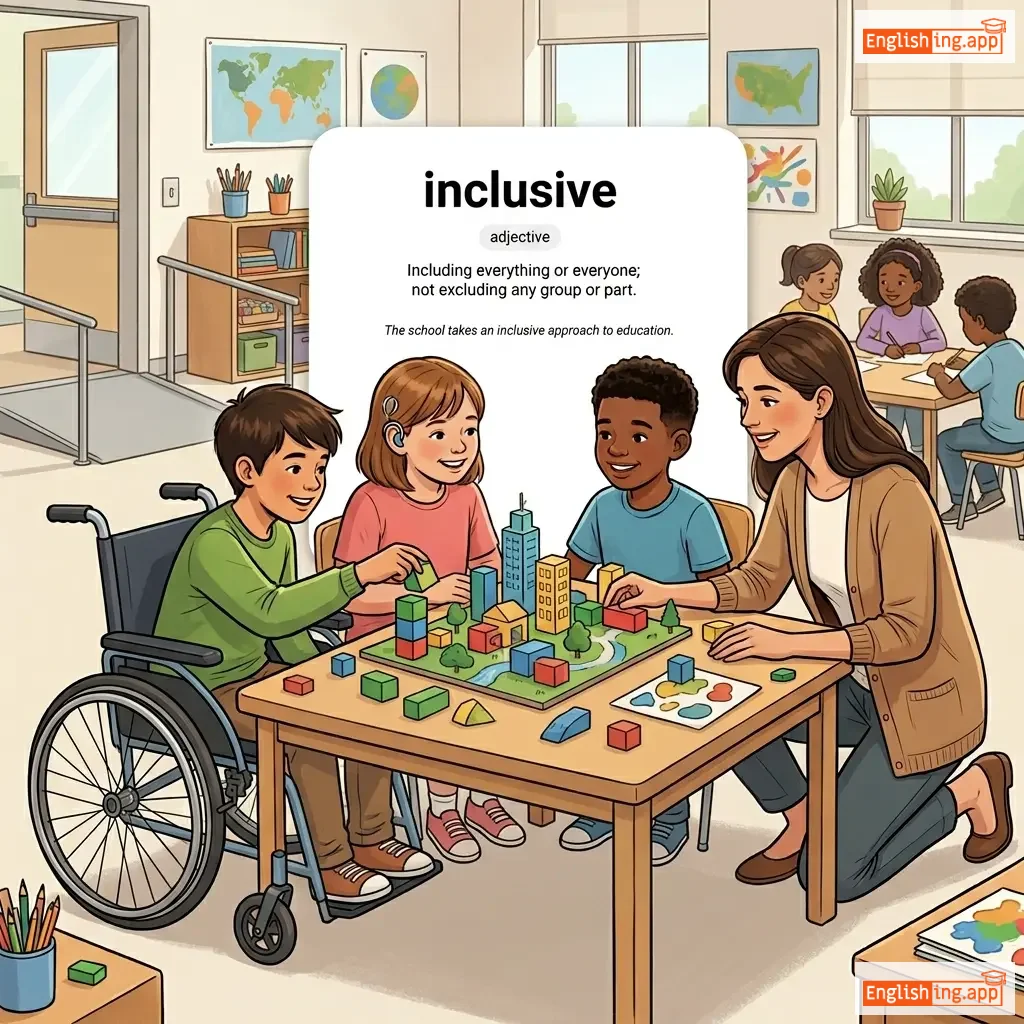
inclusive definition card — visual illustration of the meaning
adjective
/ɪnˈkluːsɪv/
inclusif (inclusif)

Including everything or everyone; not excluding any group or part.

"The school takes an inclusive approach to education."

"L'école adopte une approche inclusive de l'éducation." (L'école adopte une approche inclusive de l'éducation.)
adjective
/ˌɪnkoʊˈɜːrsəbl̩/
incoercible (incoercible)

Not capable of being forced, compelled, or restrained.

"Her incoercible spirit inspired others to fight for justice."

"Son esprit incoercible a inspiré les autres à lutter pour la justice." (Son esprit incoercible a inspiré les autres à lutter pour la justice.)
adjective
/ɪnˈkɑːdʒɪtənt/
irréfléchi (irreflechi)

Lacking thought; inconsiderate or thoughtless.

"It was incogitant of him to make such a rude comment."

"C'était incogitant de sa part de faire un commentaire aussi grossier." (C'était incogitant de sa part de faire un commentaire aussi grossier.)
adverb, adjective
/ˌɪnkɑːɡˈniːtoʊ/
incognito (incognito)

In disguise or with one's identity concealed.

"The celebrity traveled incognito to avoid the paparazzi."

"La célébrité a voyagé incognito pour éviter les paparazzis." (La célébrité a voyagé incognito pour éviter les paparazzis.)
noun
/ˌɪnkoʊˈhɪrəns/
incohérence (incoherence)

The quality of being unclear, confused, or lacking logical connection.

"His speech was full of incoherence and difficult to follow."

"Son discours était plein d'incohérences et difficile à suivre." (Son discours etait plein d'incoherences et difficile a suivre.)
adjective
/ˌɪnkəʊˈhɪərənt/
incohérent (incoherent)

Not clear or easy to understand; lacking logical connection.

"His explanation was so incoherent that nobody could follow it."

"Son explication était tellement incohérente que personne ne pouvait la suivre." (Son explication etait tellement incoherente que personne ne pouvait la suivre.)
adjective
/ˌɪnkəmˈbʌstəbl/
incombustible (incombustible)

Not capable of catching fire or burning.

"This material is incombustible and safe for construction."

"Ce matériau est incombustible et sûr pour la construction." (Ce matériau est incombustible et sûr pour la construction.)
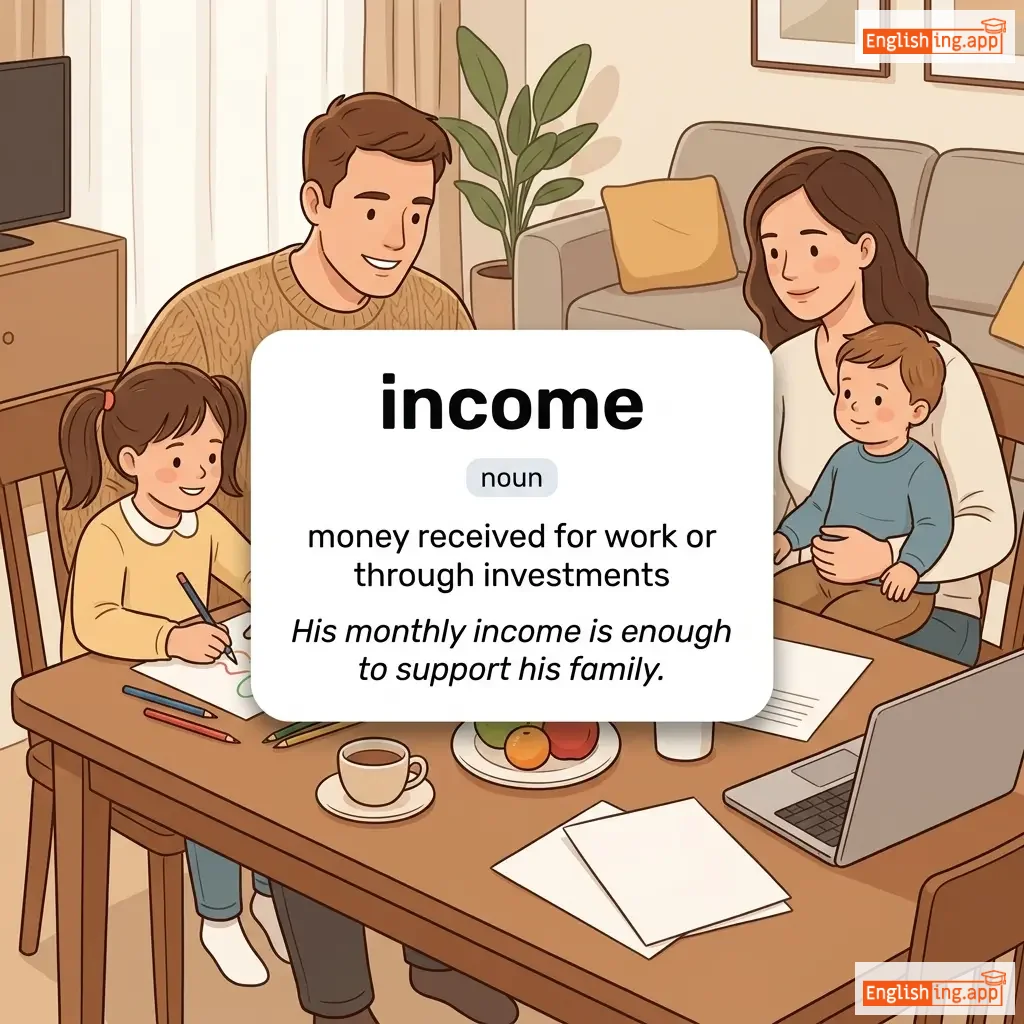
income definition card — visual illustration of the meaning
noun
/ˈɪnkʌm/
revenu (revenu)

money received for work or through investments

"His monthly income is enough to support his family."

"Ses revenus mensuels suffisent à soutenir sa famille." (Ses revenus mensuels suffisent à soutenir sa famille.)
adjective
/ˌɪnkəˈməʊdiəs/
incommode (incommode)

Uncomfortably small, cramped, or inconvenient.

"We had to stay in an incommodious room during the trip."

"Nous avons dû rester dans une chambre inconfortable pendant le voyage." (Nous avons du rester dans une chambre inconfortable pendant le voyage.)
adjective
/ɪnˈkɒmp(ə)rəbl/
incomparable (incomparable)

Without an equal in quality or excellence; matchless.

"The view from the mountain was incomparable."

"La vue depuis la montagne était incomparable." (La vue depuis la montagne était incomparable.)
noun
/ˌɪnkəmˌpætəˈbɪlɪti/
incompatibilité (incompatibilite)

the state of being unable to exist or work together harmoniously; lack of compatibility

"The project failed because of incompatibility between the two software systems."

"Le projet a échoué à cause de l’incompatibilité entre les deux systèmes logiciels." (Le projet a echoue a cause de l incompatibilite entre les deux systemes logiciels)
adjective
/ˌɪnkəmˈpætəbl/
incompatible (incompatible)

Not able to exist or work together without conflict.

"Their personalities were completely incompatible."

"Leurs personnalités étaient complètement incompatibles." (Leurs personnalités étaient complètement incompatibles.)
noun
/ɪnˈkɒmpɪtəns/
incompétence (incompetence)

Lack of ability, skill, or effectiveness in doing something.

"The project failed due to the manager’s incompetence."

"Le projet a échoué à cause de l'incompétence du manager." (Le projet a échoué à cause de l'incompétence du manager.)
adjective
/ɪnˈkɒmpɪtənt/
incompétent (incompetent)

Lacking the necessary ability or skills to do something successfully.

"He was fired because he was incompetent at his job."

"Il a été licencié parce qu'il était incompétent dans son travail." (Il a ete licencie parce qu il etait incompetent dans son travail.)
adjective
/ˌɪnkəmˈpliːt/
incomplet (incomplet)

Not finished, lacking some parts or not whole.

"Her report was incomplete and needed further details."

"Son rapport était incomplet et nécessitait des détails supplémentaires." (Son rapport était incomplet et nécessitait des détails supplémentaires.)
noun
/ˌɪnkəmˈpliːtnəs/
incomplétude (incompletude)

the state of not being complete or whole; lack of necessary parts or fullness

"The incompleteness of the report caused delays in the project."

"L’incomplétude du rapport a causé des retards dans le projet." (L incompletude du rapport a cause des retards dans le projet)
adjective
/ˌɪnkɒmprɪˈhɛnsəbl/
incompréhensible (incomprehensible)

Impossible or very difficult to understand.

"The professor’s lecture was so fast it became incomprehensible."

"Le cours du professeur était tellement rapide qu'il est devenu incompréhensible." (Le cours du professeur etait tellement rapide qu'il est devenu incomprehensible.)
adjective
/ˌɪnkəmˈprɛsəbl/
incompressible (incompressible)

Not able to be pressed or squeezed into a smaller space.

"Liquids are generally considered incompressible."

"Les liquides sont généralement considérés comme incompressibles." (Les liquides sont généralement considérés comme incompressibles.)
adjective
/ˌɪnkənˈsiːvəbl̩/
inconcevable (inconcevable)

Impossible to imagine or believe; beyond comprehension.

"It seemed inconceivable that she could finish the marathon after such little training."

"Il semblait inconcevable qu'elle puisse finir le marathon après si peu d'entraînement." (Il semblait inconcevable qu'elle puisse finir le marathon apres si peu d'entrainement.)
adjective
/ˌɪnkənˈkluːsɪv/
inconclusif (inconclusif)

Not leading to a definite result or decision.

"The investigation remained inconclusive due to a lack of evidence."

"L'enquête est restée inconclusive en raison d'un manque de preuves." (L'enquete est restee inconclusive en raison d'un manque de preuves.)
adjective
/ɪnˈkɒŋɡruənt/
incongruente (incongruente)

Not in harmony or keeping with the surroundings or other aspects.

"His casual outfit looked incongruent at the formal dinner."

"Sa tenue décontractée semblait incongruente lors du dîner formel." (Sa tenue decontractee semblait incongruente lors du diner formel.)
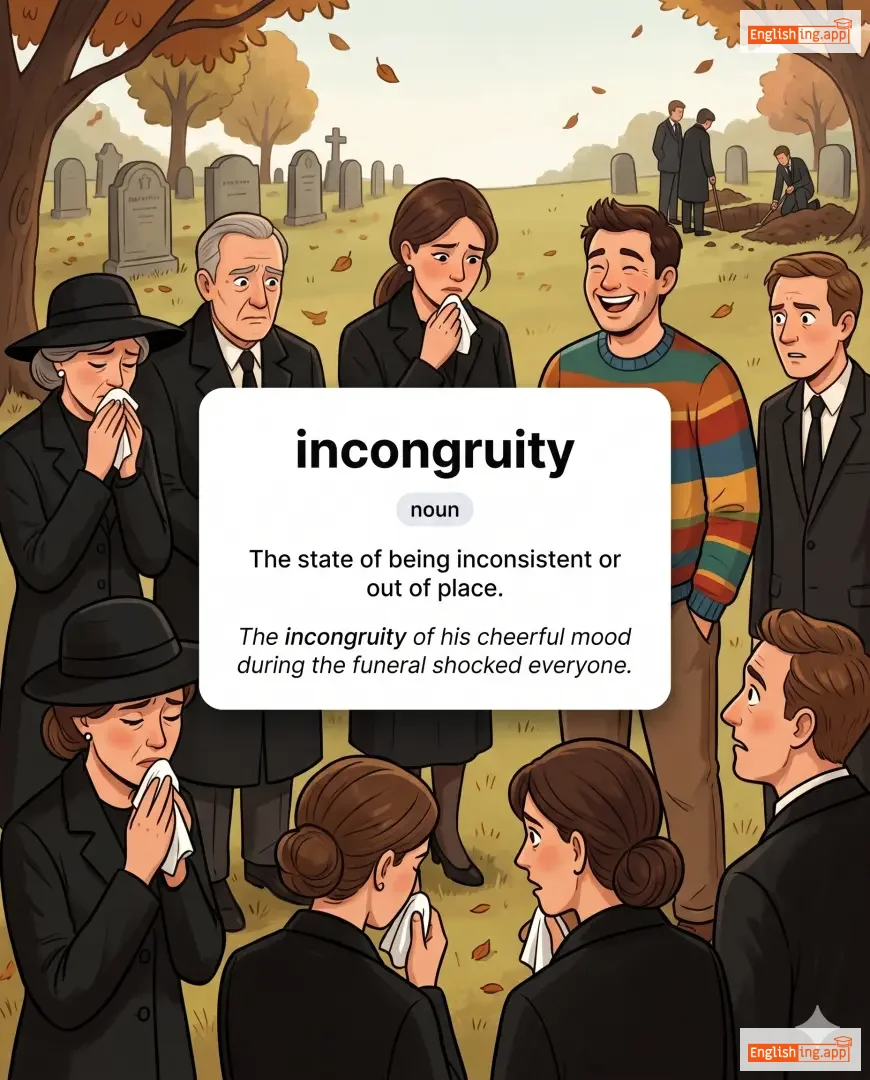
incongruity definition card — visual illustration of the meaning
noun
/ˌɪnkənˈɡruːəti/
incongruité (incongruite)

The state of being inconsistent or out of place.

"The incongruity of his cheerful mood during the funeral shocked everyone."

"L'incongruité de son humeur joyeuse pendant les funérailles a choqué tout le monde." (L'incongruite de son humeur joyeuse pendant les funerailles a choque tout le monde.)
adjective
/ɪnˈkɒŋɡruəs/
incongru (incongru)

Not fitting in with or suitable for the surroundings.

"His jokes were incongruous during the serious meeting."

"Ses blagues étaient incongrues lors de la réunion sérieuse." (Ses blagues étaient incongrues lors de la réunion sérieuse.)
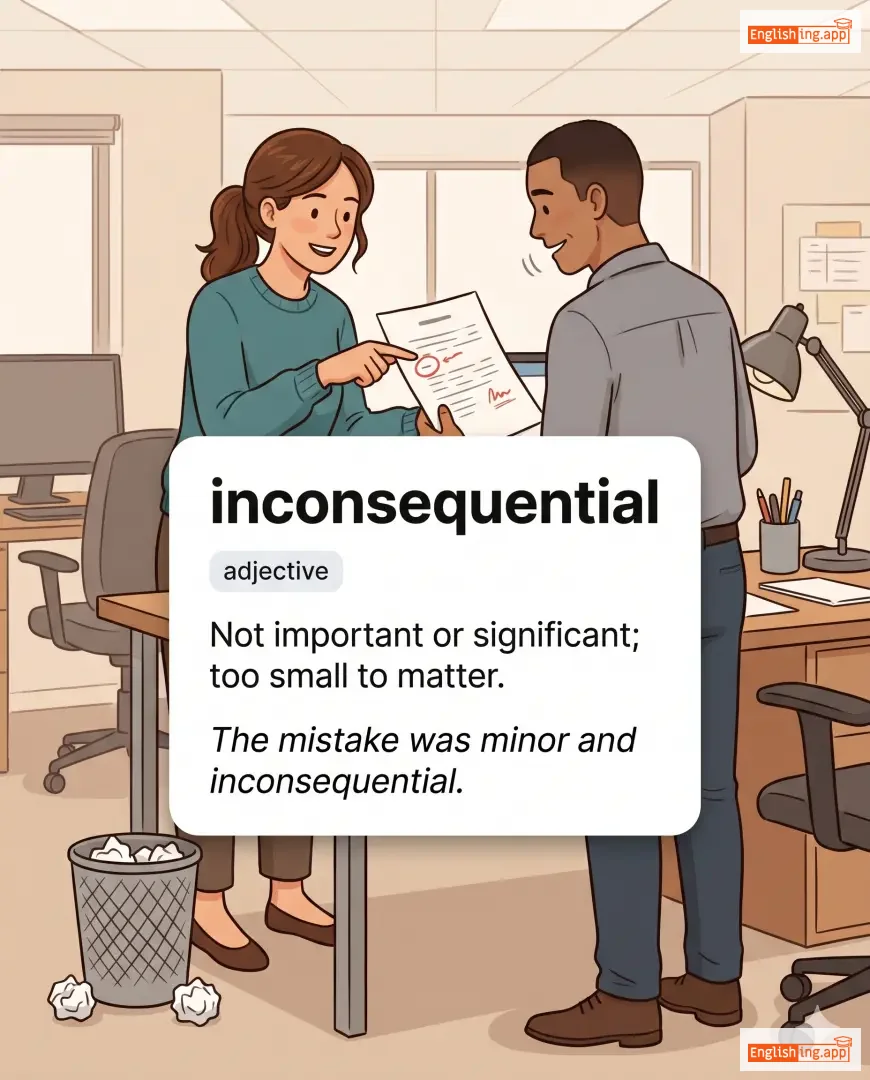
inconsequential definition card — visual illustration of the meaning
adjective
/ˌɪnˌkɒnsɪˈkwɛnʃəl/
insignifiant (insignifiant)

Not important or significant; too small to matter.

"The mistake was minor and inconsequential."

"L'erreur était mineure et insignifiante." (L'erreur était mineure et insignifiante.)
adjective
/ˌɪnkənˈsɪdərəbl/
insignifiant (insignifiant)

Too small or unimportant to be worth considering.

"The donation was not inconsiderable, though smaller than expected."

"La donation n'était pas insignifiante, bien qu'elle fût plus petite que prévu." (La donation n'était pas insignifiante, bien qu'elle fût plus petite que prévu.)
adjective
/ˌɪnkənˈsɪdərət/
inconsidéré (inconsidere)

Thoughtless; showing a lack of concern for others.

"It was inconsiderate of him to play loud music late at night."

"C'était inconsidéré de sa part de jouer de la musique forte tard dans la nuit." (C'etait inconsidere de sa part de jouer de la musique forte tard dans la nuit.)
noun
/ˌɪnkənˈsɪstənsi/
incohérence (incoherence)

The quality of being contradictory, irregular, or not staying the same.

"There is an inconsistency between his words and actions."

"Il y a une incohérence entre ses paroles et ses actions." (Il y a une incoherence entre ses paroles et ses actions.)
adjective
/ˌɪnkənˈsɪstənt/
incohérent (incoherent)

Not staying the same throughout; lacking harmony or regularity.

"His answers were inconsistent and confusing."

"Ses réponses étaient incohérentes et confuses." (Ses réponses étaient incohérentes et confuses.)
noun
/ɪnˈkɒnstənsi/
inconstance (inconstance)

The quality of changing frequently or being unreliable.

"The inconstancy of the weather makes planning difficult."

"L'inconstance du temps rend la planification difficile." (L'inconstance du temps rend la planification difficile.)
adjective
/ɪnˈkɒnstənt/
inconstant (inconstant)

frequently changing; not consistent or dependable

"His inconstant moods made it difficult to work with him."

"Ses humeurs inconstantes rendaient difficile de travailler avec lui." (Ses humeurs inconstantes rendaient difficile de travailler avec lui.)
adjective
/ɪnˈkɒntɪnənt/
incontinent (incontinent)

lacking control over urination or defecation; lacking self-restraint

"The patient was incontinent after surgery."

"Le patient était incontinent après l'opération." (Le patient etait incontinent apres l'operation.)
adjective
/ˌɪnkɒntrəˈvɜːtəbl/
incontournable (incontournable)

impossible to deny or dispute; unquestionable

"The evidence was incontrovertible and proved his innocence."

"La preuve était incontestable et a prouvé son innocence." (La preuve etait incontestable et a prouve son innocence.)
noun, verb
/ˌɪnkənˈviːniəns/
désagrément (desagrement)

trouble or difficulty caused to someone; to cause trouble or difficulty to someone

"We apologize for any inconvenience caused by the delay."

"Nous nous excusons pour tout désagrément causé par le retard." (Nous nous excusons pour tout desagrement cause par le retard)
adjective
/ˌɪnkənˈviːniənt/
incommode (incommode)

causing trouble, difficulties, or discomfort

"It was inconvenient for her to travel during the storm."

"C'était incommode pour elle de voyager pendant la tempête." (C'etait incommode pour elle de voyager pendant la tempete.)