Vocabulaires

Découvrez, apprenez et maîtrisez le vocabulaire anglais

noun
/ˌɪndɪˈkeɪʃən/
indication (indication)

A sign, piece of information, or signal that suggests something.

"Dark clouds are an indication of an approaching storm."

"Les nuages sombres sont une indication d'une tempête imminente." (Les nuages sombres sont une indication d'une tempete imminente)
adjective, noun
/ɪnˈdɪkətɪv/
indicatif (indicatif)

Serving as a sign or expression of something; in grammar, a mood used to make factual statements.

"His tone was indicative of his frustration."

"Son ton était indicatif de sa frustration." (Son ton était indicatif de sa frustration.)
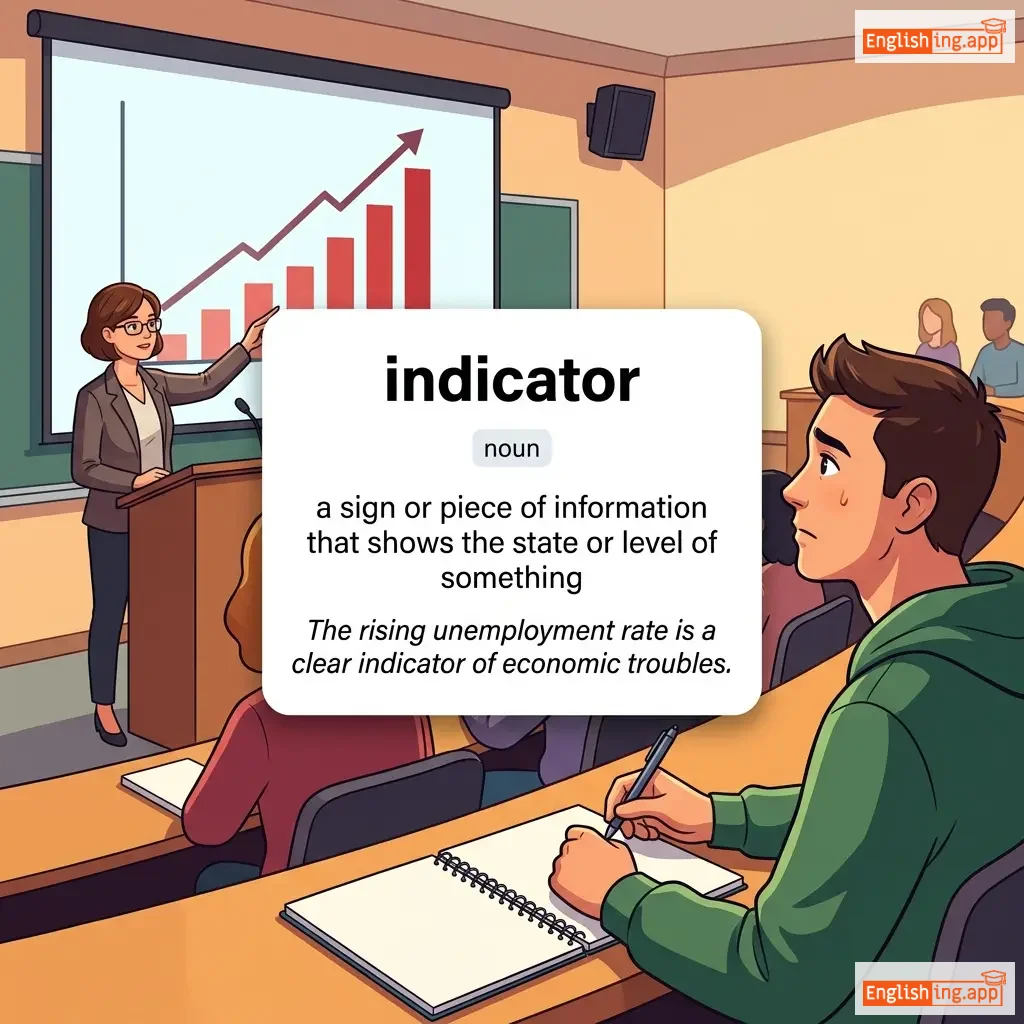
indicator definition card — visual illustration of the meaning
noun
/ˈɪndɪˌkeɪtər/
indicateur (indicateur)

a sign or piece of information that shows the state or level of something

"The rising unemployment rate is a clear indicator of economic troubles."

"Le taux de chômage croissant est un indicateur clair des problèmes économiques." (Le taux de chomage croissant est un indicateur clair des problemes economiques.)
noun (plural)
/ˈɪndɪˌsiːz/
indices (indices)

plural form of index; statistical measures or reference points used for comparison

"Stock market indices fell sharply after the announcement."

"Les indices du marché boursier ont chuté fortement après l'annonce." (Les indices du marche boursier ont chute fortement apres l'annonce.)
verb
/ɪnˈdaɪt/
inculper (inculper)

to formally accuse someone of committing a serious crime

"The grand jury decided to indict the politician for corruption."

"Le grand jury a décidé d'inculper le politicien pour corruption." (Le grand jury a décidé d'inculper le politicien pour corruption.)
noun
/ɪnˈdaɪtmənt/
acte d'accusation (akte d'aksusasyon)

a formal charge or accusation of a serious crime

"The indictment accused the company of multiple violations."

"L'acte d'accusation a accusé l'entreprise de multiples violations." (L'akte d'aksusasyon a akize l'entreprise de multiples violations.)
noun
/ɪnˈdɪfərəns/
indifférence (indifference)

lack of interest, concern, or sympathy

"He showed complete indifference to the suffering around him."

"Il a montré une indifférence totale à la souffrance autour de lui." (Il a montre une indifference totale a la souffrance autour de lui.)
adjective
/ɪnˈdɪf.ər.ənt/
indifférent (indifferente)

having no particular interest or concern; not caring one way or another

"She was indifferent to the outcome of the match."

"Elle était indifférente au résultat du match." (Elle etait indifferente au resultat du match.)
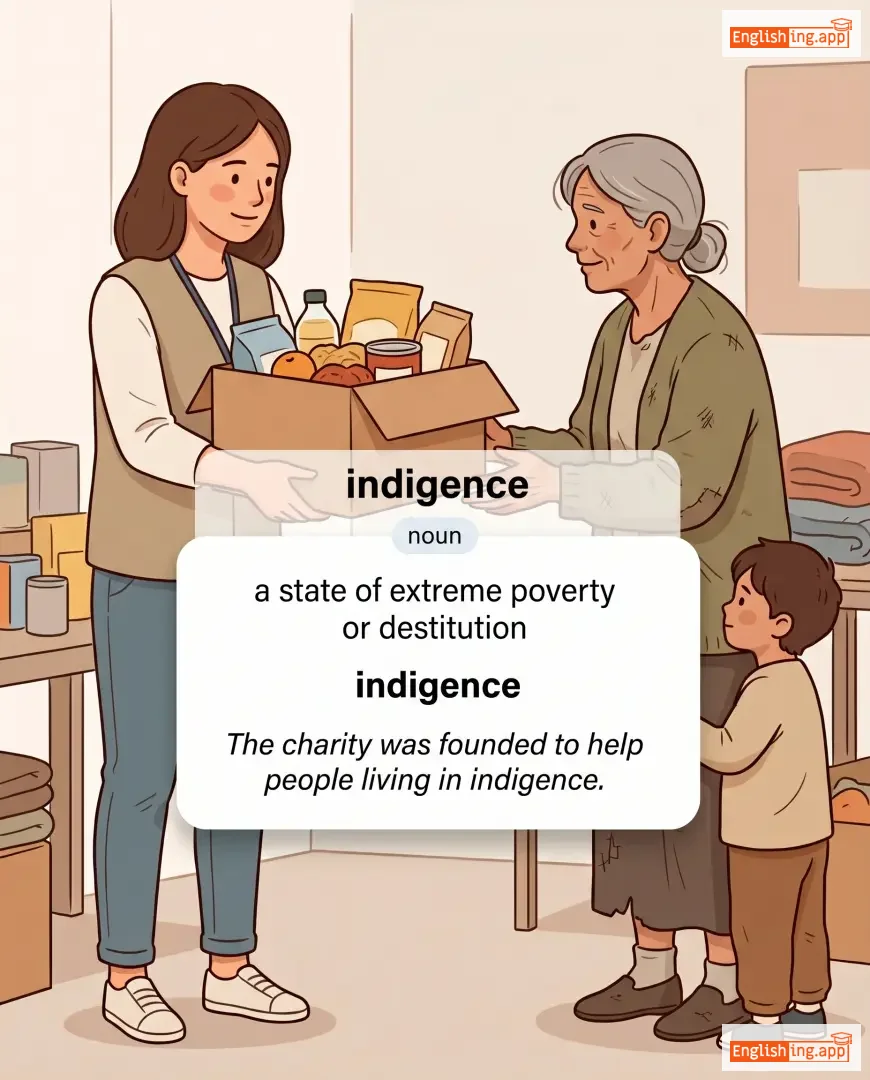
indigence definition card — visual illustration of the meaning
noun
/ˈɪn.dɪ.dʒəns/
indigence (indigence)

a state of extreme poverty or destitution

"The charity was founded to help people living in indigence."

"La charité a été fondée pour aider les personnes vivant dans l'indigence." (La charité a été fondée pour aider les personnes vivant dans l'indigence.)
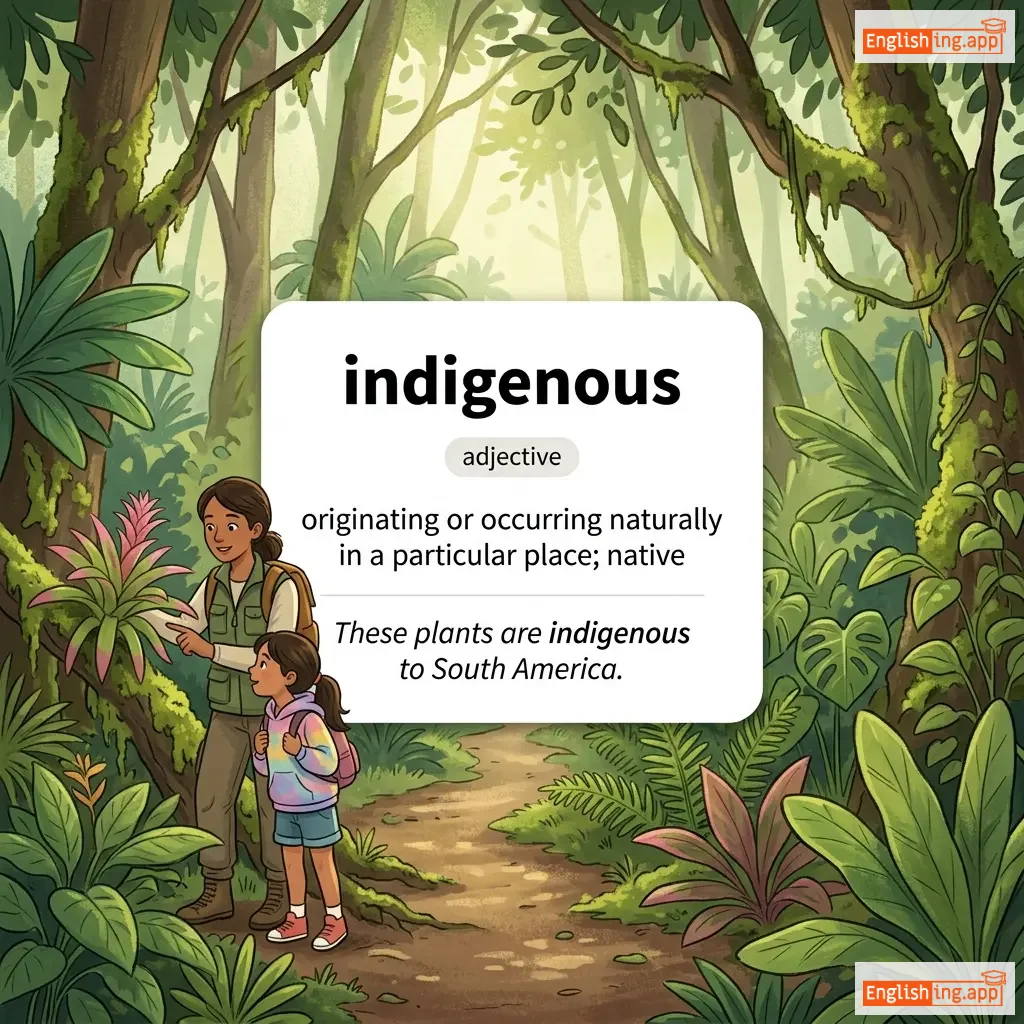
indigenous definition card — visual illustration of the meaning
adjective
/ɪnˈdɪdʒ.ə.nəs/
indigène (indigene)

originating or occurring naturally in a particular place; native

"These plants are indigenous to South America."

"Ces plantes sont indigènes d'Amérique du Sud." (Ces plantes sont indigènes d'Amérique du Sud.)
Indigenous Traditions definition card — visual illustration of the meaning
noun
ɪnˈdɪdʒɪnəs trəˈdɪʃənz
Traditions indigènes (traditions indigenes)

Cultural practices, beliefs, and customs that have been passed down through generations among native peoples.

"Indigenous traditions in the Chittagong Hill Tracts are unique."

"Les traditions indigènes dans les Chittagong Hill Tracts sont uniques." (Les traditions indigènes dans les Chittagong Hill Tracts sont uniques.)
adjective
/ˈɪn.dɪ.dʒənt/
indigent (indigent)

lacking the necessities of life due to poverty; very poor

"The hospital offers free care to indigent patients."

"L'hôpital offre des soins gratuits aux patients indigents." (L'hopital offre des soins gratuits aux patients indigents.)
adjective
/ˌɪn.daɪˈdʒes.tə.bəl/
indigeste (indigeste)

difficult or impossible to digest; hard to accept or understand

"The report was so long and detailed that it became almost indigestible."

"Le rapport était tellement long et détaillé qu'il est devenu presque indigeste." (Le rapport etait tellement long et detaille qu'il est devenu presque indigeste.)
noun
/ˌɪndɪˈdʒɛstʃən/
indigestion (indigestion)

Discomfort or pain in the stomach associated with difficulty in digesting food.

"He avoided spicy food because it often gave him indigestion."

"Il evitait les aliments epices car cela lui donnait souvent une indigestion." (Il evitait les aliments epices car cela lui donnait souvent une indigestion)
adjective
/ɪnˈdɪɡnənt/
indigné (indigné)

Feeling or showing anger at something considered unfair or unjust.

"She was indignant when accused of cheating."

"Elle était indignée lorsqu'elle a été accusée de tricher." (Elle était indignée lorsqu'elle a été accusée de tricher.)
noun
/ˌɪndɪɡˈneɪʃən/
indignation (indignation)

Strong displeasure or anger caused by something unjust, offensive, or insulting.

"Public indignation grew after the unfair verdict."

"L'indignation publique a grandi après le verdict injuste." (L'indignation publique a grandi apres le verdict injuste.)
noun
/ɪnˈdɪɡnɪti/
indignité (indignite)

Treatment or circumstances that cause one to feel shame or humiliation.

"He suffered the indignity of being ignored in the meeting."

"Il a souffert de l'indignité d'être ignoré lors de la réunion." (Il a souffert de l'indignite d'etre ignore lors de la reunion.)
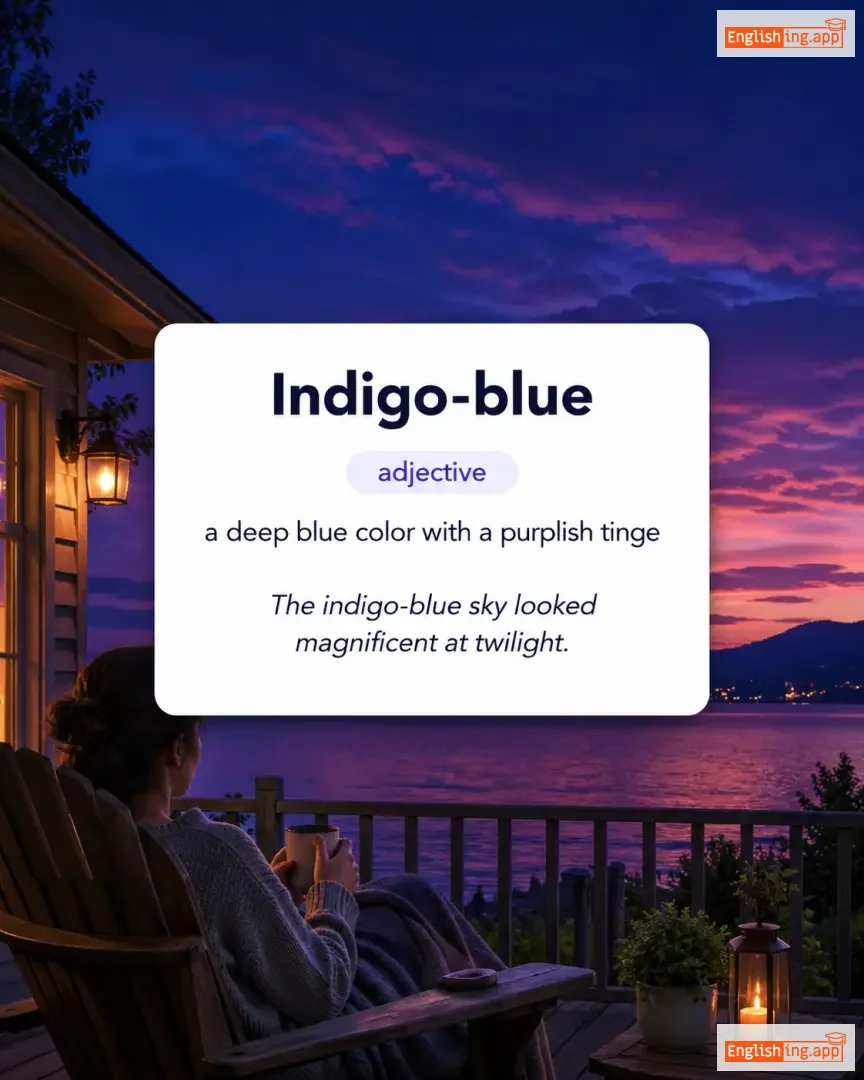
Indigo-blue definition card — visual illustration of the meaning
adjective
/ˈɪndɪɡoʊ bluː/
bleu indigo (bleu indigo)

a deep blue color with a purplish tinge

"The indigo-blue sky looked magnificent at twilight."

"Le ciel bleu indigo semblait magnifique au crépuscule." (Le ciel bleu indigo semblait magnifique au crépuscule.)
adverb
/ˌɪndəˈrɛktli/
indirectement (indirectement)

in a way that is not direct; through an intermediate means or influence

"The policy affected small businesses indirectly."

"La politique a affecté indirectement les petites entreprises." (la politique a affecte indirectement les petites entreprises)
adjective
/ˌɪndɪˈsɜːrnəbl/
indiscernable (indiscernable)

Impossible or difficult to see, notice, or distinguish.

"The difference between the two shades was almost indiscernible."

"La différence entre les deux teintes était presque indiscernable." (La difference entre les deux teintes etait presque indiscernable.)
noun
/ˌɪnˈdɪsəplɪn/
indiscipline (indiscipline)

lack of discipline or self-control; failure to obey rules or maintain order

"Indiscipline among the students disrupted the learning environment."

"L’indiscipline parmi les étudiants a perturbé l’environnement d’apprentissage." (Lindiscipline parmi les etudiants a perturbe lenvironnement dapprentissage)
adjective
/ˌɪndɪˈskriːt/
imprudent (imprudent)

Not careful in what one says or does, likely to reveal secrets or offend.

"It was indiscreet of him to mention the plan in public."

"C'était imprudent de sa part de mentionner le plan en public." (C'était imprudent de sa part de mentionner le plan en public.)
adjective
/ˌɪndɪˈskrɪmɪnət/
indiscriminé (indiscriminen)

Done without careful judgment; random or haphazard.

"The indiscriminate use of pesticides harms the environment."

"L'utilisation indiscriminée de pesticides nuit à l'environnement." (L'utilisation indiscriminée de pesticides nuit à l'environnement.)
adverb
/ˌɪn.dɪˈskrɪm.ɪ.nət.li/
indiscriminément (indiscriminement)

without making careful distinctions; randomly; without discrimination

"The company fired employees indiscriminately without considering their performance."

"L'entreprise a licencié les employés indifféremment sans prendre en compte leur performance." (L'entreprise a licencié les employés indifféremment sans prendre en compte leur performance.)
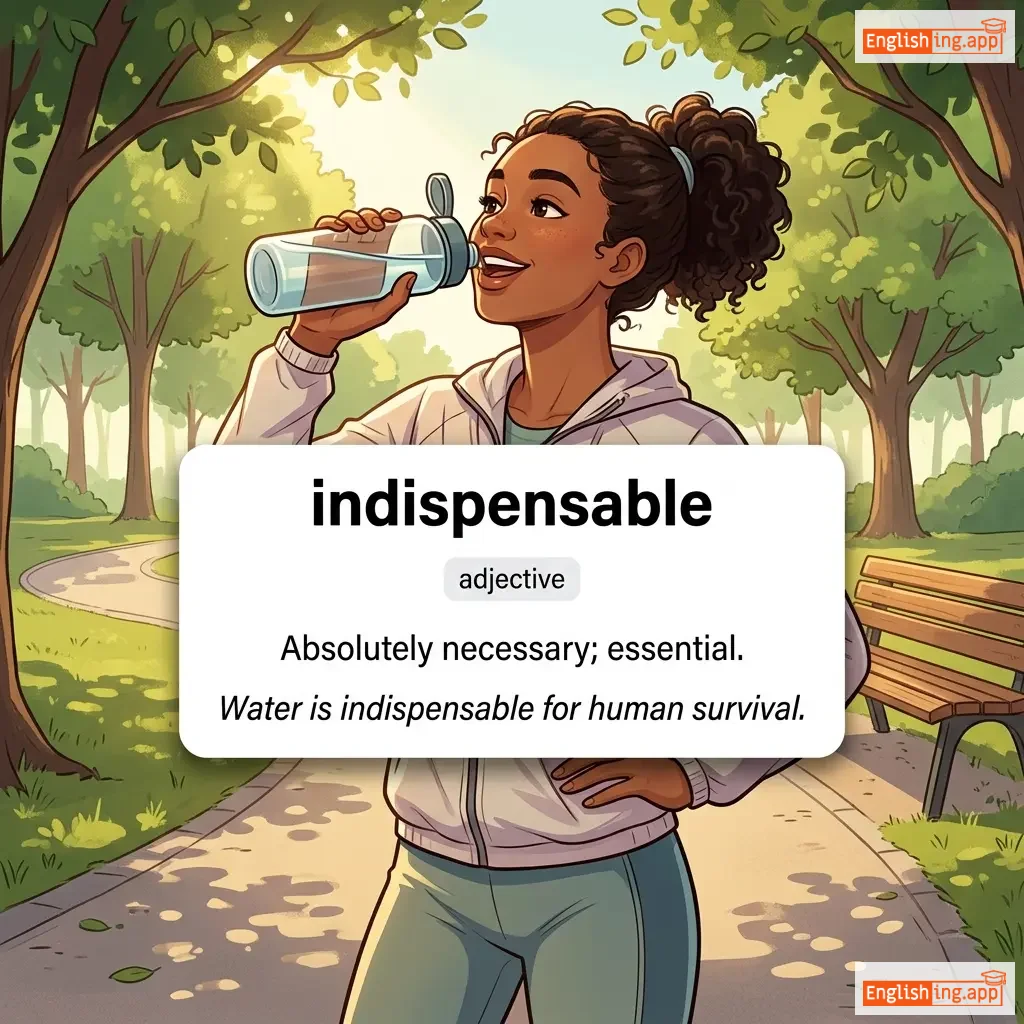
indispensable definition card — visual illustration of the meaning
adjective
/ˌɪndɪˈspɛnsəbl/
indispensable (indispensable)

Absolutely necessary; essential.

"Water is indispensable for human survival."

"L'eau est indispensable à la survie humaine." (L'eau est indispensable à la survie humaine.)
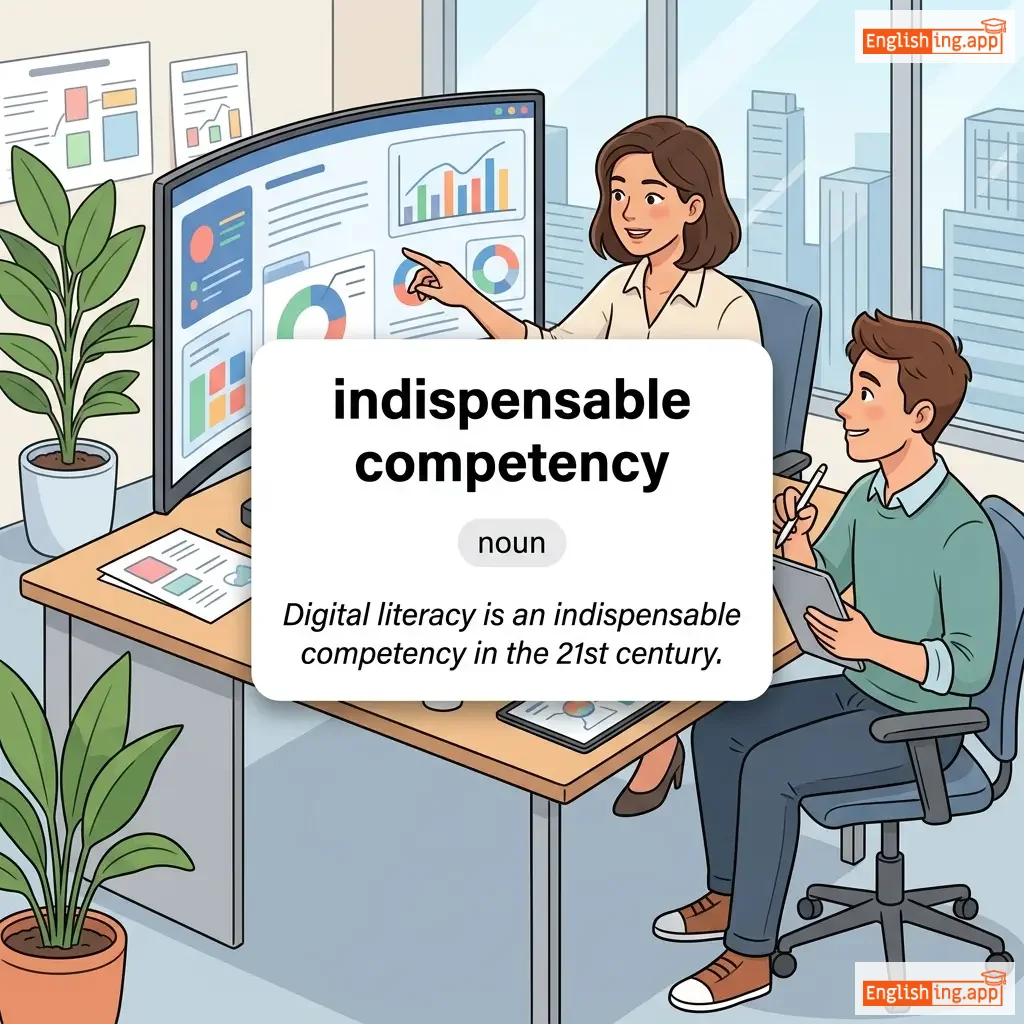
indispensable competency definition card — visual illustration of the meaning
noun
ˌɪndɪˈspensəbl̩ ˈkɒmpɪtənsi
compétence indispensable (competence indispensable)

Essential skill or ability that cannot be done without; a crucial capability that is absolutely necessary.

"Digital literacy is an indispensable competency in the 21st century."

"L'alphabétisation numérique est une compétence indispensable au XXIe siècle." (L'alphabetisation numerique est une competence indispensable au XXIe siecle.)
indispensable support definition card — visual illustration of the meaning
noun
ˌɪndɪˈspensəbl səˈpɔːrt
soutien indispensable (soutien indispensable)

Essential assistance that cannot be done without; absolutely necessary help.

"Volunteers provide indispensable support to communities."

"Les bénévoles apportent un soutien indispensable aux communautés." (Les bénévoles apportent un soutien indispensable aux communautés.)
adjective
/ˌɪndɪˈspjuːtəbl/
indiscutable (indiscutable)

Impossible to doubt or question; certain.

"It is an indisputable fact that the earth orbits the sun."

"Il est un fait indiscutable que la Terre tourne autour du Soleil." (Il est un fait indiscutable que la Terre tourne autour du Soleil.)
adjective
/ˌɪndɪˈsɒljʊbl/
Indissoluble (Indissoluble)

Unable to be destroyed, broken, or dissolved.

"Marriage was once considered an indissoluble bond."

"Le mariage était autrefois considéré comme un lien indissoluble." (Le mariage était autrefois considéré comme un lien indissoluble.)
adjective
/ˌɪndɪˈstɪŋkt/
indistinct (indistinct)

Not clear or sharply defined; vague or blurred.

"The sound of voices was indistinct in the distance."

"Le son des voix était indistinct au loin." (Le son des voix était indistinct au loin.)
verb
/ɪnˈdaɪt/
composer (composer)

To write or compose (literary or formal works).

"The poet indited a heartfelt sonnet."

"Le poète a composé un sonnet sincère." (Le poète a composé un sonnet sincère.)
adjective
/ˌɪndɪˈvɜːrtɪbəl/
indivertible (indivertible)

Not able to be turned aside or diverted.

"The judge's indivertible attention was on the case."

"L'attention indivertible du juge était sur l'affaire." (L'attention indivertible du juge etait sur l'affaire.)
noun/adjective
/ˌɪndɪˈvɪdʒuəl/
individu (individu)

A single human being as distinct from a group; relating to one person.

"Each individual has the right to freedom of speech."

"Chaque individu a le droit à la liberté d'expression." (Chaque individu a le droit à la liberté d'expression.)
adjective
/ˌɪndɪˈvɪzəbl/
indivisible (indivisible)

Not able to be divided or separated.

"The country's unity was indivisible despite differences."

"L'unité du pays était indivisible malgré les différences." (L'unite du pays etait indivisible malgre les differences.)
verb
/ɪnˈdɒktrɪˌneɪt/
endoctriner (endoctriner)

To teach someone to fully accept a set of beliefs or ideas without question.

"The regime tried to indoctrinate the youth with propaganda."

"Le régime a tenté d'endoctriner la jeunesse avec de la propagande." (Le régime a tenté d'endoctriner la jeunesse avec de la propagande.)
noun
/ˈɪndələns/
indolence (indolence)

Avoidance of activity or exertion; laziness.

"His indolence kept him from finishing the project on time."

"Son indolence l'a empêché de terminer le projet à temps." (son indolence l'a empeche de terminer le projet a temps.)
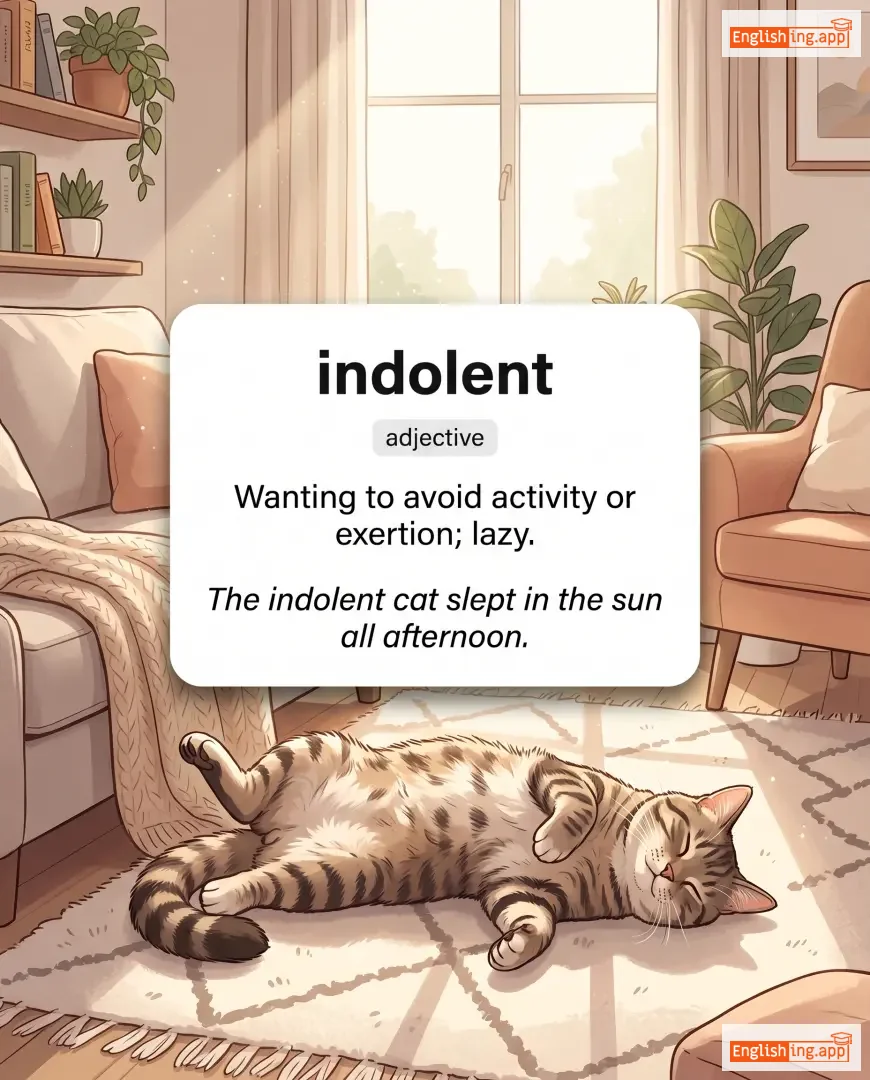
indolent definition card — visual illustration of the meaning
adjective
/ˈɪndələnt/
paresseux (paresseux)

Wanting to avoid activity or exertion; lazy.

"The indolent cat slept in the sun all afternoon."

"Le chat paresseux a dormi au soleil toute l'après-midi." (Le chat paresseux a dormi au soleil toute l'après-midi.)
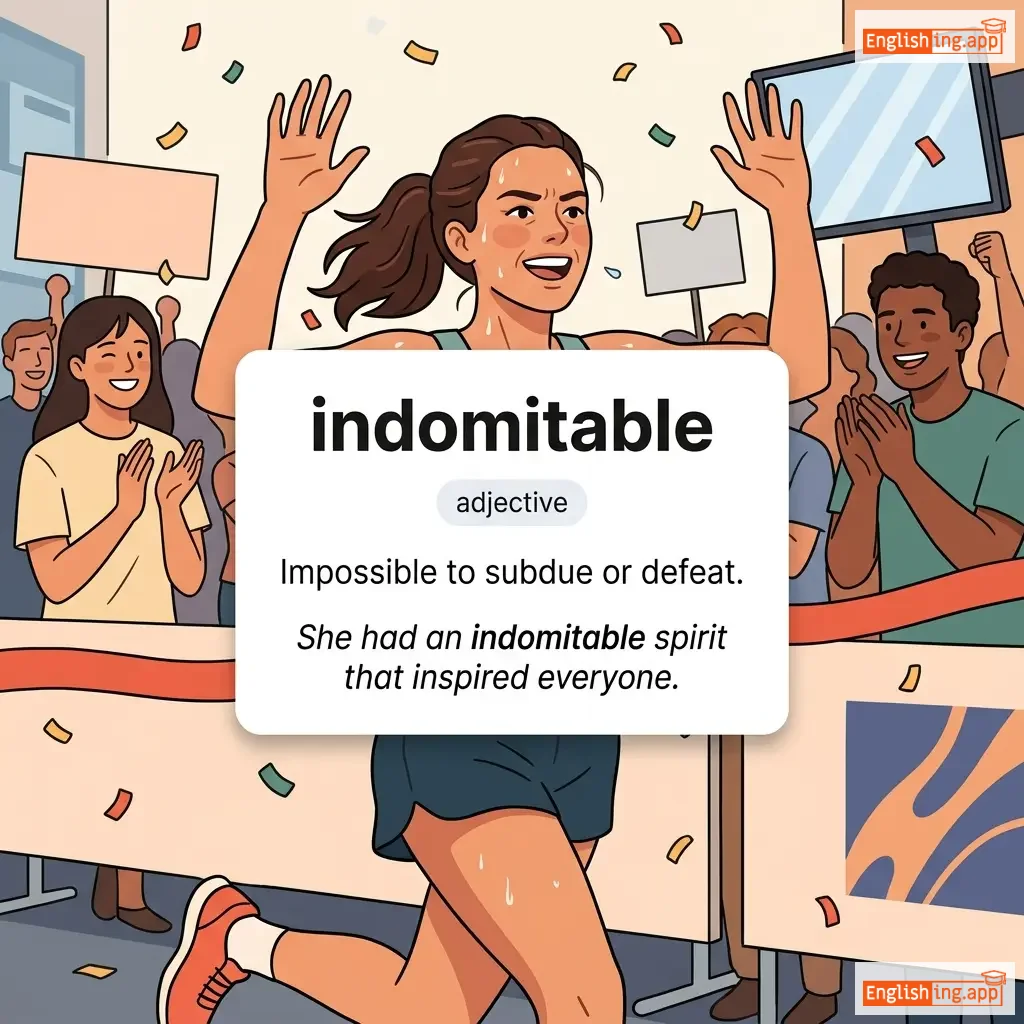
indomitable definition card — visual illustration of the meaning
adjective
/ɪnˈdɒmɪtəbl/
indomptable (indomptable)

Impossible to subdue or defeat.

"She had an indomitable spirit that inspired everyone."

"Elle avait un esprit indomptable qui a inspiré tout le monde." (Elle avait un esprit indomptable qui a inspiré tout le monde.)
adjective
/ˈɪn.dɔːr/
d'intérieur (d'interieur)

situated, occurring, or used inside a building

"Indoor plants can improve air quality at home."

"Les plantes d'intérieur peuvent améliorer la qualité de l'air à la maison." (les plantes d'interieur peuvent ameliorer la qualite de l'air a la maison)
adverb
/ˌɪnˈdɔːrz/
à l’intérieur (a linterieur)

inside a building; within an enclosed space

"Because of the rain, everyone stayed indoors."

"À cause de la pluie, tout le monde est resté à l’intérieur." (A cause de la pluie, tout le monde est reste a linterieur)
adjective
/ɪnˈdjuːbɪtəbl/
indubitable (indubitable)

Impossible to doubt; unquestionable.

"It is indubitable that hard work leads to success."

"Il est indubitable que le travail acharné mène au succès." (Il est indubitable que le travail acharné mène au succès.)
adverb
/ɪnˈdjuːbɪtəbli/
indubitablement (indubitablement)

Without a doubt; certainly.

"She is indubitably the best candidate for the job."

"Elle est indubitablement la meilleure candidate pour le poste." (Elle est indubitablement la meilleure candidate pour le poste.)
verb
/ɪnˈdjuːs/
induire (induire)

to cause or persuade someone to do something; to bring about a result

"The doctor induced sleep with a mild sedative."

"Le médecin a induit le sommeil avec un sédatif léger." (Le médecin a induit le sommeil avec un sédatif léger.)
noun
/ɪnˈdjuːsmənt/
incitation (insitation)

something that persuades or encourages someone to do something

"The company offered a bonus as an inducement to employees."

"L'entreprise a offert une prime comme incitation aux employés." (L'entreprise a offert une prime comme incitation aux employés.)
verb
/ɪnˈdʌkt/
admettre formellement quelqu'un dans une position, organisation ou bureau (admettre formellement quelqu'un dans une position, organisation ou bureau)

to formally admit someone into a position, organization, or office

"She was inducted into the university's honor society."

"Elle a été admise dans la société d'honneur de l'université." (Elle a ete admise dans la societe d'honneur de l'universite.)
adjective
/ɪnˈdʌktɪv/
inductif (induktif)

characterized by the inference of general laws from particular instances; reasoning from specific cases to general principles

"The scientist used inductive reasoning to form a hypothesis."

"Le scientifique a utilisé le raisonnement inductif pour formuler une hypothèse." (Le scientifique a utilise le raisonnement inductif pour formuler une hypothese.)
verb
/ɪnˈdʌldʒ/
se livrer (se livrer)

to allow oneself to enjoy something enjoyable, often excessively

"He indulged in a piece of chocolate cake after dinner."

"Il s'est adonné à un morceau de gâteau au chocolat après le dîner." (Il s'est adonné à un morceau de gâteau au chocolat après le dîner.)
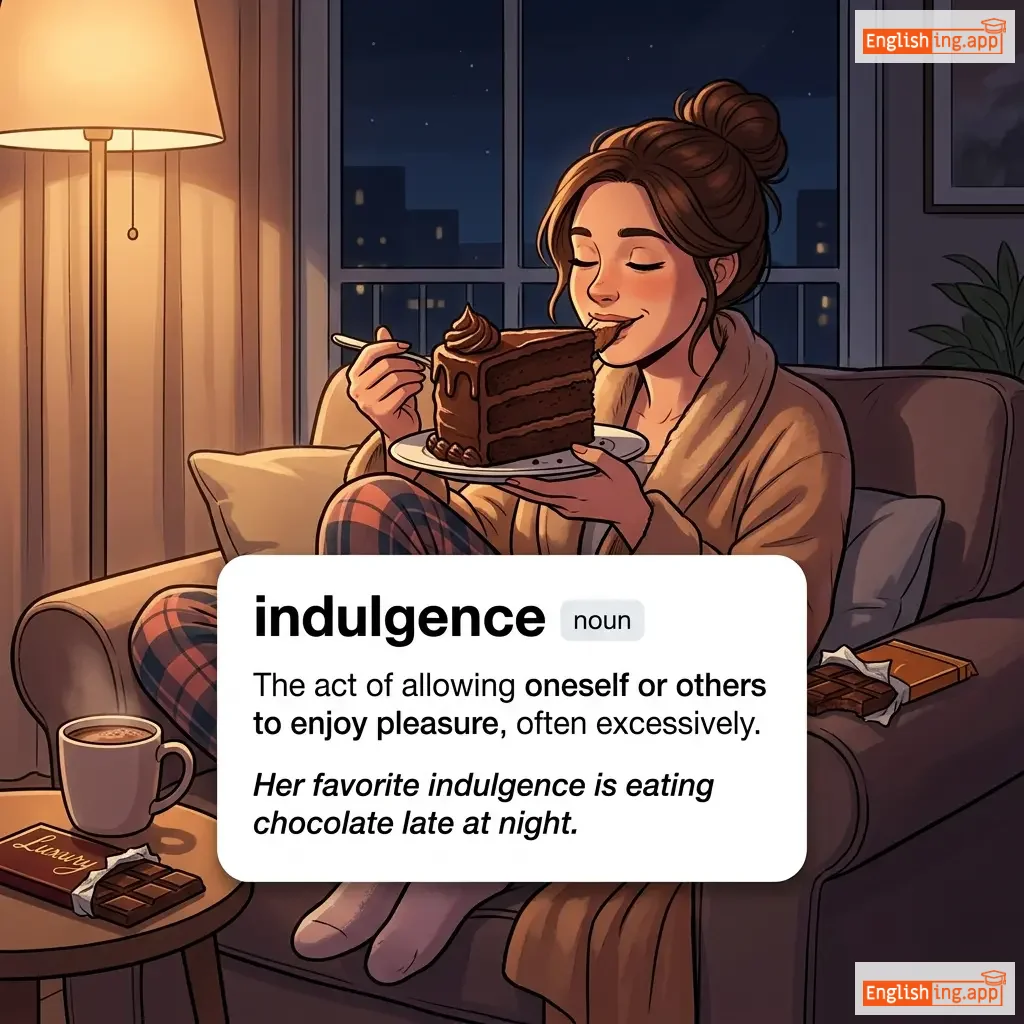
indulgence definition card — visual illustration of the meaning
noun
/ɪnˈdʌldʒəns/
indulgence (indulgence)

The act of allowing oneself or others to enjoy pleasure, often excessively.

"Her favorite indulgence is eating chocolate late at night."

"Son indulgence préférée est de manger du chocolat tard dans la nuit." (Son indulgence préférée est de manger du chocolat tard dans la nuit.)
adjective
/ɪnˈdʌldʒənt/
indulgent (indulgent)

Having a tendency to be overly generous or lenient with someone.

"The indulgent mother allowed her child to stay up late."

"La mère indulgente a permis à son enfant de rester éveillé tard." (La mère indulgente a permis à son enfant de rester éveillé tard.)
verb
/ˈɪndjʊˌreɪt/
endurcir (endurcir)

To harden or make something physically or emotionally tough.

"Years of hardship indurated his spirit."

"Des années de difficultés ont induré son esprit." (Des annees de difficultes ont indure son esprit.)