Vocabularios

Descubra, aprenda y domine el vocabulario en inglés

adjective
/ˌɪnsɪˈdɛntəl/
incidental (incidental)

happening as a minor part or in connection with something else

"Incidental expenses like snacks and tips were included in the bill."

"Gastos incidentales como bocadillos y propinas fueron incluidos en la factura." (Gastos incidentales como bocadillos y propinas fueron incluidos en la factura.)
adverb
/ˌɪnsɪˈdɛntəli/
por cierto (por cierto)

by the way; used to introduce a remark not directly related to the main subject

"Incidentally, did you know that she studied in Paris?"

"Por cierto, ¿sabías que estudió en París?" (Por cierto, ¿sabías que estudió en París?)
verb
/ɪnˈsɪnəˌreɪt/
incinerar (incinerar)

to burn something completely until it is reduced to ashes

"The city decided to incinerate the medical waste for safety."

"La ciudad decidió incinerar los desechos médicos por seguridad." (La ciudad decidió incinerar los desechos médicos por seguridad.)
noun
/ɪnˈsɪpiəns/
inicio (inicio)

the beginning or initial stage of something

"The project was still in its incipience when funding was approved."

"El proyecto aún estaba en su inicio cuando se aprobó la financiación." (El proyecto aun estaba en su inicio cuando se aprobó la financiación.)
adjective
/ɪnˈsɪpiənt/
incipiente (incipiente)

in an initial stage; beginning to develop

"The incipient storm made the sky turn dark and heavy."

"La tormenta incipiente hizo que el cielo se volviera oscuro y pesado." (La tormenta incipiente hizo que el cielo se volviera oscuro y pesado.)
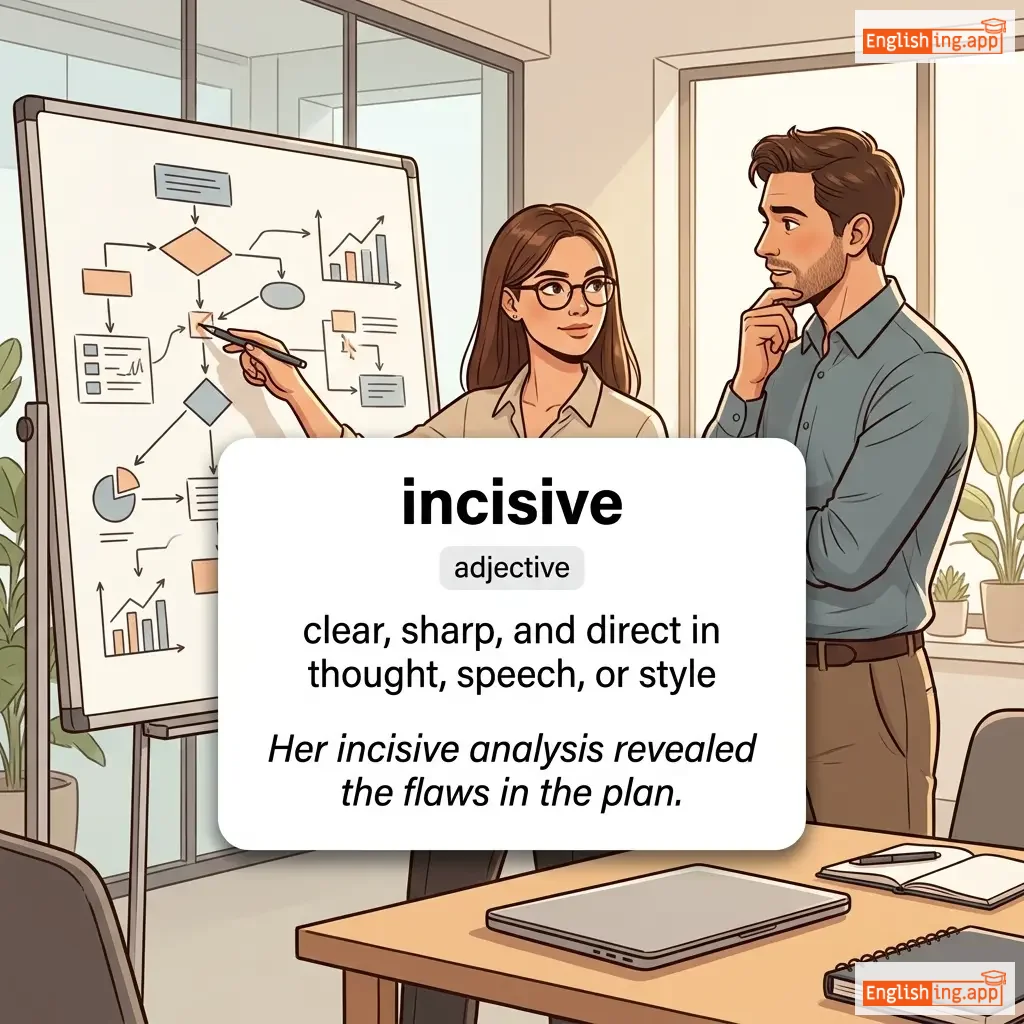
incisive definition card — visual illustration of the meaning
adjective
/ɪnˈsaɪsɪv/
agudo (agudo)

clear, sharp, and direct in thought, speech, or style

"Her incisive analysis revealed the flaws in the plan."

"Su análisis agudo reveló los defectos del plan." (Su análisis agudo reveló los defectos del plan.)
noun
/ɪnˈsaɪzər/
incisivo (insisivo)

a narrow-edged tooth at the front of the mouth, adapted for cutting

"The dentist noted that his upper left incisor was chipped."

"El dentista notó que su incisivo superior izquierdo estaba astillado." (El dentista noto que su incisivo superior izquierdo estaba astillado.)
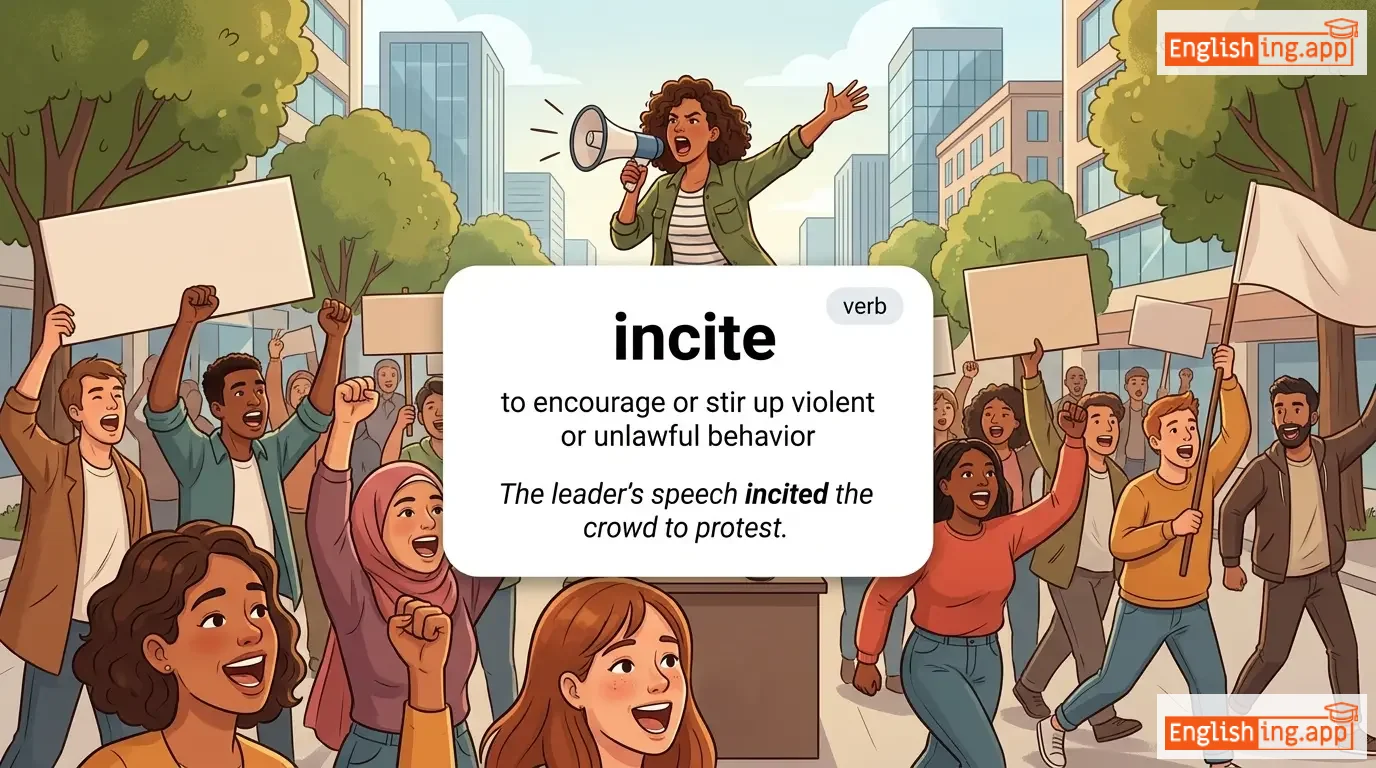
incite definition card — visual illustration of the meaning
verb
/ɪnˈsaɪt/
incitar (incitar)

to encourage or stir up violent or unlawful behavior

"The leader's speech incited the crowd to protest."

"El discurso del líder incitó a la multitud a protestar." (El discurso del líder incitó a la multitud a protestar.)
noun
/ɪnˈsaɪtmənt/
incitación (incitacion)

the action of provoking unlawful or violent behavior

"He was arrested for incitement to riot."

"Fue arrestado por incitación a la violencia." (Fue arrestado por incitacion a la violencia.)
adjective
/ɪnˈklɛmɛnt/
clima inclemente (clima inclemente)

unpleasantly cold, wet, or stormy (usually weather)

"The match was canceled due to inclement weather."

"El partido fue cancelado debido al clima inclemente." (El partido fue cancelado debido al clima inclemente.)
noun
/ˌɪnklɪˈneɪʃən/
inclinación (inclinacion)

A natural tendency or urge to act or feel in a particular way.

"She has an inclination towards helping others."

"Ella tiene una inclinación hacia ayudar a los demás." (Ella tiene una inclinación hacia ayudar a los demás.)
verb
/ɪnˈklaɪn/
inclinarse (incli-nar-se)

to feel willing or favorably disposed toward something; to bend or tilt

"She is inclined to agree with the proposal."

"Ella está inclinada a estar de acuerdo con la propuesta." (Ella esta inclinada a estar de acuerdo con la propuesta.)
adjective
/ɪnˈklaɪnd/
inclinada (inclinada)

having a tendency or disposition toward something

"He is inclined to help those in need."

"Él está inclinado a ayudar a los necesitados." (El esta inclinado a ayudar a los necesitados.)
include definition card — visual illustration of the meaning
verb
/ɪnˈkluːd/
incluir (incluir)

to make something part of a whole or group

"The package includes free breakfast."

"El paquete incluye desayuno gratuito." (El paquete incluye desayuno gratuito.)
preposition
/ɪnˈkluːdɪŋ/
incluido (incluido)

used to show that someone or something is part of a larger group

"Many people attended the event, including students and teachers."

"Muchas personas asistieron al evento, incluidos estudiantes y maestros." (Muchas personas asistieron al evento, incluidos estudiantes y maestros.)
noun
/ɪnˈkluːʒən/
inclusión (inclusion)

the action or state of including or being included within a group or structure

"Diversity and inclusion are key values in modern workplaces."

"La diversidad y la inclusión son valores clave en los lugares de trabajo modernos." (La diversidad y la inclusión son valores clave en los lugares de trabajo modernos.)
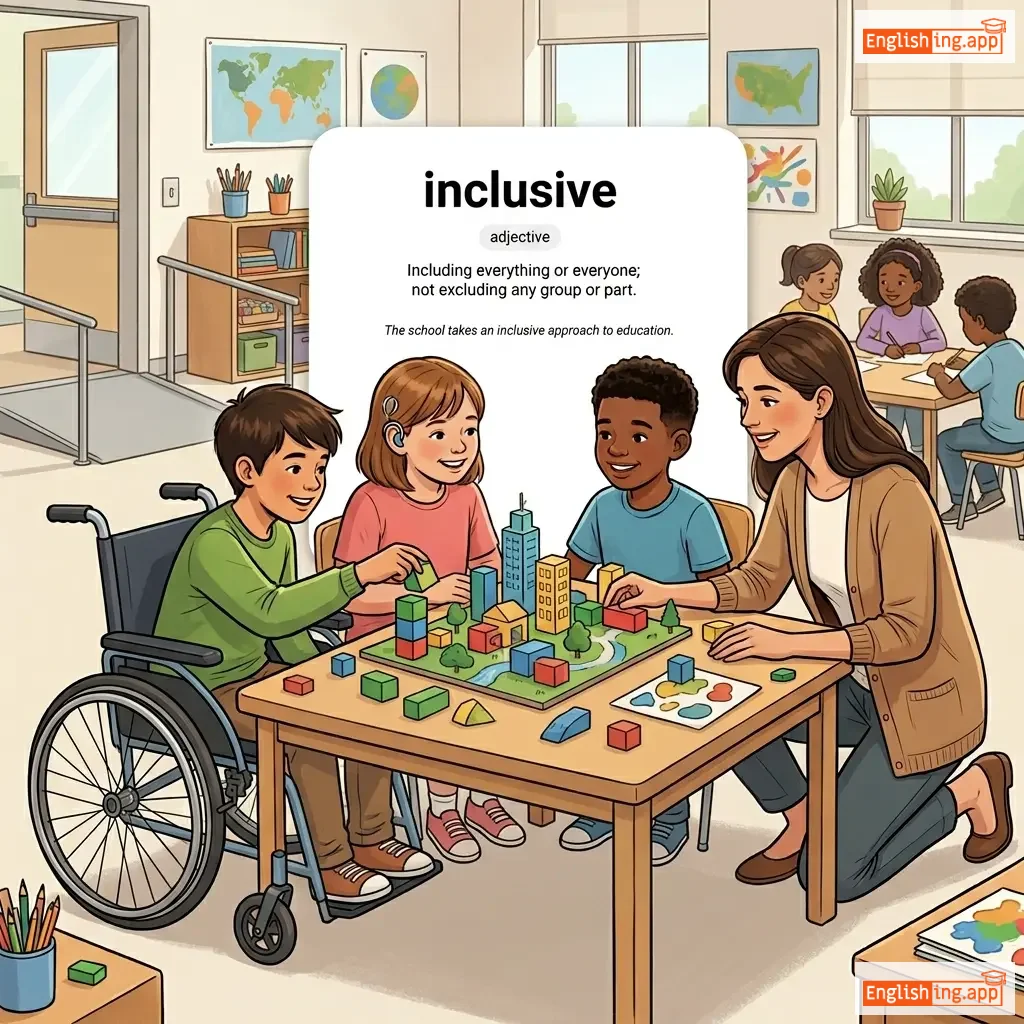
inclusive definition card — visual illustration of the meaning
adjective
/ɪnˈkluːsɪv/
inclusivo (inclusivo)

Including everything or everyone; not excluding any group or part.

"The school takes an inclusive approach to education."

"La escuela adopta un enfoque inclusivo para la educación." (La escuela adopta un enfoque inclusivo para la educación.)
adjective
/ˌɪnkoʊˈɜːrsəbl̩/
incoercible (incoercible)

Not capable of being forced, compelled, or restrained.

"Her incoercible spirit inspired others to fight for justice."

"Su espíritu incoercible inspiró a otros a luchar por la justicia." (Su espíritu incoercible inspiró a otros a luchar por la justicia.)
adjective
/ɪnˈkɑːdʒɪtənt/
desconsiderado (desconsiderado)

Lacking thought; inconsiderate or thoughtless.

"It was incogitant of him to make such a rude comment."

"Fue incogitante de su parte hacer un comentario tan grosero." (Fue incogitante de su parte hacer un comentario tan grosero.)
adverb, adjective
/ˌɪnkɑːɡˈniːtoʊ/
incógnito (incognito)

In disguise or with one's identity concealed.

"The celebrity traveled incognito to avoid the paparazzi."

"La celebridad viajó incognito para evitar a los paparazzi." (La celebridad viajó incognito para evitar a los paparazzi.)
noun
/ˌɪnkoʊˈhɪrəns/
incoherencia (incoherencia)

The quality of being unclear, confused, or lacking logical connection.

"His speech was full of incoherence and difficult to follow."

"Su discurso estaba lleno de incoherencias y era difícil de seguir." (Su discurso estaba lleno de incoherencias y era dificil de seguir.)
adjective
/ˌɪnkəʊˈhɪərənt/
incoherente (incoherente)

Not clear or easy to understand; lacking logical connection.

"His explanation was so incoherent that nobody could follow it."

"Su explicación era tan incoherente que nadie pudo seguirla." (Su explicacion era tan incoherente que nadie pudo seguirla.)
adjective
/ˌɪnkəmˈbʌstəbl/
incombustible (incombustible)

Not capable of catching fire or burning.

"This material is incombustible and safe for construction."

"Este material es incombustible y seguro para la construcción." (Este material es incombustible y seguro para la construcción.)
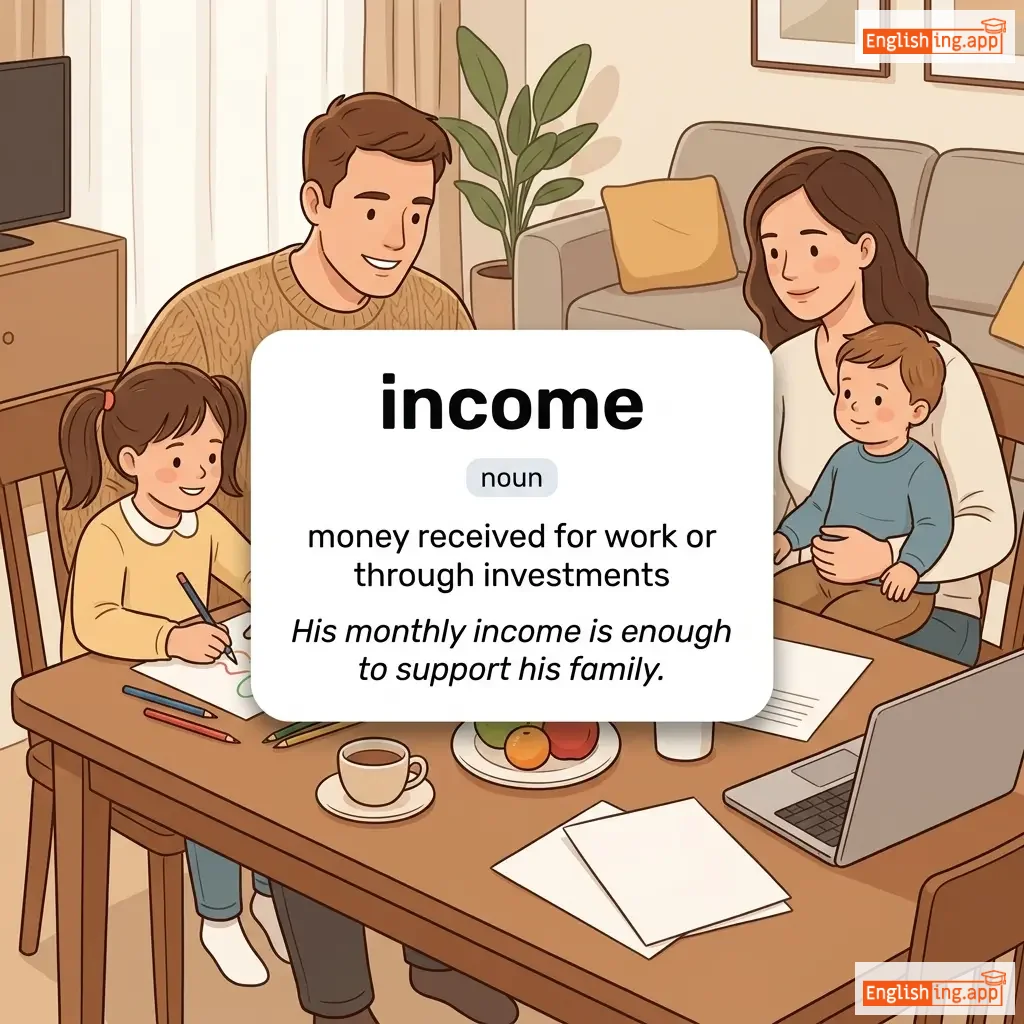
income definition card — visual illustration of the meaning
noun
/ˈɪnkʌm/
ingreso (ingreso)

money received for work or through investments

"His monthly income is enough to support his family."

"Su ingreso mensual es suficiente para mantener a su familia." (Su ingreso mensual es suficiente para mantener a su familia.)
adjective
/ˌɪnkəˈməʊdiəs/
incómodo (incomodo)

Uncomfortably small, cramped, or inconvenient.

"We had to stay in an incommodious room during the trip."

"Tuvimos que quedarnos en una habitación incómoda durante el viaje." (Tuvimos que quedarnos en una habitacion incomoda durante el viaje.)
adjective
/ɪnˈkɒmp(ə)rəbl/
incomparable (incomparable)

Without an equal in quality or excellence; matchless.

"The view from the mountain was incomparable."

"La vista desde la montaña era incomparable." (La vista desde la montaña era incomparable.)
noun
/ˌɪnkəmˌpætəˈbɪlɪti/
incompatibilidad (incompatibilidad)

the state of being unable to exist or work together harmoniously; lack of compatibility

"The project failed because of incompatibility between the two software systems."

"El proyecto fracasó por la incompatibilidad entre los dos sistemas de software." (El proyecto fracaso por la incompatibilidad entre los dos sistemas de software)
adjective
/ˌɪnkəmˈpætəbl/
incompatible (incompatible)

Not able to exist or work together without conflict.

"Their personalities were completely incompatible."

"Sus personalidades eran completamente incompatibles." (Sus personalidades eran completamente incompatibles.)
noun
/ɪnˈkɒmpɪtəns/
incompetencia (incompetencia)

Lack of ability, skill, or effectiveness in doing something.

"The project failed due to the manager’s incompetence."

"El proyecto fracasó debido a la incompetencia del gerente." (El proyecto fracasó debido a la incompetencia del gerente.)
adjective
/ɪnˈkɒmpɪtənt/
incompetente (incompetente)

Lacking the necessary ability or skills to do something successfully.

"He was fired because he was incompetent at his job."

"Lo despidieron porque era incompetente en su trabajo." (Lo despidieron porque era incompetente en su trabajo.)
adjective
/ˌɪnkəmˈpliːt/
incompleto (incompleto)

Not finished, lacking some parts or not whole.

"Her report was incomplete and needed further details."

"Su informe estaba incompleto y necesitaba más detalles." (Su informe estaba incompleto y necesitaba más detalles.)
noun
/ˌɪnkəmˈpliːtnəs/
incompletitud (incompletitud)

the state of not being complete or whole; lack of necessary parts or fullness

"The incompleteness of the report caused delays in the project."

"La incompletitud del informe causó retrasos en el proyecto." (La incompletitud del informe causo retrasos en el proyecto)
adjective
/ˌɪnkɒmprɪˈhɛnsəbl/
incomprensible (incomprensible)

Impossible or very difficult to understand.

"The professor’s lecture was so fast it became incomprehensible."

"La conferencia del profesor fue tan rápida que se volvió incomprensible." (La conferencia del profesor fue tan rapida que se volvio incomprensible.)
adjective
/ˌɪnkəmˈprɛsəbl/
incompresible (incompresible)

Not able to be pressed or squeezed into a smaller space.

"Liquids are generally considered incompressible."

"Los líquidos generalmente se consideran incomprensibles." (Los líquidos generalmente se consideran incomprensibles.)
adjective
/ˌɪnkənˈsiːvəbl̩/
inconcebible (inconseible)

Impossible to imagine or believe; beyond comprehension.

"It seemed inconceivable that she could finish the marathon after such little training."

"Parecía inconcebible que ella pudiera terminar el maratón después de tan poco entrenamiento." (Parecia inconcebible que ella pudiera terminar el maraton despues de tan poco entrenamiento.)
adjective
/ˌɪnkənˈkluːsɪv/
inconcluso (inconcluso)

Not leading to a definite result or decision.

"The investigation remained inconclusive due to a lack of evidence."

"La investigación permaneció inconclusa debido a la falta de evidencia." (La investigacion permanecio inconclusa debido a la falta de evidencia.)
adjective
/ɪnˈkɒŋɡruənt/
incongruente (incongruente)

Not in harmony or keeping with the surroundings or other aspects.

"His casual outfit looked incongruent at the formal dinner."

"Su atuendo casual se veía incongruente en la cena formal." (Su atuendo casual se veia incongruente en la cena formal.)
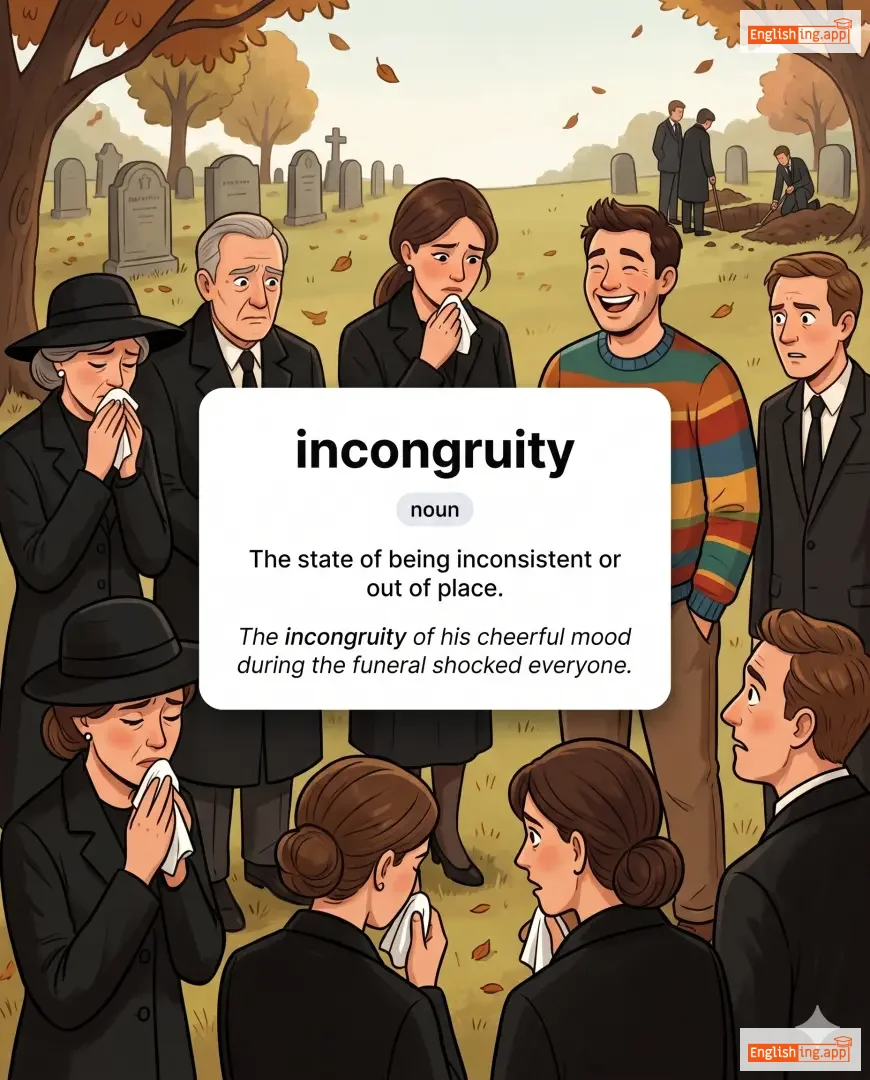
incongruity definition card — visual illustration of the meaning
noun
/ˌɪnkənˈɡruːəti/
incongruencia (incongruencia)

The state of being inconsistent or out of place.

"The incongruity of his cheerful mood during the funeral shocked everyone."

"La incongruencia de su estado de ánimo alegre durante el funeral sorprendió a todos." (La incongruencia de su estado de ánimo alegre durante el funeral sorprendió a todos.)
adjective
/ɪnˈkɒŋɡruəs/
incongruente (incongruente)

Not fitting in with or suitable for the surroundings.

"His jokes were incongruous during the serious meeting."

"Sus chistes fueron incongruentes durante la reunión seria." (Sus chistes fueron incongruentes durante la reunión seria.)
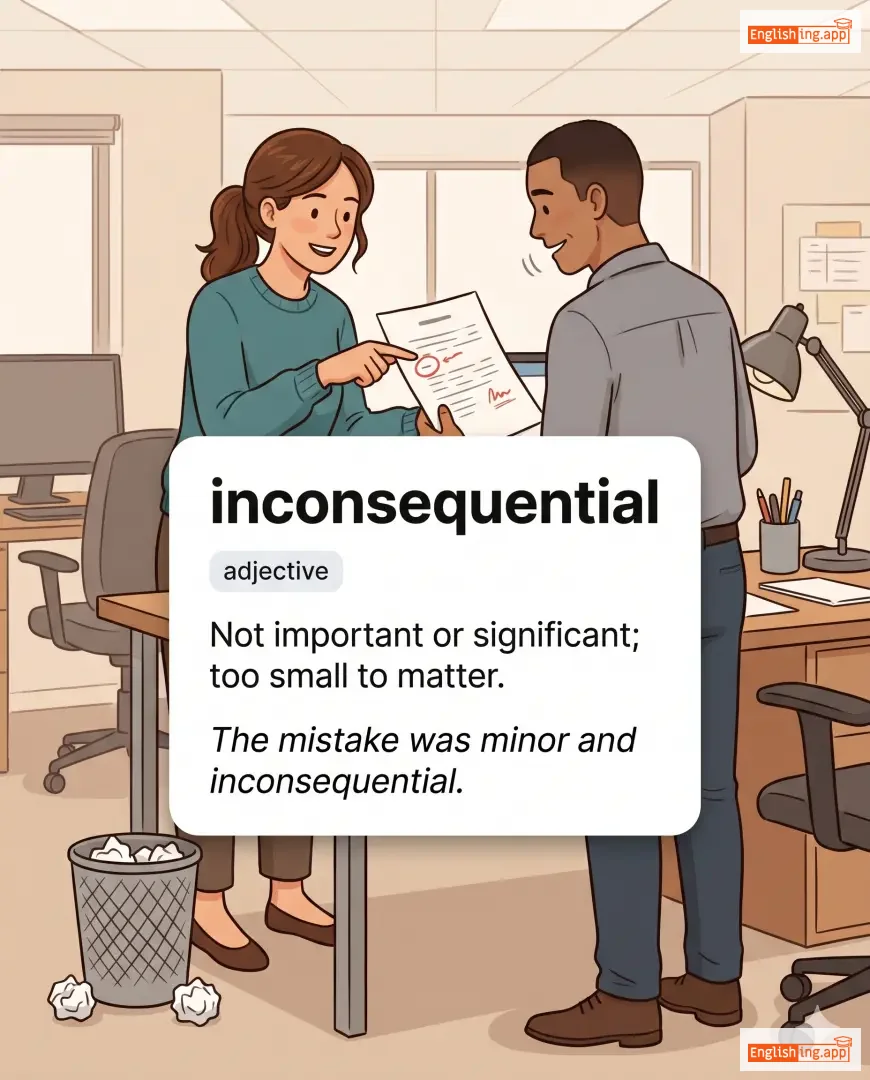
inconsequential definition card — visual illustration of the meaning
adjective
/ˌɪnˌkɒnsɪˈkwɛnʃəl/
insignificante (insignificante)

Not important or significant; too small to matter.

"The mistake was minor and inconsequential."

"El error fue menor e insignificante." (El error fue menor e insignificante.)
adjective
/ˌɪnkənˈsɪdərəbl/
insignificante (insignificante)

Too small or unimportant to be worth considering.

"The donation was not inconsiderable, though smaller than expected."

"La donación no fue insignificante, aunque más pequeña de lo esperado." (La donación no fue insignificante, aunque más pequeña de lo esperado.)
adjective
/ˌɪnkənˈsɪdərət/
desconsiderado (desconsiderado)

Thoughtless; showing a lack of concern for others.

"It was inconsiderate of him to play loud music late at night."

"Fue desconsiderado de su parte poner música alta tarde en la noche." (Fue desconsiderado de su parte poner musica alta tarde en la noche.)
noun
/ˌɪnkənˈsɪstənsi/
inconsistencia (inconsistencia)

The quality of being contradictory, irregular, or not staying the same.

"There is an inconsistency between his words and actions."

"Hay una inconsistencia entre sus palabras y acciones." (Hay una inconsistencia entre sus palabras y acciones.)
adjective
/ˌɪnkənˈsɪstənt/
inconsistente (inconsistente)

Not staying the same throughout; lacking harmony or regularity.

"His answers were inconsistent and confusing."

"Sus respuestas fueron inconsistentes y confusas." (Sus respuestas fueron inconsistentes y confusas.)
noun
/ɪnˈkɒnstənsi/
inconstancia (inconstancia)

The quality of changing frequently or being unreliable.

"The inconstancy of the weather makes planning difficult."

"La inconstancia del clima hace que planificar sea difícil." (La inconstancia del clima hace que planificar sea difícil.)
adjective
/ɪnˈkɒnstənt/
inconstante (inconstante)

frequently changing; not consistent or dependable

"His inconstant moods made it difficult to work with him."

"Sus estados de ánimo inconstantes hacían difícil trabajar con él." (Sus estados de ánimo inconstantes hacían difícil trabajar con él.)
adjective
/ɪnˈkɒntɪnənt/
incontinente (incontinente)

lacking control over urination or defecation; lacking self-restraint

"The patient was incontinent after surgery."

"El paciente era incontinente después de la cirugía." (El paciente era incontinente despues de la cirugia.)
adjective
/ˌɪnkɒntrəˈvɜːtəbl/
incontrovertible (incontrovertible)

impossible to deny or dispute; unquestionable

"The evidence was incontrovertible and proved his innocence."

"La evidencia era incontrovertible y demostró su inocencia." (La evidencia era incontrovertible y demostró su inocencia.)
noun, verb
/ˌɪnkənˈviːniəns/
inconveniente (inconveniente)

trouble or difficulty caused to someone; to cause trouble or difficulty to someone

"We apologize for any inconvenience caused by the delay."

"Pedimos disculpas por cualquier inconveniente causado por el retraso." (Pedimos disculpas por cualquier inconveniente causado por el retraso)
adjective
/ˌɪnkənˈviːniənt/
incómodo (incomodo)

causing trouble, difficulties, or discomfort

"It was inconvenient for her to travel during the storm."

"Era incómodo para ella viajar durante la tormenta." (Era incomodo para ella viajar durante la tormenta.)