Vocabularios

Descubra, aprenda y domine el vocabulario en inglés

adjective
/ɪmˈpræktɪkəbl/
impracticable (impracticable)

Not capable of being carried out or put into practice.

"The plan seemed impracticable due to limited resources."

"El plan parecía impracticable debido a los recursos limitados." (El plan parecía impracticable debido a los recursos limitados.)
verb
/ˈɪmprɪkeɪt/
imprecate (imprecate)

To utter a curse or invoke evil upon someone.

"The old woman imprecated her enemies with dark words."

"La vieja mujer imprecó a sus enemigos con palabras oscuras." (La vieja mujer imprecó a sus enemigos con palabras oscuras.)
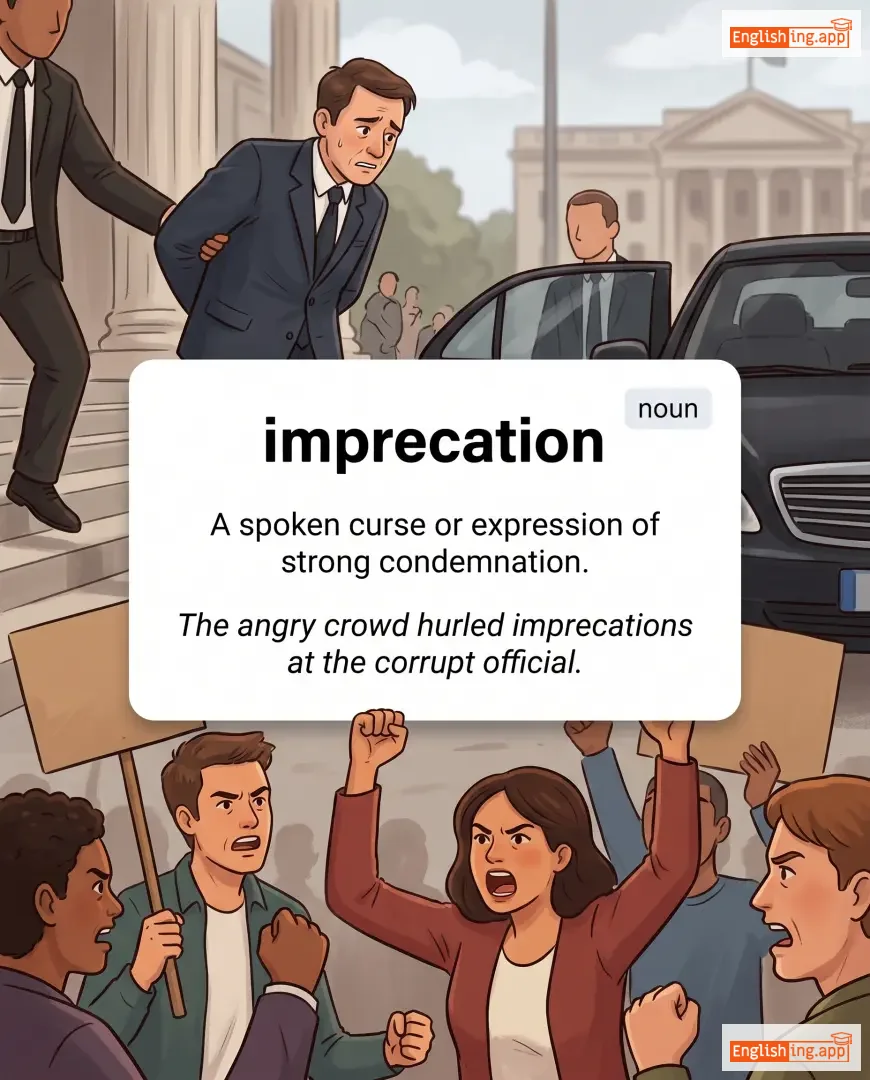
imprecation definition card — visual illustration of the meaning
noun
/ˌɪmprɪˈkeɪʃən/
maldición (maldicion)

A spoken curse or expression of strong condemnation.

"The angry crowd hurled imprecations at the corrupt official."

"La multitud enojada lanzó maldiciones al funcionario corrupto." (La multitud enojada lanzo maldiciones al funcionario corrupto.)
adjective
/ˌɪmprɪˈsaɪs/
impreciso (impreciso)

Not exact or accurate; vague.

"His explanation was too imprecise to be helpful."

"Su explicación era demasiado imprecisa para ser útil." (Su explicacion era demasiado imprecisa para ser util.)
adjective
/ɪmˈprɛɡnəbl̩/
impenetrable (impenetrable)

Unable to be captured, broken into, or defeated.

"The fortress was considered impregnable by the enemy."

"La fortaleza fue considerada impenetrable por el enemigo." (La fortaleza fue considerada impenetrable por el enemigo.)
verb
/ˈɪmprɛɡneɪt/
embarazar / impregnar (embarazar / impregnar)

To make pregnant; to fill or saturate with something.

"The scientist used a method to impregnate the material with resin."

"El científico utilizó un método para impregnar el material con resina." (El científico utilizó un método para impregnar el material con resina.)
noun
/ˌɪmprəˈsɑːrioʊ/
productor (productor)

A person who organizes or finances concerts, plays, or operas.

"The impresario arranged a series of concerts for the rising star."

"El impresario organizó una serie de conciertos para la estrella emergente." (El impresario organizó una serie de conciertos para la estrella emergente.)
verb
/ɪmˈprɛs/
impresionar (impresionar)

to cause someone to feel admiration or respect

"Her speech managed to impress the audience."

"Su discurso logró impresionar a la audiencia." (Su discurso logró impresionar a la audiencia.)
noun
/ɪmˈprɛʃən/
impresión, concepto (impresion, concepto)

an idea, feeling, or opinion about something or someone

"The book gave me a good first impression."

"El libro me dio una buena primera impresión." (El libro me dio una buena primera impresion.)
adjective
/ɪmˈprɛsɪv/
impresionante, digno de admiración (impresionante, digno de admiracion)

causing admiration or respect; remarkable

"The building is an impressive example of modern architecture."

"El edificio es un ejemplo impresionante de arquitectura moderna." (El edificio es un ejemplo impresionante de arquitectura moderna.)
noun
/ˌɪmprɪˈmɑːtər/
imprimátur (imprimatur)

An official license or approval, especially to publish a book.

"The book was released with the official imprimatur of the church."

"El libro fue lanzado con el imprimátur oficial de la iglesia." (El libro fue lanzado con el imprimatur oficial de la iglesia.)
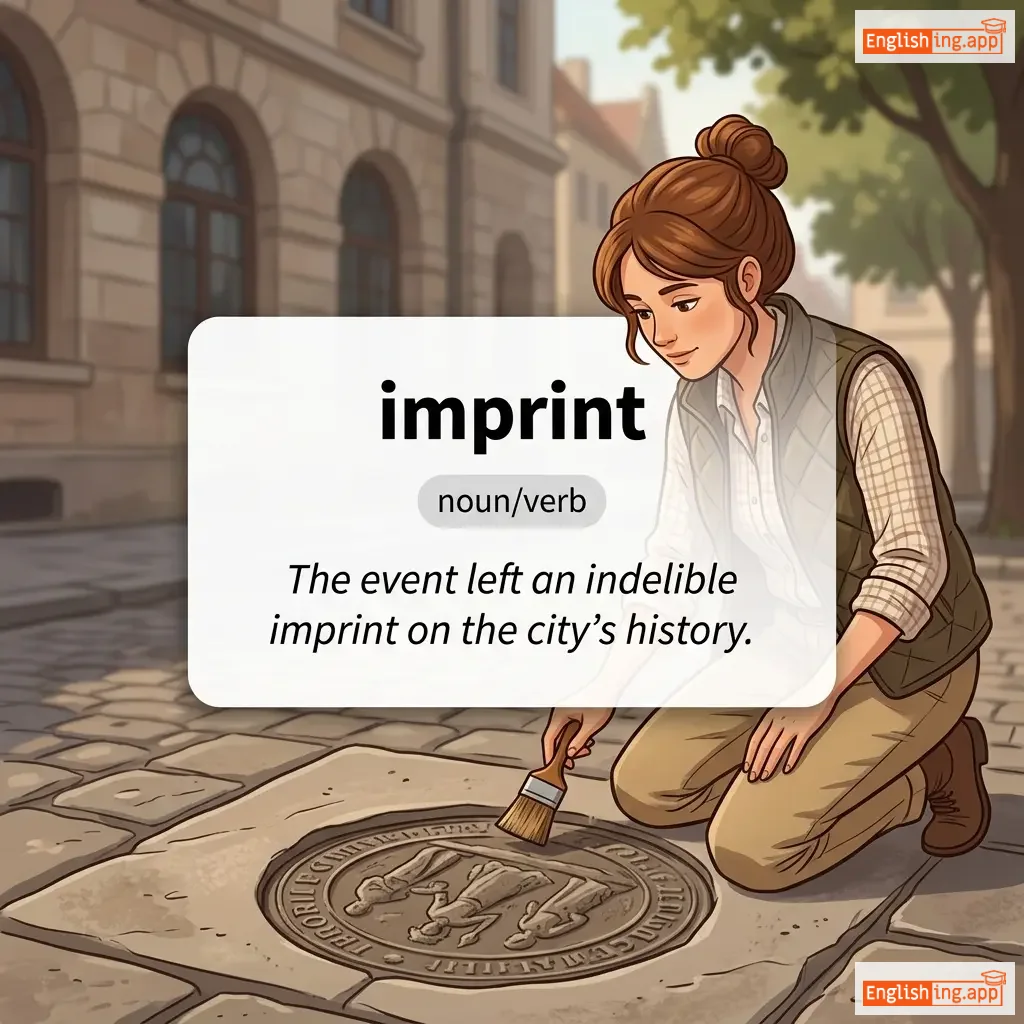
imprint definition card — visual illustration of the meaning
noun/verb
/ˈɪmprɪnt/
huella (imprint)

A mark or impression made by pressure; to establish or fix firmly in someone's mind.

"The event left an indelible imprint on the city's history."

"El evento dejó una huella indeleble en la historia de la ciudad." (El evento dejo una huella indeleble en la historia de la ciudad.)
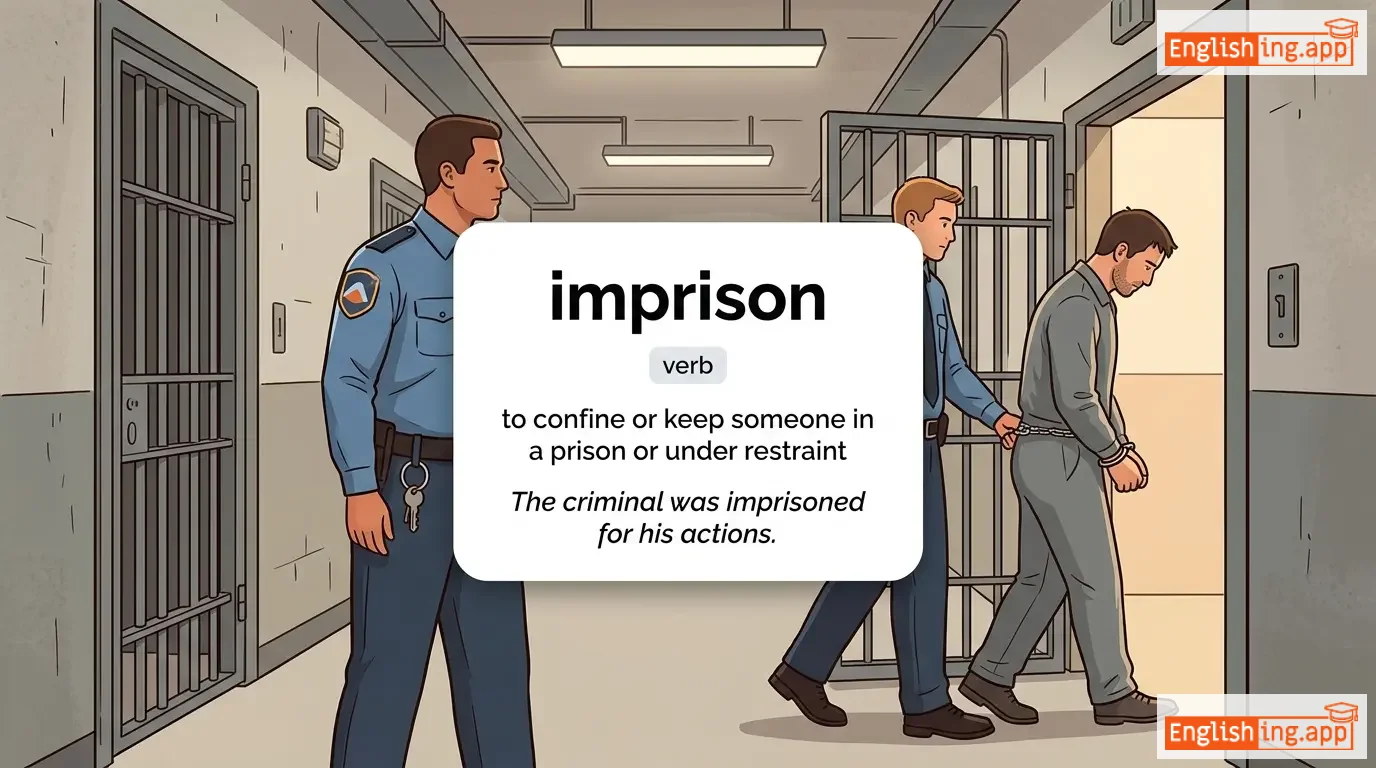
imprison definition card — visual illustration of the meaning
verb
/ɪmˈprɪzən/
encarcelar (encarcelar)

to confine or keep someone in a prison or under restraint

"The criminal was imprisoned for his actions."

"El criminal fue encarcelado por sus acciones." (El criminal fue encarcelado por sus acciones.)
noun
/ɪmˈprɪzənmənt/
encarcelamiento (encarcelamiento)

the act of putting someone in prison; the state of being confined as punishment

"He faced imprisonment for violating the court order."

"Se enfrentó al encarcelamiento por violar la orden judicial." (Se enfrento al encarcelamiento por violar la orden judicial)
noun
/ɪmˌprɒb.əˈbɪl.ə.ti/
improbabilidad (improbabilidad)

the quality or state of being improbable; unlikely to be true or to happen

"The improbability of winning the lottery twice didn't stop her from buying tickets."

"La improbabilidad de ganar la lotería dos veces no la detuvo de comprar boletos." (La improbabilidad de ganar la lotería dos veces no la detuvo de comprar boletos.)
adjective
/ɪmˈprɒbəbl/
improbable (improbable)

Not likely to be true or to happen.

"It seems improbable that he will arrive on time."

"Parece improbable que llegue a tiempo." (Parece improbable que llegue a tiempo.)
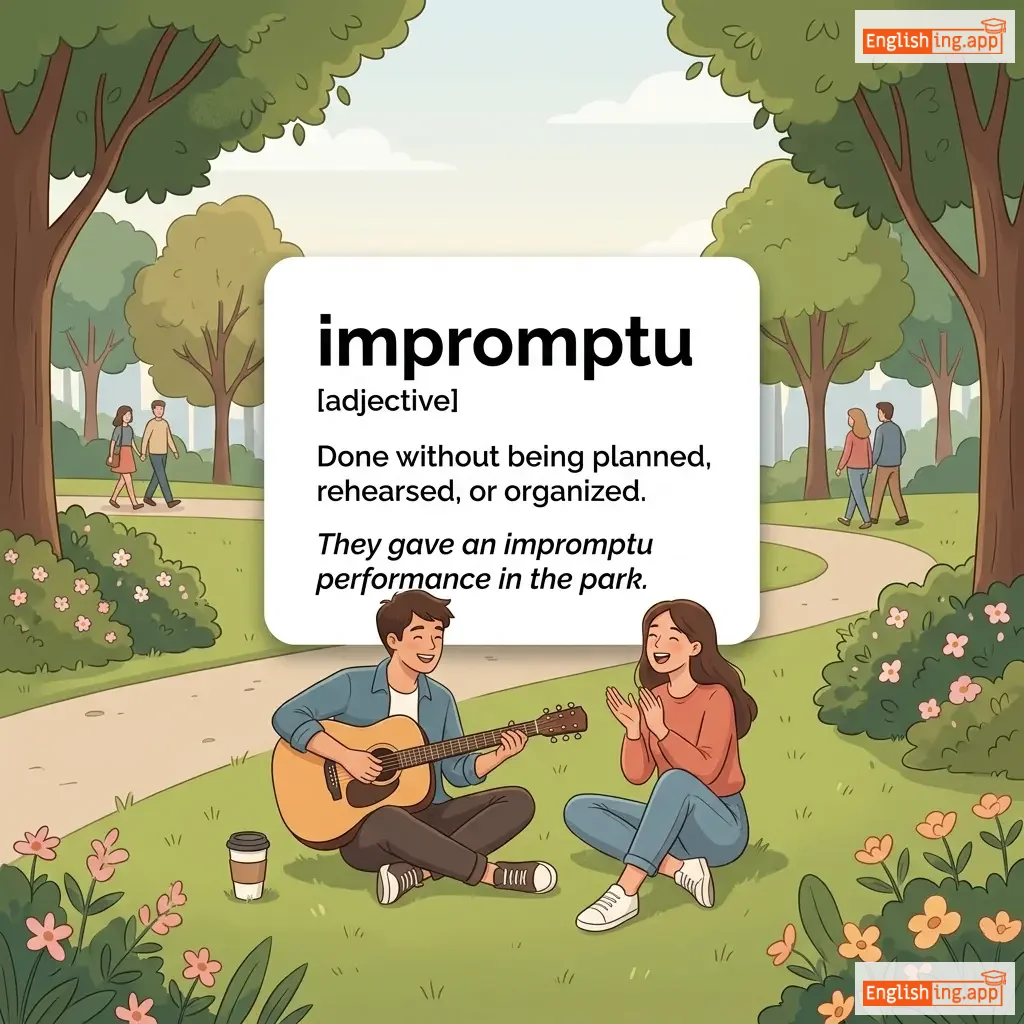
impromptu definition card — visual illustration of the meaning
adjective
/ɪmˈprɒmptjuː/
improvisado (improvisado)

Done without being planned, rehearsed, or organized.

"They gave an impromptu performance in the park."

"Ellos dieron una actuación improvisada en el parque." (Ellos dieron una actuacion improvisada en el parque.)
adjective
/ɪmˈprɒpər/
impropio (impropio)

Not suitable or appropriate; against accepted standards.

"It is improper to talk loudly in the library."

"Es impropio hablar en voz alta en la biblioteca." (Es impropio hablar en voz alta en la biblioteca.)
noun
/ˌɪmprəˈpraɪəti/
improiedad (improiedad)

Failure to observe standards of honesty or modesty; improper behavior.

"The politician was accused of financial impropriety."

"El político fue acusado de impropiedad financiera." (El politico fue acusado de impropiedad financiera.)
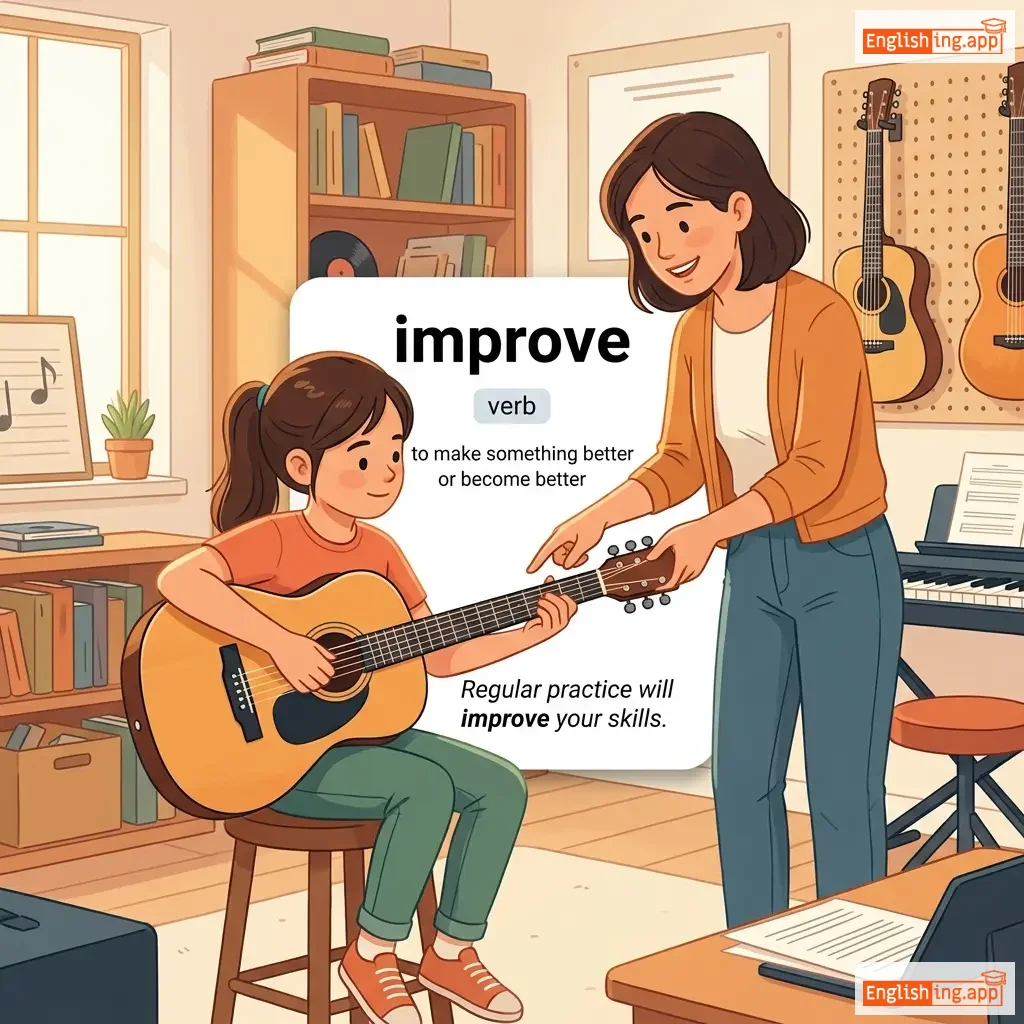
improve definition card — visual illustration of the meaning
verb
/ɪmˈpruːv/
mejorar (mejorar)

to make something better or become better

"Regular practice will improve your skills."

"la práctica regular mejorará tus habilidades." (la práctica regular mejorará tus habilidades.)
improved definition card — visual illustration of the meaning
adjective
/ɪmˈpruːvd/
mejorado (mejorado)

made better or enhanced in quality or condition

"Her health has significantly improved since last month."

"Su salud ha mejorado significativamente desde el mes pasado." (Su salud ha mejorado significativamente desde el mes pasado.)
noun
/ɪmˈpruːvmənt/
mejora (mejora)

the act of making something better

"There has been a significant improvement in his health."

"Ha habido una mejora significativa en su salud." (Ha habido una mejora significativa en su salud.)
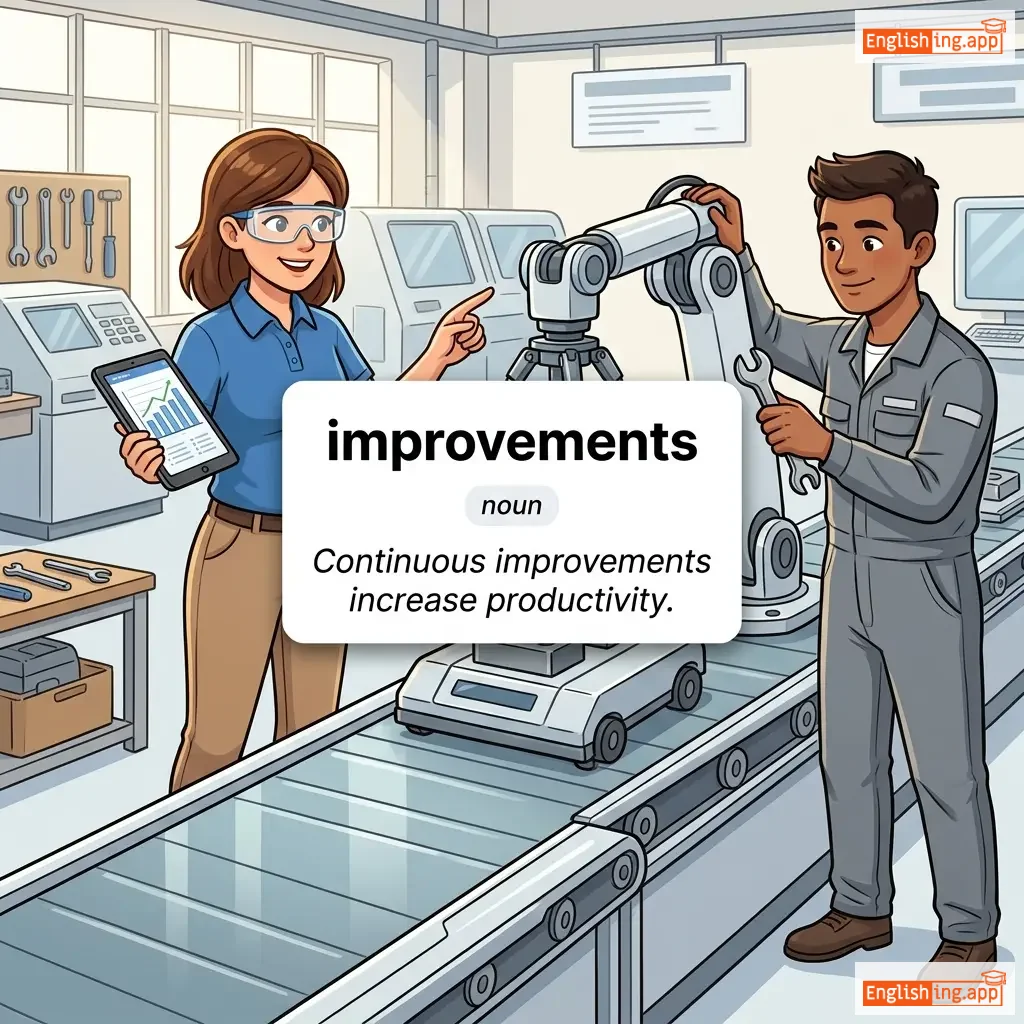
improvements definition card — visual illustration of the meaning
noun
ɪmˈpruːv.mənts
mejoras (mejoras)

The action of making or becoming better; an instance of something becoming or being made better.

"Continuous improvements increase productivity."

"Las mejoras continuas aumentan la productividad." (Las mejoras continuas aumentan la productividad.)
noun
/ɪmˈprɑːvɪdəns/
imprudencia (imprudencia)

Lack of foresight or care for future needs.

"His improvidence led to financial difficulties."

"Su imprudencia lo llevó a dificultades financieras." (Su imprudencia lo llevó a dificultades financieras.)
adjective
/ɪmˈprɒvɪdənt/
imprudente (imprudente)

Not having or showing foresight; spending wastefully or without thought for the future.

"His improvident habits left him with no savings."

"Sus hábitos imprudentes lo dejaron sin ahorros." (Sus hábitos imprudentes lo dejaron sin ahorros.)
verb
/ˈɪmprəvaɪz/
improvisar (improvisar)

To create or perform something spontaneously without preparation.

"The actor had to improvise his lines when he forgot the script."

"El actor tuvo que improvisar sus líneas cuando olvidó el guion." (El actor tuvo que improvisar sus líneas cuando olvidó el guion.)
noun
/ɪmˈpruːdəns/
imprudencia (imprudencia)

Lack of caution or good judgment.

"His imprudence in investing all his money in one stock was disastrous."

"Su imprudencia al invertir todo su dinero en una sola acción fue desastrosa." (Su imprudencia al invertir todo su dinero en una sola accion fue desastrosa.)
adjective
/ɪmˈpruːdənt/
imprudente (imprudente)

Not showing care for the consequences of an action.

"It was imprudent to drive in such stormy weather."

"Era imprudente conducir en un clima tan tormentoso." (Era imprudente conducir en un clima tan tormentoso.)
noun
/ˈɪmpjʊdəns/
desvergüenza (desverguenza)

Rude and disrespectful behavior.

"The student's impudence shocked the entire class."

"La desvergüenza del estudiante sorprendió a toda la clase." (La desverguenza del estudiante sorprendió a toda la clase.)
adjective
/ˈɪmpjəd(ə)nt/
descarado, insolente (descarado, insolente)

not showing due respect for another person; rude

"The impudent child talked back to the teacher."

"El niño descarado le contestó al maestro." (El niño descarado le contestó al maestro.)
verb
/ɪmˈpjuːn/
disputar la verdad, validez o honestidad de una declaración o motivo (disputar la verdad, validez o honestidad de una declaracion o motivo)

to dispute the truth, validity, or honesty of a statement or motive

"The lawyer tried to impugn the credibility of the witness."

"El abogado intentó impugnar la credibilidad del testigo." (El abogado intento impugnar la credibilidad del testigo.)
noun
/ɪmˈpjuːɪsəns/
impotencia, incapacidad (impotencia, incapacidad)

inability to take effective action; helplessness

"The government’s impuissance in the face of crisis frustrated the people."

"La impotencia del gobierno ante la crisis frustró al pueblo." (La impotencia del gobierno ante la crisis frustro al pueblo.)
noun
/ˈɪmpʌls/
impulso (impulso)

a sudden strong desire or urge to act without thinking

"He bought the watch on impulse without planning to."

"Compró el reloj por impulso sin planearlo." (Compró el reloj por impulso sin planearlo.)
noun
/ɪmˈpʌlʃən/
impulso (impulsion)

a strong urge or drive to act; the act of impelling

"His impulsion to travel made him leave his job suddenly."

"Su impulso de viajar lo llevó a dejar su trabajo de repente." (Su impulso de viajar lo llevo a dejar su trabajo de repente)
adjective
/ɪmˈpʌlsɪv/
impulsivo, de impulso (impulsivo, de impulso)

acting suddenly without careful thought

"She made an impulsive decision to buy the car."

"Tomó una decisión impulsiva de comprar el coche." (Tomó una decisión impulsiva de comprar el coche.)
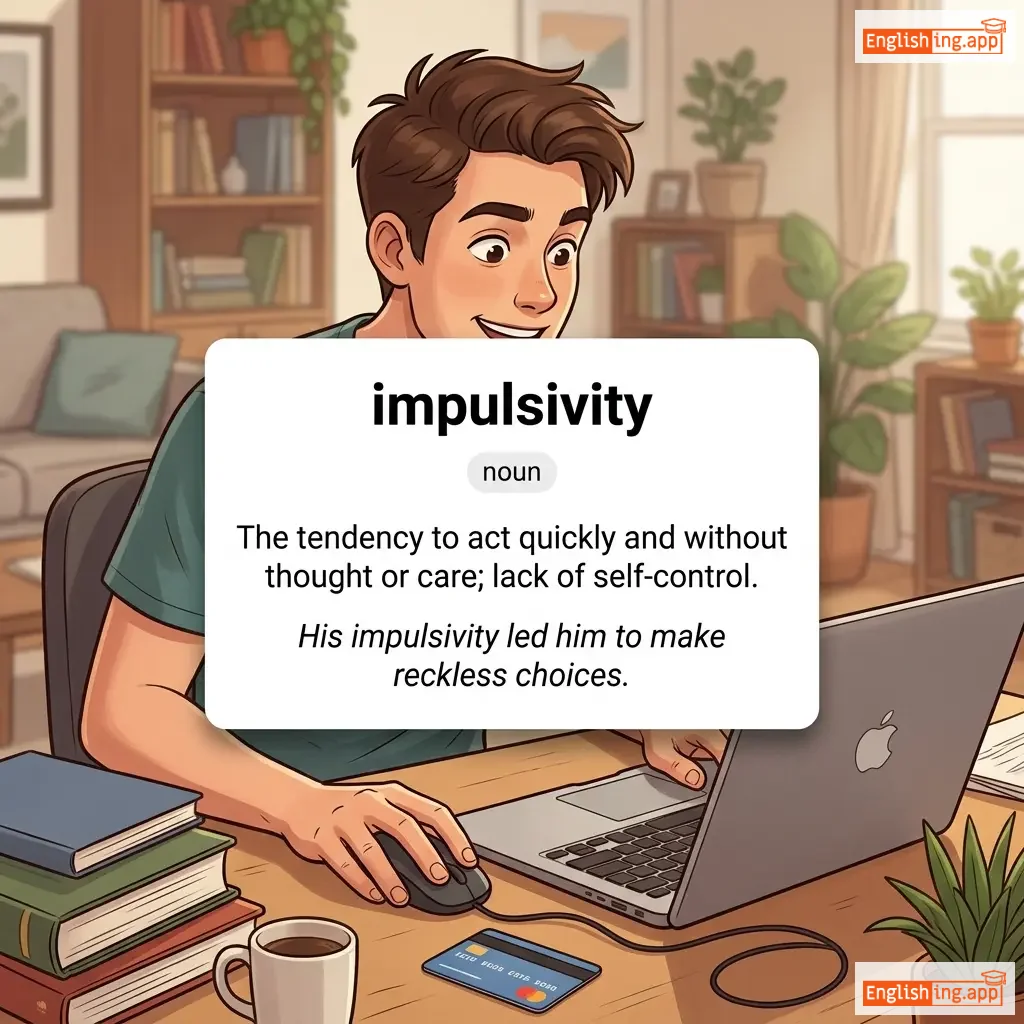
impulsivity definition card — visual illustration of the meaning
noun
ˌɪm.pʌlˈsɪv.ɪ.ti
impulsividad (impulsividad)

The tendency to act quickly and without thought or care; lack of self-control.

"His impulsivity led him to make reckless choices."

"Su impulsividad lo llevó a tomar decisiones imprudentes." (Su impulsividad lo llevó a tomar decisiones imprudentes.)
noun
/ɪmˈpjuːnɪti/
impunidad (impunidad)

freedom from punishment or harmful consequences for an action

"The dictator ruled with impunity, ignoring international laws."

"El dictador gobernó con impunidad, ignorando las leyes internacionales." (El dictador gobernó con impunidad, ignorando las leyes internacionales.)
adjective
/ɪmˈpjʊər/
impuro (impuro)

not clean or free from contamination; morally corrupt

"The water was impure and unsafe to drink."

"El agua estaba impura y no era segura para beber." (El agua estaba impura y no era segura para beber.)
noun
/ɪmˈpjʊərəti/
impureza (impureza)

the state of being unclean or contaminated; a substance that makes something impure

"The scientist removed every impurity from the water sample."

"El científico eliminó toda impureza de la muestra de agua." (el cientifico elimino toda impureza de la muestra de agua)
noun
/ˌɪmpjuˈteɪʃən/
imputación (imputacion)

an accusation or attribution of blame

"The politician denied the imputation of corruption."

"El político negó la imputación de corrupción." (El politico nego la imputacion de corrupcion.)
verb
/ɪmˈpjuːt/
imputar (imputar)

to attribute a fault or responsibility to someone

"They imputed the company's success to good leadership."

"Ellos imputaron el éxito de la empresa a un buen liderazgo." (Ellos imputaron el éxito de la empresa a un buen liderazgo.)
preposition
/ɪn/
en (en)

expressing the situation of being enclosed or surrounded by something

"She is in the kitchen preparing dinner."

"Ella está en la cocina preparando la cena." (Ella esta en la cocina preparando la cena.)
preposition
/ɪn ˈfrʌnt əv/
delante de (delante de)

positioned before or ahead of something; facing or located at the forward side of a person or object

"She stood in front of the building."

"Ella estaba de pie delante del edificio." (Ella estaba de pie delante del edificio)
noun
/ˌɪnəˈbɪləti/
incapacidad (incapacidad)

the state of being unable to do something

"His inability to make decisions affected his career."

"Su incapacidad para tomar decisiones afectó su carrera." (Su incapacidad para tomar decisiones afectó su carrera.)
adjective
/ˌɪnækˈsɛsəbl/
inaccesible (inaccesible)

unable to be reached, entered, or understood

"The remote village is almost inaccessible during the rainy season."

"El pueblo remoto es casi inaccesible durante la temporada de lluvias." (El pueblo remoto es casi inaccesible durante la temporada de lluvias.)
noun
/ɪnˈækjʊrəsi/
inexactitud (inexactitud)

lack of accuracy or precision; an incorrect or wrong detail

"The report contained several factual inaccuracies."

"El informe contenía varias inexactitudes." (el informe contenia varias inexactitudes)
adjective
/ɪnˈækjʊrət/
incorrecto (incorrecto)

Not correct, precise, or exact; containing errors.

"The report was full of inaccurate data."

"El informe estaba lleno de datos incorrectos." (El informe estaba lleno de datos incorrectos.)
adjective
/ɪnˈæktɪv/
inactivo (inactivo)

Not engaging in activity; not active.

"The account has been inactive for six months."

"La cuenta ha estado inactiva durante seis meses." (La cuenta ha estado inactiva durante seis meses.)
noun
/ˌɪnækˈtɪvɪti/
inactividad (inactividad)

the state of not being active physically or mentally; lack of action

"Prolonged inactivity can negatively affect both physical and mental health."

"La inactividad prolongada puede afectar negativamente la salud física y mental." (la inactividad prolongada puede afectar negativamente la salud fisica y mental)
noun
/ɪnˈædɪkwəsi/
insuficiencia (insuficiencia)

lack of sufficient ability, quality, or strength; a feeling of not being good enough

"She struggled with feelings of inadequacy at work despite her strong qualifications."

"Luchaba con sentimientos de insuficiencia en el trabajo a pesar de sus sólidas calificaciones." (Luchaba con sentimientos de insuficiencia en el trabajo a pesar de sus sólidas calificaciones)