Vocabularios

Descubra, aprenda y domine el vocabulario en inglés

verb
/ɪnˈvɛnt/
inventar (inventar)

to create or design something that has not existed before

"Thomas Edison invented the electric bulb."

"Thomas Edison inventó la bombilla eléctrica." (Thomas Edison invento la bombilla electrica.)
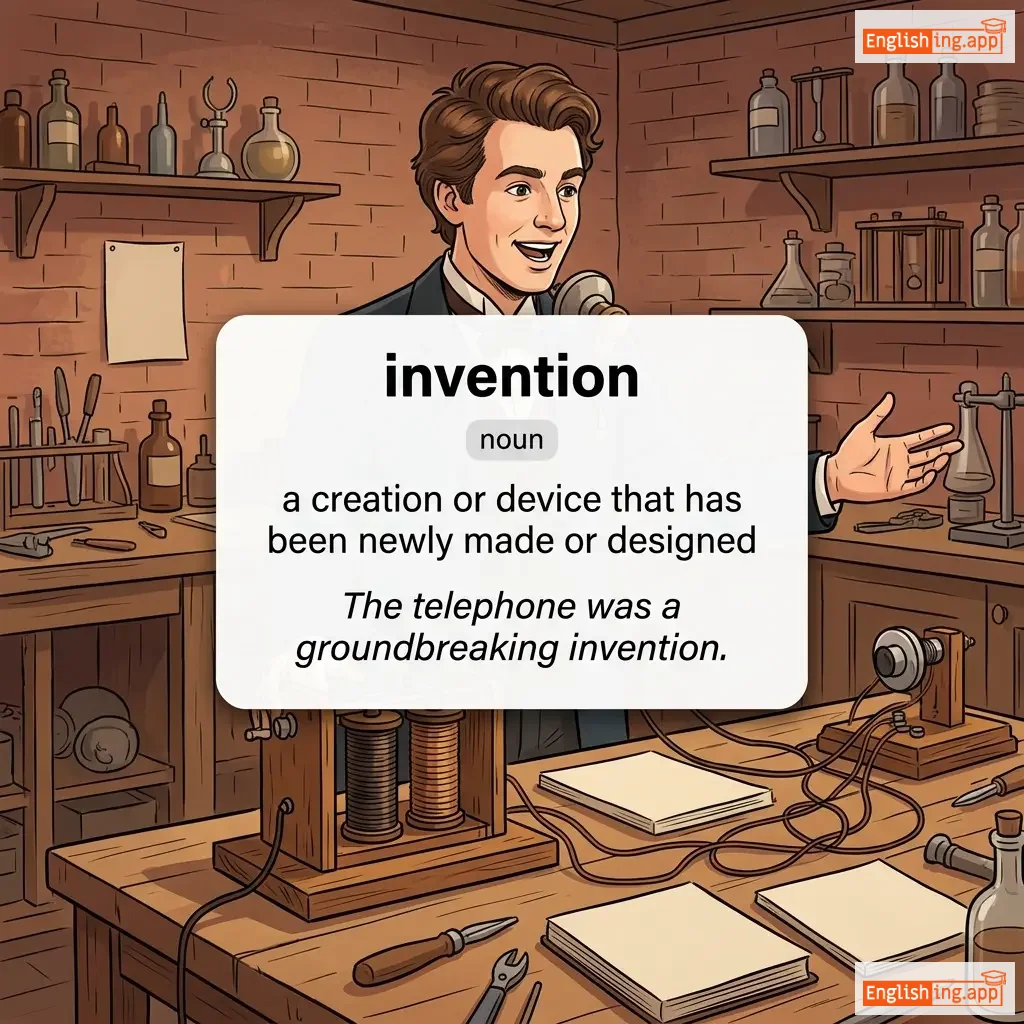
invention definition card — visual illustration of the meaning
noun
/ɪnˈvɛnʃən/
invención (invencion)

a creation or device that has been newly made or designed

"The telephone was a groundbreaking invention."

"El teléfono fue una invención revolucionaria." (El telefono fue una invencion revolucionaria.)
adjective
/ɪnˈvɛntɪv/
inventivo (inventivo)

Having the ability to create or design new things or to think originally.

"The inventor was known for his inventive solutions to everyday problems."

"El inventor era conocido por sus soluciones inventivas para los problemas cotidianos." (El inventor era conocido por sus soluciones inventivas para los problemas cotidianos.)
noun
/ɪnˈventər/
inventor (inventor)

a person who creates or designs something new, especially a device, method, or process

"The inventor patented her new medical device."

"El inventor patentó su nuevo dispositivo médico." (El inventor patento su nuevo dispositivo medico)
noun
/ˈɪnvənˌtɔːri/
inventario (inventario)

A complete list of items, such as goods in stock or property.

"The shopkeeper checked the inventory before opening the store."

"El tendero revisó el inventario antes de abrir la tienda." (El tendero revisó el inventario antes de abrir la tienda.)
adjective
/ˌɪnˈvɜːrs/
inverso (inverso)

Opposite in position, direction, order, or effect.

"There is an inverse relationship between price and demand."

"Hay una relación inversa entre el precio y la demanda." (Hay una relacion inversa entre el precio y la demanda.)
adverb
/ɪnˈvɜːrs.li/
inversamente; en sentido opuesto (inversamente; en sentido opuesto)

in a way that is opposite or contrary; in reverse order or manner

"The price of goods is inversely related to their availability in the market."

"El precio de los productos está inversamente relacionado con su disponibilidad en el mercado." (El precio de los productos está inversamente relacionado con su disponibilidad en el mercado.)
noun
/ɪnˈvɜːrʒən/
inversión (inversion)

A reversal of the normal order, position, or relationship.

"In poetry, inversion is often used to create emphasis."

"En poesía, la inversión se usa a menudo para crear énfasis." (En poesia, la inversion se usa a menudo para crear enfasis.)
verb
/ɪnˈvɜːrt/
invertir (invertir)

To turn something upside down or in the opposite position, order, or direction.

"He inverted the glass to let the water drain out."

"Él invirtió el vaso para dejar que el agua se drenara." (Él invirtió el vaso para dejar que el agua se drenara.)
invest definition card — visual illustration of the meaning
verb
/ɪnˈvɛst/
invertir (invertir)

to put money, time, or effort into something with the expectation of achieving a benefit

"He decided to invest in real estate to secure his future."

"Él decidió invertir en bienes raíces para asegurar su futuro." (El decidió invertir en bienes raíces para asegurar su futuro.)
verb
/ɪnˈvɛs.tɪ.ɡeɪt/
investigar (investigar)

to carry out a systematic inquiry to discover facts or information

"The police will investigate the incident thoroughly."

"La policía investigará el incidente a fondo." (La policia investigara el incidente a fondo.)
noun
/ɪnˌvɛs.tɪˈɡeɪ.ʃən/
investigación (investigacion)

the process of inquiring into or examining something carefully to find the truth

"The investigation revealed new evidence about the fraud."

"La investigación reveló nuevas pruebas sobre el fraude." (La investigacion revelo nuevas pruebas sobre el fraude.)
noun
/ɪnˈvɛstɪˌɡeɪtər/
felicidad (felicidad)

a person who carries out a formal inquiry or investigation

"The investigator gathered evidence from the crime scene."

"Ella no pudo ocultar su felicidad cuando recibió el premio." (Ella no pudo ocultar su felicidad cuando recibió el premio.)
investing definition card — visual illustration of the meaning
verb
ɪnˈvɛst.ɪŋ
invertir (invertir)

The act of putting money into financial schemes, shares, property, or a commercial venture with the expectation of achieving a profit.

"Investing in stocks can generate long-term wealth."

"Invertir en acciones puede generar riqueza a largo plazo." (Invertir en acciones puede generar riqueza a largo plazo.)
noun
/ɪnˈvɛstɪtʃər/
ceremonia de investidura (ceremonia de investidura)

the formal ceremony of conferring authority, rank, or office

"The king held an investiture ceremony for the new knight."

"El rey celebró una ceremonia de investidura para el nuevo caballero." (El rey celebro una ceremonia de investidura para el nuevo caballero.)
investment definition card — visual illustration of the meaning
noun
/ɪnˈvɛst.mənt/
inversión (inversion)

the action or process of putting money, time, or resources into something for future benefit

"Her investment in technology startups has paid off well."

"Su inversión en startups tecnológicas ha dado buenos resultados." (Su inversion en startups tecnologicas ha dado buenos resultados.)
noun
/ɪnˈvɛstər/
inversor (inversor)

a person or organization that puts money into financial schemes, property, or business ventures with the expectation of achieving a profit

"The investor funded the startup with a large sum of money."

"El inversor financió la startup con una gran suma de dinero." (El inversor financió la startup con una gran suma de dinero.)
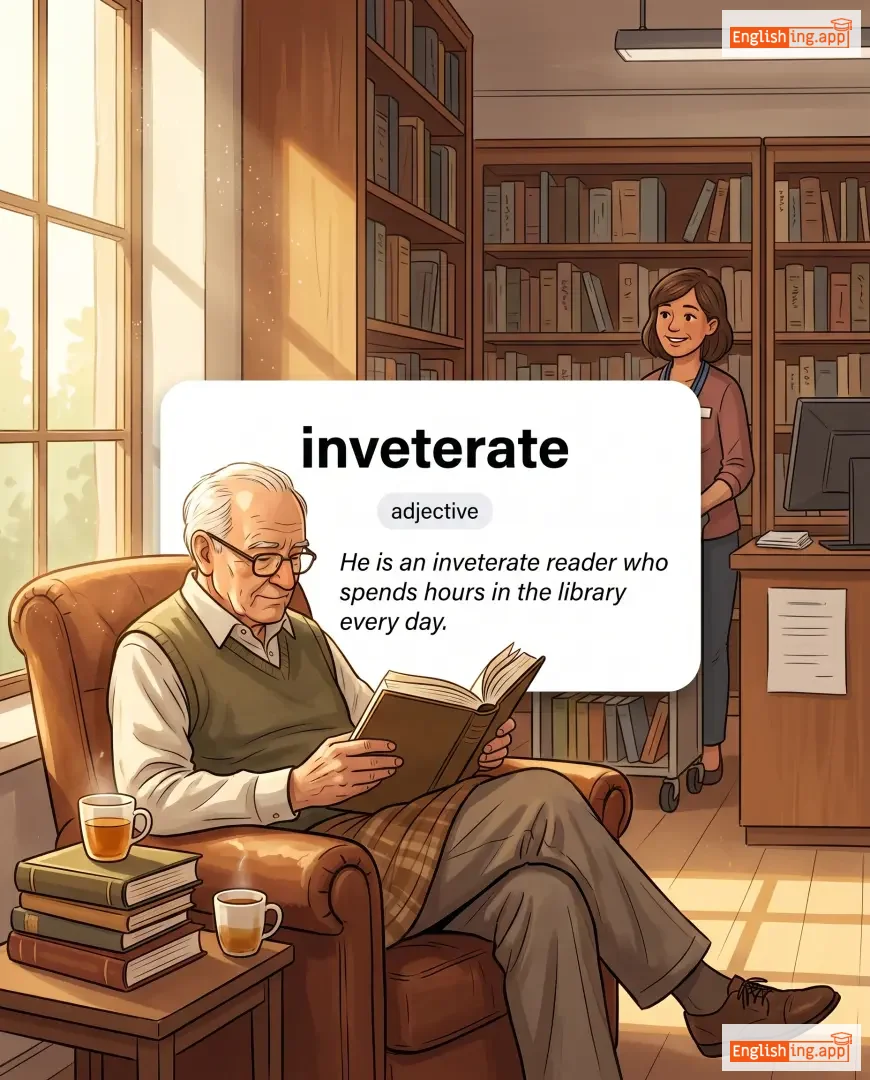
inveterate definition card — visual illustration of the meaning
adjective
/ɪnˈvɛtərət/
inmutable (inmutable)

having a long-established habit, activity, or interest that is unlikely to change

"He is an inveterate reader who spends hours in the library every day."

"Él es un lector inmutable que pasa horas en la biblioteca todos los días." (El es un lector inmutable que pasa horas en la biblioteca todos los dias.)
verb
/ɪmˈbruː/
manchar (manchar)

To stain, especially with blood.

"His hands were imbrued with blood after the battle."

"Sus manos estaban manchadas con sangre después de la batalla." (Sus manos estaban manchadas con sangre después de la batalla.)
Imbue definition card — visual illustration of the meaning
verb
/ɪmˈbjuː/
imbuir (imbuir)

to inspire or permeate with a feeling or quality

"The teacher's passion for history imbued the students with curiosity."

"La pasión del maestro por la historia imbuyó a los estudiantes con curiosidad." (La pasion del maestro por la historia imbuyo a los estudiantes con curiosidad.)
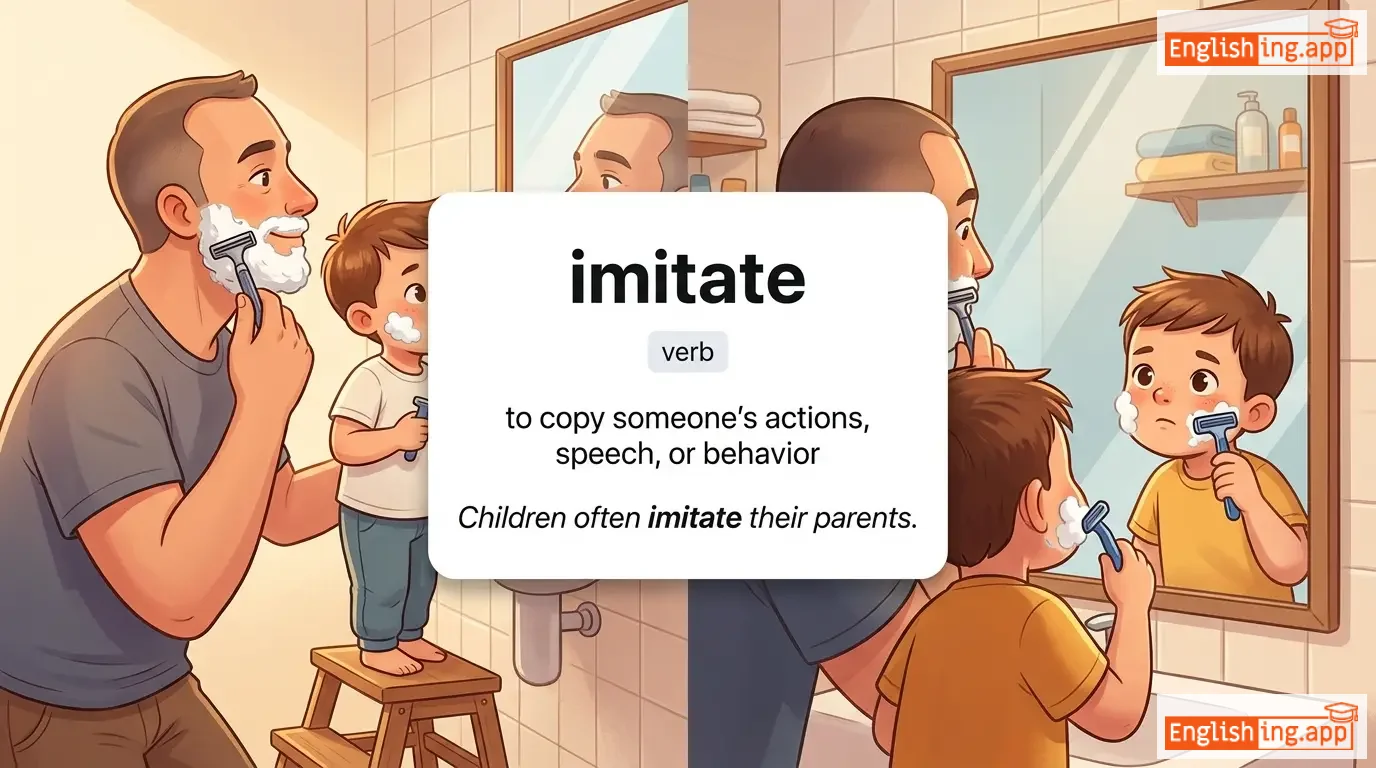
imitate definition card — visual illustration of the meaning
verb
/ˈɪmɪteɪt/
imitar (imitar)

to copy someone's actions, speech, or behavior

"Children often imitate their parents."

"Los niños a menudo imitan a sus padres." (Los niños a menudo imitan a sus padres.)
noun
/ˌɪmɪˈteɪʃən/
imitación (imitacion)

the act of copying or mimicking someone or something

"Children learn many skills through imitation."

"Los niños aprenden muchas habilidades a través de la imitación." (Los niños aprenden muchas habilidades a través de la imitación.)
noun
/ˈɪmɪˌteɪtər/
imitador (imitador)

a person who copies the behavior, style, or actions of others

"He became famous as an imitator of popular singers."

"Se hizo famoso como imitador de cantantes populares." (Se hizo famoso como imitador de cantantes populares.)
adjective
/ɪˈmækjələt/
inmaculado (inmaculado)

perfectly clean, neat, or free from flaws

"Her room was immaculate, with everything in its place."

"Su habitación estaba inmaculada, con todo en su lugar." (Su habitación estaba inmaculada, con todo en su lugar.)
adjective
/ˈɪmənənt/
inmanente (inmanente)

existing or operating within; inherent

"He believed that moral values are immanent in human nature."

"Él creía que los valores morales son inmanentes en la naturaleza humana." (El creía ke los valores morales son inmanentes en la naturaleza humana.)
adjective
/ˌɪməˈtɪəriəl/
inmaterial (inmaterial)

Not important or relevant; lacking physical substance.

"The judge ruled that the argument was immaterial to the case."

"El juez falló que el argumento no era relevante para el caso." (El juez fallo que el argumento no era relevante para el caso.)
adjective
/ˌɪməˈtjʊər/
inmaduro (inmaduro)

Not fully developed; childish or lacking maturity.

"His immature behavior annoyed everyone at the meeting."

"Su comportamiento inmaduro molestó a todos en la reunión." (Su comportamiento inmaduro molestó a todos en la reunión.)
noun
/ˌɪməˈtjʊərəti/
inmadurez (inmadurez)

the state of not being fully developed emotionally, mentally, or physically; lack of maturity

"His immaturity made it difficult for him to handle responsibility."

"Su inmadurez le dificultó manejar la responsabilidad." (su inmadurez le dificulto manejar la responsabilidad)
adjective
/ɪˈmɛʒərəbl/
inconmensurable (inconmensurable)

Too great or extreme to be measured.

"Her kindness brought him immeasurable happiness."

"Su bondad le dio una felicidad inconmensurable." (Su bondad le dio una felicidad inconmensurable.)
immediacy definition card — visual illustration of the meaning
noun
/ɪˈmiːdiəsi/
inmediación, urgencia (inmediacion, urgencia)

The quality of bringing one into direct and instant involvement with something, giving rise to a sense of urgency or excitement.

"The immediacy of digital communication has reshaped business operations."

"La inmediatez de la comunicación digital ha transformado las operaciones comerciales." (La inmediatez de la comunicacion digital ha transformado las operaciones comerciales.)
adjective
/ɪˈmiːdiət/
inmediato (inmediato)

happening or done without delay

"The doctor gave her immediate attention."

"El doctor le dio atención inmediata." (El doctor le dio atencion inmediata.)
adverb
/ɪˈmiːdiətli/
inmediatamente (inmediatamente)

at once; without delay

"She responded immediately to the emergency call."

"Ella respondió inmediatamente a la llamada de emergencia." (Ella respondió inmediatamente a la llamada de emergencia.)
adjective
/ˌɪməˈmɔːriəl/
inmemorial (inmemorial)

Extending back beyond memory or record; ancient.

"The tradition has been followed since time immemorial."

"La tradición ha sido seguida desde tiempos inmemoriales." (La tradicion ha sido seguida desde tiempos inmemoriales.)
adjective
/ɪˈmɛns/
inmenso (inmenso)

Extremely large or great in size, amount, or degree.

"The project required an immense amount of effort."

"El proyecto requirió una cantidad inmensa de esfuerzo." (El proyecto requirio una cantidad inmensa de esfuerzo.)
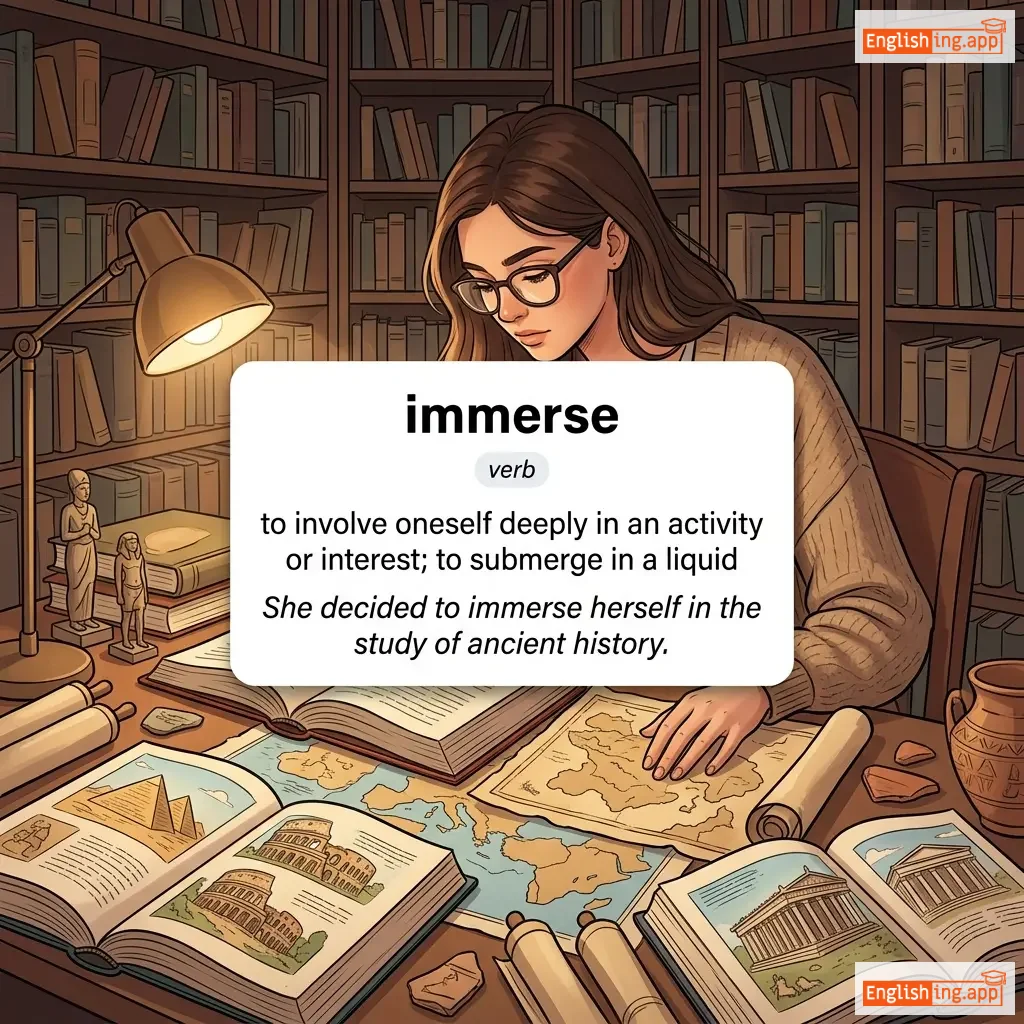
immerse definition card — visual illustration of the meaning
verb
/ɪˈmɜːrs/
sumergir, involucrarse profundamente (sumergir, involucrarse profundamente)

to involve oneself deeply in an activity or interest; to submerge in a liquid

"She decided to immerse herself in the study of ancient history."

"Ella decidió sumergirse en el estudio de la historia antigua." (Ella decidió sumergirse en el estudio de la historia antigua.)
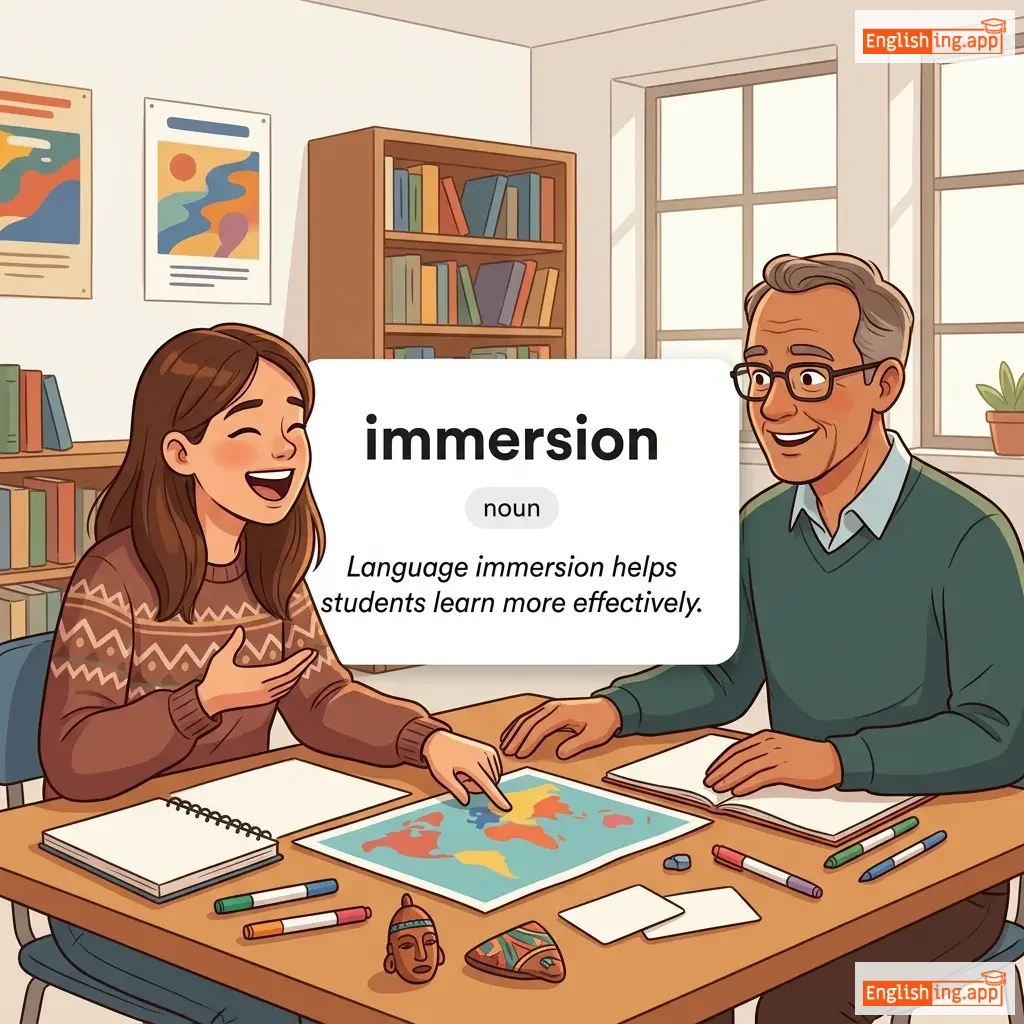
immersion definition card — visual illustration of the meaning
noun
/ɪˈmɜːrʒən/
inmersión (inmersion)

the act of deeply involving oneself in something; the state of being completely surrounded by liquid

"Language immersion helps students learn more effectively."

"La inmersión lingüística ayuda a los estudiantes a aprender de manera más efectiva." (La inmersión lingüística ayuda a los estudiantes a aprender de manera más efectiva.)
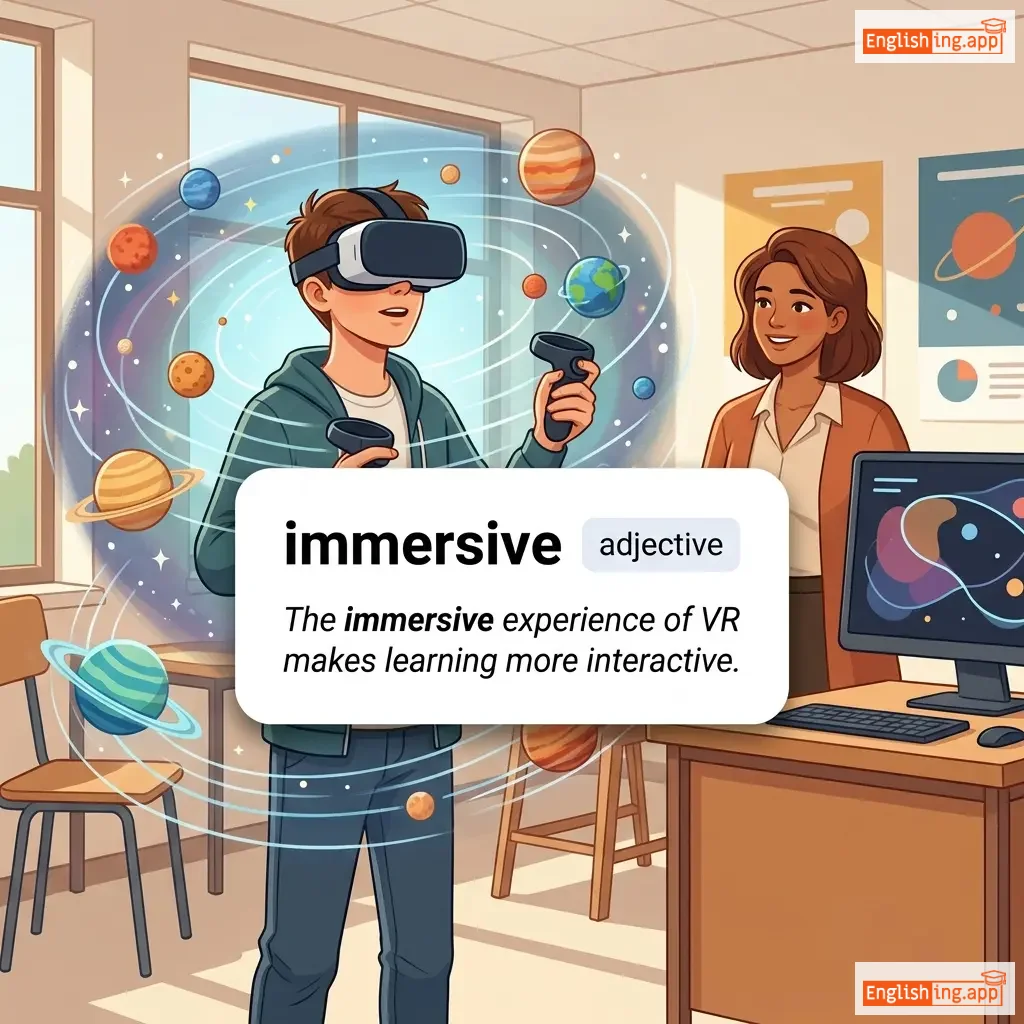
immersive definition card — visual illustration of the meaning
adjective
ɪˈmɜː.sɪv
inmersivo (inmersivo)

Providing, involving, or characterized by deep absorption or immersion in something.

"The immersive experience of VR makes learning more interactive."

"La experiencia inmersiva de la realidad virtual hace que el aprendizaje sea más interactivo." (La experiencia inmersiva de la realidad virtual hace que el aprendizaje sea más interactivo.)
noun
/ˈɪmɪɡrənt/
inmigrante (inmigrante)

a person who comes to live permanently in a foreign country

"The city has welcomed many new immigrants this year."

"La ciudad ha dado la bienvenida a muchos nuevos inmigrantes este año." (La ciudad ha dado la bienvenida a muchos nuevos inmigrantes este año.)
verb
/ˈɪmɪɡreɪt/
inmigrar (inmigrar)

to come to live permanently in a foreign country

"He immigrated to Canada five years ago."

"Él inmigró a Canadá hace cinco años." (Él inmigró a Canadá hace cinco años.)
noun
/ˌɪmɪˈɡreɪʃən/
inmigración (inmigracion)

the action of coming to live permanently in a foreign country

"Immigration policies vary from country to country."

"Las políticas de inmigración varían de un país a otro." (Las politicas de inmigracion varian de un pais a otro.)
noun
/ˈɪmɪnəns/
inminencia, estado de proximidad (inminencia, estado de proximidad)

the state of being about to happen

"The imminence of the storm forced people to take shelter."

"La inminencia de la tormenta obligó a la gente a buscar refugio." (La inminencia de la tormenta obligó a la gente a buscar refugio.)
adjective
/ˈɪmɪnənt/
inminente (inminente)

About to happen; likely to occur very soon.

"Dark clouds signaled that a storm was imminent."

"Las nubes oscuras señalaron que una tormenta era inminente." (Las nubes oscuras señalaron que una tormenta era inminente.)
adjective
/ɪˈmɪsəbl/
inmiscible (inmiscible)

Describes liquids that do not mix together.

"Oil and water are immiscible liquids."

"El aceite y el agua son líquidos inmiscibles." (El aceite y el agua son líquidos inmiscibles.)
adjective
/ɪˈmoʊbəl/
inmóvil (inmovil)

unable to move or be moved

"After the accident, he was immobile for weeks."

"Después del accidente, estuvo inmóvil durante semanas." (Despues del accidente, estuvo inmovil durante semanas.)
noun
/ˌɪməʊˈbɪləti/
inmovilidad (inmovilidad)

The state of being unable to move.

"After the accident, she suffered from immobility in her legs."

"Después del accidente, sufrió de inmovilidad en sus piernas." (Después del accidente, sufrió de inmovilidad en sus piernas.)
adjective
/ɪˈmɒdərət/
excesivo (excesivo)

excessive; beyond reasonable limits

"He has an immoderate love for sweets."

"Él tiene un amor excesivo por los dulces." (El tiene un amor excesivo por los dulces.)
adjective
/ɪˈmɒdɪst/
presuntuoso / indecente (presuntuoso / indecente)

lacking humility or decency; excessively proud or improper

"His immodest remarks offended the audience."

"Sus comentarios presuntuosos ofendieron a la audiencia." (Sus comentarios presuntuosos ofendieron a la audiencia.)
noun
/ɪˈmɒdəsti/
immodestia (immodestia)

lack of modesty or decency; behavior or attitude that is overly bold or improper

"The article was criticized for its tone of immodesty."

"El artículo fue criticado por su tono de immodestia." (El articulo fue criticado por su tono de immodestia)
verb
/ˈɪməleɪt/
inmolar (inmolar)

To kill or sacrifice, especially by burning.

"The protesters threatened to immolate themselves in front of the building."

"Los manifestantes amenazaron con inmolarse frente al edificio." (Los manifestantes amenazaron con inmolarse frente al edificio.)
adjective
/ɪˈmɒrəl/
inmoral (inmoral)

Not conforming to accepted standards of morality; unethical or wicked.

"He was fired for his immoral behavior."

"Lo despidieron por su comportamiento inmoral." (Lo despidieron por su comportamiento inmoral.)