वोकैबुलरीज

इंग्लिश वोकैबुलरी डिस्कवर, लर्न और मास्टर करें

verb
/ɪnˈvɛnt/
आविष्कार करना (avishkar karna)

to create or design something that has not existed before

"Thomas Edison invented the electric bulb."

"थॉमस एडीसन ने इलेक्ट्रिक बल्ब का आविष्कार किया।" (Thomas Edison ne electric bulb ka avishkar kiya.)
invention definition card — visual illustration of the meaning
noun
/ɪnˈvɛnʃən/
आविष्कार (aviskar)

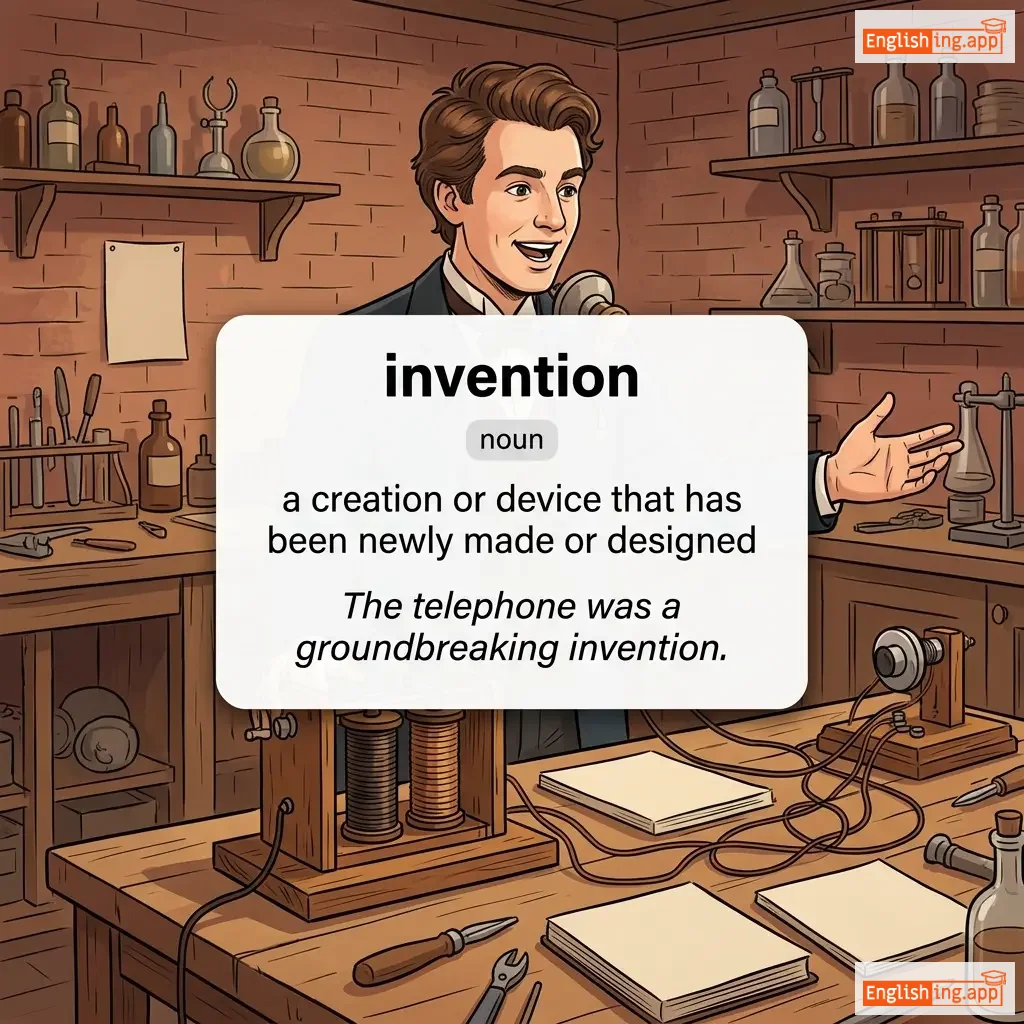
a creation or device that has been newly made or designed

"The telephone was a groundbreaking invention."

"टेलीफोन एक ग्राउंडब्रेकिंग आविष्कार था।" (Telephone ek groundbreaking aviskar tha.)
adjective
/ɪnˈvɛntɪv/
रचनात्मक (rachanatmak)

Having the ability to create or design new things or to think originally.

"The inventor was known for his inventive solutions to everyday problems."

"आविष्कारक को रोज़मर्रा की समस्याओं के लिए रचनात्मक समाधान के लिए जाना जाता था।" (Avishkark ko rozmarra ki samasyaon ke liye rachnatmak samadhan ke liye jana jata tha.)
noun
/ɪnˈventər/
आविष्कारक (avishkarak)

a person who creates or designs something new, especially a device, method, or process

"The inventor patented her new medical device."

"आविष्कारक ने अपने नए चिकित्सीय उपकरण का पेटेंट कराया।" (avishkarak ne apne naye chikitsiya upkaran ka patent karaya)
noun
/ˈɪnvənˌtɔːri/
सूची (soochi)

A complete list of items, such as goods in stock or property.

"The shopkeeper checked the inventory before opening the store."

"दुकानदार ने दुकान खोलने से पहले सूची की जांच की।" (Dukaandaar ne dukaan kholne se pehle soochi ki jaanch ki.)
adjective
/ˌɪnˈvɜːrs/
विपरीत (vipareet)

Opposite in position, direction, order, or effect.

"There is an inverse relationship between price and demand."

"मूल्य और मांग के बीच एक विपरीत संबंध है।" (Moolya aur maang ke beech ek vipareet sambandh hai.)
adverb
/ɪnˈvɜːrs.li/
विपरीत रूप से; उल्टे तरीके से (vipreet roop se; ulte tareeke se)

in a way that is opposite or contrary; in reverse order or manner

"The price of goods is inversely related to their availability in the market."

"वस्तुओं की कीमत उनकी उपलब्धता से विपरीत रूप से संबंधित है।" (vastuon ki keemat unki uplabdhata se vipreet roop se sambandhit hai.)
noun
/ɪnˈvɜːrʒən/
उलटफेर (ulatfer)

A reversal of the normal order, position, or relationship.

"In poetry, inversion is often used to create emphasis."

"कविता में, उलटफेर का उपयोग अक्सर जोर देने के लिए किया जाता है।" (Kavita mein, ulatfer ka upyog aksar zor dene ke liye kiya jata hai.)
verb
/ɪnˈvɜːrt/
उलटना (ultana)

To turn something upside down or in the opposite position, order, or direction.

"He inverted the glass to let the water drain out."

"उसने पानी बाहर निकलने के लिए गिलास को उलट दिया।" (Usne pani bahar nikalne ke liye gilas ko ulat diya.)
invest definition card — visual illustration of the meaning
verb
/ɪnˈvɛst/
निवेश करना (nivesh karna)

to put money, time, or effort into something with the expectation of achieving a benefit

"He decided to invest in real estate to secure his future."

"उसने अपने भविष्य को सुरक्षित करने के लिए रियल एस्टेट में निवेश करने का निर्णय लिया।" (Usne apne bhavishya ko surakshit karne ke liye real estate mein nivesh karne ka nirnay liya.)
verb
/ɪnˈvɛs.tɪ.ɡeɪt/
जांचना (janchna)

to carry out a systematic inquiry to discover facts or information

"The police will investigate the incident thoroughly."

"पुलिस घटना की पूरी तरह से जांच करेगी।" (Police ghatna ki poori tarah se janch karegi.)
noun
/ɪnˌvɛs.tɪˈɡeɪ.ʃən/
जांच (janch)

the process of inquiring into or examining something carefully to find the truth

"The investigation revealed new evidence about the fraud."

"जांच में धोखाधड़ी के बारे में नया प्रमाण सामने आया।" (Janch mein dhokhadhadi ke baare mein naya pramaan saamne aaya.)
noun
/ɪnˈvɛstɪˌɡeɪtər/
खुशी (khushi)

a person who carries out a formal inquiry or investigation

"The investigator gathered evidence from the crime scene."

"उसने जब पुरस्कार प्राप्त किया तो वह अपनी खुशी छुपा नहीं पाई।" (Usne jab puraskar prapt kiya to vah apni khushi chhupa nahin pai.)
investing definition card — visual illustration of the meaning
verb
ɪnˈvɛst.ɪŋ
निवेश (nivesh)

The act of putting money into financial schemes, shares, property, or a commercial venture with the expectation of achieving a profit.

"Investing in stocks can generate long-term wealth."

"शेयरों में निवेश लंबी अवधि की संपत्ति उत्पन्न कर सकता है।" (Sheeron mein nivesh lambi avadhi ki sampatti utpann kar sakta hai.)
noun
/ɪnˈvɛstɪtʃər/
पदवी प्रदान समारोह (padvi pradan samaroha)

the formal ceremony of conferring authority, rank, or office

"The king held an investiture ceremony for the new knight."

"राजा ने नए नाइट के लिए पदवी प्रदान समारोह आयोजित किया।" (raja ne naye knight ke liye padvi pradan samaroha aayojit kiya.)
investment definition card — visual illustration of the meaning
noun
/ɪnˈvɛst.mənt/
निवेश (nivesh)

the action or process of putting money, time, or resources into something for future benefit

"Her investment in technology startups has paid off well."

"उसने प्रौद्योगिकी स्टार्टअप्स में निवेश किया है और यह अच्छा परिणाम दे रहा है।" (Usne praudyogiki startup mein nivesh kiya hai aur yah accha parinaam de raha hai.)
noun
/ɪnˈvɛstər/
निवेशक (niveshak)

a person or organization that puts money into financial schemes, property, or business ventures with the expectation of achieving a profit

"The investor funded the startup with a large sum of money."

"निवेशक ने स्टार्टअप को एक बड़ी रकम से फंड किया।" (niveshak ne startup ko ek badi rakam se fund kiya.)
inveterate definition card — visual illustration of the meaning
adjective
/ɪnˈvɛtərət/
जड़वादी (jadvadi)

having a long-established habit, activity, or interest that is unlikely to change

"He is an inveterate reader who spends hours in the library every day."

"वह एक जड़वादी पाठक है जो हर दिन घंटों पुस्तकालय में बिताता है।" (vah ek jadvadi pathak hai jo har din ghanton pustakalay mein bitata hai)
verb
/ɪmˈbruː/
रंजित करना (ranjit karna)

To stain, especially with blood.

"His hands were imbrued with blood after the battle."

"युद्ध के बाद उसके हाथ खून से रंजित थे।" (Yudh ke baad uske haath khoon se ranjit the.)
Imbue definition card — visual illustration of the meaning
verb
/ɪmˈbjuː/
प्रेरित करना (prerit karna)

to inspire or permeate with a feeling or quality

"The teacher's passion for history imbued the students with curiosity."

"शिक्षक का इतिहास के प्रति जुनून छात्रों को जिज्ञासा से भर देता था।" (Shikshak ka itihaas ke prati junoon chhatron ko jigyasa se bhar deta tha.)
imitate definition card — visual illustration of the meaning
verb
/ˈɪmɪteɪt/
अनुकरण करना (anukaran karna)

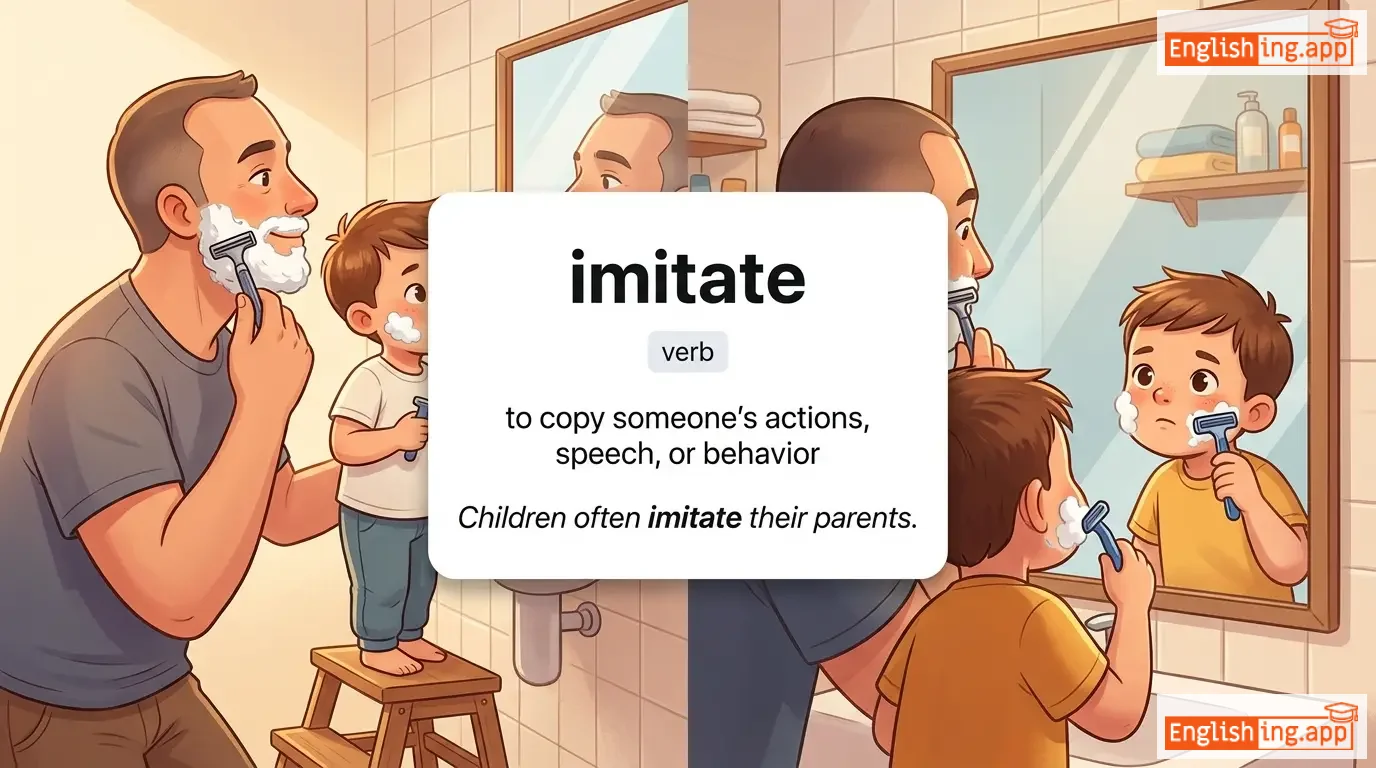
to copy someone's actions, speech, or behavior

"Children often imitate their parents."

"बच्चे अक्सर अपने माता-पिता की नकल करते हैं।" (Bacche aksar apne mata-pita ki nakal karte hain.)
noun
/ˌɪmɪˈteɪʃən/
अनुकरण (anukaran)

the act of copying or mimicking someone or something

"Children learn many skills through imitation."

"बच्चे अनुकरण के माध्यम से कई कौशल सीखते हैं।" (Bacche anukaran ke madhyam se kai kaushal seekhte hain.)
noun
/ˈɪmɪˌteɪtər/
अनुकरणकर्ता (anukaranakarta)

a person who copies the behavior, style, or actions of others

"He became famous as an imitator of popular singers."

"वह एक लोकप्रिय गायक की नकल करने के कारण प्रसिद्ध हो गया।" (vah ek lokpriya gayak ki nakal karne ke kaaran prasiddh ho gaya.)
adjective
/ɪˈmækjələt/
निर्मल (nirmal)

perfectly clean, neat, or free from flaws

"Her room was immaculate, with everything in its place."

"उसका कमरा निर्मल था, सब कुछ अपनी जगह पर था।" (Uska kamra nirmal tha, sab kuch apni jagah par tha.)
adjective
/ˈɪmənənt/
अंतर्निहित (antarnihit)

existing or operating within; inherent

"He believed that moral values are immanent in human nature."

"वह विश्वास करते थे कि नैतिक मूल्य मानव स्वभाव में अंतर्निहित हैं।" (Vah vishwas karte the ki naitik moolya manav swabhav mein antarnihit hain.)
adjective
/ˌɪməˈtɪəriəl/
अप्रासंगिक (aprasangik)

Not important or relevant; lacking physical substance.

"The judge ruled that the argument was immaterial to the case."

"न्यायाधीश ने फैसला सुनाया कि तर्क मामले से अप्रासंगिक था।" (Nyayadhish ne faisla sunaya ki tark mamle se aprasangik tha.)
adjective
/ˌɪməˈtjʊər/
अपरिपक्व (aparikpva)

Not fully developed; childish or lacking maturity.

"His immature behavior annoyed everyone at the meeting."

"उसका अपरिपक्व व्यवहार बैठक में सभी को परेशान कर रहा था।" (Uska aparikva vyavhaar baithak mein sabhi ko pareshan kar raha tha.)
noun
/ˌɪməˈtjʊərəti/
अपरिपक्वता (aparipakvata)

the state of not being fully developed emotionally, mentally, or physically; lack of maturity

"His immaturity made it difficult for him to handle responsibility."

"उसकी अपरिपक्वता ने जिम्मेदारी संभालना कठिन बना दिया।" (uski aparipakvata ne jimmedari sambhalna kathin bana diya)
adjective
/ɪˈmɛʒərəbl/
अपरिमेय (aparmeey)

Too great or extreme to be measured.

"Her kindness brought him immeasurable happiness."

"उसकी दयालुता ने उसे अपरिमेय खुशी दी।" (Uski dayaluta ne use aparimey khushi di.)
immediacy definition card — visual illustration of the meaning
noun
/ɪˈmiːdiəsi/
तत्कालिता, तात्कालिकता (tatkalita, tatkalikta)

The quality of bringing one into direct and instant involvement with something, giving rise to a sense of urgency or excitement.

"The immediacy of digital communication has reshaped business operations."

"डिजिटल संचार की तत्कालिता ने व्यापार संचालन को फिर से आकार दिया है।" (Digital sanchar ki tatkalita ne vyapar sancharan ko phir se aakaar diya hai.)
adjective
/ɪˈmiːdiət/
तत्काल (tatkaal)

happening or done without delay

"The doctor gave her immediate attention."

"डॉक्टर ने उसे तत्काल ध्यान दिया।" (Doktar ne use tatkaal dhyan diya.)
adverb
/ɪˈmiːdiətli/
तुरंत (turant)

at once; without delay

"She responded immediately to the emergency call."

"उसने आपातकालीन कॉल का तुरंत उत्तर दिया।" (Usne aapatkaaleen kol ka turant uttar diya.)
adjective
/ˌɪməˈmɔːriəl/
प्राचीनकालीन (prachinkaleen)

Extending back beyond memory or record; ancient.

"The tradition has been followed since time immemorial."

"परंपरा समय के प्राचीन काल से अनुसरण की जाती है।" (Parampara samay ke prachin kaal se anusarhan ki jaati hai.)
adjective
/ɪˈmɛns/
विशाल (vishal)

Extremely large or great in size, amount, or degree.

"The project required an immense amount of effort."

"प्रोजेक्ट को पूरा करने के लिए बहुत अधिक प्रयास की आवश्यकता थी।" (Project ko poora karne ke liye bahut adhik prayaas ki aavashyakta thi.)
immerse definition card — visual illustration of the meaning
verb
/ɪˈmɜːrs/
डुबोना, गहरे रूप से डूब जाना (dubona, gahre roop se doob jana)

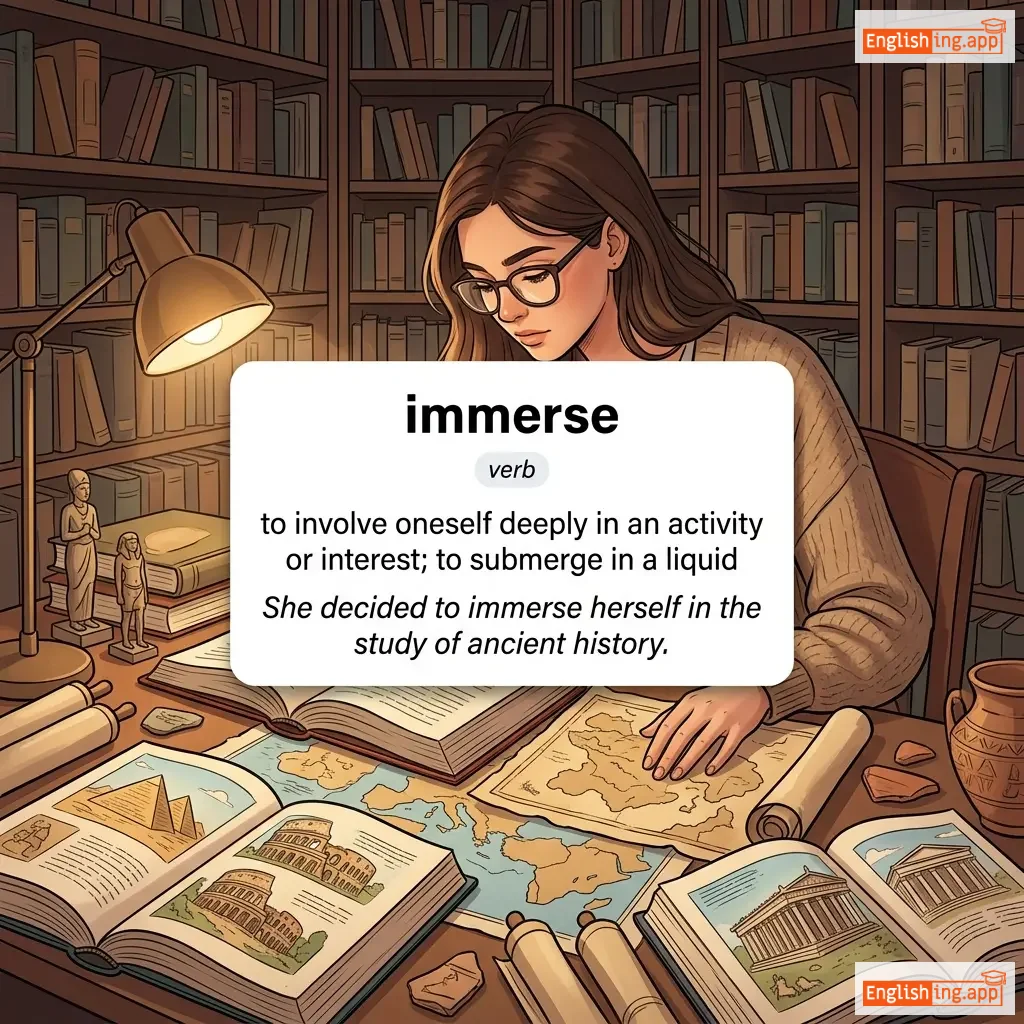
to involve oneself deeply in an activity or interest; to submerge in a liquid

"She decided to immerse herself in the study of ancient history."

"उसने प्राचीन इतिहास के अध्ययन में खुद को डुबोने का निर्णय लिया।" (Usne prachin itihas ke adhyayan mein khud ko dubone ka nirnay liya.)
immersion definition card — visual illustration of the meaning
noun
/ɪˈmɜːrʒən/
इमर्शन (immersion)

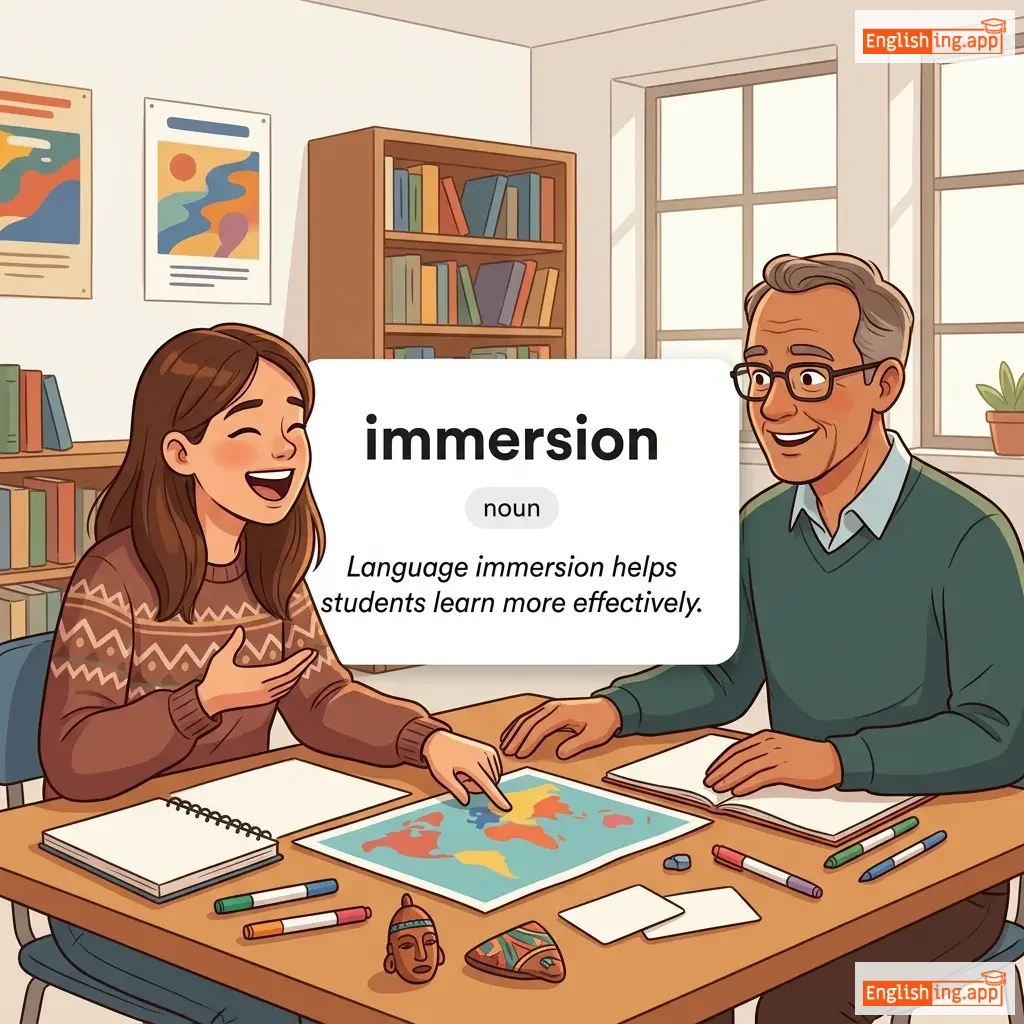
the act of deeply involving oneself in something; the state of being completely surrounded by liquid

"Language immersion helps students learn more effectively."

"भाषा इमर्शन छात्रों को अधिक प्रभावी तरीके से सीखने में मदद करता है।" (Bhasha immersion chhatron ko adhik prabhavi tareeke se seekhne mein madad karta hai.)
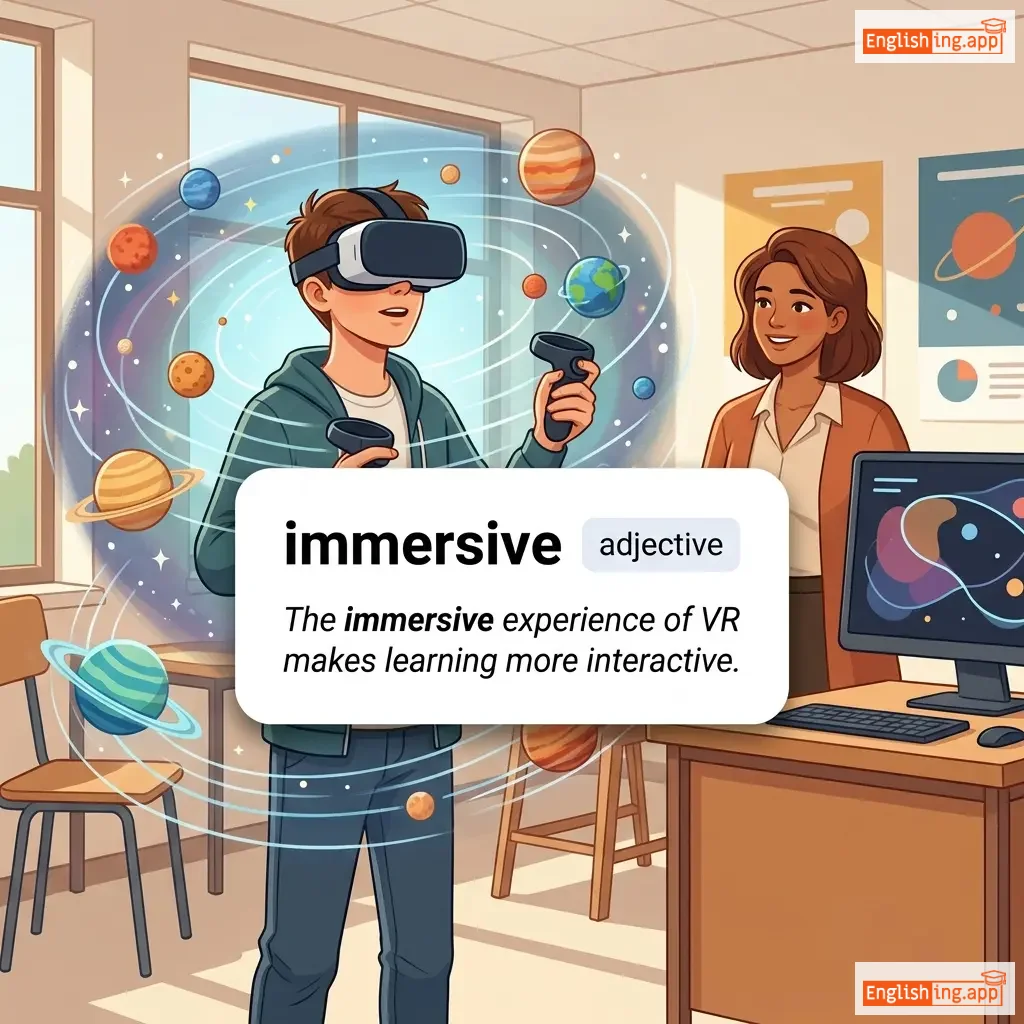
immersive definition card — visual illustration of the meaning
adjective
ɪˈmɜː.sɪv
इमर्सिव (immersive)

Providing, involving, or characterized by deep absorption or immersion in something.

"The immersive experience of VR makes learning more interactive."

"वीआर का इमर्सिव अनुभव सीखने को अधिक इंटरएक्टिव बनाता है।" (VR ka immersive anubhav seekhne ko adhik interactive banata hai)
noun
/ˈɪmɪɡrənt/
प्रवासी (pravasi)

a person who comes to live permanently in a foreign country

"The city has welcomed many new immigrants this year."

"इस वर्ष शहर ने कई नए प्रवासियों का स्वागत किया।" (Is varsh shahar ne kai naye pravasion ka swagat kiya.)
verb
/ˈɪmɪɡreɪt/
आव्रजन करना (aavragan karna)

to come to live permanently in a foreign country

"He immigrated to Canada five years ago."

"वह पांच साल पहले कनाडा में आव्रजन करने के लिए गया था।" (Vah paanch saal pehle Kanada mein aavragan karne ke liye gaya tha.)
noun
/ˌɪmɪˈɡreɪʃən/
आव्रजन (aavran)

the action of coming to live permanently in a foreign country

"Immigration policies vary from country to country."

"आव्रजन नीतियाँ देश दर देश अलग-अलग होती हैं।" (Aavran neetiyan desh dar desh alag-alag hoti hain.)
noun
/ˈɪmɪnəns/
आसन्नता, निकटवर्ती स्थिति (asannata, nikatvarti sthiti)

the state of being about to happen

"The imminence of the storm forced people to take shelter."

"तूफान की आसन्नता ने लोगों को शरण लेने के लिए मजबूर कर दिया।" (toofan ki asannata ne logon ko sharan lene ke liye majboor kar diya.)
adjective
/ˈɪmɪnənt/
निकटस्थ (nikatsth)

About to happen; likely to occur very soon.

"Dark clouds signaled that a storm was imminent."

"अंधेरे बादल संकेत दे रहे थे कि एक तूफान निकटस्थ था।" (Andhere badal sanket de rahe the ki ek toofan nikatsth tha.)
adjective
/ɪˈmɪsəbl/
अविभाज्य (avibhajy)

Describes liquids that do not mix together.

"Oil and water are immiscible liquids."

"तेल और पानी अविभाज्य तरल पदार्थ हैं।" (Tel aur paani avibhajy taral padarth hain.)
adjective
/ɪˈmoʊbəl/
अचल (achal)

unable to move or be moved

"After the accident, he was immobile for weeks."

"दुर्घटना के बाद, वह हफ्तों तक अचल था।" (Durghatna ke baad, vah hafton tak achal tha.)
noun
/ˌɪməʊˈbɪləti/
अचलता (achalata)

The state of being unable to move.

"After the accident, she suffered from immobility in her legs."

"दुर्घटना के बाद, उसे अपने पैरों में अचलता का सामना करना पड़ा।" (Durghatna ke baad, use apne pairon mein achalta ka samna karna pada.)
adjective
/ɪˈmɒdərət/
अत्यधिक (atyadhik)

excessive; beyond reasonable limits

"He has an immoderate love for sweets."

"उसकी मिठाइयों के प्रति अत्यधिक प्यार है।" (Uski mithaiyon ke prati atyadhik pyaar hai.)
adjective
/ɪˈmɒdɪst/
अक्खड़ / अशालीन (akkhad / ashaleen)

lacking humility or decency; excessively proud or improper

"His immodest remarks offended the audience."

"उसकी अक्खड़ टिप्पणी ने दर्शकों को आहत किया।" (Uski akkhad tipanni ne darshako ko aahat kiya.)
noun
/ɪˈmɒdəsti/
अशालीनता (ashalinata)

lack of modesty or decency; behavior or attitude that is overly bold or improper

"The article was criticized for its tone of immodesty."

"लेख की अशालीनता के स्वर के लिए आलोचना की गई।" (lekh ki ashalinata ke swar ke liye aalochna ki gai)
verb
/ˈɪməleɪt/
बलिदान/आग में जलाना (balidan/aag mein jalana)

To kill or sacrifice, especially by burning.

"The protesters threatened to immolate themselves in front of the building."

"प्रदर्शनकारियों ने बिल्डिंग के सामने खुद को आग में जलाने की धमकी दी थी।" (Pradarshankariyon ne building ke samne khud ko aag mein jalane ki dhamki di thi.)
adjective
/ɪˈmɒrəl/
अनीतिक (anetik)

Not conforming to accepted standards of morality; unethical or wicked.

"He was fired for his immoral behavior."

"उसे उसके अनीतिक व्यवहार के कारण निकाल दिया गया।" (Use uske anetik vyavhaar ke kaaran nikaal diya gaya.)