词汇表

英语词汇词典 | 单词含义、定义和示例

verb
/ɪnˈvɛnt/
发明 (faming)

to create or design something that has not existed before

"Thomas Edison invented the electric bulb."

"托马斯·爱迪生发明了电灯泡。" (Tuo ma si · ai di sheng fa ming le dian deng pao.)
invention definition card — visual illustration of the meaning
noun
/ɪnˈvɛnʃən/
发明 (fāmíng)

a creation or device that has been newly made or designed

"The telephone was a groundbreaking invention."

"电话是一次革命性的发明。" (Diànhuà shì yīcì gémìngxìng de fāmíng.)
adjective
/ɪnˈvɛntɪv/
富有创意的 (fù yǒu chuàng yì de)

Having the ability to create or design new things or to think originally.

"The inventor was known for his inventive solutions to everyday problems."

"发明家以其富有创意的解决方案而闻名。" (Fāmíng jiā yǐ qí fù yǒu chuàng yì de jiě jué fāng àn ér wén míng.)
noun
/ɪnˈventər/
发明家 (famingjia)

a person who creates or designs something new, especially a device, method, or process

"The inventor patented her new medical device."

"这位发明家为她的新医疗设备申请了专利。" (Zhe wei famingjia wei ta de xin yiliao shebei shenqing le zhuanli)
noun
/ˈɪnvənˌtɔːri/
清单 (qingdan)

A complete list of items, such as goods in stock or property.

"The shopkeeper checked the inventory before opening the store."

"店主在开店前检查了清单。" (Dianzhu zai kaidian qian jiancha le qingdan.)
adjective
/ˌɪnˈvɜːrs/
反向 (fanxiang)

Opposite in position, direction, order, or effect.

"There is an inverse relationship between price and demand."

"价格和需求之间存在反向关系。" (Jiage he xuqiu zhijian cunzai fanxiang guanxi.)
adverb
/ɪnˈvɜːrs.li/
反向地; 相反地 (fǎnxiàng de; xiāngfǎn de)

in a way that is opposite or contrary; in reverse order or manner

"The price of goods is inversely related to their availability in the market."

"商品的价格与其在市场上的可得性成反比。" (shāngpǐn de jiàgé yǔ qí zài shìchǎng shàng de kědéxìng chéng fǎnbǐ.)
noun
/ɪnˈvɜːrʒən/
倒置 (daozhi)

A reversal of the normal order, position, or relationship.

"In poetry, inversion is often used to create emphasis."

"在诗歌中,倒置常用来创造强调。" (Zài shīgē zhōng, dào zhì cháng yòng lái chuàng zào qiángdiào.)
verb
/ɪnˈvɜːrt/
翻转 (fanzhuan)

To turn something upside down or in the opposite position, order, or direction.

"He inverted the glass to let the water drain out."

"他翻转了玻璃杯,让水流出来。" (Ta fanzhuan le bolibei, rang shui liu chulai.)
invest definition card — visual illustration of the meaning
verb
/ɪnˈvɛst/
投资 (tóu zī)

to put money, time, or effort into something with the expectation of achieving a benefit

"He decided to invest in real estate to secure his future."

"他决定投资房地产,以确保他的未来。" (Tā juédìng tóu zī fáng dì chǎn, yǐ què bǎo tā de wèi lái.)
verb
/ɪnˈvɛs.tɪ.ɡeɪt/
调查 (diàochá)

to carry out a systematic inquiry to discover facts or information

"The police will investigate the incident thoroughly."

"警方将彻底调查此事件。" (jǐngfāng jiāng chèdǐ diàochá cǐ shìjiàn.)
noun
/ɪnˌvɛs.tɪˈɡeɪ.ʃən/
调查 (diaocha)

the process of inquiring into or examining something carefully to find the truth

"The investigation revealed new evidence about the fraud."

"调查揭示了有关欺诈的新证据。" (Diaocha jieshi le youguan qizha de xin zhengju.)
noun
/ɪnˈvɛstɪˌɡeɪtər/
幸福 (xìngfú)

a person who carries out a formal inquiry or investigation

"The investigator gathered evidence from the crime scene."

"当她获得奖项时,她无法掩饰自己的幸福。" (Dāng tā huò dé jiǎngxiàng shí, tā wúfǎ yǎnshì zìjǐ de xìngfú.)
investing definition card — visual illustration of the meaning
verb
ɪnˈvɛst.ɪŋ
投资 (tóu zī)

The act of putting money into financial schemes, shares, property, or a commercial venture with the expectation of achieving a profit.

"Investing in stocks can generate long-term wealth."

"投资股票可以产生长期财富。" (Tóu zī gǔ piào kě yǐ chǎn shēng cháng qī cáifù.)
noun
/ɪnˈvɛstɪtʃər/
授职仪式 (shòu zhí yí shì)

the formal ceremony of conferring authority, rank, or office

"The king held an investiture ceremony for the new knight."

"国王为新骑士举行了授职仪式。" (guówáng wèi xīn qíshì jǔxíngle shòu zhí yí shì)
investment definition card — visual illustration of the meaning
noun
/ɪnˈvɛst.mənt/
投资 (tóu zī)

the action or process of putting money, time, or resources into something for future benefit

"Her investment in technology startups has paid off well."

"她对科技创业公司的投资获得了不错的回报。" (Tā duì kējì chuàngyè gōngsī de tóuzī huòqǔle bùcuò de huíbào.)
noun
/ɪnˈvɛstər/
投资者 (tóu zī zhě)

a person or organization that puts money into financial schemes, property, or business ventures with the expectation of achieving a profit

"The investor funded the startup with a large sum of money."

"投资者用一大笔钱资助了这家初创公司。" (Tóu zī zhě yòng yī dà bǐ qián zīzhù le zhè jiā chūchuàng gōngsī.)
inveterate definition card — visual illustration of the meaning
adjective
/ɪnˈvɛtərət/
根深蒂固 (gēn shēn dì gù)

having a long-established habit, activity, or interest that is unlikely to change

"He is an inveterate reader who spends hours in the library every day."

"他是一个根深蒂固的读者,每天在图书馆度过几个小时。" (Tā shì yīgè gēn shēn dì gù de dúzhě, měitiān zài túshūguǎn dùguò jǐ gè xiǎoshí.)
verb
/ɪmˈbruː/
玷污 (dian wu)

To stain, especially with blood.

"His hands were imbrued with blood after the battle."

"他的手在战斗后被血染。" (Tā de shǒu zài zhàndòu hòu bèi xuè rǎn.)
Imbue definition card — visual illustration of the meaning
verb
/ɪmˈbjuː/
浸透 (jìntòu)

to inspire or permeate with a feeling or quality

"The teacher's passion for history imbued the students with curiosity."
"老师对历史的热情使学生充满了好奇心。" (Lǎoshī duì lìshǐ de rèqíng shǐ xuéshēng chōngmǎnle hàoqí xīn.)
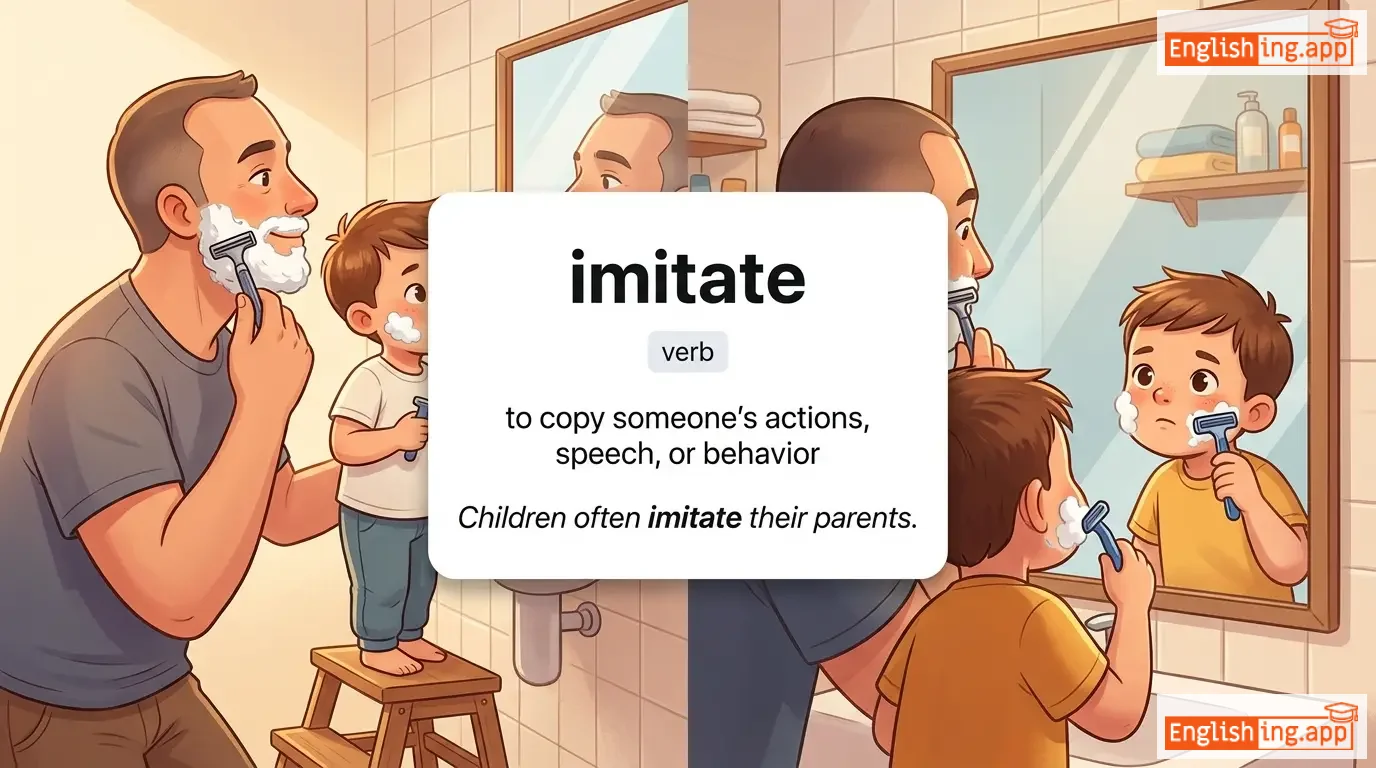
imitate definition card — visual illustration of the meaning
verb
/ˈɪmɪteɪt/
模仿 (mófǎng)

to copy someone's actions, speech, or behavior

"Children often imitate their parents."

"孩子们经常模仿他们的父母。" (Háizimen jīngcháng mófǎng tāmen de fùmǔ.)
noun
/ˌɪmɪˈteɪʃən/
模仿 (mófǎng)

the act of copying or mimicking someone or something

"Children learn many skills through imitation."

"孩子们通过模仿学习了许多技能。" (Háizimen tōngguò mófǎng xuéxíle xǔduō jìnéng.)
noun
/ˈɪmɪˌteɪtər/
模仿者 (mófǎng zhě)

a person who copies the behavior, style, or actions of others

"He became famous as an imitator of popular singers."

"他因模仿流行歌手而出名。" (Tā yīn mófǎng liúxíng gēshǒu ér chūmíng.)
adjective
/ɪˈmækjələt/
完美无瑕 (wanmei wuxia)

perfectly clean, neat, or free from flaws

"Her room was immaculate, with everything in its place."

"她的房间完美无瑕,一切都井井有条。" (Tā de fángjiān wánměi wúxiá, yīqiè dōu jǐngjǐng yǒutiáo.)
adjective
/ˈɪmənənt/
内在的 (neizai de)

existing or operating within; inherent

"He believed that moral values are immanent in human nature."

"他相信道德价值在人的本性中是内在的。" (Ta xiangxin daode jiazhi zai ren de benxing zhong shi neizai de.)
adjective
/ˌɪməˈtɪəriəl/
无关紧要 (wuguan jinyao)

Not important or relevant; lacking physical substance.

"The judge ruled that the argument was immaterial to the case."

"法官裁定,该论点与案件无关。" (Faguancaiding, gai lundian yu anjian wuguan.)
adjective
/ˌɪməˈtjʊər/
不成熟 (bù chéngshú)

Not fully developed; childish or lacking maturity.

"His immature behavior annoyed everyone at the meeting."

"他的不成熟行为在会议上让大家烦扰。" (Tā de bù chéngshú xíngwéi zài huìyì shàng ràng dàjiā fánrǎo.)
noun
/ˌɪməˈtjʊərəti/
不成熟 (bu chengshu)

the state of not being fully developed emotionally, mentally, or physically; lack of maturity

"His immaturity made it difficult for him to handle responsibility."

"他的不成熟让他难以承担责任。" (ta de bu chengshu rang ta nanyi chengdan zeren)
adjective
/ɪˈmɛʒərəbl/
无法衡量 (wúfǎ héngliàng)

Too great or extreme to be measured.

"Her kindness brought him immeasurable happiness."

"她的善良给了他无法衡量的幸福。" (Tā de shànliáng gěi le tā wúfǎ héngliàng de xìngfú.)
immediacy definition card — visual illustration of the meaning
noun
/ɪˈmiːdiəsi/
即时性, 紧迫感 (jishi xing, jinpo gan)

The quality of bringing one into direct and instant involvement with something, giving rise to a sense of urgency or excitement.

"The immediacy of digital communication has reshaped business operations."

"数字通信的即时性已经改变了商业操作。" (Shuzi tongxin de jishixing yijing gaibianle shangye caozuo.)
adjective
/ɪˈmiːdiət/
即时 (jíshí)

happening or done without delay

"The doctor gave her immediate attention."

"医生给了她即时的关注。" (Yīshēng gěile tā jíshí de guānzhù.)
adverb
/ɪˈmiːdiətli/
立即 (lìjí)

at once; without delay

"She responded immediately to the emergency call."

"她立即响应了紧急电话。" (Tā lìjí xiǎngyìngle jǐnjí diànhuà.)
adjective
/ˌɪməˈmɔːriəl/
古老的 (gǔlǎo de)

Extending back beyond memory or record; ancient.

"The tradition has been followed since time immemorial."

"这个传统自古以来就被遵循。" (Zhège chuántǒng zì gǔ yǐlái jiù bèi zūnxún.)
adjective
/ɪˈmɛns/
巨大的 (jù dà de)

Extremely large or great in size, amount, or degree.

"The project required an immense amount of effort."
"该项目需要巨大的努力。" (Gāi xiàngmù xūyào jù dà de nǔlì.)
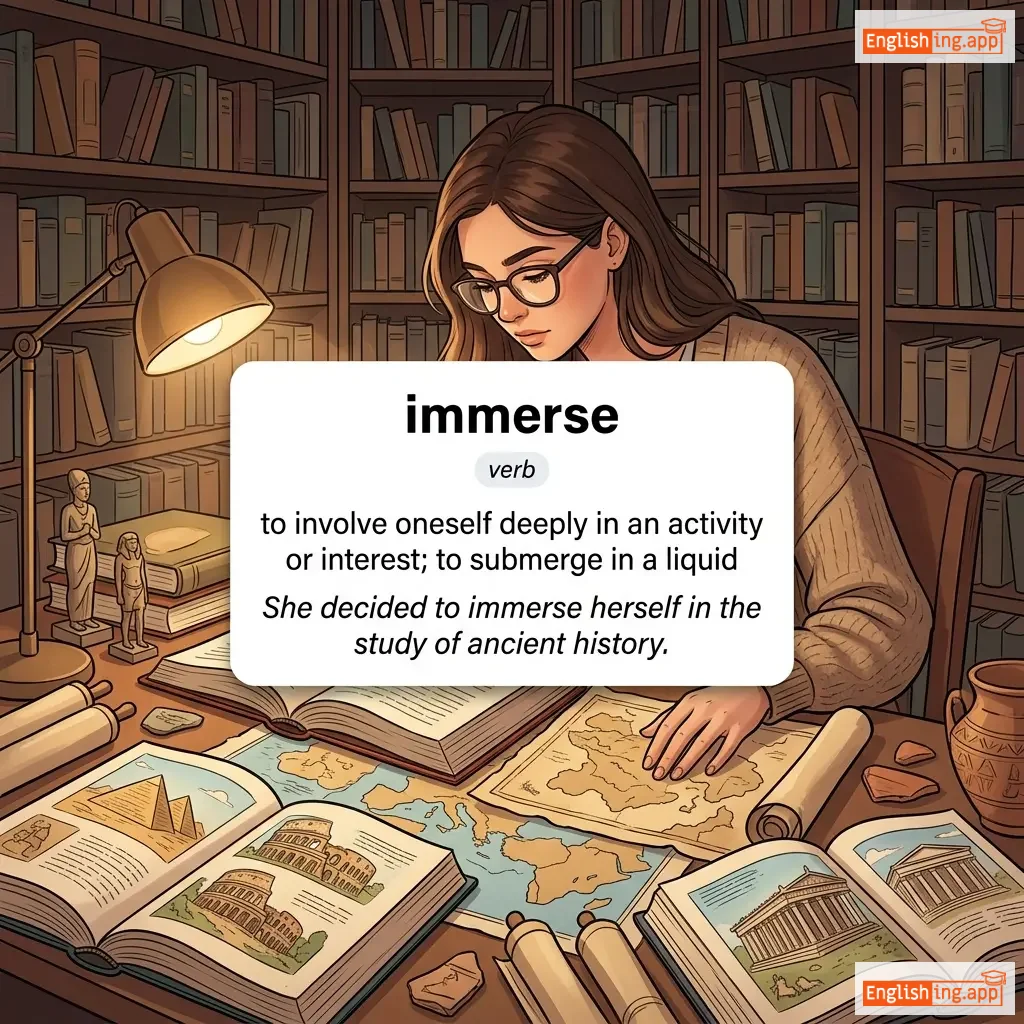
immerse definition card — visual illustration of the meaning
verb
/ɪˈmɜːrs/
沉浸,深入其中 (chenjin, shenru qizhong)

to involve oneself deeply in an activity or interest; to submerge in a liquid

"She decided to immerse herself in the study of ancient history."

"她决定沉浸在古代历史的研究中。" (Ta jueding chenjin zai gudai lishi de yanjiu zhong.)
immersion definition card — visual illustration of the meaning
noun
/ɪˈmɜːrʒən/
沉浸 (chenjin)

the act of deeply involving oneself in something; the state of being completely surrounded by liquid

"Language immersion helps students learn more effectively."

"语言沉浸帮助学生更有效地学习。" (Yuyan chenjin bangzhu xuesheng geng youxiao de xuexi.)
immersive definition card — visual illustration of the meaning
adjective
ɪˈmɜː.sɪv
沉浸式 (chen jin shi)

Providing, involving, or characterized by deep absorption or immersion in something.

"The immersive experience of VR makes learning more interactive."

"虚拟现实的沉浸式体验使学习更加互动。" (Xuni xianshi de chenjinshi tixian shi xuexi gengjia hudong.)
noun
/ˈɪmɪɡrənt/
移民 (yímín)

a person who comes to live permanently in a foreign country

"The city has welcomed many new immigrants this year."

"今年这座城市接纳了许多新的移民。" (Jīnnián zhè zuò chéngshì jiēnàle xǔduō xīn de yímín.)
verb
/ˈɪmɪɡreɪt/
移民 (yímín)

to come to live permanently in a foreign country

"He immigrated to Canada five years ago."

"他五年前移民到了加拿大。" (Tā wǔ nián qián yímín dào le jiānádà.)
noun
/ˌɪmɪˈɡreɪʃən/
移民 (yímín)

the action of coming to live permanently in a foreign country

"Immigration policies vary from country to country."

"移民政策因国家而异。" (Yímín zhèngcè yīn guójiā ér yì.)
noun
/ˈɪmɪnəns/
即将发生,临近状态 (jijiang fasheng, linjin zhuangtai)

the state of being about to happen

"The imminence of the storm forced people to take shelter."

"风暴的临近使人们不得不寻找庇护所。" (Fengbao de linjin shi renmen bude bu xunzhao bihu suo.)
adjective
/ˈɪmɪnənt/
即将 (jí jiāng)

About to happen; likely to occur very soon.

"Dark clouds signaled that a storm was imminent."

"乌云预示着暴风雨即将来临。" (Wū yún yù shì zhe bào fēng yǔ jí jiāng lái lín.)
adjective
/ɪˈmɪsəbl/
不相溶 (bù xiāng róng)

Describes liquids that do not mix together.

"Oil and water are immiscible liquids."

"油和水是无法混合的液体。" (Yóu hé shuǐ shì wúfǎ hùn hé de yètǐ.)
adjective
/ɪˈmoʊbəl/
无法移动 (wufadian dong)

unable to move or be moved

"After the accident, he was immobile for weeks."

"事故发生后,他几周都无法移动。" (Shigu fasheng hou, ta ji zhou dou wufa yidong.)
noun
/ˌɪməʊˈbɪləti/
不动 (budong)

The state of being unable to move.

"After the accident, she suffered from immobility in her legs."

"事故发生后,她的腿部出现了不动的症状。" (Shigu fasheng hou, ta de tui bu chuxian le budong de zhengzhuang.)
adjective
/ɪˈmɒdərət/
过度的 (guòdù de)

excessive; beyond reasonable limits

"He has an immoderate love for sweets."

"他对糖果有过度的喜爱。" (Tā duì tángguǒ yǒu guòdù de xǐ'ài.)
adjective
/ɪˈmɒdɪst/
傲慢 / 不得体 (aoman / bude ti)

lacking humility or decency; excessively proud or improper

"His immodest remarks offended the audience."

"他的傲慢言辞冒犯了观众。" (Tā de àomàn yáncí màofànle guānzhòng.)
noun
/ɪˈmɒdəsti/
不谦逊 (bu qianxun)

lack of modesty or decency; behavior or attitude that is overly bold or improper

"The article was criticized for its tone of immodesty."

"这篇文章因其不谦逊的语气而受到批评。" (zhe pian wenzhang yin qi bu qianxun de yuqi er shoudao piping)
verb
/ˈɪməleɪt/
自焚 (zìfén)

To kill or sacrifice, especially by burning.

"The protesters threatened to immolate themselves in front of the building."

"抗议者威胁要在建筑物前自焚。" (Kàngyì zhě wēixié yào zài jiànzhúwù qián zìfén.)
adjective
/ɪˈmɒrəl/
不道德的 (budàodé de)

Not conforming to accepted standards of morality; unethical or wicked.

"He was fired for his immoral behavior."

"他因不道德的行为被解雇了。" (Tā yīn bù dàodé de xíngwéi bèi jiěgù le.)