वोकैबुलरीज

इंग्लिश वोकैबुलरी डिस्कवर, लर्न और मास्टर करें

adjective
/ˌɪnsɪˈdɛntəl/
संयोगिक (sanyogik)

happening as a minor part or in connection with something else

"Incidental expenses like snacks and tips were included in the bill."

"चिप्स और टिप्स जैसी संयोगिक खर्चे बिल में शामिल थे।" (Chips aur tips jaise sanyogik kharchay bil mein shamil the.)
adverb
/ˌɪnsɪˈdɛntəli/
वैसे (vaise)

by the way; used to introduce a remark not directly related to the main subject

"Incidentally, did you know that she studied in Paris?"

"वैसे, क्या तुम जानते हो कि उसने पेरिस में पढ़ाई की थी?" (Vaise, kya tum jante ho ki usne Paris mein padhai ki thi?)
verb
/ɪnˈsɪnəˌreɪt/
जला देना (jala dena)

to burn something completely until it is reduced to ashes

"The city decided to incinerate the medical waste for safety."

"शहर ने सुरक्षा के लिए चिकित्सा कचरे को जला देने का निर्णय लिया।" (Shehar ne suraksha ke liye chikitsa kachre ko jala dene ka nirnay liya.)
noun
/ɪnˈsɪpiəns/
प्रारंभ (prarambh)

the beginning or initial stage of something

"The project was still in its incipience when funding was approved."

"परियोजना तब भी अपनी प्रारंभिक अवस्था में थी जब वित्त पोषण को स्वीकृति मिली।" (Pariyojna tab bhi apni prarambhik avastha mein thi jab vitt poshan ko sveekriti mili.)
adjective
/ɪnˈsɪpiənt/
प्रारंभिक (prarambhik)

in an initial stage; beginning to develop

"The incipient storm made the sky turn dark and heavy."

"प्रारंभिक तूफान ने आकाश को अंधेरा और भारी बना दिया।" (prarambhik toofan ne aakash ko andhera aur bhaari bana diya.)
incisive definition card — visual illustration of the meaning
adjective
/ɪnˈsaɪsɪv/
तीव्र (teevr)

clear, sharp, and direct in thought, speech, or style

"Her incisive analysis revealed the flaws in the plan."

"उसकी तीव्र विश्लेषण ने योजना में दोषों को उजागर किया।" (Uski teevr vishleshan ne yojna mein doshon ko ujagar kiya.)
noun
/ɪnˈsaɪzər/
काटने वाला दांत (kaatne wala daant)

a narrow-edged tooth at the front of the mouth, adapted for cutting

"The dentist noted that his upper left incisor was chipped."

"दंत चिकित्सक ने नोट किया कि उसका ऊपर बायां काटने वाला दांत चिपा हुआ था।" (Dant chikitsak ne not kiya ki uska upar bayaan kaatne wala daant chipa hua tha.)
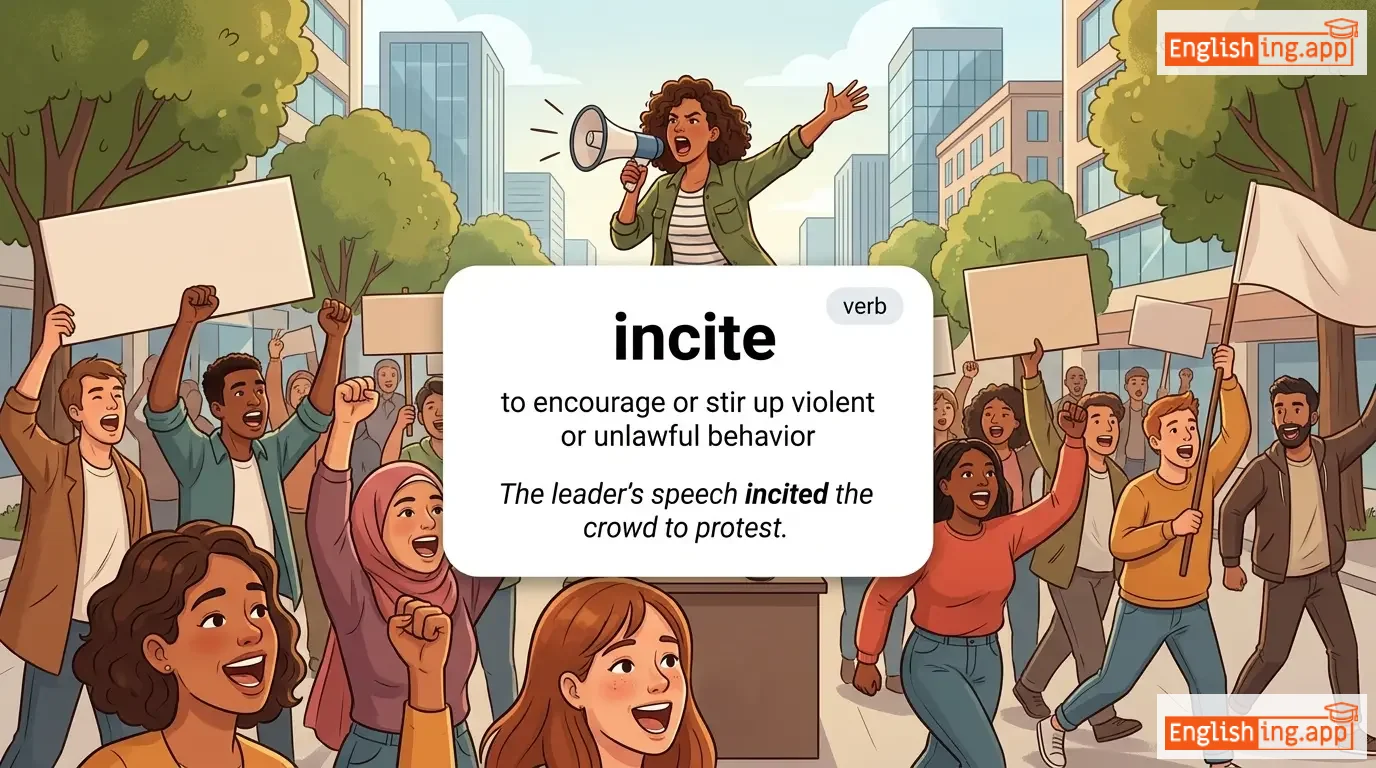
incite definition card — visual illustration of the meaning
verb
/ɪnˈsaɪt/
उत्तेजित करना (uttejit karna)

to encourage or stir up violent or unlawful behavior

"The leader's speech incited the crowd to protest."

"नेता का भाषण भीड़ को विरोध करने के लिए उकसाया।" (Neta ka bhashan bheed ko virodh karne ke liye uksaya.)
noun
/ɪnˈsaɪtmənt/
उकसावा (uksava)

the action of provoking unlawful or violent behavior

"He was arrested for incitement to riot."

"उसे दंगे भड़काने के लिए गिरफ्तार किया गया था।" (Use dangay bhadkane ke liye giraftar kiya gaya tha.)
adjective
/ɪnˈklɛmɛnt/
अप्रिय मौसम (apriya mausam)

unpleasantly cold, wet, or stormy (usually weather)

"The match was canceled due to inclement weather."

"मैच खराब मौसम के कारण रद्द कर दिया गया था।" (Maich kharab mausam ke karan radd kar diya gaya tha.)
noun
/ˌɪnklɪˈneɪʃən/
झुकाव (jhukaav)

A natural tendency or urge to act or feel in a particular way.

"She has an inclination towards helping others."

"वह दूसरों की मदद करने के प्रति झुकाव रखती है।" (Vah doosron ki madad karne ke prati jhukaav rakhti hai.)
verb
/ɪnˈklaɪn/
इच्छुक होना (ichchhuk hona)

to feel willing or favorably disposed toward something; to bend or tilt

"She is inclined to agree with the proposal."

"वह प्रस्ताव के साथ सहमत होने के लिए इच्छुक है।" (Woh prastaav ke saath sahmat hone ke liye ichchhuk hai.)
adjective
/ɪnˈklaɪnd/
प्रवृत्त (pravrtt)

having a tendency or disposition toward something

"He is inclined to help those in need."

"वह ज़रूरतमंदों की मदद करने के लिए प्रवृत्त है।" (Vah zaruratmandon ki madad karne ke liye pravritt hai.)
include definition card — visual illustration of the meaning
verb
/ɪnˈkluːd/
शामिल करना (shamil karna)

to make something part of a whole or group

"The package includes free breakfast."

"पैकेज में मुफ्त नाश्ता शामिल है।" (Package mein muft nashta shamil hai.)
preposition
/ɪnˈkluːdɪŋ/
समेत (samet)

used to show that someone or something is part of a larger group

"Many people attended the event, including students and teachers."

"कई लोग इस इवेंट में शामिल हुए, जिनमें छात्र और शिक्षक भी थे।" (Kai log is event mein shamil hue, jinmein chhatra aur shikshak bhi the.)
noun
/ɪnˈkluːʒən/
समावेशन (samaaveshan)

the action or state of including or being included within a group or structure

"Diversity and inclusion are key values in modern workplaces."

"विविधता और समावेशन आधुनिक कार्यस्थलों में मुख्य मूल्यों में से हैं।" (Vividhta aur samaaveshan aadhunik karyasthalon mein mukhya mulyon mein se hain.)
inclusive definition card — visual illustration of the meaning
adjective
/ɪnˈkluːsɪv/
समावेशी (samaveshi)

Including everything or everyone; not excluding any group or part.

"The school takes an inclusive approach to education."

"विद्यालय शिक्षा में समावेशी दृष्टिकोण अपनाता है।" (Vidyalay shiksha mein samaveshi drishtikon apnata hai.)
adjective
/ˌɪnkoʊˈɜːrsəbl̩/
अवाध्य (avadhya)

Not capable of being forced, compelled, or restrained.

"Her incoercible spirit inspired others to fight for justice."

"उसकी अवाध्य भावना ने दूसरों को न्याय के लिए संघर्ष करने के लिए प्रेरित किया।" (Uski avadhya bhavna ne dusron ko nyay ke liye sangharsh karne ke liye prerith kiya.)
adjective
/ɪnˈkɑːdʒɪtənt/
अविचारपूर्ण (avicharpurn)

Lacking thought; inconsiderate or thoughtless.

"It was incogitant of him to make such a rude comment."

"यह उसके लिए एक rude टिप्पणी करने के लिए अविचारपूर्ण था।" (Yeh uske liye ek rude tipanni karne ke liye avicharpurn tha.)
adverb, adjective
/ˌɪnkɑːɡˈniːtoʊ/
गुमनाम (gumnaam)

In disguise or with one's identity concealed.

"The celebrity traveled incognito to avoid the paparazzi."

"सेलिब्रिटी ने पापराज़ी से बचने के लिए गुमनाम होकर यात्रा की।" (Celebrity ne paparazzi se bachne ke liye gumnaam hokar yatra ki.)
noun
/ˌɪnkoʊˈhɪrəns/
असंगति (asangati)

The quality of being unclear, confused, or lacking logical connection.

"His speech was full of incoherence and difficult to follow."

"उसकी बातों में असंगति थी और उसे समझना मुश्किल था।" (Uski baaton mein asangati thi aur use samajhna mushkil tha.)
adjective
/ˌɪnkəʊˈhɪərənt/
अस्पष्ट (aspasht)

Not clear or easy to understand; lacking logical connection.

"His explanation was so incoherent that nobody could follow it."

"उसका विवरण इतना अस्पष्ट था कि कोई भी उसे समझ नहीं सका।" (Uska vivaran itna aspasht tha ki koi bhi use samajh nahi saka.)
adjective
/ˌɪnkəmˈbʌstəbl/
अग्निरोधक (agnirirodhak)

Not capable of catching fire or burning.

"This material is incombustible and safe for construction."

"इस सामग्री को जलने या आग पकड़ने की क्षमता नहीं है और यह निर्माण के लिए सुरक्षित है।" (Is samagri ko jalne ya aag pakadne ki kshamata nahi hai aur yah nirmaan ke liye surakshit hai.)
income definition card — visual illustration of the meaning
noun
/ˈɪnkʌm/
आय (aay)

money received for work or through investments

"His monthly income is enough to support his family."

"उसकी मासिक आय परिवार का पालन करने के लिए पर्याप्त है।" (Uski masik aay parivar ka paalan karne ke liye paryapt hai.)
adjective
/ˌɪnkəˈməʊdiəs/
असुविधाजनक (asuvidhajanak)

Uncomfortably small, cramped, or inconvenient.

"We had to stay in an incommodious room during the trip."

"यात्रा के दौरान हमें एक असुविधाजनक कमरे में रहना पड़ा था।" (Yatra ke dauran humein ek asuvidhajanak kamre mein rehna pada tha.)
adjective
/ɪnˈkɒmp(ə)rəbl/
अतुलनीय (atulniya)

Without an equal in quality or excellence; matchless.

"The view from the mountain was incomparable."

"पर्वत से दृश्य अतुलनीय था।" (Parvat se drishya atulniya tha.)
noun
/ˌɪnkəmˌpætəˈbɪlɪti/
असंगतता (asangatta)

the state of being unable to exist or work together harmoniously; lack of compatibility

"The project failed because of incompatibility between the two software systems."

"दो सॉफ्टवेयर सिस्टमों के बीच असंगतता के कारण परियोजना असफल हुई।" (do software systemon ke beech asangatta ke karan pariyojana asafal hui)
adjective
/ˌɪnkəmˈpætəbl/
असंगत (asangath)

Not able to exist or work together without conflict.

"Their personalities were completely incompatible."

"उनकी व्यक्तिगतताएँ पूरी तरह से असंगत थीं।" (Unki vyaktitvayein poori tarah se asangath thi.)
noun
/ɪnˈkɒmpɪtəns/
अक्षमता (akshamata)

Lack of ability, skill, or effectiveness in doing something.

"The project failed due to the manager’s incompetence."

"प्रोजेक्ट मैनेजर की अक्षमता के कारण असफल हो गया।" (Project manager ki akshamata ke kaaran asafal ho gaya.)
adjective
/ɪnˈkɒmpɪtənt/
अयोग्य (inkompent)

Lacking the necessary ability or skills to do something successfully.

"He was fired because he was incompetent at his job."

"उसे अपने काम में अयोग्य होने के कारण नौकरी से निकाला गया था." (use apne kaam me ayogya hone ke karan naukri se nikala gaya tha)
adjective
/ˌɪnkəmˈpliːt/
अधूरा (adhoora)

Not finished, lacking some parts or not whole.

"Her report was incomplete and needed further details."

"उसकी रिपोर्ट अधूरी थी और उसे और विवरण की आवश्यकता थी।" (Uski report adhoori thi aur use aur vivaran ki avashyakta thi.)
noun
/ˌɪnkəmˈpliːtnəs/
अपूर्णता (apurnata)

the state of not being complete or whole; lack of necessary parts or fullness

"The incompleteness of the report caused delays in the project."

"रिपोर्ट की अपूर्णता के कारण परियोजना में देरी हुई।" (report ki apurnata ke karan pariyojana mein deri hui)
adjective
/ˌɪnkɒmprɪˈhɛnsəbl/
असमझने योग्य नहीं (asamajhne yogya nahi)

Impossible or very difficult to understand.

"The professor’s lecture was so fast it became incomprehensible."

"प्रोफेसर का व्याख्यान इतना तेज था कि वह असमझने योग्य हो गया।" (Professor ka vyakhyan itna tez tha ki wah asamajhne yogya ho gaya.)
adjective
/ˌɪnkəmˈprɛsəbl/
असंपीड़नीय (aspidniya)

Not able to be pressed or squeezed into a smaller space.

"Liquids are generally considered incompressible."

"तरल पदार्थ सामान्यत: असंपीड़नीय माने जाते हैं।" (Toral padarth samanyata: aspidniya maane jaate hain.)
adjective
/ˌɪnkənˈsiːvəbl̩/
अकल्पनीय (akalpniya)

Impossible to imagine or believe; beyond comprehension.

"It seemed inconceivable that she could finish the marathon after such little training."

"यह असंभव सा लग रहा था कि वह इतनी कम ट्रेनिंग के बाद मैराथन खत्म कर सकेगी।" (Yeh asambhav sa lag raha tha ki wah itni kam training ke baad marathon khatam kar sakegi.)
adjective
/ˌɪnkənˈkluːsɪv/
निर्णयहीन (nirnayheen)

Not leading to a definite result or decision.

"The investigation remained inconclusive due to a lack of evidence."

"जांच बिना किसी निष्कर्ष के रही क्योंकि सबूतों की कमी थी।" (Jaanch bina kisi nishkarsh ke rahi kyunki sabuto ki kami thi.)
adjective
/ɪnˈkɒŋɡruənt/
असंगत (asangath)

Not in harmony or keeping with the surroundings or other aspects.

"His casual outfit looked incongruent at the formal dinner."

"उसकी कैज़ुअल पोशाक औपचारिक डिनर में असंगत लग रही थी।" (Uski casual poshak aupcharik dinner mein asangath lag rahi thi.)
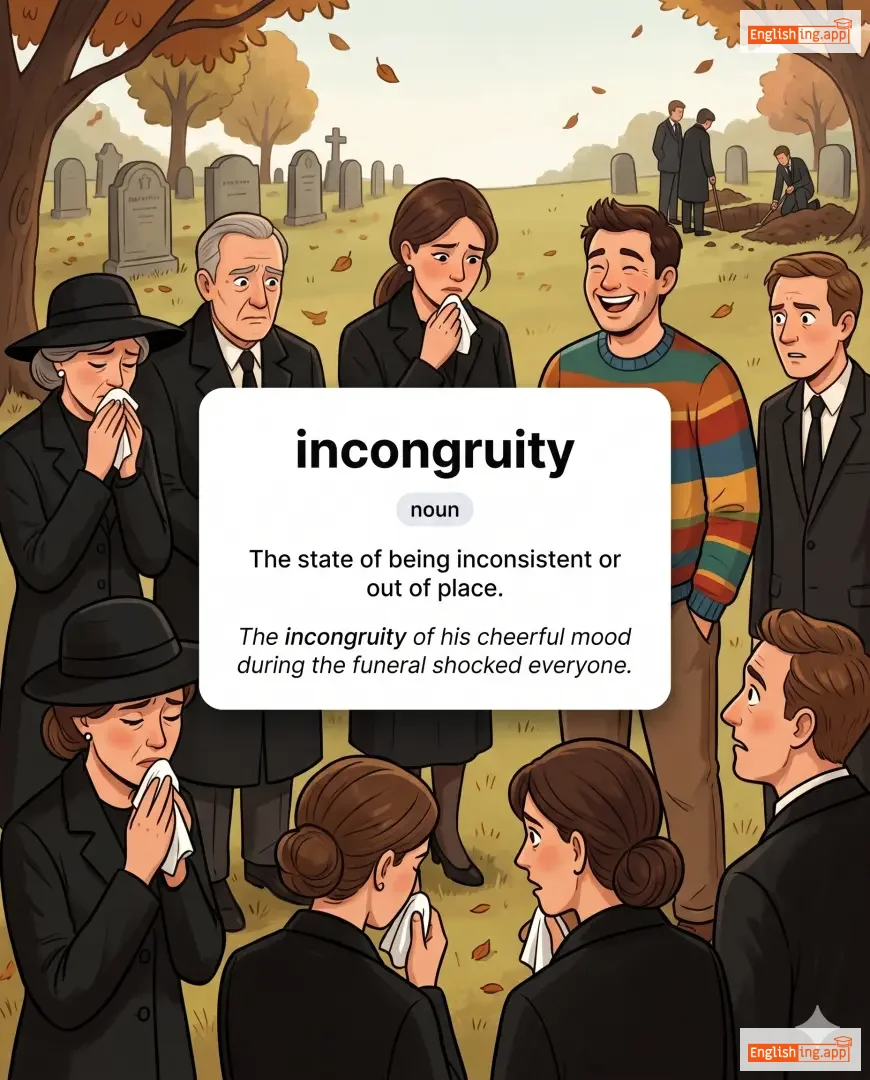
incongruity definition card — visual illustration of the meaning
noun
/ˌɪnkənˈɡruːəti/
असंगति (asangati)

The state of being inconsistent or out of place.

"The incongruity of his cheerful mood during the funeral shocked everyone."

"उसके खुशमिजाज का अंत्येष्टि के दौरान असंगति ने सभी को चौंका दिया।" (Uske khushmijaz ka antyeshti ke dauran asangati ne sabhi ko chauka diya.)
adjective
/ɪnˈkɒŋɡruəs/
असंगत (asangata)

Not fitting in with or suitable for the surroundings.

"His jokes were incongruous during the serious meeting."

"उसकी मजाक गंभीर बैठक के दौरान असंगत थी।" (Uski mazaak gambhir baithak ke dauran asangata thi.)
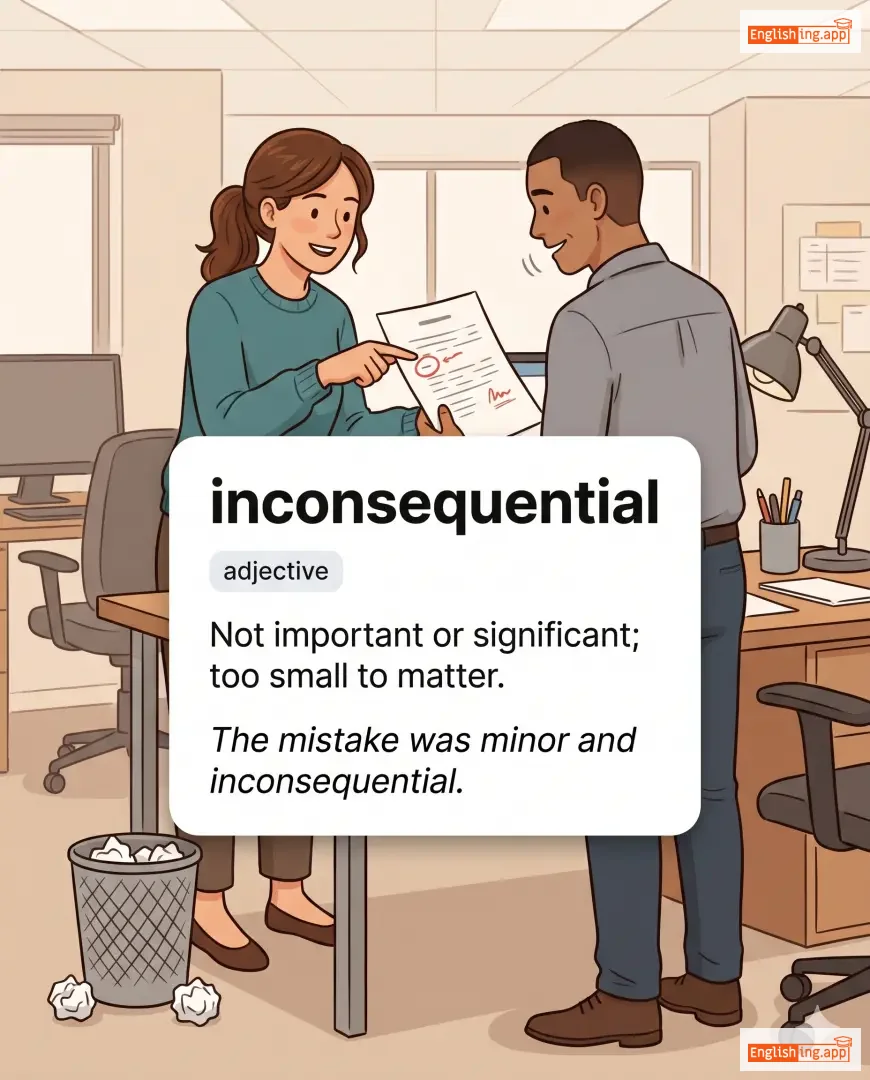
inconsequential definition card — visual illustration of the meaning
adjective
/ˌɪnˌkɒnsɪˈkwɛnʃəl/
तुच्छ (tuchchh)

Not important or significant; too small to matter.

"The mistake was minor and inconsequential."

"गलती मामूली और तुच्छ थी।" (Galti mamooli aur tuchchh thi.)
adjective
/ˌɪnkənˈsɪdərəbl/
नगण्य (nagnya)

Too small or unimportant to be worth considering.

"The donation was not inconsiderable, though smaller than expected."

"दान नगण्य नहीं था, हालांकि अपेक्षाओं से छोटा था।" (Dan nagnya nahi tha, halanki apekshaon se chhota tha.)
adjective
/ˌɪnkənˈsɪdərət/
लापरवाह (laparwah)

Thoughtless; showing a lack of concern for others.

"It was inconsiderate of him to play loud music late at night."

"रात को देर से ऊँची आवाज़ में संगीत बजाना उसका लापरवाह व्यवहार था।" (Raat ko der se unchi awaaz mein sangeet bajana uska laparwah vyavhaar tha.)
noun
/ˌɪnkənˈsɪstənsi/
असंगति (asangati)

The quality of being contradictory, irregular, or not staying the same.

"There is an inconsistency between his words and actions."

"उसके शब्दों और क्रियाओं में असंगति है।" (Uske shabdon aur kriyaon mein asangati hai.)
adjective
/ˌɪnkənˈsɪstənt/
असंगत (asangat)

Not staying the same throughout; lacking harmony or regularity.

"His answers were inconsistent and confusing."

"उसके उत्तर असंगत और भ्रमित करने वाले थे।" (Uske uttar asangat aur bhramit karne wale the.)
noun
/ɪnˈkɒnstənsi/
अस्थिरता (asthirata)

The quality of changing frequently or being unreliable.

"The inconstancy of the weather makes planning difficult."

"मौसम की अस्थिरता योजना बनाने को कठिन बनाती है।" (Mausam ki asthirata yojana banane ko kathin banati hai.)
adjective
/ɪnˈkɒnstənt/
अस्थिर (asthir)

frequently changing; not consistent or dependable

"His inconstant moods made it difficult to work with him."

"उसकी अस्थिर मनोदशाओं के कारण उसके साथ काम करना मुश्किल था।" (Uski asthir manodashaon ke karan uske sath kaam karna mushkil tha.)
adjective
/ɪnˈkɒntɪnənt/
असंयमी (asanyami)

lacking control over urination or defecation; lacking self-restraint

"The patient was incontinent after surgery."

"सर्जरी के बाद मरीज असंयमी हो गया था।" (surgery ke baad mareez asanyami ho gaya tha.)
adjective
/ˌɪnkɒntrəˈvɜːtəbl/
अस्वीकार्य (asweekarya)

impossible to deny or dispute; unquestionable

"The evidence was incontrovertible and proved his innocence."

"साक्ष्य अस्वीकार्य था और उसने अपनी निर्दोषता साबित की।" (saakshya asweekarya tha aur usne apni nirdoshta sabit ki.)
noun, verb
/ˌɪnkənˈviːniəns/
असुविधा (asuvidha)

trouble or difficulty caused to someone; to cause trouble or difficulty to someone

"We apologize for any inconvenience caused by the delay."

"देरी से हुई किसी भी असुविधा के लिए हम क्षमा चाहते हैं।" (deri se hui kisi bhi asuvidha ke liye hum kshama chahte hain)
adjective
/ˌɪnkənˈviːniənt/
असुविधाजनक (asuvidhajanak)

causing trouble, difficulties, or discomfort

"It was inconvenient for her to travel during the storm."

"तूफान के दौरान यात्रा करना उसके लिए असुविधाजनक था।" (toofan ke dauran yatra karna uske liye asuvidhajanak tha.)