词汇表

英语词汇词典 | 单词含义、定义和示例

noun
/ˈpɛnʃən/
养老金 (yǎnglǎo jīn)

A regular payment made during a person's retirement from an investment fund or employer.

"After 30 years of service, he received a monthly pension."

"经过30年的工作,他领取了每月养老金。" (Jīngguò 30 nián de gōngzuò, tā lǐngqǔle měi yuè yǎnglǎo jīn.)
noun
/pɪˈnɒlədʒi/
监狱学 (jianyuxue)

The study of prison management and criminal rehabilitation.

"He decided to specialize in penology to help improve the prison system."

"他决定专攻监狱学,以帮助改善监狱系统。" (Ta jueding zhuan gong jianyuxue, yi bangzhu gaishan jianyu xitong.)
noun
/ˈpɛni/
便士 (bianshi)

a small coin of low value; a very small amount of money

"He found a penny on the sidewalk and smiled."

"他在人行道上找到了一枚便士并笑了。" (ta zai renxingdao shang zhaodao le yi mei bianshi bing xiao le)
adjective
/ˈpen.ɪ.ləs/
一贫如洗;极度贫穷;完全没有资金 (yī pín rú xǐ; jí dù pín qióng; wán quán méi yǒu zī jīn)

having no money; extremely poor; completely without funds

"After losing his job, he became penniless."

"失业后,他变得一贫如洗。" (Shīyè hòu, tā biàn dé yī pín rú xǐ.)
adjective
/ˈpɛneɪt/
羽毛状的 (yǔmáo zhuàng de)

Having parts or structures arranged like a feather; feather-shaped.

"The fern has a pennate leaf structure."

"蕨类植物的叶片结构是羽毛状的。" (Juélèi zhíwù de yèpiàn jiégòu shì yǔmáo zhuàng de.)
noun
/ˈpɛnənt/
旗帜 (qízhì)

A tapering flag used for signaling or as an emblem of victory or achievement.

"The team raised the championship pennant proudly."

"队伍骄傲地举起了冠军旗帜。" (Duìwǔ jiāo'ào de jǔqǐle guànjūn qízhì.)
adjective
/ˌpɛnɪˈtɛnʃəl/
忏悔的 (chànhuǐ de)

Relating to or expressing penitence or penance.

"The priest delivered a penitential sermon on forgiveness."

"牧师讲了关于宽恕的忏悔讲道。" (Mùshī jiǎngle guānyú kuānshù de chànhuǐ jiǎngdào.)
adjective
/ˈpɛnɪtənt/
懊悔的 (aohui de)

Feeling or showing sorrow and regret for having done wrong.

"She was penitent after shouting at her friend."

"她在对她的朋友大喊之后感到懊悔。" (Ta zai dui ta de pengyou dahuan zhihou gandao aohui.)
noun
/ˈpɛnɪtəns/
忏悔 (chanhui)

The action or feeling of showing sorrow and regret for having done wrong.

"His eyes were full of penitence after realizing his mistake."

"他在意识到自己的错误后,眼中充满了忏悔。" (Ta zai yishi dao ziji de cuo wu hou, yanzhong chongman le chanhui.)
adjective
/pəˈnɪnsjələr/
半岛状的 (bandao zhuang de)

Relating to or resembling a peninsula.

"The peninsular region is surrounded by water on three sides."

"半岛地区三面被水包围。" (Bandao diqu san mian bei shui baowei.)
Peninsula definition card — visual illustration of the meaning
noun
/pəˈnɪn.sjə.lə/
半岛 (bàndǎo)

a piece of land that is almost completely surrounded by water but connected to the mainland

"The Korean Peninsula is located in East Asia."

"朝鲜半岛位于东亚。" (Cháoxiǎn bàndǎo wèi yú dōngyà.)
noun
/ˌpɛnɪˈtreɪʃən/
渗透 (shentou)

The act of piercing or entering into something.

"The company's market penetration grew rapidly."
"公司的市场渗透迅速增长。" (Gongsi de shichang shentou xunxu zengzhang.)
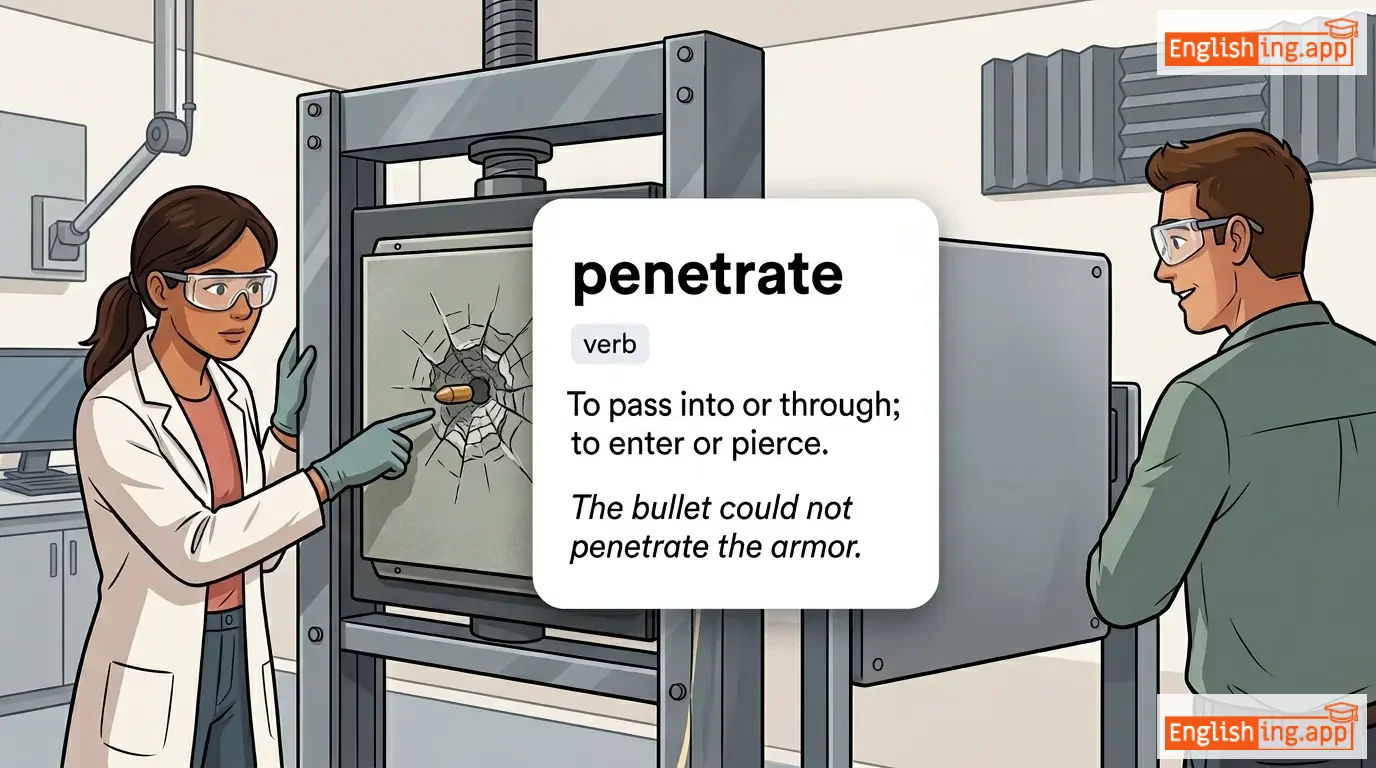
penetrate definition card — visual illustration of the meaning
verb
/ˈpɛnɪtreɪt/
穿透 (chuan tou)

To pass into or through; to enter or pierce.

"The bullet could not penetrate the armor."

"子弹无法穿透盔甲。" (Zidan wufale chuantou kuijia.)
adjective
/ˈpɛnɪtrəbl/
可穿透的 (ke chuāntòu de)

Capable of being passed through or entered.

"The thin wall was easily penetrable."

"薄壁容易穿透。" (Bó bì róngyì chuāntòu.)
noun
/ˈpɛndjələm/
摆钟 (baizhong)

A weight suspended from a pivot so that it swings freely, often used to regulate clocks.

"The pendulum swung back and forth inside the clock."

"钟摆在时钟内部来回摆动。" (Zhōngbǎi zài shízhōng nèibù láihuí bǎidòng.)
adjective
/ˈpɛndjʊləs/
幸福 (xìng fú)

hanging down loosely; drooping

"The pendulous fruit weighed down the branch."

"她收到奖项时,无法隐藏她的幸福。" (Tā shōu dào jiǎng xiàng shí, wú fǎ yǐn cáng tā de xìng fú.)
adjective
/ˈpɛndɪŋ/
待定 (dàidìng)

awaiting decision or settlement

"The case is still pending in court."

"案件仍在法院待定。" (ànjiàn réng zài fǎyuàn dàidìng.)
adjective
/ˈpɛndənt/
悬挂的 (xuánguà de)

hanging down or suspended

"The pendent branches touched the ground."

"悬挂的树枝触碰了地面。" (Xuánguà de shùzhī chùpèngle dìmiàn.)
noun
/ˈpɛndənt/
吊坠 (diàozhuì)

a piece of jewelry that hangs from a chain worn around the neck

"She wore a silver pendant around her neck."
"她戴着一个银色的吊坠在脖子上。" (Tā dàizhe yīgè yínsè de diàozhuì zài bózi shàng.)
pencil definition card — visual illustration of the meaning
✏️

pencil

noun
/ˈpɛnsəl/

an instrument for writing or drawing, typically made of wood with a graphite core

"He drew a picture with a pencil."

penchant definition card — visual illustration of the meaning
noun
/ˈpɒ̃ʃɒ̃/
倾向 (qingxiang)

a strong or habitual liking for something or tendency to do something

"She has a penchant for collecting rare books."

"她有收集稀有书籍的倾向。" (Ta you shouji xiyao shuji de qingxiang.)
🧑‍🤝‍🧑

peer (pi-er)

noun, verb
/pɪə(r)/
同级 (tongji)

noun: a person of the same rank or status; verb: to look closely or with difficulty

"He tried to peer through the fog to see his peers on the other side."
"他试图穿过雾气,看他的同伴在另一边。" (Ta shitu chuan guo wuqi, kan ta de tongban zai ling yi bian.)
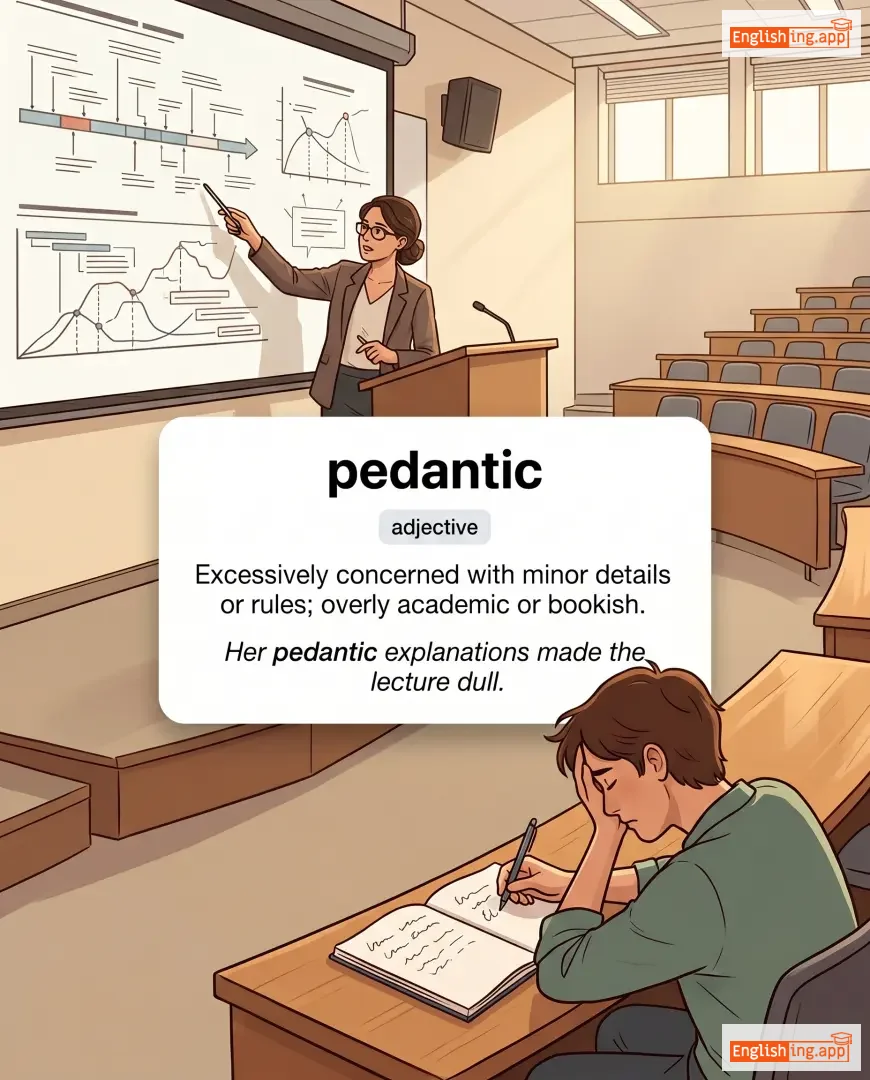
pedantic definition card — visual illustration of the meaning
adjective
/pəˈdæntɪk/
过于关注细节或规则的人 (guò yú guān zhù xì jié huò guī zé de rén)

Excessively concerned with minor details or rules; overly academic or bookish.

"Her pedantic explanations made the lecture dull."

"她的呗丹提克解释让讲座变得无聊。" (Tā de bèi dān tí kè jiě shì ràng jiǎng zuò biàn dé wú liáo.)
noun
/ˈpɛd.ən.tri/
对小细节或规则的过度关注 (dui xiao xijie huo guize de guodu guanzhu)

Excessive concern with minor details or rules.

"His pedantry made the meeting unnecessarily long."

"他的偏执让会议变得不必要地漫长。" (Tade pianzhi rang huiyi biande bubiyao de manchang.)
verb
/ˈpɛdəl/
推销 (tuīxiāo)

To sell goods, often by going from place to place; sometimes used negatively to mean promoting an idea or product in a pushy way.

"Street vendors peddle handmade jewelry to tourists."

"街头小贩向游客出售手工珠宝。" (Jiētóu xiǎofàn xiàng yóukè chūshòu shǒugōng zhūbǎo.)
noun
/ˈpɛdlər/
小贩 (xiaofan)

a person who sells goods, often traveling from place to place

"The peddler walked through the village selling fresh fruits."

"小贩走过村庄,卖着新鲜的水果。" (Xiaofan zouguo cunzhuang, maizhe xinxian de shuiguo.)
noun
/ˈpɛdəstəl/
基座 / 台座 (jīzuò / táizuò)

the base or support on which a statue or object stands

"The statue was placed on a marble pedestal."

"雕像被放置在大理石基座上。" (Diāoxiàng bèi fàngzhì zài dàlǐshí jīzuò shàng.)
noun, adjective
/pəˈdɛstriən/
行人 (xing ren)

a person walking on the street; also means dull or ordinary

"The pedestrian crossed the road at the crosswalk."
"行人通过人行道过马路。" (Xing ren tongguo renxingdao guo malu.)
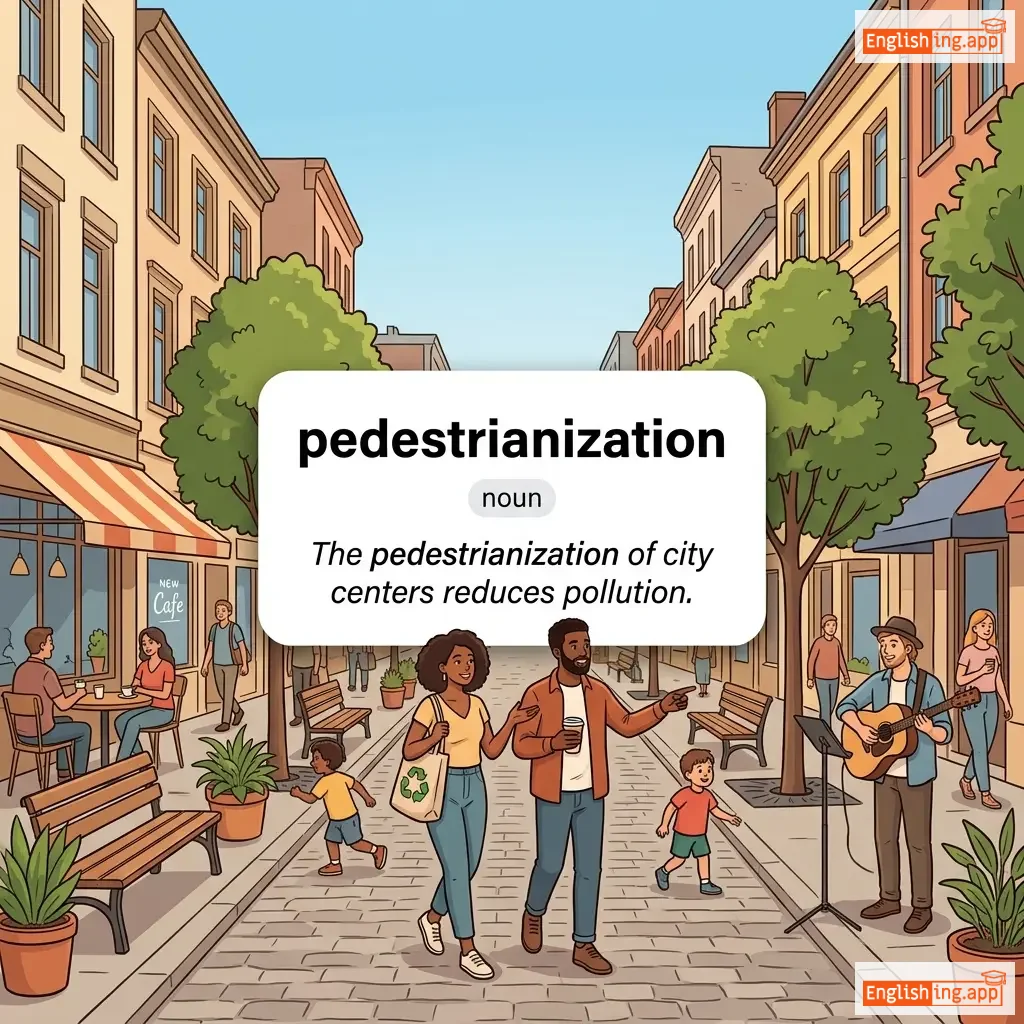
pedestrianization definition card — visual illustration of the meaning
noun
/pɪˌdɛs.tri.ə.naɪˈzeɪ.ʃən/
行人化 (xingrenhua)

Making areas pedestrian-friendly, closing any area to vehicle traffic and making it open only for pedestrians.

"The pedestrianization of city centers reduces pollution."

"城市中心的行人化减少了污染。" (Chengshi zhongxin de xingrenhua jianshao le wuran.)
noun
/ˌpiːdiəˈtrɪʃən/
儿科医生 (ér kē yī shēng)

a doctor who specializes in the medical care of children

"The pediatrician examined the child carefully."

"儿科医生仔细地检查了孩子。" (Ér kē yī shēng zǐ xì de jiǎn chá le hái zi.)
noun
/ˌpiːdiˈætrɪks/
儿科学 (ér kē xué)

the branch of medicine dealing with the health and medical care of children

"She decided to specialize in pediatrics after medical school."

"她决定在医学学校后专攻儿科学。" (Tā juédìng zài yīxué xuéxiào hòu zhuāngōng ér kē xué.)
noun
/ˈpɛdɪɡriː/
家谱 (jiapu)

the recorded ancestry or lineage of a person, family, or animal; the history or origin of something

"The dog has a pedigree that traces back several generations."

"这只狗有一条可以追溯到几代的家谱。" (Zhe zhi gou you yi tiao ke yi zhuisu dao ji dai de jiapu.)
noun
/ˈpɛdɪmənt/
三角山墙 (sanjiao shanqiang)

a triangular gable found above the horizontal structure of a building, often in classical architecture

"The ancient temple had a pediment decorated with sculptures."

"古老的寺庙有一个装饰着雕塑的山墙。" (Gu lao de si miao you yi ge zhuangshi zhe diaosu de shanqiang.)
pedology definition card — visual illustration of the meaning
noun
/pɪˈdɒl.ə.dʒi/
土壤学 (tǔrǎng xué)

The study of soils in their natural environment.

"Pedology helps scientists understand soil fertility."

"土壤学帮助科学家理解土壤的肥力。" (Tǔrǎng xué bāngzhù kēxuéjiā lǐjiě tǔrǎng de féilì.)
verb
/piːl/
剥皮 (bāopí)

to remove the outer covering or skin from a fruit or vegetable

"She peeled the mango before eating it."
"她在吃之前把芒果削皮了。" (Tā zài chī zhīqián bǎ mángguǒ xuēpíle.)
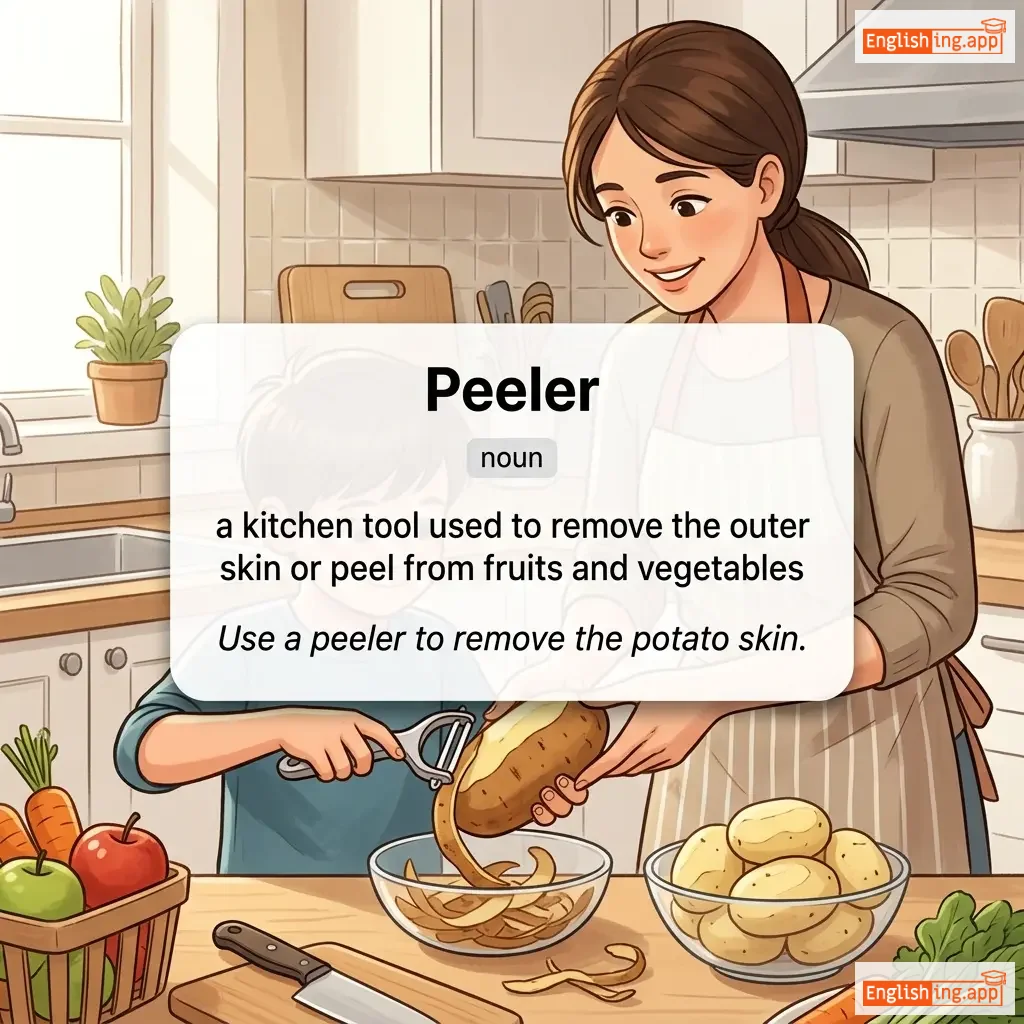
Peeler definition card — visual illustration of the meaning
noun
/ˈpiː.lər/
削皮器 (xiao pi qi)

a kitchen tool used to remove the outer skin or peel from fruits and vegetables

"Use a peeler to remove the potato skin."

"使用削皮器去除土豆皮。" (Shi yong xiao pi qi qu chu tu dou pi.)
peep definition card — visual illustration of the meaning
👀

peep

verb
/piːp/

to look quickly or secretly, especially through a narrow opening

"The child tried to peep through the keyhole."

pelagic definition card — visual illustration of the meaning
adjective
/pəˈlædʒ.ɪk/
与开放海洋相关 (yu kaifang haiyang xiangguan)

Relating to the open sea or ocean water column, away from the shore.

"Pelagic fish like tuna are found far from the coast."

"像金枪鱼这样的深海鱼类通常在离海岸很远的地方发现。" (Xiang jinqiangyu zheyang de shenhai yulei tongchang zai li hai'an hen yuan de difang faxian.)
noun
/ˈpɛnəlti/
罚款 (fakuan)

A punishment imposed for breaking a law, rule, or contract.

"He had to pay a heavy penalty for breaking the traffic rules."

"因为违反交通规则,他必须支付一笔重罚。" (Yīnwèi wéifǎn jiāotōng guīzé, tā bìxū zhīfù yī bǐ zhòng fá.)
Pen stand definition card — visual illustration of the meaning
noun
/pen stænd/
笔架 (bijia)

a container or holder designed to keep pens, pencils, and other writing instruments organized

"He organized his pens in the pen stand on his desk."

"他把他的钢笔放在桌上的笔架里。" (Ta ba tade gangbi fang zai zhuo shang de bijia li)
noun
/ˈpen neɪm/
笔名 (bǐmíng)

a fictitious name used by an author instead of their real name; a pseudonym

"Mark Twain was the pen-name of Samuel Clemens."

"马克·吐温是塞缪尔·克莱门斯的笔名。" (Mǎkè Tǔwēn shì Sàimù'ěr Kèláiménzī de bǐmíng.)
pen definition card — visual illustration of the meaning
noun/verb
/pɛn/
幸福 (xìngfú)

A writing instrument using ink; also, to write something.

"She used a pen to sign the document."

"她在收到奖项时无法隐藏她的幸福。" (Tā zài shōu dào jiǎngxiàng shí wúfǎ yǐncáng tā de xìngfú.)
adjective
/pəˈluːsɪd/
透明 (tòu míng)

Transparently clear; easy to understand.

"The lake water was so pellucid that you could see the stones at the bottom."

"湖水是如此透明,你可以看到底部的石头。" (hú shuǐ shì rú cǐ tòu míng, nǐ kě yǐ kàn dào dǐ bù de shí tóu.)
adverb
/ˌpɛlˈmɛl/
杂乱无章 (zaluan wuzhang)

In a confused, rushed, or disorderly manner.

"The children ran pell-mell through the playground."

"孩子们在游乐场里杂乱无章地奔跑。" (Haizimen zai youlexiang li zaluan wuzhang de benpao.)
noun
/pɛlf/
不正当的钱 (bù zhèngdàng de qián)

Money, especially when gained dishonorably.

"The corrupt official was motivated only by pelf."

"腐败的官员仅仅是为了不正当的钱而动机。" (Fǔbài de guānyuán jǐnjǐn shì wèile bù zhèngdàng de qián ér dòngjī.)
verb
/piːv/
烦扰 (fanrao)

To annoy or irritate someone.

"His constant interruptions really peeve me."

"他的不断打断真的让我很烦。" (Tade buduan daduan zhen de rangwo hen fan.)
peer influence definition card — visual illustration of the meaning
noun
pɪər ˈɪnfluəns
同龄人影响 (tongling ren yingxiang)

The effect that members of a peer group have on each other, especially in terms of behavior, attitudes, and decision-making.

"Peer influence can shape juvenile behavior significantly."

"同龄人影响可以显著塑造青少年的行为。" (Tongling ren yingxiang keyi xianzhu shuzhao qingshaonian de xingwei.)
noun
/ˈpɪərɪdʒ/
贵族身份 (guìzú shēnfèn)

the title or rank of a peer; the nobility as a group

"He was elevated to the peerage by the king."

"他被国王提升为贵族身份。" (Tā bèi guówáng tíshēng wéi guìzú shēnfèn.)
adjective
/ˈpɪələs/
无与伦比 (wú yǔ lún bǐ)

Unequaled; without rival or match.

"Her peerless performance earned her a standing ovation."

"她无与伦比的表现为她赢得了全场起立的掌声。" (Tā wú yǔ lún bǐ de biǎo xiàn wèi tā yíng dé le quánchǎng qǐlì de zhǎng shēng.)
noun
/pəˈnʌmbrə/
部分阴影 (bùfen yīnyǐng)

a partially shaded area around the shadow of an object, especially during an eclipse

"The moon’s penumbra created a dim shadow over the Earth."

"月亮的阴影带在地球上创造了一个微弱的阴影。" (Yuèliàng de yīnyǐngdài zài dìqiú shàng chuàngzàole yīgè wēiruò de yīnyǐng.)