Vocabulaires

Découvrez, apprenez et maîtrisez le vocabulaire anglais

noun
/ˈpɛnʃən/
pension (pension)

A regular payment made during a person's retirement from an investment fund or employer.

"After 30 years of service, he received a monthly pension."

"Après 30 ans de service, il a reçu une pension mensuelle." (Apres 30 ans de service, il a recu une pension mensuelle.)
noun
/pɪˈnɒlədʒi/
pénologie (penologie)

The study of prison management and criminal rehabilitation.

"He decided to specialize in penology to help improve the prison system."

"Il a décidé de se spécialiser en pénologie pour améliorer le système pénitentiaire." (Il a decide de se specialiser en penologie pour ameliorer le systeme penitencier.)
noun
/ˈpɛni/
centime (centime)

a small coin of low value; a very small amount of money

"He found a penny on the sidewalk and smiled."

"Il a trouvé un centime sur le trottoir et a souri." (il a trouve un centime sur le trottoir et a souri)
adjective
/ˈpen.ɪ.ləs/
sans argent; extrêmement pauvre; complètement sans fonds (sans argent; extrêmement pauvre; complètement sans fonds)

having no money; extremely poor; completely without funds

"After losing his job, he became penniless."

"Après avoir perdu son emploi, il est devenu sans argent." (Après avoir perdu son emploi, il est devenu sans argent.)
adjective
/ˈpɛneɪt/
en forme de plume (en forme de plume)

Having parts or structures arranged like a feather; feather-shaped.

"The fern has a pennate leaf structure."

"La structure de la feuille de fougère est en forme de plume." (La structure de la feuille de fougère est en forme de plume.)
noun
/ˈpɛnənt/
pennon (pennon)

A tapering flag used for signaling or as an emblem of victory or achievement.

"The team raised the championship pennant proudly."

"L'équipe a fièrement brandi le pennon du championnat." (L'équipe a fièrement brandi le pennon du championnat.)
adjective
/ˌpɛnɪˈtɛnʃəl/
pénitent (penitent)

Relating to or expressing penitence or penance.

"The priest delivered a penitential sermon on forgiveness."

"Le prêtre a donné un sermon pénitent sur le pardon." (Le prêtre a donné un sermon pénitent sur le pardon.)
adjective
/ˈpɛnɪtənt/
pénitent (penitent)

Feeling or showing sorrow and regret for having done wrong.

"She was penitent after shouting at her friend."

"Elle était pénitente après avoir crié sur son amie." (Elle était pénitente après avoir crié sur son amie.)
noun
/ˈpɛnɪtəns/
pénitence (penitans)

The action or feeling of showing sorrow and regret for having done wrong.

"His eyes were full of penitence after realizing his mistake."

"Ses yeux étaient pleins de pénitence après avoir réalisé son erreur." (Ses yeux étaient pleins de pénitence après avoir réalisé son erreur.)
adjective
/pəˈnɪnsjələr/
péninsulaire (peninsulaire)

Relating to or resembling a peninsula.

"The peninsular region is surrounded by water on three sides."

"La région péninsulaire est entourée d'eau sur trois côtés." (La region peninsulaire est entouree d'eau sur trois cotes.)
Peninsula definition card — visual illustration of the meaning
noun
/pəˈnɪn.sjə.lə/
péninsule (peninsule)

a piece of land that is almost completely surrounded by water but connected to the mainland

"The Korean Peninsula is located in East Asia."

"La péninsule coréenne est située en Asie de l'Est." (La peninsula coreenne est situee en Asie de l'Est.)
noun
/ˌpɛnɪˈtreɪʃən/
pénétration (penetration)

The act of piercing or entering into something.

"The company's market penetration grew rapidly."

"La pénétration du marché de l'entreprise a rapidement augmenté." (La penetration du marche de l'entreprise a rapidement augmente.)
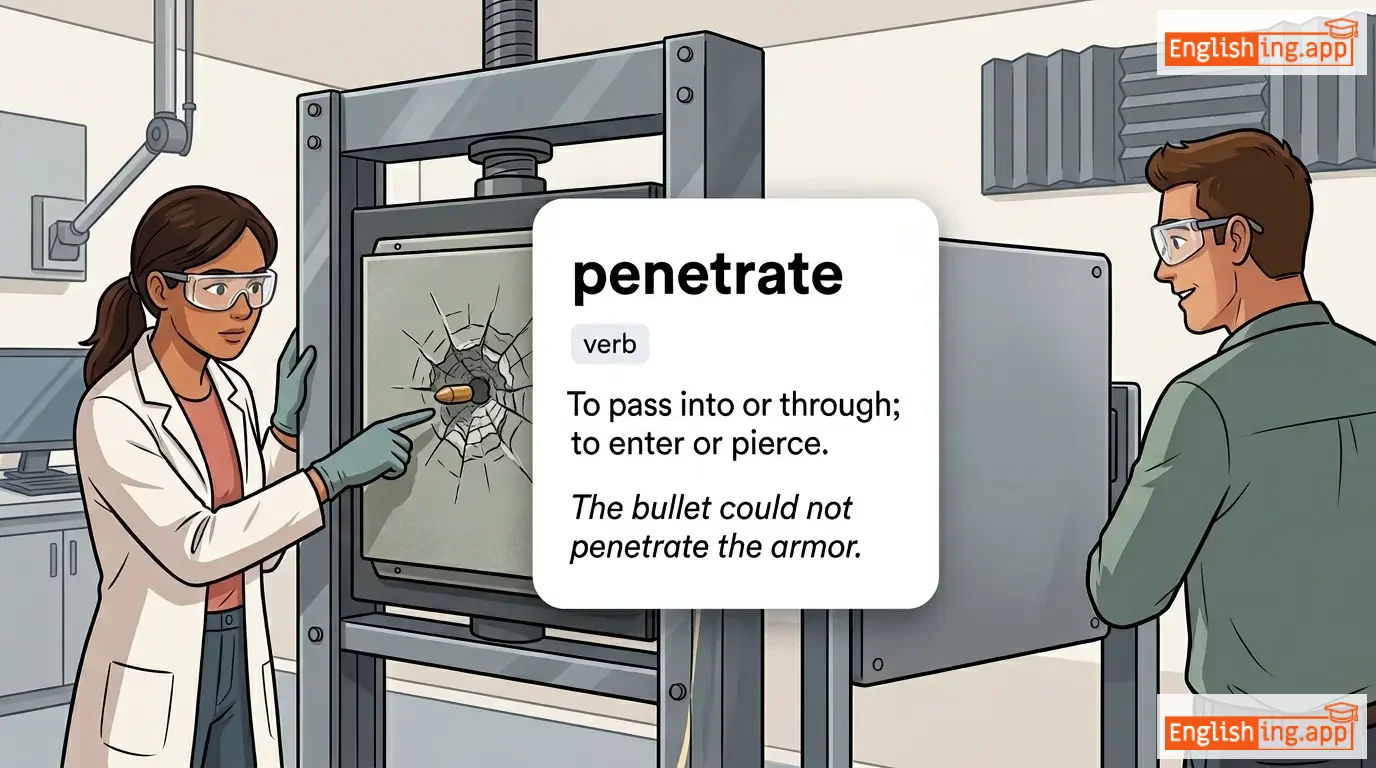
penetrate definition card — visual illustration of the meaning
verb
/ˈpɛnɪtreɪt/
pénétrer (penetrer)

To pass into or through; to enter or pierce.

"The bullet could not penetrate the armor."

"La balle n'a pas pu pénétrer l'armure." (La balle n'a pas pu pénétrer l'armure.)
adjective
/ˈpɛnɪtrəbl/
pénétrable (penetrable)

Capable of being passed through or entered.

"The thin wall was easily penetrable."

"Le mur mince était facilement pénétrable." (Le mur mince était facilement pénétrable.)
noun
/ˈpɛndjələm/
pendule (pendule)

A weight suspended from a pivot so that it swings freely, often used to regulate clocks.

"The pendulum swung back and forth inside the clock."

"Le pendule oscillait d'avant en arrière à l'intérieur de l'horloge." (Le pendule oscillait d'avant en arrière à l'intérieur de l'horloge.)
adjective
/ˈpɛndjʊləs/
bonheur (bonheur)

hanging down loosely; drooping

"The pendulous fruit weighed down the branch."

"Elle ne pouvait cacher son bonheur lorsqu'elle reçut le prix." (Elle ne pouvait cacher son bonheur lorsqu'elle reçut le prix.)
adjective
/ˈpɛndɪŋ/
en attente (en attente)

awaiting decision or settlement

"The case is still pending in court."

"L'affaire est toujours en attente au tribunal." (L'affaire est toujours en attente au tribunal.)
adjective
/ˈpɛndənt/
pendant (pendant)

hanging down or suspended

"The pendent branches touched the ground."

"Les branches pendantes ont touché le sol." (Les branches pendantes ont touché le sol.)
noun
/ˈpɛndənt/
pendentif (pendentif)

a piece of jewelry that hangs from a chain worn around the neck

"She wore a silver pendant around her neck."

"Elle portait un pendentif en argent autour du cou." (Elle portait un pendentif en argent autour du cou.)
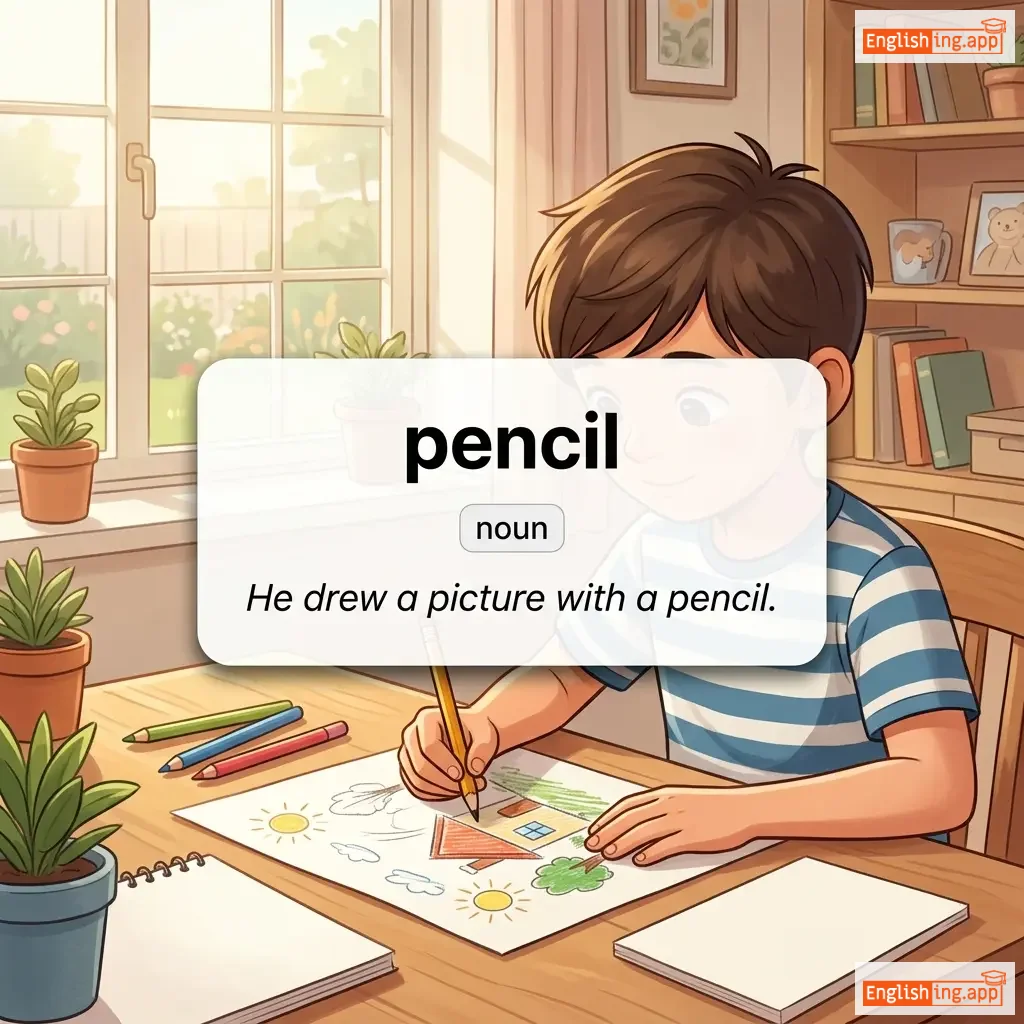
pencil definition card — visual illustration of the meaning
noun
/ˈpɛnsəl/
crayon (crayon)

an instrument for writing or drawing, typically made of wood with a graphite core

"He drew a picture with a pencil."

"Il a dessiné un dessin avec un crayon." (Il a dessine un dessin avec un crayon.)
penchant definition card — visual illustration of the meaning
noun
/ˈpɒ̃ʃɒ̃/
penchant (penchant)

a strong or habitual liking for something or tendency to do something

"She has a penchant for collecting rare books."

"Elle a un penchant pour collectionner des livres rares." (Elle a un penchant pour collectionner des livres rares.)
🧑‍🤝‍🧑

peer (pir)

noun, verb
/pɪə(r)/
pair (pair)

noun: a person of the same rank or status; verb: to look closely or with difficulty

"He tried to peer through the fog to see his peers on the other side."

"Il a essayé de regarder à travers le brouillard pour voir ses pairs de l'autre côté." (Il a essayé de regarder à travers le brouillard pour voir ses pairs de l'autre côté.)
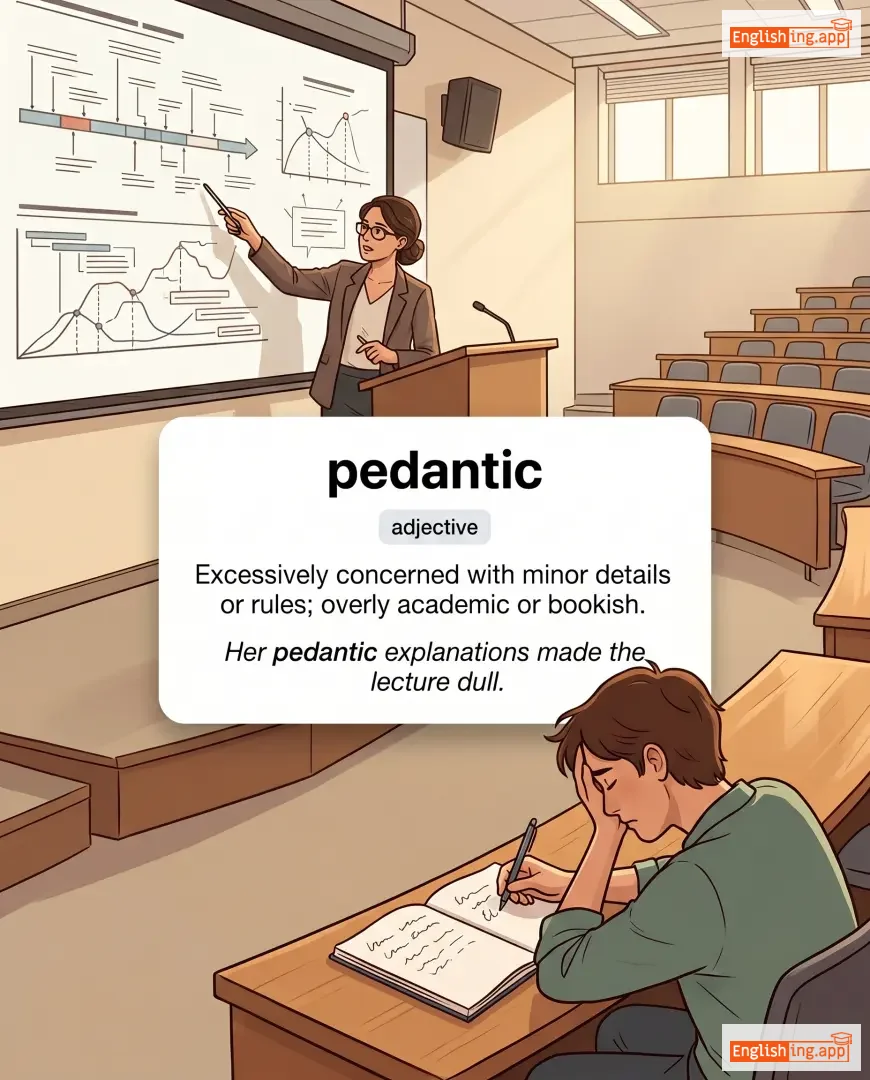
pedantic definition card — visual illustration of the meaning
adjective
/pəˈdæntɪk/
excessivement préoccupé par les détails mineurs ou les règles (excessivement preoccupe par les details mineurs ou les regles)

Excessively concerned with minor details or rules; overly academic or bookish.

"Her pedantic explanations made the lecture dull."

"Ses explications pédantes ont rendu la conférence ennuyeuse." (Ses explications pédantes ont rendu la conférence ennuyeuse.)
noun
/ˈpɛd.ən.tri/
préoccupation excessive pour les détails ou les règles mineures (preoccupation excessive pour les details ou les regles mineures)

Excessive concern with minor details or rules.

"His pedantry made the meeting unnecessarily long."

"Sa pédanterie a rendu la réunion inutilement longue." (Sa pedanterie a rendu la reunion inutilement longue.)
verb
/ˈpɛdəl/
vendre (vendre)

To sell goods, often by going from place to place; sometimes used negatively to mean promoting an idea or product in a pushy way.

"Street vendors peddle handmade jewelry to tourists."

"Les vendeurs de rue vendent des bijoux faits à la main aux touristes." (Les vendeurs de rue vendent des bijoux faits à la main aux touristes.)
noun
/ˈpɛdlər/
vendeur ambulant (vendeur ambulant)

a person who sells goods, often traveling from place to place

"The peddler walked through the village selling fresh fruits."

"Le vendeur ambulant traversait le village en vendant des fruits frais." (Le vendeur ambulant traversait le village en vendant des fruits frais.)
noun
/ˈpɛdəstəl/
socle / piédestal (socle / piedestal)

the base or support on which a statue or object stands

"The statue was placed on a marble pedestal."

"La statue a été placée sur un piédestal en marbre." (La statue a été placée sur un piédestal en marbre.)
noun, adjective
/pəˈdɛstriən/
piéton (pieton)

a person walking on the street; also means dull or ordinary

"The pedestrian crossed the road at the crosswalk."

"Le piéton a traversé la rue sur le passage piéton." (Le pieton a traverse la rue sur le passage pieton.)
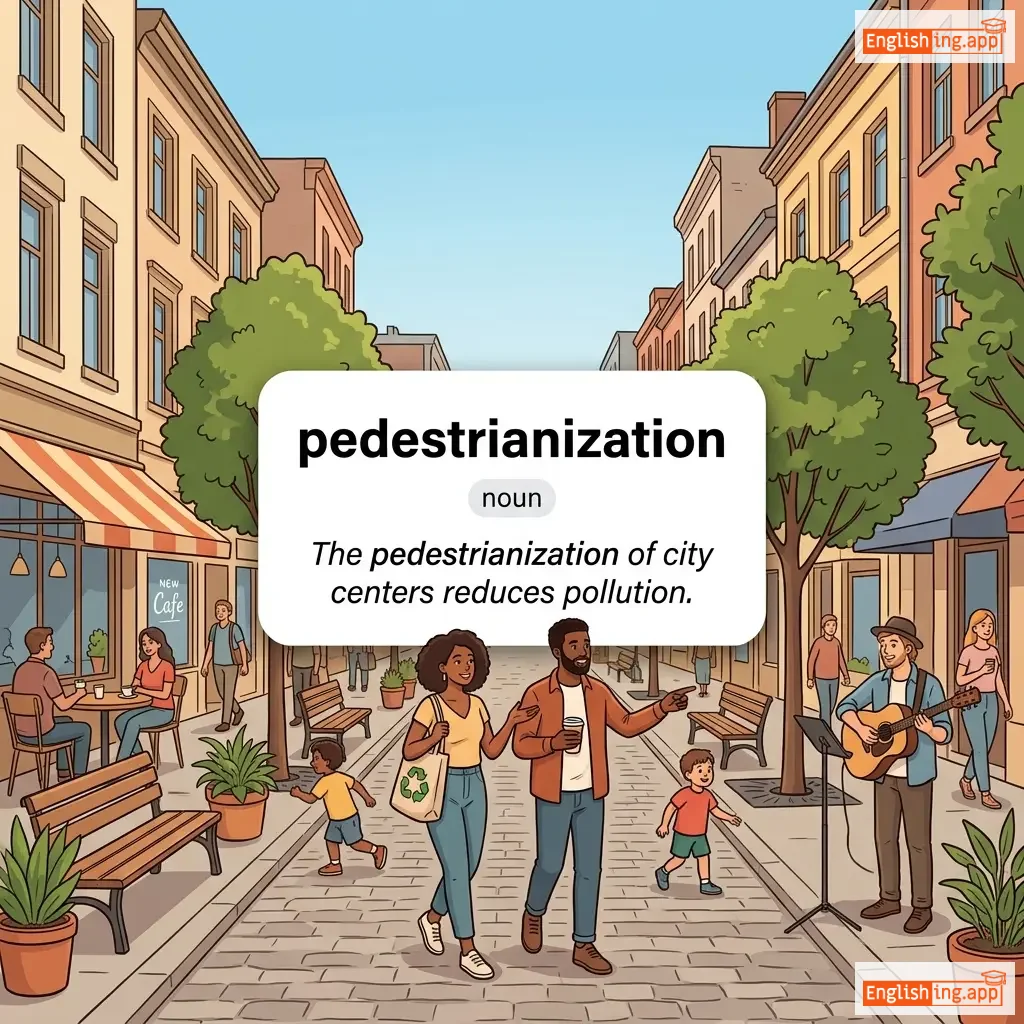
pedestrianization definition card — visual illustration of the meaning
noun
/pɪˌdɛs.tri.ə.naɪˈzeɪ.ʃən/
pédestrianisation (pedestrianisation)

Making areas pedestrian-friendly, closing any area to vehicle traffic and making it open only for pedestrians.

"The pedestrianization of city centers reduces pollution."

"La piétonnisation des centres-villes réduit la pollution." (La pietonnisation des centres-villes reduit la pollution.)
noun
/ˌpiːdiəˈtrɪʃən/
pédiatre (pediatre)

a doctor who specializes in the medical care of children

"The pediatrician examined the child carefully."

"Le pédiatre a examiné l'enfant avec soin." (Le pediatre a examine l'enfant avec soin.)
noun
/ˌpiːdiˈætrɪks/
pédiatrie (pediatrie)

the branch of medicine dealing with the health and medical care of children

"She decided to specialize in pediatrics after medical school."

"Elle a décidé de se spécialiser en pédiatrie après l'école de médecine." (Elle a decide de se specialiser en pediatrie apres l'ecole de medecine.)
noun
/ˈpɛdɪɡriː/
lignée (ligne)

the recorded ancestry or lineage of a person, family, or animal; the history or origin of something

"The dog has a pedigree that traces back several generations."

"Le chien a une lignée qui remonte à plusieurs générations." (Le chien a une ligne qui remonte à plusieurs générations.)
noun
/ˈpɛdɪmənt/
fronton triangulaire (fronton triangulaire)

a triangular gable found above the horizontal structure of a building, often in classical architecture

"The ancient temple had a pediment decorated with sculptures."

"Le temple antique avait un fronton décoré de sculptures." (Le temple antique avait un fronton décoré de sculptures.)
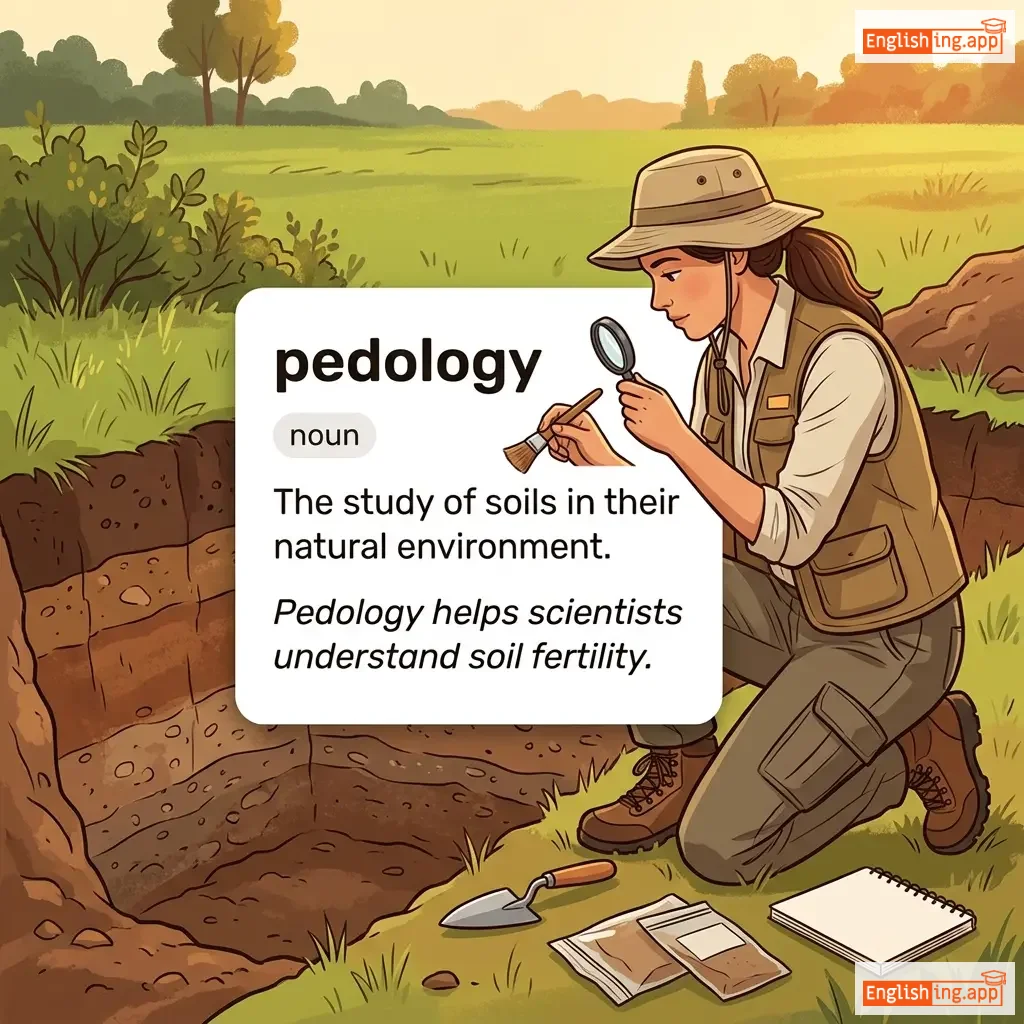
pedology definition card — visual illustration of the meaning
noun
/pɪˈdɒl.ə.dʒi/
science des sols (science des sols)

The study of soils in their natural environment.

"Pedology helps scientists understand soil fertility."

"La pédologie aide les scientifiques à comprendre la fertilité du sol." (La pédologie aide les scientifiques à comprendre la fertilité du sol.)
verb
/piːl/
peler (peler)

to remove the outer covering or skin from a fruit or vegetable

"She peeled the mango before eating it."

"Elle a pelé la mangue avant de la manger." (Elle a pelé la mangue avant de la manger.)
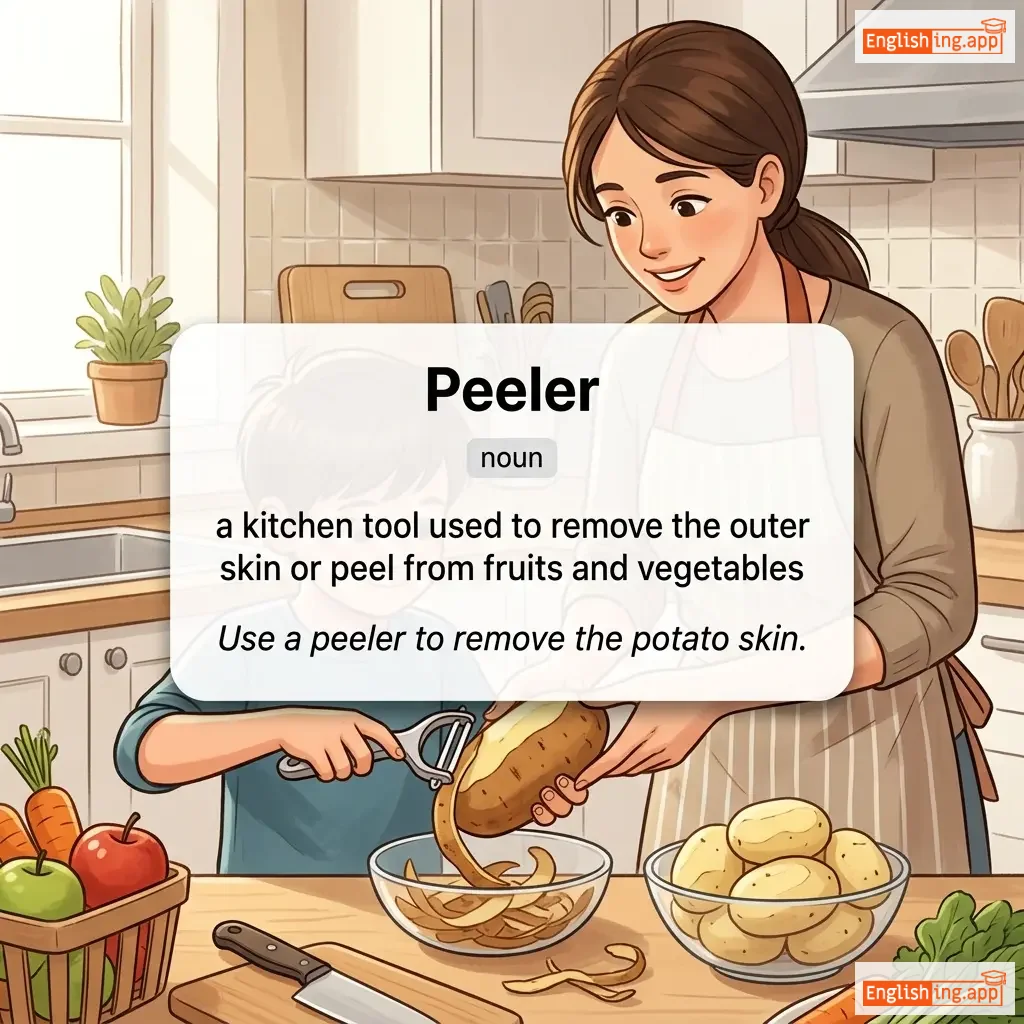
Peeler definition card — visual illustration of the meaning
noun
/ˈpiː.lər/
éplucheur (epuleur)

a kitchen tool used to remove the outer skin or peel from fruits and vegetables

"Use a peeler to remove the potato skin."

"Utilisez un éplucheur pour enlever la peau de la pomme de terre." (Utilisez un éplucheur pour enlever la peau de la pomme de terre.)
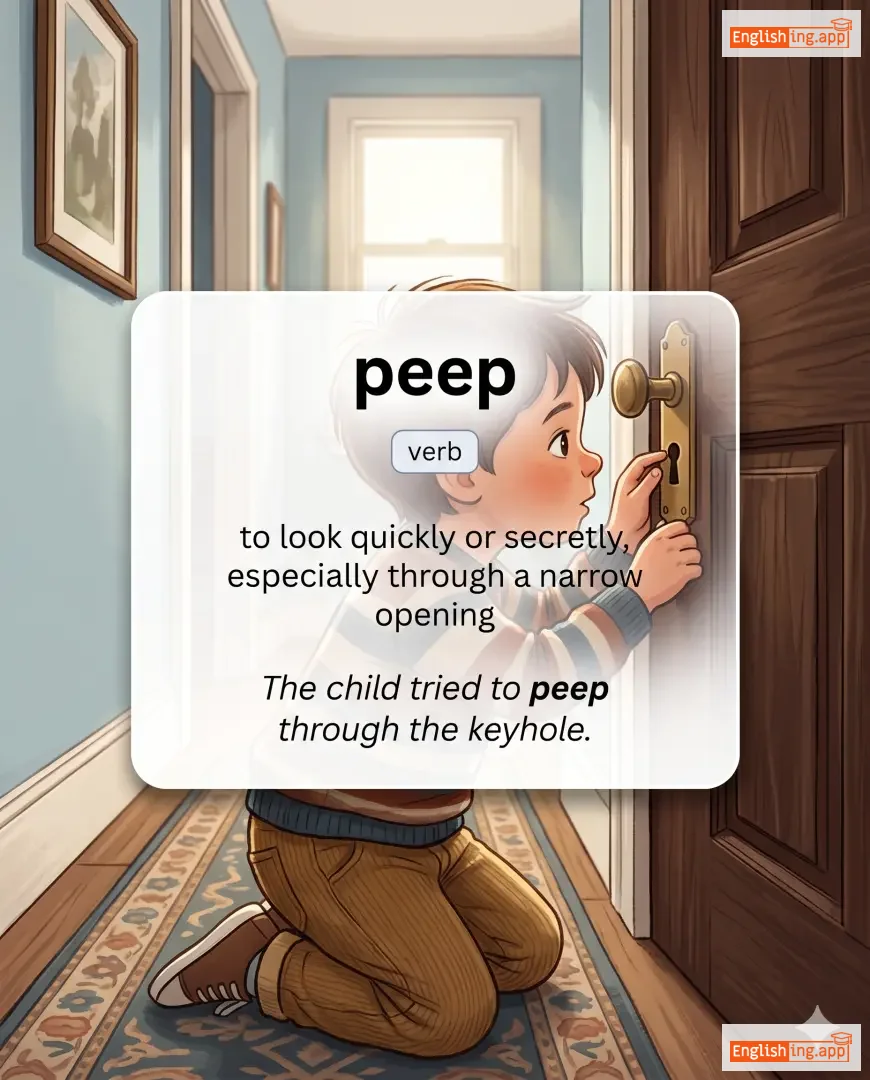
peep definition card — visual illustration of the meaning
verb
/piːp/
espionner (espionner)

to look quickly or secretly, especially through a narrow opening

"The child tried to peep through the keyhole."

"L'enfant a essayé de regarder par le trou de serrure." (L'enfant a essaie de regarder par le trou de serrure.)
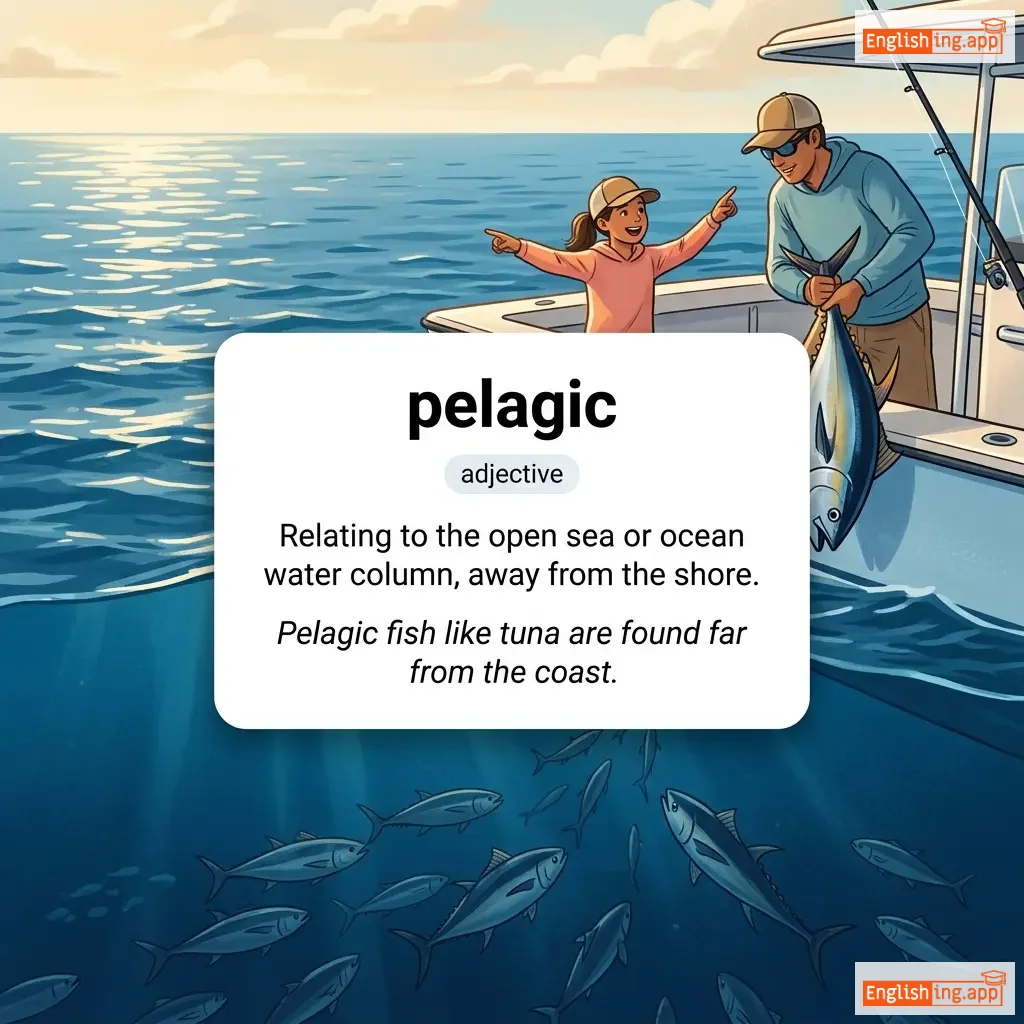
pelagic definition card — visual illustration of the meaning
adjective
/pəˈlædʒ.ɪk/
relatif à l'océan ouvert (relatif a l'ocean ouvert)

Relating to the open sea or ocean water column, away from the shore.

"Pelagic fish like tuna are found far from the coast."

"Les poissons pélagiques comme le thon se trouvent loin de la côte." (Les poissons pélagiques comme le thon se trouvent loin de la côte.)
noun
/ˈpɛnəlti/
pénalité (penalite)

A punishment imposed for breaking a law, rule, or contract.

"He had to pay a heavy penalty for breaking the traffic rules."

"Il a dû payer une lourde pénalité pour avoir enfreint les règles de circulation." (Il a du payer une lourde penalite pour avoir enfreint les regles de circulation.)
Pen stand definition card — visual illustration of the meaning
noun
/pen stænd/
porte-stylo (porte-stylo)

a container or holder designed to keep pens, pencils, and other writing instruments organized

"He organized his pens in the pen stand on his desk."

"Il a organisé ses stylos dans le porte-stylo sur son bureau." (Il a organise ses stylos dans le porte-stylo sur son bureau)
noun
/ˈpen neɪm/
pseudonyme (pseudonyme)

a fictitious name used by an author instead of their real name; a pseudonym

"Mark Twain was the pen-name of Samuel Clemens."

"Mark Twain était le pseudonyme de Samuel Clemens." (Mark Twain etait le pseudonyme de Samuel Clemens.)
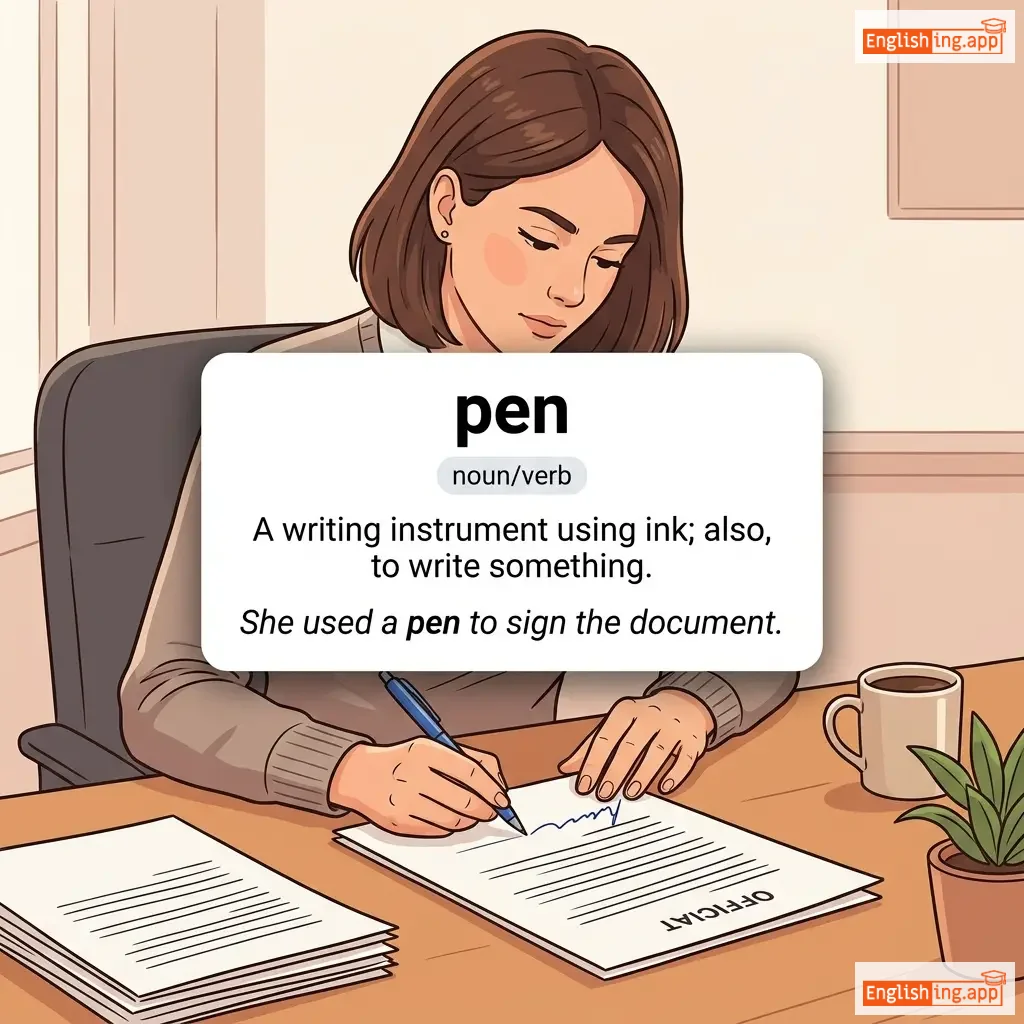
pen definition card — visual illustration of the meaning
noun/verb
/pɛn/
bonheur (bonheur)

A writing instrument using ink; also, to write something.

"She used a pen to sign the document."

"Elle n'a pas pu cacher son bonheur quand elle a reçu le prix." (Elle n'a pas pu cacher son bonheur quand elle a reçu le prix.)
adjective
/pəˈluːsɪd/
transparent (transparent)

Transparently clear; easy to understand.

"The lake water was so pellucid that you could see the stones at the bottom."

"L'eau du lac était tellement transparente que vous pouviez voir les pierres au fond." (L'eau du lac etait tellement transparente que vous pouviez voir les pierres au fond.)
🏃‍♂️

pell-mell (pel-mel)

adverb
/ˌpɛlˈmɛl/
de manière désordonnée (de maniere desordonnee)

In a confused, rushed, or disorderly manner.

"The children ran pell-mell through the playground."

"Les enfants ont couru de manière désordonnée à travers la cour de récréation." (Les enfants ont couru de maniere desordonnee a travers la cour de recreation.)
noun
/pɛlf/
argent malhonnête (argent malhonnete)

Money, especially when gained dishonorably.

"The corrupt official was motivated only by pelf."

"Le fonctionnaire corrompu était motivé uniquement par l'argent malhonnête." (Le fonctionnaire corrompu était motivé uniquement par l'argent malhonnête.)
verb
/piːv/
agacer (agacer)

To annoy or irritate someone.

"His constant interruptions really peeve me."

"Ses interruptions constantes me vexent vraiment." (Ses interruptions constantes me vexent vraiment.)
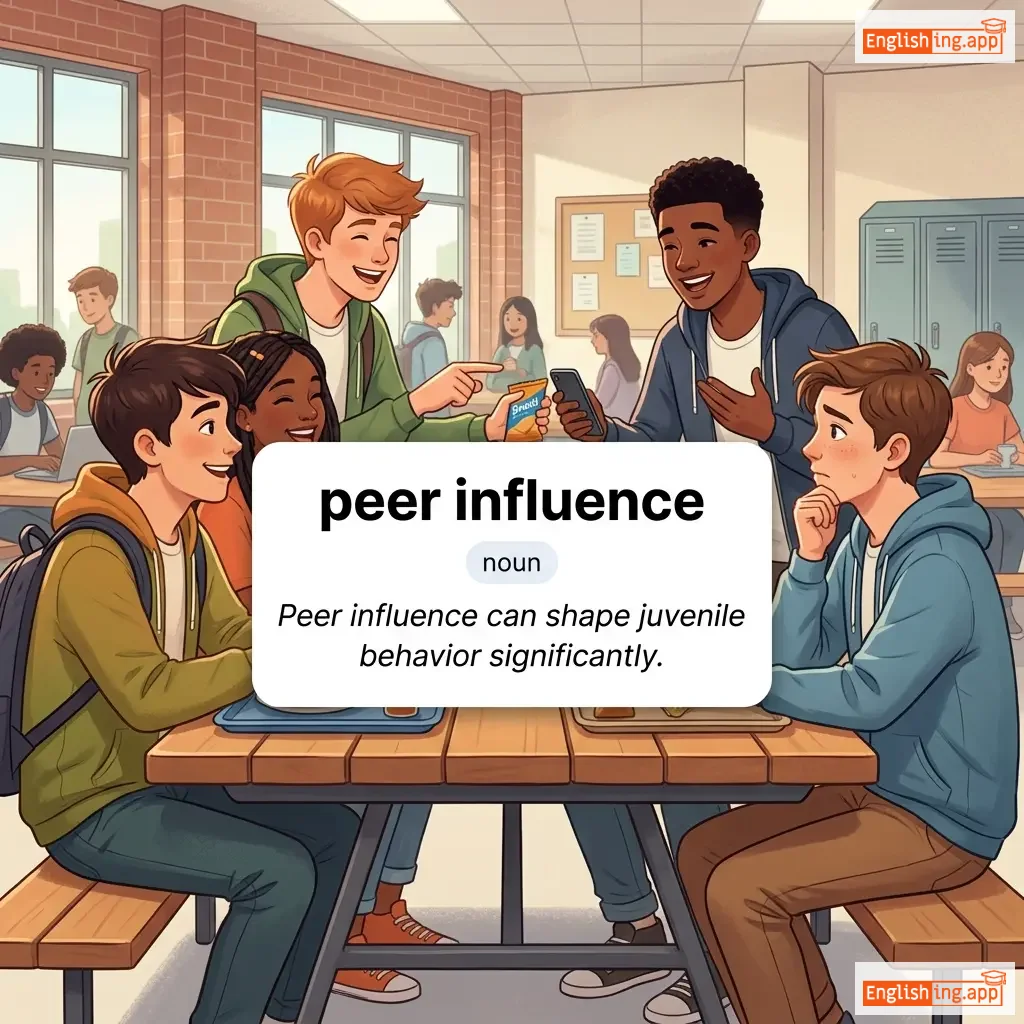
peer influence definition card — visual illustration of the meaning
noun
pɪər ˈɪnfluəns
influence des pairs (influence des pairs)

The effect that members of a peer group have on each other, especially in terms of behavior, attitudes, and decision-making.

"Peer influence can shape juvenile behavior significantly."

"L'influence des pairs peut façonner de manière significative le comportement des jeunes." (L'influence des pairs peut faconner de maniere significative le comportement des jeunes.)
noun
/ˈpɪərɪdʒ/
noblesse (noblesse)

the title or rank of a peer; the nobility as a group

"He was elevated to the peerage by the king."

"Il a été élevé à la noblesse par le roi." (Il a été élevé à la noblesse par le roi.)
adjective
/ˈpɪələs/
incomparable (incomparable)

Unequaled; without rival or match.

"Her peerless performance earned her a standing ovation."

"Sa performance incomparable lui a valu une ovation debout." (Sa performance incomparable lui a valu une ovation debout.)
noun
/pəˈnʌmbrə/
zone partiellement ombragée (zone partiellement ombragée)

a partially shaded area around the shadow of an object, especially during an eclipse

"The moon’s penumbra created a dim shadow over the Earth."

"La pénumbra de la lune a créé une ombre tamisée sur la Terre." (La pénumbra de la lune a créé une ombre tamisée sur la Terre.)