語彙集

英単語辞書 | 単語の意味、定義、例文

verb
/bɪˈhuːv/
誰かが何かをすることが必要または適切である (dareka ga nanika o suru koto ga hitsuyou matawa tekisetsu de aru)

to be necessary, proper, or appropriate for someone to do

"It would behoove you to study before the exam."

"試験の前に勉強することが必要です。" (Shiken no mae ni benkyou suru koto ga hitsuyou desu.)
verb
/bɪˈhuːvz/
必要である (hitsuyou de aru)

third person singular form of 'behoove'; means it is proper or necessary

"It behooves every citizen to follow the law."

"すべての市民は法律を守るべきです。" (Subete no shimin wa hōritsu o mamoru beki desu.)
verb
/bɪˈhəʊv/
適切である (tekisetsu de aru)

British spelling of 'behoove'; to be appropriate or necessary

"It would behove the company to listen to its customers."

"会社は顧客の意見に耳を傾けるべきです。" (Kaisha wa kokyaku no iken ni mimi o katamukeru beki desu.)
noun/verb
/ˈbiːɪŋ/
存在 (sonzai)

Existence; the state of living; a living creature.

"Kindness is part of being human."

"親切は人間であることの一部です。" (Shinsetsu wa ningen de aru koto no ichibu desu.)
🗣️

belabor

verb
/bɪˈleɪbər/

to argue or elaborate on a subject in excessive detail; to attack verbally or physically

"The professor belabored the point until the students grew restless."

verb
/bɪˈleɪbə/
くどく説明する (kudoku setsumei suru)

to explain something repeatedly or with excessive detail; to criticize or attack verbally at length

"The teacher did not belabour the point once the students understood it."

"学生が理解した後、教師はその点をくどく説明しなかった。" (gakusei ga rikai shita ato kyoushi wa sono ten o kudoku setsumei shinakatta)
verb
/bɪˈleɪt/
遅れる (okureru)

to delay or make late

"Heavy traffic belated our arrival at the party."

"渋滞が私たちのパーティーへの到着を遅らせました。" (Jūtai ga watashitachi no pātī e no tōchaku o okurashimashita.)
adjective
/bɪˈleɪtɪd/
遅れた (okureta)

coming or happening later than expected or usual

"She sent me a belated birthday card."

"彼女は遅れた誕生日カードを送ってくれた。" (Kanojo wa okureta tanjoubi kaado wo okutte kureta.)
verb
/bɪˈleɪ/
ロープを固定する (rōpu o kotei suru)

to secure a rope by winding it around an object; to stop or cancel an order (nautical/military use)

"The climber asked his partner to belay the rope tightly."

"クライマーはパートナーにロープをしっかりと確保するように頼んだ。" (Kuraimā wa pātonā ni rōpu o shikkari to kakuho suru yō ni tanonda.)
verb; noun
/beltʃ/
げっぷをする (geppu o suru)

to expel air noisily from the stomach through the mouth; to emit or pour out suddenly and forcefully

"After drinking the soda, he belched loudly."

"ソーダを飲んだ後、彼は大きなげっぷをした。" (sooda o nonda ato kare wa ookina geppu o shita)
noun
/ˈbeɪleɪ/
ベレ魚 (bere sakana)

a type of freshwater fish found in South Asian rivers, known for its distinctive appearance

"The bele fish is commonly caught in the rivers of Bangladesh."

"ベレ魚はバングラデシュの川でよく捕まえられる。" (bere sakana wa banguradeshu no kawa de yoku tsukamaerareru)
verb
/bɪˈliːɡər/
包囲する, 困らせる (hōi suru, komarasero)

to cause difficulties, troubles, or harassment; to surround with military forces

"The company was beleaguered by constant complaints from its customers."

"その会社は顧客からの絶え間ない苦情で包囲されていた。" (Sono kaisha wa kokyaku kara no taemanai kujō de hōi sarete ita.)
noun
/ˈbɛlfri/
鐘楼 (shōrō)

A bell tower, especially one attached to a church or building.

"The church belfry housed a large bronze bell."

"教会の鐘楼には大きな銅の鐘がありました。" (Kyōkai no shōrō ni wa ōkina dō no kane ga arimashita.)
belie definition card — visual illustration of the meaning
verb
/bɪˈlaɪ/
偽る (itsuwaru)

To give a false impression of something; to contradict.

"His calm face belied his inner anxiety."

"彼の落ち着いた顔は彼の内なる不安を偽っていた。" (Kare no ochitsuita kao wa kare no uchi naru fuan o itsuwatte ita.)
noun
/bɪˈliːf/
信念 (shinnen)

an acceptance that something exists or is true, especially without proof

"Her belief in kindness inspired many people."

"彼女の親切さへの信念は多くの人々にインスピレーションを与えました。" (kanojo no shinsetsu sa e no shinnen wa ooku no hitobito ni insupireeshon wo ataemashita.)
adjective
/bɪˈliːvəbl̩/
信じられる (shinjirareru)

Able to be trusted or accepted as true or reasonable.

"Her story was so detailed that it sounded believable."

"彼女の話は非常に詳細で、信じられるように聞こえました。" (Kanojo no hanashi wa hijō ni shōsai de, shinjiraru yō ni kikoemashita.)
believe definition card — visual illustration of the meaning
verb
/bɪˈliːv/
信じる (shinjiru)

To accept something as true; to have faith or confidence in.

"She believes in the power of kindness."

"彼女は親切の力を信じています。" (Kanojo wa shinsetsu no chikara o shinjiteimasu.)
noun
/bɪˈliːvər/
信者 (shinja)

a person who believes in something, especially a religious faith, idea, or principle

"She is a strong believer in hard work and honesty."

"彼女は努力と正直さを強く信じている。" (kanojo wa doryoku to shojikisa o tsuyoku shinjite iru)
verb
/bɪˈlɪtl/
軽視する (keishi suru)

To make someone or something seem less important or less valuable.

"He often belittled his coworkers to feel superior."

"彼はしばしば自分を優位に感じるために同僚を軽視していた。" (Kare wa shibashiba jibun o yūi ni kanjiru tame ni dōryō o keishi shiteita.)
🔔

Bell

noun
/bɛl/

a hollow object, usually made of metal, that makes a ringing sound when struck

"The school bell rang loudly at noon."

noun
/bel ˈæp.əl/
ベルリンゴ (beru ringo)

a tropical fruit with a crisp texture and sweet taste, scientifically known as Syzygium malaccense

"The bell apple tree produces beautiful red fruits that are popular in tropical regions."

"ベルリンゴの木は美しい赤い果物を生産し、熱帯地域で人気があります" (Beru ringo no ki wa utsukushī akai kudamono o seisan shi, nettai chiiki de ninki ga arimasu)
noun
/bɛl/
美しい女性 (utsukushii josei)

A beautiful woman, especially the most attractive woman at a gathering.

"She was the belle of the ball that evening."

"彼女はその晩の舞踏会のベルでした。" (Kanojo wa sono ban no butoukai no beru deshita.)
adjective
/ˈbɛlɪˌkoʊs/
戦闘的 (sentō-teki)

Showing a tendency to argue or fight; aggressive.

"His bellicose attitude often got him into unnecessary conflicts."

"彼の戦闘的な態度はしばしば不必要な対立を引き起こした。" (Kare no sentō-teki na taido wa shibashiba fuhitsuyōna tairitsu o hikiokoshita.)
belligerent definition card — visual illustration of the meaning
adjective
/bəˈlɪdʒərənt/
好戦的な (kōsenteki na)

Hostile and aggressive; eager to fight.

"She became belligerent when the waiter got her order wrong."

"彼女はウェイターが注文を間違えたとき、好戦的になった。" (Kanojo wa weitaa ga chūmon o machigaeta toki, kōsenteki ni natta.)
noun
/ˈbɛlˌwɛðər/
先駆者 (senkusha)

A person or thing that leads or indicates a trend.

"The company is seen as a bellwether of the technology industry."

"その会社はテクノロジー業界の先駆者と見なされています。" (Sono kaisha wa tekunorojī gyōkai no senkusha to minasareteimasu.)
noun
/ˈbɛli/
お腹 (onaka)

The front part of the human body below the chest; stomach or abdomen.

"He rubbed his belly after the big meal."

"彼は大きな食事の後、お腹を擦った。" (Kare wa ōkina shokuji no ato, onaka o sutta.)
verb
/bɪˈlɒŋ/
所属する (shozoku suru)

to be in the right place or to be a member of a group

"She felt she truly belonged to the team."

"彼女はチームに本当に所属していると感じていました。" (Kanojo wa chīmu ni hontōni shozoku shite iru to kanjite imashita.)
adjective
/bɪˈlʌvɪd/
愛されている (aisareteiru)

dearly loved, highly regarded

"She was the beloved queen of the kingdom."

"彼女は王国の愛されている女王でした。" (Kanojo wa ōkoku no aisareteiru joō deshita.)
preposition
/bɪˈloʊ/
(shita)

At a lower level or position than something else.

"The basement is below the ground floor."

"地下室は一階の下にあります。" (Chikashitsu wa ikkai no shita ni arimasu.)
👖

Belt

noun
/bɛlt/

a strip of material worn around the waist to support clothes or as decoration

"He tightened his belt before leaving for work."

verb
/bɪˈmoʊn/
嘆く (nageku)

To express discontent or sorrow over something.

"Critics bemoaned the lack of diversity in the film."

"批評家たちは映画の多様性の欠如を嘆いた。" (Hihyōka-tachi wa eiga no tayō-sei no ketsujo o nageita.)
verb
/bɪˈmjuːz/
困惑させる (konwaku saseru)

To confuse or puzzle someone.

"The complex instructions bemused the new employees."

"複雑な指示が新しい従業員を困惑させました。" (Fukuzatsu na shiji ga atarashī jūgyōin o konwaku sasemashita.)
adjective
/bɪˈmjuːzd/
困惑した, ぼんやりした (konwaku shita, bonyari shita)

confused, puzzled, or lost in thought

"She looked bemused when he asked the strange question."

"彼が奇妙な質問をしたとき、彼女は困惑しているように見えた。" (Kare ga kimyō na shitsumon o shita toki, kanojo wa konwaku shite iru yō ni mieta.)
noun
/bɛntʃ/
ベンチ (benchi)

a long seat for several people, typically made of wood or stone

"They sat on the park bench watching the sunset."

"彼らは公園のベンチに座って夕日を見ていました。" (Karera wa kouen no benchi ni suwatte yuuhi wo miteimashita.)
benchmark definition card — visual illustration of the meaning
noun
/ˈbɛntʃmɑːrk/
基準 (kijun)

a standard or point of reference against which things are compared or assessed

"The company set a new benchmark for customer service."

"その会社は顧客サービスの新しい基準を設定しました。" (Sono kaisha wa kokyaku saabisu no atarashī kijun o settei shimashita.)
benchmarking definition card — visual illustration of the meaning
noun
/ˈbɛntʃˌmɑːr.kɪŋ/
ベンチマーキング (benchimākingu)

Comparing with a specific industry or competitor to set standards

"Companies use benchmarking to assess their performance."

"企業はパフォーマンスを評価するためにベンチマーキングを使用します。" (Kigyō wa pafōmansu o hyōka suru tame ni benchimākingu o shiyō shimasu.)
verb
/bɛnd/
曲げる / かがむ (mageru / kagamu)

to curve something or cause it to change shape; to move the body or part of it downward or forward

"She had to bend down to pick up the coin."

"彼女はコインを拾うためにかがむ必要がありました。" (Kanojo wa koin o hirou tame ni kagamu hitsuyou ga arimashita.)
adjective
/ˈbɛndi/
柔軟な (jūnan na)

Easily curved or flexible.

"The bendy straw made it easier to drink from the cup."

"曲がるストローでカップから飲むのが楽になった。" (Magaru sutōrō de kappu kara nomu no ga raku ni natta.)
preposition
/bɪˈniːθ/
(shita)

in or to a lower position than something; under

"The cat was hiding beneath the bed."

"猫はベッドの下に隠れていた。" (Neko wa beddo no shita ni kakurete ita.)
noun
/ˌbɛnɪˈdɪkʃən/
祝福 (shukufuku)

a blessing or expression of good wishes, often at the end of a religious service

"The priest gave a final benediction before the congregation left."

"神父は会衆が去る前に最後の祝福を与えました。" (Shinpu wa kaishū ga saru mae ni saigo no shukufuku o ataemashita.)
noun
/ˈbɛnɪˌfæktər/
寄付者, 恩人 (kifusha, onjin)

a person who gives money or help to a cause or individual

"The school received a large donation from an anonymous benefactor."

"学校は匿名の寄付者から大きな寄付を受け取りました。" (Gakkō wa tokumei no kifusha kara ōkina kifu o ukemashita.)
noun
/ˈbɛnɪfɪs/
教会職 (kyōkai shoku)

a permanent church appointment for which property and income are provided

"The bishop appointed him to a wealthy benefice."
"司教は彼を裕福な教会職に任命しました。" (Shikyō wa kare o yūfukuna kyōkai shoku ni ninmei shimashita.)
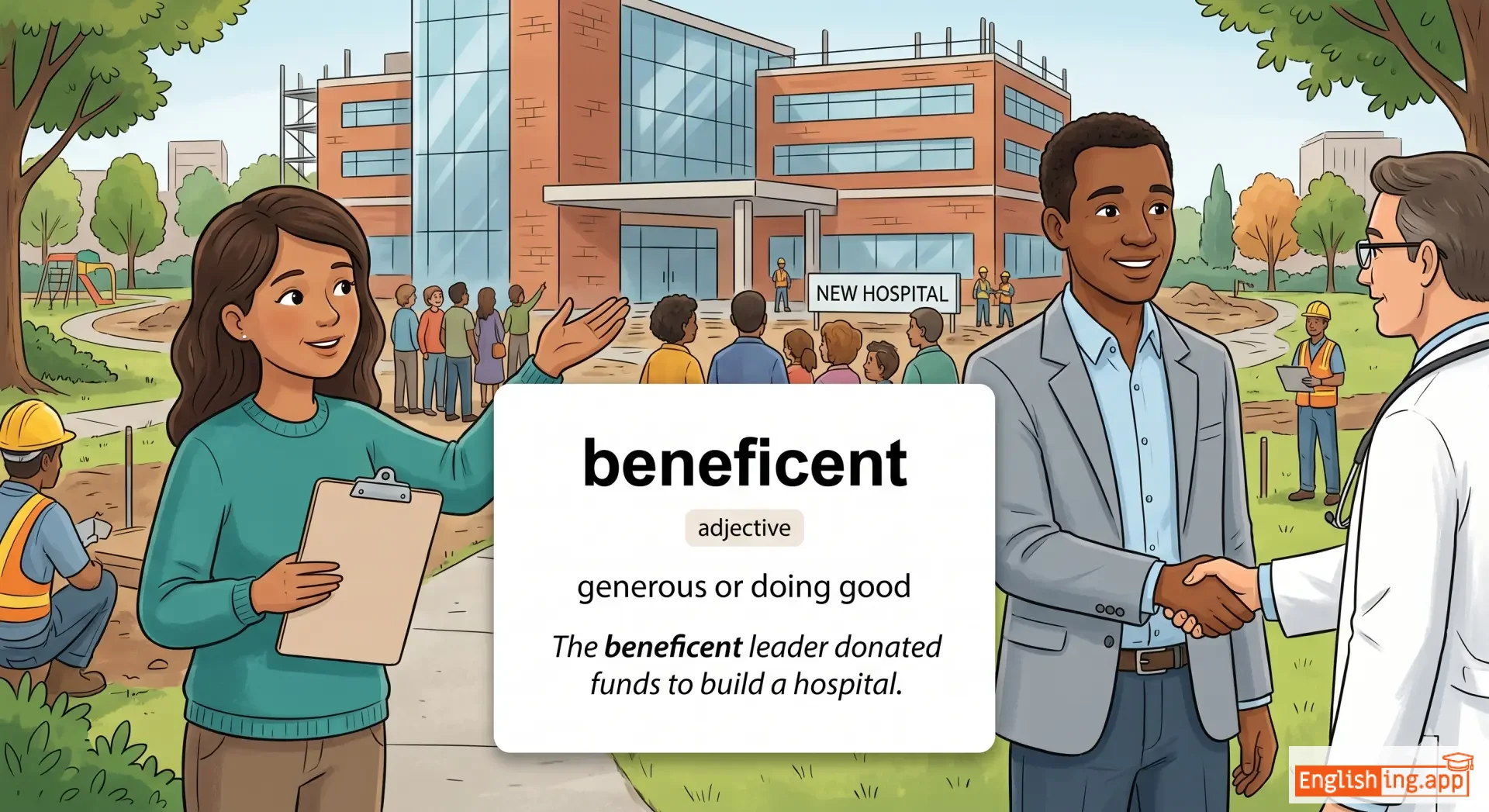
beneficent definition card — visual illustration of the meaning
adjective
/bəˈnɛfɪsənt/
慈悲深い, 寛大な (jihi fukai, kandaina)

generous or doing good

"The beneficent leader donated funds to build a hospital."

"寛大な指導者は病院を建設するために資金を寄付しました。" (Kandaina shidōsha wa byōin o kensetsu suru tame ni shikin o kifu shimashita.)
beneficial definition card — visual illustration of the meaning
adjective
/ˌbɛnɪˈfɪʃəl/
有益な (yuueki na)

producing good or helpful results; favorable or advantageous

"Regular exercise is beneficial for your health."

"定期的な運動はあなたの健康に有益です。" (Teikiteki na undou wa anata no kenko ni yūeki desu.)
noun
/ˌbɛnɪˈfɪʃəri/
受益者 (shūekisha)

a person who receives something, especially money or property, from a will or insurance policy

"She is the sole beneficiary of her father’s estate."

"彼女は父親の遺産の唯一の受益者です。" (Kanojo wa chichioya no isan no yuiitsu no shūekisha desu.)
noun/verb
/ˈbɛnɪfɪt/
利益 / 便益 (rieki / ben'eki)

an advantage, profit, or good effect; to receive help or an advantage

"Employees benefit from the company’s health insurance program."
"従業員は会社の健康保険プログラムから利益を得ます。" (jūgyōin wa kaisha no kenko hoken puroguramu kara rieki o emasu.)
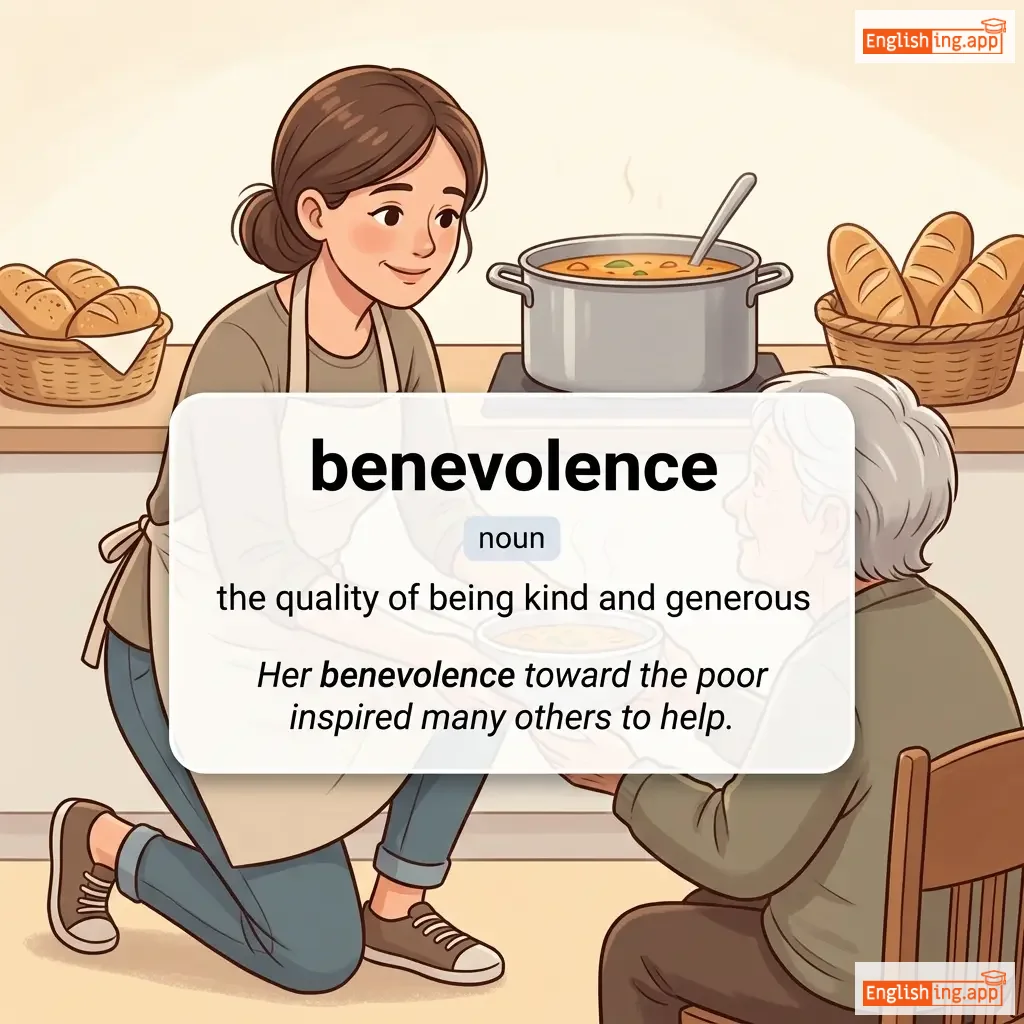
benevolence definition card — visual illustration of the meaning
noun
/bəˈnɛvələns/
慈善 (jizen)

the quality of being kind and generous

"Her benevolence toward the poor inspired many others to help."

"貧しい人々への彼女の慈善は、多くの人々を助けるように促しました。" (Mazushii hitobito e no kanojo no jizen wa, ooku no hitobito wo tasukeru you ni unagimashita.)
benevolent definition card — visual illustration of the meaning
adjective
/bəˈnɛvələnt/
慈悲深い (jihi fukai)

well-meaning and kindly; generous

"The benevolent teacher helped students beyond the classroom."

"慈悲深い教師は教室を超えて生徒を助けました。" (Jihi fukai kyoushi wa kyoushitsu o koete seito o tasukemashita.)
adjective
/bɪˈnaɪtɪd/
暗い、無知な (kurai, muchina)

In a state of intellectual or moral ignorance; overtaken by darkness.

"The explorers were lost in the benighted forest without any guide."

"探検家たちはガイドなしで暗い森の中で迷子になった。" (Tankenka-tachi wa gaido nashi de kurai mori no naka de maigo ni natta.)
adjective
/bɪˈnaɪn/

Gentle, kind, or not harmful (especially of a disease or tumor).

"The doctor assured her that the tumor was benign."