词汇表

英语词汇词典 | 单词含义、定义和示例

title
/ˈmɪstər/
先生 (xiānsheng)

a title used before a man's name

"Mr. Rahman is our new teacher."

"先生拉赫曼是我们的新老师。" (Xiānsheng Rahman shì wǒmen de xīn lǎoshī.)
title
/ˈmɪsɪz/
夫人 (fūrén)

a title used before a married woman's name

"Mrs. Karim is the headmistress of the school."

"夫人卡里姆是学校的校长。" (Fūrén Kǎlǐm shì xuéxiào de xiàozhǎng.)
👩‍💼

ms (米兹)

title
/mɪz/
女士 (nüshi)

a title used before a woman's name, regardless of marital status

"Ms. Akter will give a speech at the seminar."

"阿克特女士将在研讨会上发表演讲。" (Akter nǚshì jiāng zài yántǎo huì shàng fābiǎo yǎnjiǎng.)
adjective, adverb, pronoun
/mʌtʃ/
很多 (hen duo)

a large amount or degree of something

"She doesn’t have much time to finish the project."

"她没有很多时间来完成这个项目。" (Ta meiyou henduo shijian lai wancheng zhege xiangmu.)
noun
/mʌd/
泥土 (nítǔ)

soft, wet earth or soil

"The children were playing in the mud after the rain."

"孩子们在雨后玩泥巴。" (Háizimen zài yǔhòu wán níba.)
verb
/ˈmʌd.əl/
搞乱 (gǎo luàn)

to mix things up in a confused way or to make a mess of something

"He muddled the papers and couldn’t find the report."

"他把文件搞乱了,找不到报告。" (Tā bǎ wénjiàn gǎo luàn le, zhǎo bù dào bàogào.)
adjective
/ˈmʌd.i/
泥泞的 (nínìng de)

covered in or full of mud; unclear or confused

"The children came back with muddy shoes after playing outside."

"孩子们玩耍后,穿着泥泞的鞋子回来了。" (Háizimen wánshuǎ hòu, chuānzhuó nínìng de xiézi huílái le.)
verb
/ˈmʌfəl/
压制 (yāzhì)

to make a sound quieter or less distinct; to cover or wrap something to reduce noise or warmth

"She tried to muffle her laughter with a scarf."

"她试图用围巾压制她的笑声。" (Tā shìtú yòng wéijīn yāzhì tā de xiàoshēng.)
Muffler definition card — visual illustration of the meaning
noun
/ˈmʌflər/
消声器 (xiaoshengqi)

a device on a vehicle's exhaust to reduce noise; also a scarf worn around the neck for warmth

"The car's muffler needs to be replaced."

"汽车的消音器需要更换。" (Qìchē de xiāoyīnqì xūyào gēnghuàn.)
Mug definition card — visual illustration of the meaning
noun
/mʌɡ/
杯子 (bei zi)

a large cup, typically cylindrical and having a handle and used without a saucer

"She drank her morning coffee from a ceramic mug."

"她喝了早晨的咖啡,使用了一个陶瓷杯。" (Ta he le zaochen de kafei, shiyong le yi ge taoci bei.)
adjective
/ˈmʌɡi/
闷热和潮湿 (menre he chaoshi)

uncomfortably warm and humid

"It was a muggy afternoon in July."

"七月的下午非常闷热。" (Qiyue de xiawu feichang menre.)
noun
/ˈmʌɡwʌmp/
独立于党派的人 (dúlì yú dǎngpài de rén)

a person who remains independent from party politics or remains aloof from disputes

"He was called a mugwump for refusing to join either political side."

"他因为拒绝加入任何政治派别而被称为马格旺普。" (Tā yīnwèi jùjué jiārù rènhé zhèngzhì pàibié ér bèi chēng wèi mǎgéwàngpǔ.)
noun
/mjuːˈlætoʊ/
混血种人(过时且冒犯性的术语) (hunxue zhongren (guoshi qie maofenxing de shuyu))

an outdated and now offensive term historically used to describe a person of mixed white and Black ancestry

"The word 'mulatto' is now considered outdated and offensive."

"‘穆拉特’这个词现在被认为是过时的且冒犯性的。" ('Mulatto' zhege ci xianzai bei renwei shi guoshi de qie maofenxing de.)
verb
/mʌlkt/
罚款 / 欺诈 (fá kuǎn / qī zhà)

to punish by a fine or to defraud someone of money

"The corrupt official was mulcted for his misconduct."
"腐败的官员因不当行为而被罚款。" (Fǔbài de guānyuán yīn bùdàng xíngwéi ér bèi fá kuǎn.)
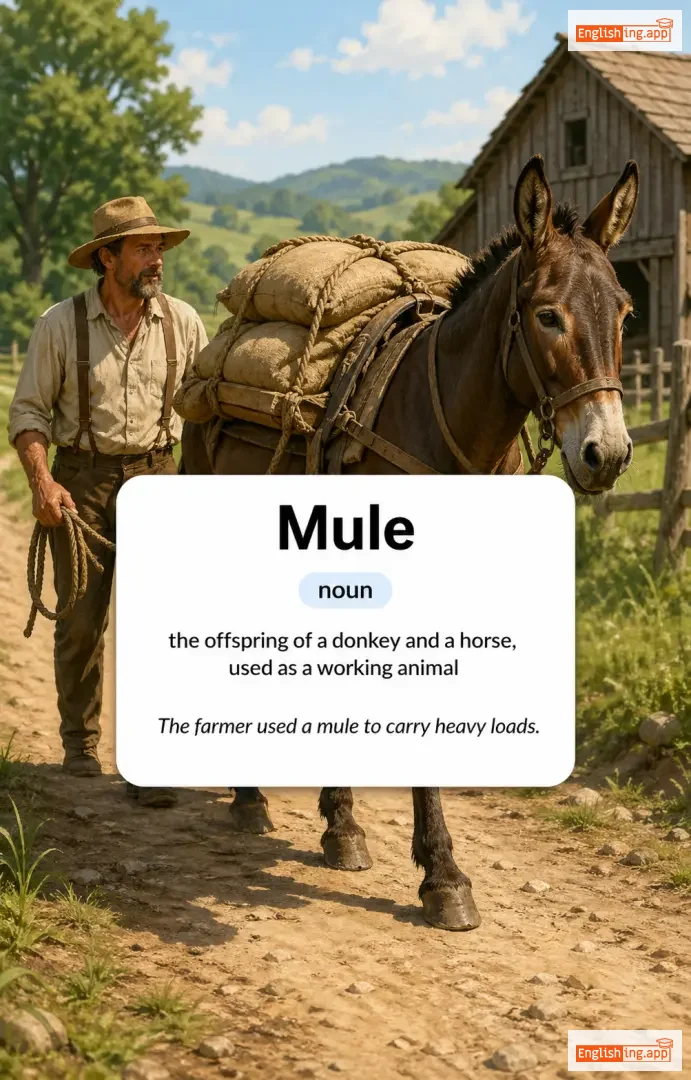
Mule definition card — visual illustration of the meaning
noun
/mjuːl/
骡子 (luózi)

the offspring of a donkey and a horse, used as a working animal

"The farmer used a mule to carry heavy loads."

"农民用骡子搬运重物。" (Nóngmín yòng luózi bānyùn zhòngwù.)
noun
/ˌmjuːlˈtɪər/
骡夫 (luófū)

a person who drives or takes care of mules

"The muleteer guided the animals safely across the mountain path."

"骡夫安全地将动物引导过山路。" (Luófū ānquán de jiāng dòngwù yǐndǎo guò shānlù.)
Mulethi definition card — visual illustration of the meaning
noun
/muˈleθi/
甘草根 (gancao gen)

licorice root, a sweet-tasting herb used in traditional medicine and cooking

"She prepared a herbal tea with mulethi to soothe her sore throat."

"她用木莲蒂泡了一杯草药茶,以缓解喉咙痛。" (Ta yong mulian ti pao le yi bei caoyao cha, yi huanjie houlong tong.)
adjective
/ˈmjuːlɪʃ/

extremely stubborn or unwilling to change

"She remained mulish despite all the convincing arguments."

multifaceted definition card — visual illustration of the meaning
adjective
/ˌmʌltiˈfæsɪtɪd/
多方面 (duō fāngmiàn)

having many different aspects or features

"Her career is multifaceted, involving teaching, research, and writing."

"她的事业是多方面的,涉及教学、研究和写作。" (Tā de shìyè shì duō fāngmiàn de, shèjí jiàoxué, yánjiū hé xiězuò.)
multifaceted information frameworks definition card — visual illustration of the meaning
noun
ˌmʌltɪˈfæsɪtɪd ˌɪnfərˈmeɪʃən ˈfreɪmwɜːrks
多面信息框架 (duō miàn xìnxī kuàngjià)

Complex, comprehensive structures for organizing and managing information that have multiple aspects or dimensions.

"Digital literacy involves building multifaceted information frameworks."

"数字素养包括构建多面信息框架。" (Shùzì sùyǎng bāokuò gòujiàn duō miàn xìnxī kuàngjià.)
adjective
/ˌmʌltɪˈfɛərɪəs/
多样的 (duō yàng de)

having many different parts, elements, or kinds

"The museum displayed a multifarious collection of artifacts."

"博物馆展示了种类繁多的文物收藏。" (Bówùguǎn zhǎnshìle zhǒnglèi fánduō de wénwù shōucáng.)
adjective
/ˈmʌltɪfɔːrm/
多形式 (duo xing shi)

Having many different forms or appearances.

"The festival was a multiform celebration of art, music, and culture."

"这个节日是艺术、音乐和文化的多形式庆祝。" (Zhege jieri shi yishu, yinyue he wenhua de duo xing shi qingzhu.)
adjective
/ˌmʌltɪˈlɪŋɡwəl/
多语种 (duoyu zhong)

Able to speak or written in several languages.

"She grew up in a multilingual household."

"她在一个多语言的家庭中长大。" (Tā zài yī gè duō yǔ zhǒng de jiātíng zhōng zhǎng dà.)
adjective
/ˈmʌltɪpl/
多个 (duō gè)

involving or consisting of many parts or elements

"The company faced multiple challenges during the year."

"公司在一年中面临了多个挑战。" (Gōngsī zài yī nián zhōng miànlínle duō gè tiǎozhàn.)
noun
/ˌmʌltɪplɪˈkeɪʃən/
乘法 (chengfa)

the mathematical process of combining numbers to get a product; the act of increasing in number or amount

"Multiplication is one of the basic operations taught in elementary mathematics."

"乘法是小学数学中的基本运算之一。" (chengfa shi xiaoxue shuxue zhong de jiben yunsuan zhiyi)
noun
/ˌmʌltɪˈplɪsɪti/
多样性 (duo yang xing)

A large number or variety of something.

"The project faced a multiplicity of challenges."

"该项目面临着多样化的挑战。" (Gai xiangmu mianlinzhe duoyanghua de tiaozhan.)
noun
/ˈmʌltɪplaɪər/
乘数 (chengshu)

a number or factor by which another number is multiplied; something that increases the effect or value of something else

"In economics, government spending can act as a multiplier for economic growth."

"在经济学中,政府支出可以成为经济增长的乘数。" (zai jingjixue zhong zhengfu zhichu keyi chengwei jingji zengzhang de chengshu)
multiply definition card — visual illustration of the meaning
verb
/ˈmʌltɪplaɪ/
乘法 (chengfa)

to increase in number; to perform mathematical multiplication

"The bacteria multiply rapidly in warm conditions."

"细菌在温暖的条件下迅速繁殖。" (Xijun zai wenruan de tiaojian xia xunsu fanzhi)
adjective
/ˌmʌl.tiˈpɜː.pəs/
多用途的 (duō yòng tú de)

having multiple uses or functions; versatile

"This multipurpose tool can be used as a knife, screwdriver, and bottle opener."
"这个多功能工具可以用作刀子、螺丝刀和开瓶器。" (Zhège duō yòngtú de gōngjù kěyǐ yòng zuò dāozi, luósīdāo hé kāi píngqì.)
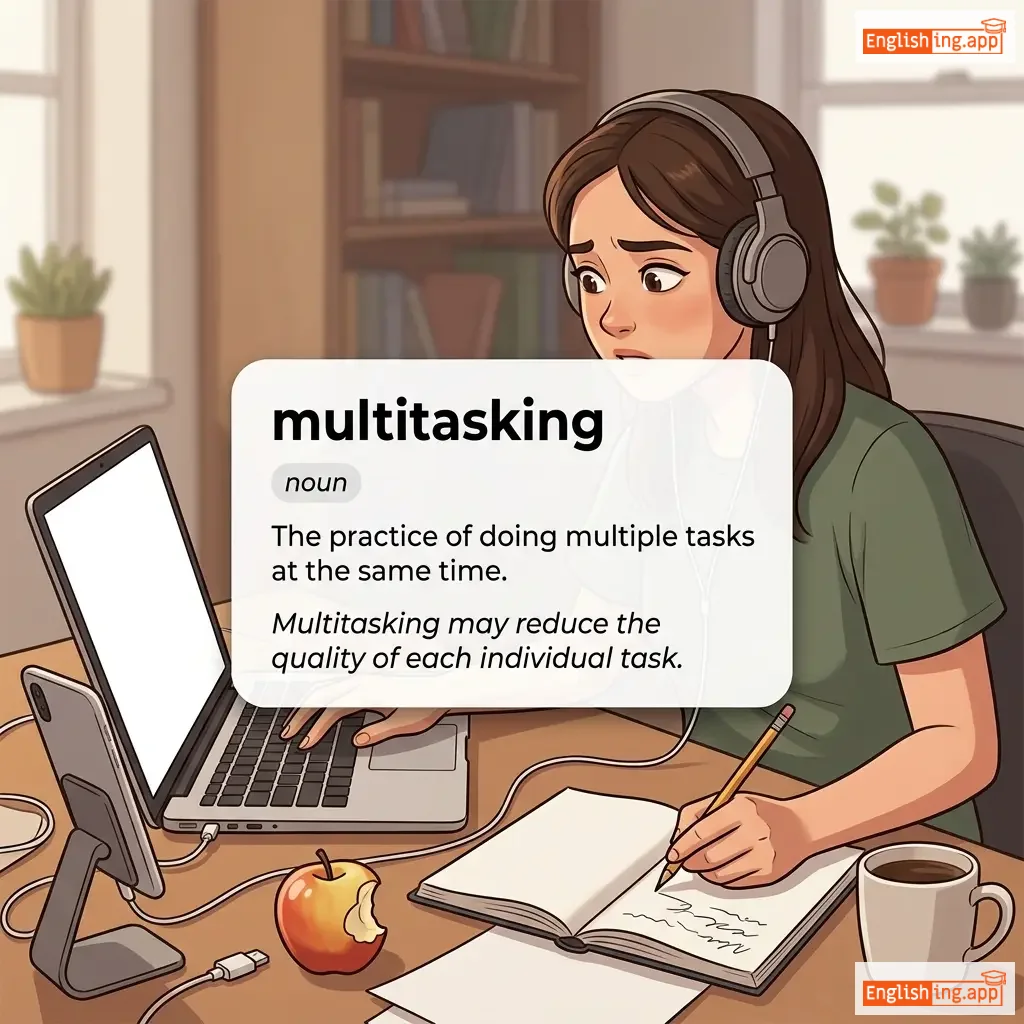
multitasking definition card — visual illustration of the meaning
noun
ˈmʌltɪˌtɑːskɪŋ
同时进行多个任务 (tóngshí jìnxíng duō gè rènwù)

The practice of doing multiple tasks at the same time.

"Multitasking may reduce the quality of each individual task."

"多任务处理可能会降低每个任务的质量。" (Duō rènwù chǔlǐ kěnéng huì jiàngdī měi gè rènwù de zhìliàng.)
noun
/ˈmʌltɪtuːd/
大量 (dàliàng)

A large number of people or things.

"A multitude of fans gathered at the stadium."

"大量的粉丝聚集在体育场。" (dàliàng de fěnsī jùjí zài tǐyùchǎng.)
adjective
/mʌm/
沉默的; 什么也不说; 保持安静 (chenmo de; shenme ye bu shuo; baochi anjing)

silent; saying nothing; keeping quiet

"He kept mum about the surprise party plans."

"他对惊喜派对的计划保持沉默。" (Ta dui jingxi paidui de jihua baochi chenmo.)
verb
/ˈmʌmbəl/

To speak quietly and not clearly so that words are difficult to understand.

"He mumbled an apology before leaving."

mundane definition card — visual illustration of the meaning
adjective
/mʌnˈdeɪn/
平凡 (pingfan)

lacking interest or excitement; dull and ordinary

"She tried to escape her mundane routine by traveling."

"她试图通过旅行逃避她平凡的日常。" (Ta shitu tongguo lvxing taobi ta pingfan de ritchang.)
verb
/nəˈsɛsɪteɪt/
使成为必要 (shǐ chéngwéi bìyào)

To make something necessary or unavoidable.

"The heavy rains necessitated the cancellation of the event."

"大雨使得活动的取消成为必然。" (Dàyǔ shǐdé huódòng de qǔxiāo chéngwéi bìrán.)
noun
/niːp/
低潮 (dīcháo)

A tide just after the first or third quarters of the moon when the difference between high and low tide is least.

"During a neap tide, the water level change is minimal."

"在低潮期间,水位变化最小。" (Zai dīcháo qījiān, shuǐwèi biànhuà zuìxiǎo.)
preposition
/nɪə(r)/
(jin)

At or to a short distance away; close in space, time, or relationship.

"There is a park near my house."

"我家附近有一个公园。" (Wo jia fujin you yige gongyuan.)
adverb
/ˈnɪərbaɪ/
附近; 在附近 (fùjìn; zài fùjìn)

close to; not far away; in the neighborhood

"There is a grocery store nearby."

"附近有一家杂货店。" (Fùjìn yǒu yī jiā záhuòdiàn.)
adjective
/ˈnɪəˌbaɪ/
附近 (fujin)

close to a particular place or person

"The nearest gas station is nearby."

"最近的加油站就在附近。" (Zui jin de jia you zhan jiu zai fujin.)
adverb
/ˈnɪəli/
几乎 (jīhū)

almost, but not completely

"She nearly missed the bus."

"她差点错过了公交车。" (Tā chàdiǎn cuòguòle gōngjiāochē.)
Neat definition card — visual illustration of the meaning
adjective
/niːt/
整洁 (zhěngjié)

tidy, orderly, and well-arranged; simple and elegant

"His handwriting is very neat and easy to read."

"他的字迹很整洁,容易阅读。" (Tā de zìjì hěn zhěngjié, róngyì yuèdú.)
adverb
/ˈniːtli/
整齐地; 干净地 (zhěngqí de; gānjìng de)

in a tidy and orderly way; carefully and precisely

"She arranged the books neatly on the shelf."

"她把书整齐地放在书架上。" (Tā bǎ shū zhěngqí de fàng zài shūjià shàng.)
noun
/ˈneb.jʊ.lə/
星云 (xingyun)

A cloud of gas and dust in outer space, sometimes visible in the night sky.

"The Orion Nebula is one of the brightest in the sky."

"猎户座星云是天空中最明亮的之一。" (Liè hù zuò xīng yún shì tiānkōng zhōng zuì míngliàng de zhī yī.)
adjective
/ˈnɛbjələs/
朦胧 (ménglóng)

Unclear, vague, or ill-defined; resembling a cloud or haze.

"His plan for the future was still nebulous and hard to understand."

"他对未来的计划仍然是朦胧的,难以理解。" (tā duì wèilái de jìhuà réngrán shì ménglóng de, nán yǐ lǐjiě.)
adverb
/ˌnɛsəˈsɛrɪli/
不一定 (bù yí dìng)

as a necessary result; inevitably

"It doesn’t necessarily mean you’re wrong."

"这不一定意味着你错了。" (Zhè bù yí dìng yìwèizhe nǐ cuòle.)
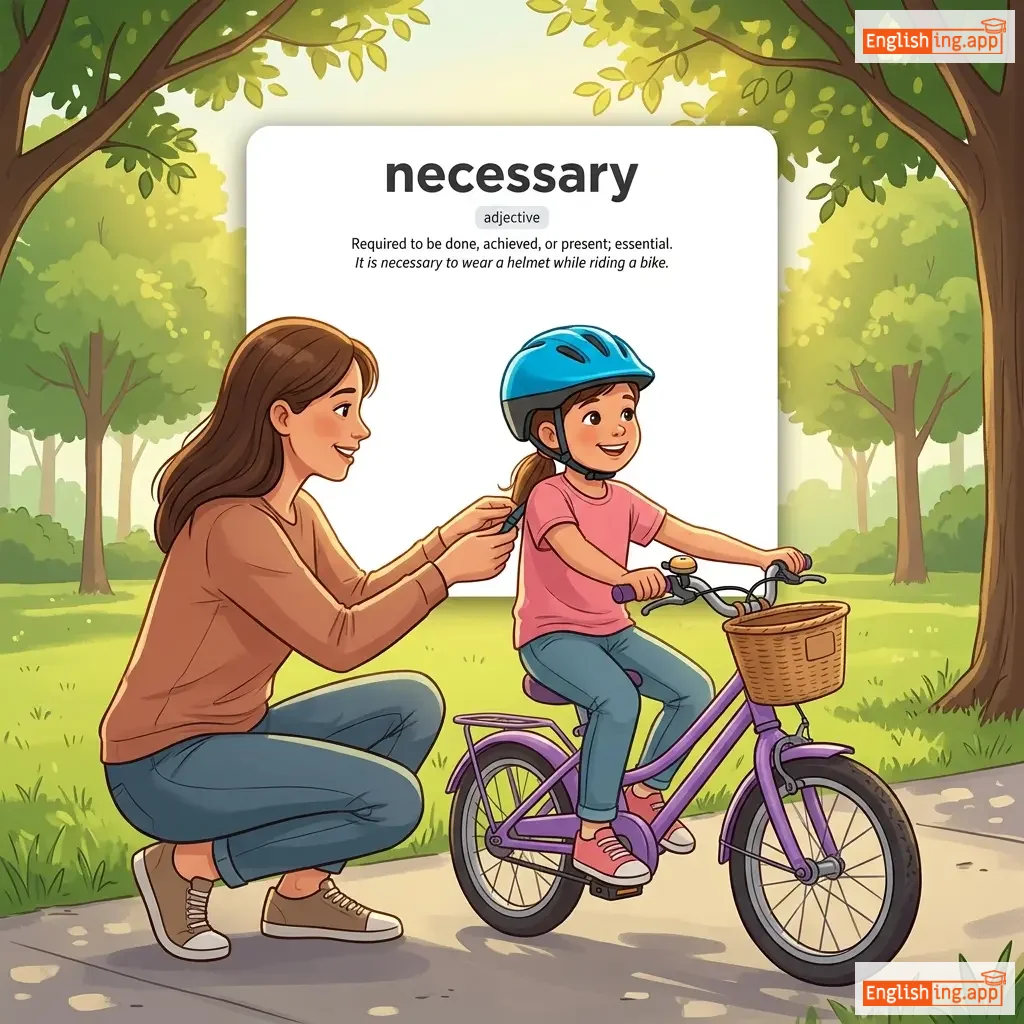
necessary definition card — visual illustration of the meaning
adjective
/ˈnɛsəsɛri/

Required to be done, achieved, or present; essential.

"It is necessary to wear a helmet while riding a bike."

noun
/nəˈkrɒpəlɪs/
古代墓地 (gǔdài mùdì)

a large ancient cemetery with elaborate tombs

"The archaeologists discovered artifacts in the necropolis of the ancient city."

"考古学家在古城的内克罗波利斯中发现了文物。" (Kǎogǔxuéjiā zài gǔ chéng de nèikèluōbōlìsī zhōng fāxiànle wénwù.)
🧙‍♂️

necromancer

noun
/ˈnɛkrəˌmænsər/

a person who practices necromancy; a wizard or magician who claims to communicate with the dead

"The villagers feared the old necromancer who lived at the edge of the forest."

noun
/ˈnɛkrəˌmænsi/
死灵法 (sǐlíng fǎ)

the practice of communicating with the dead, often to predict the future

"Ancient texts described rituals of necromancy performed by priests."

"古代的文献描述了由祭司执行的死灵法仪式。" (Gǔdài de wénxiàn miáoshùle yóu jìsī zhíxíng de sǐlíng fǎ yíshì.)
noun
/nɪˈkrɒlədʒi/
讣告 (fugao)

An obituary notice or a list of people who have recently died.

"The newspaper published a necrology of notable figures who passed away that year."

"报纸发布了该年已故知名人物的讣告。" (Baozhi fabulei gai nian yigou zhiming renwu de fugao.)