वोकैबुलरीज

इंग्लिश वोकैबुलरी डिस्कवर, लर्न और मास्टर करें

title
/ˈmɪstər/
श्री. (shree.)

a title used before a man's name

"Mr. Rahman is our new teacher."

"श्री. रहमान हमारे नए शिक्षक हैं।" (Shree. Rahman humare naye shikshak hain.)
title
/ˈmɪsɪz/
मिसेज़ (misez)

a title used before a married woman's name

"Mrs. Karim is the headmistress of the school."

"मिसेज़ करीम स्कूल की प्रधान शिक्षिका हैं।" (Misez Karim school ki pradhan shikshika hain.)
title
/mɪz/
मिज़ (miz)

a title used before a woman's name, regardless of marital status

"Ms. Akter will give a speech at the seminar."

"मिज़ आक्तर सेमिनार में एक भाषण देंगी।" (Miz Akter seminar mein ek bhaashan dengi.)
adjective, adverb, pronoun
/mʌtʃ/
बहुत (bahut)

a large amount or degree of something

"She doesn’t have much time to finish the project."

"उसे परियोजना समाप्त करने के लिए बहुत कम समय है।" (use pariyojana samaapt karne ke liye bahut kam samay hai.)
noun
/mʌd/
कीचड़ (keechad)

soft, wet earth or soil

"The children were playing in the mud after the rain."

"बच्चे बारिश के बाद कीचड़ में खेल रहे थे।" (Bacche baarish ke baad keechad mein khel rahe the.)
verb
/ˈmʌd.əl/
गड़बड़ करना (gadbadh karna)

to mix things up in a confused way or to make a mess of something

"He muddled the papers and couldn’t find the report."

"उसने कागजों को गड़बड़ कर दिया और रिपोर्ट नहीं ढूँढ पाया।" (Usne kagazon ko gadbadh kar diya aur report nahi dhoondh paaya.)
adjective
/ˈmʌd.i/
कीचड़ से ढका हुआ (keechad se dhaka hua)

covered in or full of mud; unclear or confused

"The children came back with muddy shoes after playing outside."

"बच्चे बाहर खेलकर कीचड़ में सने जूते पहनकर वापस आए।" (bachche baahar khelkar keechad mein sone joote pehankar wapas aaye.)
verb
/ˈmʌfəl/
दबाना (dabana)

to make a sound quieter or less distinct; to cover or wrap something to reduce noise or warmth

"She tried to muffle her laughter with a scarf."

"वह एक दुपट्टे से अपनी हंसी दबाने की कोशिश कर रही थी।" (Vah ek dupatte se apni hasi dabane ki koshish kar rahi thi.)
Muffler definition card — visual illustration of the meaning
noun
/ˈmʌflər/
मफलर (maflar)

a device on a vehicle's exhaust to reduce noise; also a scarf worn around the neck for warmth

"The car's muffler needs to be replaced."

"कार का मफलर बदलने की जरूरत है।" (Kar ka maflar badalne ki zarurat hai.)
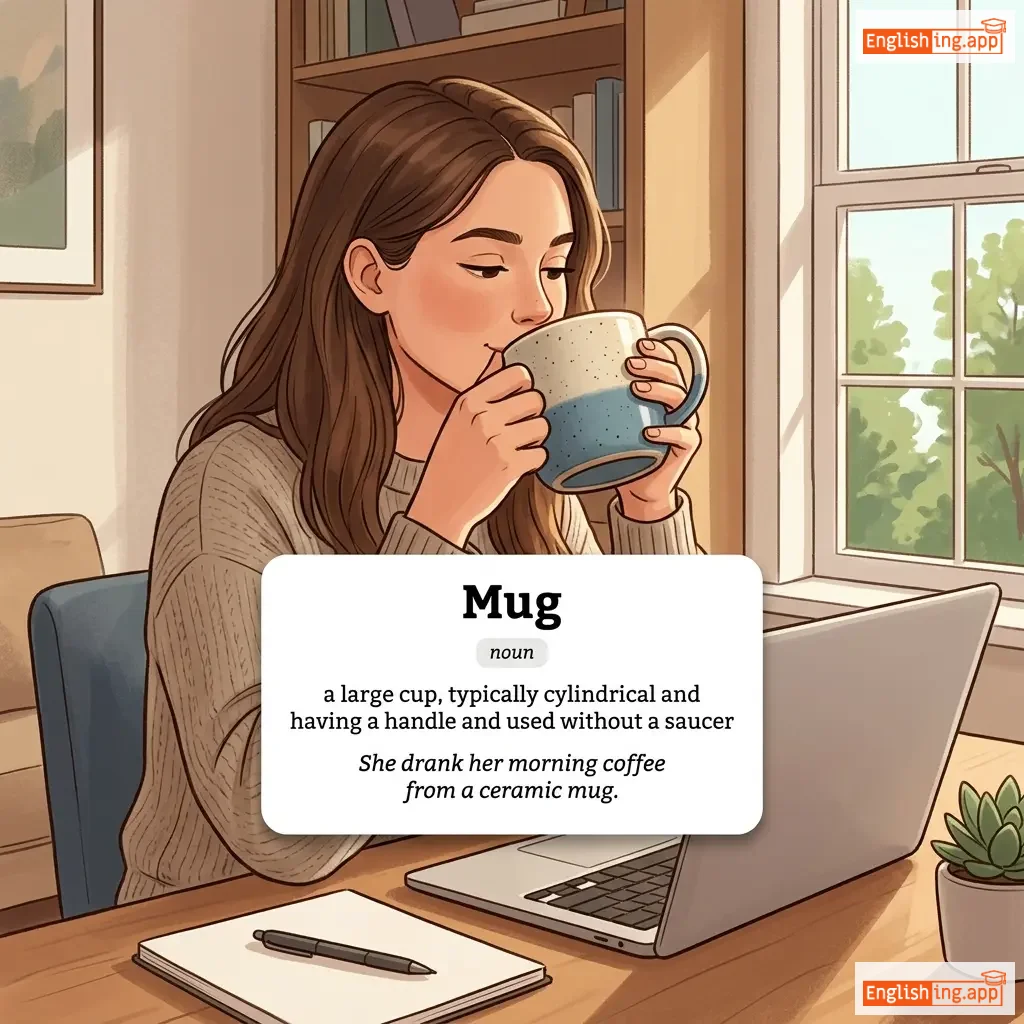
Mug definition card — visual illustration of the meaning
noun
/mʌɡ/
मग (mag)

a large cup, typically cylindrical and having a handle and used without a saucer

"She drank her morning coffee from a ceramic mug."

"वह अपनी सुबह की कॉफी एक सिरेमिक मग से पी रही थी।" (vah apni subah ki kofi ek seramik mag se pee rahi thi.)
adjective
/ˈmʌɡi/
उबाला और आर्द्र (ubala aur aardra)

uncomfortably warm and humid

"It was a muggy afternoon in July."

"जुलाई में एक उबाला और आर्द्र दोपहर था।" (Julai mein ek ubala aur aardra dopahar tha.)
noun
/ˈmʌɡwʌmp/
राजनीतिक दलों से अप्रभावित व्यक्ति (rajnitik dalon se aprabhavit vyakti)

a person who remains independent from party politics or remains aloof from disputes

"He was called a mugwump for refusing to join either political side."

"उसे राजनीतिक दलों में से किसी भी एक में शामिल होने से इंकार करने पर मगवंप कहा गया।" (Use rajnaitik dalon mein se kisi bhi ek mein shamil hone se inkaar karne par mugwump kaha gaya.)
noun
/mjuːˈlætoʊ/
मिश्रित नस्ल का व्यक्ति (पुराना और आपत्तिजनक शब्द) (mishrit nasl ka vyakti (purana aur aapattijanak shabd))

an outdated and now offensive term historically used to describe a person of mixed white and Black ancestry

"The word 'mulatto' is now considered outdated and offensive."

"'मुलाटो' शब्द अब पुराना और आपत्तिजनक माना जाता है।" ('Mulatto' shabd ab purana aur aapattijanak maana jaata hai.)
verb
/mʌlkt/
जुर्माना लगाना / धोखाधड़ी करना (jurmana lagana / dhokhadhdi karna)

to punish by a fine or to defraud someone of money

"The corrupt official was mulcted for his misconduct."

"दुराचार के लिए भ्रष्ट अधिकारी को जुर्माना लगाया गया।" (Durachar ke liye bhrasht adhikari ko jurmana lagaya gaya.)
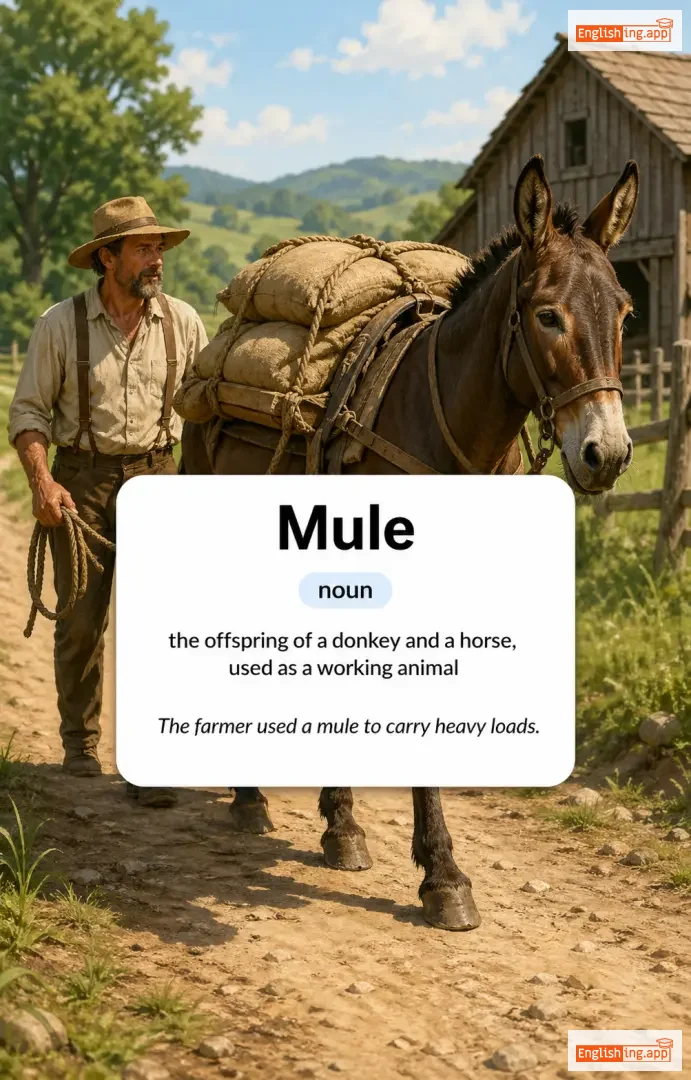
Mule definition card — visual illustration of the meaning
noun
/mjuːl/
खच्चर (khachchar)

the offspring of a donkey and a horse, used as a working animal

"The farmer used a mule to carry heavy loads."

"किसान ने भारी बोझ ढोने के लिए एक खच्चर का इस्तेमाल किया।" (kisan ne bhari bojh dhone ke liye ek khachchar ka istemal kiya.)
noun
/ˌmjuːlˈtɪər/
खच्चर चालक (khacchar chalak)

a person who drives or takes care of mules

"The muleteer guided the animals safely across the mountain path."

"खच्चर चालक ने जानवरों को सुरक्षित रूप से पहाड़ी रास्ते पर मार्गदर्शन किया।" (Khacchar chalak ne janwaron ko surakshit roop se pahaadi raaste par maargdarshan kiya.)
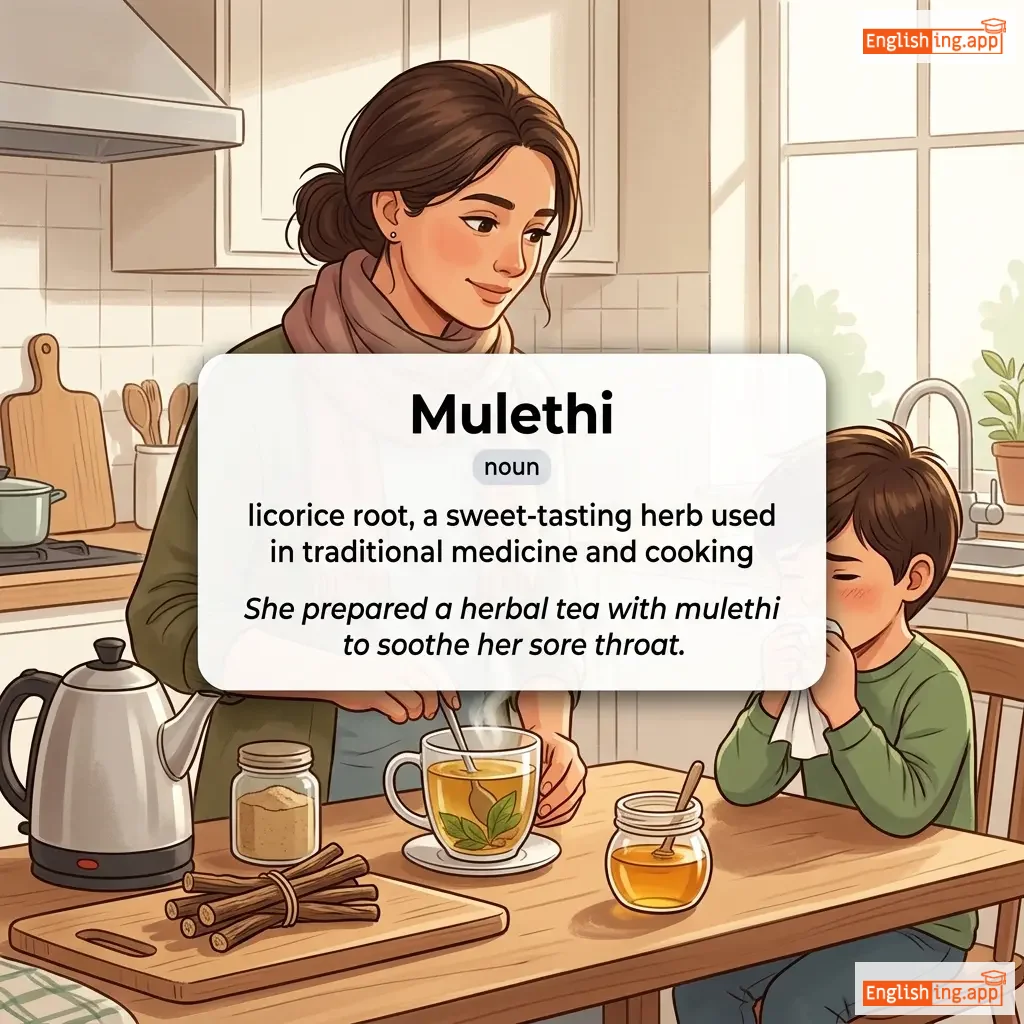
Mulethi definition card — visual illustration of the meaning
noun
/muˈleθi/
मुलेठी (mulethee)

licorice root, a sweet-tasting herb used in traditional medicine and cooking

"She prepared a herbal tea with mulethi to soothe her sore throat."

"उसने गले की खराश को ठीक करने के लिए मुलैथी से हर्बल चाय बनाई।" (Usne gale ki kharash ko theek karne ke liye mulethi se herbal chai banai.)
adjective
/ˈmjuːlɪʃ/
जिद्दी (ziddi)

extremely stubborn or unwilling to change

"She remained mulish despite all the convincing arguments."

"उसने सभी समझाने के तर्कों के बावजूद बहुत जिद्दी बनी रही।" (usne sabhi samjhane ke tarkon ke bavjood bahut jiddi bani rahi)
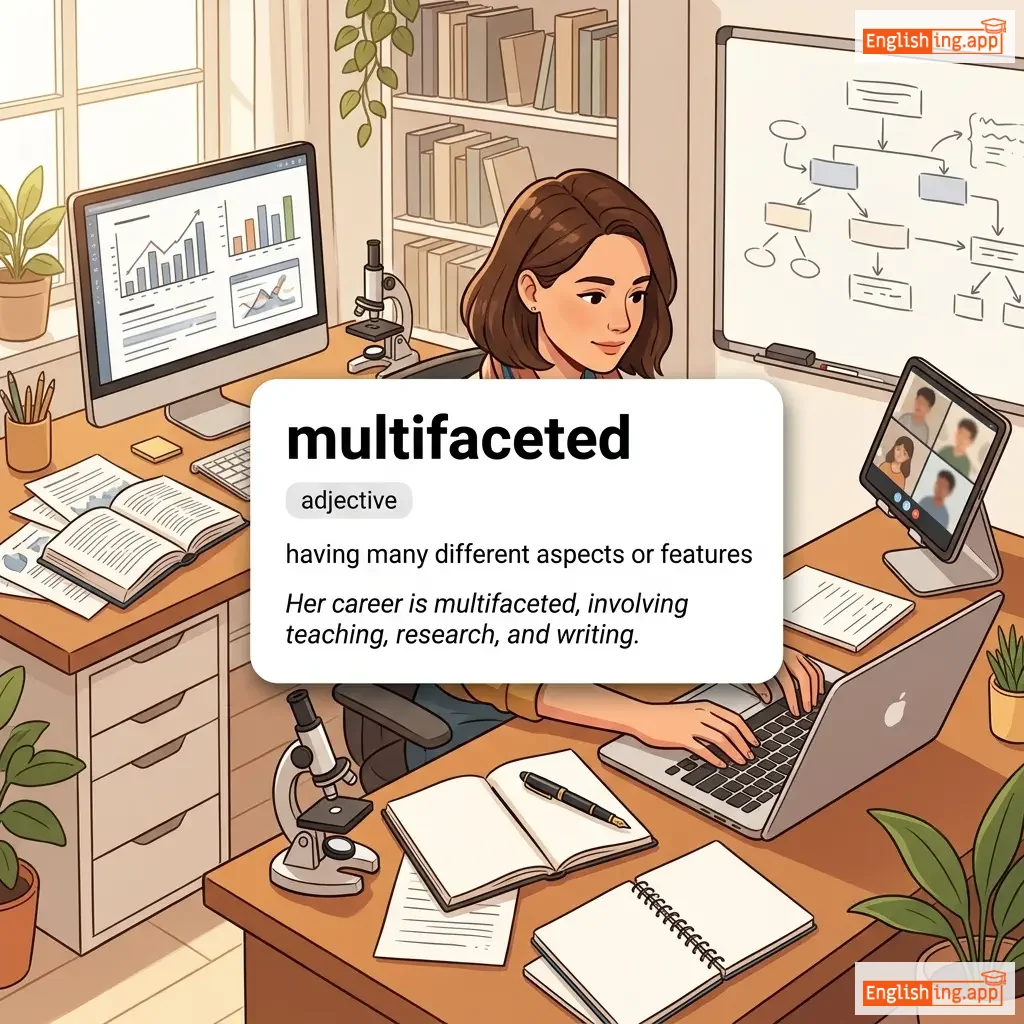
multifaceted definition card — visual illustration of the meaning
adjective
/ˌmʌltiˈfæsɪtɪd/
बहुआयामी (bahuayami)

having many different aspects or features

"Her career is multifaceted, involving teaching, research, and writing."

"उसका करियर बहुआयामी है, जिसमें शिक्षण, शोध, और लेखन शामिल हैं।" (Uska career bahuayami hai, jismein shikshan, shodh, aur lekhan shamil hain.)
multifaceted information frameworks definition card — visual illustration of the meaning
noun
ˌmʌltɪˈfæsɪtɪd ˌɪnfərˈmeɪʃən ˈfreɪmwɜːrks
बहुआयामी सूचना ढांचे (bahuayami soochna dhancha)

Complex, comprehensive structures for organizing and managing information that have multiple aspects or dimensions.

"Digital literacy involves building multifaceted information frameworks."

"डिजिटल साक्षरता में बहुआयामी सूचना ढांचे का निर्माण शामिल है।" (Digital saksharta mein bahuayami soochna dhancha ka nirmaan shaamil hai.)
adjective
/ˌmʌltɪˈfɛərɪəs/
विविध (vividh)

having many different parts, elements, or kinds

"The museum displayed a multifarious collection of artifacts."

"म्यूजियम ने विभिन्न प्रकार के कलाकृतियों का प्रदर्शन किया।" (Muzeem ne vibhinn prakar ke kalakrution ka pradarshan kiya.)
adjective
/ˈmʌltɪfɔːrm/
बहुरूपी (bahurupi)

Having many different forms or appearances.

"The festival was a multiform celebration of art, music, and culture."

"उत्सव एक बहुरूपी कला, संगीत और संस्कृति का उत्सव था।" (Utsav ek bahurupi kala, sangeet aur sanskriti ka utsav tha.)
adjective
/ˌmʌltɪˈlɪŋɡwəl/
बहुभाषी (bahubhashi)

Able to speak or written in several languages.

"She grew up in a multilingual household."

"वह एक बहुभाषी परिवार में पली-बढ़ी।" (Vah ek bahubhashi parivar mein pali-badhi.)
adjective
/ˈmʌltɪpl/
बहुत से (bahut se)

involving or consisting of many parts or elements

"The company faced multiple challenges during the year."

"कंपनी को साल के दौरान कई चुनौतियों का सामना करना पड़ा।" (kampani ko saal ke dauran kai chunautiyon ka samna karna pada.)
noun
/ˌmʌltɪplɪˈkeɪʃən/
गुणा (guna)

the mathematical process of combining numbers to get a product; the act of increasing in number or amount

"Multiplication is one of the basic operations taught in elementary mathematics."

"प्राथमिक गणित में गुणा एक बुनियादी क्रिया है।" (prathamik ganit mein guna ek buniyadi kriya hai)
noun
/ˌmʌltɪˈplɪsɪti/
बहुतता (bahtata)

A large number or variety of something.

"The project faced a multiplicity of challenges."

"प्रोजेक्ट को कई प्रकार की चुनौतियों का सामना करना पड़ा।" (Project ko kai prakar ki chunautiyon ka samna karna pada.)
noun
/ˈmʌltɪplaɪər/
गुणक (gunak)

a number or factor by which another number is multiplied; something that increases the effect or value of something else

"In economics, government spending can act as a multiplier for economic growth."

"अर्थशास्त्र में सरकारी खर्च आर्थिक वृद्धि के लिए एक गुणक हो सकता है।" (arthashastra mein sarkari kharch arthik vriddhi ke liye ek gunak ho sakta hai)
multiply definition card — visual illustration of the meaning
verb
/ˈmʌltɪplaɪ/
गुणा करना (guna karna)

to increase in number; to perform mathematical multiplication

"The bacteria multiply rapidly in warm conditions."

"गर्म परिस्थितियों में बैक्टीरिया तेजी से बढ़ते हैं।" (Garm paristhitiyon mein bacteria tezi se badhte hain)
adjective
/ˌmʌl.tiˈpɜː.pəs/
बहुउद्देशीय (bahudeshīya)

having multiple uses or functions; versatile

"This multipurpose tool can be used as a knife, screwdriver, and bottle opener."

"इस बहुउद्देशीय उपकरण का उपयोग चाकू, स्क्रूड्राइवर और बोतल ओपनर के रूप में किया जा सकता है।" (is bahudeshīya upkaran kā upayog chākū, screw driver aur botel opener ke rūp mein kiyā jā sakta hai.)
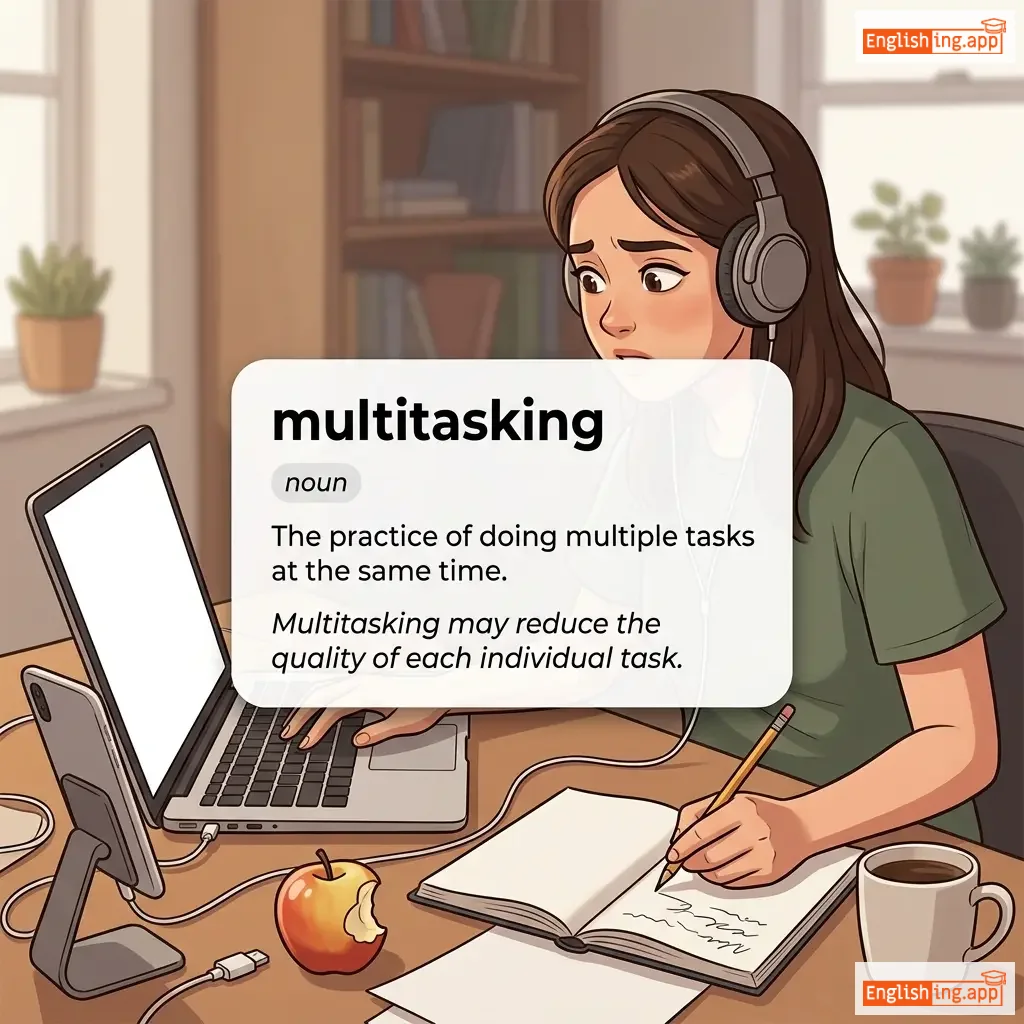
multitasking definition card — visual illustration of the meaning
noun
ˈmʌltɪˌtɑːskɪŋ
कई कार्य एक साथ करना (kai kary ek sath karna)

The practice of doing multiple tasks at the same time.

"Multitasking may reduce the quality of each individual task."

"मल्टीटास्किंग से प्रत्येक कार्य की गुणवत्ता कम हो सकती है।" (Multitasking se pratyek kary ki gunwatta kam ho sakti hai.)
noun
/ˈmʌltɪtuːd/
असंख्य (asankhya)

A large number of people or things.

"A multitude of fans gathered at the stadium."

"स्टेडियम में असंख्य प्रशंसक इकट्ठा हुए थे।" (Stadium mein asankhya prashansak ikattha hue the.)
adjective
/mʌm/
मौन; कुछ नहीं कहना; चुप रहना (maun; kuch nahi kehna; chup rehna)

silent; saying nothing; keeping quiet

"He kept mum about the surprise party plans."

"वह सरप्राइज पार्टी की योजना के बारे में मौन रहा।" (vah surprise party ki yojana ke baare mein maun raha.)
verb
/ˈmʌmbəl/
मध्यम आवाज में बोलना (madhyam awaaz mein bolna)

To speak quietly and not clearly so that words are difficult to understand.

"He mumbled an apology before leaving."

"वह जाने से पहले धीरे से एक माफी बोला।" (vah jane se pehle dheere se ek maafi bola.)
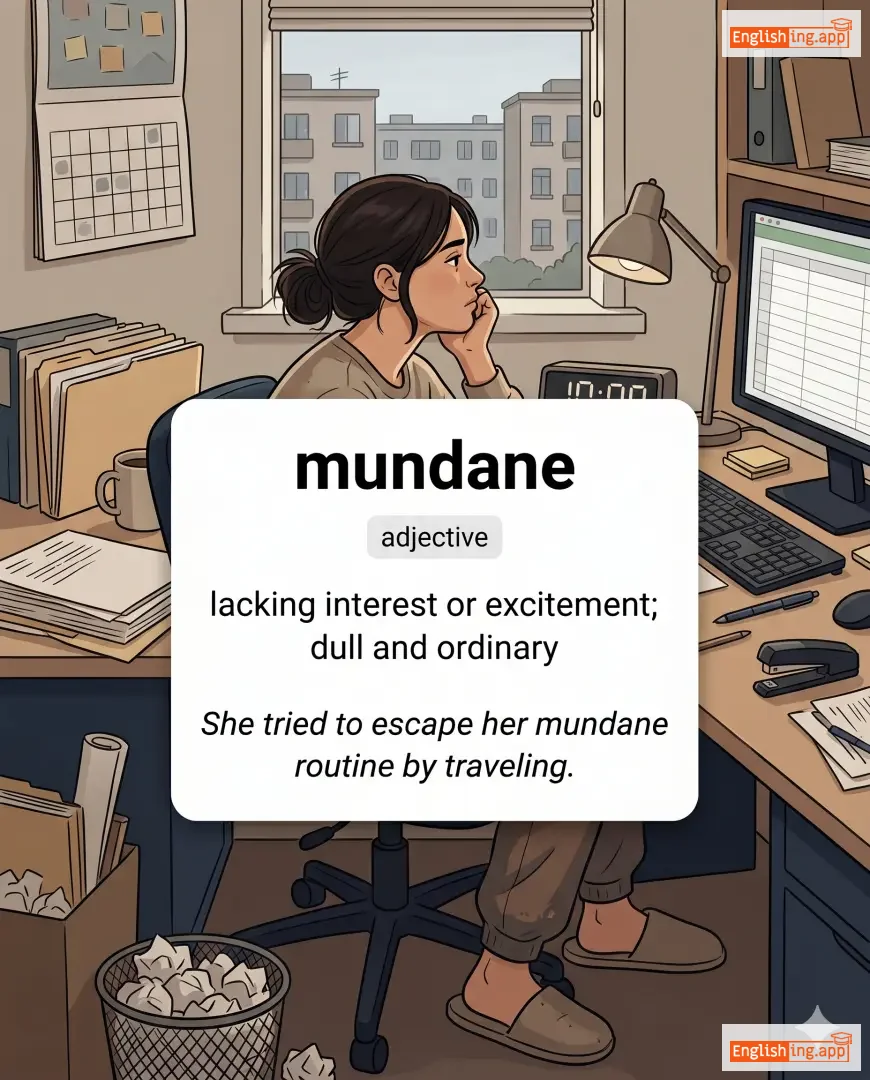
mundane definition card — visual illustration of the meaning
adjective
/mʌnˈdeɪn/
सामान्य (samanaya)

lacking interest or excitement; dull and ordinary

"She tried to escape her mundane routine by traveling."

"वह यात्रा करके अपनी नीरस दिनचर्या से बचने की कोशिश कर रही थी।" (Vah yatra karke apni neeras dincharya se bachne ki koshish kar rahi thi.)
verb
/nəˈsɛsɪteɪt/
अपरिहार्य बनाना (apariharry banana)

To make something necessary or unavoidable.

"The heavy rains necessitated the cancellation of the event."

"भारी बारिश ने कार्यक्रम के रद्द होने को अपरिहार्य बना दिया।" (bhari barish ne karyakram ke radd hone ko apariharry bana diya.)
noun
/niːp/
नैप ज्वार (neap jwaar)

A tide just after the first or third quarters of the moon when the difference between high and low tide is least.

"During a neap tide, the water level change is minimal."

"नीप ज्वार के दौरान पानी का स्तर परिवर्तन न्यूनतम होता है।" (neap jwaar ke dauran paani ka sttar parivartan nyuntam hota hai.)
preposition
/nɪə(r)/
पास (paas)

At or to a short distance away; close in space, time, or relationship.

"There is a park near my house."

"मेरे घर के पास एक पार्क है।" (Mere ghar ke paas ek park hai.)
adverb
/ˈnɪərbaɪ/
नजदीक; पास में (najdeek; paas mein)

close to; not far away; in the neighborhood

"There is a grocery store nearby."

"वहाँ पास में एक किराना दुकान है।" (vahaan paas mein ek kiraana dukaan hai)
adjective
/ˈnɪəˌbaɪ/
पास (paas)

close to a particular place or person

"The nearest gas station is nearby."

"निकटतम गैस स्टेशन पास में है।" (nikatam gas station paas mein hai.)
adverb
/ˈnɪəli/
लगभग (lagbhag)

almost, but not completely

"She nearly missed the bus."

"वह लगभग बस को मिस कर गई।" (vah lagbhag bas ko mis kar gayi.)
Neat definition card — visual illustration of the meaning
adjective
/niːt/
सुथरा (suthra)

tidy, orderly, and well-arranged; simple and elegant

"His handwriting is very neat and easy to read."

"उसकी लिखावट बहुत सुथरी और पढ़ने में आसान है।" (Uski likhavat bahut suthri aur padhne mein aasan hai.)
adverb
/ˈniːtli/
सलीके से; सफाई से; (sallike se; safai se;)

in a tidy and orderly way; carefully and precisely

"She arranged the books neatly on the shelf."

"उसने किताबों को शेल्फ पर सलीके से रखा।" (usne kitabon ko shelf par sallike se rakha)
noun
/ˈneb.jʊ.lə/
नेबुला (nebula)

A cloud of gas and dust in outer space, sometimes visible in the night sky.

"The Orion Nebula is one of the brightest in the sky."

"ऑरियन नेबुला आकाश में सबसे चमकदार में से एक है।" (Orion nebula aakash mein sabse chamakdaar mein se ek hai.)
adjective
/ˈnɛbjələs/
धुंधला (dhundhla)

Unclear, vague, or ill-defined; resembling a cloud or haze.

"His plan for the future was still nebulous and hard to understand."

"भविष्य के लिए उसकी योजना अभी भी धुंधली और समझने में कठिन थी।" (bhavishya ke liye uski yojna abhi bhi dhundhli aur samajhne mein kathin thi.)
adverb
/ˌnɛsəˈsɛrɪli/
अनिवार्य रूप से (anivarya roop se)

as a necessary result; inevitably

"It doesn’t necessarily mean you’re wrong."

"इसका मतलब यह नहीं है कि आप गलत हैं।" (Iska matlab yeh nahin hai ki aap galat hain.)
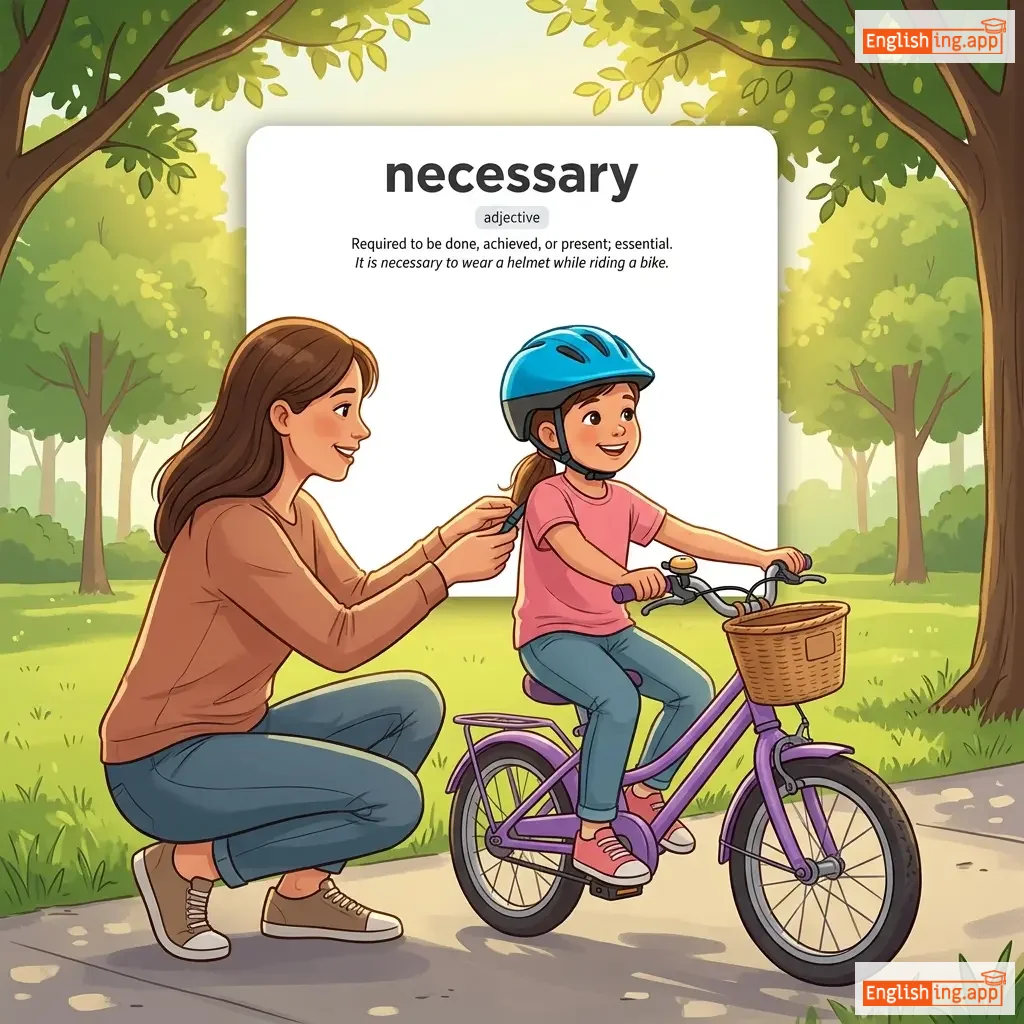
necessary definition card — visual illustration of the meaning
adjective
/ˈnɛsəsɛri/
आवश्यक (nesesari)

Required to be done, achieved, or present; essential.

"It is necessary to wear a helmet while riding a bike."

"साइकिल चलाते समय हेलमेट पहनना ज़रूरी है।" (saikil chalaate samay helmet pehnana zaruri hai)
noun
/nəˈkrɒpəlɪs/
प्राचीन कब्रिस्तान (prachin kabristan)

a large ancient cemetery with elaborate tombs

"The archaeologists discovered artifacts in the necropolis of the ancient city."

"पुरातत्ववेत्ताओं ने प्राचीन शहर के नेक्रोपोलिस में अवशेषों की खोज की।" (Puratattvavettaon ne prachin shahar ke nekropolis mein avsheshon ki khoj ki.)
noun
/ˈnɛkrəˌmænsər/
मृत आत्माओं से संवाद करने वाला जादूगर (nekromansar)

a person who practices necromancy; a wizard or magician who claims to communicate with the dead

"The villagers feared the old necromancer who lived at the edge of the forest."

"गांव वालों को जंगल के किनारे रहने वाले पुराने नेक्रोमैनसर से डर लगता था." (gaon vaalon ko jangal ke kinare rehne wale purane nekromansar se dar lagta tha)
noun
/ˈnɛkrəˌmænsi/
मृतकों से संपर्क करने की जादूगरी (mrutkon se sampark karne ki jadugari)

the practice of communicating with the dead, often to predict the future

"Ancient texts described rituals of necromancy performed by priests."

"प्राचीन ग्रंथों में पुरोहितों द्वारा की जाने वाली नेक्रोमांसी के अनुष्ठान का वर्णन किया गया है।" (Prachin granthon mein purohiton dwara ki jaane wali necromancy ke anushthan ka varnan kiya gaya hai)
noun
/nɪˈkrɒlədʒi/
शोकसूचना (shoksuchna)

An obituary notice or a list of people who have recently died.

"The newspaper published a necrology of notable figures who passed away that year."

"द न्यूज़पेपर ने उस वर्ष निधन करने वाले प्रमुख व्यक्तियों की नेक्रोलॉजी प्रकाशित की।" (da newspaper ne us varsh nidhan karne wale pramukh vyaktiyon ki nekroloji prakashit ki.)