वोकैबुलरीज

इंग्लिश वोकैबुलरी डिस्कवर, लर्न और मास्टर करें

adjective
/ˈmʌski/
मस्ख़ी (maskhi)

having a strong, sweet, earthy smell like musk

"The perfume had a musky fragrance."

"परफ्यूम में मस्ख़ी खुशबू थी।" (Perfume mein maskhi khushboo thi.)
noun
/ˈmʊzlɪm/
मुसलिम (muslim)

a follower of Islam

"He is a devout Muslim."

"वह एक पक्का मुसलिम है।" (Wah ek pakka Muslim hai.)
verb
/mʌst/
करना होगा (karna hoga)

to be required or obligated to

"You must complete your homework before you go out."

"तुम्हें अपना होमवर्क खत्म करना होगा, फिर तुम बाहर जा सकते हो।" (Tumhein apna homework khatam karna hoga, phir tum bahar ja sakte ho.)
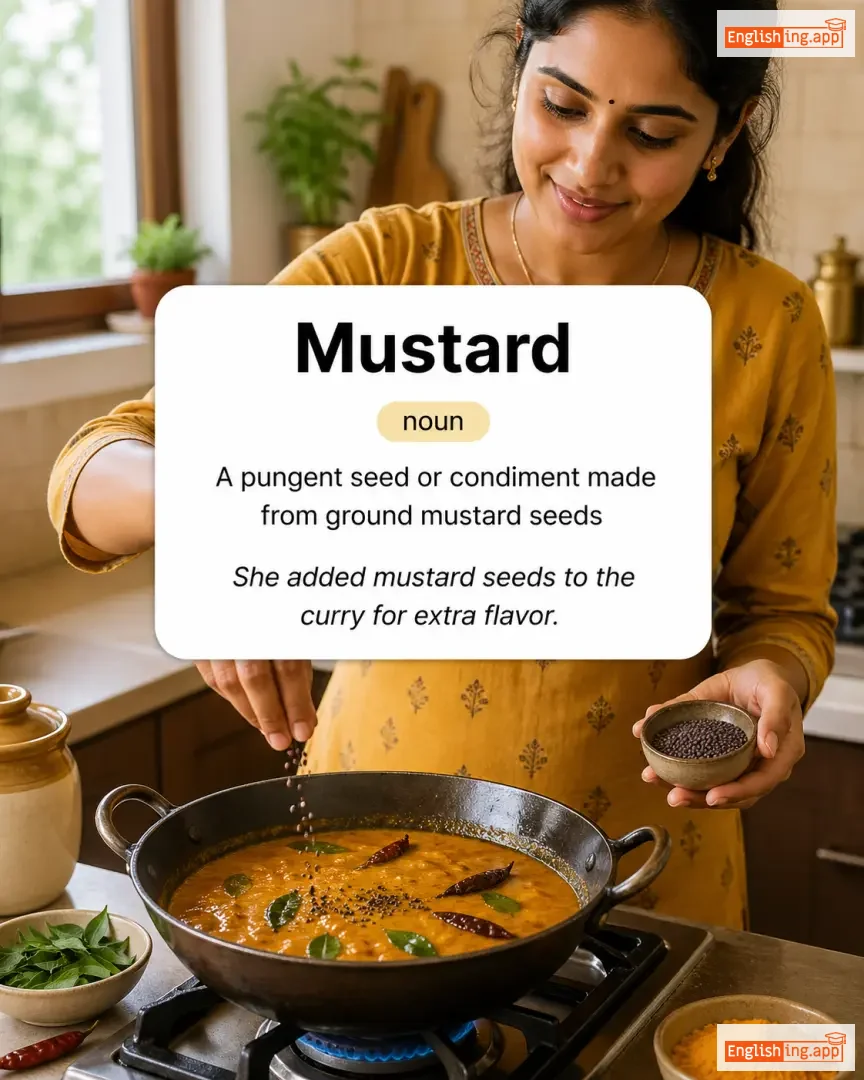
Mustard definition card — visual illustration of the meaning
noun
/ˈmʌs.tərd/
सरसों (sarson)

A pungent seed or condiment made from ground mustard seeds

"She added mustard seeds to the curry for extra flavor."

"उसने करी में अतिरिक्त स्वाद के लिए सरसों के बीज डाले।" (usne kari mein atirikt swad ke liye sarson ke beej daale.)
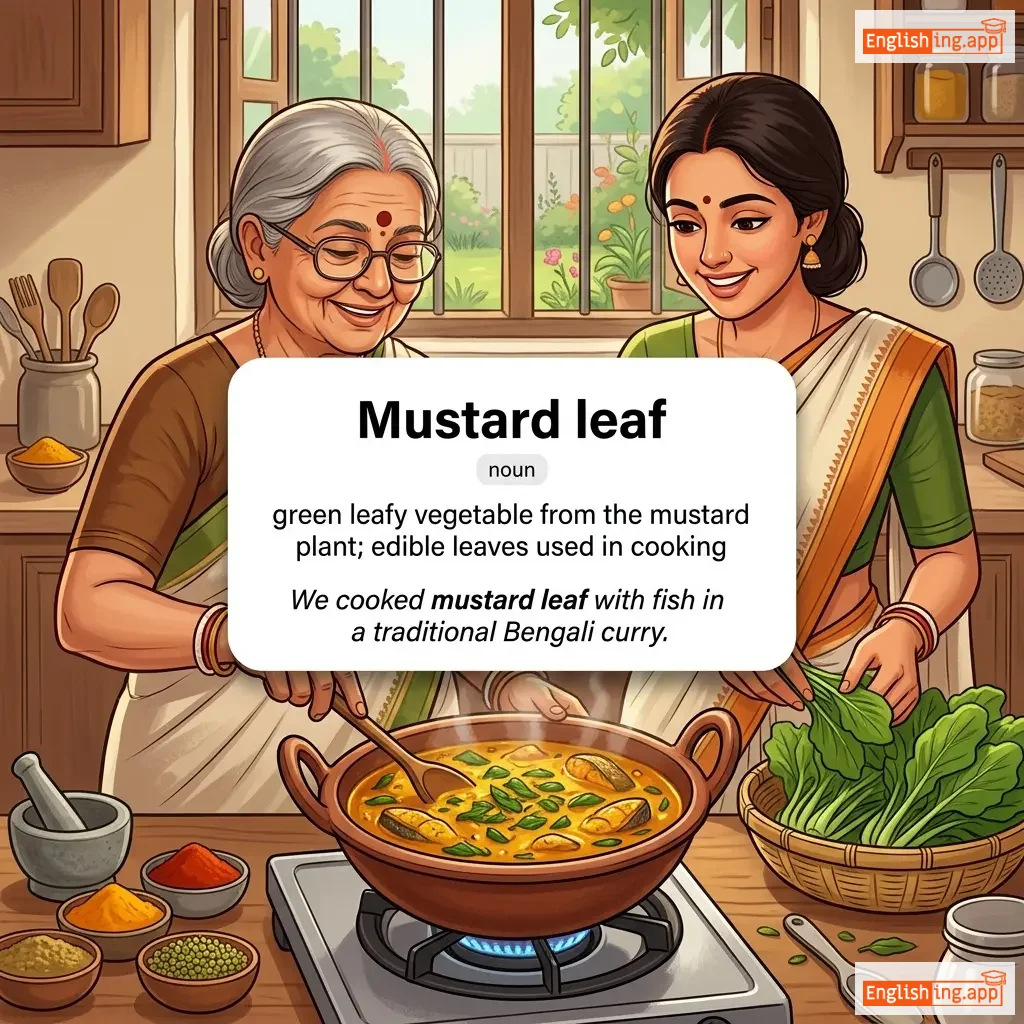
Mustard leaf definition card — visual illustration of the meaning
noun
/ˈmʌs.tərd liːf/
सरसों का पत्ता (sarson ka patta)

green leafy vegetable from the mustard plant; edible leaves used in cooking

"We cooked mustard leaf with fish in a traditional Bengali curry."

"हमने पारंपरिक बांग्ला करी में मछली के साथ सरसों के पत्ते पकाए।" (hamne paaramparik baangla kari mein machhli ke saath sarson ke patte pakaaye.)
Mustard Oil definition card — visual illustration of the meaning
noun
/ˈmʌstərd ɔɪl/
सरसों का तेल (sarson ka tel)

oil extracted from mustard seeds, commonly used for cooking and medicinal purposes

"We use mustard oil for cooking vegetables in our kitchen."

"हम अपनी रसोई में सब्ज़ियाँ पकाने के लिए सरसों के तेल का इस्तेमाल करते हैं।" (ham apni rasoee mein sabziyaan pakane ke liye sarson ke tel ka istemaal karte hain.)
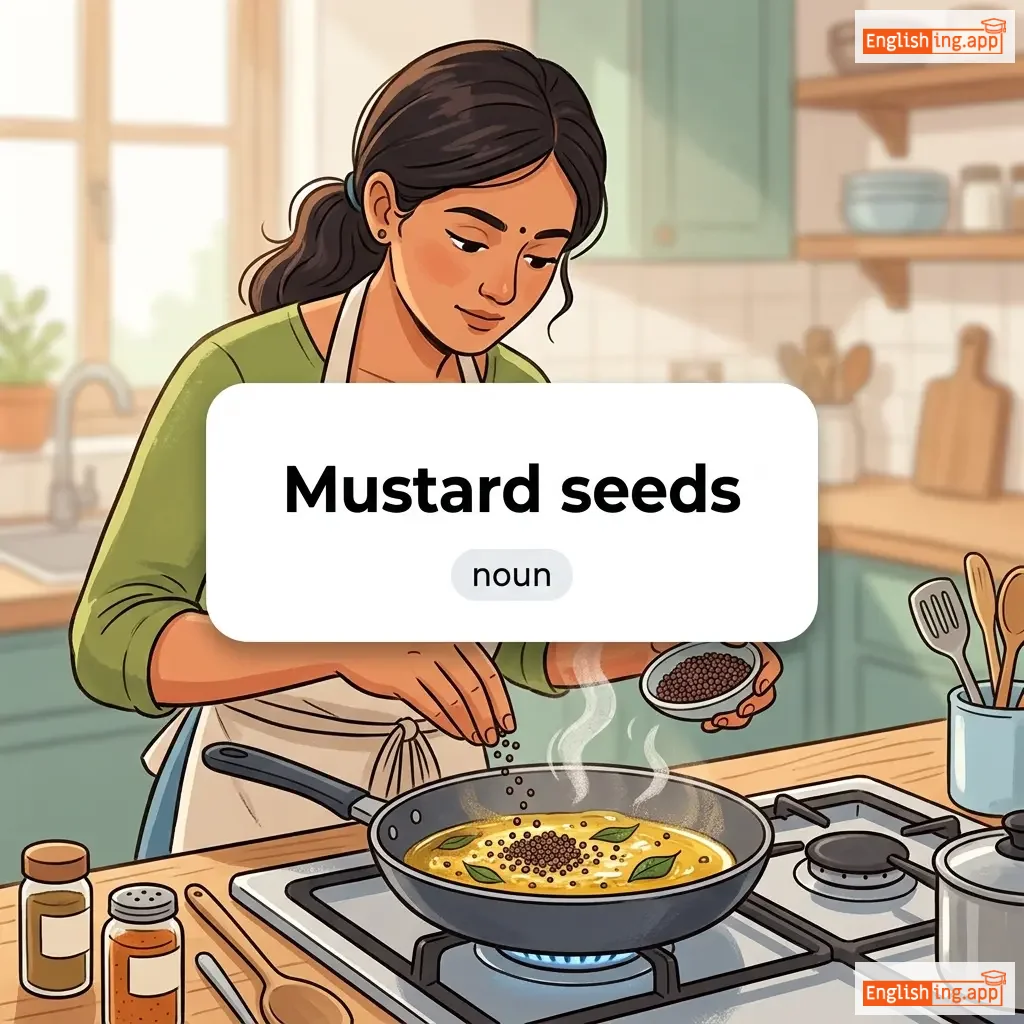
Mustard seeds definition card — visual illustration of the meaning
noun
/ˈmʌs.tərd siːdz/
सरसों के बीज (sarson ke beej)

small round seeds from the mustard plant, used as a spice and for making mustard condiment

"Mustard seeds are often tempered in hot oil to release their nutty flavor before adding to dishes."

"सरसों के बीज को अक्सर गर्म तेल में तड़का लगाया जाता है ताकि उनका नट्टी फ्लेवर निकल सके और खाने में डाला जा सके।" (sarson ke beej ko aksar garm tel mein tadka lagaya jata hai taki unka nutty flavor nikal sake aur khane mein dala ja sake.)
verb, noun
/ˈmʌstər/
इकट्ठा करना / साहस जुटाना (ikatha karna / sahas jutana)

to gather people, especially soldiers; to summon courage or strength

"He mustered enough courage to face the challenge."

"उसने चुनौती का सामना करने के लिए पर्याप्त साहस जुटाया।" (Usne chunauti ka samna karne ke liye paryapt sahas jutaya.)
adjective
/ˈmʌsti/
बासी, सड़ा हुआ या नम गंध (basi, sda hua ya nam gandh)

having a stale, moldy, or damp smell

"The old books had a musty odor."

"पुरानी किताबों में बासी गंध थी।" (Purani kitabon mein basi gandh thi.)
noun
/ˌmjuːtəˈbɪləti/
परिवर्तनशीलता (parivartansheelta)

The quality of being changeable or capable of change.

"The mutability of fashion trends makes it hard to keep up."

"फैशन ट्रेंड्स की परिवर्तनशीलता को बनाए रखना कठिन होता है।" (Fashion trends ki parivartansheelta ko banaye rakhna kathin hota hai.)
adjective
/ˈmjuːtəbl/
परिवर्तनीय (parivartaniy)

Capable of change or alteration.

"Human emotions are mutable and can shift rapidly."

"मानव भावनाएँ परिवर्तनीय होती हैं और जल्दी बदल सकती हैं।" (Manav bhavnaayein parivartaniy hoti hain aur jaldi badal sakti hain.)
noun
/ˌmjuːtəˈbɪləti/
म्यूटाबिलिटी (गलत वर्तनी) (mutability (galat vartani))

A misspelled form of 'mutability', meaning the quality of being changeable.

"The document contained the misspelled word 'mutablility' instead of 'mutability'."

"दस्तावेज़ में 'mutability' के स्थान पर 'mutablility' की गलत वर्तनी थी।" (Dastaavez mein 'mutability' ke sthan par 'mutablility' ki galat vartani thi.)
verb
/ˈmjuːteɪt/
रूपांतरित होना (roopantarit hona)

To change or cause to change in form, nature, or character.

"The virus can mutate into a more dangerous strain."

"वायरस एक और अधिक खतरनाक रूप में म्यूटेट कर सकता है।" (Virus ek aur adhik khatarnak roop mein mutate kar sakta hai.)
noun
/mjuːˈteɪʃn/
परिवर्तन, आनुवंशिक उत्परिवर्तन (parivartan, anuvanshik utparivartan)

A change in form, structure, or nature, especially in genetics.

"Scientists discovered a genetic mutation that caused the disorder."

"वैज्ञानिकों ने एक आनुवंशिक उत्परिवर्तन की खोज की जिसने इस विकार का कारण बना।" (Vaigyanikon ne ek anuvanshik utparivartan ki khoj ki jisne is vikaar ka kaaran bana.)
adjective
/mjuːt/
चुप (myoot)

silent or unable to speak; not expressed in words

"She remained mute during the entire meeting."

"पूरी मीटिंग के दौरान वह मौन रही।" (poori meeting ke dauran vah maun rahi)
adjective
/ˈmjuːtɪd/
मद्धम (maddham)

softened in sound, color, or effect; subdued

"The room was painted in muted shades of blue and grey."

"कमरे को नीले और ग्रे के मद्धम रंगों में रंगा गया था।" (Kamre ko neele aur grey ke maddham rangon mein ranga gaya tha.)
verb
/ˈmjuːtɪleɪt/
विकृत करना (vikrit karna)

to inflict serious damage on something, often by cutting or tearing

"The ancient manuscript was mutilated by careless handling."

"प्राचीन पाण्डुलिपि को लापरवाह तरीके से हैंडल करने से विकृत कर दिया गया था।" (Prachin pandulipi ko laaparwah tareeke se handle karne se vikrit kar diya gaya tha.)
adjective
/ˈmjuːtɪnəs/
विद्रोही (vidrohi)

refusing to obey authority; rebellious

"The soldiers grew mutinous after months without pay."

"सैनिक महीने भर बिना वेतन के रहने के बाद विद्रोही हो गए थे।" (Sainik mahine bhar bina vetan ke rehne ke baad vidrohi ho gaye the.)
noun
/ˈmjuːtɪni/
विद्रोह (vidroh)

an open rebellion against authority, especially by soldiers or sailors

"The sailors staged a mutiny against their captain."

"नाविकों ने अपने कप्तान के खिलाफ विद्रोह किया।" (Navikon ne apne kaptan ke khilaf vidroh kiya.)
verb
/ˈmʌtər/
बुदबुदाना (budbudana)

to speak in a low or barely audible voice, often in dissatisfaction or irritation

"He muttered something under his breath as he walked away."

"उसने चलते हुए कुछ बुदबुदाया।" (Usne chalte hue kuch budbudaya.)
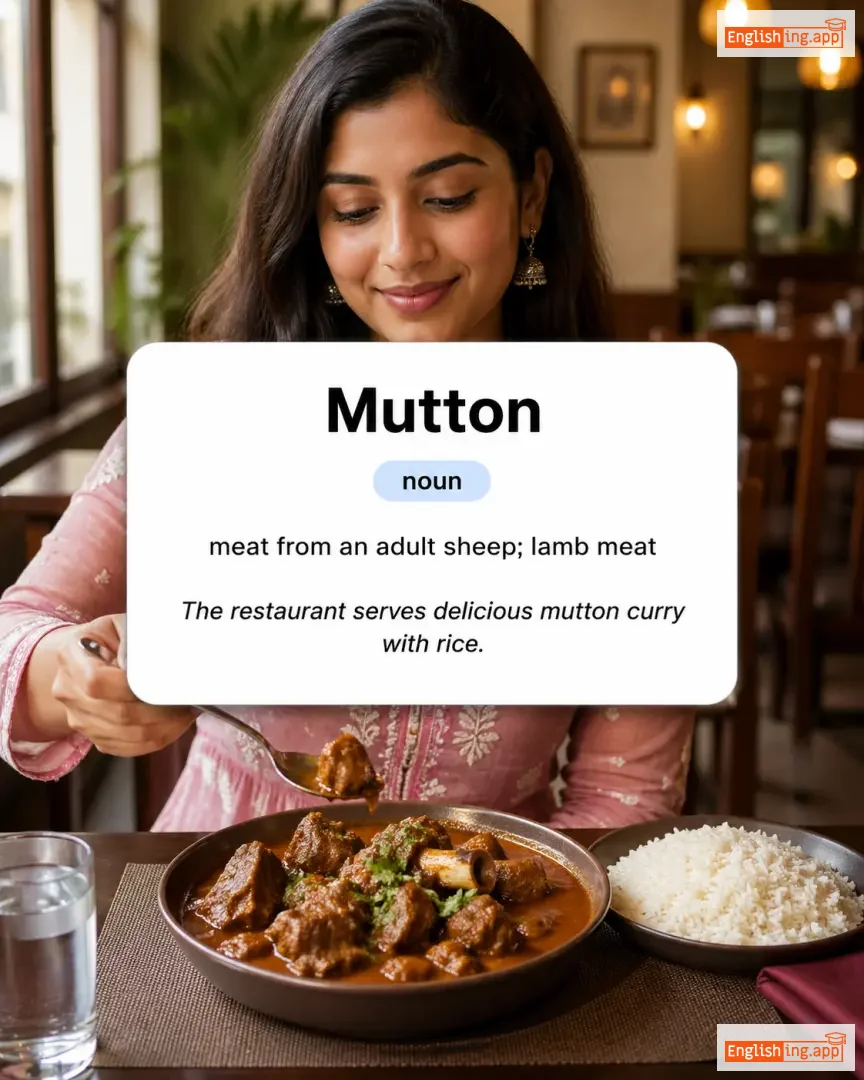
Mutton definition card — visual illustration of the meaning
noun
/ˈmʌtn/
बकरा मांस (bakra maans)

meat from an adult sheep; lamb meat

"The restaurant serves delicious mutton curry with rice."

"रेस्टोरेंट चावल के साथ स्वादिष्ट बकरा मांस करी सर्व करता है।" (restorent chawal ke saath swadisht bakra maans curry serve karta hai.)
adjective
/ˈmjuːtʃuəl/
आपसी (aapsi)

felt, shared, or done by two or more people equally

"They have mutual respect for each other."

"उनके बीच आपसी सम्मान है।" (Unke beech aapsi sammaan hai.)
pronoun
/maɪ/
मेरा (mera)

used to indicate possession or ownership

"This is my book."

"यह मेरी किताब है।" (Yeh meri kitaab hai.)
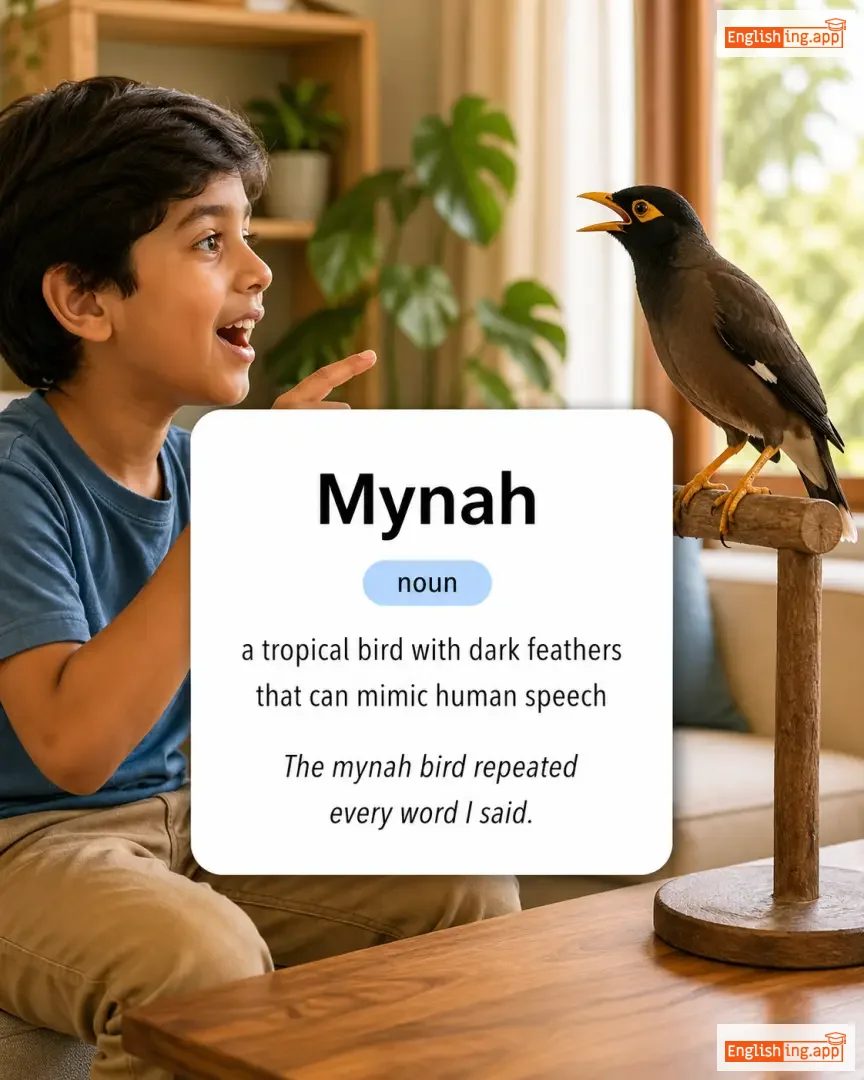
Mynah definition card — visual illustration of the meaning
noun
/ˈmaɪ.nə/
मयना (mayna)

a tropical bird with dark feathers that can mimic human speech

"The mynah bird repeated every word I said."

"मयना पक्षी ने जो भी मैंने कहा, उसे दोहराया।" (mayna pakshi ne jo bhi maine kaha, use dohraya)
adjective
/maɪˈɑːpɪk/
दृष्टिहीन, संकीर्ण दृष्टि (drishtihin, sankirn drishti)

lacking foresight or long-term perspective; also refers to nearsightedness

"The company’s myopic strategy led to long-term losses."

"कंपनी की दृष्टिहीन रणनीति से दीर्घकालिक नुकसान हुआ।" (Company ki drishtihin rananeeti se dirghkalik nuksan hua.)
pronoun
/maɪˈsɛlf/
खुद (khud)

used for emphasis or to refer to oneself

"I will do it myself."

"मैं इसे खुद करूंगा।" (Main ise khud karunga.)
noun/adjective
/ˈmɪriəd/
अनगिनत (anganginat)

a countless or extremely great number

"There are myriad stars in the night sky."

"रात के आकाश में अनगिनत तारे हैं।" (Raat ke aakaash mein anginat taare hain.)
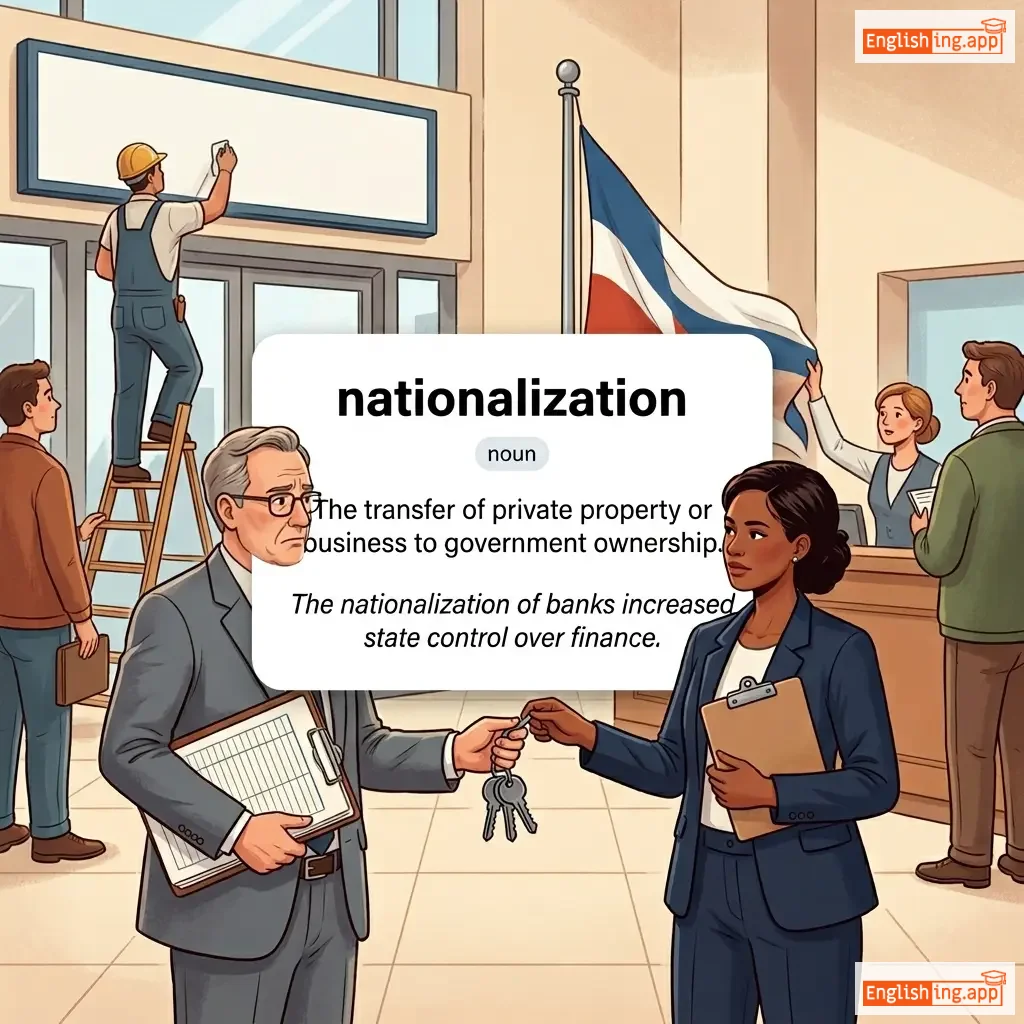
nationalization definition card — visual illustration of the meaning
noun
/ˌnæʃ.ən.ə.laɪˈzeɪ.ʃən/
राष्ट्रीयकरण (rashtriyakaran)

The transfer of private property or business to government ownership.

"The nationalization of banks increased state control over finance."

"बैंकों का राष्ट्रीयकरण ने वित्तीय नियंत्रण को बढ़ाया।" (Bankon ka rashtriyakaran ne vittiya niyantran ko badhaya.)
noun
/ˌnæʃəˈnæləti/
राष्ट्रीयता (rāṣṭrīyatā)

The status of belonging to a particular nation, either by birth or naturalization.

"Her nationality is Canadian, though she was born in France."

"उसकी राष्ट्रीयता कनाडाई है, हालाँकि वह फ्रांस में पैदा हुई थी।" (uski rāṣṭrīyatā kanāḍā'ī hai, hālnāki vah phrāns mein paidā huī thī.)
noun
/ˈnæʃənəl ˈænθəm/
राष्ट्रीय गान (rashtriya gaan)

an official patriotic song of a country, performed at national events and ceremonies

"The national anthem was played before the international match."

"अंतरराष्ट्रीय मैच से पहले राष्ट्रीय गान बजाया गया।" (antarashtriya match se pehle rashtriya gaan bajaya gaya)
adjective
/ˈnæʃənəl/
राष्ट्रीय (rāṣhṭrīya)

relating to a nation, especially its culture, language, or government

"The national anthem was played at the ceremony."

"राष्ट्रीय गान समारोह में बजाया गया था।" (rāṣhṭrīya gān samāroh mein bajāyā gayā thā.)
noun
/ˈneɪʃən/
राष्ट्र (rashtra)

a large group of people united by common descent, history, culture, or language

"The nation celebrated its independence day with pride."

"राष्ट्र ने अपने स्वतंत्रता दिवस को गर्व के साथ मनाया" (Rashtra ne apne swatantrata divas ko garv ke saath manaya)
noun
/næˈteɪʃən/
तैराकी (tairaki)

The act or sport of swimming.

"She took lessons in natation to improve her swimming skills."

"उसने अपनी तैराकी कौशल को सुधारने के लिए नैटेशन कक्षाएं लीं।" (Usne apni tairaki kaushal ko sudharne ke liye natation kakshaen leen.)
adjective
/ˈneɪtl/
जन्मस्थान से संबंधित (janmasthan se sambandhit)

Relating to birth or the place of birth.

"She returned to her natal village after many years."

"वह कई वर्षों बाद अपने जन्मस्थान लौट आई।" (vah kai varsho baad apne janmasthan laut aayi.)
adjective
/ˈnæsti/
घिनौना (ghinouna)

very unpleasant, unkind, or offensive

"He made a nasty comment about her dress."

"उसने उसकी ड्रेस के बारे में एक घिनौना टिप्पणी की।" (Usne uski dress ke baare mein ek ghinouna tippani ki.)
nascent definition card — visual illustration of the meaning
adjective
/ˈneɪsnt/
नवजात (navjat)

Just coming into existence and beginning to develop.

"The nascent technology has great potential."

"नवजात प्रौद्योगिकी में महान संभावनाएँ हैं।" (Navjat pradyogiki mein mahaan sambhavnayein hain.)
adjective
/ˈneɪzl/
नाक से संबंधित (nak se sambandhit)

Relating to the nose; a sound produced through the nose.

"He spoke with a nasal voice due to his cold."

"उसने सर्दी के कारण नाक में आवाज़ के साथ बात की।" (Usne sardi ke kaaran nak mein awaaz ke saath baat ki.)
adverb
/ˈnæroʊli/
थोड़ा अंतर; मुश्किल से (thoda antar; mushkil se)

by a small margin; barely; in a limited way

"She narrowly escaped the accident."

"वह एक छोटे से अंतर से दुर्घटना से बची।" (vah ek chhote se antar se durghatna se bachi.)
adjective
/ˌnæroʊˈmaɪndɪd/
संकीर्ण मानसिकता वाला (sankirn mansikta wala)

Having a limited outlook or unwillingness to accept different opinions or ideas.

"She was too narrow-minded to consider other perspectives."

"वह दूसरों के दृष्टिकोणों पर विचार करने के लिए बहुत संकीर्ण मानसिकता वाली थी." (vah doosron ke drishtikonon par vichaar karne ke liye bahut sankirn mansikta wali thi)
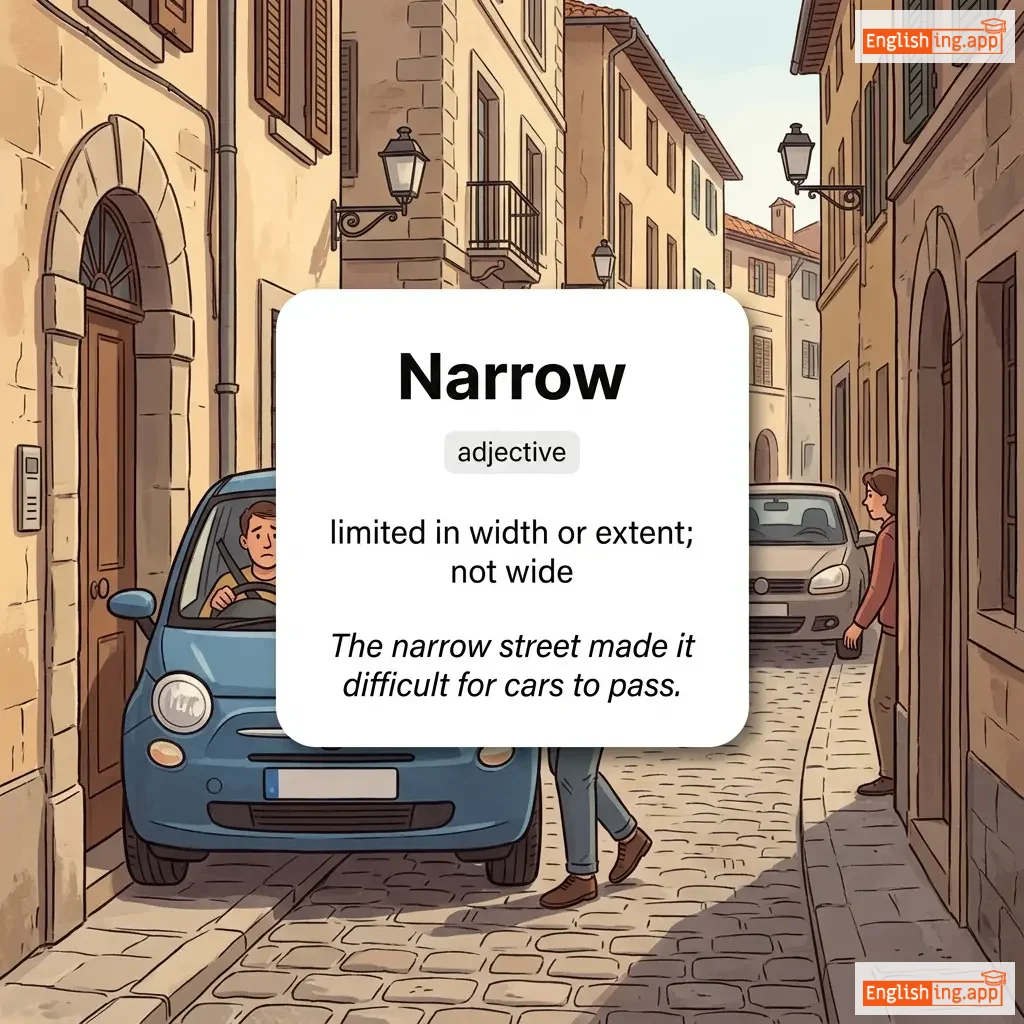
Narrow definition card — visual illustration of the meaning
adjective
/ˈnær.oʊ/
संकीर्ण (sankirn)

limited in width or extent; not wide

"The narrow street made it difficult for cars to pass."

"संकीर्ण सड़क ने कारों के लिए गुजरना मुश्किल बना दिया।" (Sankirn sadak ne kaaron ke liye guzarna mushkil bana diya.)
noun
/ˈnæreɪtər/
कथावाचक (kathavachak)

A person who tells the story in a book, play, or film.

"The narrator guided the audience through the complex plot."

"कथावाचक ने दर्शकों को जटिल प्लॉट के माध्यम से मार्गदर्शन किया।" (Kathavachak ne darshako ko jatil plot ke madhyam se margdarshan kiya.)
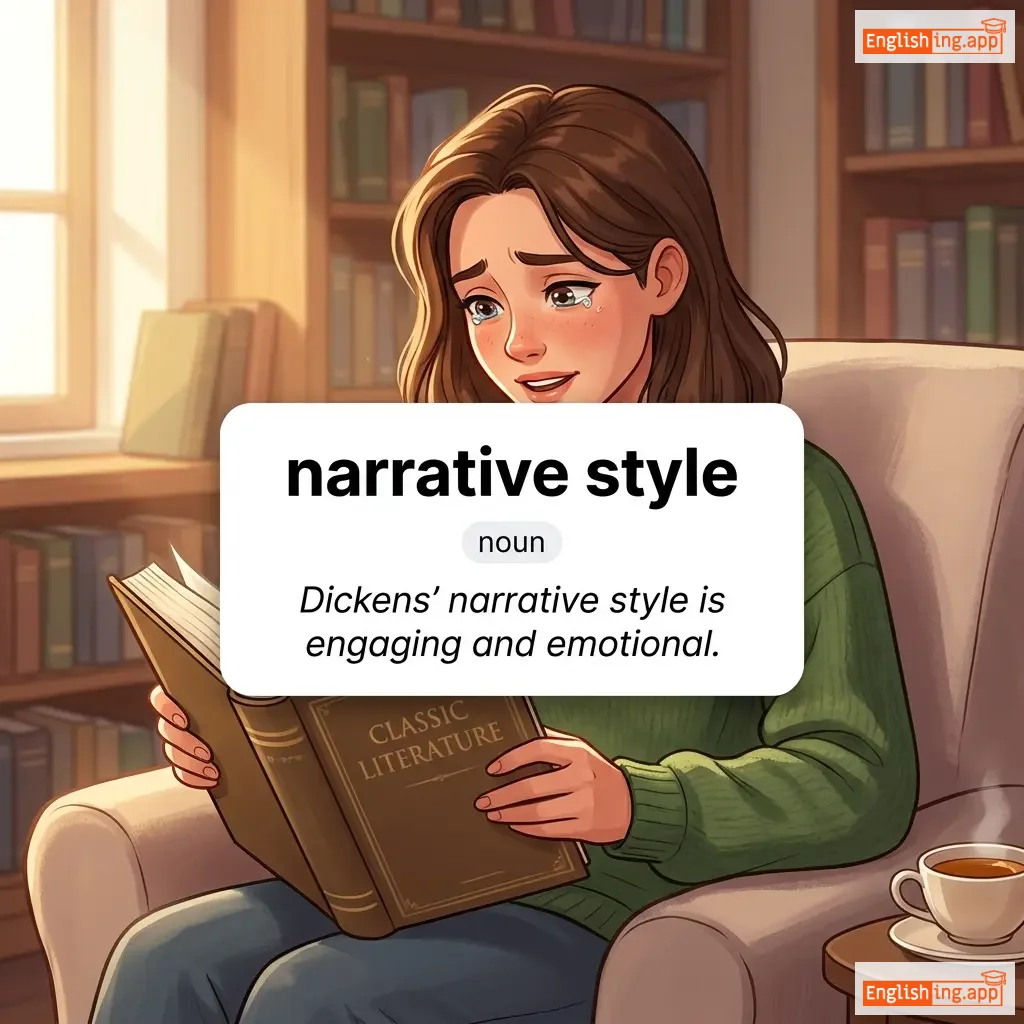
narrative style definition card — visual illustration of the meaning
noun
ˈnærətɪv staɪl
कथन शैली (kathan shaili)

The way in which a story is told, including the point of view and the voice of the narrator.

"Dickens' narrative style is engaging and emotional."

"डिकेन्स की कथन शैली आकर्षक और भावनात्मक है।" (Dickens ki kathan shaili akarsak aur bhavnatmak hai.)
noun
/ˈnærətɪv/
वर्णन, कहानी (varnan, kahani)

A spoken or written account of connected events; a story.

"The novel’s narrative explores themes of identity and freedom."

"उपन्यास की वर्णन पहचान और स्वतंत्रता के विषयों का अन्वेषण करती है।" (Upanyas ki varnan pehchan aur svatantrata ke vishayon ka anvishan karti hai.)
noun
/næˈreɪʃən/
कथन (kathan)

The act of telling a story or describing events in detail.

"The movie’s narration was done by a famous actor."

"फिल्म की कथन एक प्रसिद्ध अभिनेता द्वारा की गई थी।" (Film ki kathan ek prasiddh abhineta dwara ki gayi thi.)
verb
/ˈnæreɪt/
वर्णन करना (varnan karna)

To tell a story or describe events, often in detail.

"She will narrate the events of her journey to the audience."

"वह अपनी यात्रा के घटनाओं का वर्णन दर्शकों से करेगी।" (Wah apni yatra ke ghatnaon ka varnan darshako se karegi.)
noun
/nɑːrˈkɒtɪk/
नशीला पदार्थ (nashila padarth)

A drug that dulls the senses and relieves pain, often causing sleep and sometimes addiction.

"The police seized a large amount of narcotic substances."

"पुलिस ने बड़ी मात्रा में नशीला पदार्थ जब्त किया।" (Police ne badi matra mein nashila padarth jobt kiya.)
noun
/nɑːrˈsɪsəs/
नार्सिसस फूल (narsisas phool)

A type of flowering plant with yellow or white blooms, often associated with self-love from Greek mythology.

"A narcissus bloomed in the garden during spring."

"वसंत में बग़ीचे में एक नार्सिसस खिल रहा था।" (Vasant mein bagiche mein ek narsisas khil raha tha.)
noun
/ˈnɑːrsɪsɪst/
नार्सीसिस्ट (narcissist)

A person who has an excessive interest in or admiration of themselves.

"Everyone avoided him because he was a narcissist."

"हर कोई उससे बचता था क्योंकि वह एक नार्सीसिस्ट था।" (har koi usse bachta tha kyonki vah ek narcissist tha.)
adjective, adverb
/ˈneɪʃənˌwaɪd/
सार्वभौमिक (sarvabhaumik)

existing or happening throughout an entire nation

"The campaign received nationwide support."

"अभियान को सर्वभौमिक समर्थन प्राप्त हुआ।" (Abhiyan ko sarvabhaumik samarthan prapt hua.)
noun
/ˈneɪdɪər/
सबसे निम्न बिंदु (naidir)

The lowest point of a situation or condition.

"The company reached its nadir during the financial crisis."

"वित्तीय संकट के दौरान कंपनी अपने सबसे निम्न बिंदु पर पहुँची।" (vittiya sankat ke dauran kampani apne sabse nimn bindu par pahunchi.)