词汇表

英语词汇词典 | 单词含义、定义和示例

adjective
/ˈmʌski/
麝香味的 (shèxiāng wèi de)

having a strong, sweet, earthy smell like musk

"The perfume had a musky fragrance."

"香水有一种麝香味。" (Xiāngshuǐ yǒu yī zhǒng shèxiāng wèi.)
noun
/ˈmʊzlɪm/
穆斯林 (musilin)

a follower of Islam

"He is a devout Muslim."

"他是一个虔诚的穆斯林。" (Tā shì yīgè qiánchéng de mùsīlín.)
verb
/mʌst/
必须 (bìxū)

to be required or obligated to

"You must complete your homework before you go out."
"你必须完成作业,然后才能出去。" (Nǐ bìxū wánchéng zuòyè, ránhòu cáinéng chūqù.)
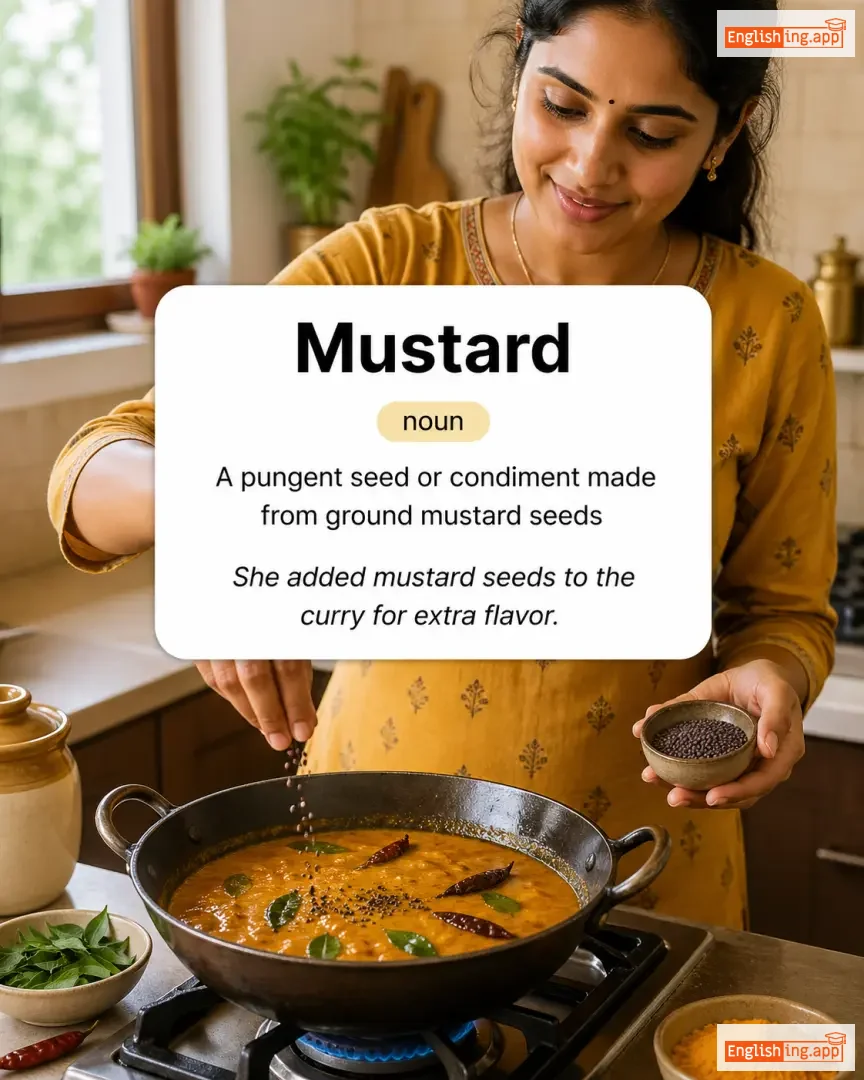
Mustard definition card — visual illustration of the meaning
noun
/ˈmʌs.tərd/
芥末 (jiè mò)

A pungent seed or condiment made from ground mustard seeds

"She added mustard seeds to the curry for extra flavor."
"她将芥末种子加入咖喱中,以增添更多风味。" (tā jiāng jiè mò zhǒng zǐ jiārù gālí zhōng, yǐ zēngtiān gèng duō fēngwèi.)
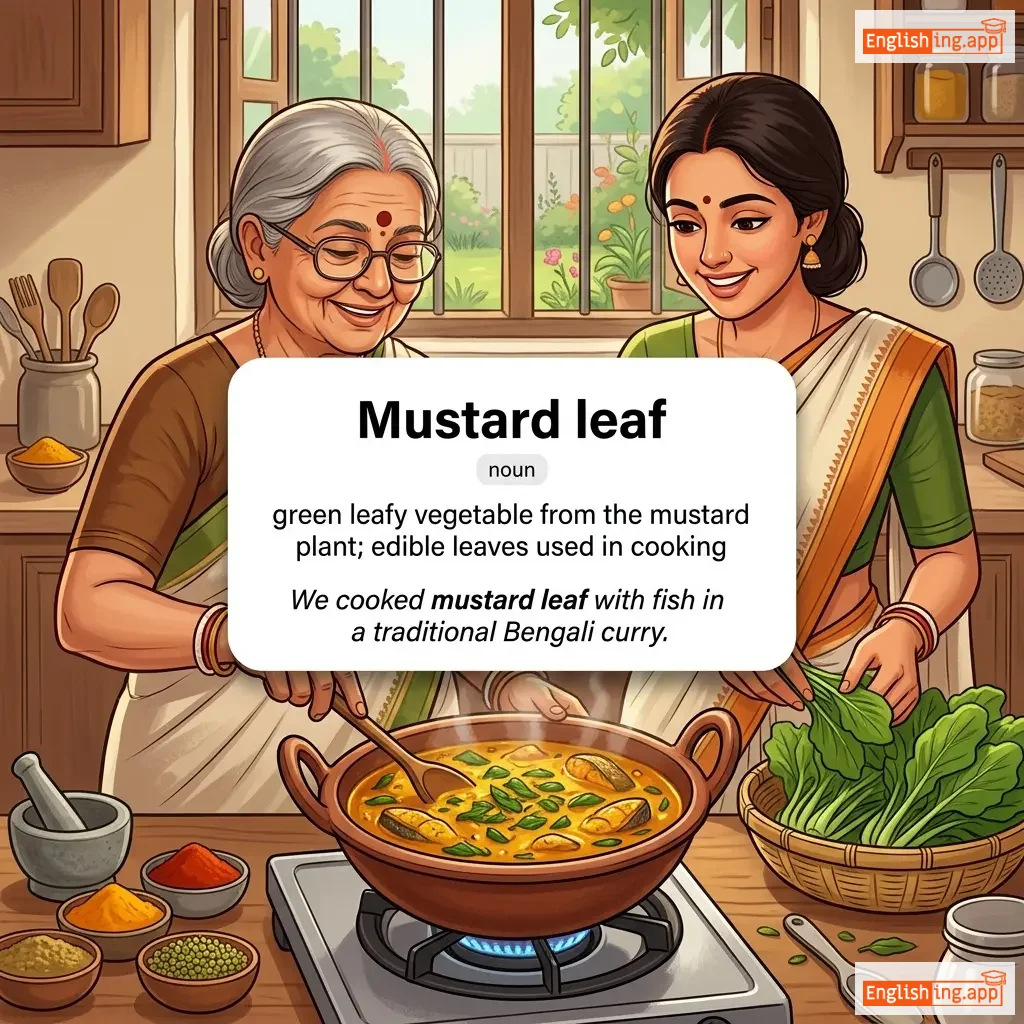
Mustard leaf definition card — visual illustration of the meaning
noun
/ˈmʌs.tərd liːf/
芥菜叶 (jiè cài yè)

green leafy vegetable from the mustard plant; edible leaves used in cooking

"We cooked mustard leaf with fish in a traditional Bengali curry."

"我们在传统的孟加拉咖喱中与鱼一起煮了芥菜叶。" (Wǒmen zài chuántǒng de mèngjiālā kālí zhōng yǔ yú yīqǐ zhǔle jiè cài yè.)
Mustard Oil definition card — visual illustration of the meaning
noun
/ˈmʌstərd ɔɪl/
芥末油 (jiè mò yóu)

oil extracted from mustard seeds, commonly used for cooking and medicinal purposes

"We use mustard oil for cooking vegetables in our kitchen."
"我们在厨房里用芥末油来煮蔬菜。" (Wǒmen zài chúfáng lǐ yòng jiè mò yóu lái zhǔ shū cài.)
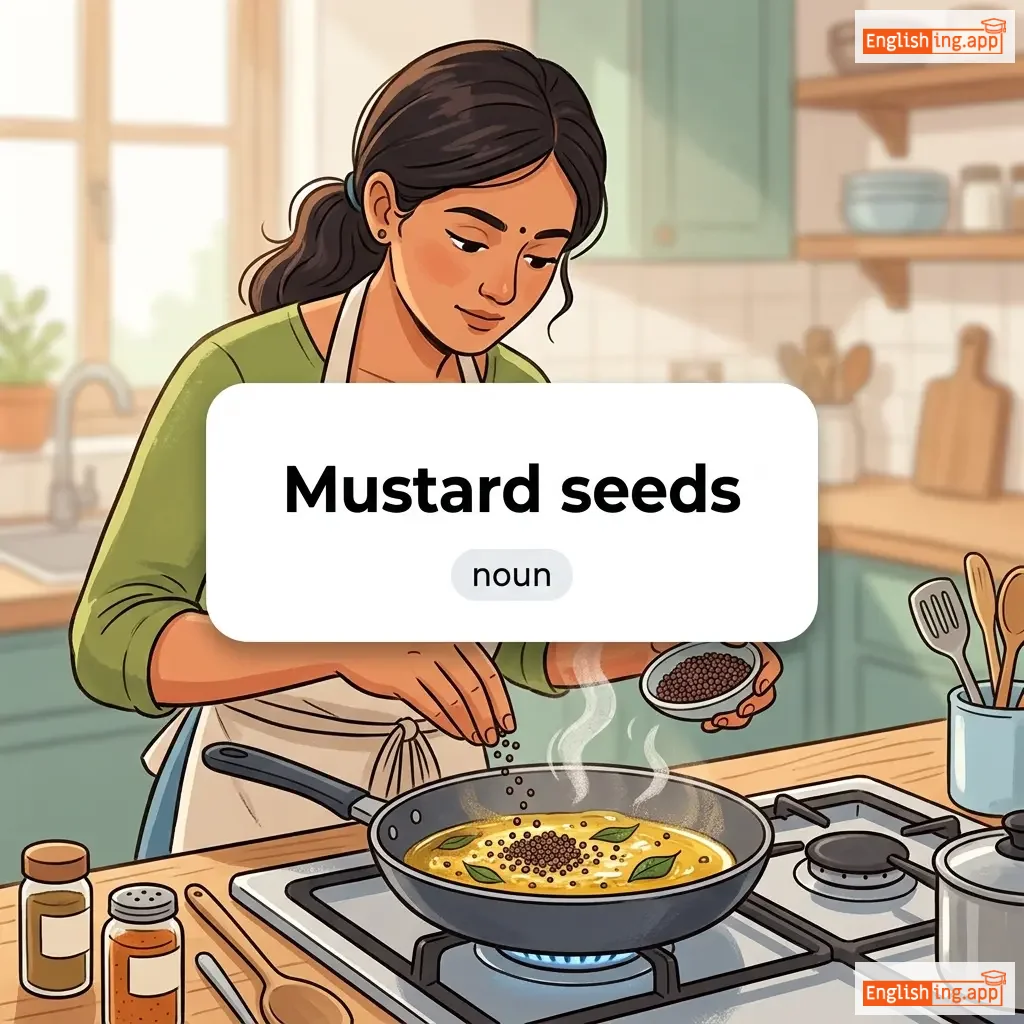
Mustard seeds definition card — visual illustration of the meaning
noun
/ˈmʌs.tərd siːdz/
芥菜种子 (jiè cài zhǒng zǐ)

small round seeds from the mustard plant, used as a spice and for making mustard condiment

"Mustard seeds are often tempered in hot oil to release their nutty flavor before adding to dishes."

"芥菜种子常常在热油中炒制,释放它们的坚果味道,然后加入菜肴中。" (Jiè cài zhǒng zǐ cháng cháng zài rè yóu zhōng chǎo zhì, shì fàng tā men de jiān guǒ wèi dào, rán hòu jiā rù cài yáo zhōng.)
verb, noun
/ˈmʌstər/
聚集 / 集合勇气 (jùjí / jíhé yǒngqì)

to gather people, especially soldiers; to summon courage or strength

"He mustered enough courage to face the challenge."

"他积聚了足够的勇气来面对挑战。" (Tā jījùle zúgòu de yǒngqì lái miànduì tiǎozhàn.)
adjective
/ˈmʌsti/
发霉的,潮湿的或有霉味的 (fāméi de, cháoshī de huò yǒu méi wèi de)

having a stale, moldy, or damp smell

"The old books had a musty odor."

"旧书有霉味。" (Jiù shū yǒu méi wèi.)
noun
/ˌmjuːtəˈbɪləti/
可变性 (kebiànxìng)

The quality of being changeable or capable of change.

"The mutability of fashion trends makes it hard to keep up."

"时尚潮流的变动性使得跟上它变得困难。" (Shíshàng cháoliú de biàndòngxìng shǐdé gēn shàng tā biàndé kùnnán.)
adjective
/ˈmjuːtəbl/
可变的 (kebian de)

Capable of change or alteration.

"Human emotions are mutable and can shift rapidly."

"人类的情感是可变的,能够迅速变化。" (Rénlèi de qínggǎn shì kěbiàn de, nénggòu xùnsù biànhuà.)
noun
/ˌmjuːtəˈbɪləti/
变异性 (拼写错误) (bianyixing (pinyin cuowu))

A misspelled form of 'mutability', meaning the quality of being changeable.

"The document contained the misspelled word 'mutablility' instead of 'mutability'."

"文件中包含了拼写错误的词 'mutablility',而不是 'mutability'。" (Wenjian zhong baohanle pinxie cuowu de ci 'mutablility', er bushi 'mutability'.)
verb
/ˈmjuːteɪt/
突变 (tubian)

To change or cause to change in form, nature, or character.

"The virus can mutate into a more dangerous strain."

"病毒可以突变成一种更危险的菌株。" (Bingdu keyi tubian cheng yizhong geng weixian de junzhu.)
noun
/mjuːˈteɪʃn/
突变,基因变异 (tūbiàn, jīyīn biànyì)

A change in form, structure, or nature, especially in genetics.

"Scientists discovered a genetic mutation that caused the disorder."

"科学家发现了一种基因突变,导致了这种疾病。" (Kēxuéjiā fāxiànle yī zhǒng jīyīn tūbiàn, dǎozhìle zhè zhǒng jíbìng.)
🤐

Mute

adjective
/mjuːt/

silent or unable to speak; not expressed in words

"She remained mute during the entire meeting."

adjective
/ˈmjuːtɪd/
柔和的 (rouhe de)

softened in sound, color, or effect; subdued

"The room was painted in muted shades of blue and grey."

"房间用蓝色和灰色的柔和色调粉刷。" (Fangjian yong lanse he huise de rouhe se tiao fen shua.)
verb
/ˈmjuːtɪleɪt/
摧残 (cuīcán)

to inflict serious damage on something, often by cutting or tearing

"The ancient manuscript was mutilated by careless handling."

"古老的手稿因不小心处理而被摧残。" (Gǔlǎo de shǒugǎo yīn bù xiǎoxīn chǔlǐ ér bèi cuīcán.)
adjective
/ˈmjuːtɪnəs/
叛乱的 (pànluàn de)

refusing to obey authority; rebellious

"The soldiers grew mutinous after months without pay."

"士兵们在几个月没有工资后变得叛乱了。" (Shìbīngmen zài jǐ gè yuè méiyǒu gōngzī hòu biàn dé pànluàn le.)
noun
/ˈmjuːtɪni/
叛乱 (pànluàn)

an open rebellion against authority, especially by soldiers or sailors

"The sailors staged a mutiny against their captain."

"水手们发动了对他们船长的叛乱。" (Shuǐshǒu men fādòng le duì tāmen chuánzhǎng de pànluàn.)
verb
/ˈmʌtər/
低声说 (dīshēng shuō)

to speak in a low or barely audible voice, often in dissatisfaction or irritation

"He muttered something under his breath as he walked away."
"他低声咕哝着什么,走开了。" (Tā dīshēng gūnóng zhe shénme, zǒu kāi le.)
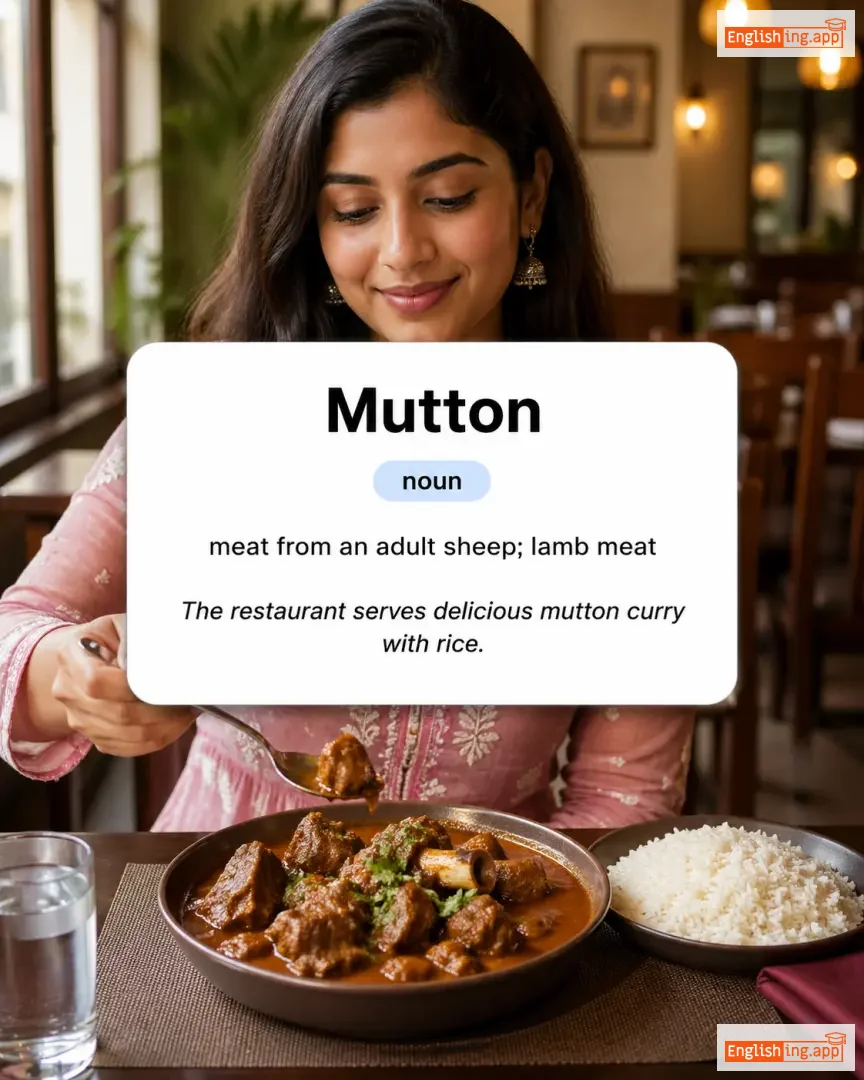
Mutton definition card — visual illustration of the meaning
noun
/ˈmʌtn/
羊肉 (yáng ròu)

meat from an adult sheep; lamb meat

"The restaurant serves delicious mutton curry with rice."

"餐厅提供美味的羊肉咖喱配米饭。" (Cāntīng tígōng měiwèi de yángròu gālí pèi mǐfàn.)
adjective
/ˈmjuːtʃuəl/
相互的 (xiānghù de)

felt, shared, or done by two or more people equally

"They have mutual respect for each other."
"他们彼此有相互的尊重。" (Tāmen bǐcǐ yǒu xiānghù de zūnzhòng.)
pronoun
/maɪ/
我的 (wǒ de)

used to indicate possession or ownership

"This is my book."

"这是我的书。" (Zhè shì wǒ de shū.)
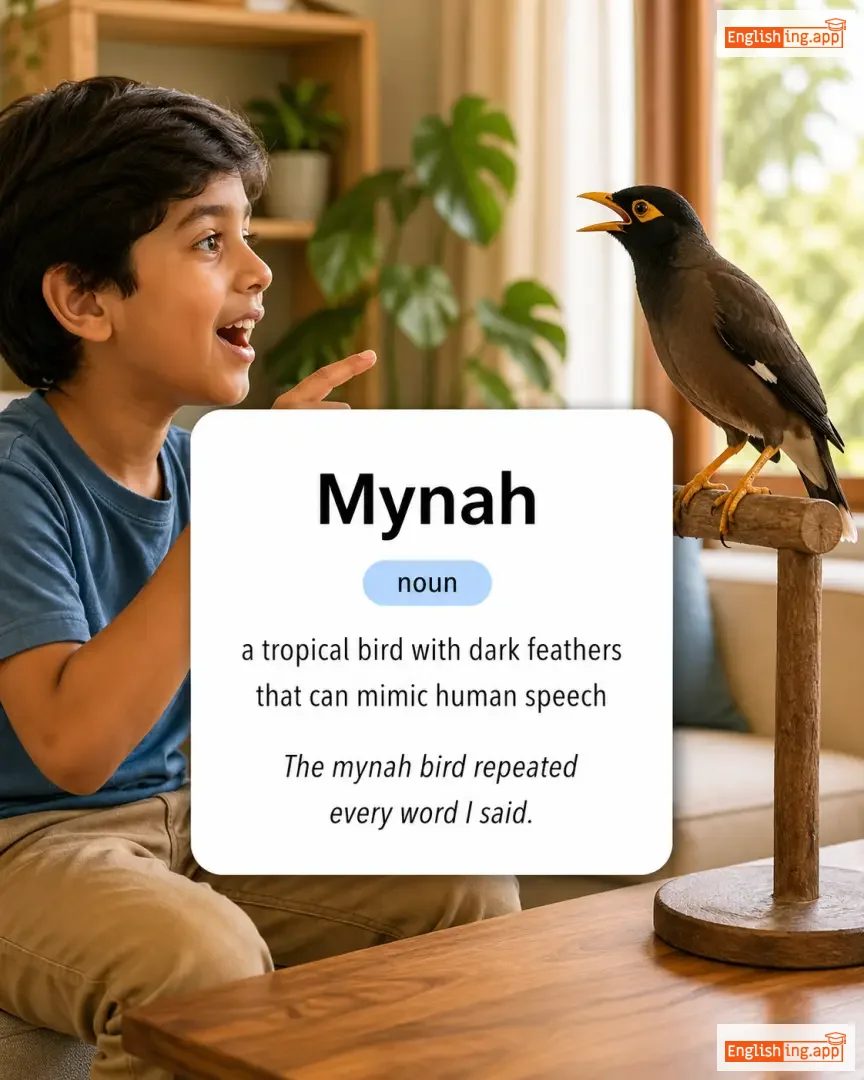
Mynah definition card — visual illustration of the meaning
noun
/ˈmaɪ.nə/
八哥 (bā gē)

a tropical bird with dark feathers that can mimic human speech

"The mynah bird repeated every word I said."

"八哥鸟重复了我说的每一个词。" (bā gē niǎo chóngfùle wǒ shuō de měi yīgè cí)
adjective
/maɪˈɑːpɪk/
近视,狭隘的视野 (jìnshì, xiá'ài de shìyě)

lacking foresight or long-term perspective; also refers to nearsightedness

"The company’s myopic strategy led to long-term losses."

"公司的近视战略导致了长期损失。" (Gōngsī de jìnshì zhànlüè dǎozhì le chángqī sǔnshī.)
pronoun
/maɪˈsɛlf/
我自己 (wǒ zìjǐ)

used for emphasis or to refer to oneself

"I will do it myself."

"我会自己做。" (Wǒ huì zìjǐ zuò.)
noun/adjective
/ˈmɪriəd/
无数 (wú shù)

a countless or extremely great number

"There are myriad stars in the night sky."

"夜空中有无数的星星。" (Yè kōng zhōng yǒu wú shù de xīng xīng.)
nationalization definition card — visual illustration of the meaning
noun
/ˌnæʃ.ən.ə.laɪˈzeɪ.ʃən/
国家化 (guojiahua)

The transfer of private property or business to government ownership.

"The nationalization of banks increased state control over finance."

"银行的国家化增加了国家对金融的控制。" (Yinhang de guojiahua zengjia le guo jia dui jinrong de kongzhi.)
noun
/ˌnæʃəˈnæləti/
国籍 (guójí)

The status of belonging to a particular nation, either by birth or naturalization.

"Her nationality is Canadian, though she was born in France."

"她的国籍是加拿大的,尽管她出生在法国。" (Tā de guójí shì jiānádà de, jǐnguǎn tā chūshēng zài fǎguó.)
noun
/ˈnæʃənəl ˈænθəm/
国歌 (guoge)

an official patriotic song of a country, performed at national events and ceremonies

"The national anthem was played before the international match."

"国际比赛前演奏了国歌。" (Guoji bisai qian yanzou le guoge)
adjective
/ˈnæʃənəl/
国家的 (guójiā de)

relating to a nation, especially its culture, language, or government

"The national anthem was played at the ceremony."

"国歌在仪式上播放。" (Guógē zài yíshì shàng bōfàng.)
noun
/ˈneɪʃən/
国家 (guójiā)

a large group of people united by common descent, history, culture, or language

"The nation celebrated its independence day with pride."

"国家以自豪的心情庆祝独立日。" (Guójiā yǐ zìháo de xīnqíng qìngzhù dúlì rì.)
noun
/næˈteɪʃən/
游泳 (you yong)

The act or sport of swimming.

"She took lessons in natation to improve her swimming skills."

"她参加了游泳课程,以提高她的游泳技巧。" (Ta canjia le youyong kecheng, yi tigao ta de youyong jiqiao.)
adjective
/ˈneɪtl/
与出生有关的 (yu chusheng youguan de)

Relating to birth or the place of birth.

"She returned to her natal village after many years."

"她在许多年后返回了她的出生村庄。" (Ta zai xu duo nian hou fanhui le ta de chusheng cunzhuang.)
adjective
/ˈnæsti/
令人不快的 (lìng rén bù kuài de)

very unpleasant, unkind, or offensive

"He made a nasty comment about her dress."

"他对她的裙子发表了令人不快的评论。" (Tā duì tā de qúnzi fābiǎo le lìng rén bù kuài de pínglùn.)
nascent definition card — visual illustration of the meaning
adjective
/ˈneɪsnt/
萌芽 (méngyá)

Just coming into existence and beginning to develop.

"The nascent technology has great potential."

"萌芽中的技术具有巨大的潜力。" (Méngyá zhōng de jìshù jùyǒu jùdà de qiánlì.)
adjective
/ˈneɪzl/
鼻音的 (bīyīn de)

Relating to the nose; a sound produced through the nose.

"He spoke with a nasal voice due to his cold."

"他因感冒说话带有鼻音。" (Tā yīn gǎnmào shuōhuà dàiyǒu bíyīn.)
adverb
/ˈnæroʊli/
勉强地; 刚好 (miǎnqiǎng de; gānghǎo)

by a small margin; barely; in a limited way

"She narrowly escaped the accident."

"她差点逃脱了事故。" (Tā chàdiǎn táotuōle shìgù.)
adjective
/ˌnæroʊˈmaɪndɪd/

Having a limited outlook or unwillingness to accept different opinions or ideas.

"She was too narrow-minded to consider other perspectives."
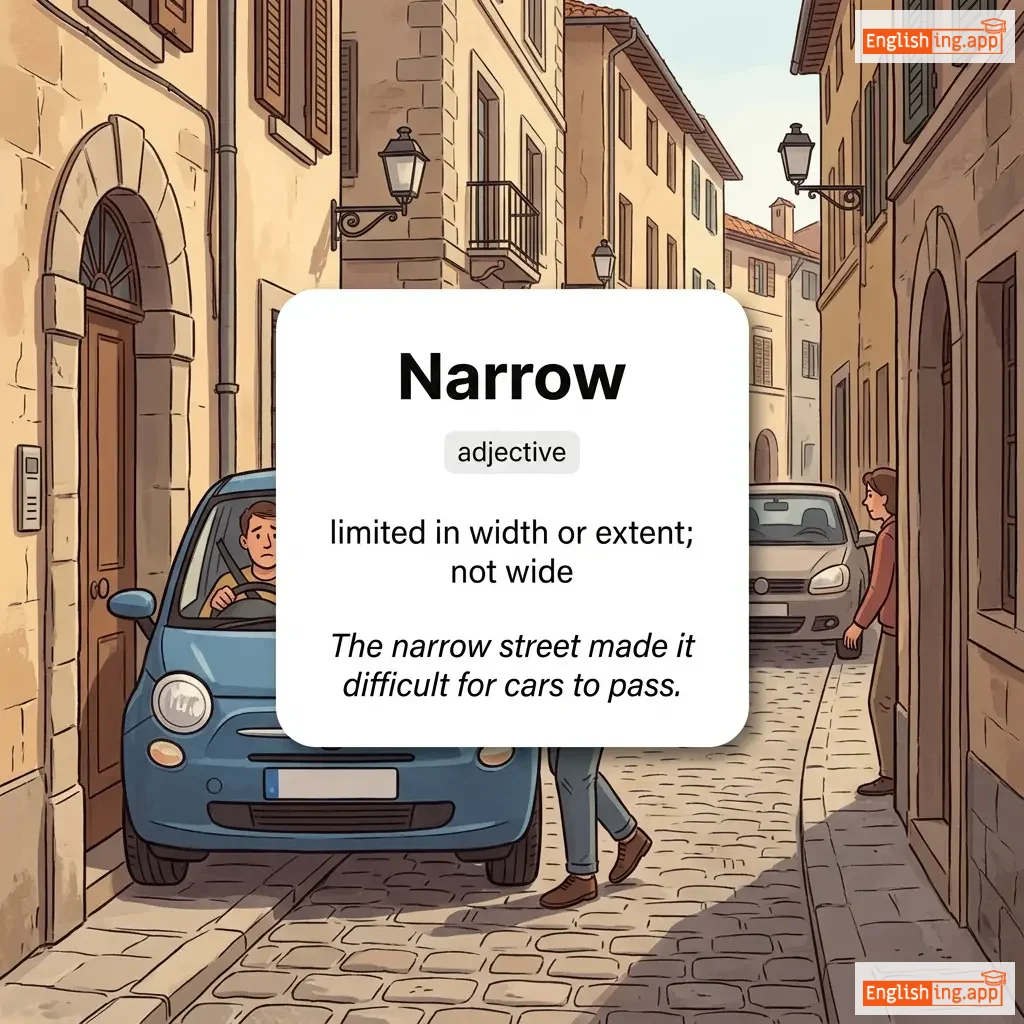
Narrow definition card — visual illustration of the meaning
adjective
/ˈnær.oʊ/
狭窄 (xiazhai)

limited in width or extent; not wide

"The narrow street made it difficult for cars to pass."

"狭窄的街道使得汽车很难通过。" (Xiazhai de jiedao shide qiche hendan tongguo.)
noun
/ˈnæreɪtər/
叙述者 (xùshù zhě)

A person who tells the story in a book, play, or film.

"The narrator guided the audience through the complex plot."

"叙述者引导观众穿越复杂的情节。" (Xùshù zhě yǐndǎo guānzhòng chuānyuè fùzá de qíngjié.)
narrative style definition card — visual illustration of the meaning
noun
ˈnærətɪv staɪl
叙事风格 (xushi fengge)

The way in which a story is told, including the point of view and the voice of the narrator.

"Dickens' narrative style is engaging and emotional."

"狄更斯的叙事风格引人入胜且富有情感。" (Dí gèngsī de xùshì fēnggé yǐn rén rù shèng qiě fùyǒu qínggǎn.)
noun
/ˈnærətɪv/

A spoken or written account of connected events; a story.

"The novel’s narrative explores themes of identity and freedom."

noun
/næˈreɪʃən/
叙述 (xushu)

The act of telling a story or describing events in detail.

"The movie’s narration was done by a famous actor."

"电影的叙述由一位著名演员完成。" (Dianying de xushu you yi wei zhuming yanyuan wancheng.)
verb
/ˈnæreɪt/
叙述 (xushù)

To tell a story or describe events, often in detail.

"She will narrate the events of her journey to the audience."

"她将向观众叙述她旅途中的事件。" (Ta jiang xiang guanzhong xushu ta lütu zhong de shijian.)
noun
/nɑːrˈkɒtɪk/
麻醉品 (mázuìpǐn)

A drug that dulls the senses and relieves pain, often causing sleep and sometimes addiction.

"The police seized a large amount of narcotic substances."

"警察查获了一大批麻醉品。" (Jǐngchá cháhuòle yī dà pī mázuìpǐn.)
noun
/nɑːrˈsɪsəs/
水仙花 (shuǐxiān huā)

A type of flowering plant with yellow or white blooms, often associated with self-love from Greek mythology.

"A narcissus bloomed in the garden during spring."

"春天时,一朵水仙花在花园里盛开。" (Chūntiān shí, yī duǒ shuǐxiān huā zài huāyuán lǐ shèngkāi.)
noun
/ˈnɑːrsɪsɪst/
自恋者 (zìliàn zhě)

A person who has an excessive interest in or admiration of themselves.

"Everyone avoided him because he was a narcissist."

"每个人都避开他,因为他是一个自恋者。" (měi gè rén dōu bì kāi tā, yīnwèi tā shì yīgè zìliàn zhě.)
adjective, adverb
/ˈneɪʃənˌwaɪd/
全国范围 (quanguo fanwei)

existing or happening throughout an entire nation

"The campaign received nationwide support."

"这项运动得到了全国范围的支持。" (Zhe xiang yundong dedaole quanguo fanwei de zhichi.)
⬇️

nadir

noun
/ˈneɪdɪər/

The lowest point of a situation or condition.

"The company reached its nadir during the financial crisis."