語彙集

英単語辞書 | 単語の意味、定義、例文

verb
/ˈdɒɡmətaɪz/
ドグマ化する (doguma-ka suru)

To state opinions or beliefs as if they were absolute truths.

"The professor tended to dogmatize on political issues."

"その教授は政治的な問題でドグマタイズする傾向があった。" (Sono kyōju wa seijiteki na mondai de dogumataizu suru keikō ga atta.)
noun
/ˈdɒldrəmz/

A state of inactivity, stagnation, or low spirits; also a region near the equator with calm winds.

"After the project failed, the team was stuck in the doldrums for months."

adjective
/ˈdəʊl.fəl/
悲しい (kanashii)

Expressing sorrow or sadness; mournful.

"She gave him a doleful look before leaving."

"彼女は去る前に悲しそうな目を彼に向けました。" (Kanojo wa saru mae ni kanashisō na me o kare ni mukemashita.)
adjective
/ˈdəʊl.səm/
悲しい (kanashii)

Filled with grief or sadness; mournful.

"The dolesome ballad brought tears to their eyes."

"その悲しい歌は彼らの目に涙をもたらしました。" (Sono kanashii uta wa karera no me ni namida wo motarashimashita.)
noun
/dɒl/
人形 (ningyo)

a small toy resembling a human figure, especially for children

"The little girl hugged her favorite doll tightly."

"小さな女の子はお気に入りの人形をしっかり抱きしめました。" (Chiisana onnanoko wa okiniiri no ningyo wo shikkari dakishimemashita.)
noun
/ˈdɒlər/
ドル (doru)

The basic monetary unit of the United States and some other countries

"I need five dollars to buy this book."

"この本を買うには5ドル必要です。" (Kono hon o kau ni wa go doru hitsuyou desu.)
noun
/ˈdəʊ.lər/
痛み (itami)

A state of great sorrow or distress.

"The nation was in deep dolor after the tragedy."

"国は悲劇の後、深い痛みに沈んでいた。" (Kuni wa higeki no ato, fukai itami ni shizunde ita.)
☹️

dolorous

adjective
/ˈdəʊ.lə.rəs/

Expressing great sorrow or distress.

"He spoke in a dolorous tone after the loss."

noun
/ˈdɒlfɪn/
イルカ (iruka)

A highly intelligent marine mammal with a streamlined body and dorsal fin

"Dolphins are known for their playful behavior and intelligence."

"イルカは遊び好きな行動と知性で知られています。" (iruka wa asobisuki na kodo to chisei de shirareteimasu)
noun
/doʊlt/
ばか (baka)

A stupid or slow-witted person.

"Only a dolt would believe such a story."

"そんな話を信じるのはばかだけだ。" (Son'na hanashi o shinjiru no wa baka dake da.)
noun
/dəˈmeɪn/
領域 (ryouiki)

An area of knowledge, activity, or territory over which control is exercised.

"Mathematics is her main domain of expertise."
"数学は彼女の主な専門領域です。" (Suugaku wa kanojo no omona senmon ryouiki desu.)
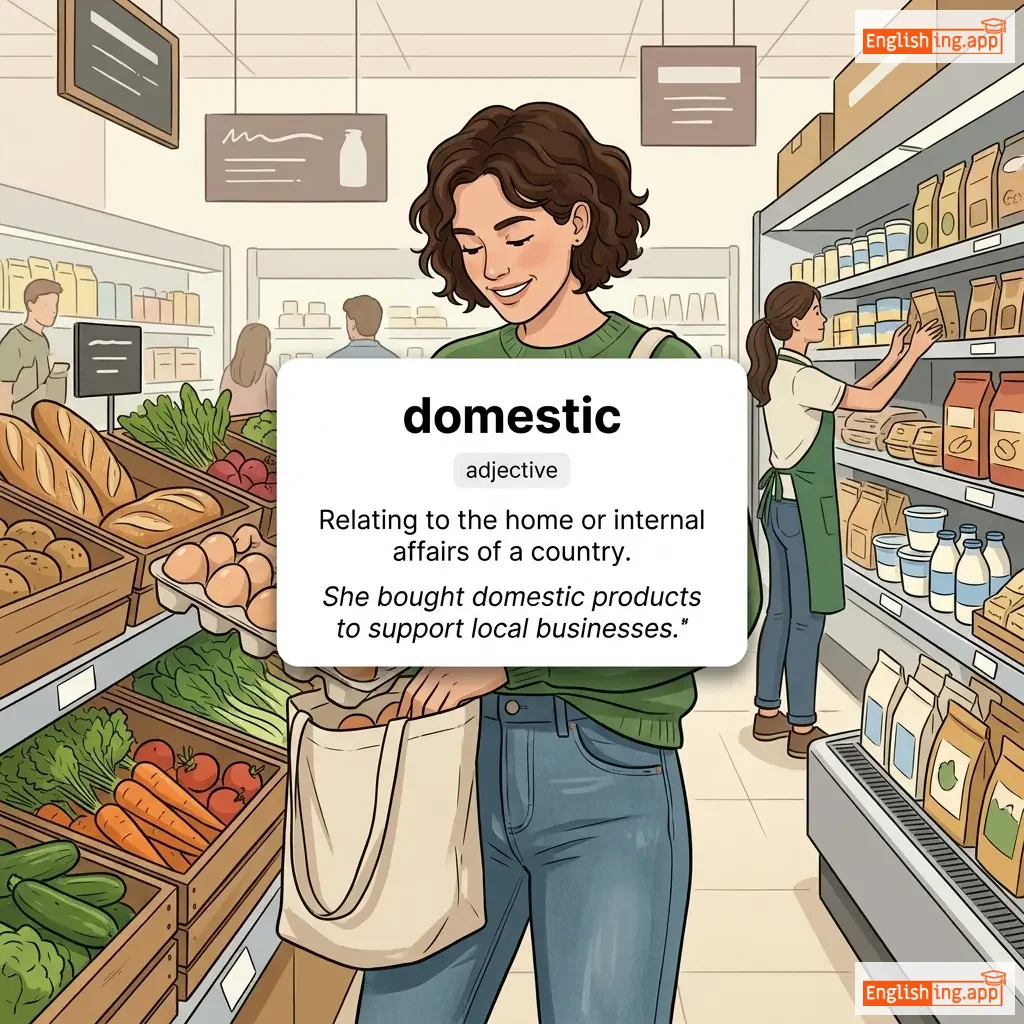
domestic definition card — visual illustration of the meaning
adjective
/dəˈmɛstɪk/
幸福 (kōfuku)

Relating to the home or internal affairs of a country.

"She bought domestic products to support local businesses."

"彼女は賞を受け取ったとき、幸せを隠すことができませんでした。" (Kanojo wa shō o uketotta toki, kōfuku o kakusu koto ga dekimasen deshita.)
verb
/dəˈmɛstɪkeɪt/
家畜化する (kachikuka suru)

to tame an animal for use by humans; to adapt something for domestic use

"Humans domesticated dogs thousands of years ago."
"人間は数千年前に犬を家畜化しました。" (Ningen wa suusen nen mae ni inu wo kachikuka shimashita.)
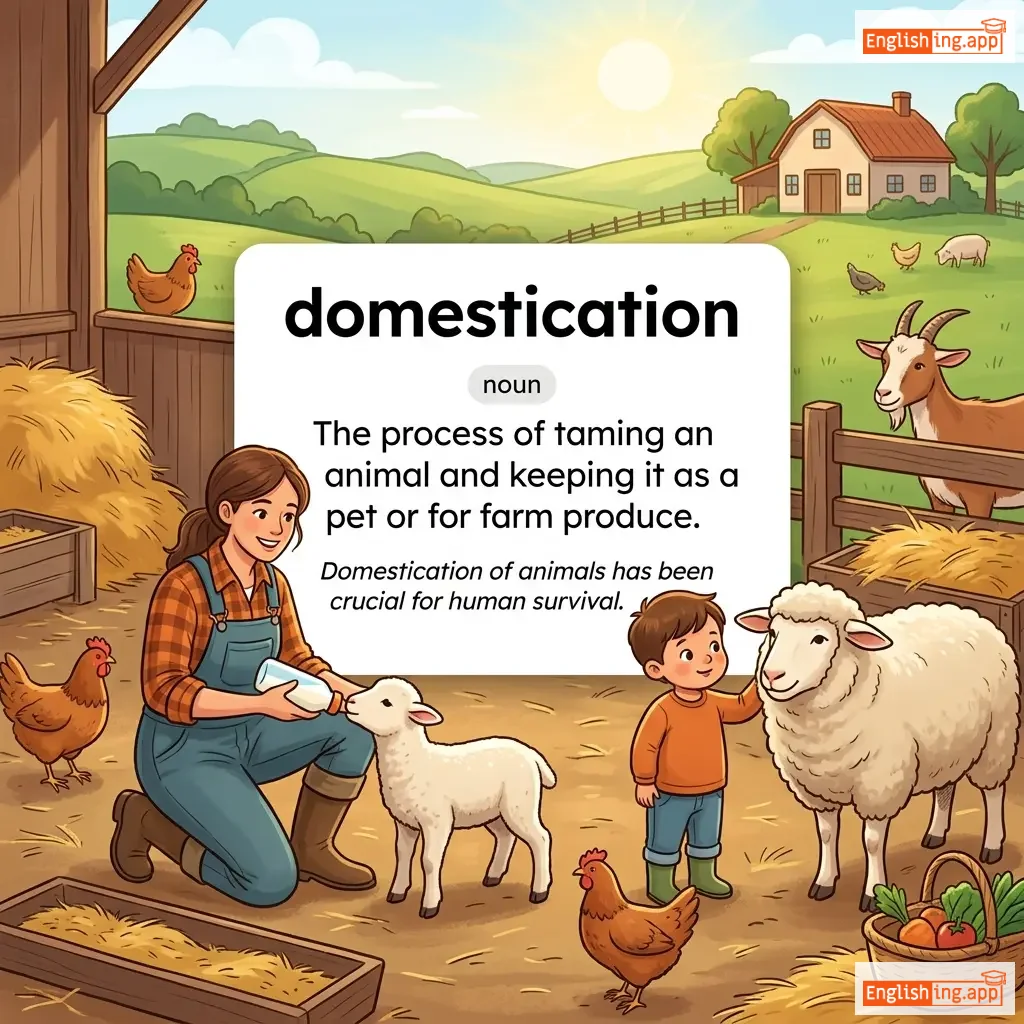
domestication definition card — visual illustration of the meaning
noun
dəˌmɛstɪˈkeɪʃən
家畜化 (kachokuba)

The process of taming an animal and keeping it as a pet or for farm produce.

"Domestication of animals has been crucial for human survival."

"動物の家畜化は人間の生存にとって重要だった。" (Doubutsu no kachokuba wa ningen no seizon ni totte juuyou datta.)
noun
/ˌdoʊ.məˈstɪs.ə.ti/
家庭生活 (katei seikatsu)

Life at home or devotion to family life.

"She enjoys the domesticity of cooking and gardening."

"彼女は料理とガーデニングの家庭生活を楽しんでいます。" (Kanojo wa ryori to ga-deningu no katei seikatsu o tanoshindeimasu.)
noun
/ˈdɑː.mə.saɪl/
住居地 (jūkyochi)

A person's legal residence or permanent home.

"He declared Canada as his legal domicile."

"彼はカナダを彼の法的な住居地として宣言しました。" (Kare wa Kanada o kare no hōteki na jūkyōchi toshite sengen shimashita.)
dominance definition card — visual illustration of the meaning
noun
/ˈdɑː.mə.nəns/
支配力 (shihairyoku)

The state of having power and influence over others.

"The company has maintained dominance in the smartphone market."

"その会社はスマートフォン市場で支配力を維持しています。" (Sono kaisha wa sumātofon shijō de shihairyoku o iji shiteimasu.)
adjective
/ˈdɑː.mə.nənt/
支配的な (shihaiten na)

Having power, authority, or influence over others; most important.

"English has become the dominant language in international business."

"英語は国際ビジネスにおいて支配的な言語となった。" (Eigo wa kokusai bijinesu ni oite shihaiten na gengo to natta.)
verb
/ˈdɒmɪneɪt/
支配する (shihai suru)

to have power or control over something or someone

"The company dominates the smartphone market."

"その会社はスマートフォン市場を支配しています。" (Sono kaisha wa sumātōfon shijō o shihai shiteimasu.)
noun
/ˌdɒmɪˈneɪʃən/
支配 (shihai)

the exercise of control or influence over someone or something

"The empire sought domination over its neighbors."

"帝国は隣国に対する支配を求めていた。" (Teikoku wa ringoku ni taisuru shihai o motomete ita.)
verb
/ˌdɒmɪˈnɪə/
支配する (shihai suru)

to assert one's will over another in an arrogant way

"He tends to domineer over his younger colleagues."
"彼は若い同僚に対して支配的な態度を取ることが多い。" (Kare wa wakai dōryō ni taishite shihai-teki na taido o toru koto ga ōi.)
verb, noun
/dɒn/
着る / リーダー (kiru / riidaa)

to put on (an article of clothing); also used as a title for a respected person

"She donned her coat before leaving."

"彼女は出かける前にコートを着た。" (Kanojo wa dekakeru mae ni kooto o kita.)
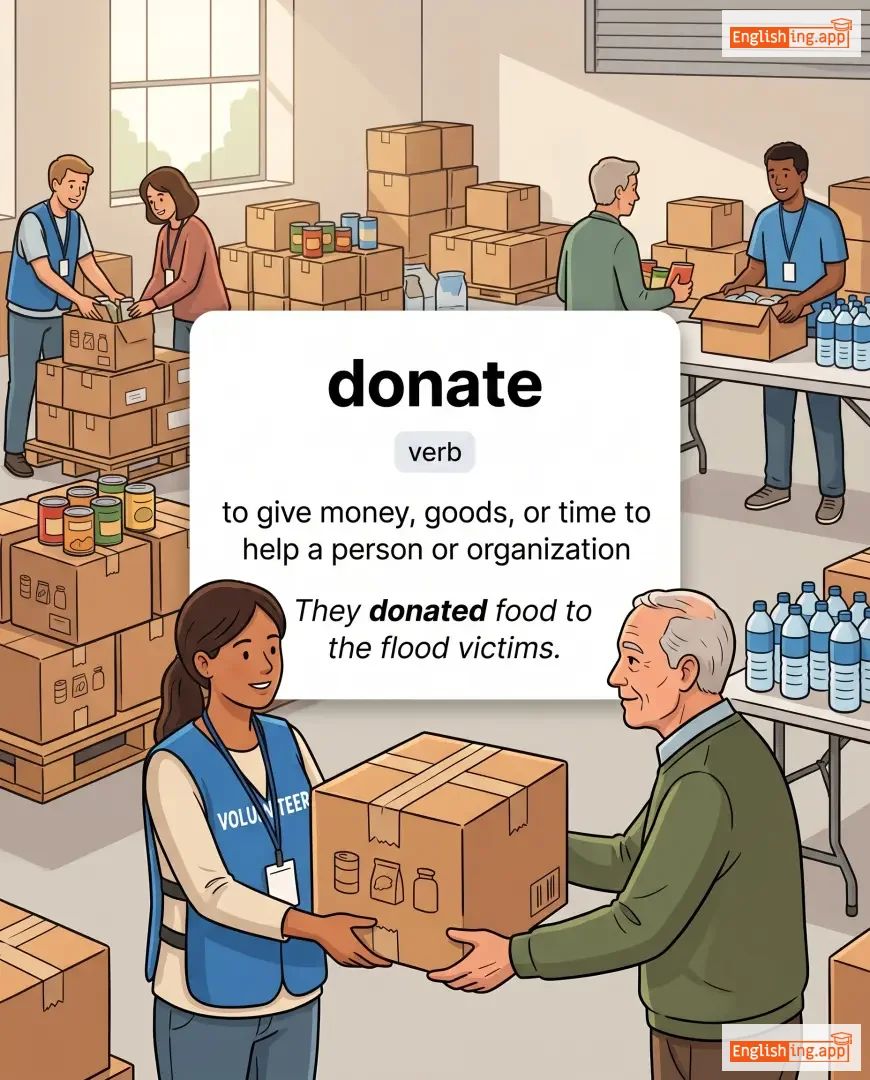
donate definition card — visual illustration of the meaning
verb
/dəʊˈneɪt/
寄付する (kifu suru)

to give money, goods, or time to help a person or organization

"They donated food to the flood victims."

"彼らは洪水の被害者に食べ物を寄付しました。" (Karera wa kōzui no higaisha ni tabemono o kifu shimashita.)
noun
/dəʊˈneɪ.ʃən/
寄付 (kifu)

something that is given to help a person or organization, often money

"He made a generous donation to the local orphanage."

"彼は地元の孤児院に寛大な寄付をしました。" (Kare wa jimoto no kojiin ni kandaina kifu o shimashita.)
noun
/ˈdoʊneɪtər/
寄付者 (kifusha)

A person who gives something, especially money or goods, as a donation.

"The donator wished to remain anonymous after contributing a large sum."

"寄付者は大きな金額を寄付した後、匿名でいることを希望しました。" (Kifusha wa ōkina kingaku o kifu shita ato, tokumei de iru koto o kibō shimashita.)
noun
/doʊˈniː/
受贈者 (juzo-sha)

A person who receives a gift or donation.

"The scholarship fund’s donee expressed heartfelt gratitude."

"奨学金基金の受贈者は心からの感謝の意を表しました。" (Shougakukin kikin no juzo-sha wa kokoro kara no kansha no i wo hyoushimashita.)
noun
/ˈdɒŋ.ki/
ロバ (roba)

a domesticated animal related to the horse, with long ears and a braying call

"The donkey carried heavy bags up the mountain."

"そのロバは重い袋を山へ運びました。" (Sono roba wa omoi fukuro o yama e hakobimashita.)
noun
/ˈdoʊnər/
ドナー (donā)

A person who gives something, especially to a charity or cause.

"The donor contributed generously to the hospital’s new wing."

"ドナーは病院の新しい翼に寛大に寄付しました。" (Donā wa byōin no atarashī tsubasa ni kandai ni kifu shimashita.)
✏️

doodle

verb
/ˈduːdəl/

To draw or scribble absentmindedly, often while thinking about something else.

"She doodled flowers in the corner of her notebook during class."

noun
/duːm/
運命 (unmei)

A terrible fate, destruction, or unavoidable bad outcome.

"The ancient prophecy foretold the city’s doom."

"古代の予言は都市の運命を予見していた。" (Kodai no yogen wa toshi no unmei o yoken shite ita.)
noun
/ˈduːmz.deɪ/
世界の終わり; 最後の審判の日 (sekai no owari; saigo no shinpan no hi)

the last day of the world's existence; a time of catastrophic destruction

"The preacher spoke about doomsday and the importance of preparing spiritually."

"伝道師は世界の終わりと霊的な準備の重要性について話しました。" (Dendōshi wa sekai no owari to reiteki na junbi no jūyō-sei ni tsuite hanashimashita.)
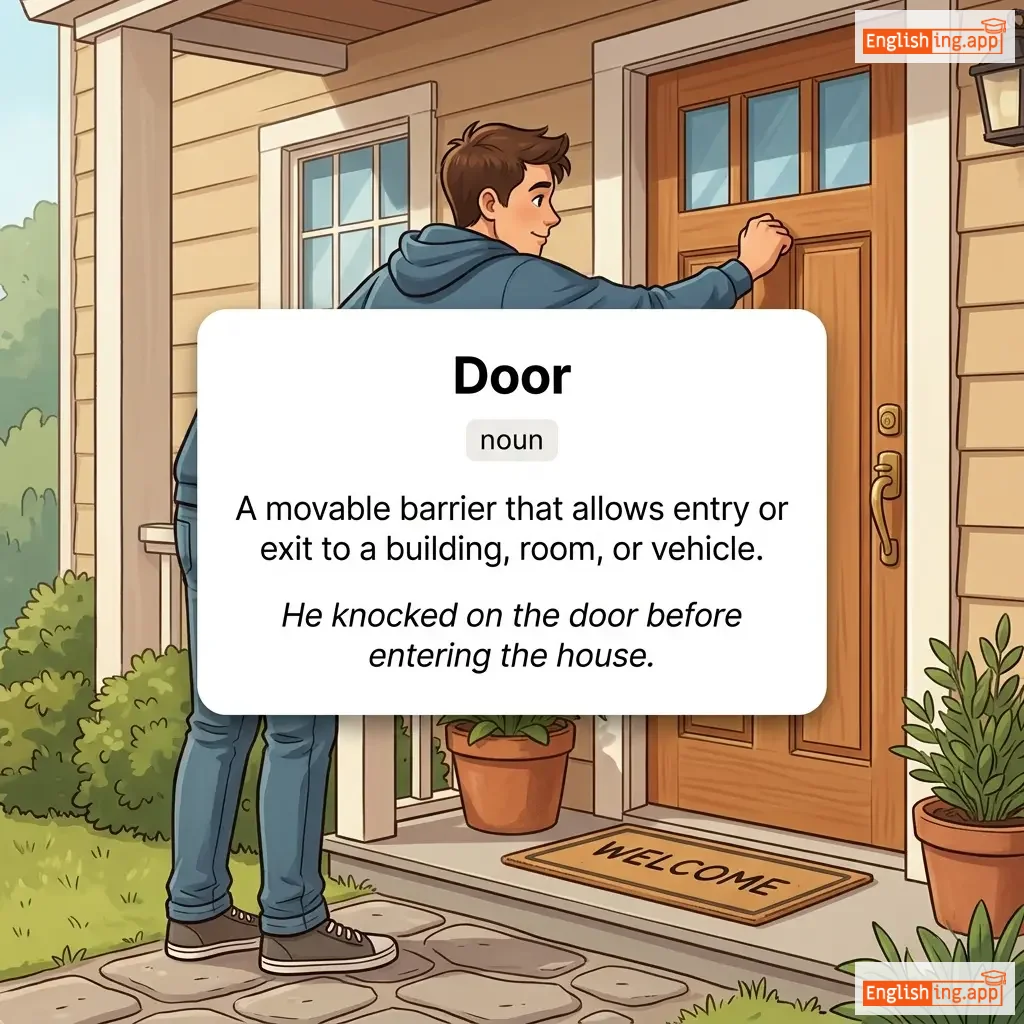
Door definition card — visual illustration of the meaning
noun
/dɔːr/
ドア (doa)

A movable barrier that allows entry or exit to a building, room, or vehicle.

"He knocked on the door before entering the house."

"彼は家に入る前にドアをノックした。" (Kare wa ie ni hairu mae ni doa o nokkushita.)
noun
/ˈdɔːr.mæt/
ドアマット (doamatto)

a mat placed in front of a door for wiping feet

"Please wipe your feet on the door-mat before entering the house."

"家に入る前にドアマットで足を拭いてください。" (Ie ni hairu mae ni doamatto de ashi o fuite kudasai.)
noun
/ˈdɔːrˌkiːpər/
門番 (monban)

A person whose job is to guard or manage the entrance of a building or room.

"The doorkeeper checked everyone’s passes before they entered the hall."

"ドアキーパーは皆がホールに入る前に通行証を確認した。" (Doakipa wa mina ga hall ni hairu mae ni tsuukoushou o kakunin shita)
noun
/ˈdɔː.weɪ/
ドアの入口 (doa no iriguchi)

the space where a door opens into a room or building

"She stood in the doorway waiting for him to arrive."

"彼女はドアの入口に立って、彼が来るのを待っていました。" (Kanojo wa doa no iriguchi ni tatte, kare ga kuru no o matte imashita.)
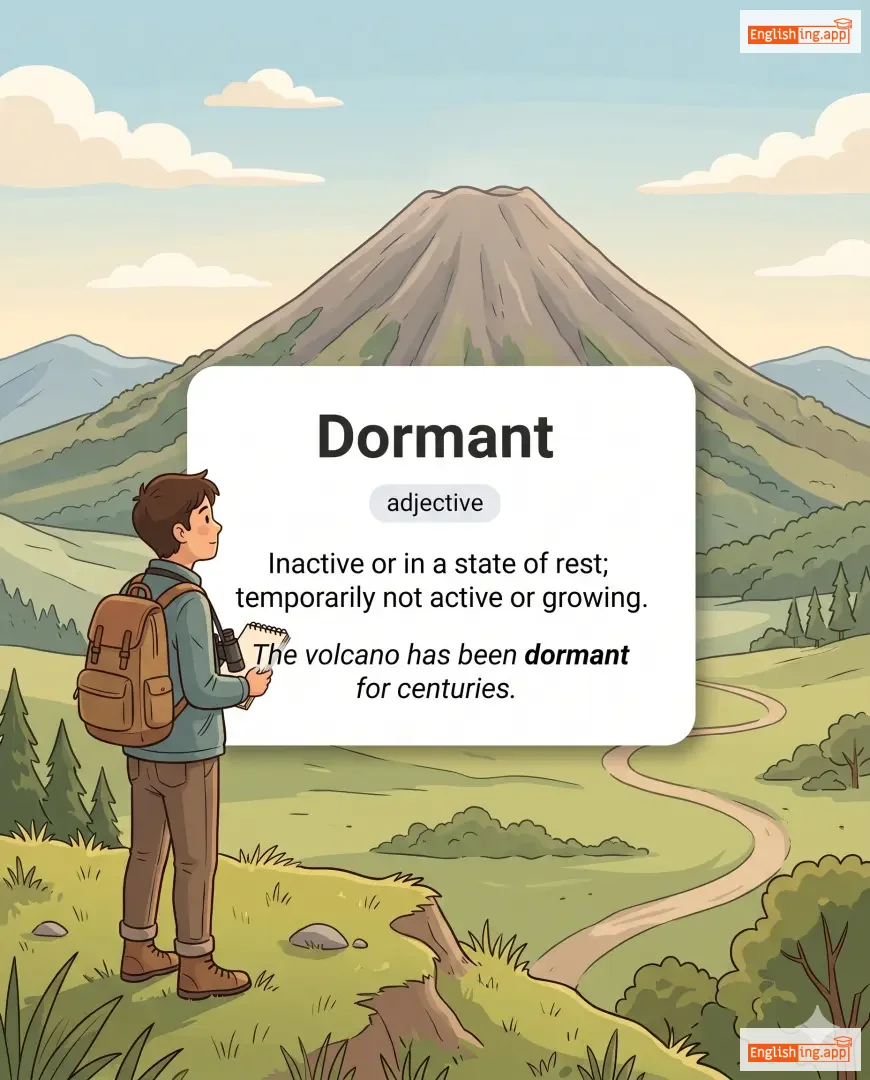
Dormant definition card — visual illustration of the meaning
adjective
/ˈdɔːrmənt/

Inactive or in a state of rest; temporarily not active or growing.

"The volcano has been dormant for centuries."

noun
/ˈdɔːrmər/
ドーマー窓 (dōmā mado)

A window that projects vertically from a sloping roof.

"The old house had a dormer overlooking the garden."

"その古い家には庭を見下ろすドーマー窓がありました。" (Sono furui ie ni wa niwa o miorosu dōmā mado ga arimashita.)
adjective
/ˈdɔːrsəl/
背鰭 (seki)

Relating to the back or upper side of an animal or body part.

"Sharks have a prominent dorsal fin."

"サメは目立つ背鰭を持っています。" (Same wa medatsu seki o motteimasu.)
noun
/doʊs/
用量 (yōryō)

a measured amount of a medicine or drug taken at one time

"The doctor prescribed one dose of the medicine every six hours."

"医者は6時間ごとに1回薬のドーズを処方しました。" (Isha wa roku-jikan goto ni ikkai kusuri no dōzu o shohō shimashita.)
noun
/ˈdɑːsieɪ/
ファイル (fairu)

A collection of documents about a particular person, event, or subject.

"The lawyer presented a dossier of evidence to the court."

"弁護士は証拠のドシエを裁判所に提出しました。" (Bengoshi wa shouko no doshie wo saibansho ni teishutsu shimashita.)
noun
/dɒt/
(ten)

a small round mark or spot

"She drew a red dot on the paper."

"彼女は紙に赤い点を描きました。" (Kanojo wa kami ni akai ten o kakimashita.)
noun
/ˈdoʊtɪdʒ/
老年 (rōnen)

The period of old age, especially when one is weak or senile.

"He spent his dotage reminiscing about his youth."

"彼は晩年を若い頃を思い出して過ごしました。" (Kare wa ban'nenn o wakai koro o omoidasite sugosimashita.)
verb
/doʊt/
溺愛する (dekai suru)

to show excessive love or fondness for someone or something

"She tends to dote on her grandchildren."

"彼女は孫たちに溺愛する傾向があります。" (Kanojo wa magomotachi ni dekai suru keikou ga arimasu.)
verb
/ˈdʌbəl/
倍増する (baizō suru)

to make twice as much in size, number, or amount

"The company hopes to double its profits this year."

"会社は今年、利益を倍増させることを望んでいます。" (Kaisha wa kotoshi, rieki o baizō saseru koto o nozondeimasu.)
noun
/ˈdʌbəl ˈdekər/
二階建てバス (nikaidate basu)

a bus with two levels or floors for passengers

"The red double decker bus is a famous symbol of London."

"赤いダブルデッカーバスはロンドンの有名なシンボルです。" (Akai daburu dekkā basu wa rondon no yūmei na shinboru desu.)
noun
/ˈdʌblɪt/
ダブレット / タイトジャケット (daburetto / taito jaketto)

a close-fitting jacket worn by men in the Renaissance; also, a pair of similar things

"The actor wore a velvet doublet for the Shakespearean play."

"俳優はシェイクスピア劇のためにベルベットのダブレットを着ました。" (Haiyū wa Sheikusupia geki no tame ni berubetto no daburetto o kimashita.)
adverb
/ˈdʌbli/
二重に (nijū ni)

in a twofold manner; to twice the degree

"She felt doubly fortunate after winning the prize and getting a promotion."

"彼女は賞を受賞し、昇進した後、二重に幸運だと感じました。" (Kanojo wa shō o jushō shi, shōshin shita ato, nijū ni kōun da to kanjimashita.)
Doubt definition card — visual illustration of the meaning
noun/verb
/daʊt/
疑い (utagai)

a feeling of uncertainty or lack of conviction; to be uncertain about something

"She had doubts about the success of the plan."

"彼女は計画の成功に疑問を抱いていた。" (Kanojo wa keikaku no seikou ni gimon o daiteita.)
adjective
/ˈdaʊt.fəl/
疑わしい; 不確かな; 何かに対して不確かに感じる (ugowashī; fukakushina; nanika ni taishite fukakushin ni kanjiru)

uncertain; questionable; feeling uncertain about something

"I am doubtful about the success of this project."

"私はこのプロジェクトの成功について疑問を持っています。" (Watashi wa kono purojekuto no seikō ni tsuite gimon o motteimasu.)
noun
/doʊ/
生地 (kiji)

a mixture of flour, water, and other ingredients used to make bread or pastries

"She kneaded the dough for ten minutes before baking."

"彼女は生地を10分間こねた後、それを焼きました。" (Kanojo wa kiji o juppun kan koneta ato, sore o yakimashita.)