वोकैबुलरीज

इंग्लिश वोकैबुलरी डिस्कवर, लर्न और मास्टर करें

verb
/ˈdɒɡmətaɪz/
अपना मत कठोरता से पेश करना (apna mat kathorta se pesh karna)

To state opinions or beliefs as if they were absolute truths.

"The professor tended to dogmatize on political issues."

"प्रोफेसर राजनीतिक मुद्दों पर कठोर रूप से अपने विचार पेश करने की प्रवृत्ति रखते थे।" (Professor rajnaitik muddon par kathor roop se apne vichar pesh karne ki pravritti rakhte the.)
noun
/ˈdɒldrəmz/
नीरस अवस्था (doldrums)

A state of inactivity, stagnation, or low spirits; also a region near the equator with calm winds.

"After the project failed, the team was stuck in the doldrums for months."

"परियोजना के असफल होने के बाद, टीम महीनों तक डॉल्ड्रम्स में फंसी रही." (pariyojana ke asafal hone ke baad, team mahino tak doldrums mein fansi rahi)
adjective
/ˈdəʊl.fəl/
उदास (udas)

Expressing sorrow or sadness; mournful.

"She gave him a doleful look before leaving."

"वह उसे जाने से पहले एक उदास नज़र से देख रही थी।" (Wah use jane se pehle ek udaas nazar se dekh rahi thi.)
adjective
/ˈdəʊl.səm/
दुःखभरा (dukhbhara)

Filled with grief or sadness; mournful.

"The dolesome ballad brought tears to their eyes."

"दुःखभरी गाने ने उनके आँखों में आंसू भर दिए।" (Dukhbhari gane ne unke aankhon mein aansu bhar diye.)
noun
/dɒl/
गुड़िया (gudiya)

a small toy resembling a human figure, especially for children

"The little girl hugged her favorite doll tightly."

"छोटी लड़की ने अपनी पसंदीदा गुड़िया को कसकर गले लगाया।" (chhoti ladki ne apni pasandida gudiya ko kaskar gale lagaya.)
noun
/ˈdɒlər/
डॉलर (dolar)

The basic monetary unit of the United States and some other countries

"I need five dollars to buy this book."

"मुझे इस किताब को खरीदने के लिए पांच डॉलर चाहिए।" (mujhe is kitab ko kharidne ke liye paanch dolar chahiye.)
noun
/ˈdəʊ.lər/
दुःख (dukh)

A state of great sorrow or distress.

"The nation was in deep dolor after the tragedy."

"देश त्रासदी के बाद गहरे दुःख में था।" (Desh traasdi ke baad gehre dukh mein tha.)
adjective
/ˈdəʊ.lə.rəs/
दुखपूर्ण (dukhpoorn)

Expressing great sorrow or distress.

"He spoke in a dolorous tone after the loss."

"हानि के बाद उसने दुखपूर्ण लहजे में बोला।" (haani ke baad usne dukhpoorn lahje mein bola)
noun
/ˈdɒlfɪn/
डॉल्फिन (dolphin)

A highly intelligent marine mammal with a streamlined body and dorsal fin

"Dolphins are known for their playful behavior and intelligence."

"डॉल्फिन अपने चंचल व्यवहार और बुद्धिमत्ता के लिए जानी जाती हैं।" (dolphin apne chanchal vyavhar aur buddhimatta ke liye jani jati hain)
noun
/doʊlt/
मूर्ख (moorkh)

A stupid or slow-witted person.

"Only a dolt would believe such a story."

"केवल एक मूर्ख ही ऐसी कहानी पर विश्वास करेगा।" (Keval ek moorkh hi aisi kahani par vishwas karega.)
noun
/dəˈmeɪn/
क्षेत्र (kshetra)

An area of knowledge, activity, or territory over which control is exercised.

"Mathematics is her main domain of expertise."

"गणित उसका मुख्य क्षेत्र है।" (Ganit uska mukhya kshetra hai.)
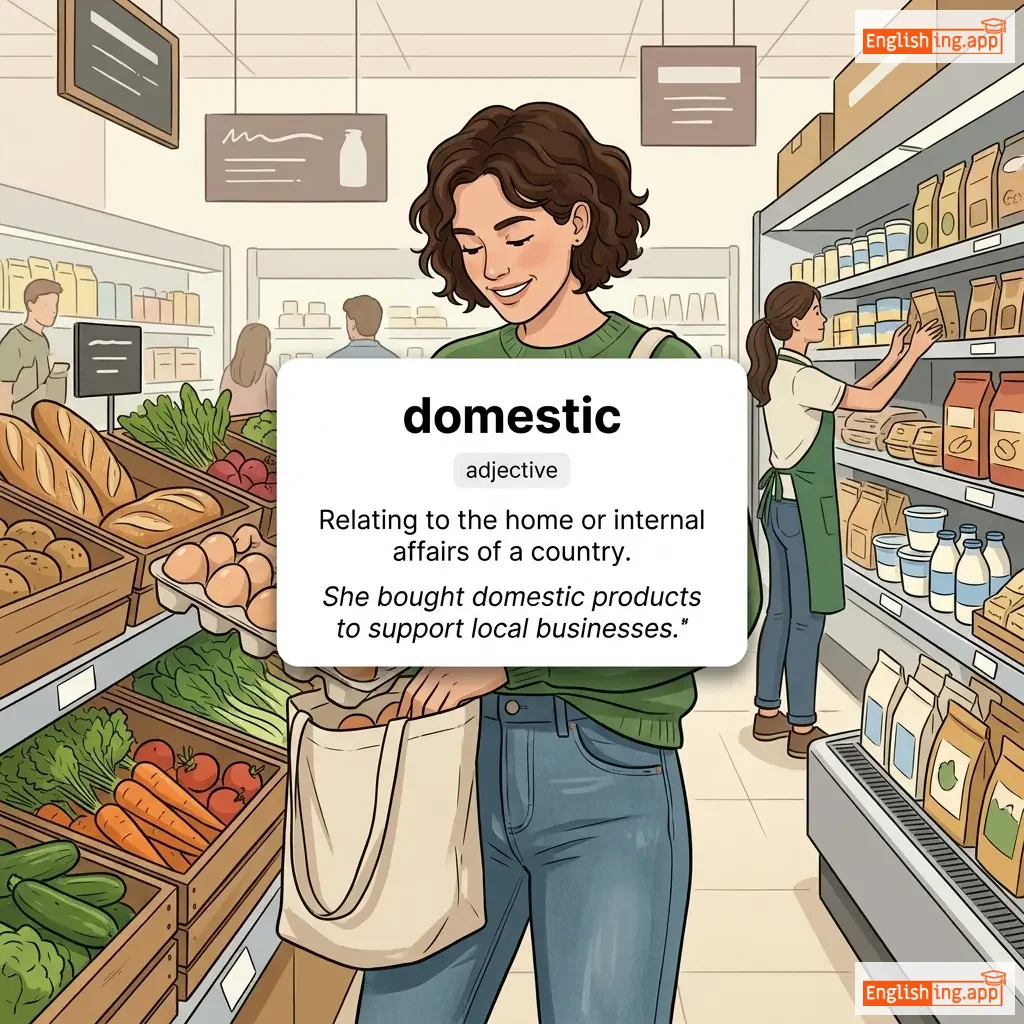
domestic definition card — visual illustration of the meaning
adjective
/dəˈmɛstɪk/
खुशी (khushi)

Relating to the home or internal affairs of a country.

"She bought domestic products to support local businesses."

"वह जब पुरस्कार प्राप्त करती, तो वह अपनी खुशी नहीं छुपा पाई।" (Wah jab puraskar prapt karti, to wah apni khushi nahi chhupa pai.)
verb
/dəˈmɛstɪkeɪt/
पालतू बनाना (paaltu banana)

to tame an animal for use by humans; to adapt something for domestic use

"Humans domesticated dogs thousands of years ago."

"मनुष्य हजारों साल पहले कुत्तों को पालतू बना चुके थे।" (Manushya hazaron saal pehle kutto ko paaltu bana chuke the.)
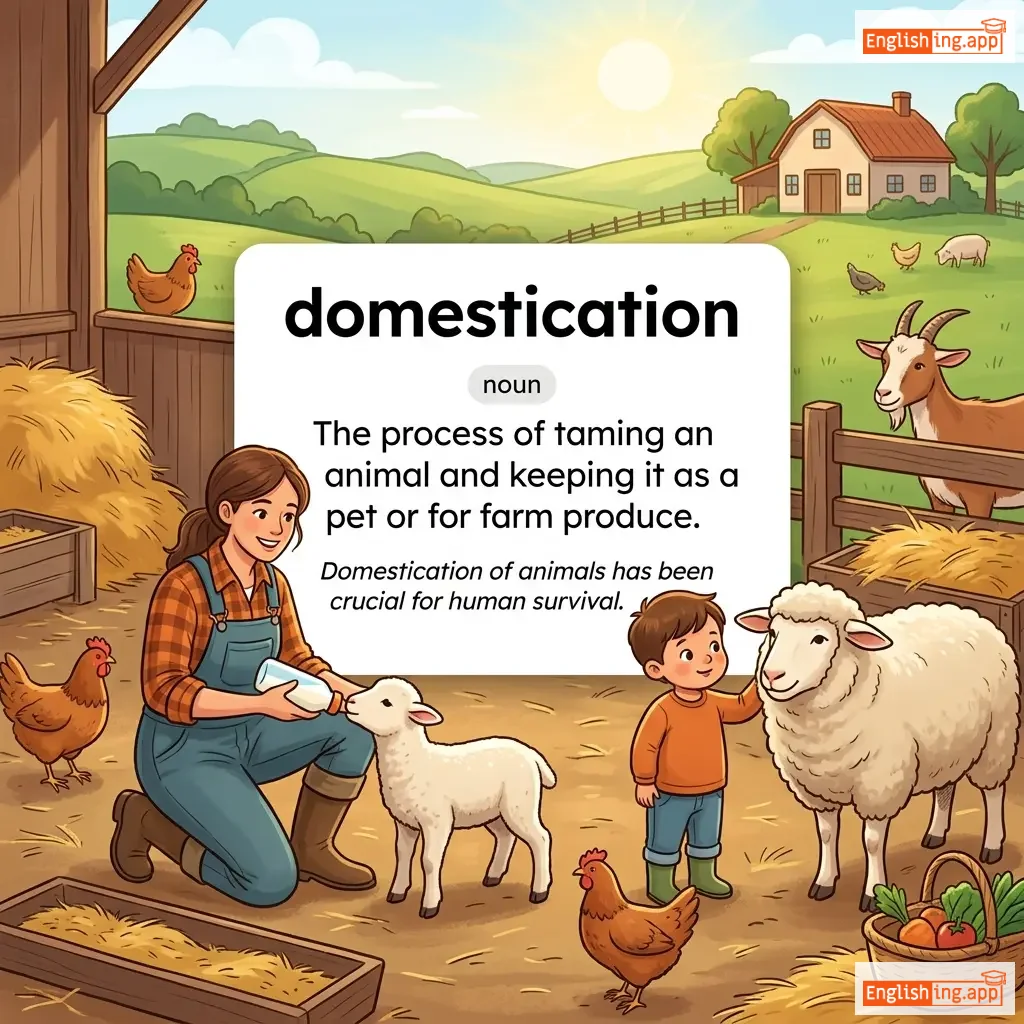
domestication definition card — visual illustration of the meaning
noun
dəˌmɛstɪˈkeɪʃən
पालतूपन (paltupan)

The process of taming an animal and keeping it as a pet or for farm produce.

"Domestication of animals has been crucial for human survival."

"पालतूपन जानवरों के लिए मनुष्य की अस्तित्व के लिए महत्वपूर्ण रहा है।" (Paltupan janwaron ke liye manushya ki astitva ke liye mahatvapurn raha hai.)
noun
/ˌdoʊ.məˈstɪs.ə.ti/
घरेलूपन (ghareloopan)

Life at home or devotion to family life.

"She enjoys the domesticity of cooking and gardening."

"वह खाना पकाने और बागवानी के घरेलूपन का आनंद लेती है।" (Vah khana pakane aur bagwani ke ghareloopan ka anand leti hai.)
noun
/ˈdɑː.mə.saɪl/
निवास स्थान (nivas sthaan)

A person's legal residence or permanent home.

"He declared Canada as his legal domicile."

"उसने कनाडा को अपनी कानूनी डोमिसाइल घोषित किया।" (Usne Kanada ko apni kanooni domicile ghoshit kiya.)
dominance definition card — visual illustration of the meaning
noun
/ˈdɑː.mə.nəns/
प्रभुत्व (prabhutv)

The state of having power and influence over others.

"The company has maintained dominance in the smartphone market."

"कंपनी ने स्मार्टफोन बाजार में प्रभुत्व बनाए रखा है।" (Kampani ne smartphone bazar mein prabhutv banaye rakha hai.)
adjective
/ˈdɑː.mə.nənt/
प्रभुत्वशाली (prabhutvashali)

Having power, authority, or influence over others; most important.

"English has become the dominant language in international business."

"अंग्रेज़ी ने अंतर्राष्ट्रीय व्यापार में प्रमुख भाषा बन गई है।" (Angrezi ne antarraashtreey vyapar mein pramukh bhasha ban gayi hai.)
verb
/ˈdɒmɪneɪt/
प्रभुत्व करना (prabhutv karna)

to have power or control over something or someone

"The company dominates the smartphone market."

"कंपनी स्मार्टफोन बाजार पर प्रभुत्व जमाती है।" (Company smartphone bazar par prabhutv jamaati hai.)
noun
/ˌdɒmɪˈneɪʃən/
वर्चस्व (varchasva)

the exercise of control or influence over someone or something

"The empire sought domination over its neighbors."

"साम्राज्य अपने पड़ोसियों पर वर्चस्व चाहता था।" (Samrajya apne padosiyon par varchasva chahta tha.)
verb
/ˌdɒmɪˈnɪə/
अहंकार से नियंत्रण करना (ahankar se niyantran karna)

to assert one's will over another in an arrogant way

"He tends to domineer over his younger colleagues."

"वह अपने छोटे सहकर्मियों पर प्रभुत्व जमाने की प्रवृत्ति रखता है।" (Vah apne chhote sahakarmiyon par prabhutv jamane ki pravritti rakhta hai.)
verb, noun
/dɒn/
पहनना / नेता (pehnna / neta)

to put on (an article of clothing); also used as a title for a respected person

"She donned her coat before leaving."

"वह बाहर जाने से पहले अपना कोट पहनने लगी।" (Woh baahar jaane se pehle apna coat pehnne lagi.)
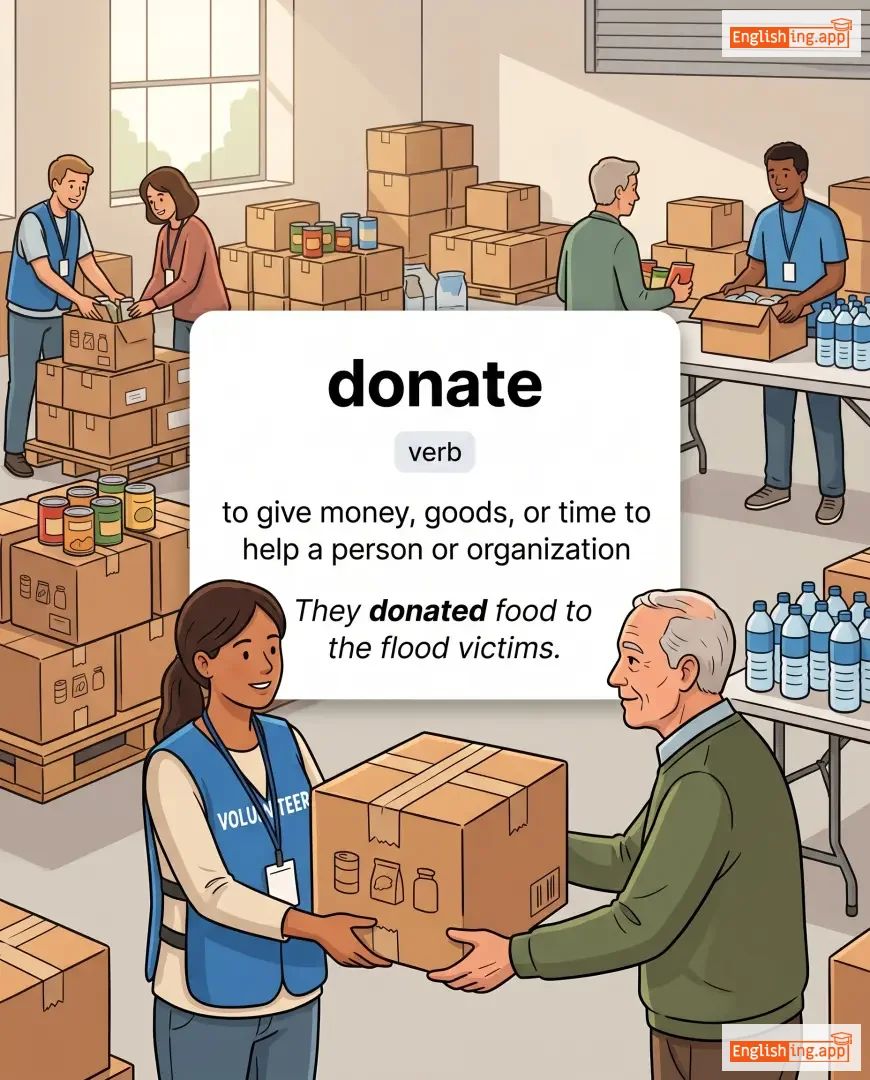
donate definition card — visual illustration of the meaning
verb
/dəʊˈneɪt/
दान करना (dan karna)

to give money, goods, or time to help a person or organization

"They donated food to the flood victims."

"उन्होंने बाढ़ पीड़ितों को खाना दान किया।" (Unhone baadh peediton ko khana dan kiya.)
noun
/dəʊˈneɪ.ʃən/
दान (daan)

something that is given to help a person or organization, often money

"He made a generous donation to the local orphanage."

"उसने स्थानीय अनाथालय को एक उदार दान दिया।" (Usne sthaniya anathalay ko ek udar dan diya.)
noun
/ˈdoʊneɪtər/
दानकर्ता (daankarta)

A person who gives something, especially money or goods, as a donation.

"The donator wished to remain anonymous after contributing a large sum."

"दानकर्ता ने एक बड़ी राशि दान करने के बाद गुमनाम रहने की इच्छा जताई।" (Daankarta ne ek badi rashi daan karne ke baad gumnaam rehne ki ichha jatai.)
noun
/doʊˈniː/
प्राप्तकर्ता (praptakarta)

A person who receives a gift or donation.

"The scholarship fund’s donee expressed heartfelt gratitude."

"स्कॉलरशिप फंड का प्राप्तकर्ता गहरी आभार व्यक्त किया।" (Scholarship fund ka praptakarta gahri aabhaar vyakt kiya.)
noun
/ˈdɒŋ.ki/
गधा (gadha)

a domesticated animal related to the horse, with long ears and a braying call

"The donkey carried heavy bags up the mountain."

"गधे ने पहाड़ पर भारी बैग उठाए।" (gadhe ne pahaad par bhaari baag uthaye.)
noun
/ˈdoʊnər/
दाताः (dataa)

A person who gives something, especially to a charity or cause.

"The donor contributed generously to the hospital’s new wing."

"दानदाता ने अस्पताल के नए विंग में उदारता से योगदान दिया।" (Daatada ne aspataal ke naye wing mein udarta se yogdan diya.)
verb
/ˈduːdəl/
डूडल करना (doodle karna)

To draw or scribble absentmindedly, often while thinking about something else.

"She doodled flowers in the corner of her notebook during class."

"वह कक्षा के दौरान अपनी नोटबुक के कोने में फूल डूडल कर रही थी।" (Vah kaksha ke dauran apni notebook ke kone mein phool doodle kar rahi thi.)
noun
/duːm/
विनाश (vinash)

A terrible fate, destruction, or unavoidable bad outcome.

"The ancient prophecy foretold the city’s doom."

"प्राचीन भविष्यवाणी ने शहर के विनाश की भविष्यवाणी की थी।" (Prachin bhavishyavani ne shahar ke vinash ki bhavishyavani ki thi.)
noun
/ˈduːmz.deɪ/
कियामत का दिन; दुनिया के अंत का दिन (kiyamat ka din; duniya ke ant ka din)

the last day of the world's existence; a time of catastrophic destruction

"The preacher spoke about doomsday and the importance of preparing spiritually."

"धर्मगुरु ने कियामत के दिन और आध्यात्मिक रूप से तैयारी करने के महत्व के बारे में बात की।" (dharmguru ne kiyamat ke din aur adhyatmik roop se taiyaari karne ke mahatva ke baare mein baat ki.)
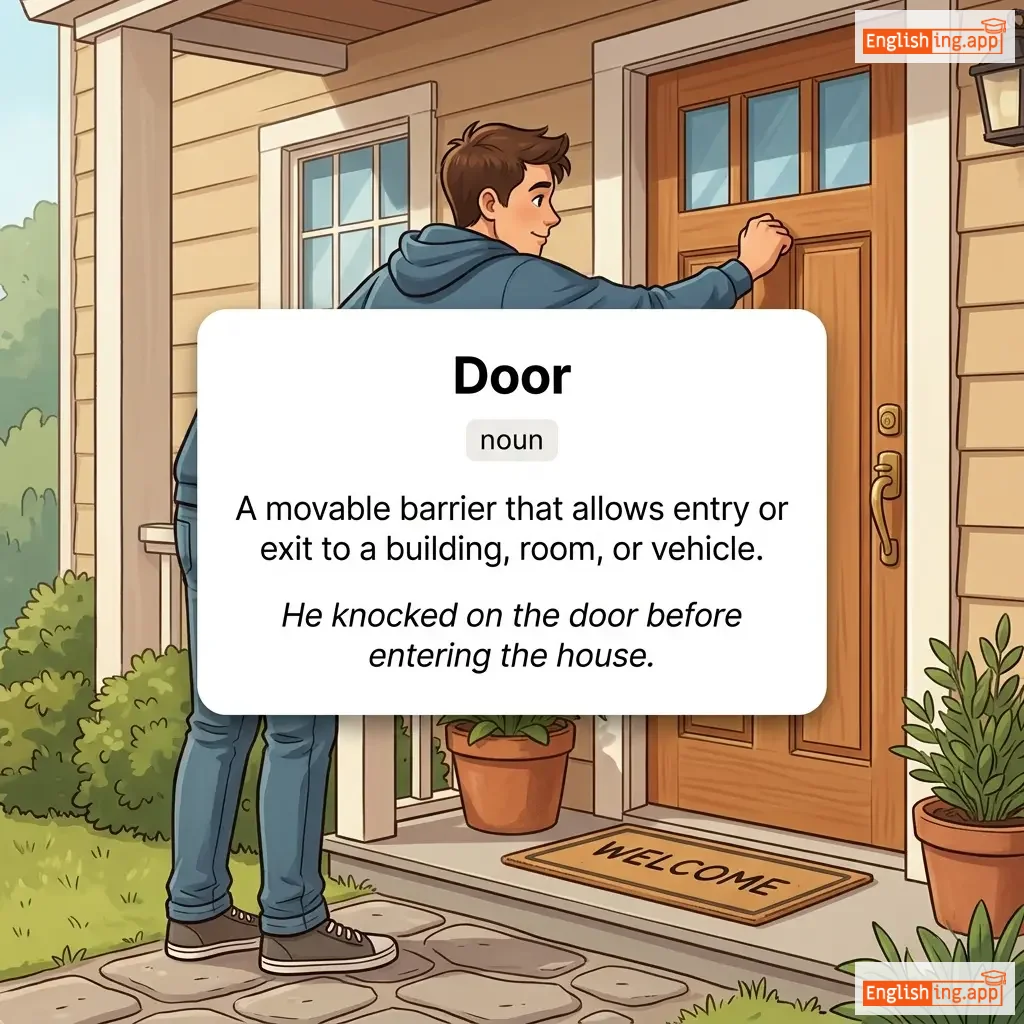
Door definition card — visual illustration of the meaning
noun
/dɔːr/
दरवाजा (darwaza)

A movable barrier that allows entry or exit to a building, room, or vehicle.

"He knocked on the door before entering the house."

"उसने घर में प्रवेश करने से पहले दरवाजे पर दस्तक दी।" (Usne ghar mein pravesh karne se pehle darwaze par dastak di.)
noun
/ˈdɔːr.mæt/
दरवाज़ा चटाई (darwaza chatai)

a mat placed in front of a door for wiping feet

"Please wipe your feet on the door-mat before entering the house."

"कृपया घर में प्रवेश करने से पहले दरवाज़ा चटाई पर अपने पैर पोंछें।" (kripya ghar mein pravesh karne se pehle darwaza chatai par apne pair ponchen.)
noun
/ˈdɔːrˌkiːpər/
दरबान (darban)

A person whose job is to guard or manage the entrance of a building or room.

"The doorkeeper checked everyone’s passes before they entered the hall."

"डोरकीपर ने हॉल में प्रवेश करने से पहले सभी के पास जांचे।" (Dorkeeper ne hall me pravesh karne se pehle sabhi ke pass jaanche)
noun
/ˈdɔː.weɪ/
दरवाजे का रास्ता (darwaze ka rasta)

the space where a door opens into a room or building

"She stood in the doorway waiting for him to arrive."

"वह दरवाजे के पास खड़ी थी, उसे आने का इंतजार कर रही थी।" (Vah darwaze ke paas khadi thi, use aane ka intezaar kar rahi thi.)
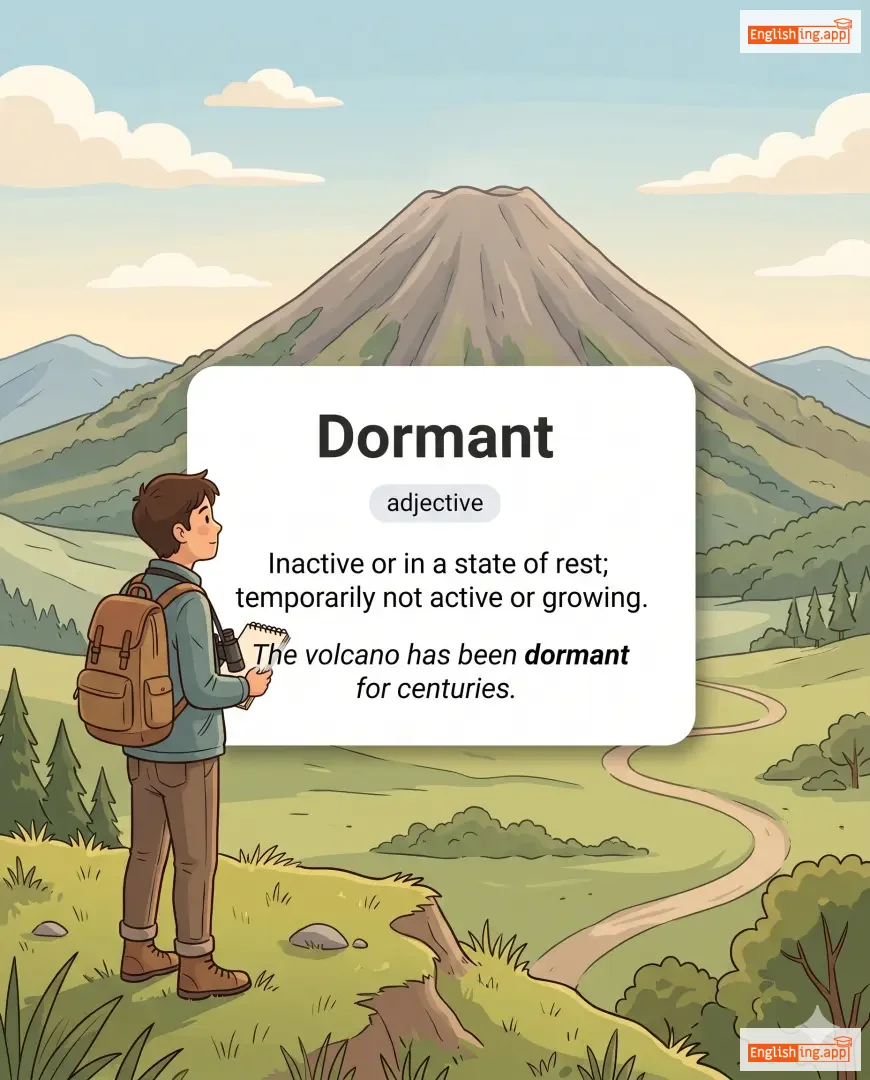
Dormant definition card — visual illustration of the meaning
adjective
/ˈdɔːrmənt/
निष्क्रिय (nishkriya)

Inactive or in a state of rest; temporarily not active or growing.

"The volcano has been dormant for centuries."

"ज्वालामुखी सदी दर सदी निष्क्रिय रहा है।" (Jwalamukhi sadi dar sadi nishkriya raha hai.)
noun
/ˈdɔːrmər/
छत की खिड़की (chhat ki khidki)

A window that projects vertically from a sloping roof.

"The old house had a dormer overlooking the garden."

"पुरानी घर में एक डॉरमर था जो बाग़ीचे को देख रहा था।" (Purani ghar mein ek dormer tha jo baagiche ko dekh raha tha.)
adjective
/ˈdɔːrsəl/
पीठीय (peethiy)

Relating to the back or upper side of an animal or body part.

"Sharks have a prominent dorsal fin."

"शार्क्स के पास एक प्रमुख पीठीय पंख होता है।" (Sharks ke paas ek pramukh peethiy pankh hota hai.)
noun
/doʊs/
खुराक (khuraak)

a measured amount of a medicine or drug taken at one time

"The doctor prescribed one dose of the medicine every six hours."

"डॉक्टर ने हर छह घंटे में एक डोज़ दवाई लेने के लिए कहा था।" (Daktar ne har chhah ghante mein ek doze dawa lene ke liye kaha tha.)
noun
/ˈdɑːsieɪ/
डॉसिएर (dosier)

A collection of documents about a particular person, event, or subject.

"The lawyer presented a dossier of evidence to the court."

"वकील ने अदालत में साक्ष्य का एक डॉसिएर प्रस्तुत किया।" (Vakil ne adalat mein sakshya ka ek dosier prastut kiya.)
noun
/dɒt/
बिंदु (bindu)

a small round mark or spot

"She drew a red dot on the paper."

"उसने कागज पर एक लाल बिंदु बनाया।" (Usne kagaz par ek laal bindu banaya.)
noun
/ˈdoʊtɪdʒ/
बुढ़ापे (budhape)

The period of old age, especially when one is weak or senile.

"He spent his dotage reminiscing about his youth."

"उसने अपनी बुढ़ापे में अपनी जवानी की यादें ताजा करते हुए समय बिताया।" (Usne apni budhape mein apni jawani ki yaadein taza karte hue samay bitaya.)
verb
/doʊt/
अत्यधिक प्यार (atyadhik pyaar)

to show excessive love or fondness for someone or something

"She tends to dote on her grandchildren."

"वह अपने पोते-पोतियों पर अत्यधिक प्यार दिखाती है।" (Vah apne pote-potiyon par atyadhik pyaar dikhati hai.)
verb
/ˈdʌbəl/
दोगुना करना (doguna karna)

to make twice as much in size, number, or amount

"The company hopes to double its profits this year."

"कंपनी इस वर्ष अपने लाभ को दोगुना करने की उम्मीद कर रही है।" (Kampani is varsh apne labh ko doguna karne ki ummid kar rahi hai.)
noun
/ˈdʌbəl ˈdekər/
डबल डेकker बस (dabal deker bas)

a bus with two levels or floors for passengers

"The red double decker bus is a famous symbol of London."

"लाल डबल डेकker बस लंदन का एक प्रसिद्ध प्रतीक है।" (lal dabal deker bas london ka ek prasiddh pratik hai)
noun
/ˈdʌblɪt/
डबलट / घनी जैकेट (doublet / ghani jacket)

a close-fitting jacket worn by men in the Renaissance; also, a pair of similar things

"The actor wore a velvet doublet for the Shakespearean play."

"अभिनेता ने शेक्सपियरियन नाटक के लिए एक वेलवेट डबलट पहना।" (Abhineta ne Shakespeareian natak ke liye ek velvet doublet pehna.)
adverb
/ˈdʌbli/
दोहरी तरह से (dohri tarah se)

in a twofold manner; to twice the degree

"She felt doubly fortunate after winning the prize and getting a promotion."

"उसने पुरस्कार जीतने और पदोन्नति पाने के बाद खुद को दोहरी किस्मत वाला महसूस किया।" (Usne puraskaar jeetne aur padonnati paane ke baad khud ko dohari kismat waala mehsoos kiya.)
Doubt definition card — visual illustration of the meaning
noun/verb
/daʊt/
संदेह (sandeh)

a feeling of uncertainty or lack of conviction; to be uncertain about something

"She had doubts about the success of the plan."

"उसने योजना की सफलता के बारे में संदेह किया।" (Usne yojana ki safalta ke baare mein sandeh kiya.)
adjective
/ˈdaʊt.fəl/
संदिग्ध; सवालों से भरा; किसी चीज़ के बारे में अनिश्चित महसूस करना (sandigdh; sawalon se bhara; kisi cheez ke baare mein anishchit mehsoos karna)

uncertain; questionable; feeling uncertain about something

"I am doubtful about the success of this project."

"मैं इस परियोजना की सफलता को लेकर संदिग्ध हूँ।" (main is pariyojana ki safalta ko lekar sandigdh hoon.)
noun
/doʊ/
आटा (ata)

a mixture of flour, water, and other ingredients used to make bread or pastries

"She kneaded the dough for ten minutes before baking."

"उसने दस मिनट तक आटा गूंधा और फिर उसे पकाया।" (Usne das minute tak aata goondha aur phir use pakaya.)