词汇表

英语词汇词典 | 单词含义、定义和示例

verb
/ˈdɒɡmətaɪz/
教条化 (jiaotiaohua)

To state opinions or beliefs as if they were absolute truths.

"The professor tended to dogmatize on political issues."

"教授倾向于在政治问题上教条主义。" (Jiaoshou qingxiang yu zai zhengzhi wenti shang jiaotiaozhuyi.)
noun
/ˈdɒldrəmz/

A state of inactivity, stagnation, or low spirits; also a region near the equator with calm winds.

"After the project failed, the team was stuck in the doldrums for months."

adjective
/ˈdəʊl.fəl/
悲伤 (bēishāng)

Expressing sorrow or sadness; mournful.

"She gave him a doleful look before leaving."

"她在离开前给了他一个悲伤的眼神。" (Tā zài líkāi qián gěile tā yīgè bēishāng de yǎnshén.)
adjective
/ˈdəʊl.səm/
悲伤 (bēishāng)

Filled with grief or sadness; mournful.

"The dolesome ballad brought tears to their eyes."

"那首悲伤的歌让他们眼中充满了泪水。" (Nà shǒu bēishāng de gē ràng tāmen yǎnzhōng chōngmǎnle lèishuǐ.)
noun
/dɒl/
洋娃娃 (yangwawa)

a small toy resembling a human figure, especially for children

"The little girl hugged her favorite doll tightly."

"小女孩紧紧抱着她最喜欢的洋娃娃。" (xiao nuhai jinjing baozhe ta zui xihuan de yangwawa.)
noun
/ˈdɒlər/
美元 (meiyuan)

The basic monetary unit of the United States and some other countries

"I need five dollars to buy this book."

"我需要五美元来买这本书。" (Wo xuyao wu meiyuan lai mai zhe ben shu.)
noun
/ˈdəʊ.lər/
痛苦 (tongku)

A state of great sorrow or distress.

"The nation was in deep dolor after the tragedy."

"国家在悲剧发生后陷入了深深的痛苦。" (Guójiā zài bēijù fāshēng hòu xiànrùle shēnshēn de tòngkǔ.)
☹️

dolorous

adjective
/ˈdəʊ.lə.rəs/

Expressing great sorrow or distress.

"He spoke in a dolorous tone after the loss."

noun
/ˈdɒlfɪn/
海豚 (haitun)

A highly intelligent marine mammal with a streamlined body and dorsal fin

"Dolphins are known for their playful behavior and intelligence."

"海豚以其顽皮的行为和聪明而闻名。" (haitun yi qi wanpi de xingwei he congming er wenming)
noun
/doʊlt/
傻瓜 (sha gua)

A stupid or slow-witted person.

"Only a dolt would believe such a story."

"只有傻瓜才会相信这样的故事。" (Zhi you sha gua cai hui xiangxin zheyang de gushi.)
noun
/dəˈmeɪn/
领域 (lingyu)

An area of knowledge, activity, or territory over which control is exercised.

"Mathematics is her main domain of expertise."
"数学是她主要的专业领域。" (Shuxue shi ta zhuyao de zhuanye lingyu.)
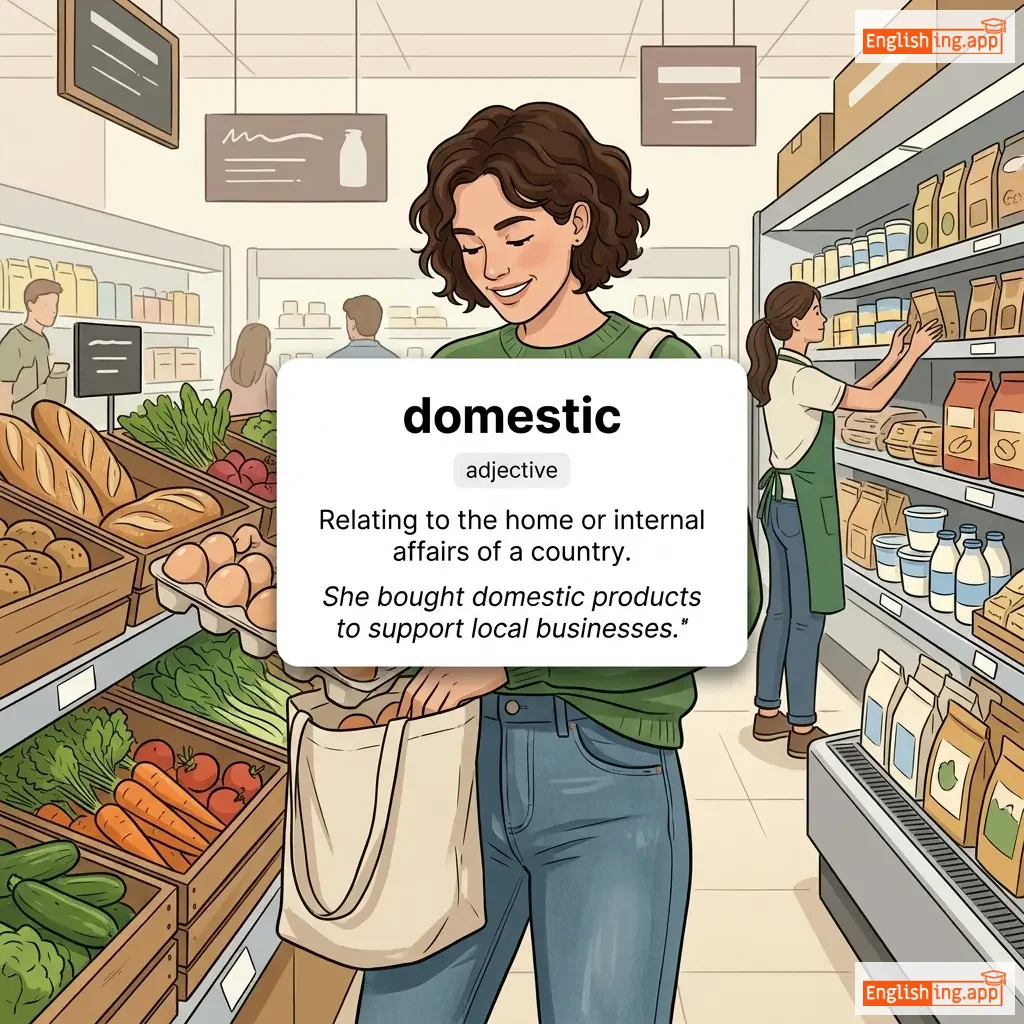
domestic definition card — visual illustration of the meaning
adjective
/dəˈmɛstɪk/
幸福 (xìngfú)

Relating to the home or internal affairs of a country.

"She bought domestic products to support local businesses."

"当她获得奖项时,她无法隐藏自己的幸福。" (Dāng tā huòdé jiǎngxiàng shí, tā wúfǎ yǐncáng zìjǐ de xìngfú.)
verb
/dəˈmɛstɪkeɪt/
驯化 (xunhua)

to tame an animal for use by humans; to adapt something for domestic use

"Humans domesticated dogs thousands of years ago."
"人类几千年前驯化了狗。" (Renlei jiqian nian qinhuale gou.)
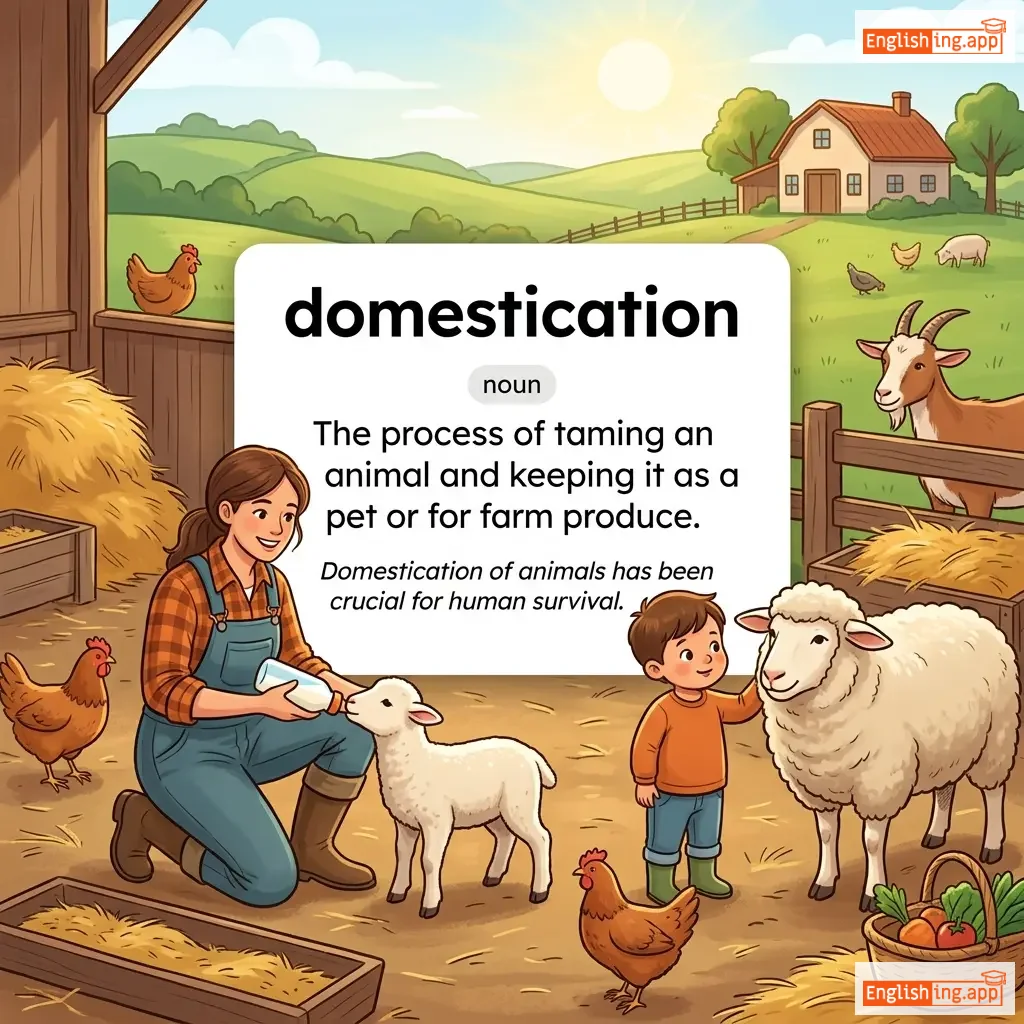
domestication definition card — visual illustration of the meaning
noun
dəˌmɛstɪˈkeɪʃən
驯化 (xunhua)

The process of taming an animal and keeping it as a pet or for farm produce.

"Domestication of animals has been crucial for human survival."

"动物的驯化对人类生存至关重要。" (Dongwu de xunhua dui renlei shengcun zhiguang zhongyao.)
noun
/ˌdoʊ.məˈstɪs.ə.ti/
家庭生活 (jiating shenghuo)

Life at home or devotion to family life.

"She enjoys the domesticity of cooking and gardening."

"她喜欢做饭和园艺的家庭生活。" (Ta xihuan zuofan he yuanyi de jiating shenghuo.)
noun
/ˈdɑː.mə.saɪl/
住所 (zhùsuǒ)

A person's legal residence or permanent home.

"He declared Canada as his legal domicile."

"他宣布加拿大为他的法定住所。" (Tā xuānbù Jiānádà wéi tā de fǎdìng zhùsuǒ.)
dominance definition card — visual illustration of the meaning
noun
/ˈdɑː.mə.nəns/
支配 (zhīpèi)

The state of having power and influence over others.

"The company has maintained dominance in the smartphone market."

"公司在智能手机市场上保持了支配地位。" (Gōngsī zài zhìnéng shǒujī shìchǎng shàng bǎochíle zhīpèi dìwèi.)
adjective
/ˈdɑː.mə.nənt/
主导的 (zhǔdǎo de)

Having power, authority, or influence over others; most important.

"English has become the dominant language in international business."

"英语已经成为国际商务中的主导语言。" (Yīngyǔ yǐjīng chéngwéi guójì shāngwù zhōng de zhǔdǎo yǔyán.)
verb
/ˈdɒmɪneɪt/
主导 (zhudao)

to have power or control over something or someone

"The company dominates the smartphone market."

"这家公司主导了智能手机市场。" (Zhè jiā gōngsī zhǔdǎo le zhìnéng shǒujī shìchǎng.)
noun
/ˌdɒmɪˈneɪʃən/
统治 (tongzhi)

the exercise of control or influence over someone or something

"The empire sought domination over its neighbors."

"帝国寻求对其邻国的统治。" (Diguo xunqiu dui qi lingguo de tongzhi.)
verb
/ˌdɒmɪˈnɪə/
支配 (zhīpèi)

to assert one's will over another in an arrogant way

"He tends to domineer over his younger colleagues."
"他倾向于支配年轻的同事。" (Tā qīngxiàng yú zhīpèi niánqīng de tóngshì.)
verb, noun
/dɒn/
穿上 / 领袖 (chuan shang / lingxiu)

to put on (an article of clothing); also used as a title for a respected person

"She donned her coat before leaving."

"她在离开前穿上了外套。" (Tā zài líkāi qián chuān shàngle wàitào.)
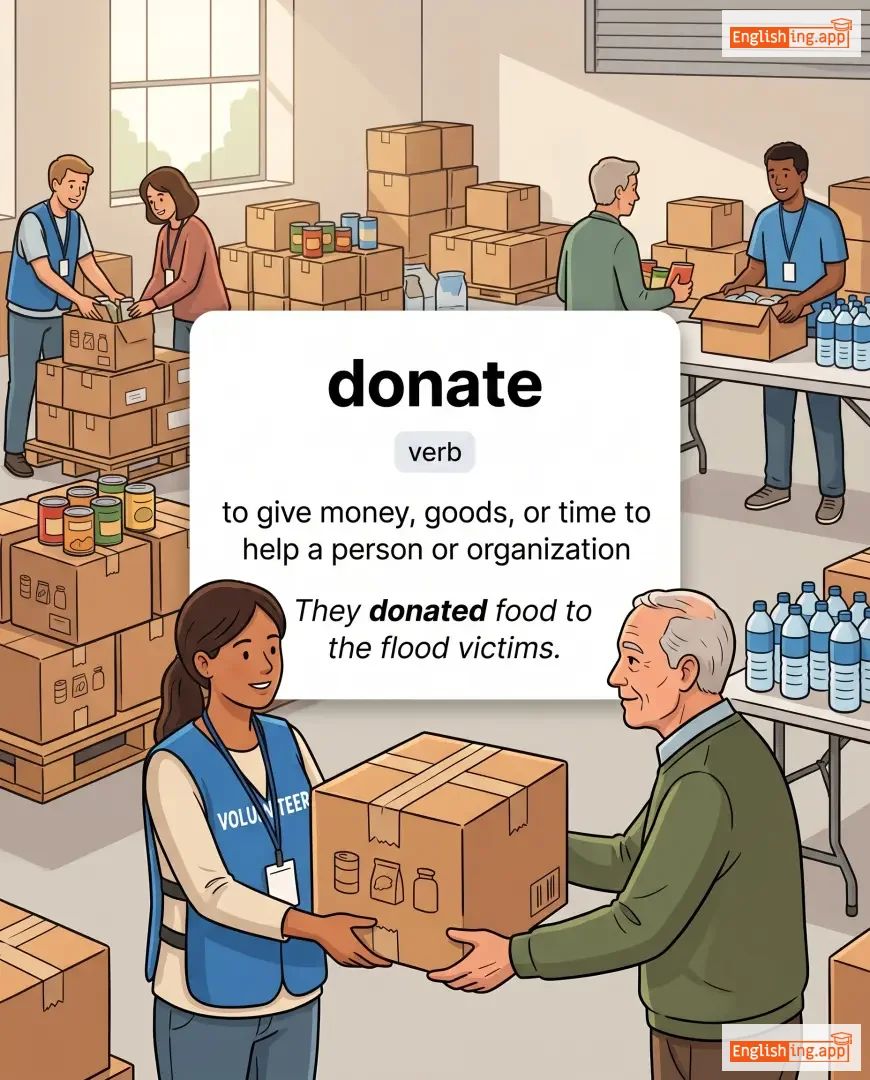
donate definition card — visual illustration of the meaning
verb
/dəʊˈneɪt/
捐赠 (juānzèng)

to give money, goods, or time to help a person or organization

"They donated food to the flood victims."

"他们捐赠了食物给洪水受害者。" (Tāmen juānzèngle shíwù gěi hóngshuǐ shòuhài zhě.)
noun
/dəʊˈneɪ.ʃən/
捐赠 (juānzèng)

something that is given to help a person or organization, often money

"He made a generous donation to the local orphanage."

"他向当地孤儿院做了慷慨的捐赠。" (Tā xiàng dāngdì gū'ér yuàn zuòle kāngkǎi de juānzèng.)
noun
/ˈdoʊneɪtər/
捐赠者 (juānzèng zhě)

A person who gives something, especially money or goods, as a donation.

"The donator wished to remain anonymous after contributing a large sum."

"捐赠者在捐赠了一大笔钱后希望保持匿名。" (Juānzèng zhě zài juānzèngle yī dà bǐ qián hòu xīwàng bǎochí nìmíng.)
noun
/doʊˈniː/
受赠人 (shou zeng ren)

A person who receives a gift or donation.

"The scholarship fund’s donee expressed heartfelt gratitude."

"奖学金基金的受赠人表达了深深的感激之情。" (Jiang xuejin jijin de shou zeng ren biao da le shen shen de gan ji zhi qing.)
noun
/ˈdɒŋ.ki/
驴子 (lǘzi)

a domesticated animal related to the horse, with long ears and a braying call

"The donkey carried heavy bags up the mountain."

"驴子把重袋子背到山上。" (Lǘzi bǎ zhòng dàizi bēi dào shān shàng.)
noun
/ˈdoʊnər/
捐赠者 (juan zeng zhe)

A person who gives something, especially to a charity or cause.

"The donor contributed generously to the hospital’s new wing."

"捐赠者慷慨地为医院的新翼捐赠了资金。" (Juan zeng zhe kang kai de wei yi yuan de xin yi juan zeng le zi jin.)
✏️

doodle

verb
/ˈduːdəl/

To draw or scribble absentmindedly, often while thinking about something else.

"She doodled flowers in the corner of her notebook during class."

noun
/duːm/
厄运 (eyun)

A terrible fate, destruction, or unavoidable bad outcome.

"The ancient prophecy foretold the city’s doom."

"古老的预言预示了这座城市的厄运。" (Gǔlǎo de yùyán yùshìle zhè zuò chéngshì de èyùn.)
noun
/ˈduːmz.deɪ/
世界末日; 最后的审判日 (shìjiè mò rì; zuìhòu de shěnpàn rì)

the last day of the world's existence; a time of catastrophic destruction

"The preacher spoke about doomsday and the importance of preparing spiritually."

"传教士谈到了世界末日和灵性准备的重要性。" (Chuánjiàoshì tán dào le shìjiè mò rì hé língxìng zhǔnbèi de zhòngyào xìng.)
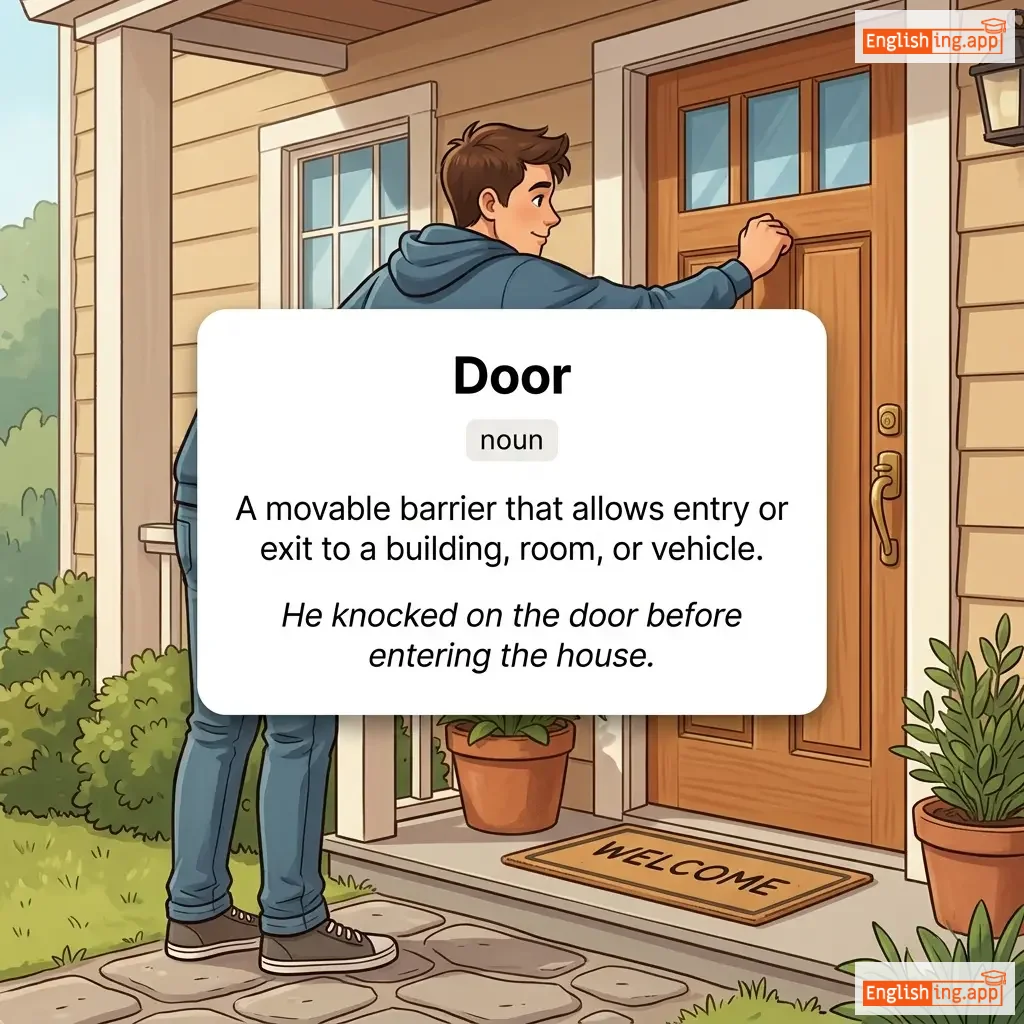
Door definition card — visual illustration of the meaning
noun
/dɔːr/
(mén)

A movable barrier that allows entry or exit to a building, room, or vehicle.

"He knocked on the door before entering the house."

"他在进入房子之前敲了敲门。" (Tā zài jìnrù fángzi zhīqián qiāole qiāo mén.)
noun
/ˈdɔːr.mæt/
门垫 (mén diàn)

a mat placed in front of a door for wiping feet

"Please wipe your feet on the door-mat before entering the house."

"请在进入房子之前在门垫上擦脚。" (qǐng zài jìnrù fángzi zhīqián zài mén diàn shàng cā jiǎo.)
noun
/ˈdɔːrˌkiːpər/
门卫 (menwei)

A person whose job is to guard or manage the entrance of a building or room.

"The doorkeeper checked everyone’s passes before they entered the hall."

"多尔基珀在大家进入大厅前检查了通行证。" (Duojiper zai dajia jinru dating qian jiancha le tongxingzheng)
noun
/ˈdɔː.weɪ/
门口 (menkou)

the space where a door opens into a room or building

"She stood in the doorway waiting for him to arrive."

"她站在门口,等待他的到来。" (Ta zhan zai menkou, dengdai tade daolai.)
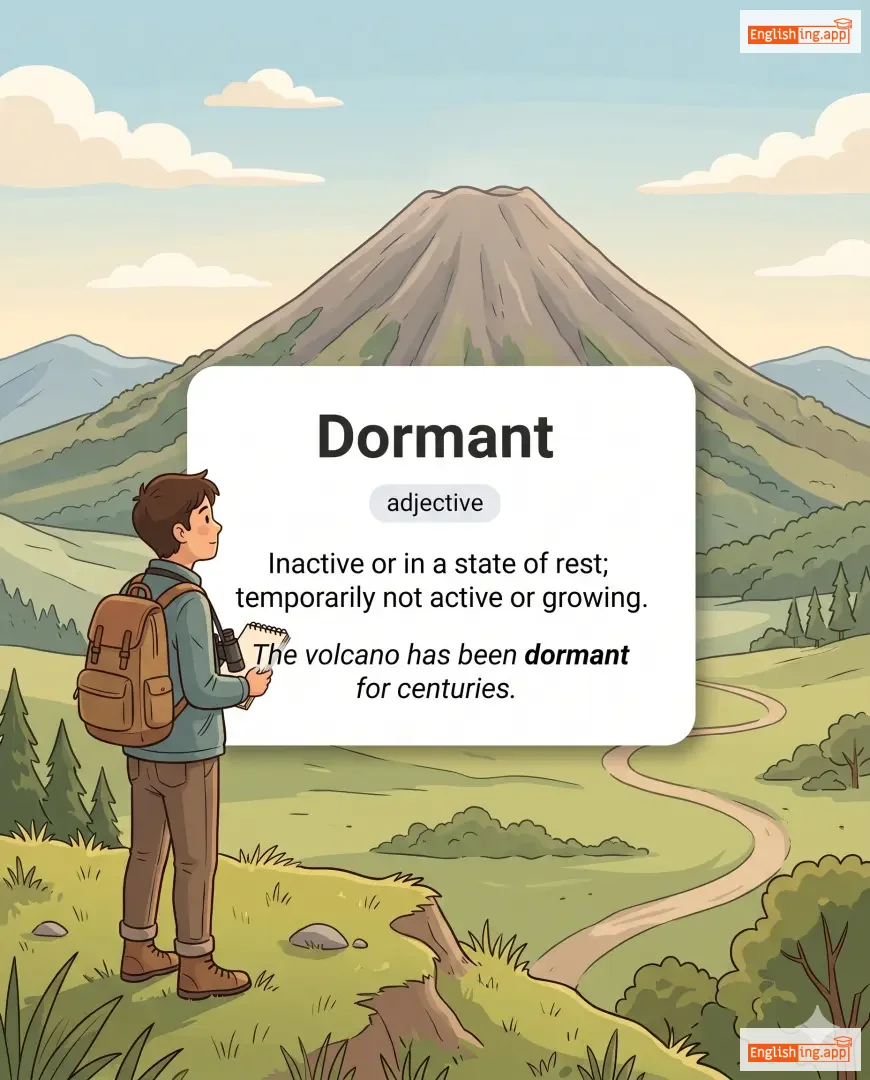
Dormant definition card — visual illustration of the meaning
adjective
/ˈdɔːrmənt/

Inactive or in a state of rest; temporarily not active or growing.

"The volcano has been dormant for centuries."

noun
/ˈdɔːrmər/
天窗 (tiānchuāng)

A window that projects vertically from a sloping roof.

"The old house had a dormer overlooking the garden."

"那座老房子有一个天窗,可以看到花园。" (Nà zuò lǎo fángzi yǒu yī gè tiānchuāng, kěyǐ kàn dào huāyuán.)
adjective
/ˈdɔːrsəl/
背鳍 (bèi qí)

Relating to the back or upper side of an animal or body part.

"Sharks have a prominent dorsal fin."

"鲨鱼有一个显眼的背鳍。" (Shāyú yǒu yī gè xiǎn yǎn de bèi qí.)
noun
/doʊs/
剂量 (jiliang)

a measured amount of a medicine or drug taken at one time

"The doctor prescribed one dose of the medicine every six hours."

"医生每六小时开一次药物的剂量。" (Yisheng mei liu xiaoshi kai yici yaowu de jiliang.)
noun
/ˈdɑːsieɪ/
档案 (dang'an)

A collection of documents about a particular person, event, or subject.

"The lawyer presented a dossier of evidence to the court."

"律师向法庭提交了一个证据档案。" (Lüshi xiang fating tijiao le yige zhengju dang'an.)
noun
/dɒt/
(dian)

a small round mark or spot

"She drew a red dot on the paper."

"她在纸上画了一个红点。" (Tā zài zhǐ shàng huàle yīgè hóng diǎn.)
noun
/ˈdoʊtɪdʒ/
暮年 (mùnián)

The period of old age, especially when one is weak or senile.

"He spent his dotage reminiscing about his youth."

"他度过了自己的暮年,回忆着自己的青春。" (Tā dùguòle zìjǐ de mùnián, huíyìzhe zìjǐ de qīngchūn.)
verb
/doʊt/
宠爱 (chǒng'ài)

to show excessive love or fondness for someone or something

"She tends to dote on her grandchildren."

"她倾向于宠爱她的孙子孙女。" (Tā qīngxiàng yú chǒng'ài tā de sūnzi sūn nǚ.)
verb
/ˈdʌbəl/
翻倍 (fānbèi)

to make twice as much in size, number, or amount

"The company hopes to double its profits this year."

"公司希望今年能使其利润翻倍。" (Gōngsī xīwàng jīnnián néng shǐ qí lìrùn fānbèi.)
noun
/ˈdʌbəl ˈdekər/
双层巴士 (shuang ceng ba shi)

a bus with two levels or floors for passengers

"The red double decker bus is a famous symbol of London."

"红色的双层巴士是伦敦的一个著名象征。" (Hóngsè de shuāng céng bā shì shì lún dūn de yīgè zhùmíng xiàngzhēng.)
noun
/ˈdʌblɪt/
双件外套 / 紧身夹克 (shuangjian waike / jinshen jiake)

a close-fitting jacket worn by men in the Renaissance; also, a pair of similar things

"The actor wore a velvet doublet for the Shakespearean play."

"演员为莎士比亚的戏剧穿了一件天鹅绒的达布雷特。" (Yǎnyuán wèi Shāshìbǐyà de xìjù chuānle yī jiàn tiān'é róng de dábùléitè.)
adverb
/ˈdʌbli/
双重地 (shuangchóng de)

in a twofold manner; to twice the degree

"She felt doubly fortunate after winning the prize and getting a promotion."

"在赢得奖项并获得晋升后,她感到双倍幸运。" (Zài yíngdé jiǎngxiàng bìng huòqǔ jìnshēng hòu, tā gǎndào shuāngbèi xìngyùn.)
Doubt definition card — visual illustration of the meaning
noun/verb
/daʊt/
怀疑 (huaiyi)

a feeling of uncertainty or lack of conviction; to be uncertain about something

"She had doubts about the success of the plan."

"她对计划的成功表示怀疑。" (Tā duì jìhuà de chénggōng biǎoshì huáiyí.)
adjective
/ˈdaʊt.fəl/
怀疑的; 不确定的; 对某事感到不确定 (huáiyí de; bù quèdìng de; duì mǒu shì gǎndào bù quèdìng)

uncertain; questionable; feeling uncertain about something

"I am doubtful about the success of this project."

"我对这个项目的成功表示怀疑。" (Wǒ duì zhège xiàngmù de chénggōng biǎoshì huáiyí.)
noun
/doʊ/
面团 (miàn tuán)

a mixture of flour, water, and other ingredients used to make bread or pastries

"She kneaded the dough for ten minutes before baking."

"她揉了十分钟面团然后烤了它。" (Ta rou le shi fenzhong miantuan ranhou kao le ta.)