词汇表

英语词汇词典 | 单词含义、定义和示例

engineering definition card — visual illustration of the meaning
noun
/ˌɛndʒɪˈnɪərɪŋ/
工程学 (gongchengxue)

The branch of science and technology concerned with the design, building, and use of engines, machines, and structures.

"She studied civil engineering at university."

"她在大学学习了土木工程。" (Tā zài dàxué xuéxíle tǔmù gōngchéng.)
noun/adjective
/ˈɪŋɡlɪʃ/
英语 (yingyu)

The language of England, widely spoken around the world; relating to England or its people.

"She is learning English to study abroad."
"她正在学习英语,以便出国留学。" (Tā zhèngzài xuéxí yīngyǔ, yǐbiàn chūguó liúxué.)
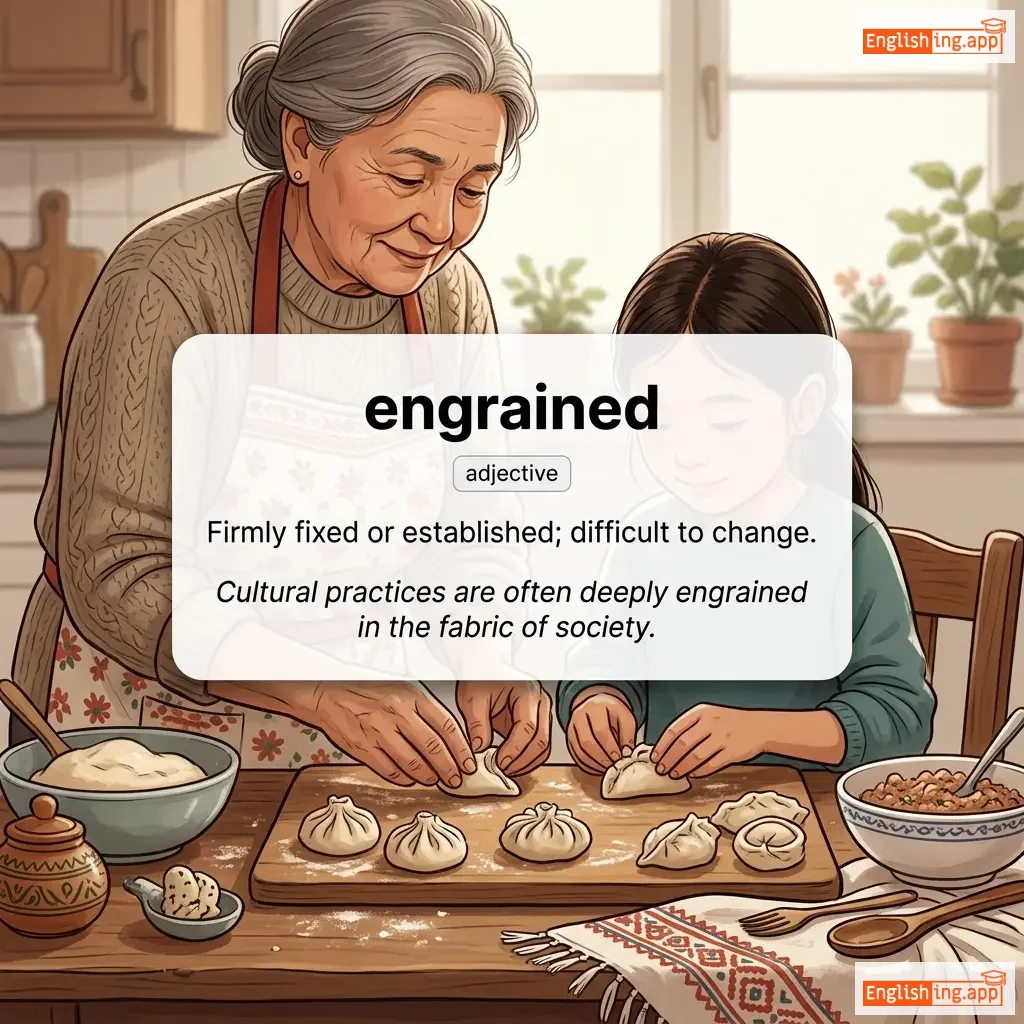
engrained definition card — visual illustration of the meaning
adjective
/ɪnˈɡreɪnd/
根深蒂固,难以改变 (gēn shēn dì gù, nán yǐ gǎi biàn)

Firmly fixed or established; difficult to change.

"Cultural practices are often deeply engrained in the fabric of society."

"文化习俗常常深深植根于社会的结构中。" (Wénhuà xísú chángcháng shēn shēn zhí gēn yú shèhuì de jiégòu zhōng.)
Engram definition card — visual illustration of the meaning
noun
ˈɛn.ɡræm
大脑中用于存储和提取记忆的物理标记 (Dà nǎo zhōng yòng yú cúnchú hé tíqǔ jìyì de wùlǐ biāojì)

Physical signs or patterns in the brain for memory storage and retrieval

"Scientists study engrams to understand how memories are stored."

"科学家们研究恩格拉姆,以了解记忆是如何存储的。" (Kēxuéjiāmen yánjiū ēngélāmǔ, yǐ liǎojiě jìyì shì rúhé cúnchú de.)
verb
/ɪnˈɡreɪv/
雕刻 (diāokè)

to cut or carve a design, letter, or pattern into a hard surface

"The craftsman engraved her name on the silver ring."

"工匠在银戒指上刻下了她的名字。" (Gōngjiàng zài yín jièzhǐ shàng kèxiàle tā de míngzì.)
verb
/ɪnˈɡroʊs/
专注 (zhuanzhu)

to absorb all the attention or interest of someone

"She was so engrossed in the book that she forgot the time."

"她如此专心读书,以至于忘记了时间。" (Tā rúcǐ zhuānxīn dúshū, yǐzhì yú wàngjìle shíjiān.)
adjective
/ɪnˈɡroʊst/
全神贯注 (quánshén guànzhù)

completely absorbed or deeply involved in something

"She was so engrossed in the book that she forgot the time."

"她全神贯注地看书,以至于忘记了时间。" (Tā quánshén guànzhù de kànshū, yǐzhì yú wàngjìle shíjiān.)
verb
/ɪnˈɡʌlf/
吞没 (tunmo)

to completely surround or cover something or someone

"The village was engulfed by floodwaters."

"村庄被洪水吞没了。" (Cun zhuang bei hongshui tunmo le.)
enhance definition card — visual illustration of the meaning
verb
/ɪnˈhæns/
提升 (tisheng)

to improve the quality, value, or extent of something

"The new features will enhance the user experience."

"新的功能将提升用户体验。" (Xin de gongneng jiang tisheng yonghu tiaoyan.)
enhanced definition card — visual illustration of the meaning
verb
ɪnˈhɑːnst
增强的 (zēngqiáng de)

Intensify, increase, or further improve the quality, value, or extent of something.

"Enhanced strategies improve outcomes."

"增强的策略改善了结果。" (Zēngqiáng de cèlüè gǎishànle jiéguǒ.)
enhancement definition card — visual illustration of the meaning
noun
/ɪnˈhɑːns.mənt/
提升或增强 (tisheng huo zengqiang)

Improving the quality, value, or effectiveness of something.

"The software update included significant enhancements in performance."
"软件更新包括了性能上的显著提升。" (Ruǎnjiàn gēngxīn bāokuòle xìngnéng shàng de xiǎnzhù tishēng.)
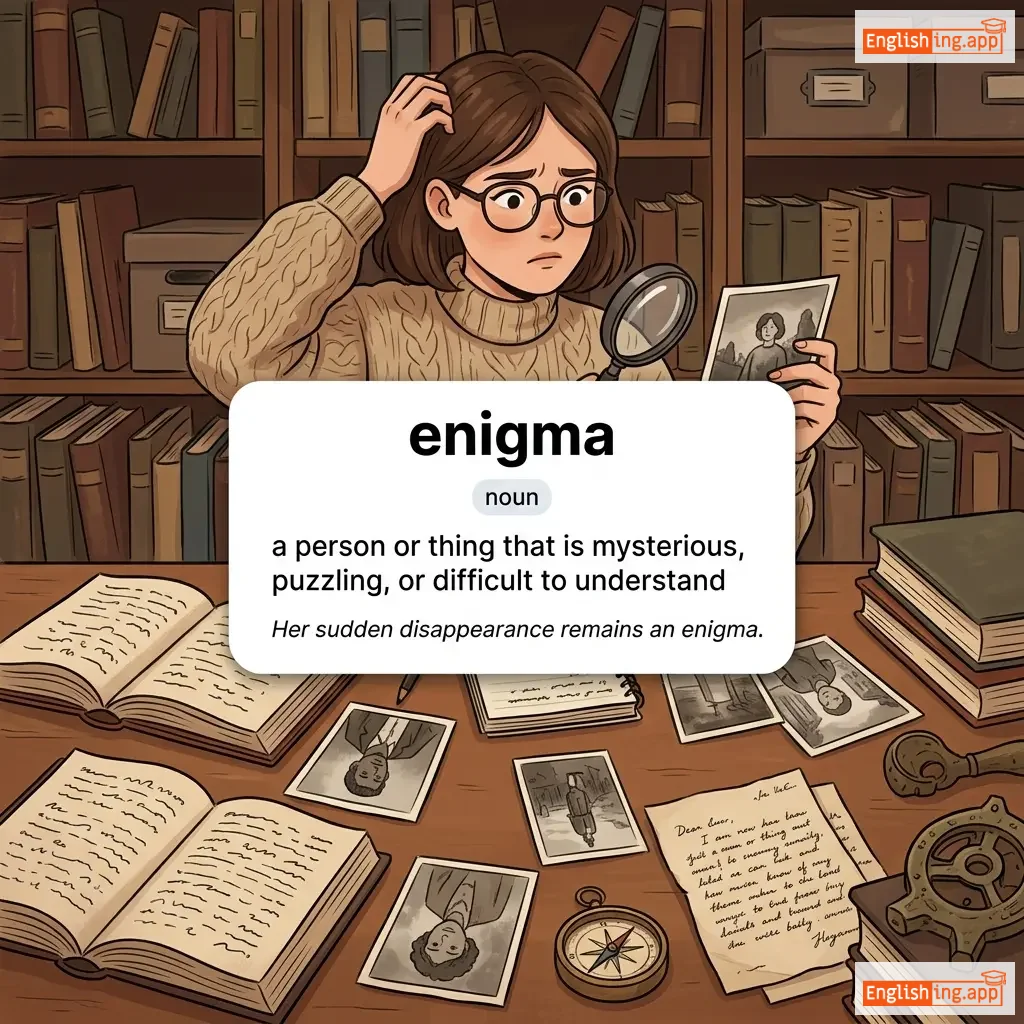
enigma definition card — visual illustration of the meaning
noun
/ɪˈnɪɡmə/
谜团 (mituan)

a person or thing that is mysterious, puzzling, or difficult to understand

"Her sudden disappearance remains an enigma."

"她的突然消失仍然是一个谜团。" (Ta de tuoran xiaoshi rengran shi yige mituan.)
adjective
/ˌɛnɪɡˈmætɪk/
神秘的 (shenmi de)

mysterious and difficult to interpret or understand

"He gave me an enigmatic smile."

"他给了我一个神秘的微笑。" (Ta geile wo yige shenmi de weixiao.)
divest definition card — visual illustration of the meaning
verb
/daɪˈvɛst/

to strip away possessions, rights, or assets; to rid oneself of

"The company decided to divest its unprofitable division."

noun
/daɪˈvɛstɪtʃər/
资产剥离 (zīchǎn bōlí)

the action of selling off or disposing of business interests or assets

"The divestiture of the subsidiary was completed last year."

"子公司的资产剥离于去年完成。" (Zǐ gōngsī de zīchǎn bōlí yú qùnián wánchéng.)
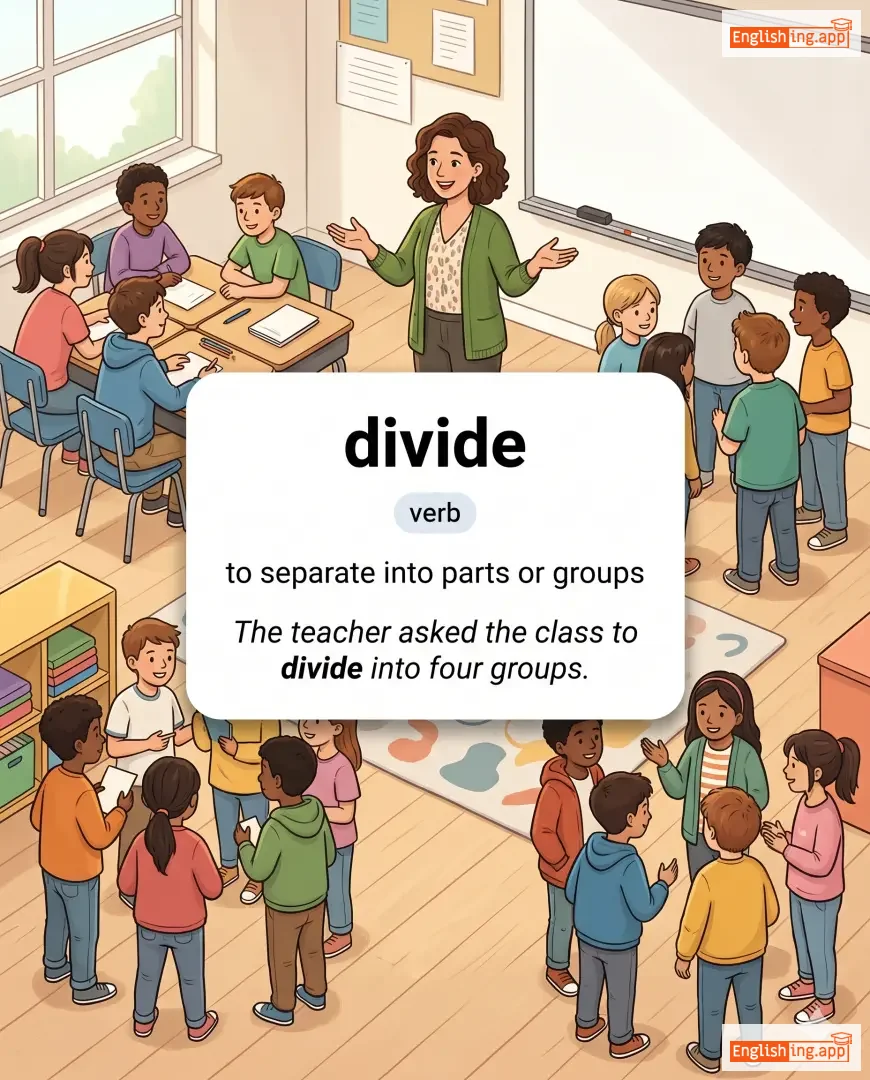
divide definition card — visual illustration of the meaning
verb
/dɪˈvaɪd/

to separate into parts or groups

"The teacher asked the class to divide into four groups."

noun
/ˌdɪvɪˈneɪʃən/
占卜 (zhānbǔ)

the practice of seeking knowledge of the future or the unknown by supernatural means

"Ancient people often relied on divination to guide important decisions."

"古人常常依赖占卜来指导重要的决策。" (Gǔrén chángcháng yīlài zhānbǔ lái zhǐdǎo zhòngyào de juécè.)
adjective, verb
/dɪˈvaɪn/

Relating to God or a deity; exceptionally wonderful or pleasing; to discover or foresee by intuition or supernatural means.

"She believed the divine power guided her actions."

noun
/dɪˈvɪnɪti/
神性 (shenxing)

The quality or state of being divine; a deity.

"The priest spoke about the divinity of the soul."

"神父谈到了灵魂的神性。" (Shenfu tandao le linghun de shenxing.)
adjective
/dɪˈvɪzəbl/
可被除 (ke bei chu)

Capable of being divided by another number without leaving a remainder.

"Twelve is divisible by three and four."

"十二可以被三和四整除。" (Shi er ke yi bei san he si zheng chu.)
noun
/dɪˈvɪʒən/
部门 (bumen)

the action of separating something into parts; or a large administrative unit

"The company has a separate division for research and development."

"公司有一个专门的部门负责研究和开发。" (Gongsi you yige zhuanmen de bumen fuze yanjiu he kaifa.)
noun
/dɪˈvaɪzər/
除数 (chúshù)

A number by which another number is divided.

"In the equation 12 ÷ 3, the number 3 is the divisor."

"在方程式12 ÷ 3中,数字3是除数。" (Zài fāngchéngshì 12 ÷ 3 zhōng, shùzì 3 shì chúshù.)
noun/verb
/dɪˈvɔːrs/
离婚 (líhūn)

the legal ending of a marriage; to officially end a marriage

"After years of conflict, they decided to get a divorce."

"经过多年的冲突,他们决定离婚。" (Jīngguò duōnián de chōngtū, tāmen juédìng líhūn.)
adjective
/dɪˈvɔːrst/
离婚 (líhūn)

No longer married because the marriage has been legally dissolved.

"She has been divorced for five years."

"她已经离婚五年了。" (Tā yǐjīng líhūn wǔ nián le.)
divulge definition card — visual illustration of the meaning
verb
/daɪˈvʌldʒ/
透露 (tòulù)

to make known something private, secret, or previously unknown

"She refused to divulge the source of her information."

"她拒绝透露她信息的来源。" (Tā jùjué tòulù tā xìnxī de láiyuán.)
noun
/daɪˈvʌldʒəns/
透露 (tòulù)

the act of revealing or disclosing something secret or private

"The divulgence of company secrets caused a major scandal."

"公司机密的透露引发了一场大丑闻。" (Gōngsī jīmì de tòulù yǐn fàle yī chǎng dà chǒuwén.)
noun
/ˌdiː.enˈeɪ/
脱氧核糖核酸 (DNA)

Deoxyribonucleic acid, the molecule that carries genetic information in living organisms.

"Scientists extracted DNA from the ancient bones."

"科学家从古代骨头中提取了DNA。" (Ke xue jia cong gu dai gu tou zhong ti qu le DNA.)
verb
/duː/
(zuò)

To perform an action, task, or activity.

"I need to do my homework before dinner."

"我需要在晚餐前做完作业。" (Wǒ xūyào zài wǎncān qián zuò wán zuòyè.)
adjective
/ˈdɑːsəl/ or /ˈdəʊsaɪl/
顺从的 (shùn cóng de)

easily managed, taught, or controlled; submissive

"The docile puppy quickly learned new tricks."

"顺从的小狗很快学会了新把戏。" (Shùn cóng de xiǎo gǒu hěn kuài xuéhuìle xīn bǎxì.)
noun
/dɒk/
码头 (mǎtóu)

a structure where ships are loaded, unloaded, or repaired

"The ship stayed at the dock for two days."

"船只在码头停留了两天。" (Chuán zhī zài mǎ tóu tíng liú le liǎng tiān.)
noun
/ˈdɒkɪt/
清单 (qingdan)

a list or schedule of cases to be tried in a court or items to be done

"The judge reviewed the docket before starting the session."

"法官在开始会议之前审查了清单。" (Faguang zai kaishi huiyi zhiqian shencha le qingdan.)
doctor definition card — visual illustration of the meaning
noun
/ˈdɒktər/
医生 (yīshēng)

A qualified medical professional who treats illnesses and injuries.

"The doctor prescribed medicine for the patient."

"医生为病人开了药。" (Yīshēng wèi bìngrén kāi le yào.)
doctrinaire definition card — visual illustration of the meaning
adjective
/ˌdɒktrɪˈnɛər/
教条主义者 (jiàotiáo zhǔyì zhě)

stubbornly devoted to a theory or doctrine without regard to practical considerations

"His doctrinaire approach to politics alienated many supporters."

"他对政治的教条主义方法使许多支持者感到疏远。" (Tā duì zhèngzhì de jiàotiáo zhǔyì fāngfǎ shǐ xǔduō zhīchí zhě gǎndào shūyuǎn.)
noun
/ˈdɒktrɪn/
教义 (jiaoyi)

A set of beliefs or principles held and taught by a religious, political, or other group.

"The church follows a strict doctrine on moral values."

"教会遵循一项关于道德价值的严格教义。" (Jiaohui zunxun yixiang guanyu daode jiazhi de yange jiaoyi.)
document definition card — visual illustration of the meaning
noun/verb
/ˈdɒkjʊmənt/
文件 (wenjian)

Noun: A written, printed, or electronic record that provides information or evidence. Verb: To record information in written or electronic form.

"She carefully documented all the expenses of the trip."

"她仔细记录了旅行的所有费用。" (Ta zǐxì jìlùle lǚxíng de suǒyǒu fèiyòng.)
noun/adjective
/ˌdɒkjʊˈmɛntri/
纪录片 (jìlùpiàn)

A film or television program that provides a factual record or report.

"We watched a documentary about climate change."

"我们观看了关于气候变化的纪录片。" (Wǒmen guānkànle guānyú qìhòu biànhuà de jìlùpiàn.)
noun
/ˌdɒkjʊmɛnˈteɪʃən/
文档 (wendang)

material that provides official information or evidence

"The documentation for the project is available for review."

"项目的文档可供审查。" (Xiàngmù de wéndàng kě gòng shěnchá.)
🚶‍♂️

dodder (多德)

verb
/ˈdɒdə/
颤抖着走路 (chan tiao zhe zou lu)

To move in a weak and unsteady way, especially due to old age.

"The old man doddered across the street with a cane."

"那位老人拄着拐杖走过街道,步履蹒跚。" (Na wei lao ren zhu zhe guai zhang zou guo jie dao, bu luo pan shan.)
adjective
/ˈdɒdərɪŋ/
颤抖的 / 虚弱的 (chandiao de / xuruo de)

Weak, shaky, or unsteady, especially due to old age.

"The doddering professor struggled to climb the stairs."

"那位dodering教授艰难地爬上了楼梯。" (Na wei dodering jiaoshou jiannan de pa shang le louti.)
dodge definition card — visual illustration of the meaning
verb
/dɒdʒ/
躲避 (duobi)

to avoid something by moving quickly to the side or by being clever

"He managed to dodge the ball at the last second."

"他成功地在最后一刻躲过了球。" (Ta chenggong de zai zuihou yike duoguo le qiu.)
adjective
/ˈdɒdʒi/
可疑的; 值得怀疑的; 不可靠的; 危险的或有风险的 (kěyí de; zhídé huáiyí de; bù kěkào de; wēixiǎn de huò yǒu fēngxiǎn de)

suspicious; questionable; unreliable; risky or dangerous

"That deal sounds dodgy to me."

"这个交易听起来很可疑。" (Zhège jiāoyì tīng qǐlái hěn kěyí.)
noun
/doʊ/
母鹿 (mu lu)

a female deer, especially an adult one

"The doe and her fawn were grazing in the meadow."

"母鹿和她的小鹿在草地上吃草。" (Mu lu he ta de xiao lu zai caodi shang chi cao.)
verb
/dɒf/
脱掉(帽子)表示尊敬 (tuō diào (mào zi) biǎo shì zūn jìng)

to take off an item of clothing, especially a hat, as a sign of respect

"He doffed his hat as the procession passed."

"他在队伍经过时摘下了帽子。" (Tā zài duì wǔ jīng guò shí zhāi xià le mào zi.)
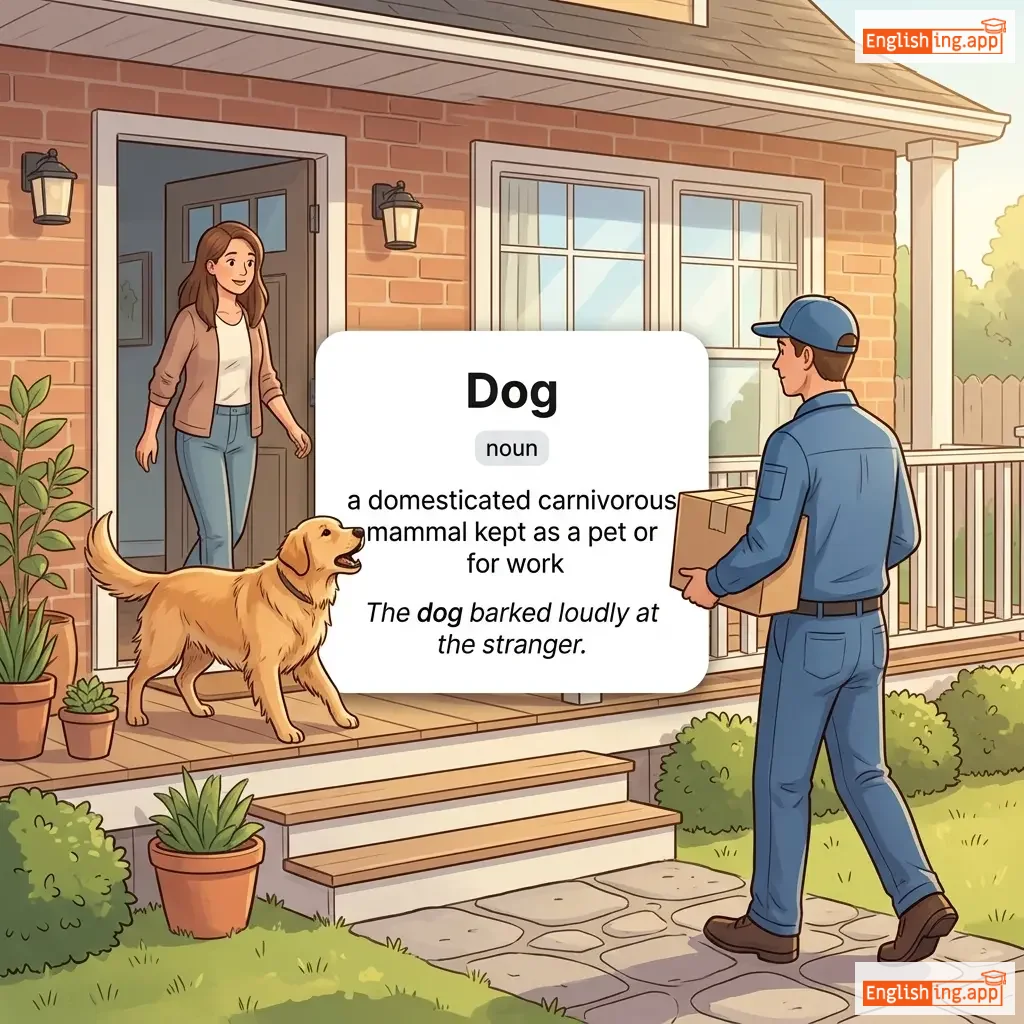
Dog definition card — visual illustration of the meaning
noun
/dɔːɡ/
(gǒu)

a domesticated carnivorous mammal kept as a pet or for work

"The dog barked loudly at the stranger."

"狗对陌生人大声叫。" (Gǒu duì mò shēng rén dà shēng jiào.)
noun
/ˈdɒɡ roʊz/
狗玫瑰 (gǒu méiguī)

A wild rose species with pink or white flowers and thorny stems, common in hedgerows

"The dog-rose bush grew wild along the countryside path."

"狗玫瑰灌木在乡村小路旁野生生长。" (Gǒu méiguī guànmù zài xiāngcūn xiǎolù páng yěshēng shēngzhǎng.)
adjective
/ˈdɒɡɪd/
顽强 (wanqiang)

showing stubborn determination and persistence

"She succeeded through dogged determination."

"她通过顽强的决心取得了成功。" (Ta tongguo wanqiang de juexin qude le chenggong.)
doggedness definition card — visual illustration of the meaning
noun
ˈdɒɡ.ɪd.nəs
顽强 (wánqiáng)

Stubborn persistence in achieving something without giving up.

"His doggedness in pursuing his goals was inspiring."
"他在追求目标时的顽强精神令人鼓舞。" (Tā zài zhuīqiú mùbiāo shí de wánqiáng jīngshén lìng rén gǔwǔ.)
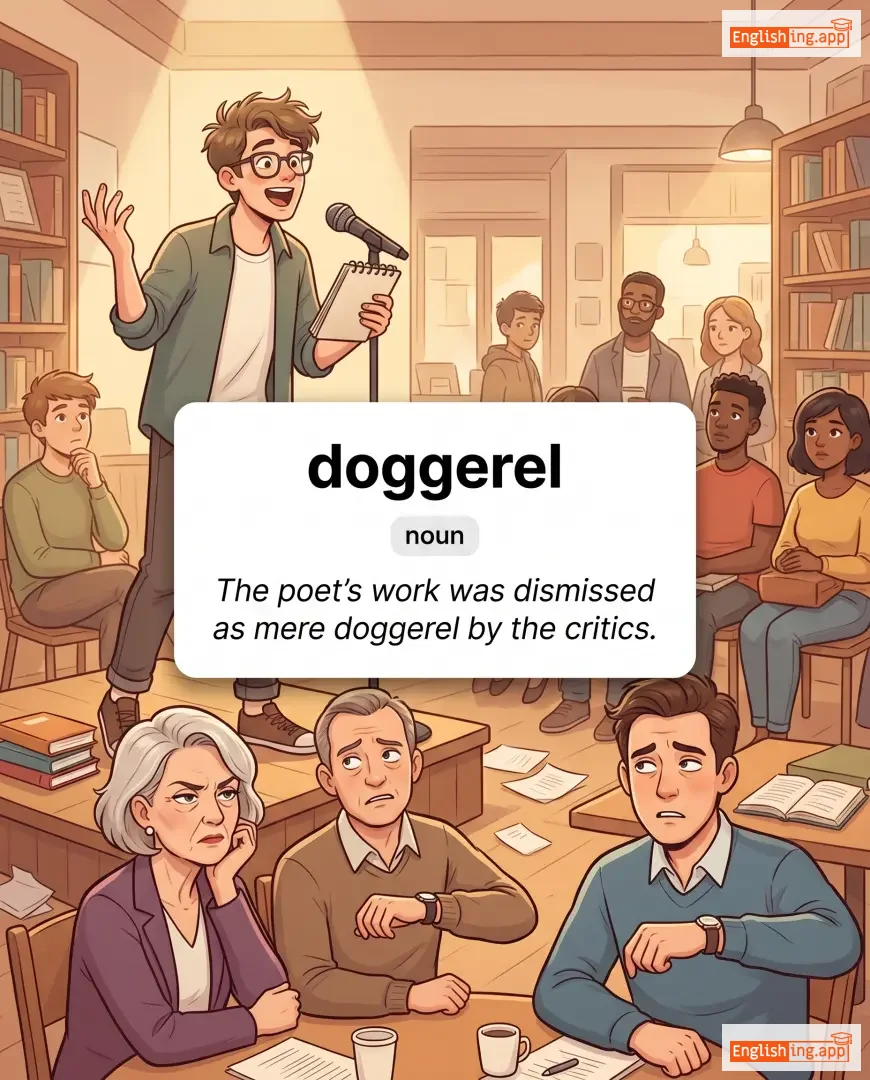
doggerel definition card — visual illustration of the meaning
noun
/ˈdɒɡərəl/
低俗诗句 (dī sú shī jù)

Comic or irregular verse, often poorly constructed and lacking in artistic quality.

"The poet’s work was dismissed as mere doggerel by the critics."

"诗人的作品被评论家视为单纯的低俗诗句。" (shī rén de zuò pǐn bèi píng lùn jiā shì wéi dān chún de dī sú shī jù.)
noun
/ˈdɒɡmə/
教条 (jiàotiáo)

A principle or set of principles laid down by an authority as incontrovertibly true.

"The religious leader strictly adhered to traditional dogma."

"宗教领袖严格遵守传统的教条。" (Zōngjiào lǐngxiù yángé zūnshǒu chuántǒng de jiàotiáo.)
dogmatic definition card — visual illustration of the meaning
adjective
/dɒɡˈmætɪk/
教条的 (jiaotiaode)

Inclined to lay down principles as undeniably true, without consideration of evidence or others’ opinions.

"Her dogmatic approach left little room for debate."

"她的教条主义方法几乎不给辩论留下空间。" (Tā de jiàotiáo zhǔyì fāngfǎ jīhū bù gěi biànlùn liúxià kōngjiān.)