词汇表

英语词汇词典 | 单词含义、定义和示例

adjective
/ˈdaʊti/
勇敢的 (yǒnggǎn de)

brave, valiant, courageous

"The doughty soldier never backed down from a challenge."

"勇敢的士兵从不退缩面对挑战。" (Yǒnggǎn de shìbīng cóng bù tuìsuō miànduì tiǎozhàn.)
adjective
/ˈdaʊ.ər/
严厉 (yanli)

relentlessly severe, stern, or gloomy in manner or appearance

"His dour expression made the meeting uncomfortable."

"他严厉的表情让会议变得不舒服。" (Tā yánlì de biǎoqíng ràng huìyì biàn dé bù shūfú.)
verb
/daʊs/
扑灭 / 倒 (pūmiè / dào)

to pour liquid over; to extinguish a fire or light

"Firefighters doused the flames with water."

"消防员用水扑灭了火焰。" (Xiāofángyuán yòng shuǐ pūmiè le huǒyàn.)
noun
/dʌv/
鸽子 (gezi)

a small, gentle bird with soft cooing sounds, often white and symbolizing peace

"The white dove flew peacefully across the blue sky."

"白鸽平静地飞翔在蓝天上。" (bai ge ping jing de fei xiang zai lan tian shang)
verb
/ˈdʌv.teɪl/
完美契合 (wanmei qihe)

to fit or combine perfectly together

"Her plans dovetail perfectly with our goals."

"她的计划与我们的目标完美契合。" (Ta de jihua yu women de mubiao wanmei qihe.)
adjective
/ˈdaʊ.di/
过时的 / 旧式的 (guòshí de / jiùshì de)

unfashionable, dull, or shabby in appearance

"She wore a dowdy dress to the party."

"她穿了一件过时的裙子参加聚会。" (Tā chuānle yī jiàn guòshí de qúnzi cānjiā jùhuì.)
adverb
/daʊn/
(xia)

from a higher to a lower position

"He walked down the stairs slowly."

"他慢慢地走下楼梯。" (Ta man man de zou xia lou ti.)
adjective
/ˈdaʊn.kæst/

feeling sad, dejected, or with lowered eyes

"He looked downcast after hearing the bad news."

noun
/ˈdaʊn.fɔːl/
衰退; 失败; 毁灭 (shuāituì, shībài, huǐmiè)

a loss of power, prosperity, or status; the cause of such a loss

"His arrogance and pride led to his eventual downfall in business."

"他的傲慢和自豪导致了他在生意中的最终失败。" (Tā de àomàn hé zìháo dǎozhìle tā zài shēngyì zhōng de zuìzhōng shībài.)
verb
/ˈdaʊn.pleɪ/
淡化 (dànhuà)

to make something seem less important than it really is

"The company tried to downplay the risks of the new product."

"公司试图淡化新产品的风险。" (Gōngsī shìtú dànhuà xīn chǎnpǐn de fēngxiǎn.)
noun
/ˈdaʊnˌpɔːr/
暴雨 (baoyu)

A sudden and heavy fall of rain.

"We got caught in a sudden downpour on our way home."

"我们在回家的路上突然被大暴雨困住了。" (Wǒmen zài huí jiā de lùshàng túrán bèi dà bàoyǔ kùnzhùle.)
adverb
/ˌdaʊnˈsteəz/
楼下 (lóuxià)

on or to a lower floor of a building

"Please go downstairs and wait in the lobby."

"请下楼并在大厅等候。" (qǐng xià lóu bìng zài dàtīng děnghòu.)
noun
/ˈdaʊnˌtaʊn/
市中心 (shì zhōngxīn)

the central part of a city

"They spent the afternoon shopping downtown."

"他们在市中心购物度过了下午。" (Tāmen zài shì zhōngxīn gòuwù dùguòle xiàwǔ.)
adverb
/ˈdaʊnwədz/
向下 (xiang xia)

towards a lower place or position; in a downward direction

"The ball rolled downwards along the slope."

"球沿坡道向下滚动。" (Qiu yan podao xiang xia gundong.)
noun
/ˈdaʊri/
嫁妆 (jiàzhuāng)

Property or money brought by a bride to her husband at marriage.

"The dowry tradition is still followed in some cultures."

"一些文化仍然遵循嫁妆的传统。" (Yīxiē wénhuà réngrán zūn xún jiàzhuāng de chuántǒng.)
verb
/daʊz/
使用占卜棒寻找地下水或矿物; 也指用液体浸湿或扑灭。 (shiyong zhanbu bang xunzhao dixia shui huo kuangwu; ye zhi yong ye ti jinshi huo pomei.)

To search for underground water or minerals using a divining rod; also to drench or extinguish with liquid.

"The farmer tried to dowse for water in the dry field."

"农民试图在干旱的田地中寻找水源。" (Nongmin shitu zai ganhan de tian di zhong xunzhao shuiyuan.)
noun
/ˈdɔɪən/
最受尊敬的人 (zui shou zunjing de ren)

The most respected or prominent person in a particular field.

"He is regarded as the doyen of modern literature in the country."

"他被视为该国现代文学的多伊恩。" (Ta bei shi wei gai guo xian dai wen xue de duo yi en.)
verb
/doʊz/
打盹 (dǎdǔn)

To sleep lightly for a short time.

"He dozed off while reading the book."

"他在读书时打了个盹。" (Tā zài dúshū shí dǎle gè dǔn.)
noun
/ˈdʌzən/
打算 (dǎsuàn)

a group of twelve

"She bought a dozen eggs from the market."

"她从市场上买了十二个鸡蛋。" (Tā cóng shìchǎng shàng mǎile shí'èr gè jīdàn.)
adjective
/dræb/
单调 (dandiao)

Dull, lacking brightness or interest; monotonous.

"The room looked drab with its gray walls and dim lighting."

"这个房间因为灰色的墙壁和昏暗的灯光显得很单调。" (zhege fangjian yinwei huise de qiangbi he hunan de dengguang xiande hen dandiao)
noun
/ˈdrækmə/
德拉克马 (délākèmǎ)

The basic monetary unit of Greece before the adoption of the euro.

"The old coin collection included a silver drachma."

"这枚古老的硬币收藏包括一枚银德拉克马。" (Zhè meí gǔlǎo de yìngbì shōucáng bāokuò yī meí yín délākèmǎ.)
adjective
/drəˈkoʊniən/
龙般的 (long ban de)

Extremely harsh and severe, especially laws or rules.

"The new regulations were criticized as draconian."

"新的规定被批评为龙般的。" (Xīn de guīdìng bèi pīpíng wéi lóng bān de.)
draft definition card — visual illustration of the meaning
noun/verb
/dræft/
草稿 (caogao)

A preliminary version of a piece of writing; to prepare a preliminary version of a document.

"She finished the first draft of her novel."

"她完成了小说的第一份草稿。" (Ta wanchengle xiaoshuo de diyi fen caogao.)
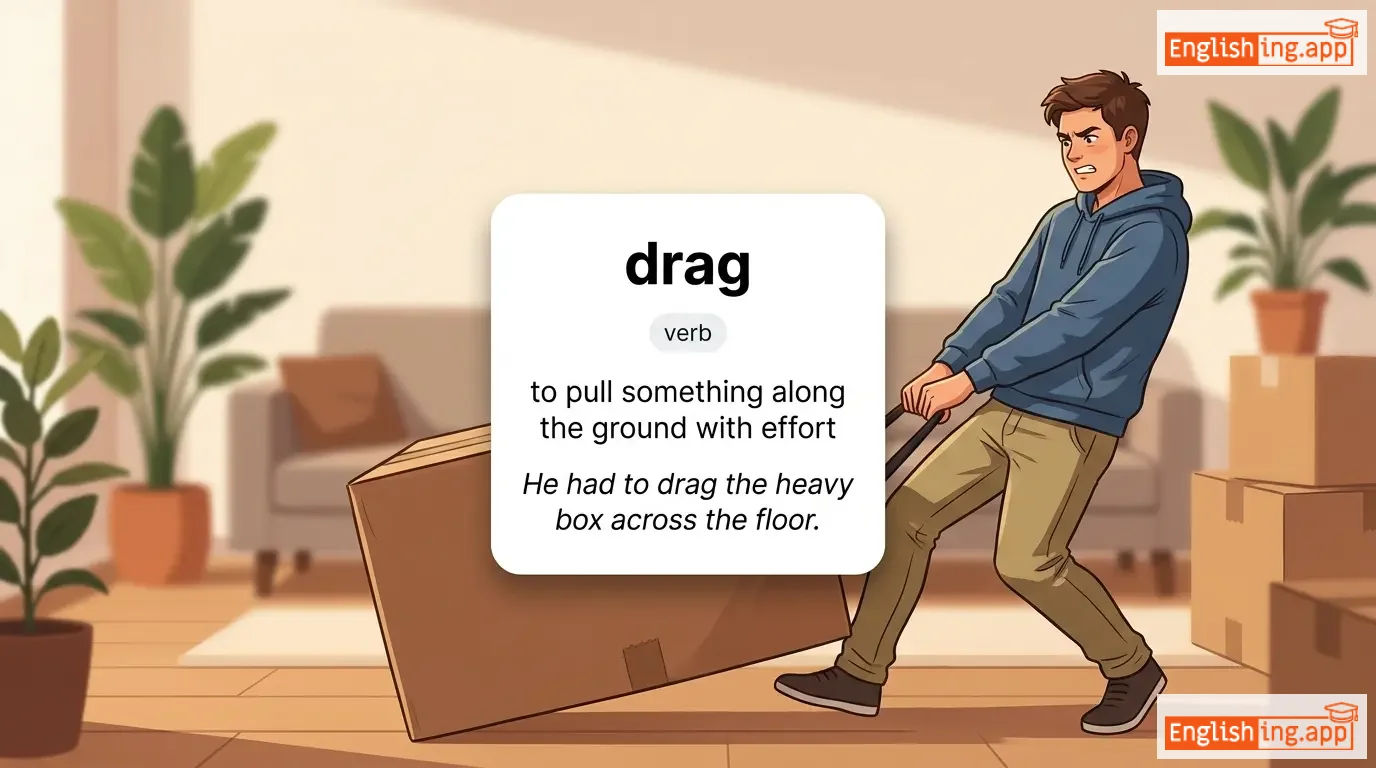
drag definition card — visual illustration of the meaning
verb
/dræɡ/
(tuo)

to pull something along the ground with effort

"He had to drag the heavy box across the floor."

"他不得不把重盒子拖过地板。" (Ta budebu ba zhong hezi tuo guo diban.)
noun
/ˈdræɡˌnɛt/
大规模搜捕 (dà guīmó sōu bǔ)

A systematic search or investigation, often by police to catch criminals.

"The police launched a dragnet to capture the fugitives."

"警察发起了大规模搜捕,试图抓捕逃犯。" (Jǐngchá fāqǐle dà guīmó sōubǔ, shìtú zhuābǔ táofàn.)
noun
/ˈdræɡ.ən.flaɪ/
蜻蜓 (qīngtíng)

a large insect with four transparent wings that lives near water

"The dragonfly hovered over the pond."

"蜻蜓在池塘上方盘旋。" (qīngtíng zài chítáng shàngfāng pánxuán)
verb
/drəˈɡuːn/
强迫 (qiangpo)

to force someone to do something through coercion or intimidation

"The manager tried to dragoon the team into working overtime."

"经理试图强迫团队加班。" (Jingli shitu qiangpo tuandui jiaban.)
🚰

drain

verb
/dreɪn/

to cause liquid to flow away from something; to remove liquid

"He drained the pasta before adding the sauce."

noun
/ˈdreɪ.nɪdʒ/
排水 (paishui)

the system or process by which water or other liquids are drained away

"Poor drainage caused flooding in the neighborhood."

"糟糕的排水系统导致了邻里的洪水。" (Zaogao de paishui xitong daozhi le linli de hongshui.)
noun
/dreɪk/
雄鸭 (xióng yā)

a male duck; a type of waterfowl

"The drake led his family of ducks across the pond."
"那只雄鸭带领它的鸭家族穿过了池塘。" (nà zhī xióng yā dàilǐng tā de yā jiāzú chuānguò le chí táng.)
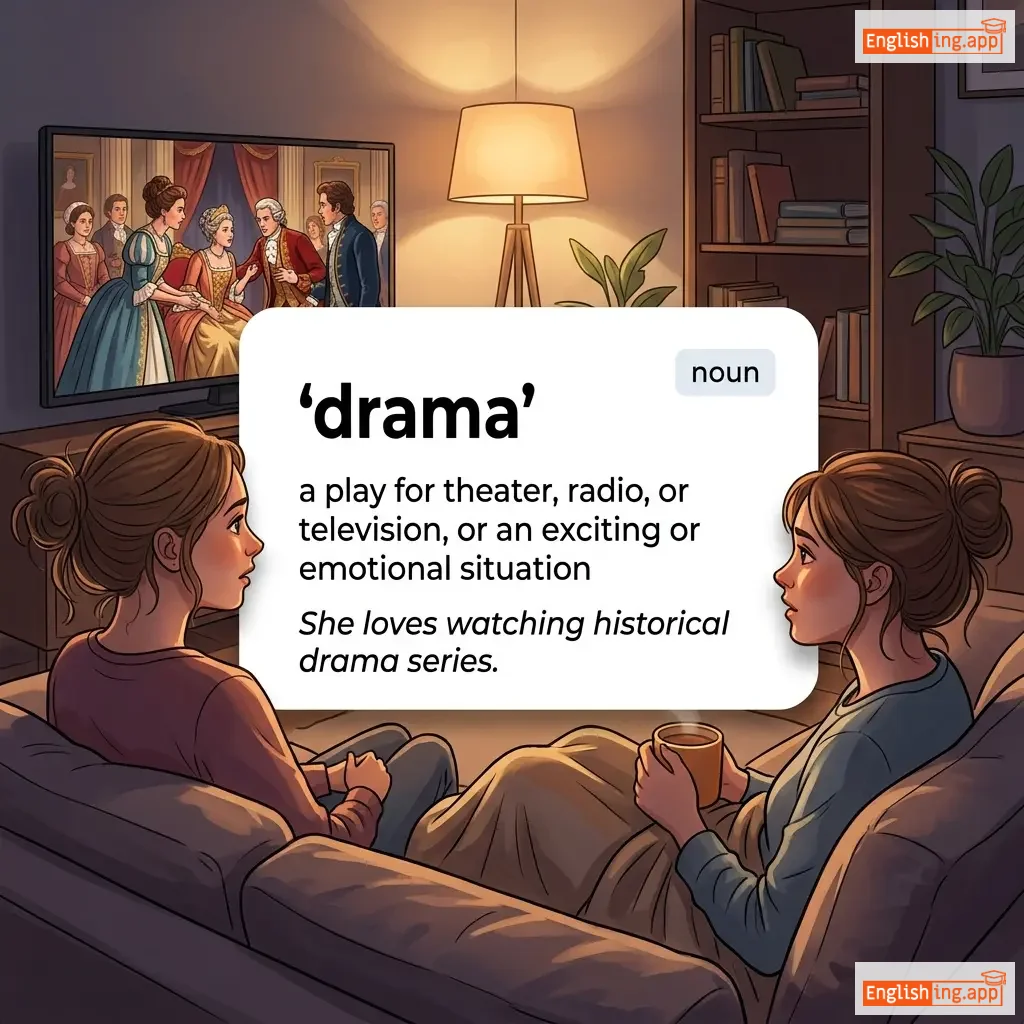
drama definition card — visual illustration of the meaning
noun
/ˈdrɑː.mə/
戏剧 (xiju)

a play for theater, radio, or television, or an exciting or emotional situation

"She loves watching historical drama series."

"她喜欢观看历史剧集。" (tā xǐhuān guānkàn lìshǐ jùjí.)
adjective
/drəˈmætɪk/
戏剧性的 (xijuxing de)

sudden and striking; relating to drama or theater

"The play ended with a dramatic twist."

"戏剧以一个戏剧性的转折结束。" (Xìjù yǐ yīgè xìjùxìng de zhuǎnzhé jiéshù.)
adverb
/drəˈmætɪkli/
戏剧性地 (xìjùxìng de)

in a sudden, striking, or exaggerated way

"Sales increased dramatically after the campaign."

"在活动后,销售额戏剧性地增长了。" (Zài huódòng hòu, xiāoshòu'é xìjùxìng de zēngzhǎngle.)
noun
/ˈdræm.ə.tɪst/
剧作家 (juzuo jia)

a person who writes plays

"Shakespeare is one of the greatest dramatists in history."

"莎士比亚是历史上最伟大的剧作家之一。" (Shashibiya shi lishi shang zui weida de juzuo jia zhi yi.)
verb
/ˈdræm.ə.taɪz/
戏剧化 (xiju hua)

to present a story in a dramatic way, or to exaggerate something

"The novel was dramatized into a popular TV series."

"这本小说被改编成了一部受欢迎的电视系列剧。" (Zhe ben xiaoshuo bei gaibian cheng le yi bu shou huanying de dianshi xilie ju.)
adjective
/ˈdræstɪk/
激烈 (jīliè)

likely to have a strong or far-reaching effect; extreme and severe

"The company had to take drastic measures to survive the crisis."

"公司必须采取激烈的措施才能度过危机。" (Gōngsī bìxū cǎiqǔ jīliè de cuòshī cáinéng dùguò wēijī.)
noun
/drɑːft/ (UK), /dræft/ (US)

a current of cool air in a room or another confined space; also a portion of liquid, especially beer, served from a barrel or cask

"She closed the window to keep out the cold draught."

verb
/drɔː/
画画 / 拉 (huà huà / lā)

to produce a picture by making lines and marks on paper; to pull or move something in a particular direction

"The child loves to draw pictures of animals."

"孩子喜欢画动物的画。" (Háizi xǐhuān huà dòngwù de huà.)
noun
/ˈdrɔː.bæk/
缺点; 不利因素; 问题 (quēdiǎn, bùlì yīnsù, wèntí)

a feature that renders something less acceptable; a disadvantage or problem

"The main drawback of living in the city is the high cost of housing."

"住在城市的主要缺点是高昂的住房成本。" (Zhù zài chéngshì de zhǔyào quēdiǎn shì gāo'áng de zhùfáng chéngběn.)
noun
/ˈdrɔːər/
抽屉 (chouti)

a box-shaped storage compartment that slides in and out of furniture

"She kept her jewelry in the top drawer of the dresser."

"她把珠宝放在梳妆台的上层抽屉里。" (Tā bǎ zhūbǎo fàng zài shūzhuāngtái de shàngcéng chōuti lǐ.)
noun
/ˈdrɔːɪŋ/
幸福 (xìngfú)

a picture or diagram made with a pencil, pen, or crayons rather than paint

"She showed me a drawing of her house."

"当她获得奖项时,她无法掩饰自己的幸福。" (Dāng tā huòdé jiǎngxiàng shí, tā wúfǎ yǎnshì zìjǐ de xìngfú.)
verb
/drɔːl/
懒散地说话 (lǎnsàn de shuōhuà)

to speak in a slow, lazy way with prolonged vowel sounds

"He tends to drawl when he is tired."

"他在累的时候说话会很慢。" (Tā zài lèi de shíhòu shuōhuà huì hěn màn.)
adjective
/ˈdrɛdfəl/
可怕的 (kěpà de)

causing or involving great fear or suffering; very bad or unpleasant

"The weather was dreadful during our trip."

"我们旅行时天气很可怕。" (Wǒmen lǚxíng shí tiānqì hěn kěpà.)
dream definition card — visual illustration of the meaning
noun/verb
/driːm/
梦想 (mengxiang)

a series of thoughts, images, or emotions occurring during sleep; a cherished aspiration or goal

"She dreamed of becoming a doctor."

"她梦想成为一名医生。" (Ta mengxiang chengwei yi ming yisheng.)
adjective
/ˈdrɪəri/
沉闷的 / 阴沉的 (chenmen de / yīnchén de)

dull, bleak, and lifeless; depressing

"The long, dreary winter made everyone feel gloomy."

"漫长而阴沉的冬天让每个人都感到沮丧。" (Manchang er yinchen de dongtian rang meige ren dou gandao jushang.)
noun
/drɛɡz/
残渣 (cancha)

the remnants of a liquid left in a container, together with any sediment or grounds; the most worthless part of something

"He drank the dregs of the coffee before leaving."

"他在离开前喝了咖啡的残渣。" (Ta zai likai qian he le kafei de cancha.)
verb
/drɛntʃ/
浸湿 (jin shi)

to make someone or something completely wet

"The sudden rain drenched the players on the field."

"突如其来的大雨让场上的球员全部湿透。" (Tu ru qi lai de da yu rang chang shang de qiu yuan quan bu shi tou.)
noun/verb
/drɛs/
幸福 (xìng fú)

a one-piece garment for women or girls; to put on clothes

"She wore a beautiful red dress to the party."

"她收到奖项时无法掩饰她的幸福。" (Tā shōu dào jiǎng xiàng shí wú fǎ yǎn shì tā de xìng fú.)
noun
/ˈdrɛsɪŋ/
沙拉酱 / 调味料混合物 (shālā jiàng / tiáowèiliào hùnhéwù)

a sauce for salads; or material used to cover a wound

"She prepared a delicious salad with Italian dressing."

"她用意大利沙拉酱准备了一道美味的沙拉。" (Tā yòng Yìdàlì shālā jiàng zhǔnbèile yīdào měiwèi de shālā.)
noun
/ˈdrɛsˌmeɪkər/
女裁缝 (nv caifeng)

A person who makes or alters women's clothing professionally.

"The dressmaker crafted a beautiful gown for the bride."

"女裁缝为新娘制作了一件漂亮的礼服。" (Nv caifeng wei xinniang zhizuo le yi jian piaoliang de lifu)