ভোকাবুলারিসমূহ

ইংরেজি শব্দের বাংলা অর্থ | English to Bangla Word Meaning Dictionary

adjective
/ˈdaʊti/
সাহসী (sahosi)

brave, valiant, courageous

"The doughty soldier never backed down from a challenge."

"সাহসী সৈনিক কখনো কোনো চ্যালেঞ্জ থেকে পিছিয়ে যাননি।" (Sahosi soinik kokhono kono challenge theke pichiye janini.)
adjective
/ˈdaʊ.ər/
গম্ভীর (gombhir)

relentlessly severe, stern, or gloomy in manner or appearance

"His dour expression made the meeting uncomfortable."

"তার গম্ভীর মুখভঙ্গি বৈঠকটিকে অস্বস্তিকর করে তুলেছিল।" (Tar gombhir mukhbhangi boithoktike ashostikor kore tulchhilo.)
verb
/daʊs/
নেভানো / ভিজানো (nebhano / bhijano)

to pour liquid over; to extinguish a fire or light

"Firefighters doused the flames with water."

"দমকল কর্মীরা পানির মাধ্যমে আগুন নেভাল।" (Domkol kormira panir madhyome agun nebhlo.)
noun
/dʌv/
ঘুঘু (ghu-ghu)

a small, gentle bird with soft cooing sounds, often white and symbolizing peace

"The white dove flew peacefully across the blue sky."

"সাদা ঘুঘুটি নীল আকাশের উপর দিয়ে শান্তিপূর্ণভাবে উড়ে গেল।" (sha-da ghu-ghu-ti nil a-kash-er u-por di-ye shan-ti-pur-no-bha-be u-re ge-lo)
verb
/ˈdʌv.teɪl/
মিল খাওয়া / সুন্দরভাবে মানানসই হওয়া (mil khaoa / sundorbhabe manansoi howa)

to fit or combine perfectly together

"Her plans dovetail perfectly with our goals."

"তার পরিকল্পনা আমাদের লক্ষ্যগুলোর সাথে পুরোপুরি মিলে যায়।" (Tar porikolpona amader lokkhogulor sathe puropuri mile jay.)
adjective
/ˈdaʊ.di/
অফ্যাশনেবল / জীর্ণ (ofashionable / jirno)

unfashionable, dull, or shabby in appearance

"She wore a dowdy dress to the party."

"সে পার্টিতে একটি পুরনো ধাঁচের পোশাক পরেছিল।" (Se partite ekti purono dhacher poshak porechilo.)
adverb
/daʊn/
নিচে (niche)

from a higher to a lower position

"He walked down the stairs slowly."

"সে ধীরে ধীরে সিঁড়ি বেয়ে নিচে নামলো।" (Se dhire dhire siri beye niche namlo.)
adjective
/ˈdaʊn.kæst/
মন খারাপ / হতাশ (mon kharap / hotash)

feeling sad, dejected, or with lowered eyes

"He looked downcast after hearing the bad news."

"খারাপ খবর শোনার পর সে মন খারাপ করেছিল।" (Kharap khobor shonar por se mon kharap korechilo.)
noun
/ˈdaʊn.fɔːl/
অবনতি; পতন; ধ্বংস; (obonoti, poton, dhongso)

a loss of power, prosperity, or status; the cause of such a loss

"His arrogance and pride led to his eventual downfall in business."

"তার অহংকার এবং গর্ব ব্যবসায় তার শেষ পর্যন্ত পতনের দিকে নিয়ে গিয়েছিল।" (tar ohonkar ebong gorbo byabshay tar shesh porjonto potoner dike niye giyechhilo.)
verb
/ˈdaʊn.pleɪ/
তুচ্ছ করা / গুরুত্ব কমিয়ে দেখা (tuchcho kora / gurutto komiye dekha)

to make something seem less important than it really is

"The company tried to downplay the risks of the new product."

"কোম্পানি নতুন পণ্যের ঝুঁকিকে তুচ্ছ করার চেষ্টা করেছিল।" (Company notun ponner jhuki tuchcho korar chesta korechilo.)
noun
/ˈdaʊnˌpɔːr/
মুষলধারে বৃষ্টি (musholdhare brishti)

A sudden and heavy fall of rain.

"We got caught in a sudden downpour on our way home."

"আমরা বাড়ি ফেরার পথে হঠাৎ মুষলধারে বৃষ্টিতে ভিজে গিয়েছিলাম।" (Amra bari ferar pothe hotath musholdhare brishtite vige giechilam.)
adverb
/ˌdaʊnˈsteəz/
নিচের তলা বা তলায়; (nicher tola)

on or to a lower floor of a building

"Please go downstairs and wait in the lobby."

"অনুগ্রহ করে নিচে গিয়ে লবিতে অপেক্ষা করুন।" (onugroho kore niche giye lobite opekha korun)
noun
/ˈdaʊnˌtaʊn/
শহরের কেন্দ্র (shohorer kendra)

the central part of a city

"They spent the afternoon shopping downtown."

"তারা দুপুরটা ডাউনটাউনে কেনাকাটা করে কাটিয়েছিল।" (Tara dupur ta downtown e kenakata kore katiyechilo.)
adverb
/ˈdaʊnwədz/
নিচের দিকে; নিম্নাভিমুখে; (nicer dike)

towards a lower place or position; in a downward direction

"The ball rolled downwards along the slope."

"বলটি ঢালু পথ ধরে নিচের দিকে গড়িয়ে গেল।" (bolti dhalu path dhore nicer dike goriye gelo)
noun
/ˈdaʊri/
যৌতুক (joutuk)

Property or money brought by a bride to her husband at marriage.

"The dowry tradition is still followed in some cultures."

"কিছু সংস্কৃতিতে এখনো যৌতুকের প্রথা চালু রয়েছে।" (Kichu sonkritite ekhono joutuker protha chalu royeche.)
verb
/daʊz/
পানি খোঁজা বা ছিটানো (pani khoja ba chitano)

To search for underground water or minerals using a divining rod; also to drench or extinguish with liquid.

"The farmer tried to dowse for water in the dry field."

"কৃষক শুকনো জমিতে পানি খুঁজতে ডাউস করার চেষ্টা করেছিলেন।" (Krishok shukno jomite pani khujte dause korar cheshta korechilen.)
noun
/ˈdɔɪən/
প্রবীণ ও সম্মানিত ব্যক্তি (probin o sommanito bekti)

The most respected or prominent person in a particular field.

"He is regarded as the doyen of modern literature in the country."

"তিনি দেশের আধুনিক সাহিত্যের প্রবীণ হিসেবে বিবেচিত।" (Tini desher adhunik sahityer probin hisebe bicharito.)
verb
/doʊz/
তন্দ্রা যাওয়া (tondra jaoya)

To sleep lightly for a short time.

"He dozed off while reading the book."

"সে বই পড়ার সময় তন্দ্রাচ্ছন্ন হয়ে পড়েছিল।" (Se boi porar somoy tondrachchhono hoye porichhilo.)
noun
/ˈdʌzən/
ডজন (dojon)

a group of twelve

"She bought a dozen eggs from the market."

"সে বাজার থেকে এক ডজন ডিম কিনেছিল।" (Se bajar theke ek dojon dim kinchilo.)
adjective
/dræb/
নিরস (niros)

Dull, lacking brightness or interest; monotonous.

"The room looked drab with its gray walls and dim lighting."

"ধূসর দেয়াল ও ম্লান আলোয় ঘরটি নিরস দেখাচ্ছিল।" (Dhushor deyal o mlan aloy ghorti niros dekhachhilo.)
noun
/ˈdrækmə/
ড্রাকমা (drakma)

The basic monetary unit of Greece before the adoption of the euro.

"The old coin collection included a silver drachma."

"পুরানো মুদ্রা সংগ্রহে একটি রৌপ্য ড্রাকমা ছিল।" (Purano mudra songrohe ekti rouppyo drakma chhilo.)
adjective
/drəˈkoʊniən/
অত্যন্ত কঠোর (ottyonto kothor)

Extremely harsh and severe, especially laws or rules.

"The new regulations were criticized as draconian."

"নতুন বিধিনিষেধগুলোকে অত্যন্ত কঠোর বলে সমালোচনা করা হয়েছিল।" (Notun bidhinishadgulo ke ottyonto kothor bole somalochona kora hoyechhilo.)
draft definition card — visual illustration of the meaning
noun/verb
/dræft/
খসড়া (khosra)

A preliminary version of a piece of writing; to prepare a preliminary version of a document.

"She finished the first draft of her novel."

"সে তার উপন্যাসের প্রথম খসড়া শেষ করেছিল।" (Se tar uponnasher prothom khosra shesh korechhilo.)
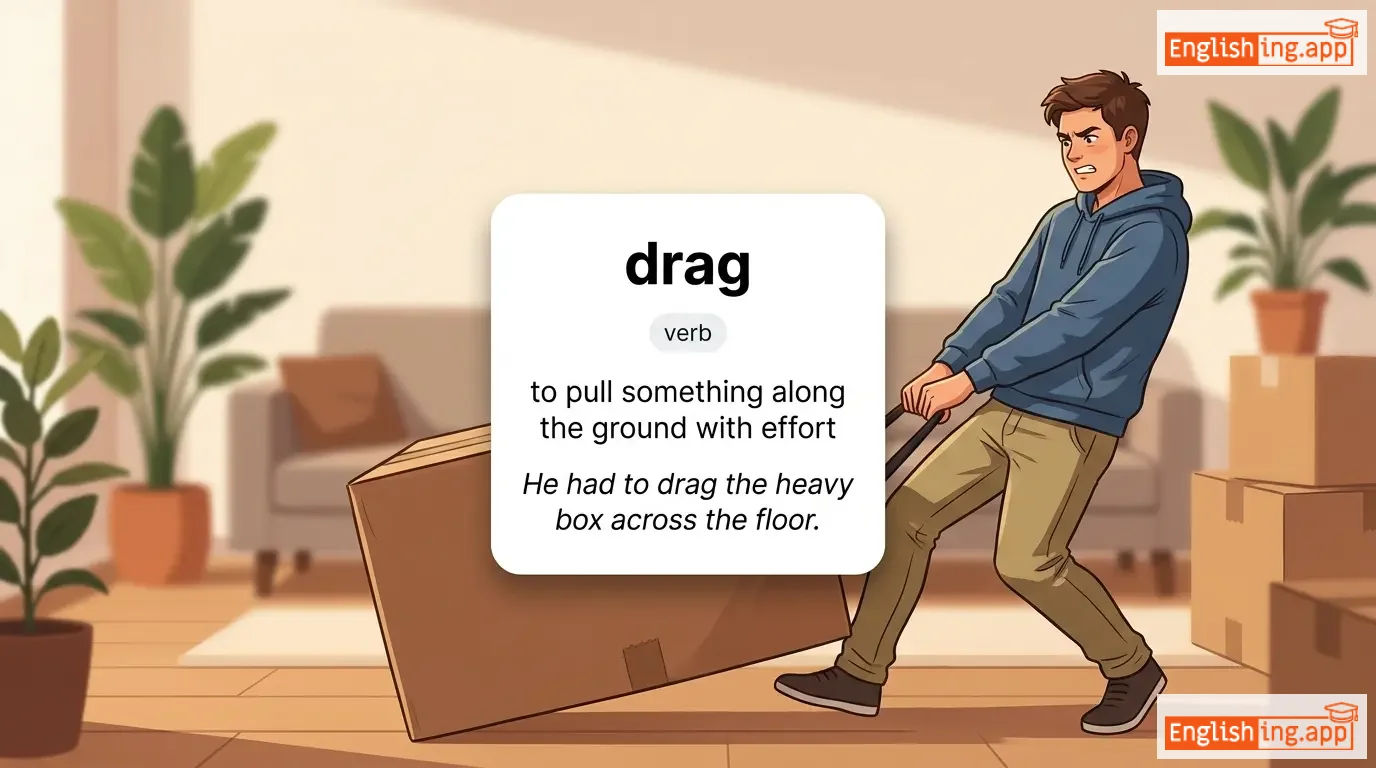
drag definition card — visual illustration of the meaning
verb
/dræɡ/
টেনে আনা (tene ana)

to pull something along the ground with effort

"He had to drag the heavy box across the floor."

"তাকে মেঝের উপর ভারী বাক্সটি টেনে আনতে হয়েছিল।" (Take mejher upor bhari bakshti tene ante hoyechilo.)
noun
/ˈdræɡˌnɛt/
বিস্তারিত তল্লাশি (bistrito tollashi)

A systematic search or investigation, often by police to catch criminals.

"The police launched a dragnet to capture the fugitives."

"পুলিশ অপরাধীদের ধরতে একটি বিস্তারিত তল্লাশি শুরু করেছিল।" (Police oporadhider dhorte ekti bistrito tollashi shuru korechhilo.)
noun
/ˈdræɡ.ən.flaɪ/
ফড়িং জাতীয় পোকা (phoring jatiya poka)

a large insect with four transparent wings that lives near water

"The dragonfly hovered over the pond."

"ফড়িংটি পুকুরের উপরে ভেসে বেড়াচ্ছিল।" (phoring-ti pukurer upore veshe berachilo)
verb
/drəˈɡuːn/
জোরপূর্বক বাধ্য করা (joropurbok baddho kora)

to force someone to do something through coercion or intimidation

"The manager tried to dragoon the team into working overtime."

"ম্যানেজার দলকে অতিরিক্ত সময় কাজ করতে জোর করেছিল।" (Manager dolke otirikto somoy kaj korte jor korechilo.)
verb
/dreɪn/
পানি ঝরানো (pani jhorano)

to cause liquid to flow away from something; to remove liquid

"He drained the pasta before adding the sauce."

"সে সস দেওয়ার আগে পাস্তা থেকে পানি ঝরিয়ে দিয়েছিল।" (Se sos deowar age pasta theke pani jhorie diechhilo.)
noun
/ˈdreɪ.nɪdʒ/
নিকাশী ব্যবস্থা (nikashi byabostha)

the system or process by which water or other liquids are drained away

"Poor drainage caused flooding in the neighborhood."

"খারাপ নিকাশীর কারণে এলাকায় জলাবদ্ধতা সৃষ্টি হয়েছিল।" (Kharap nikashir karone elakay jolaboddhota sristi hoyechilo.)
noun
/dreɪk/
পানকৌড়ি (pankoori)

a male duck; a type of waterfowl

"The drake led his family of ducks across the pond."

"পানকৌড়িটি তার হাঁসের পরিবারকে পুকুর পার করে নিয়ে গেল।" (pankooriti tar hanser poribarke pukur par kore niye gelo)
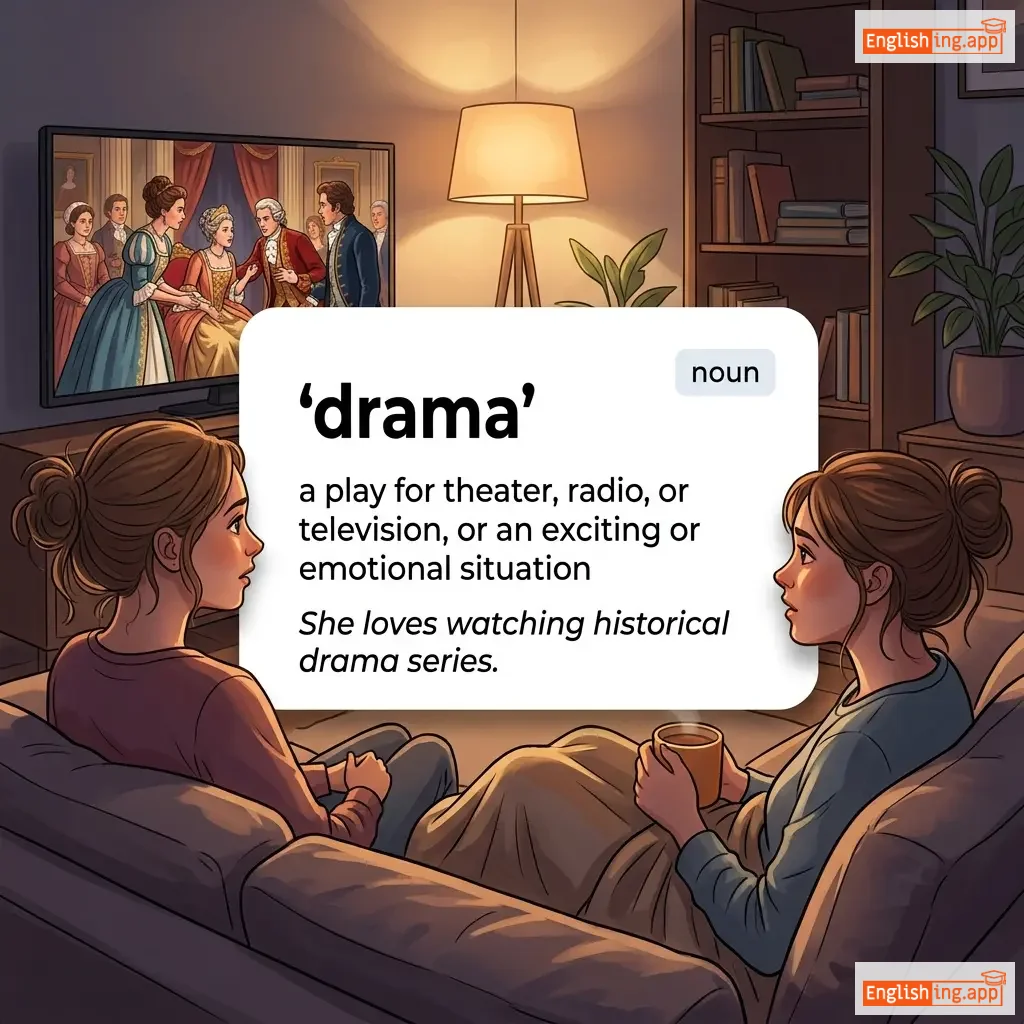
drama definition card — visual illustration of the meaning
noun
/ˈdrɑː.mə/
নাটক (natok)

a play for theater, radio, or television, or an exciting or emotional situation

"She loves watching historical drama series."

"সে ঐতিহাসিক নাটক সিরিজ দেখতে ভালোবাসে।" (Se oitihashik natok series dekhte bhalobashe.)
adjective
/drəˈmætɪk/
নাটকীয় (natokiyo)

sudden and striking; relating to drama or theater

"The play ended with a dramatic twist."

"নাটকটি নাটকীয় মোড় নিয়ে শেষ হয়েছিল।" (Natokti natokiyo mor niye shesh hoyechhilo.)
adverb
/drəˈmætɪkli/
নাটকীয়ভাবে (natokiyobhabe)

in a sudden, striking, or exaggerated way

"Sales increased dramatically after the campaign."

"ক্যাম্পেইনের পর বিক্রি নাটকীয়ভাবে বেড়েছিল।" (Campaign-er por bikri natokiyobhabe berechhilo.)
noun
/ˈdræm.ə.tɪst/
নাট্যকার (nattyokar)

a person who writes plays

"Shakespeare is one of the greatest dramatists in history."

"শেক্সপিয়ার ইতিহাসের অন্যতম শ্রেষ্ঠ নাট্যকার।" (Shakespeare itihasher onnomo shreshto nattyokar.)
verb
/ˈdræm.ə.taɪz/
নাটকীয় করা (natokiyo kora)

to present a story in a dramatic way, or to exaggerate something

"The novel was dramatized into a popular TV series."

"উপন্যাসটি একটি জনপ্রিয় টিভি সিরিজে নাটকীয়ভাবে উপস্থাপন করা হয়েছিল।" (Uponyasti ekti jonopriyo TV seriese natokiyo vabe uposthapon kora hoyechilo.)
adjective
/ˈdræstɪk/
কঠোর (kothor)

likely to have a strong or far-reaching effect; extreme and severe

"The company had to take drastic measures to survive the crisis."

"সংকট থেকে বাঁচতে কোম্পানিকে কঠোর ব্যবস্থা নিতে হয়েছিল।" (Songkot theke bachte kompani ke kothor byabostha nite hoyechilo.)
noun
/drɑːft/ (UK), /dræft/ (US)
হাওয়ার প্রবাহ / ড্রাফট বীয়ার (hawar probah / draft beer)

a current of cool air in a room or another confined space; also a portion of liquid, especially beer, served from a barrel or cask

"She closed the window to keep out the cold draught."

"ঠান্ডা বাতাস ঢুকতে না দেওয়ার জন্য সে জানালা বন্ধ করল।" (Thanda batas dhukte na dewar jonno se janala bondho korlo.)
verb
/drɔː/
আঁকা / টানা (anka / tana)

to produce a picture by making lines and marks on paper; to pull or move something in a particular direction

"The child loves to draw pictures of animals."

"শিশুটি প্রাণীর ছবি আঁকতে ভালোবাসে।" (Shishuti pranir chobi akte bhalobashe.)
noun
/ˈdrɔː.bæk/
অসুবিধা; বাধা; অপূর্ণতা; (oshubidhá, badha, opurnota)

a feature that renders something less acceptable; a disadvantage or problem

"The main drawback of living in the city is the high cost of housing."

"শহরে বসবাসের প্রধান অসুবিধা হল আবাসনের উচ্চ খরচ।" (shohore boshobash prodhan oshubidhá holo abashoner uchcho khoroch.)
noun
/ˈdrɔːər/
ড্রয়ার (droyar)

a box-shaped storage compartment that slides in and out of furniture

"She kept her jewelry in the top drawer of the dresser."

"সে ড্রেসারের উপরের ড্রয়ারে তার গয়না রেখেছিল।" (Se dresser er upor er droyare tar goyna rekhechhilo.)
noun
/ˈdrɔːɪŋ/
অঙ্কন (onkon)

a picture or diagram made with a pencil, pen, or crayons rather than paint

"She showed me a drawing of her house."

"সে আমাকে তার বাড়ির একটি অঙ্কন দেখিয়েছিল।" (Se amake tar barir ekti onkon dekhiyechhilo.)
verb
/drɔːl/
আলসেমিভাবে টেনে টেনে বলা (alsemivabe tene tene bola)

to speak in a slow, lazy way with prolonged vowel sounds

"He tends to drawl when he is tired."

"সে যখন ক্লান্ত থাকে তখন টেনে টেনে কথা বলে।" (Se jokhon klanto thake tokhon tene tene kotha bole.)
adjective
/ˈdrɛdfəl/
ভয়াবহ (bhoyaboh)

causing or involving great fear or suffering; very bad or unpleasant

"The weather was dreadful during our trip."

"আমাদের ভ্রমণের সময় আবহাওয়া ভয়াবহ ছিল।" (Amader vromoner somoy abohawa bhoyaboh chilo.)
dream definition card — visual illustration of the meaning
noun/verb
/driːm/
স্বপ্ন (shopno)

a series of thoughts, images, or emotions occurring during sleep; a cherished aspiration or goal

"She dreamed of becoming a doctor."

"সে ডাক্তার হওয়ার স্বপ্ন দেখেছিল।" (Se daktar howar shopno dekhiyechhilo.)
adjective
/ˈdrɪəri/
মনমরা / নিরানন্দ (monmora / niranondo)

dull, bleak, and lifeless; depressing

"The long, dreary winter made everyone feel gloomy."

"দীর্ঘ, নিরানন্দ শীতকাল সবাইকে বিষণ্ণ করে তুলেছিল।" (Dirgho, niranondo shitkal sobaike bishonno kore tulchilo.)
noun
/drɛɡz/
অবশেষ (oboshesh)

the remnants of a liquid left in a container, together with any sediment or grounds; the most worthless part of something

"He drank the dregs of the coffee before leaving."

"সে বের হওয়ার আগে কফির অবশিষ্ট অংশ পান করল।" (Se ber howar age kofir oboshishto angsho pan korlo.)
verb
/drɛntʃ/
ভিজিয়ে দেওয়া (bhijie deowa)

to make someone or something completely wet

"The sudden rain drenched the players on the field."

"হঠাৎ বৃষ্টিতে মাঠের খেলোয়াড়রা ভিজে গেল।" (Hothat brishtite matir khelowar ra bhije gelo.)
noun/verb
/drɛs/
পোশাক/ড্রেস (poshak/dress)

a one-piece garment for women or girls; to put on clothes

"She wore a beautiful red dress to the party."

"সে পার্টিতে একটি সুন্দর লাল পোশাক পরেছিল।" (Se partite ekti sundor lal poshak porechhilo.)
noun
/ˈdrɛsɪŋ/
ড্রেসিং / মসলা মিশ্রণ (dresing / mosla mishron)

a sauce for salads; or material used to cover a wound

"She prepared a delicious salad with Italian dressing."

"সে ইতালিয়ান ড্রেসিং দিয়ে একটি সুস্বাদু স্যালাড প্রস্তুত করেছিল।" (Se Italian dresing diye ekti suswadu salad prostut korechilo.)
noun
/ˈdrɛsˌmeɪkər/
ড্রেসশিল্পী (dressshilpi)

A person who makes or alters women's clothing professionally.

"The dressmaker crafted a beautiful gown for the bride."

"ড্রেসশিল্পী কনেকে জন্য একটি সুন্দর গাউন তৈরি করেছেন।" (dressshilpi koneke jonyo ekti sundor gaun toiri korechhen)