वोकैबुलरीज

इंग्लिश वोकैबुलरी डिस्कवर, लर्न और मास्टर करें

adjective
/ˈdaʊti/
साहसी (sahasi)

brave, valiant, courageous

"The doughty soldier never backed down from a challenge."

"साहसी सैनिक कभी भी किसी चुनौती से पीछे नहीं हटा।" (Sahasi sainik kabhi bhi kisi chunauti se peeche nahi hata.)
adjective
/ˈdaʊ.ər/
कठोर (kathor)

relentlessly severe, stern, or gloomy in manner or appearance

"His dour expression made the meeting uncomfortable."

"उसकी कठोर मुद्रा ने बैठक को असहज बना दिया।" (Uski kathor mudra ne baithak ko asahaj bana diya.)
verb
/daʊs/
बुझाना / डालना (bujhana / dalna)

to pour liquid over; to extinguish a fire or light

"Firefighters doused the flames with water."

"फायरफाइटर्स ने पानी से आग बुझाई।" (Firefighters ne pani se aag bujhayi.)
noun
/dʌv/
कबूतर (kabootar)

a small, gentle bird with soft cooing sounds, often white and symbolizing peace

"The white dove flew peacefully across the blue sky."

"सफेद कबूतर नीले आकाश में शांति से उड़ रहा था।" (safed kabootar neele aakash mein shanti se ud raha tha)
verb
/ˈdʌv.teɪl/
मेल खाना / पूरी तरह से एक साथ फिट होना (mel khaana / poori tarah se ek saath fit hona)

to fit or combine perfectly together

"Her plans dovetail perfectly with our goals."

"उसकी योजनाएँ हमारे लक्ष्यों के साथ पूरी तरह मेल खाती हैं।" (Uski yojnaayein hamare lakshyon ke saath poori tarah mel khaati hain.)
adjective
/ˈdaʊ.di/
फैशनहीन / बेरंग (fashionheen / berang)

unfashionable, dull, or shabby in appearance

"She wore a dowdy dress to the party."

"उसने पार्टी में एक फैशनहीन ड्रेस पहनी।" (Usne party mein ek fashionheen dress pehni.)
adverb
/daʊn/
नीचे (neeche)

from a higher to a lower position

"He walked down the stairs slowly."

"वह धीरे-धीरे सीढ़ियों से नीचे आया।" (Wah dheere-dheere seediyaan se neeche aaya.)
adjective
/ˈdaʊn.kæst/
उदास (daunkaast)

feeling sad, dejected, or with lowered eyes

"He looked downcast after hearing the bad news."

"खराब खबर सुनने के बाद वह उदास दिखा" (kharab khabar sunne ke baad vah udaas dikha)
noun
/ˈdaʊn.fɔːl/
पतन; गिरावट; विनाश (patan, girawat, vinash)

a loss of power, prosperity, or status; the cause of such a loss

"His arrogance and pride led to his eventual downfall in business."

"उसकी अडिगता और घमंड ने अंततः व्यापार में उसके पतन का कारण बना दिया।" (uski adigta aur ghamand ne antatah vyapar mein uske patan ka karan bana diya.)
verb
/ˈdaʊn.pleɪ/
महत्व कम करना (mahatv kam karna)

to make something seem less important than it really is

"The company tried to downplay the risks of the new product."

"कंपनी नए उत्पाद के जोखिमों को महत्व कम करने की कोशिश कर रही थी।" (Company naye utpad ke jokhimo ko mahatv kam karne ki koshish kar rahi thi.)
noun
/ˈdaʊnˌpɔːr/
मूसलधार बारिश (moosaldhaar barish)

A sudden and heavy fall of rain.

"We got caught in a sudden downpour on our way home."

"हम घर जाते समय अचानक मूसलधार बारिश में फंस गए।" (Hum ghar jaate samay achanak moosaldhaar baarish mein fans gaye.)
adverb
/ˌdaʊnˈsteəz/
नीचे (neeche)

on or to a lower floor of a building

"Please go downstairs and wait in the lobby."

"कृपया नीचे जाएं और लॉबी में इंतजार करें।" (kripya neeche jaayein aur lobby mein intezaar karein)
noun
/ˈdaʊnˌtaʊn/
शहर का केंद्रीय भाग (shahar ka kendriya bhag)

the central part of a city

"They spent the afternoon shopping downtown."

"उन्होंने दोपहर में शहर के केंद्रीय भाग में खरीदारी की।" (Unhone dopahar mein shahar ke kendriya bhag mein khareedari ki.)
adverb
/ˈdaʊnwədz/
नीचे की ओर; निचले दिशा में (neeche ki or; nichle disha mein)

towards a lower place or position; in a downward direction

"The ball rolled downwards along the slope."

"गेंद ढलान के साथ नीचे की ओर लुकी।" (gend dhalan ke saath neeche ki or luki.)
noun
/ˈdaʊri/
दहेज (dahej)

Property or money brought by a bride to her husband at marriage.

"The dowry tradition is still followed in some cultures."

"कुछ संस्कृतियों में आज भी दहेज की परंपरा निभाई जाती है।" (Kuch sanskritiyon mein aaj bhi dahej ki parampara nibhaayi jaati hai.)
verb
/daʊz/
पानी खोजना या भिगोना (pani khojna ya bhigona)

To search for underground water or minerals using a divining rod; also to drench or extinguish with liquid.

"The farmer tried to dowse for water in the dry field."

"किसान ने सूखे खेत में पानी खोजना के लिए डाउज़ करने की कोशिश की।" (Kisan ne sukhay khet mein pani khojna ke liye douse karne ki koshish ki.)
noun
/ˈdɔɪən/
प्रमुख व्यक्ति (pramukh vyakti)

The most respected or prominent person in a particular field.

"He is regarded as the doyen of modern literature in the country."

"वह देश में आधुनिक साहित्य के डॉयेन माने जाते हैं।" (Vah desh mein aadhunik sahitye ke doyen maane jaate hain.)
verb
/doʊz/
तंद्रा लगना (tandra lagna)

To sleep lightly for a short time.

"He dozed off while reading the book."

"वह किताब पढ़ते हुए तंद्रा में चला गया।" (Woh kitaab padhte huye tandra mein chala gaya.)
noun
/ˈdʌzən/
दर्जन (darjan)

a group of twelve

"She bought a dozen eggs from the market."

"उसने बाजार से एक दर्जन अंडे खरीदे।" (Usne bazaar se ek darjan ande khareede.)
adjective
/dræb/
नीरस (niros)

Dull, lacking brightness or interest; monotonous.

"The room looked drab with its gray walls and dim lighting."

"धूसर दीवारों और मद्धम रोशनी के साथ कमरा नीरस लग रहा था।" (dhoosar deewaron aur maddham roshni ke saath kamra niros lag raha tha)
noun
/ˈdrækmə/
ड्रैक्मा (drakma)

The basic monetary unit of Greece before the adoption of the euro.

"The old coin collection included a silver drachma."

"द पुराने सिक्के संग्रह में एक चांदी की ड्रैक्मा शामिल थी।" (Da purane sikke sangrah mein ek chaandi ki drakma shamil thi.)
adjective
/drəˈkoʊniən/
क्रूर (kroor)

Extremely harsh and severe, especially laws or rules.

"The new regulations were criticized as draconian."

"नई विनियमों को क्रूर बताया गया।" (Nayi viniyamon ko kroor bataya gaya.)
draft definition card — visual illustration of the meaning
noun/verb
/dræft/
ड्राफ्ट (draft)

A preliminary version of a piece of writing; to prepare a preliminary version of a document.

"She finished the first draft of her novel."

"वह अपनी उपन्यास का पहला ड्राफ्ट पूरा कर चुकी थी।" (Wah apni upanyas ka pehla draft poora kar chuki thi.)
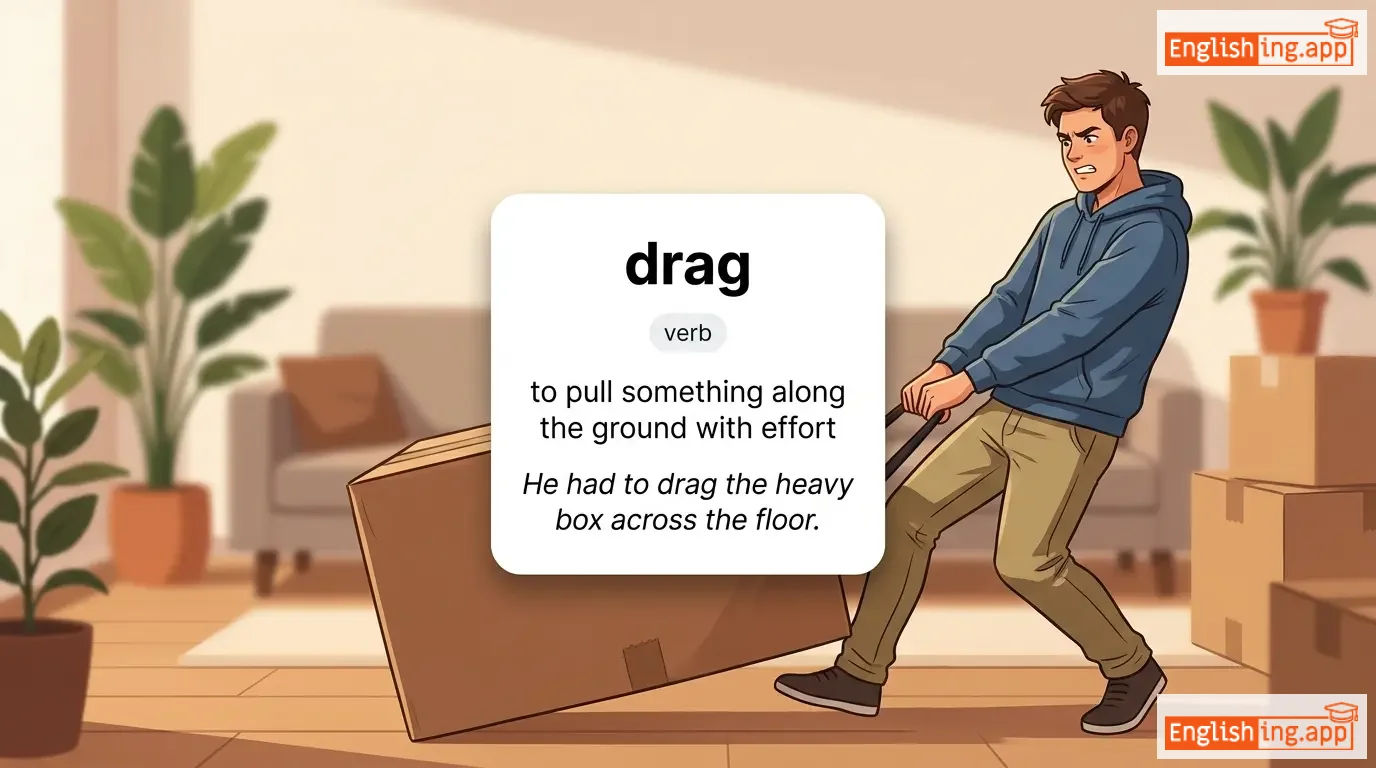
drag definition card — visual illustration of the meaning
verb
/dræɡ/
खींचना (kheenchna)

to pull something along the ground with effort

"He had to drag the heavy box across the floor."

"उसे भारी बॉक्स को फर्श पर खींचना पड़ा।" (Use bhari box ko farsh par kheenchna pada.)
noun
/ˈdræɡˌnɛt/
विस्तृत जांच (vistrit jaanch)

A systematic search or investigation, often by police to catch criminals.

"The police launched a dragnet to capture the fugitives."

"पुलिस ने अपराधियों को पकड़ने के लिए एक विस्तृत जांच शुरू की।" (Police ne apraadhiyon ko pakadne ke liye ek vistrit jaanch shuru ki.)
noun
/ˈdræɡ.ən.flaɪ/
ड्रैगनफ्लाई (dragonfly)

a large insect with four transparent wings that lives near water

"The dragonfly hovered over the pond."

"ड्रैगनफ्लाई तालाब के ऊपर मंडरा रही थी।" (dragonfly taalab ke upar mandra rahi thi)
verb
/drəˈɡuːn/
जबरदस्ती करना (jabardasti karna)

to force someone to do something through coercion or intimidation

"The manager tried to dragoon the team into working overtime."

"मैनेजर ने टीम को ओवरटाइम काम करने के लिए मजबूर करने की कोशिश की।" (Manager ne team ko overtime kaam karne ke liye majboor karne ki koshish ki.)
verb
/dreɪn/
पानी निकालना (pani nikalna)

to cause liquid to flow away from something; to remove liquid

"He drained the pasta before adding the sauce."

"उसने सॉस डालने से पहले पास्ता से पानी निकाला।" (Usne sauce daalne se pehle pasta se pani nikala.)
noun
/ˈdreɪ.nɪdʒ/
जलनिकासी (jalnikasi)

the system or process by which water or other liquids are drained away

"Poor drainage caused flooding in the neighborhood."

"खराब जलनिकासी के कारण पड़ोस में बाढ़ आई।" (Kharab jalnikasi ke kaaran pados mein baadh aayi.)
noun
/dreɪk/
बतख (batakh)

a male duck; a type of waterfowl

"The drake led his family of ducks across the pond."

"बतख ने अपने बत्तख के परिवार को तालाब के पार ले जाया।" (batakh ne apne battakh ke parivar ko talab ke paar le jaya.)
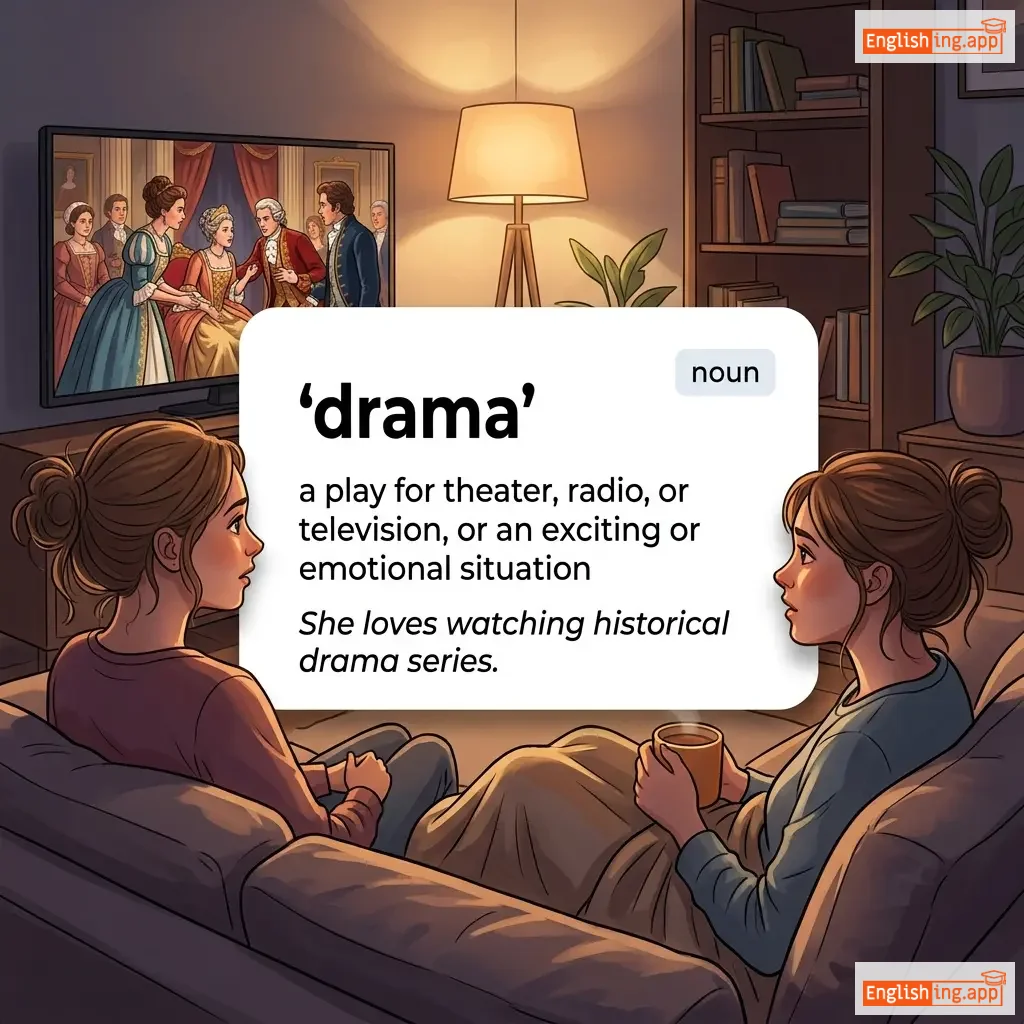
drama definition card — visual illustration of the meaning
noun
/ˈdrɑː.mə/
नाटक (natak)

a play for theater, radio, or television, or an exciting or emotional situation

"She loves watching historical drama series."

"वह ऐतिहासिक नाटक सीरीज़ देखना पसंद करती है।" (vah aitihasik natak series dekhna pasand karti hai.)
adjective
/drəˈmætɪk/
नाटकीय (natakiy)

sudden and striking; relating to drama or theater

"The play ended with a dramatic twist."

"प्ले एक नाटकीय मोड़ के साथ समाप्त हुआ।" (Play ek natakiy mod ke saath samaapt hua.)
adverb
/drəˈmætɪkli/
नाटकीय रूप से (naatakiya roop se)

in a sudden, striking, or exaggerated way

"Sales increased dramatically after the campaign."

"कंपेन के बाद बिक्री नाटकीय रूप से बढ़ी।" (Campaign ke baad bikri naatakiya roop se badhi.)
noun
/ˈdræm.ə.tɪst/
नाट्यकार (natyakar)

a person who writes plays

"Shakespeare is one of the greatest dramatists in history."

"शेक्सपियर इतिहास के सबसे महान नाट्यकारों में से एक हैं।" (Shakespeare itihas ke sabse mahan natyakarom mein se ek hain.)
verb
/ˈdræm.ə.taɪz/
नाटकीय बनाना (naatakiya banana)

to present a story in a dramatic way, or to exaggerate something

"The novel was dramatized into a popular TV series."

"उपन्यास को एक लोकप्रिय टीवी सीरीज़ में नाटकीय रूप से प्रस्तुत किया गया था।" (Upanyas ko ek lokpriya TV series mein naatakiya roop se prastut kiya gaya tha.)
adjective
/ˈdræstɪk/
कट्टर (kattar)

likely to have a strong or far-reaching effect; extreme and severe

"The company had to take drastic measures to survive the crisis."

"संकट से बचने के लिए कंपनी को कठोर कदम उठाने पड़े।" (Sankat se bachne ke liye company ko kathor kadam uthana pade.)
noun
/drɑːft/ (UK), /dræft/ (US)
हवा का झोंका (draaft)

a current of cool air in a room or another confined space; also a portion of liquid, especially beer, served from a barrel or cask

"She closed the window to keep out the cold draught."

"उसने ठंडी हवा को बाहर रोकने के लिए खिड़की बंद कर दी." (usne thandi hawa ko baahar rokne ke liye khidki band kar di.)
verb
/drɔː/
आकना / खींचना (aakna / kheenchna)

to produce a picture by making lines and marks on paper; to pull or move something in a particular direction

"The child loves to draw pictures of animals."

"बच्चा जानवरों की तस्वीरें बनाना पसंद करता है।" (Baccha janwaron ki tasveeren banana pasand karta hai.)
noun
/ˈdrɔː.bæk/
कमज़ोरी; नुक़सान; समस्या (kamzori, nuqsan, samasya)

a feature that renders something less acceptable; a disadvantage or problem

"The main drawback of living in the city is the high cost of housing."

"शहर में रहने का मुख्य कमज़ोरी घर की उच्च कीमत है।" (shahar mein rehne ka mukhya kamzori ghar ki uchcha keemat hai.)
noun
/ˈdrɔːər/
दराज (daraaj)

a box-shaped storage compartment that slides in and out of furniture

"She kept her jewelry in the top drawer of the dresser."

"उसने अपने गहनों को ड्रेसर के ऊपर वाले दराज में रखा।" (Usne apne gahno ko dresser ke upar wale daraaj mein rakha.)
noun
/ˈdrɔːɪŋ/
सुख (sukh)

a picture or diagram made with a pencil, pen, or crayons rather than paint

"She showed me a drawing of her house."

"जब उसने पुरस्कार प्राप्त किया तो वह अपनी खुशी छुपा नहीं सकी।" (Jab usne puraskaar praapt kiya to vah apni khushi chhupa nahin sakee.)
verb
/drɔːl/
धीमी, आलसी आवाज में बोलना (dhimi, aalsi aawaaz mein bolna)

to speak in a slow, lazy way with prolonged vowel sounds

"He tends to drawl when he is tired."

"वह थका हुआ होने पर धीमी और आलसी आवाज में बोलता है।" (Vah thaka hua hone par dheemi aur aalsi awaaz mein bolta hai.)
adjective
/ˈdrɛdfəl/
भयानक (bhayanak)

causing or involving great fear or suffering; very bad or unpleasant

"The weather was dreadful during our trip."

"हमारी यात्रा के दौरान मौसम भयानक था।" (Hamari yatra ke dauran mausam bhayanak tha.)
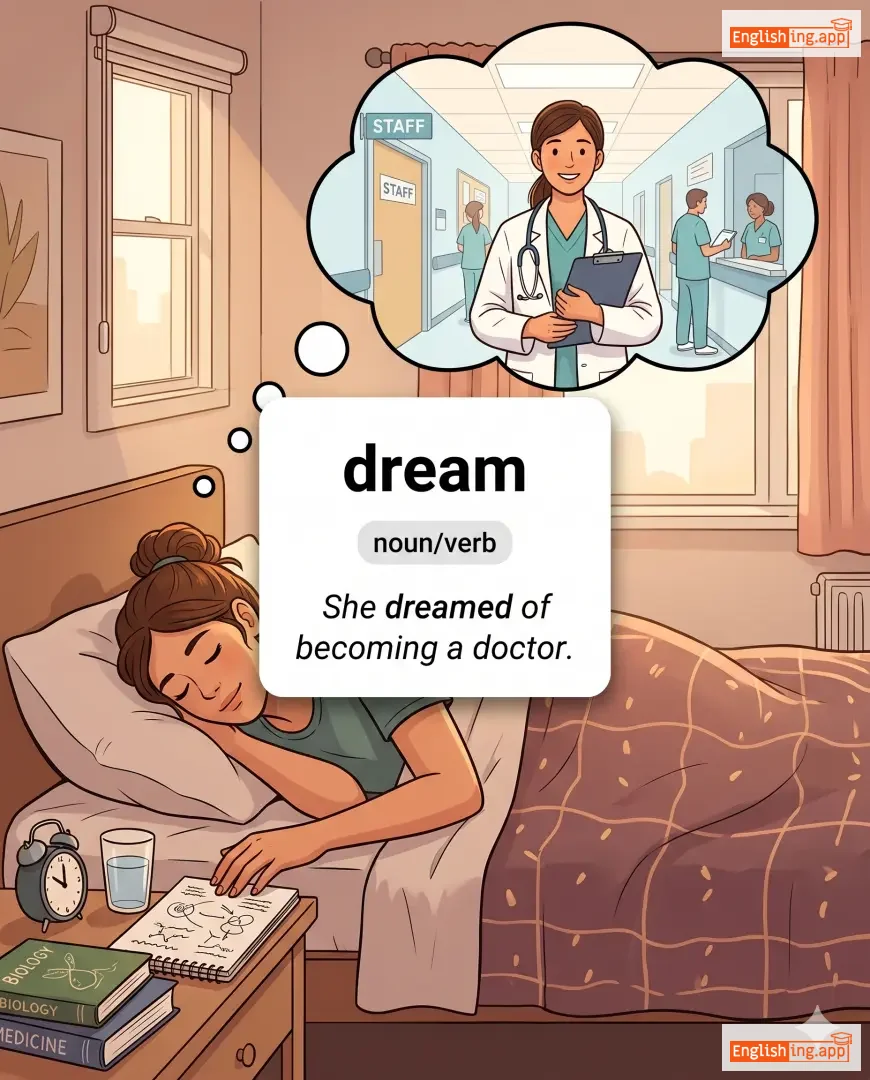
dream definition card — visual illustration of the meaning
noun/verb
/driːm/
खुशी (khushi)

a series of thoughts, images, or emotions occurring during sleep; a cherished aspiration or goal

"She dreamed of becoming a doctor."

"वह पुरस्कार प्राप्त करते समय अपनी खुशी को छिपा नहीं पाई।" (Wah puraskar prapt karte samay apni khushi ko chhupa nahi pai.)
adjective
/ˈdrɪəri/
उदास / नीरस (udaas / neeras)

dull, bleak, and lifeless; depressing

"The long, dreary winter made everyone feel gloomy."

"लंबी, नीरस सर्दी ने सभी को उदास कर दिया।" (Lambi, neeras sardi ne sabhi ko udaas kar diya.)
noun
/drɛɡz/
अपशिष्ट (apashisht)

the remnants of a liquid left in a container, together with any sediment or grounds; the most worthless part of something

"He drank the dregs of the coffee before leaving."

"वह जाने से पहले कॉफी के अपशिष्ट को पी गया।" (Vah jane se pehle coffee ke apashisht ko pee gaya.)
verb
/drɛntʃ/
भीगोना (bhigona)

to make someone or something completely wet

"The sudden rain drenched the players on the field."

"अचानक बारिश ने मैदान में खिलाड़ियों को भीगो दिया।" (Achanak barish ne maidan mein kheladiyon ko bhigo diya.)
noun/verb
/drɛs/
सुख (sukh)

a one-piece garment for women or girls; to put on clothes

"She wore a beautiful red dress to the party."

"जब उसने पुरस्कार प्राप्त किया, तो वह अपनी खुशी को छिपा नहीं सकी।" (Jab usne puraskar prapt kiya, to vah apni khushi ko chhupa nahi saki.)
noun
/ˈdrɛsɪŋ/
ड्रेसिंग / मसाला मिश्रण (dressing / masala mishran)

a sauce for salads; or material used to cover a wound

"She prepared a delicious salad with Italian dressing."

"उसने इतालवी ड्रेसिंग से एक स्वादिष्ट सलाद तैयार किया।" (Usne Italian dressing se ek swadisht salad tayar kiya.)
noun
/ˈdrɛsˌmeɪkər/
पोशाककार (poshakkaar)

A person who makes or alters women's clothing professionally.

"The dressmaker crafted a beautiful gown for the bride."

"पोशाककार ने दुल्हन के लिए एक सुंदर गाउन बनाया।" (poshakkaar ne dulhan ke liye ek sundar gaun banaya)