
词汇表

英语词汇词典 | 单词含义、定义和示例

Profit definition card — visual illustration of the meaning
noun, verb
/ˈprɒfɪt/
利润 (lìrùn)

financial gain, especially the difference between the amount earned and the amount spent

"The company made a huge profit this quarter."

"公司在本季度赚了大笔利润。" (Gōngsī zài běn jìdù zhuànle dà bǐ lìrùn.)
profitability definition card — visual illustration of the meaning
noun
ˌprɒf.ɪ.təˈbɪl.ə.ti
盈利能力,财务收益的程度 (yí lì néng lì, cái wù shōu yì de chéng dù)

The degree to which a business or activity yields profit or financial gain.

"Increased efficiency enhances business profitability."

"提高效率能增强企业的盈利能力。" (Tígāo xiàolǜ néng zēngqiáng qǐyè de yí lì néng lì.)
adjective
/ˈprɒfɪtəbl/
盈利的 (yí lì de)

yielding profit or financial gain

"The company has become highly profitable after the new strategy was implemented."

"公司在实施新策略后变得极具盈利性。" (Gōngsī zài shíshī xīn cèlüè hòu biàn dé jí jù yí lì xìng.)
noun
/ˌprɑːfɪˈtɪr/
牟取暴利者 (móu qǔ bào lì zhě)

a person who makes excessive profits, especially unfairly or illegally

"The government punished war profiteers."

"政府惩罚了战争的牟取暴利者。" (Zhèngfǔ chéngfá le zhànzhēng de móu qǔ bào lì zhě.)
noun
/ˈprɑːflɪɡəsi/
挥霍 (huihuo)

reckless wastefulness or extravagance

"His profligacy with money led him to bankruptcy."

"他的挥霍导致了破产。" (Tā de huihuo dǎozhì le pòchǎn.)
adjective
/ˈprɑːflɪɡət/
挥霍无度 (huīhuò wúdù)

recklessly extravagant or wasteful in resources

"The king was known for his profligate lifestyle."

"国王以奢侈的生活方式而闻名。" (Guó wáng yǐ shēchǐ de shēnghuó fāngshì ér wénmíng.)
profound definition card — visual illustration of the meaning
adjective
/prəˈfaʊnd/
深刻 (shenke)

very great or intense; showing deep insight or understanding

"Her speech had a profound impact on the audience."
"她的演讲对观众产生了深刻的影响。" (Ta de yanjiang dui guanzhong chanshengle shenke de yingxiang.)
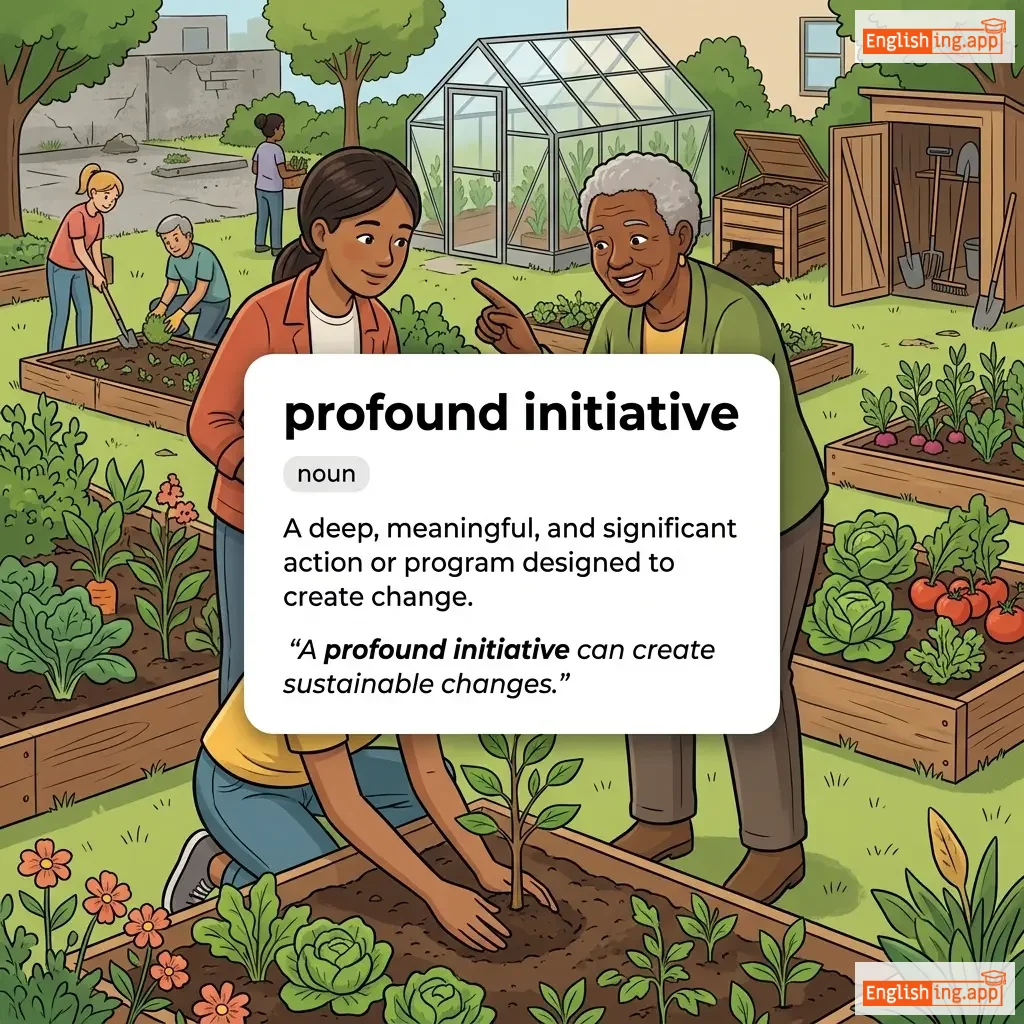
profound initiative definition card — visual illustration of the meaning
noun
prəˈfaʊnd ɪˈnɪʃətɪv
深远的倡议 (shēnyuǎn de chàngyì)

A deep, meaningful, and significant action or program designed to create change.

"A profound initiative can create sustainable changes."

"一个深刻的倡议可以创造可持续的变化。" (Yī gè shēnkè de chàngyì kěyǐ chuàngzào kěchíxù de biànhuà.)
profundity definition card — visual illustration of the meaning
noun
/prəˈfʌndɪti/
深度 (shendù)

great depth of insight, knowledge, or emotion

"The essay impressed the judges with its clarity and profundity."

"这篇文章以其清晰度和深度打动了评委。" (Zhè piān wén zhāng yǐ qí qīng xī dù hé shēn dù dǎ dòng le píng wěi.)
adjective
/prəˈfjuːs/
丰富的 (fēngfù de)

existing or given in large amounts; abundant

"He offered profuse thanks for their timely help."

"他为他们及时的帮助表示了丰富的感谢。" (Tā wèi tāmen jíshí de bāngzhù biǎoshìle fēngfù de gǎnxiè.)
noun
/prəˈfjuːʒən/
丰富 (fengfu)

an abundance or large quantity of something

"Spring brought a profusion of wildflowers to the valley."

"春天给山谷带来了大量的野花。" (Chūntiān gěi shāngǔ dàiláile dàliàng de yěhuā.)
noun
/proʊˈdʒɛnɪtər/
祖先 (zu xian)

a direct ancestor; a person or thing that originates something

"Researchers traced the custom back to a common progenitor."
"研究人员追溯了这个习俗,发现它源自一个共同的祖先。" (Yánjiū rényuán zhuīsùle zhège xísú, fāxiàn tā yuánzì yīgè gòngtóng de zǔxiān.)
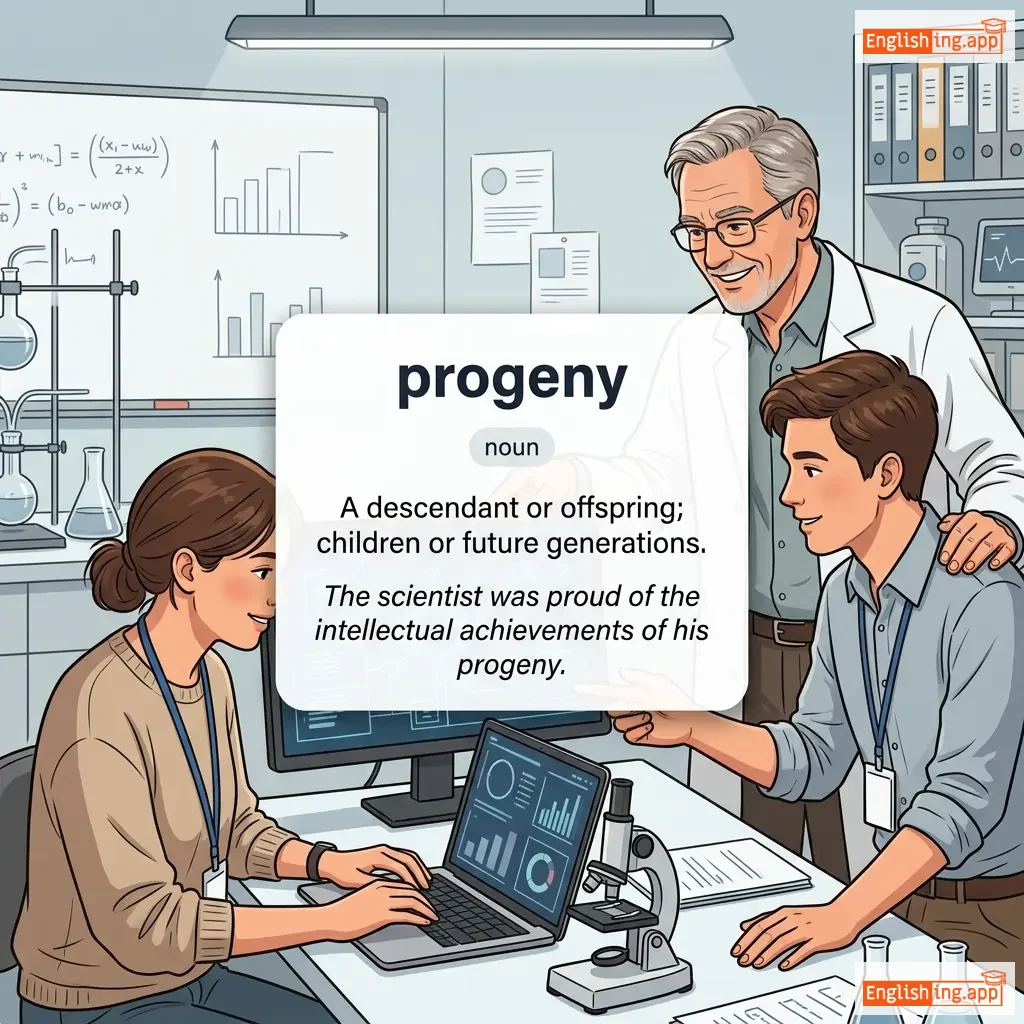
progeny definition card — visual illustration of the meaning
noun
/ˈprɒdʒəni/
后代 (hòudài)

A descendant or offspring; children or future generations.

"The scientist was proud of the intellectual achievements of his progeny."

"科学家为自己后代的智力成就感到骄傲。" (Kēxuéjiā wèi zìjǐ hòudài de zhìlì chéngjiù gǎndào jiāo'ào.)
adjective
/ˈprɒɡnəθəs/
前突颌骨 (qiántū hégǔ)

Having jaws that project forward beyond the rest of the face.

"The fossil displayed a distinctly prognathous skull structure."

"化石展示了一个明显的前突颌骨结构。" (Huàshí zhǎnshìle yīgè míngxiǎn de qiántū hégǔ jiégòu.)
noun
/prɒɡˈnoʊsɪs/
预后 (yùhòu)

A forecast of the likely outcome of a disease or situation.

"The doctor gave a positive prognosis for the patient's recovery."

"医生给出了患者康复的积极预后。" (Yīshēng gěi chūle huànzhě kāngfù de jījí yùhòu.)
verb
/prɒɡˈnɒstɪkeɪt/
预测 (yùcè)

To foretell or predict future events, especially based on current signs.

"Experts attempted to prognosticate the outcome of the election."

"专家们尝试预测选举结果。" (Zhuānjiāmen chángshì yùcè xuǎnjǔ jiéguǒ.)
noun
/prɒɡˌnɒstɪˈkeɪʃən/
预言 (yùyán)

The act of foretelling or predicting future events.

"The astrologer's prognostication fascinated the audience."

"占星师的预言吸引了观众。" (Zhānxīngshī de yùyán xīyǐnle guānzhòng.)
noun
/ˈprəʊɡræm/
程序 (chengxu)

a planned series of events or activities

"The program starts at 9 AM sharp."

"程序在上午9点准时开始。" (Chengxu zai shangwu 9 dian zhunshi kaishi.)
noun
/ˈproʊɡræmɪŋ/
编程 (biancheng)

the process of writing computer code to create software or applications

"He spends most of his time learning computer programming."

"他把大部分时间用来学习计算机编程。" (Ta ba dabufen shijian yonglai xuexi jisuanci biancheng.)
noun
/ˈprəʊɡræmɪŋ/
编程 (biancheng)

the process of designing and writing computer programs

"He has been learning programming for several months now."
"他已经学习编程好几个月了。" (Ta yijing xuexi biancheng hao ji ge yue le.)
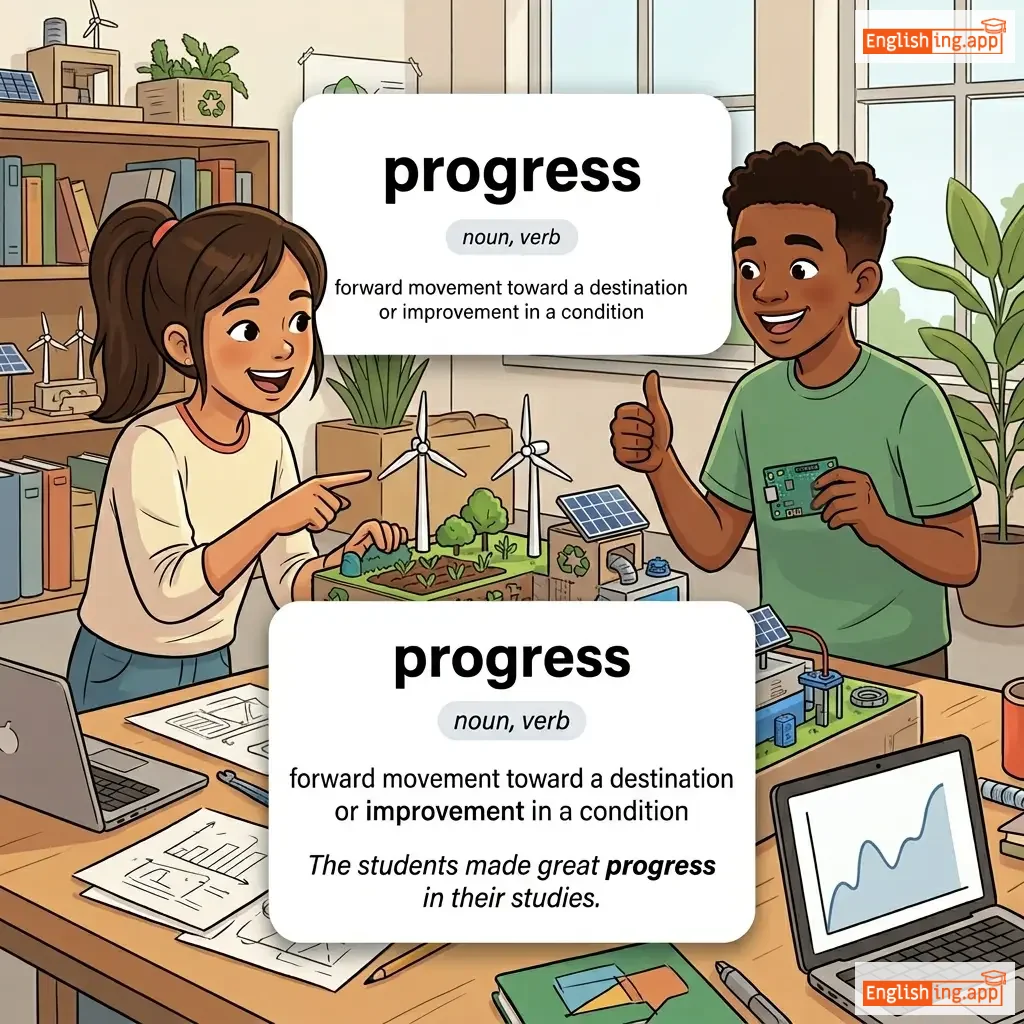
progress definition card — visual illustration of the meaning
noun, verb
/ˈprəʊɡrɛs/ (noun), /prəˈɡrɛs/ (verb)
进展 (jìnzhǎn)

forward movement toward a destination or improvement in a condition

"The students made great progress in their studies."
"学生们在学习上取得了巨大进展。" (Xuéshēngmen zài xuéxí shàng qǔdéle jùdà jìnzhǎn.)
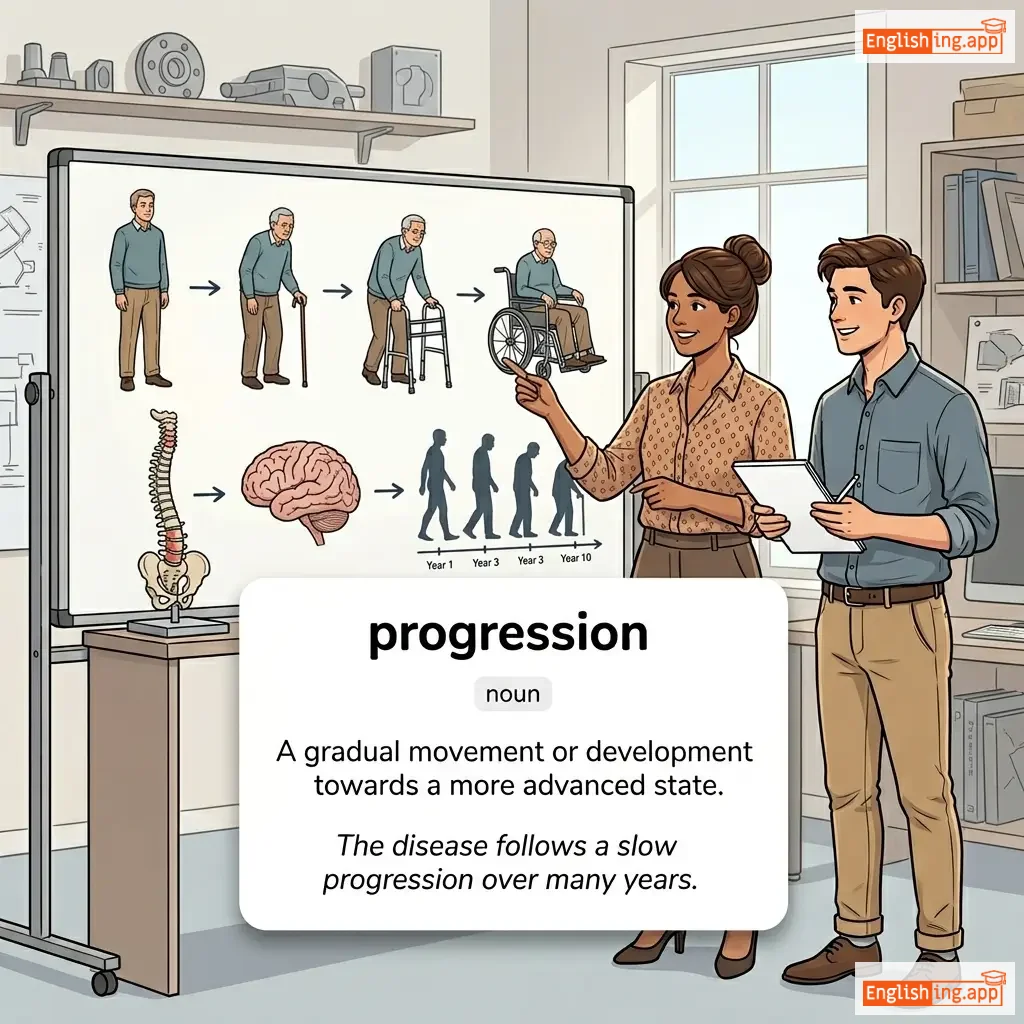
progression definition card — visual illustration of the meaning
noun
/prəˈɡrɛʃən/
进展 (jin zhan)

A gradual movement or development towards a more advanced state.

"The disease follows a slow progression over many years."

"该疾病在许多年来逐步进展。" (Gai jibing zai xuduo nianlai zhubu jin zhan.)
noun
/prəˈtɛstər/
抗议者 (kàngyì zhě)

a person who takes part in a protest or demonstration

"The protester spoke passionately about the cause."

"抗议者激情洋溢地谈论了这个原因。" (Kàngyì zhě jīqíng yángyì de tánlùnle zhège yuányīn.)
noun
/ˈprɒvɪdəns/
神的眷顾 (shén de juàngù)

the protective care of God or nature as a spiritual power; foresight or prudence

"They believed their survival was due to divine providence."

"他们相信他们的生存归功于神的眷顾。" (Tāmen xiāngxìn tāmen de shēngcún guīgōng yú shén de juàngù.)
verb
/prəˈvaɪdɪd/
提供的 (tigong de)

gave or supplied something that was needed

"The hotel provided free breakfast for all guests."

"酒店为所有客人提供了免费早餐。" (Jiudian wei suoyou ke ren tigong le miantiao zaochan.)
provide definition card — visual illustration of the meaning
verb
/prəˈvaɪd/
提供 (tigong)

to give or supply something that is needed or wanted

"The teacher will provide extra materials for the students."

"老师将为学生提供额外的材料。" (Laoshi jiang wei xuesheng tigong ewai de cailiao.)
noun
/ˈprɒvərb/
谚语 (yànyǔ)

a short, commonly known saying that expresses a truth or piece of advice

"The proverb 'A stitch in time saves nine' teaches the value of prompt action."

"谚语‘亡羊补牢’教导我们迅速采取行动的价值。" (Yànyǔ ‘wáng yáng bǔ láo’ jiàodǎo wǒmen xùncháng cǎiqǔ xíngdòng de jiàzhí.)
noun
/ˈprɒvəndər/
牲畜食物 (shēngchù shíwù)

food or provisions, especially for livestock

"The barn was filled with provender for the cattle."

"谷仓里装满了牲畜的食物。" (Gǔcāng lǐ zhuāngmǎnle shēngchù de shíwù.)
noun
/ˈprɒvənəns/
来源 (laiyuan)

The origin or source of something.

"The museum verified the provenance of the ancient manuscript."

"博物馆验证了古代手稿的出处。" (Bówùguǎn yànzhèngle gǔdài shǒugǎo de chūchù.)
prove definition card — visual illustration of the meaning
verb
/pruːv/
证明 (zhèngmíng)

to demonstrate the truth or existence of something by evidence or argument.

"The scientist was able to prove his hypothesis through experiments."

"科学家通过实验能够证明他的假设。" (Kēxuéjiā tōngguò shíyàn nénggòu zhèngmíng tā de jiǎshè.)
adverb
/ˈpraʊdli/
自豪地 (zihao de)

in a way that shows pride or satisfaction; with a sense of honor or achievement

"She proudly displayed her achievements to her family."

"她自豪地向家人展示了她的成就。" (ta zihao de xiang jiaren zhanshi le ta de chengjiu)
Proud definition card — visual illustration of the meaning
adjective
/praʊd/
骄傲 (jiaoao)

Feeling deep pleasure or satisfaction as a result of achievements or qualities.

"She felt proud of her son's accomplishments."

"她为儿子的成就感到骄傲。" (Tā wèi érzi de chéngjiù gǎndào jiāoào.)
verb
/ˈproʊtjuːbəreɪt/
膨胀 (péngzhàng)

To swell out or bulge.

"The roots began to protuberate from the ground."

"根开始从土壤中膨胀出来。" (Gēn kāishǐ cóng tǔrǎng zhōng péngzhàng chūlái.)
adjective
/prəˈtuːbərənt/
突出或膨胀 (tūchū huò péngzhàng)

Sticking out or bulging.

"His protuberant belly showed after the meal."

"饭后他凸出的肚子显现出来。" (Fàn hòu tā tūchū de dùzi xiǎnxiàn chūlái.)
noun
/prəˈtuːbərəns/
肿块 (zhǒng kuài)

A rounded swelling or lump on a surface.

"The doctor examined the small protuberance on his arm."

"医生检查了他手臂上的小肿块。" (Yīshēng jiǎnchá le tā shǒubì shàng de xiǎo zhǒng kuài.)
noun
/prəˈtruːʒən/
突出部分 (tūchū bùfen)

Something that sticks out or projects from a surface.

"The protrusion on the wall made it difficult to move the furniture."

"墙上的突出部分使得移动家具变得困难。" (Qiáng shàng de túchū bùfen shǐdé yídòng jiājù biàn dé kùnnán.)
verb
/proʊˈtruːd/
突出 (tuchu)

To stick out or extend beyond a surface.

"A nail was protruding from the wooden board."

"一根钉子从木板中突出出来。" (Yi gen dingzi cong muban zhong tuchu chulai.)
protracted definition card — visual illustration of the meaning
adjective
/prəˈtræktɪd/
拖延的 (tuōyán de)

Lasting for a long time or longer than expected.

"The negotiation turned into a protracted process."

"谈判变成了一个拖延的过程。" (Tánpàn biàn chéngle yīgè tuōyán de guòchéng.)
verb
/proʊˈtrækt/
延长 (yáncháng)

To prolong or extend in time or duration.

"Negotiations were protracted for several months."

"谈判持续了几个月。" (Tánpàn chíxùle jǐ gè yuè.)
noun
/ˈproʊtəˌtaɪp/
原型 (yuánxíng)

The first model or version of something, used as a sample for testing or improvement.

"The company built a prototype of the new smartphone before mass production."

"公司在大规模生产之前构建了新智能手机的原型。" (Gōngsī zài dà guīmó shēngchǎn zhīqián gòujiànle xīn zhìnéng shǒujī de yuánxíng.)
noun
/ˈproʊtoʊˌplæzəm/
原生质 (yuán shēng zhí)

The living substance inside a cell, including the cytoplasm and nucleus.

"Scientists observed the movement of protoplasm under the microscope."

"科学家在显微镜下观察了原生质的运动。" (Kēxuéjiā zài xiǎnwēijìng xià guānchá le yuán shēng zhí de yùndòng.)
noun
/ˈproʊtoʊˌmɑːrtɚ/
第一位殉道者 (dì yī wèi xùn dào zhě)

The first martyr in a cause or religion, often referring to the first Christian martyr.

"St. Stephen is known as the protomartyr of Christianity."

"圣斯蒂芬被称为基督教的原始殉道者。" (Sheng Siti fen bei cheng wei Jidujiao de yuanshi xundaozhe.)
noun
/ˈproʊtəkɔːl/
协议 (xieyi)

an official procedure or system of rules

"The security team followed strict protocol during the event."

"安全团队在活动期间遵循了严格的协议。" (Anquan tuandui zai huodong qijian zunxunle yange de xieyi.)
adjective
/ˈprɒspərəs/

successful in material terms; flourishing financially or in general well-being

"The town became prosperous after the new trade route opened."

protect definition card — visual illustration of the meaning
verb
/prəˈtɛkt/
保护 (baohu)

to keep safe from harm or danger

"It is important to protect your personal information online."

"保护个人信息在网上非常重要。" (Baohu geren xinxi zai wangshang feichang zhongyao.)
adjective
/ˈproʊtiən/
多变的 (duobian de)

tending or able to change frequently or easily; versatile

"She is a protean artist who experiments with many styles."

"她是一位多变的艺术家,尝试许多不同的风格。" (Ta shi yi wei duobian de yishujia, changshi xu duo butong de fengge.)
protagonist definition card — visual illustration of the meaning
noun
/prəˈtæɡənɪst/
主角 (zhǔjiǎo)

the main character or leading figure in a story, drama, or other work

"The protagonist of the novel struggles with her inner conflicts."

"小说的主角正在与她的内心冲突斗争。" (xiǎoshuō de zhǔjiǎo zhèngzài yǔ tā de nèixīn chōngtú dòuzhēng.)
adjective/verb
/ˈprɒstreɪt/
俯卧 (fǔwò)

lying stretched out on the ground with one's face downward, often as a sign of submission or exhaustion

"He lay prostrate on the ground after the long battle."

"他在长时间的战斗后趴倒在地。" (Tā zài cháng shíjiān de zhàndòu hòu pā dǎo zài dì.)
verb
/ˈprɒspər/
繁荣 (fánróng)

to succeed or flourish, especially in financial or business matters

"With hard work and determination, she managed to prosper in her career."

"凭借努力工作和决心,她在事业中取得了成功。" (Píngjiè nǔlì gōngzuò hé juéxīn, tā zài shìyè zhōng qǔdéle chénggōng.)
prospects definition card — visual illustration of the meaning
noun
/ˈprɒs.pekts/
前景 (qianjing)

The possibility or likelihood of some future event occurring.

"The prospects for growth look promising."

"增长的前景看起来很有前途。" (Zengzhang de qianjing kan qilai hen you qiantu.)