Vocabulaires

Découvrez, apprenez et maîtrisez le vocabulaire anglais

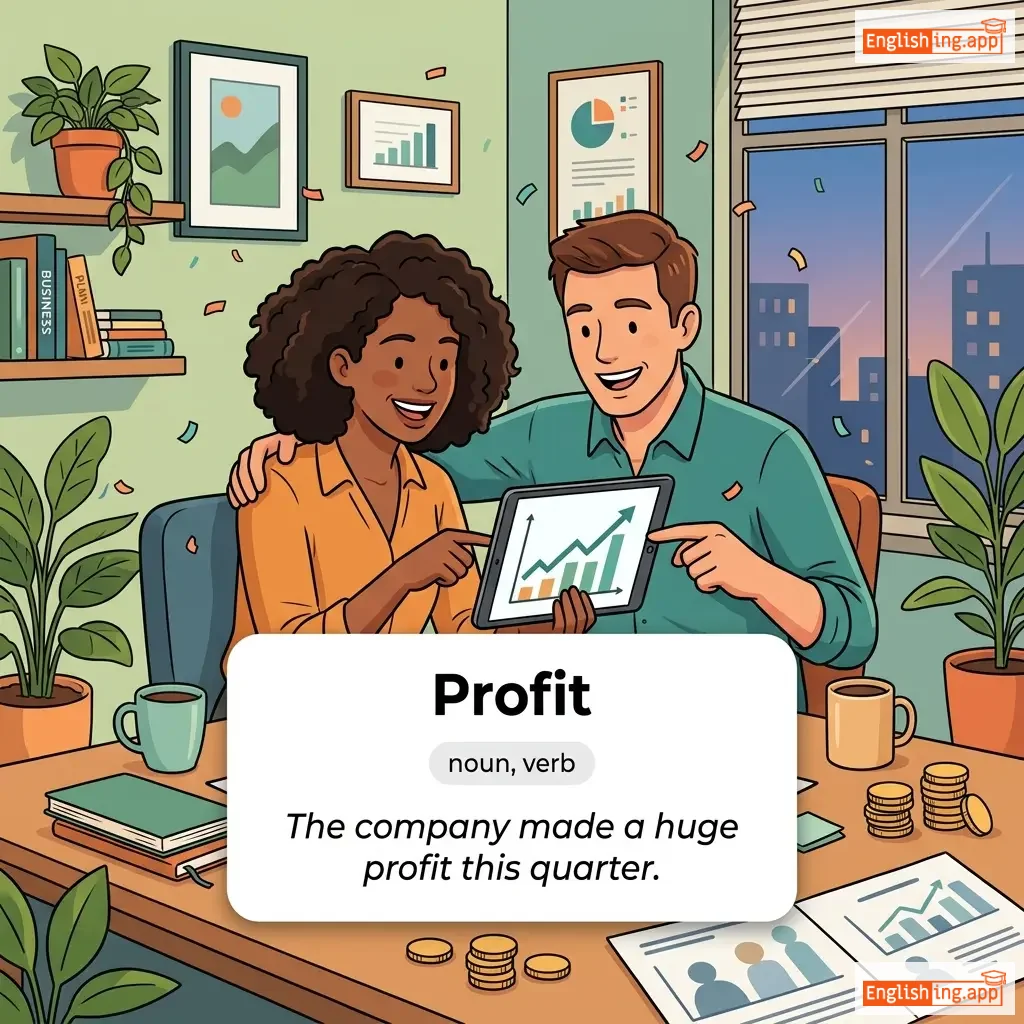
Profit definition card — visual illustration of the meaning
noun, verb
/ˈprɒfɪt/
bénéfice (bénéfice)

financial gain, especially the difference between the amount earned and the amount spent

"The company made a huge profit this quarter."

"L'entreprise a réalisé un énorme bénéfice ce trimestre." (L'entreprise a réalisé un énorme bénéfice ce trimestre.)
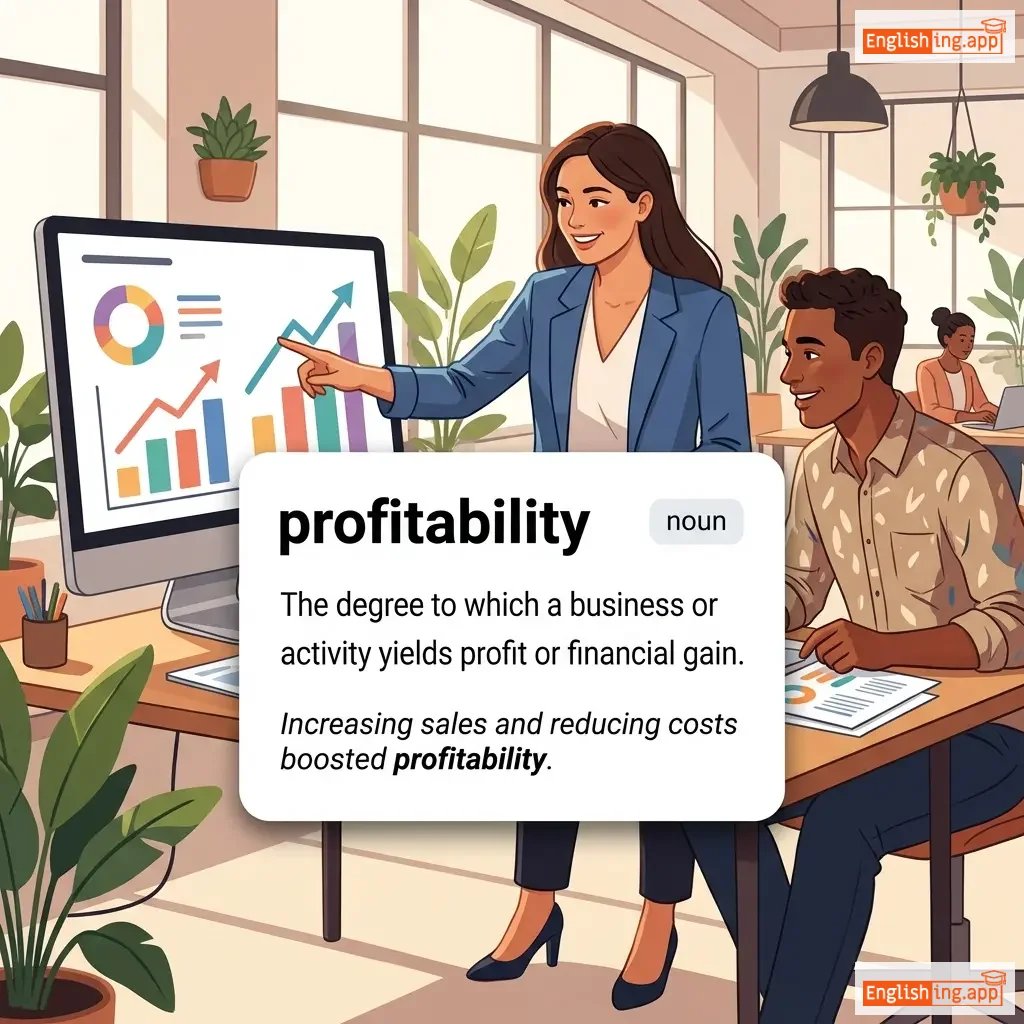
profitability definition card — visual illustration of the meaning
noun
ˌprɒf.ɪ.təˈbɪl.ə.ti
rentabilité, degré de profit financier (rentabilité, degré de profit financier)

The degree to which a business or activity yields profit or financial gain.

"Increased efficiency enhances business profitability."

"L'efficacité accrue améliore la rentabilité de l'entreprise." (L'efficacité accrue améliore la rentabilité de l'entreprise.)
adjective
/ˈprɒfɪtəbl/
rentable (rentable)

yielding profit or financial gain

"The company has become highly profitable after the new strategy was implemented."

"L'entreprise est devenue très rentable après la mise en place de la nouvelle stratégie." (L'entreprise est devenue très rentable après la mise en place de la nouvelle stratégie.)
noun
/ˌprɑːfɪˈtɪr/
profiteur (profiteur)

a person who makes excessive profits, especially unfairly or illegally

"The government punished war profiteers."

"Le gouvernement a puni les profiteurs de guerre." (Le gouvernement a puni les profiteurs de guerre.)
noun
/ˈprɑːflɪɡəsi/
dépense excessive (depense excessive)

reckless wastefulness or extravagance

"His profligacy with money led him to bankruptcy."

"Sa dépense excessive l'a conduit à la faillite." (Sa depense excessive l'a conduit a la faillite.)
adjective
/ˈprɑːflɪɡət/
dissipateur (dissipateur)

recklessly extravagant or wasteful in resources

"The king was known for his profligate lifestyle."

"Le roi était connu pour son style de vie dissipateur." (Le roi etait connu pour son style de vie dissipateur.)
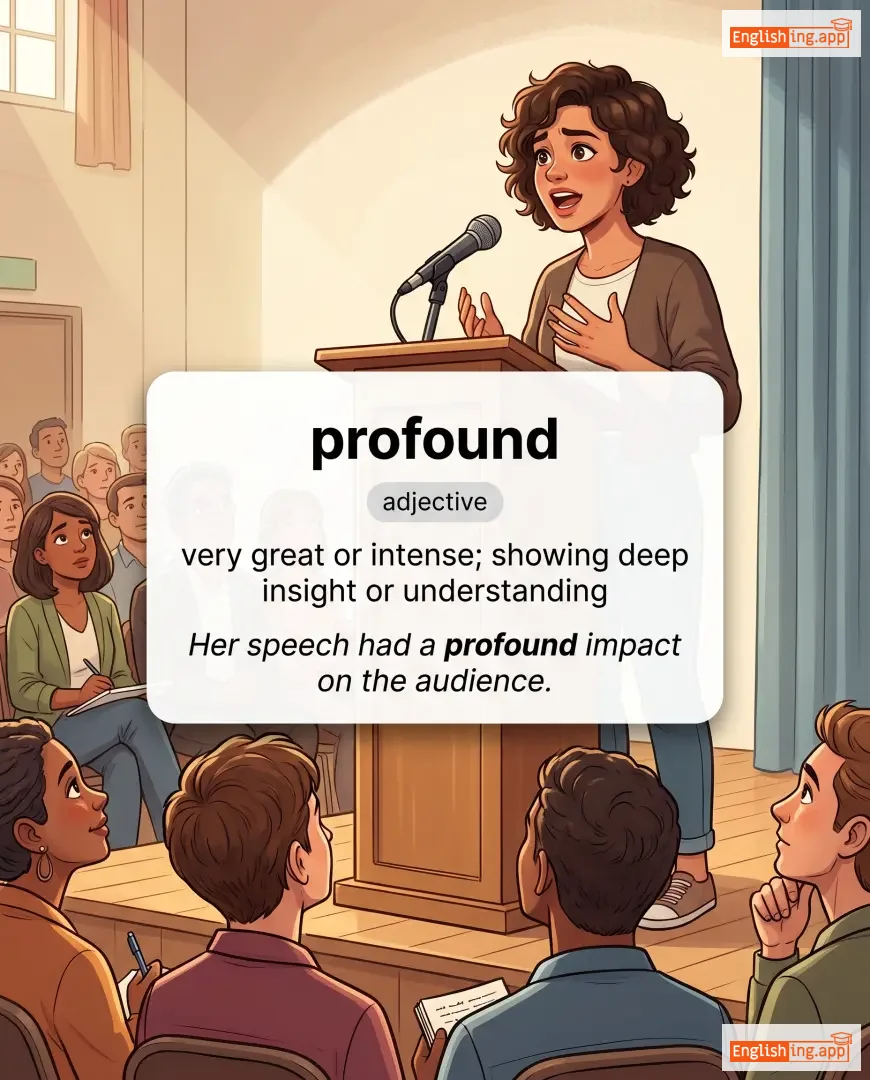
profound definition card — visual illustration of the meaning
adjective
/prəˈfaʊnd/
profond (profond)

very great or intense; showing deep insight or understanding

"Her speech had a profound impact on the audience."

"Son discours a eu un impact profond sur le public." (Son discours a eu un impact profond sur le public.)
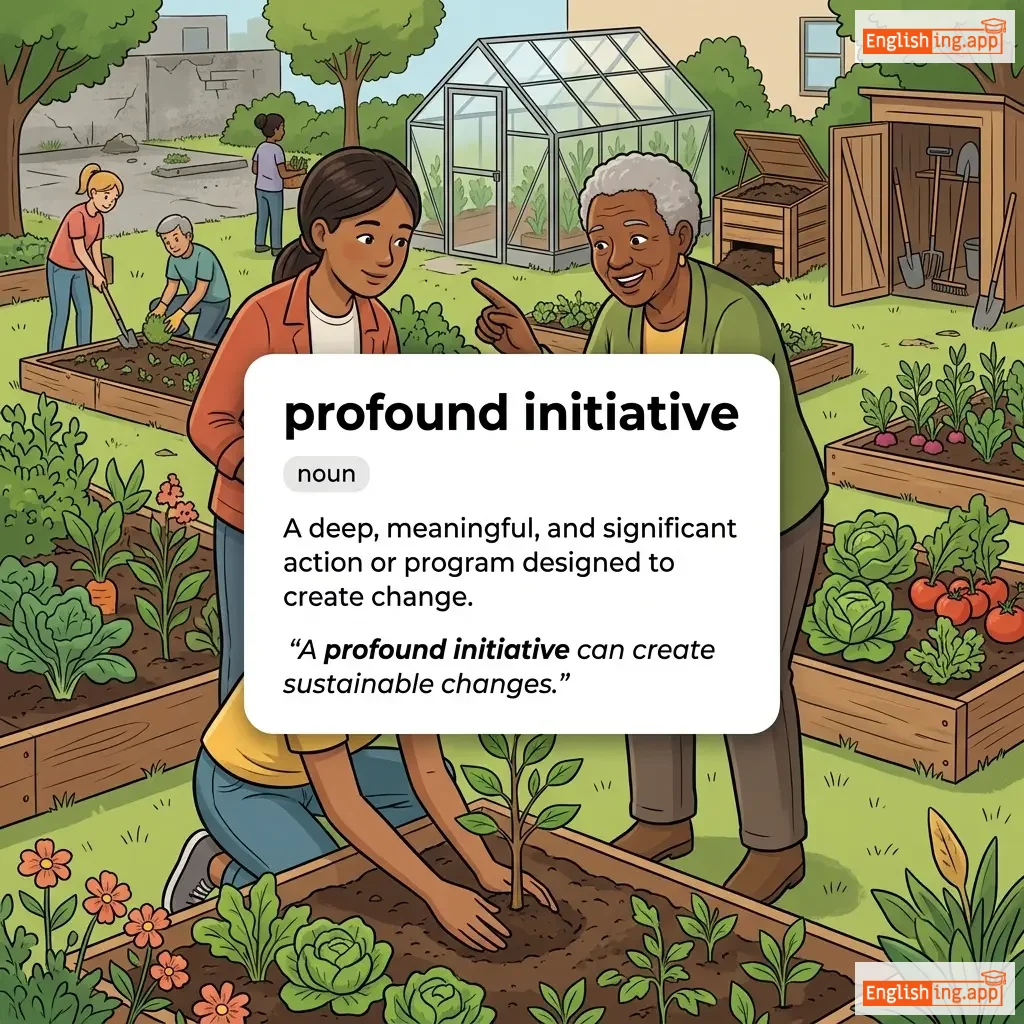
profound initiative definition card — visual illustration of the meaning
noun
prəˈfaʊnd ɪˈnɪʃətɪv
initiative profonde (initiative profonde)

A deep, meaningful, and significant action or program designed to create change.

"A profound initiative can create sustainable changes."

"Une initiative profonde peut créer des changements durables." (Une initiative profonde peut créer des changements durables.)
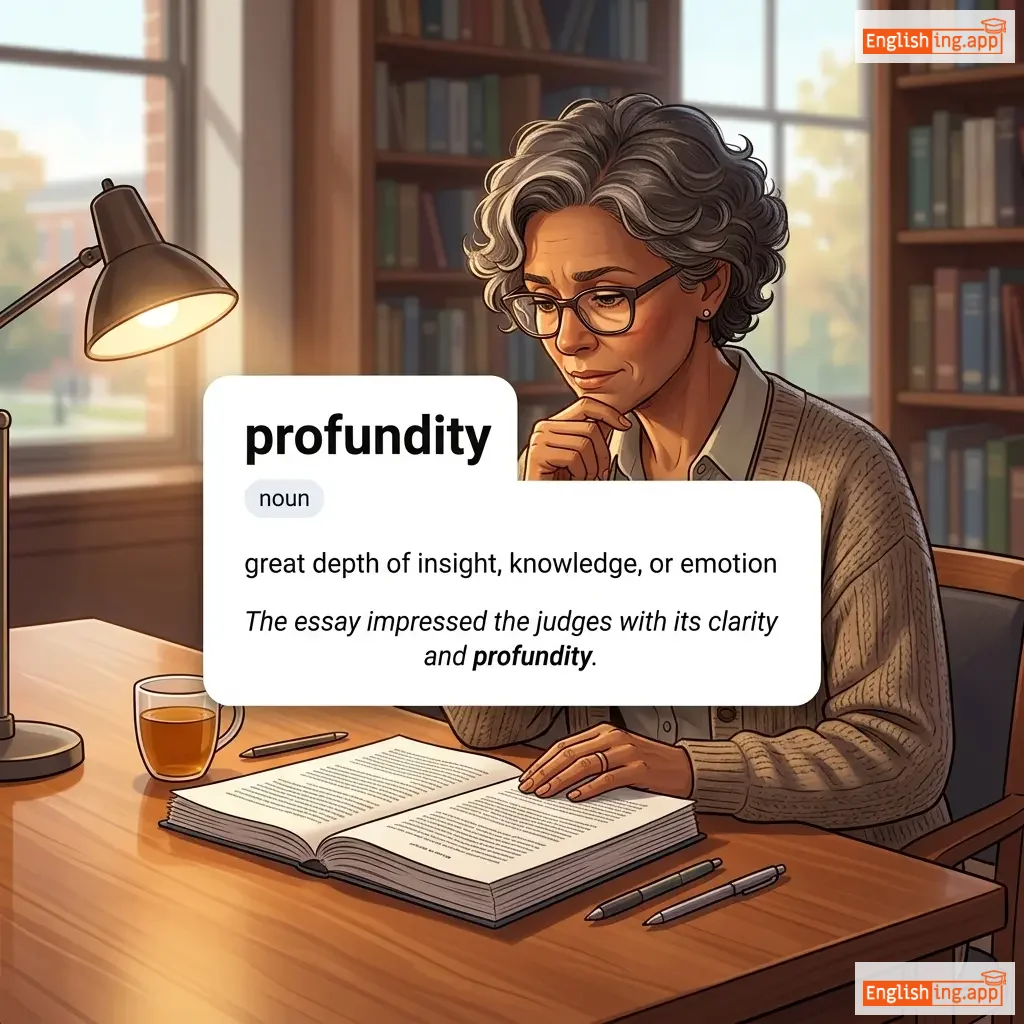
profundity definition card — visual illustration of the meaning
noun
/prəˈfʌndɪti/
profondeur (profondeur)

great depth of insight, knowledge, or emotion

"The essay impressed the judges with its clarity and profundity."

"L'essai a impressionné les juges par sa clarté et sa profondeur." (L'essai a impressionne les juges par sa clarte et sa profondeur.)
adjective
/prəˈfjuːs/
profus (profus)

existing or given in large amounts; abundant

"He offered profuse thanks for their timely help."

"Il a offert de profonds remerciements pour leur aide opportune." (Il a offert de profonds remerciements pour leur aide opportune.)
noun
/prəˈfjuːʒən/
profusion (profusion)

an abundance or large quantity of something

"Spring brought a profusion of wildflowers to the valley."

"Le printemps a apporté une profusion de fleurs sauvages dans la vallée." (Le printemps a apporté une profusion de fleurs sauvages dans la vallée.)
noun
/proʊˈdʒɛnɪtər/
ancêtre (ancetre)

a direct ancestor; a person or thing that originates something

"Researchers traced the custom back to a common progenitor."

"Les chercheurs ont retracé la coutume jusqu'à un ancêtre commun." (Les chercheurs ont retrace la coutume jusqu'a un ancetre commun.)
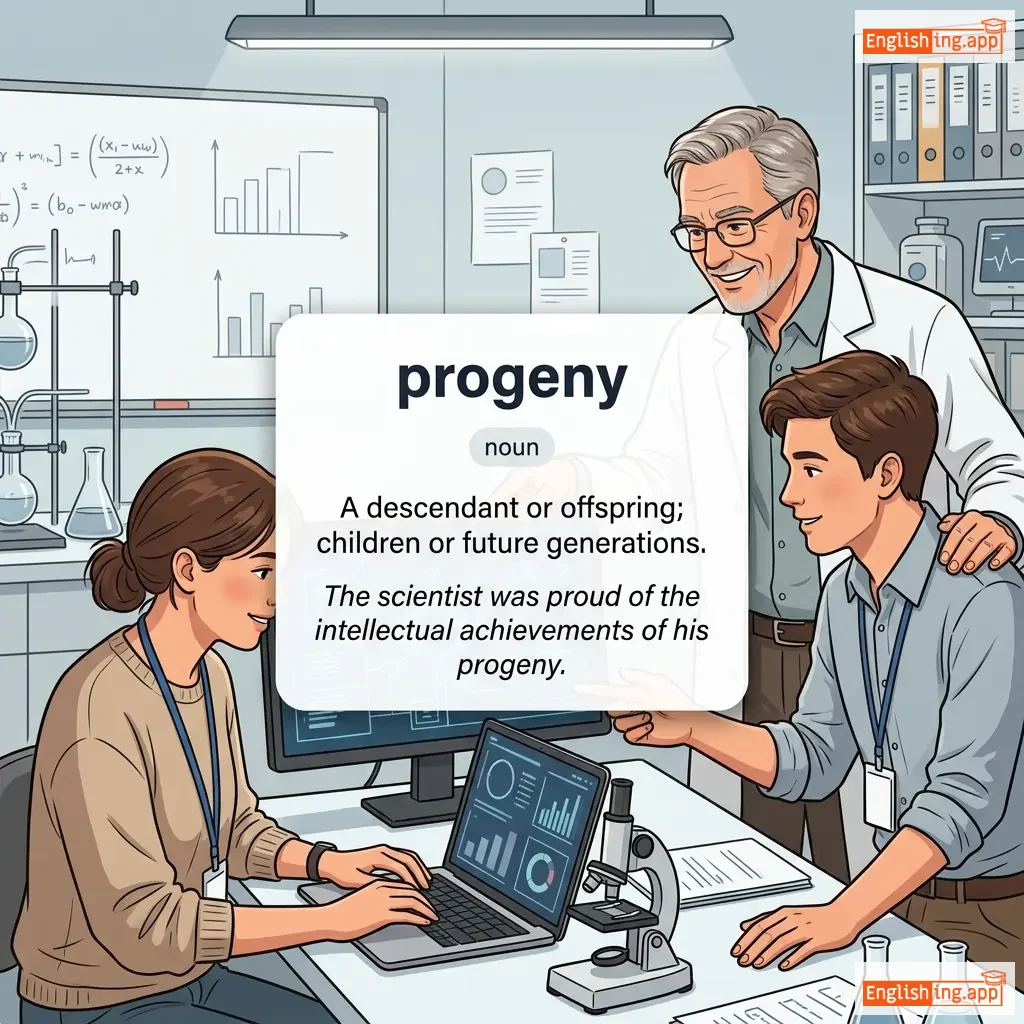
progeny definition card — visual illustration of the meaning
noun
/ˈprɒdʒəni/
progéniture (progeniture)

A descendant or offspring; children or future generations.

"The scientist was proud of the intellectual achievements of his progeny."

"Le scientifique était fier des réalisations intellectuelles de sa progéniture." (Le scientifique etait fier des realisations intellectuelles de sa progeniture.)
adjective
/ˈprɒɡnəθəs/
prognathe (prognathe)

Having jaws that project forward beyond the rest of the face.

"The fossil displayed a distinctly prognathous skull structure."

"Le fossile affichait une structure de crâne distinctement prognathe." (Le fossile affichait une structure de crane distinctement prognathe.)
noun
/prɒɡˈnoʊsɪs/
pronostic (pronostic)

A forecast of the likely outcome of a disease or situation.

"The doctor gave a positive prognosis for the patient's recovery."

"Le médecin a donné un pronostic positif pour la récupération du patient." (Le medecin a donne un pronostic positif pour la recuperation du patient.)
verb
/prɒɡˈnɒstɪkeɪt/
prédire (predire)

To foretell or predict future events, especially based on current signs.

"Experts attempted to prognosticate the outcome of the election."

"Les experts ont tenté de pronostiquer le résultat de l'élection." (Les experts ont tente de pronostiquer le resultat de l'election.)
noun
/prɒɡˌnɒstɪˈkeɪʃən/
prédiction (prediction)

The act of foretelling or predicting future events.

"The astrologer's prognostication fascinated the audience."

"La prédiction de l'astrologue a fasciné l'audience." (La prediction de l'astrologue a fascine l'audience.)
noun
/ˈprəʊɡræm/
programme (programme)

a planned series of events or activities

"The program starts at 9 AM sharp."

"Le programme commence à 9h précises." (Le programme commence à 9h précises.)
noun
/ˈproʊɡræmɪŋ/
programmation (programmation)

the process of writing computer code to create software or applications

"He spends most of his time learning computer programming."

"Il passe la plupart de son temps à apprendre la programmation informatique." (Il passe la plupart de son temps a apprendre la programmation informatique.)
noun
/ˈprəʊɡræmɪŋ/
programmation (programmation)

the process of designing and writing computer programs

"He has been learning programming for several months now."

"Il apprend la programmation depuis plusieurs mois maintenant." (Il apprend la programmation depuis plusieurs mois maintenant.)
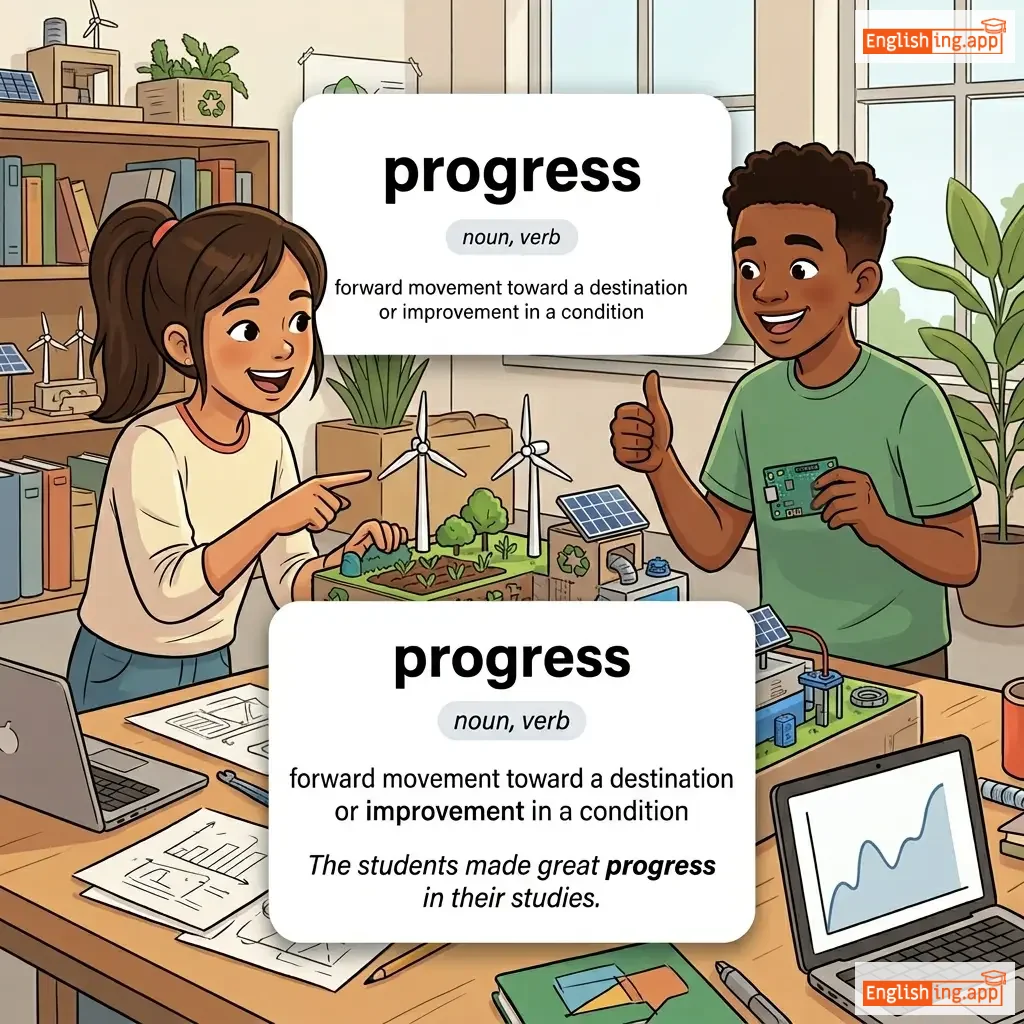
progress definition card — visual illustration of the meaning
noun, verb
/ˈprəʊɡrɛs/ (noun), /prəˈɡrɛs/ (verb)
progrès (progres)

forward movement toward a destination or improvement in a condition

"The students made great progress in their studies."

"Les étudiants ont fait de grands progrès dans leurs études." (Les étudiants ont fait de grands progrès dans leurs études.)
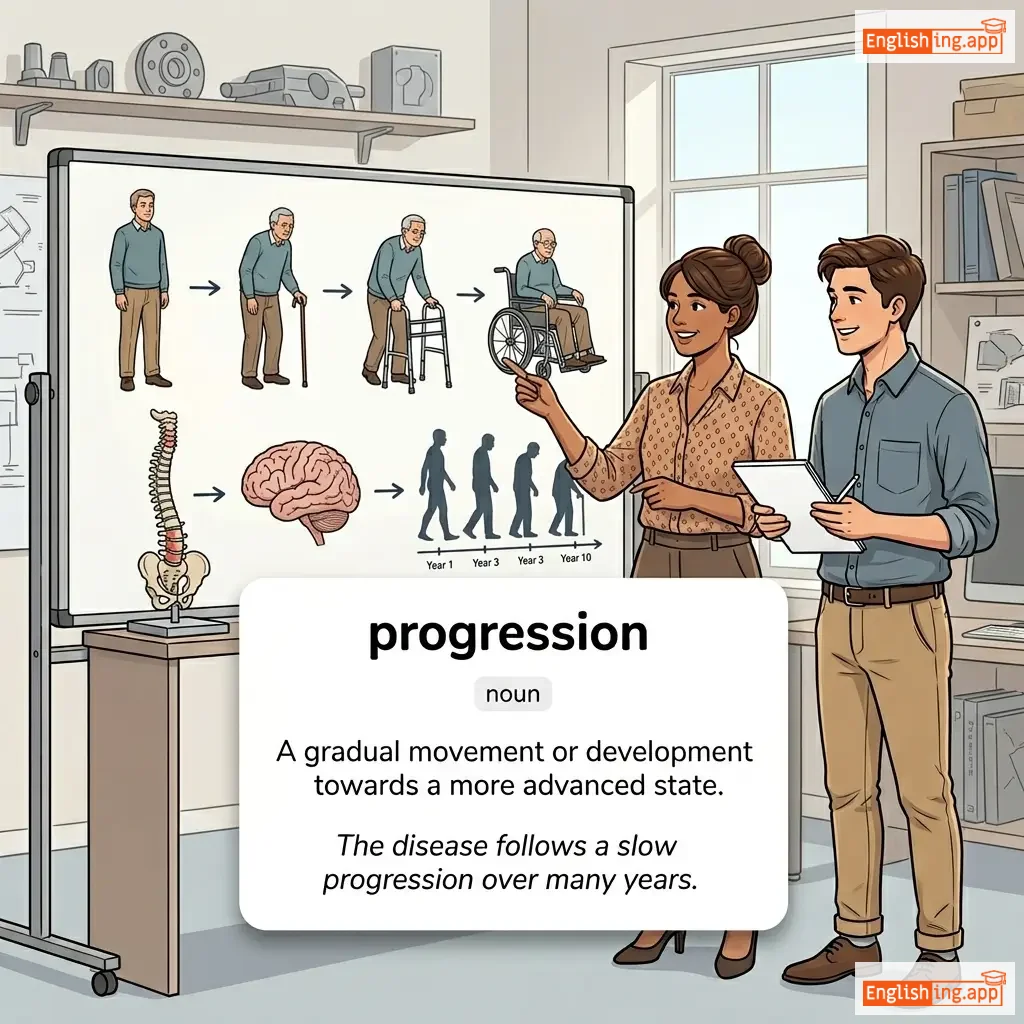
progression definition card — visual illustration of the meaning
noun
/prəˈɡrɛʃən/
progression (progression)

A gradual movement or development towards a more advanced state.

"The disease follows a slow progression over many years."

"La maladie suit une progression lente pendant plusieurs années." (La maladie suit une progression lente pendant plusieurs années.)
noun
/prəˈtɛstər/
manifestant (manifestant)

a person who takes part in a protest or demonstration

"The protester spoke passionately about the cause."

"Le manifestant a parlé avec passion de la cause." (Le manifestant a parlé avec passion de la cause.)
noun
/ˈprɒvɪdəns/
providence divine (providence divine)

the protective care of God or nature as a spiritual power; foresight or prudence

"They believed their survival was due to divine providence."

"Ils croyaient que leur survie était due à la providence divine." (Ils croyaient que leur survie etait due a la providence divine.)
verb
/prəˈvaɪdɪd/
fourni (fourni)

gave or supplied something that was needed

"The hotel provided free breakfast for all guests."

"L'hôtel a fourni un petit-déjeuner gratuit pour tous les invités." (L'hôtel a fourni un petit-déjeuner gratuit pour tous les invités.)
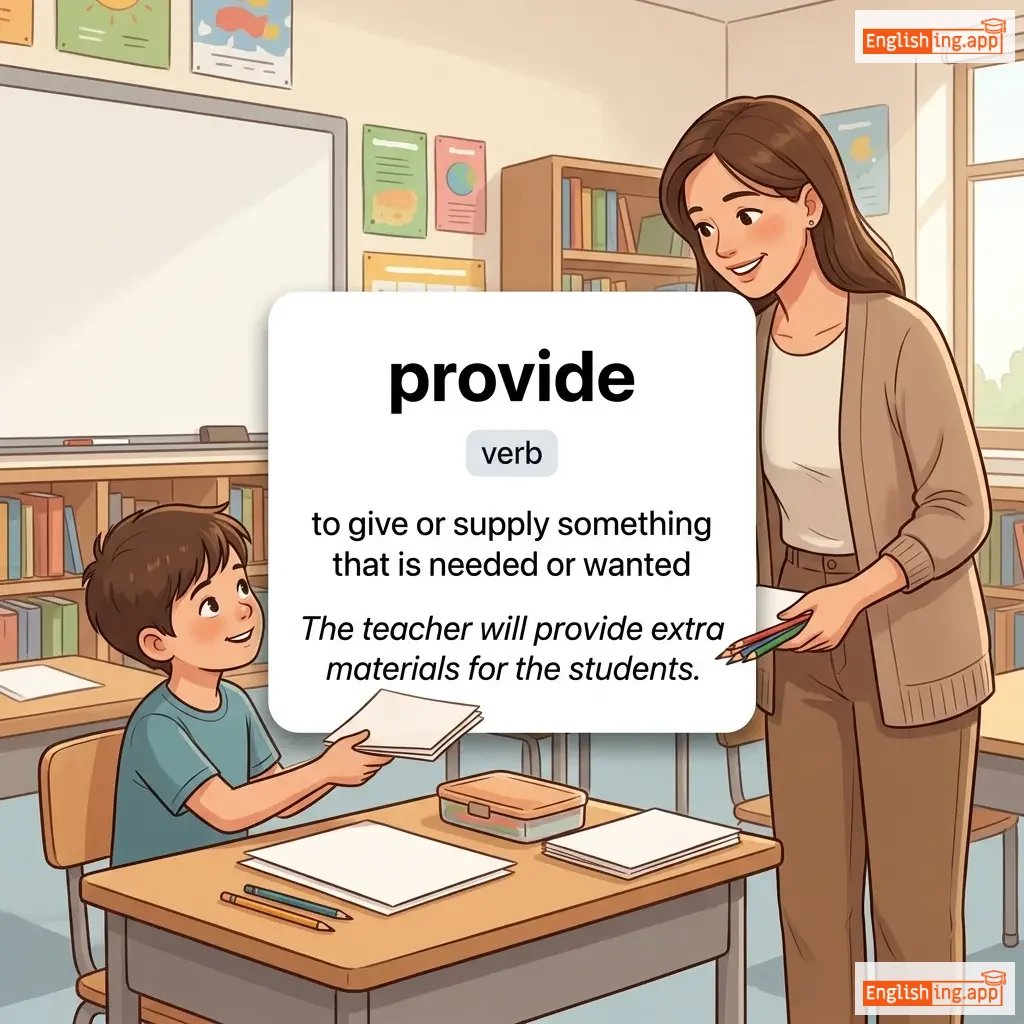
provide definition card — visual illustration of the meaning
verb
/prəˈvaɪd/
fournir (fournir)

to give or supply something that is needed or wanted

"The teacher will provide extra materials for the students."

"Le professeur fournira des matériaux supplémentaires pour les étudiants." (Le professeur fournira des matériaux supplémentaires pour les étudiants.)
noun
/ˈprɒvərb/
proverbe (proverbe)

a short, commonly known saying that expresses a truth or piece of advice

"The proverb 'A stitch in time saves nine' teaches the value of prompt action."

"Le proverbe 'Un sou est un sou' enseigne l'importance d'agir rapidement." (Le proverbe 'Un sou est un sou' enseigne l'importance d'agir rapidement.)
noun
/ˈprɒvəndər/
fourrage pour le bétail (fourrage pour le betail)

food or provisions, especially for livestock

"The barn was filled with provender for the cattle."

"La grange était remplie de fourrage pour le bétail." (La grange était remplie de fourrage pour le bétail.)
noun
/ˈprɒvənəns/
provenance (provenance)

The origin or source of something.

"The museum verified the provenance of the ancient manuscript."

"Le musée a vérifié l'origine du manuscrit ancien." (Le musée a vérifié l'origine du manuscrit ancien.)
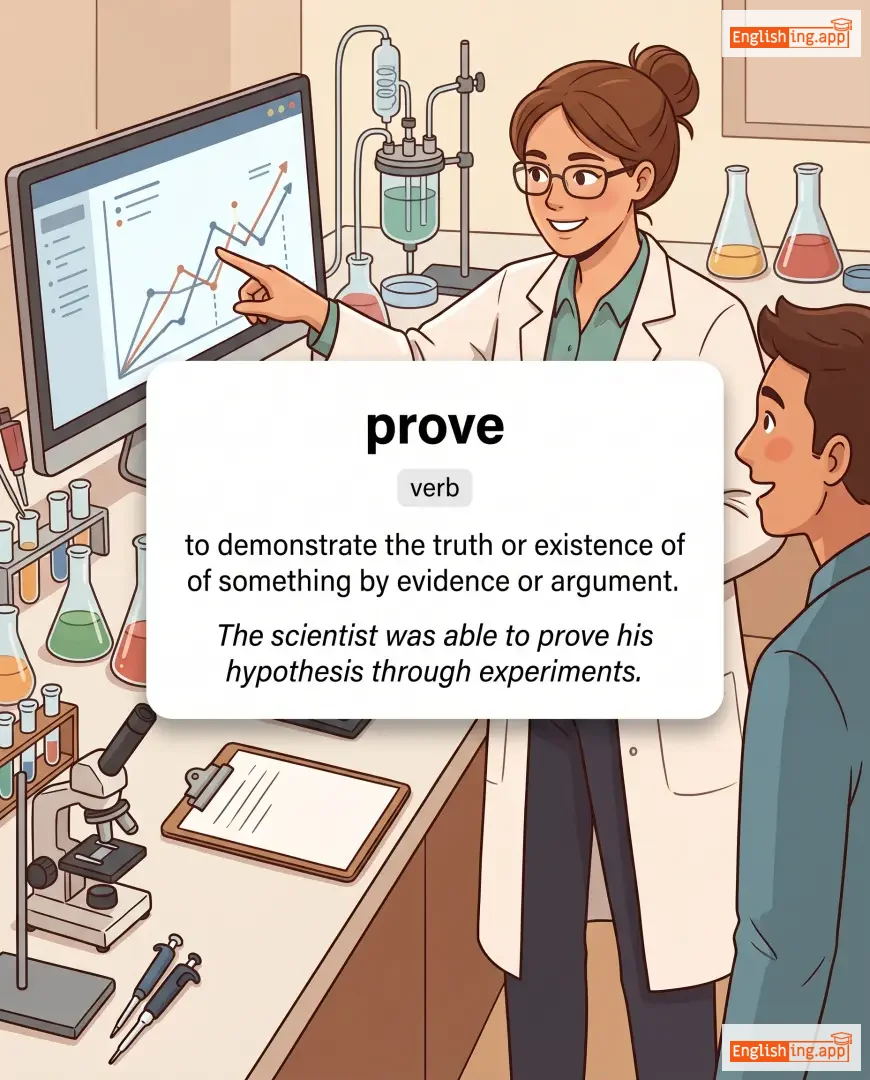
prove definition card — visual illustration of the meaning
verb
/pruːv/
prouver (prouver)

to demonstrate the truth or existence of something by evidence or argument.

"The scientist was able to prove his hypothesis through experiments."

"Le scientifique a pu prouver son hypothèse grâce aux expériences." (Le scientifique a pu prouver son hypothese grace aux experiences.)
adverb
/ˈpraʊdli/
fièrement (fierement)

in a way that shows pride or satisfaction; with a sense of honor or achievement

"She proudly displayed her achievements to her family."

"Elle a fièrement montré ses réussites à sa famille." (elle a fierement montre ses reussites a sa famille)
Proud definition card — visual illustration of the meaning
adjective
/praʊd/
fier (fier)

Feeling deep pleasure or satisfaction as a result of achievements or qualities.

"She felt proud of her son's accomplishments."

"Elle se sentait fière des réalisations de son fils." (Elle se sentait fiere des realisations de son fils.)
verb
/ˈproʊtjuːbəreɪt/
gonfler (gonfler)

To swell out or bulge.

"The roots began to protuberate from the ground."

"Les racines ont commencé à gonfler du sol." (Les racines ont commencé à gonfler du sol.)
adjective
/prəˈtuːbərənt/
proéminent (proeminant)

Sticking out or bulging.

"His protuberant belly showed after the meal."

"Son ventre proéminent est apparu après le repas." (Son ventre proéminent est apparu apres le repas.)
noun
/prəˈtuːbərəns/
protubérance (protuberance)

A rounded swelling or lump on a surface.

"The doctor examined the small protuberance on his arm."

"Le médecin a examiné la petite protubérance sur son bras." (Le médecin a examiné la petite protubérance sur son bras.)
noun
/prəˈtruːʒən/
saillie (saillie)

Something that sticks out or projects from a surface.

"The protrusion on the wall made it difficult to move the furniture."

"La saillie sur le mur a rendu difficile de déplacer les meubles." (La saillie sur le mur a rendu difficile de déplacer les meubles.)
verb
/proʊˈtruːd/
dépasser (depasser)

To stick out or extend beyond a surface.

"A nail was protruding from the wooden board."

"Un clou dépassait du panneau de bois." (Un clou depassait du panneau de bois.)
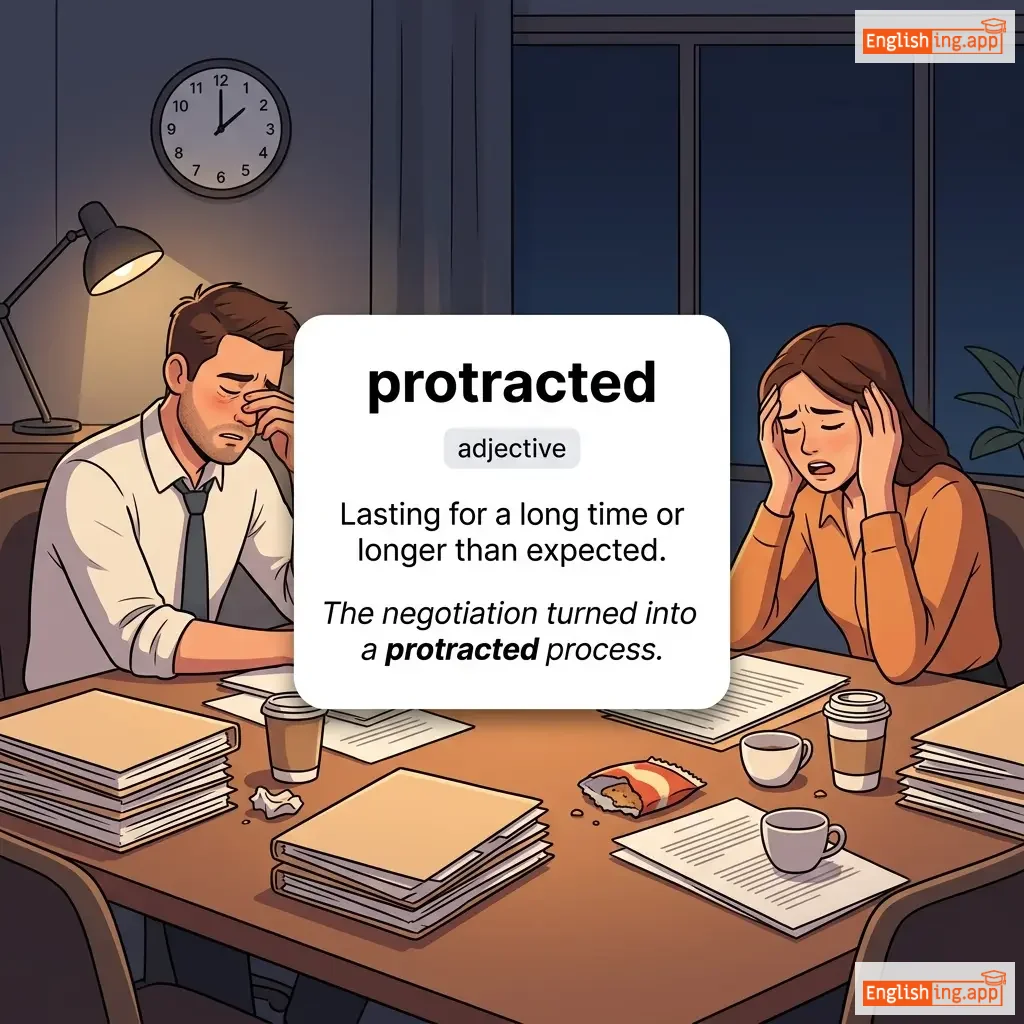
protracted definition card — visual illustration of the meaning
adjective
/prəˈtræktɪd/
prolongé (prolonge)

Lasting for a long time or longer than expected.

"The negotiation turned into a protracted process."

"La négociation s'est transformée en un processus prolongé." (La negociation s'est transformee en un processus prolonge.)
verb
/proʊˈtrækt/
prolonger (prolonger)

To prolong or extend in time or duration.

"Negotiations were protracted for several months."

"Les négociations ont été prolongées pendant plusieurs mois." (Les négociations ont été prolongées pendant plusieurs mois.)
noun
/ˈproʊtəˌtaɪp/
prototype (prototype)

The first model or version of something, used as a sample for testing or improvement.

"The company built a prototype of the new smartphone before mass production."

"L'entreprise a construit un prototype du nouveau smartphone avant la production en série." (L'entreprise a construit un prototype du nouveau smartphone avant la production en serie.)
noun
/ˈproʊtoʊˌplæzəm/
protoplasme (protoplasme)

The living substance inside a cell, including the cytoplasm and nucleus.

"Scientists observed the movement of protoplasm under the microscope."

"Les scientifiques ont observé le mouvement du protoplasme sous le microscope." (Les scientifiques ont observé le mouvement du protoplasme sous le microscope.)
noun
/ˈproʊtoʊˌmɑːrtɚ/
premier martyr (premier martyr)

The first martyr in a cause or religion, often referring to the first Christian martyr.

"St. Stephen is known as the protomartyr of Christianity."

"Saint Étienne est connu comme le protomartyr du christianisme." (Saint Etienne est connu comme le protomartyr du christianisme.)
noun
/ˈproʊtəkɔːl/
protocole (protocole)

an official procedure or system of rules

"The security team followed strict protocol during the event."

"L'équipe de sécurité a suivi un protocole strict lors de l'événement." (L'equipe de securite a suivi un protocole strict lors de l'evenement.)
adjective
/ˈprɒspərəs/
prospère (prosper)

successful in material terms; flourishing financially or in general well-being

"The town became prosperous after the new trade route opened."

"La ville est devenue prospère après l'ouverture de la nouvelle route commerciale." (La ville est devenue prospère après l'ouverture de la nouvelle route commerciale.)
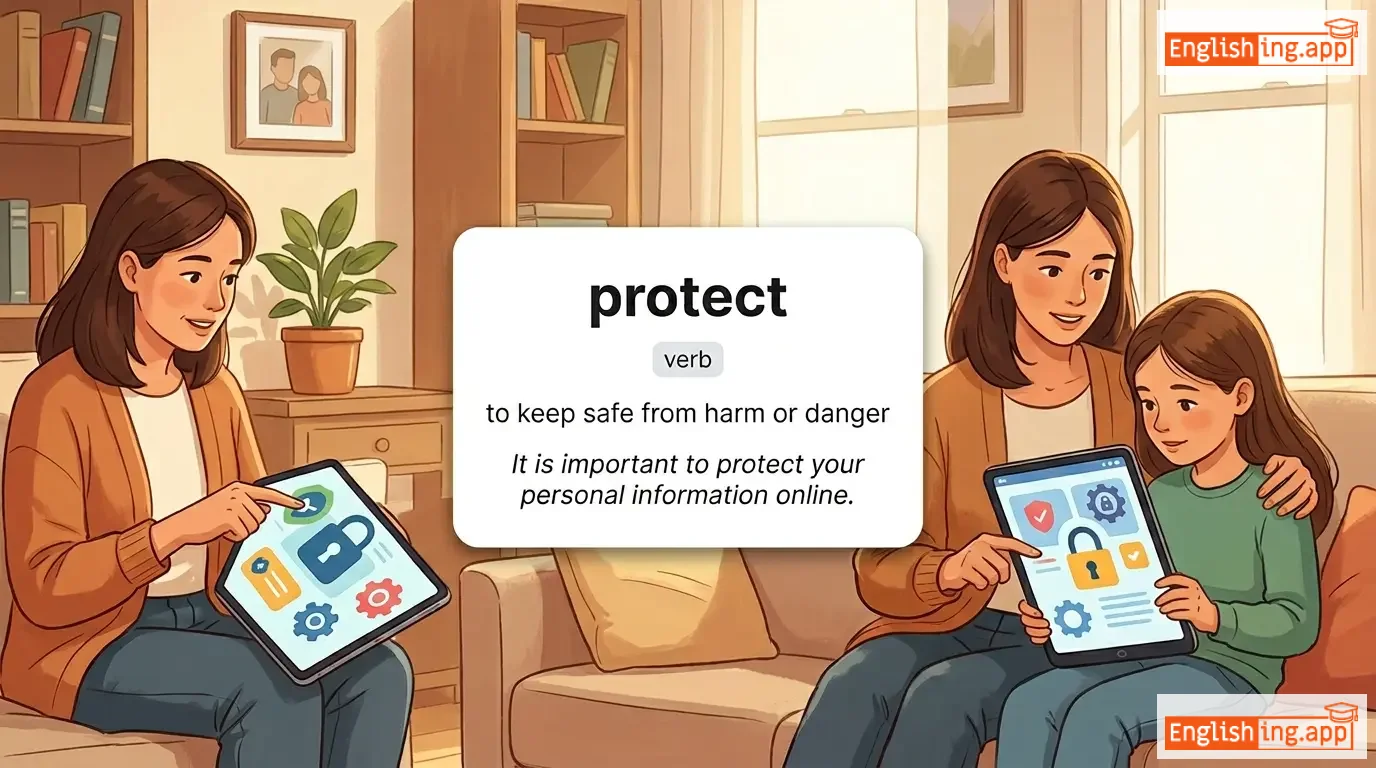
protect definition card — visual illustration of the meaning
verb
/prəˈtɛkt/
protéger (proteger)

to keep safe from harm or danger

"It is important to protect your personal information online."

"Il est important de protéger vos informations personnelles en ligne." (Il est important de proteger vos informations personnelles en ligne.)
adjective
/ˈproʊtiən/
polyvalent (polyvalent)

tending or able to change frequently or easily; versatile

"She is a protean artist who experiments with many styles."

"C'est une artiste polyvalente qui expérimente avec de nombreux styles." (C'est une artiste polyvalente qui expérimente avec de nombreux styles.)
protagonist definition card — visual illustration of the meaning
noun
/prəˈtæɡənɪst/
protagoniste (protagoniste)

the main character or leading figure in a story, drama, or other work

"The protagonist of the novel struggles with her inner conflicts."

"Le protagoniste du roman lutte avec ses conflits intérieurs." (Le protagoniste du roman lutte avec ses conflits intérieurs.)
adjective/verb
/ˈprɒstreɪt/
prosterné (prosterné)

lying stretched out on the ground with one's face downward, often as a sign of submission or exhaustion

"He lay prostrate on the ground after the long battle."

"Il s'est allongé prosterné après la longue bataille." (Il s'est allongé prosterné après la longue bataille.)
verb
/ˈprɒspər/
prospérer (prosperer)

to succeed or flourish, especially in financial or business matters

"With hard work and determination, she managed to prosper in her career."

"Avec du travail acharné et de la détermination, elle a réussi à prospérer dans sa carrière." (Avec du travail acharne et de la determination, elle a reussi a prosperer dans sa carriere.)
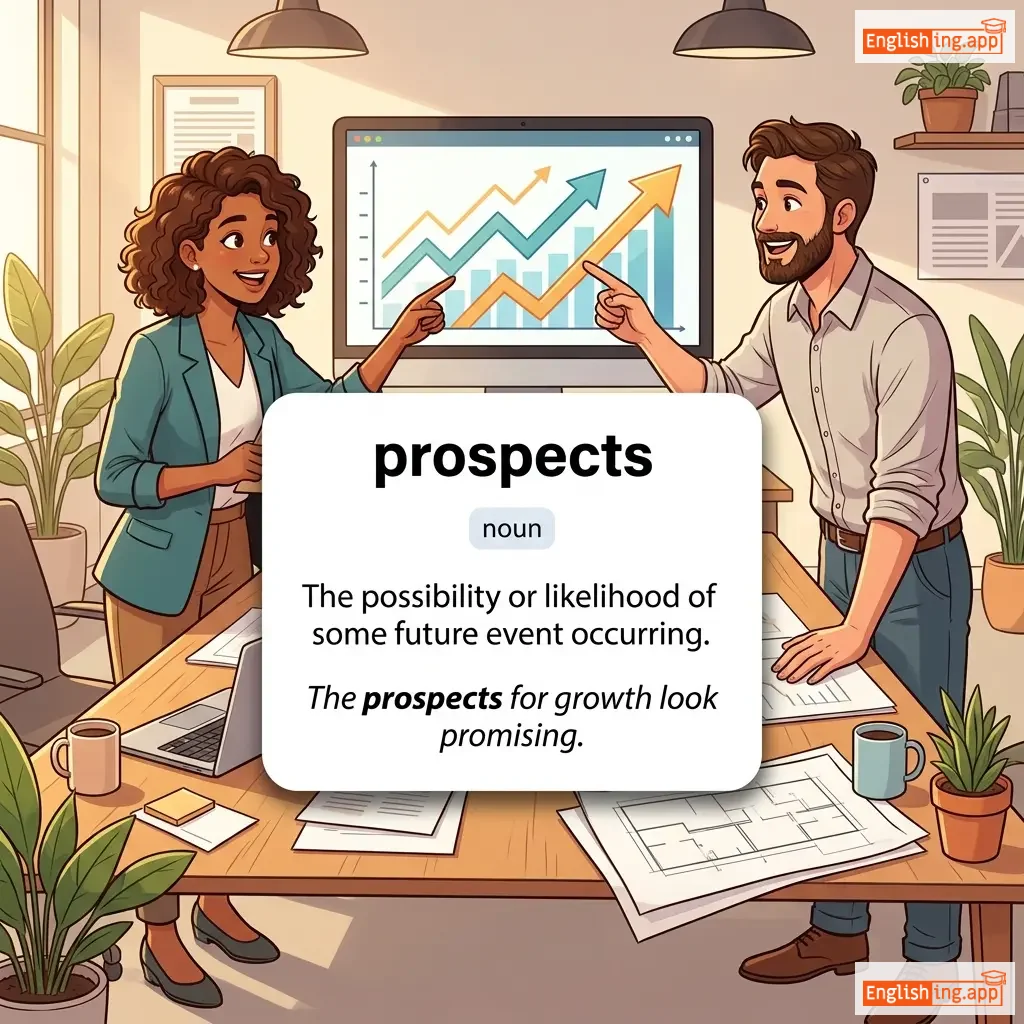
prospects definition card — visual illustration of the meaning
noun
/ˈprɒs.pekts/
perspectives (perspectives)

The possibility or likelihood of some future event occurring.

"The prospects for growth look promising."

"Les perspectives de croissance semblent prometteuses." (Les perspectives de croissance semblent prometteuses.)