
词汇表

英语词汇词典 | 单词含义、定义和示例

conquer definition card — visual illustration of the meaning
verb
/ˈkɒŋkər/
征服 (zhēngfú)

To defeat and take control of a place or people by force.

"The king set out to conquer new lands."

"国王出发征服新土地。" (guówáng chūfā zhēngfú xīn tǔdì.)
adjective
/kɒnˈsæŋɡwɪn/
同血缘的 (tóng xuèyuán de)

Of the same blood or origin; related by birth.

"The two families were consanguine through their grandparents."

"这两个家庭通过他们的祖父母是同血缘的。" (Zhè liǎng gè jiātíng tōngguò tāmen de zǔfùmǔ shì tóng xuèyuán de.)
adjective
/ˌkɒnsæŋˈɡwɪniəs/
同血缘的 (tóng xuèyuán de)

Related by blood; descended from the same ancestor.

"The study focused on genetic disorders in consanguineous families."

"研究集中于同血缘家庭中的遗传疾病。" (Yánjiū jízhōng yú tóng xuèyuán jiātíng zhōng de yíchuán jíbìng.)
👨‍👩‍👧‍👦

consanguinity (血缘关系)

noun
/ˌkɒnsæŋˈɡwɪnɪti/
血缘关系 (xueyuan guanxi)

The fact of being descended from the same ancestor; blood relationship.

"The degree of consanguinity was important in inheritance laws."

"继承法中,血缘关系的程度至关重要。" (Jicheng fa zhong, xueyuan guanxi de chengdu zhiguang zhongyao.)
noun
/ˈkɒnʃəns/
良心 (liángxīn)

An inner sense of right and wrong that guides a person's actions.

"Her conscience told her to admit the mistake."

"她的良心告诉她承认错误。" (Tā de liángxīn gàosù tā chéngrèn cuòwù.)
conscientious definition card — visual illustration of the meaning
adjective
/ˌkɒnʃiˈɛnʃəs/
有责任心且尽职尽责 (yǒu zérèn xīn qiě jìnzhí jìnzé)

Wishing to do what is right, especially to do one's work or duty well and thoroughly.

"He is a conscientious employee who always meets deadlines."

"他是一个有责任心且尽职尽责的员工,总是按时完成任务。" (Tā shì yīgè yǒu zérèn xīn qiě jìnzhí jìnzé de yuángōng, zǒng shì ànshí wánchéng rènwù.)
conscientiousness definition card — visual illustration of the meaning
noun
/ˌkɒn.ʃiˈen.ʃəs.nəs/
尽责, 责任, 勤奋 (jinze, zeren, qinfen)

The quality of wishing to do what is right, especially to do one's work or duty well and thoroughly.

"Her conscientiousness makes her a great leader."

"她的责任感使她成为一位伟大的领导者。" (Tā de zérèn gǎn shǐ tā chéngwéi yī wèi wěidà de lǐngdǎo zhě.)
adjective
/ˈkɒnʃəs/
清醒 (qingxing)

Aware of and responding to one's surroundings; awake.

"She was fully conscious after the surgery."

"她在手术后完全清醒。" (Tā zài shǒushù hòu wánquán qīngxǐng.)
consciousness definition card — visual illustration of the meaning
noun
/ˈkɒnʃəsnəs/
意识 (yìshi)

the state of being aware of and able to think about oneself and the environment

"The patient regained consciousness after the surgery."

"患者在手术后恢复了意识。" (huànzhě zài shǒushù hòu huīfùle yìshi.)
conscript definition card — visual illustration of the meaning
verb
/ˈkɒnskrɪpt/
强迫某人参军 (qiángpò mǒu rén cānjūn)

to force someone into military service

"The government conscripted young men during the war."

"政府在战争期间征召了年轻人。" (Zhèngfǔ zài zhànzhēng qījiān zhēngzhào le niánqīng rén.)
consecrate definition card — visual illustration of the meaning
verb
/ˈkɒnsɪkreɪt/
奉献 (fèngxiàn)

to make something sacred, usually through a religious ceremony

"The church was consecrated by the bishop."

"教堂由主教奉献。" (Jiàotáng yóu zhǔjiào fèngxiàn.)
adjective
/kənˈsɛkjʊtɪv/
连续的 (liánxù de)

following one after another without interruption

"She won three consecutive matches."

"她赢得了三场连续的比赛。" (Tā yíngdéle sān chǎng liánxù de bǐsài.)
consensus definition card — visual illustration of the meaning
noun
/kənˈsɛnsəs/
共识 (gongshi)

general agreement among a group of people

"The team reached a consensus on the new strategy."

"团队就新战略达成了一致意见。" (Tuánduì jiù xīn zhànlüè dáchéngle yīzhì yìjiàn.)
consent definition card — visual illustration of the meaning
noun
/kənˈsɛnt/
同意 (tongyi)

permission for something to happen or agreement to do something

"She gave her consent before the operation."

"她在手术前给了她的同意。" (Ta zai shoushu qian geile ta de tongyi.)
consequence definition card — visual illustration of the meaning
noun
/ˈkɒnsɪkwəns/
后果 (hòuguǒ)

a result or effect of an action or condition

"She failed the exam as a consequence of not studying."
"她因未学习而未通过考试,结果就是这样。" (Tā yīn wèi xuéxí ér wèi tōngguò kǎoshì, jiéguǒ jiùshì zhèyàng.)
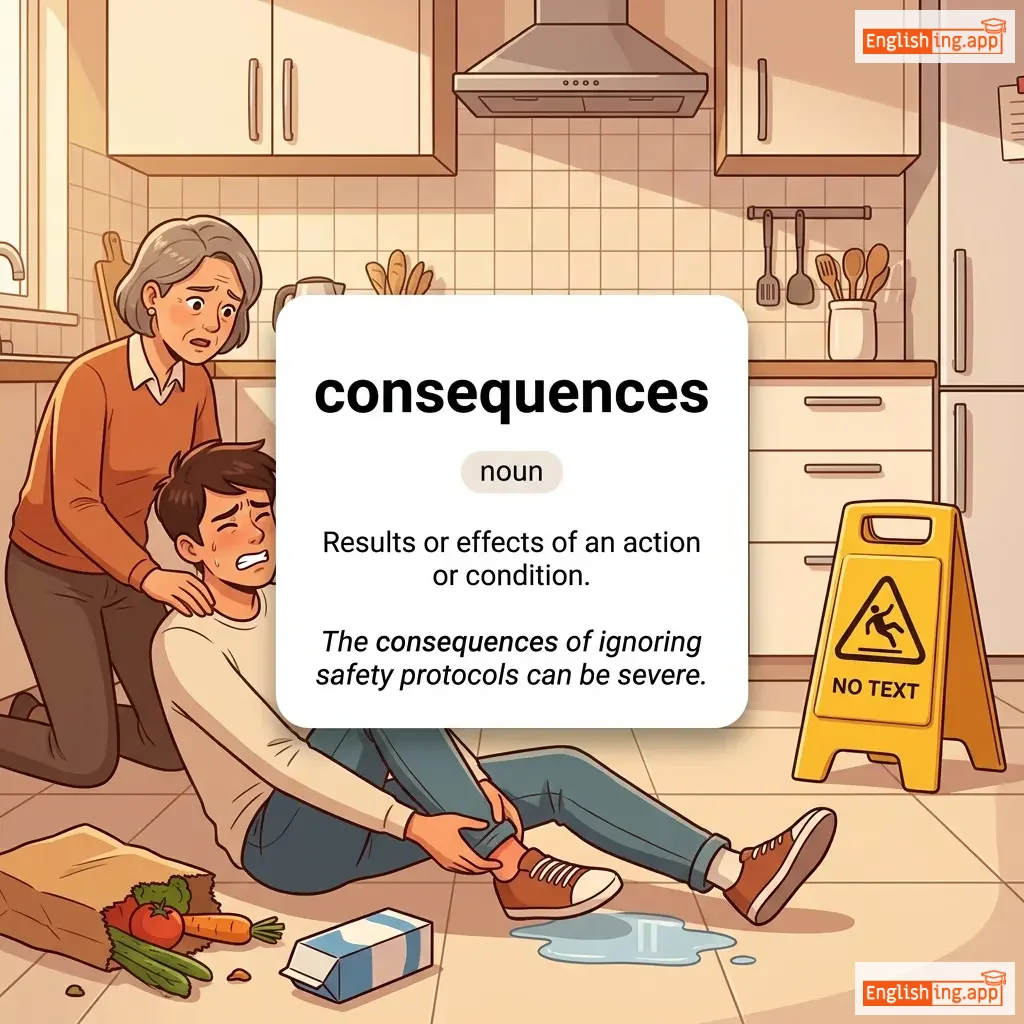
consequences definition card — visual illustration of the meaning
noun
/ˈkɒnsɪkwənsɪz/
后果 (houguo)

Results or effects of an action or condition.

"The consequences of ignoring safety protocols can be severe."

"忽视安全协议的后果可能是严重的。" (Hushi anquan xieyi de houguo keneng shi yanzhong de.)
adjective
/ˌkɒnsɪˈkwɛnʃəl/
重要的 (zhòngyào de)

Having important or significant consequences; resulting from something.

"The meeting was consequential for the future of the project."

"这次会议对项目的未来至关重要。" (Zhè cì huìyì duì xiàngmù de wèilái zhìguān zhòngyào.)
adverb
/ˈkɒnsɪkwəntli/
因此 (yīncǐ)

as a result; therefore

"He didn’t study, and consequently he failed the exam."

"他没有学习,因此他没通过考试。" (Tā méiyǒu xuéxí, yīncǐ tā méi tōngguò kǎoshì.)
conservation definition card — visual illustration of the meaning
noun
/ˌkɒnsəˈveɪʃən/
保护 (baohu)

the protection and preservation of natural resources and the environment

"Conservation of forests is essential to prevent climate change."

"森林的保护对于防止气候变化至关重要。" (senlin de baohu duiyu fangzhi qihou bianhua zhiguan zhongyao.)
Conservation Movement definition card — visual illustration of the meaning
noun
/ˌkɒnsərˈveɪʃən ˈmuːvmənt/
自然保护运动 (zìrán bǎohù yùndòng)

A political, environmental, and social movement that seeks to protect natural resources including plant and animal species as well as their habitat for the future.

"The conservation movement began in the 19th century to protect wildlife."

"自然保护运动在19世纪开始,旨在保护野生动物。" (Zìrán bǎohù yùndòng zài 19 shìjì kāishǐ, zhǐ zài bǎohù yěshēng dòngwù.)
noun
/kənˈsɜːvəˌtɪzəm/
保守主义 (baoshou zhuyi)

A political or social philosophy promoting traditional institutions and resistance to change.

"Conservatism values tradition and gradual development."

"保守主义重视传统和渐进的发展。" (Baoshou zhuyi zhongshi chuantong he jianjin de fazhan.)
adjective
/kənˈsɜːvətɪv/
保守的 (baoshou de)

Favoring traditional views and values; resistant to change.

"He has conservative views on family and society."

"他对家庭和社会持有保守的看法。" (Tā duì jiātíng hé shèhuì chí yǒu bǎoshǒu de kànfǎ.)
noun
/ˈkɒnsəvəˌtwɑː/
音乐学院 (yīnyuè xuéyuàn)

A school specializing in the study of music or drama.

"She trained as a pianist at the Paris Conservatoire."

"她在巴黎音乐学院接受了钢琴训练。" (Tā zài bālí yīnyuè xuéyuàn jiēshòule gāngqín xùnliàn.)
noun
/kənˈsɜːvəˌtɔːri/
温室 / 音乐和艺术学校 (wēnshì / yīnyuè hé yìshù xuéxiào)

A greenhouse for growing plants or a school for music and the arts.

"They grew exotic plants in the conservatory."

"他们在温室里种植了异国植物。" (Tāmen zài wēnshì lǐ zhòngzhí le yìguó zhíwù.)
verb
/kənˈsɜːrv/
节约 (jiéyuē)

to protect something from harm or destruction; to use resources carefully to avoid waste

"We must conserve water during the dry season."

"我们必须在干旱季节节约水。" (Wǒmen bìxū zài gānhàn jìjié jiéyuē shuǐ.)
verb
/kənˈsɪdər/
考虑 (kaolu)

to think carefully about something, especially before making a decision

"She is considering studying abroad next year."

"她正在考虑明年出国留学。" (Ta zhengzai kaolu mingnian chuguo liuxue.)
adjective
/kənˈsɪdərəbl/
相当的 (xiāngdāng de)

large in amount, size, or importance

"The project required a considerable amount of time and money."

"该项目需要相当多的时间和金钱。" (Gāi xiàngmù xūyào xiāngdāng duō de shíjiān hé jīnqián.)
adverb
/kənˈsɪdərəbli/
显著地 (xiǎnzhù de)

to a great extent or degree; significantly

"The weather has improved considerably since last week."

"天气自上周以来显著改善。" (Tiānqì zì shàng zhōu yǐlái xiǎnzhù gǎishàn.)
adjective
/kənˈsɪdərət/
体贴的 (tǐtiē de)

showing concern for the needs and feelings of others

"He is always considerate of his neighbors."

"他总是关心他的邻居。" (Tā zǒng shì guānxīn tā de línjū.)
noun
/kənˌsɪdəˈreɪʃən/
幸福 (xìngfú)

careful thought or attention to something before making a decision

"After much consideration, she accepted the job offer."

"当她收到奖项时,她无法掩饰她的幸福。" (Dāng tā shōu dào jiǎngxiàng shí, tā wúfǎ yǎnshì tā de xìngfú.)
verb
/kənˈsaɪn/
托付 (tuōfù)

to deliver something to a person or place, often for selling or safekeeping

"He consigned the package to the shipping company."

"他将包裹交给了运输公司。" (Tā jiāng bāoguǒ jiāo gěi le yùnshū gōngsī.)
noun
/ˌkɒnsaɪˈniː/
收货人 (shōuhuò rén)

the person or company to whom goods are delivered

"The consignee received the shipment on time."

"收货人按时收到了货物。" (Shōuhuò rén ànshí shōudàole huòwù.)
noun
/kənˈsaɪnər/
发货人 (fāhuò rén)

a person or company that sends goods to be sold or transported

"The consignor shipped the goods to the warehouse."

"发货人将商品发送到仓库。" (Fāhuò rén jiāng shāngpǐn fāsòng dào cāngkù.)
verb
/kənˈsɪst/
由...组成 (you...zucheng)

to be made up or composed of certain parts or elements

"The committee consists of five members."

"委员会由五个成员组成。" (Wei yuan hui you wu ge cheng yuan zu cheng.)
consistency definition card — visual illustration of the meaning
noun
/kənˈsɪstənsi/
一致性, 稳定性 (yīzhìxìng, wěndìngxìng)

the quality of always behaving or performing in a similar way; uniformity

"Her consistency in work earned her a promotion."

"她在工作中的一致性为她赢得了晋升。" (Tā zài gōngzuò zhōng de yīzhìxìng wèi tā yíngdé le jìnshēng.)
consistent definition card — visual illustration of the meaning
adjective
/kənˈsɪstənt/
一致的 (yīzhì de)

acting or done in the same way over time; reliable or uniform

"He is very consistent in his work."

"他在工作中非常一致。" (Tā zài gōngzuò zhōng fēicháng yīzhì.)
adverb
/kənˈsɪstəntli/
持续地 (chíxù de)

in a way that does not vary; regularly and dependably

"She has been performing consistently well in her studies."

"她在学习中始终表现得很好。" (Tā zài xuéxí zhōng shǐzhōng biǎoxiàn dé hěn hǎo.)
verb
/kənˈsoʊl/
安慰 (ānwèi)

to comfort someone at a time of grief or disappointment

"She tried to console him after his loss."

"她在他的损失后试图安慰他。" (Tā zài tā de sǔnshī hòu shìtú ānwèi tā.)
consolidate definition card — visual illustration of the meaning
verb
/kənˈsɑːlɪdeɪt/
整合 (zhěnghé)

to combine into a single, more effective or coherent whole

"The company plans to consolidate its offices into one building."

"公司计划将其办公室合并到一栋建筑中。" (Gōngsī jìhuà jiāng qí bàngōngshì hébìng dào yī dòng jiànzhú zhōng.)
Consolidation definition card — visual illustration of the meaning
noun
/kənˌsɑːlɪˈdeɪʃən/
合并 (hebing)

the act or process of combining into a single, stronger or more effective entity

"The consolidation of the two companies improved efficiency."

"两家公司的合并提高了效率。" (Liang jia gongsi de hebing tigao le xiaolv.)
noun
/ˈkɒnsənəns/
和谐, 音响和谐 (hexie, yinxiang hexie)

Agreement or harmony among parts; a pleasing combination of sounds in music or words.

"The consonance between their ideas made the project successful."

"他们的思想之间的和谐使得项目成功。" (Tāmen de sīxiǎng zhī jiān de héxié shǐdé xiàngmù chénggōng.)
noun
/ˈkɒnsənənt/
辅音 (fǔyīn)

A speech sound produced by blocking air flow, or a letter representing such a sound.

"The word 'cat' has two consonants and one vowel."

"‘猫’这个词有两个辅音和一个元音。" ('Māo' zhège cí yǒu liǎng gè fǔyīn hé yīgè yuán yīn.)
verb
/ˈkɒnsɔːrt/

To associate with someone, typically with disapproval; also, a spouse of a reigning monarch.

"He was criticized for consorting with criminals."

consortium definition card — visual illustration of the meaning
noun
kənˈsɔː.ti.əm
联合体 (liánhé tǐ)

An association of several companies or organizations formed to undertake an enterprise beyond the resources of any one member.

"The consortium worked collaboratively to build the cable."

"该联盟协同合作建设了电缆。" (Gāi liánhé tǐ xiétóng hézuò jiànshè le diànlǎn.)
adjective
/kənˈspɪkjuəs/
显眼的 (xianyan de)

Easily noticeable; attracting attention due to being unusual or prominent.

"Her red dress made her conspicuous at the party."

"她的红色裙子使她在派对上显眼。" (Tā de hóngsè qúnzi shǐ tā zài pàiduì shàng xiǎnyǎn.)
noun
/kənˈspɪrəsi/
阴谋 (yīnmóu)

A secret plan by a group to do something unlawful or harmful.

"The police uncovered a conspiracy to overthrow the government."

"警方揭露了一项推翻政府的阴谋。" (Jǐngfāng jiēlùle yī xiàng tuīfān zhèngfǔ de yīnmóu.)
noun
/kənˈspɪrə.tər/
阴谋者 (yinmou zhe)

a person who secretly plans with others to do something unlawful or harmful

"The conspirator was arrested before the plan could be carried out."

"阴谋者在计划得以实施之前被捕。" (Yinmou zhe zai jihua deyi shishi zhiqian bei bu.)
verb
/kənˈspaɪər/
密谋 (mìmóu)

to secretly plan with others to do something harmful or illegal

"They conspired to overthrow the government."

"他们密谋推翻政府。" (Tāmen mìmóu tuīfān zhèngfǔ.)
noun
/ˈkʌn.stə.bəl/
巡警 (xúnjǐng)

a police officer of the lowest rank

"The constable directed traffic at the busy intersection."

"巡警在繁忙的十字路口指挥交通。" (Xúnjǐng zài fánmáng de shízì lùkǒu zhǐhuī jiāotōng.)
noun
/ˈkɒnstənsi/
忠诚/恒常 (zhongcheng/hengchang)

the quality of being faithful and dependable

"Her constancy in friendship is admirable."

"她在友谊中的恒常令人钦佩。" (Ta zai youyi zhong de hengchang ling ren qinpei.)