词汇表

英语词汇词典 | 单词含义、定义和示例

noun
/ˌkɒndɛnˈseɪʃən/
冷凝 (lěngníng)

The process of water vapor changing into liquid; also, the act of making something more concise.

"Condensation formed on the windows during the cold night."

"在寒冷的夜晚,窗户上形成了冷凝。" (Zài hánlěng de yèwǎn, chuānghù shàng xíngchéngle lěngníng.)
condense definition card — visual illustration of the meaning
verb
/kənˈdɛns/
压缩 (yāsuō)

to make something shorter, more concentrated, or more compact

"The editor asked the writer to condense the article into one page."

"编辑要求作者将文章压缩到一页。" (Biānjí yāoqiú zuòzhě jiāng wénzhāng yāsuō dào yī yè.)
noun
/kənˈdenst mɪlk/
炼乳 (liànrǔ)

milk from which water has been removed and sugar added, creating a thick, sweet product

"The recipe calls for a can of condensed milk to make the dessert extra creamy."

"这个食谱需要一罐炼乳来让甜点更加奶油味。" (Zhège shípǔ xūyào yī guàn liànrǔ lái ràng tiándiǎn gèngjiā nǎiyóu wèi.)
verb
/ˌkɒndɪˈsɛnd/
从高处以友善的态度 (cóng gāo chù yǐ yǒu shàn de tàidù)

to behave as if one is superior while being gracious to others

"He would not condescend to answer such a trivial question."

"他不会屈尊回答如此琐碎的问题。" (Tā bù huì qūzūn huídá rúcǐ suǒsuì de wèntí.)
adjective
/ˌkɒndɪˈsɛndɪŋ/
居高临下 (jū gāo lín xià)

having or showing an attitude of patronizing superiority

"Her condescending tone upset her colleagues."

"她居高临下的语气让她的同事感到不满。" (Tā jū gāo lín xià de yǔqì ràng tā de tóngshì gǎndào bùmǎn.)
adjective
/ˈkɒndaɪn/
应得的 (yīngdé de)

deserved, appropriate, and fitting (especially punishment)

"The criminal received condign punishment for his crimes."

"罪犯因其罪行受到了应得的惩罚。" (Zuìfàn yīn qí zuìxíng shòu dào le yīngdé de chéngfá.)
noun
/ˈkɒndɪmənt/
调味品/酱料 (tiaoweipin/jiangliao)

a substance such as salt, mustard, or ketchup that is used to add flavor to food

"Ketchup is a popular condiment in many countries."

"番茄酱是许多国家受欢迎的调味品。" (Fanqiejiang shi xu duo guo jia shou huanying de tiaoweipin.)
noun
/ˈkɒndɪmənts/
调味品或酱料 (tiáowèipǐn huò jiàngliào)

Seasonings or sauces used to add flavor to food.

"Ketchup and mustard are popular condiments for burgers."

"番茄酱和芥末是汉堡的常见调味品。" (Fānqiéjiàng hé jièmò shì hànbǎo de chángjiàn tiáowèipǐn.)
condition definition card — visual illustration of the meaning
noun
/kənˈdɪʃən/
状态, 条件 (zhuangtai, tiaojian)

The state of something with regard to its appearance, quality, or working order; a requirement that must be met.

"The car is in excellent condition."

"这辆车的状态很好。" (Zhe liang che de zhuangtai hen hao.)
adjective
/kənˈdɪʃ.ən.əl/
有条件的; 依赖于条件 (yǒu tiáojiàn de; yīlài yú tiáojiàn)

dependent on certain conditions; not absolute

"The job offer is conditional upon passing the background check."

"工作机会取决于通过背景调查。" (Gōngzuò jīhuì qǔjué yú tōngguò bèijǐng diàochá.)
verb
/kənˈdəʊl/
表示同情 (biao shi tong qing)

To express sympathy for someone who is suffering or grieving.

"Neighbors came to condole with the family after the tragedy."

"邻居们在悲剧后前来向家属表示慰问。" (Linju men zai beiju hou qianlai xiang jiashu biaoshi weiwun.)
noun
/kənˈdəʊləns/
慰问 (weiwen)

An expression of sympathy, especially on the occasion of death.

"She offered her sincere condolence to the grieving family."

"她向悲痛的家庭表示了最真诚的慰问。" (Ta xiang beitong de jiating biaoshile zui zhencheng de weiwen.)
condone definition card — visual illustration of the meaning
verb
/kənˈdəʊn/
宽容 (kuanrong)

To accept or allow behavior that is morally wrong or offensive.

"The manager refused to condone harassment in the workplace."

"经理拒绝在工作场所宽容骚扰。" (Jingli jujue zai gongzuo changsuo kuanrong saorao.)
verb
/kənˈdjuːs/
有助于 (you zhu yu)

To help bring about a particular result; to contribute to something.

"Regular exercise conduces to better health."

"定期锻炼有助于更好的健康。" (Dingqi duanlian you zhu yu geng hao de jiankang.)
conducive definition card — visual illustration of the meaning
adjective
/kənˈdjuːsɪv/
有利的 (you li de)

making a certain situation or outcome likely or possible

"A quiet environment is conducive to studying."

"安静的环境有利于学习。" (Anjing de huanjing you li yu xuexi.)
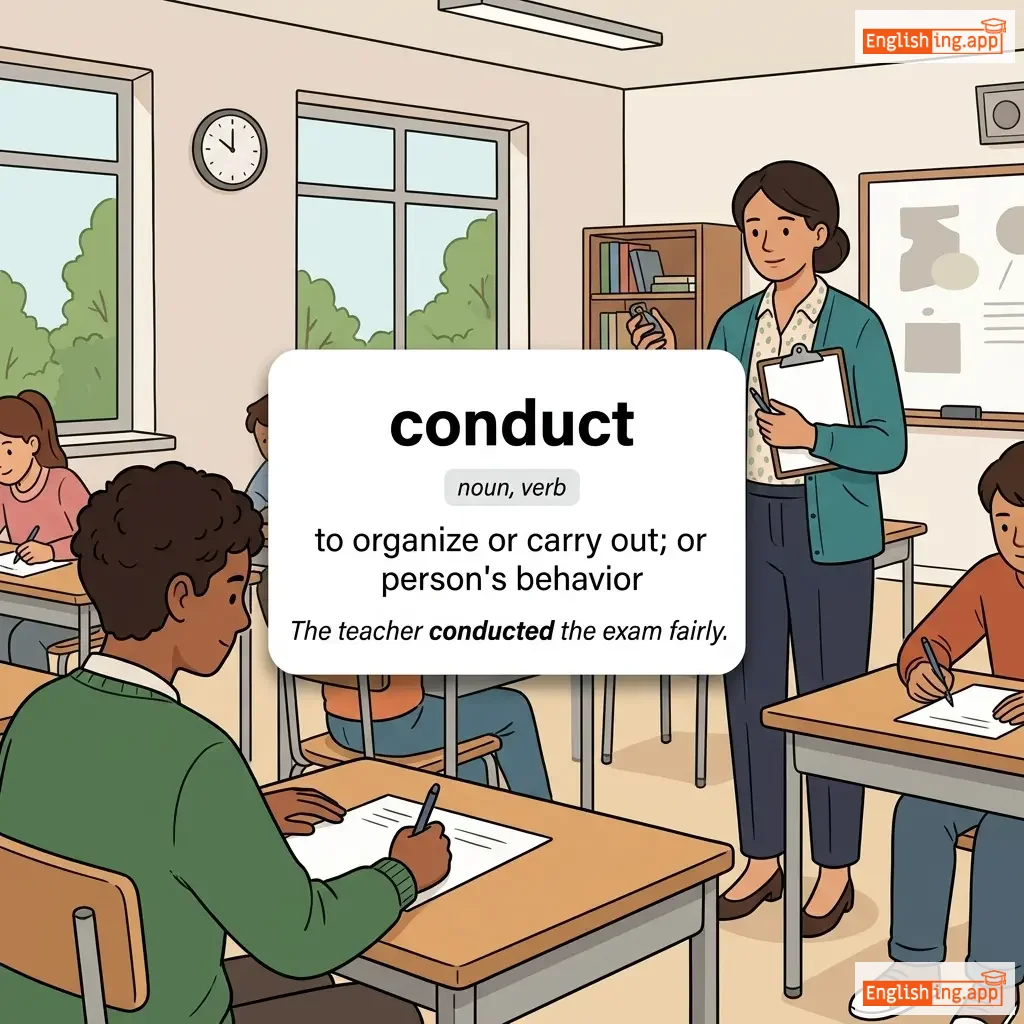
conduct definition card — visual illustration of the meaning
🧑‍🏫

conduct

noun, verb
/ˈkɒndʌkt/ (noun), /kənˈdʌkt/ (verb)

to organize or carry out; or a person's behavior

"The teacher conducted the exam fairly."

adjective
/kənˈdʌktəbl̩/
导电的 (daodian de)

capable of being conducted, especially electricity or heat

"Copper is highly conductible to electricity."

"铜的导电性很高。" (Tong de daodianxing hen gao.)
noun
/kənˈdʌktər/
指挥 / 导电材料 (zhǐhuī / dǎodiàn cáiliào)

a person who directs a performance or someone who collects fares on public transport; or a material that conducts electricity

"The conductor waved his baton to start the orchestra."

"指挥挥动他的指挥棒开始了乐团的演奏。" (Zhǐhuī huīdòng tā de zhǐhuībàng kāishǐle yuètuán de yǎnzòu.)
noun
/ˈkɒndjuɪt/ or /ˈkɑːnduɪt/
管道 / 媒介 (guǎndào / méijiè)

a channel or pipe for conveying water, electricity, or information

"The cable was placed inside a protective conduit."

"电缆被放入保护管道中。" (diànlǎn bèi fàng rù bǎohù guǎndào zhōng.)
noun
/kənˈfɛkʃəneri/
糖果店 (tángguǒ diàn)

sweets, candies, and other food items made with sugar

"The shop sells a wide variety of confectionery."

"商店出售各种各样的糖果。" (Shāngdiàn chūshòu gèzhǒng gè yàng de tángguǒ.)
noun
/kənˈfɛdərəsi/
联邦 (lianbang)

a group of states, people, or organizations united for a common purpose

"The southern states formed a confederacy during the civil war."

"南方各州在内战期间组成了联邦。" (Nan fang ge zhou zai neizhan qijian zu cheng le lianbang.)
noun/adjective
/kənˈfɛdərət/
同盟 (tóngméng)

a person, group, or state joined in an alliance or union; relating to a confederacy

"The confederate soldiers fought bravely in the war."

"同盟士兵在战争中英勇作战。" (Tóngméng shìbīng zài zhànzhēng zhōng yīngyǒng zuòzhàn.)
verb
/kənˈfɜːr/

to discuss something important or to grant or bestow something

"The committee will confer to decide on the new policy."

noun
/ˌkɒnfəˈriː/
会议参与者 (huiyi canyu zhe)

a person who takes part in a conference

"Each conferee received a badge at the registration desk."

"每个会议参与者在注册桌上都收到了一枚徽章。" (Měi gè huìyì cānyù zhě zài zhùcè zhuō shàng dōu shōudào le yī méi huīzhāng.)
conference definition card — visual illustration of the meaning
noun
/ˈkɒnfərəns/
会议 (huiyi)

A formal meeting for discussion, especially about a particular subject.

"She is attending an international business conference."

"她正在参加一个国际商业会议。" (Tā zhèngzài cānjiā yīgè guójì shāngyè huìyì.)
confess definition card — visual illustration of the meaning
verb
/kənˈfɛs/
承认 (chéngrèn)

to admit that you have done something wrong or illegal

"He confessed that he had stolen the money."

"他承认他偷了钱。" (Tā chéngrèn tā tōu le qián.)
noun
/kənˈfɛʃən/
忏悔 (chanhui)

a statement admitting that one is guilty of a crime or has done something wrong

"The suspect made a full confession to the police."

"嫌疑人向警方做出了完整的忏悔。" (Xianyi ren xiang jingfang zuochu le wanzheng de chanhui.)
noun
/kənˈfɛsər/
忏悔者 (chànhuǐ zhě)

A person who confesses sins or secrets, especially to a priest.

"The confessor listened patiently to the troubled man."

"忏悔者耐心地听着困扰的男人。" (Chànhuǐ zhě nàixīn de tīngzhe kùnrǎo de nánrén.)
noun
/ˈkɒnfɪdænt/
知己 (zhi ji)

A person with whom one shares a secret or private matter, trusting them not to repeat it.

"She found a true confidant in her childhood friend."

"她在她的童年朋友中找到了一个真正的知己。" (Ta zai ta de tongnian pengyou zhong zhaodao le yige zhenzheng de zhiji.)
noun
/ˌkɒnfɪˈdɑːnt/
知己 (zhī jǐ)

A woman with whom one shares a secret or private matter, trusting her not to repeat it.

"The queen’s maid became her most trusted confidante."

"皇后的女仆成为了她最信任的知己。" (Huánghòu de nǚpú chéngwéi le tā zuì xìnrèn de zhījǐ.)
verb
/kənˈfaɪd/

To tell someone about a secret or private matter while trusting them not to repeat it.

"He confided his worries to his best friend."

Confidence definition card — visual illustration of the meaning
noun
/ˈkɒnfɪdəns/
自信 (zìxìn)

The feeling or belief that one can rely on someone or something; firm trust or self-assurance.

"She spoke with great confidence during the meeting."

"她在会议中表现出极大的自信。" (Tā zài huìyì zhōng biǎoxiàn chū jí dà de zìxìn.)
adjective
/ˈkɒnfɪdənt/
自信 (zìxìn)

feeling or showing certainty about something; having self-assurance

"She was confident about her ability to succeed."

"她对自己能够成功充满自信。" (Tā duì zìjǐ nénggòu chénggōng chōngmǎn zìxìn.)
adjective
/ˌkɒnfɪˈdɛnʃl/
机密的 (jī mì de)

intended to be kept secret or private

"The lawyer shared confidential documents with her client."

"律师与客户分享了机密文件。" (lǜshī yǔ kèhù fēnxiǎngle jīmì wénjiàn.)
confidentiality definition card — visual illustration of the meaning
noun
ˌkɒn.fɪ.den.ʃiˈæl.ɪ.ti
保密性 (bǎomìxìng)

The state of keeping or being kept secret or private

"Confidentiality is crucial in data security."

"保密性对数据安全至关重要。" (Bǎomìxìng duì shùjù ānquán zhìguān zhòngyào.)
adverb
/ˌkɒnfɪˈdenʃəli/
机密地 (jimi di)

in a confidential manner; secretly; privately

"The information was shared confidentially between the two managers."

"信息在两个经理之间以机密方式共享。" (Xinxi zai liang ge jingli zhijian yi jimi fangshi gongxiang.)
noun
/kənˌfɪɡəˈreɪʃən/
配置 (peizhi)

an arrangement of parts or elements in a particular form or structure

"The configuration of the system needs to be adjusted for better performance."

"系统配置需要调整以提高性能。" (Xitong peizhi xuyao tiaozheng yi tigao xingneng.)
confine definition card — visual illustration of the meaning
verb
/kənˈfaɪn/
限制 (xiànzhì)

to keep or restrict someone or something within limits

"He was confined to his room after the surgery."

"他在手术后被限制在他的房间里。" (Tā zài shǒushù hòu bèi xiànzhì zài tā de fángjiān lǐ.)
noun
/kənˈfaɪnmənt/
拘禁 (jūjìn)

the state of being confined or restricted

"The prisoner endured years of confinement."

"囚犯忍受了多年的拘禁。" (Qiúfàn rěnshòu le duōnián de jūjìn.)
confirm definition card — visual illustration of the meaning
verb
/kənˈfɜːrm/
确认 (queren)

to establish the truth, accuracy, or validity of something

"The hotel will confirm your reservation by email."

"酒店将通过电子邮件确认您的预订。" (Jiudian jiang tongguo dianzi youjian queren nin de yuding.)
noun
/kənˌfɜːˈmeɪʃən/
确认 (queren)

the action of confirming something or the state of being confirmed

"She received a confirmation email for her appointment."

"她收到了她预约的确认电子邮件。" (Tā shōudàole tā yùyuē de quèrèn diànzǐ yóujiàn.)
verb
/ˈkɒnfɪskeɪt/

to take something away officially, often as a punishment

"The teacher confiscated the student's phone during class."

noun
/ˌkɒnfləˈɡreɪʃən/
拼写错误(来自 'conflagration') (pīnxiě cuòwù (lái zì 'conflagration'))

This is a common misspelling of 'conflagration', which means a large, destructive fire.

"The term 'conflagaration' is often incorrectly used instead of 'conflagration'."

"'conflagaration' 这个词常常被错误地用来代替 'conflagration'。" ('Conflagaration' zhège cí chángcháng bèi cuòwù de yòng lái dàitì 'conflagration'.)
noun
/ˌkɒnfləˈɡreɪʃən/
大规模毁灭性火灾 (dà guīmó huǐmiè xìng huǒzāi)

A large, destructive fire that destroys a great deal of land or property.

"The forest was devastated by a massive conflagration that lasted for days."

"这片森林被一场持续了几天的大火摧毁。" (Zhè piàn sēnlín bèi yī chǎng chíxùle jǐ tiān de dà huǒ cuīhuǐ.)
verb
/kənˈfleɪt/
合并 / 混合 (hébìng / hùn hé)

To combine two or more things, often confusingly, into one.

"The article tends to conflate facts with opinions."

"文章倾向于将事实和意见混为一谈。" (Wénzhāng qīngxiàng yú jiāng shìshí hé yìjiàn hùn wéi yī tán.)
noun
/ˈkɒnflɪkt/
冲突 (chōngtū)

A serious disagreement or argument, often a prolonged one.

"The two countries are trying to resolve the conflict through negotiations."

"这两个国家正在通过谈判解决冲突。" (Zhè liǎng gè guójiā zhèngzài tōngguò tánpàn jiějué chōngtū.)
conflict resolution definition card — visual illustration of the meaning
noun
/ˈkɒn.flɪkt ˌrez.əˈluː.ʃən/
冲突解决 (chōngtú jiějué)

The process of finding peaceful solutions to disputes or disagreements between parties.

"Conflict resolution is vital for global peace."

"冲突解决对于全球和平至关重要。" (Chōngtú jiějué duìyú quánqiú hépíng zhìguān zhòngyào.)
confluence definition card — visual illustration of the meaning
noun
/ˈkɒnfluəns/
汇合 (huìhé)

The junction of two rivers; also a situation where people or things come together.

"The city was founded at the confluence of two great rivers."

"这座城市建立在两条大河的汇合处。" (Zhè zuò chéngshì jiànlì zài liǎng tiáo dàhé de huìhé chù.)
adjective
/ˈkɒnfluənt/
汇流 (huìliú)

Flowing together or merging; coming together at one point.

"The confluent streams formed a mighty river."

"汇流的溪流形成了一条强大的河流。" (Huìliú de xīliú xíngchéngle yītiáo qiángdà de héliú.)
verb
/kənˈfɔːrm/
遵守 (zūnshǒu)

To comply with rules, standards, or laws.

"Students must conform to the school regulations."

"学生必须遵守学校的规定。" (Xuéshēng bìxū zūnshǒu xuéxiào de guīdìng.)