Vocabularios

Descubra, aprenda y domine el vocabulario en inglés

noun
/ˌkɒndɛnˈseɪʃən/
condensación (condensacion)

The process of water vapor changing into liquid; also, the act of making something more concise.

"Condensation formed on the windows during the cold night."

"Se formó condensación en las ventanas durante la fría noche." (Se formo condensacion en las ventanas durante la fria noche.)
condense definition card — visual illustration of the meaning
verb
/kənˈdɛns/
condensar (kondensar)

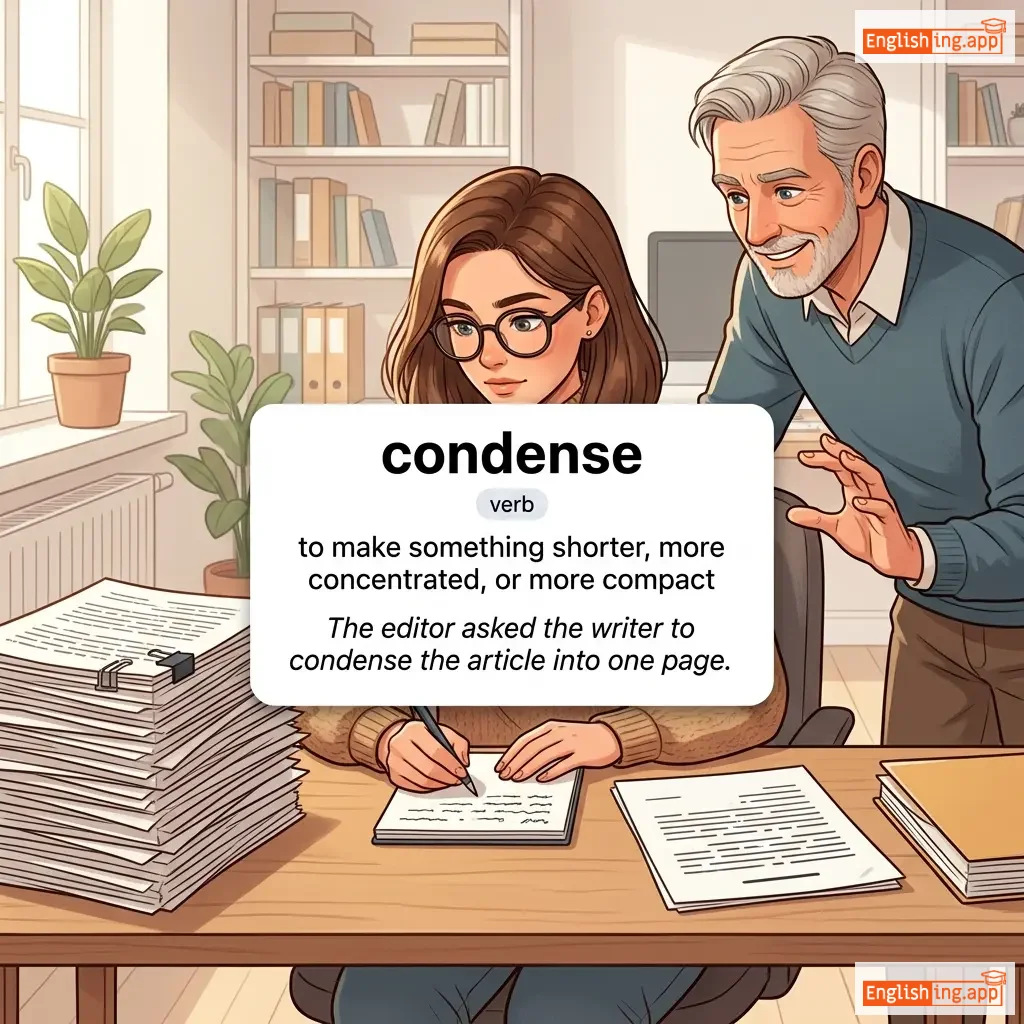
to make something shorter, more concentrated, or more compact

"The editor asked the writer to condense the article into one page."

"El editor le pidió al escritor que condensara el artículo en una página." (El editor le pidio al escritor que condensara el articulo en una pagina.)
noun
/kənˈdenst mɪlk/
leche condensada (leche condensada)

milk from which water has been removed and sugar added, creating a thick, sweet product

"The recipe calls for a can of condensed milk to make the dessert extra creamy."

"La receta requiere una lata de leche condensada para hacer el postre extra cremoso." (La receta requiere una lata de leche condensada para hacer el postre extra cremoso.)
verb
/ˌkɒndɪˈsɛnd/
mirar desde arriba con amabilidad (mirar desde arriba con amabilidad)

to behave as if one is superior while being gracious to others

"He would not condescend to answer such a trivial question."

"Él no se dignaría a responder una pregunta tan trivial." (Él no se dignaría a responder una pregunta tan trivial.)
adjective
/ˌkɒndɪˈsɛndɪŋ/
condescendiente (condescendiente)

having or showing an attitude of patronizing superiority

"Her condescending tone upset her colleagues."

"Su tono condescendiente molestó a sus compañeros." (Su tono condescendiente molestó a sus compañeros.)
adjective
/ˈkɒndaɪn/
adecuado (adecuado)

deserved, appropriate, and fitting (especially punishment)

"The criminal received condign punishment for his crimes."

"El criminal recibió un castigo adecuado por sus crímenes." (El criminal recibió un castigo adecuado por sus crímenes.)
noun
/ˈkɒndɪmənt/
condimento (condimento)

a substance such as salt, mustard, or ketchup that is used to add flavor to food

"Ketchup is a popular condiment in many countries."

"El kétchup es un condimento popular en muchos países." (El ketchup es un condimento popular en muchos paises.)
noun
/ˈkɒndɪmənts/
condimentos o salsas (condimentos o salsas)

Seasonings or sauces used to add flavor to food.

"Ketchup and mustard are popular condiments for burgers."

"El kétchup y la mostaza son condimentos populares para las hamburguesas." (El ketchup y la mostaza son condimentos populares para las hamburguesas.)
condition definition card — visual illustration of the meaning
noun
/kənˈdɪʃən/
estado, condición (estado, condicion)

The state of something with regard to its appearance, quality, or working order; a requirement that must be met.

"The car is in excellent condition."

"El coche está en excelente condición." (El coche está en excelente condición.)
adjective
/kənˈdɪʃ.ən.əl/
condicional; sujeto a condiciones (condicional; sujeto a condiciones)

dependent on certain conditions; not absolute

"The job offer is conditional upon passing the background check."

"La oferta de trabajo es condicional a pasar la verificación de antecedentes." (La oferta de trabajo es condicional a pasar la verificación de antecedentes.)
verb
/kənˈdəʊl/
expresar simpatía (expresar simpatia)

To express sympathy for someone who is suffering or grieving.

"Neighbors came to condole with the family after the tragedy."

"Los vecinos vinieron a expresar simpatía con la familia después de la tragedia." (Los vecinos vinieron a expresar simpatia con la familia despues de la tragedia.)
noun
/kənˈdəʊləns/
pésame (pesame)

An expression of sympathy, especially on the occasion of death.

"She offered her sincere condolence to the grieving family."

"Ella ofreció su más sentido pésame a la familia afligida." (Ella ofrecio su mas sentido pesame a la familia afligida.)
condone definition card — visual illustration of the meaning
verb
/kənˈdəʊn/
condonar (condonar)

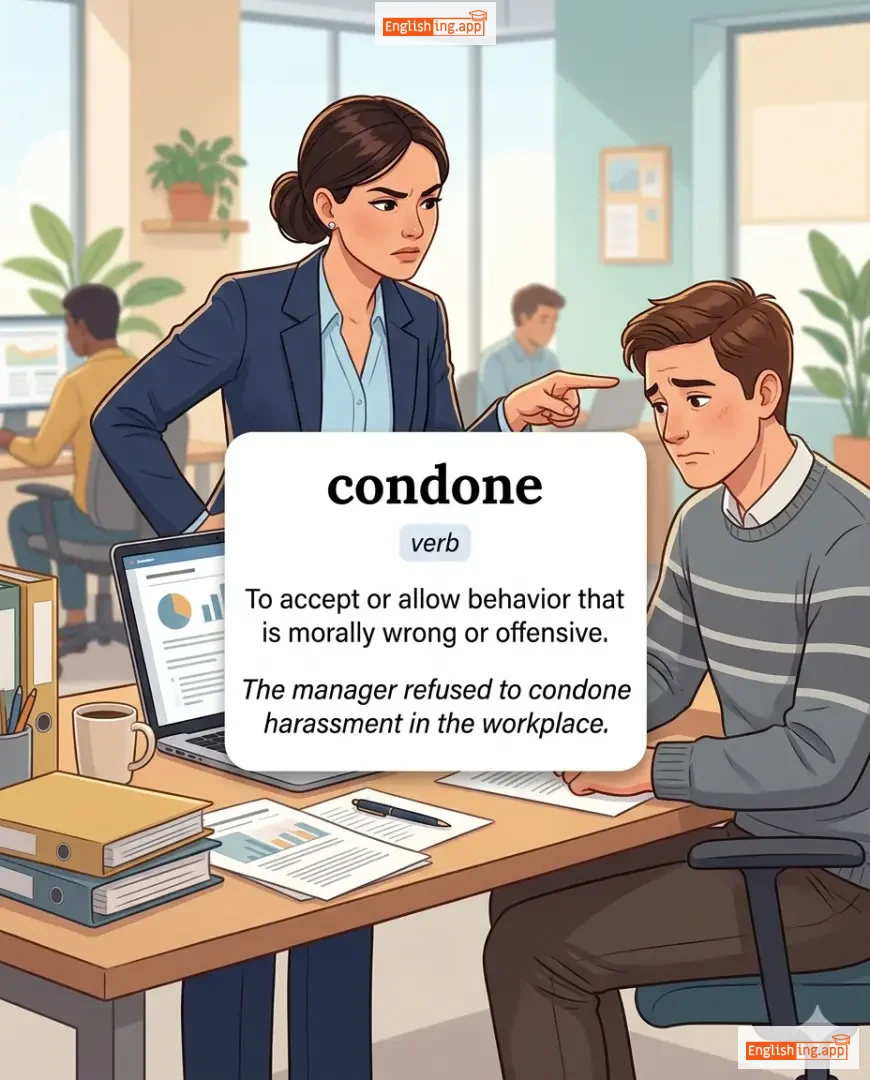
To accept or allow behavior that is morally wrong or offensive.

"The manager refused to condone harassment in the workplace."

"El gerente se negó a condonar el acoso en el lugar de trabajo." (El gerente se negó a condonar el acoso en el lugar de trabajo.)
verb
/kənˈdjuːs/
contribuir (contribuir)

To help bring about a particular result; to contribute to something.

"Regular exercise conduces to better health."

"El ejercicio regular contribuye a una mejor salud." (El ejercicio regular contribuye a una mejor salud.)
conducive definition card — visual illustration of the meaning
adjective
/kənˈdjuːsɪv/
propicio (propicio)

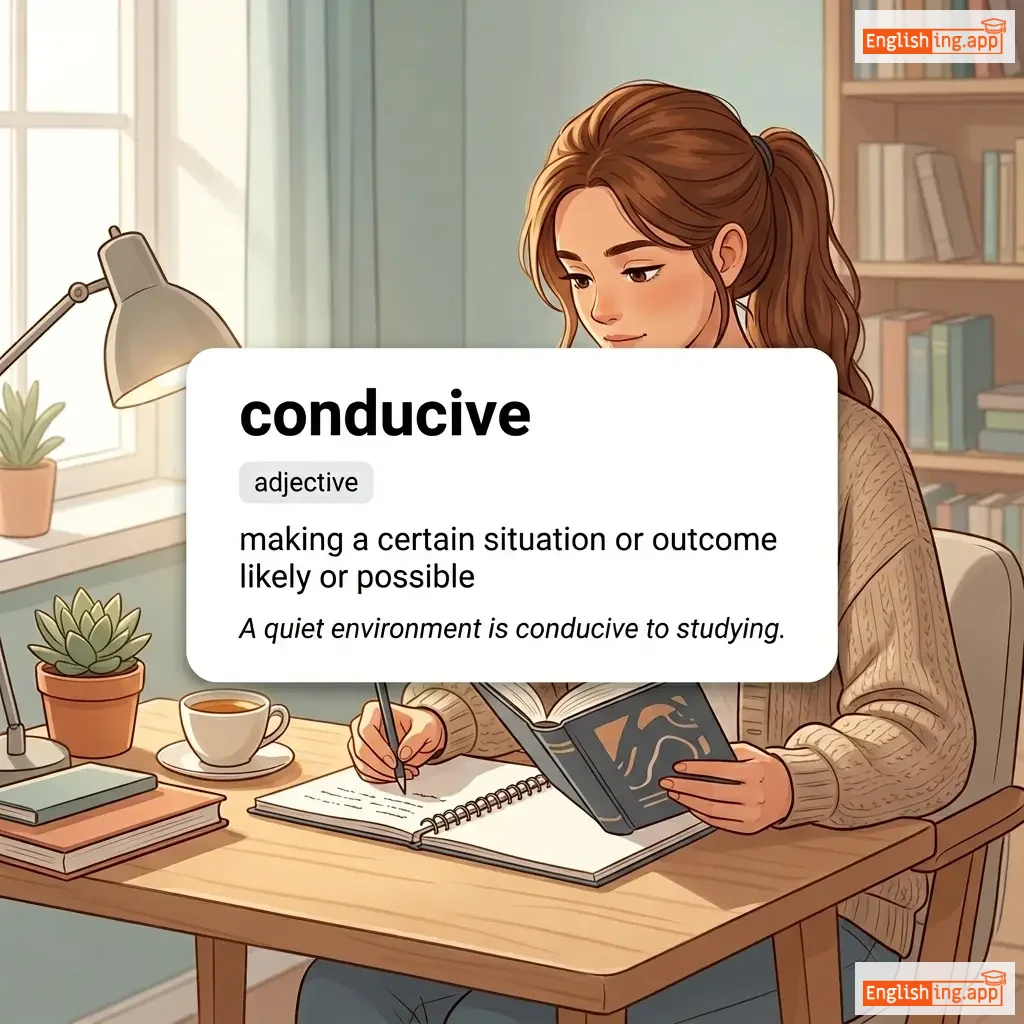
making a certain situation or outcome likely or possible

"A quiet environment is conducive to studying."

"Un ambiente tranquilo es propicio para estudiar." (Un ambiente tranquilo es propicio para estudiar.)
conduct definition card — visual illustration of the meaning
noun, verb
/ˈkɒndʌkt/ (noun), /kənˈdʌkt/ (verb)
comportamiento / conducir (comportamiento / conducir)

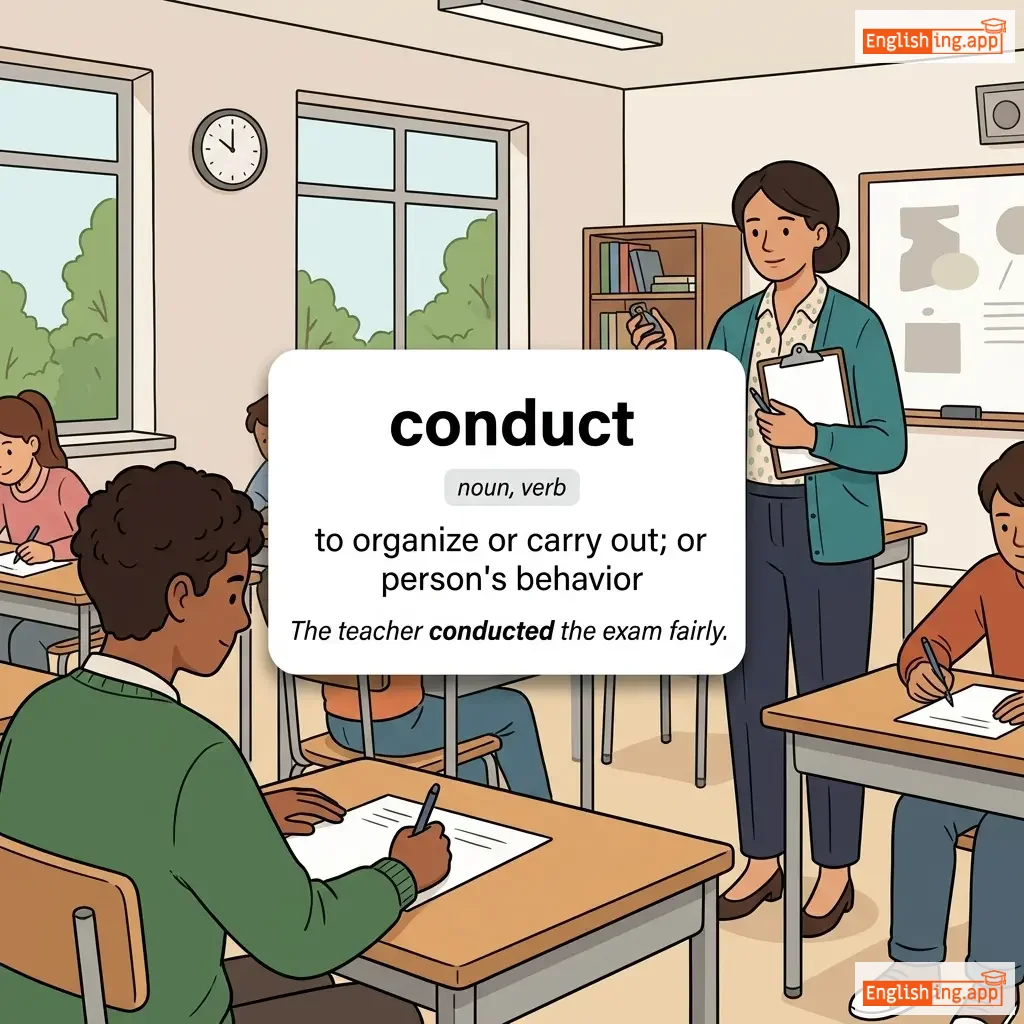
to organize or carry out; or a person's behavior

"The teacher conducted the exam fairly."

"La profesora condujo el examen de manera justa." (La profesora condujo el examen de manera justa.)
adjective
/kənˈdʌktəbl̩/
conductible (conductible)

capable of being conducted, especially electricity or heat

"Copper is highly conductible to electricity."

"El cobre es altamente conductible para la electricidad." (El cobre es altamente conductible para la electricidad.)
noun
/kənˈdʌktər/
director / conductor (director / conductor)

a person who directs a performance or someone who collects fares on public transport; or a material that conducts electricity

"The conductor waved his baton to start the orchestra."

"El conductor agitó su batuta para comenzar la orquesta." (El conductor agito su batuta para comenzar la orquesta.)
noun
/ˈkɒndjuɪt/ or /ˈkɑːnduɪt/
conducto / medio (conducto / medio)

a channel or pipe for conveying water, electricity, or information

"The cable was placed inside a protective conduit."

"El cable fue colocado dentro de un conducto protector." (El cable fue colocado dentro de un conducto protector.)
noun
/kənˈfɛkʃəneri/
confitería (konfiteria)

sweets, candies, and other food items made with sugar

"The shop sells a wide variety of confectionery."

"La tienda vende una gran variedad de confitería." (La tienda vende una gran variedad de confiteria.)
noun
/kənˈfɛdərəsi/
confederación (confederacion)

a group of states, people, or organizations united for a common purpose

"The southern states formed a confederacy during the civil war."

"Los estados del sur formaron una confederación durante la guerra civil." (Los estados del sur formaron una confederacion durante la guerra civil.)
noun/adjective
/kənˈfɛdərət/
confederado (confederado)

a person, group, or state joined in an alliance or union; relating to a confederacy

"The confederate soldiers fought bravely in the war."

"Los soldados confederados lucharon valientemente en la guerra." (Los soldados confederados lucharon valientemente en la guerra.)
verb
/kənˈfɜːr/
consultar / otorgar (consultar / otorgar)

to discuss something important or to grant or bestow something

"The committee will confer to decide on the new policy."

"El comité se reunirá para decidir sobre la nueva política." (El comité se reunirá para decidir sobre la nueva política.)
noun
/ˌkɒnfəˈriː/
participante en la conferencia (participante en la conferencia)

a person who takes part in a conference

"Each conferee received a badge at the registration desk."

"Cada participante en la conferencia recibió una placa en el mostrador de registro." (Cada participante en la conferencia recibió una placa en el mostrador de registro.)
conference definition card — visual illustration of the meaning
noun
/ˈkɒnfərəns/
conferencia (conferencia)

A formal meeting for discussion, especially about a particular subject.

"She is attending an international business conference."

"Ella está asistiendo a una conferencia internacional de negocios." (Ella esta asistiendo a una conferencia internacional de negocios.)
confess definition card — visual illustration of the meaning
verb
/kənˈfɛs/
confesar (confesar)

to admit that you have done something wrong or illegal

"He confessed that he had stolen the money."

"Él confesó que había robado el dinero." (Él confesó que había robado el dinero.)
noun
/kənˈfɛʃən/
confesión (confesion)

a statement admitting that one is guilty of a crime or has done something wrong

"The suspect made a full confession to the police."

"El sospechoso hizo una confesión completa a la policía." (El sospechoso hizo una confesión completa a la policía.)
noun
/kənˈfɛsər/
confesor (confesor)

A person who confesses sins or secrets, especially to a priest.

"The confessor listened patiently to the troubled man."

"El confesor escuchó pacientemente al hombre angustiado." (El confesor escuchó pacientemente al hombre angustiado.)
noun
/ˈkɒnfɪdænt/
confidente (confidente)

A person with whom one shares a secret or private matter, trusting them not to repeat it.

"She found a true confidant in her childhood friend."

"Ella encontró un verdadero confidente en su amigo de la infancia." (Ella encontró un verdadero confidente en su amigo de la infancia.)
noun
/ˌkɒnfɪˈdɑːnt/
amiga de confianza (amiga de confianza)

A woman with whom one shares a secret or private matter, trusting her not to repeat it.

"The queen’s maid became her most trusted confidante."

"La criada de la reina se convirtió en su confidente más confiable." (La criada de la reina se convirtió en su confidente más confiable.)
verb
/kənˈfaɪd/
confiar (konfiar)

To tell someone about a secret or private matter while trusting them not to repeat it.

"He confided his worries to his best friend."

"Él confió sus preocupaciones a su mejor amigo." (Él confió sus preocupaciones a su mejor amigo.)
Confidence definition card — visual illustration of the meaning
noun
/ˈkɒnfɪdəns/
confianza (confianza)

The feeling or belief that one can rely on someone or something; firm trust or self-assurance.

"She spoke with great confidence during the meeting."

"Ella habló con gran confianza durante la reunión." (Ella habló con gran confianza durante la reunión.)
adjective
/ˈkɒnfɪdənt/
seguro de sí mismo (seguro de si mismo)

feeling or showing certainty about something; having self-assurance

"She was confident about her ability to succeed."

"Ella estaba segura de su capacidad para tener éxito." (Ella estaba segura de su capacidad para tener éxito.)
adjective
/ˌkɒnfɪˈdɛnʃl/
confidencial (confidencial)

intended to be kept secret or private

"The lawyer shared confidential documents with her client."

"El abogado compartió documentos confidenciales con su cliente." (El abogado compartió documentos confidenciales con su cliente.)
confidentiality definition card — visual illustration of the meaning
noun
ˌkɒn.fɪ.den.ʃiˈæl.ɪ.ti
confidencialidad (konfiden-syal-i-dad)

The state of keeping or being kept secret or private

"Confidentiality is crucial in data security."

"La confidencialidad es crucial en la seguridad de datos." (La confidencialidad es crucial en la seguridad de datos.)
adverb
/ˌkɒnfɪˈdenʃəli/
de manera confidencial (de manera confidencial)

in a confidential manner; secretly; privately

"The information was shared confidentially between the two managers."

"La información fue compartida confidencialmente entre los dos gerentes." (La informacion fue compartida confidencialmente entre los dos gerentes.)
noun
/kənˌfɪɡəˈreɪʃən/
configuración (configuracion)

an arrangement of parts or elements in a particular form or structure

"The configuration of the system needs to be adjusted for better performance."

"La configuración del sistema debe ajustarse para un mejor rendimiento." (La configuracion del sistema debe ajustarse para un mejor rendimiento.)
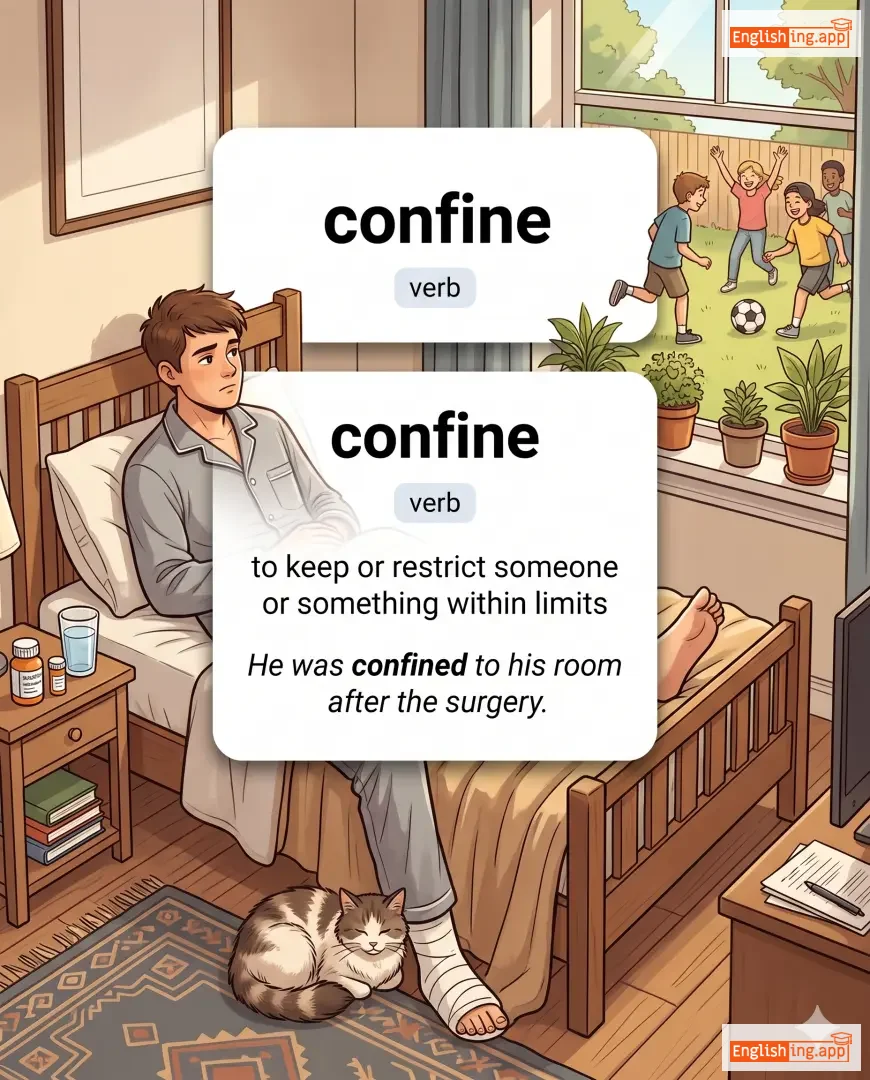
confine definition card — visual illustration of the meaning
verb
/kənˈfaɪn/
confinar (confinar)

to keep or restrict someone or something within limits

"He was confined to his room after the surgery."

"Fue confinado a su habitación después de la cirugía." (Fue confinado a su habitacion despues de la cirugia.)
noun
/kənˈfaɪnmənt/
confinamiento (confinamiento)

the state of being confined or restricted

"The prisoner endured years of confinement."

"El prisionero soportó años de confinamiento." (El prisionero soportó años de confinamiento.)
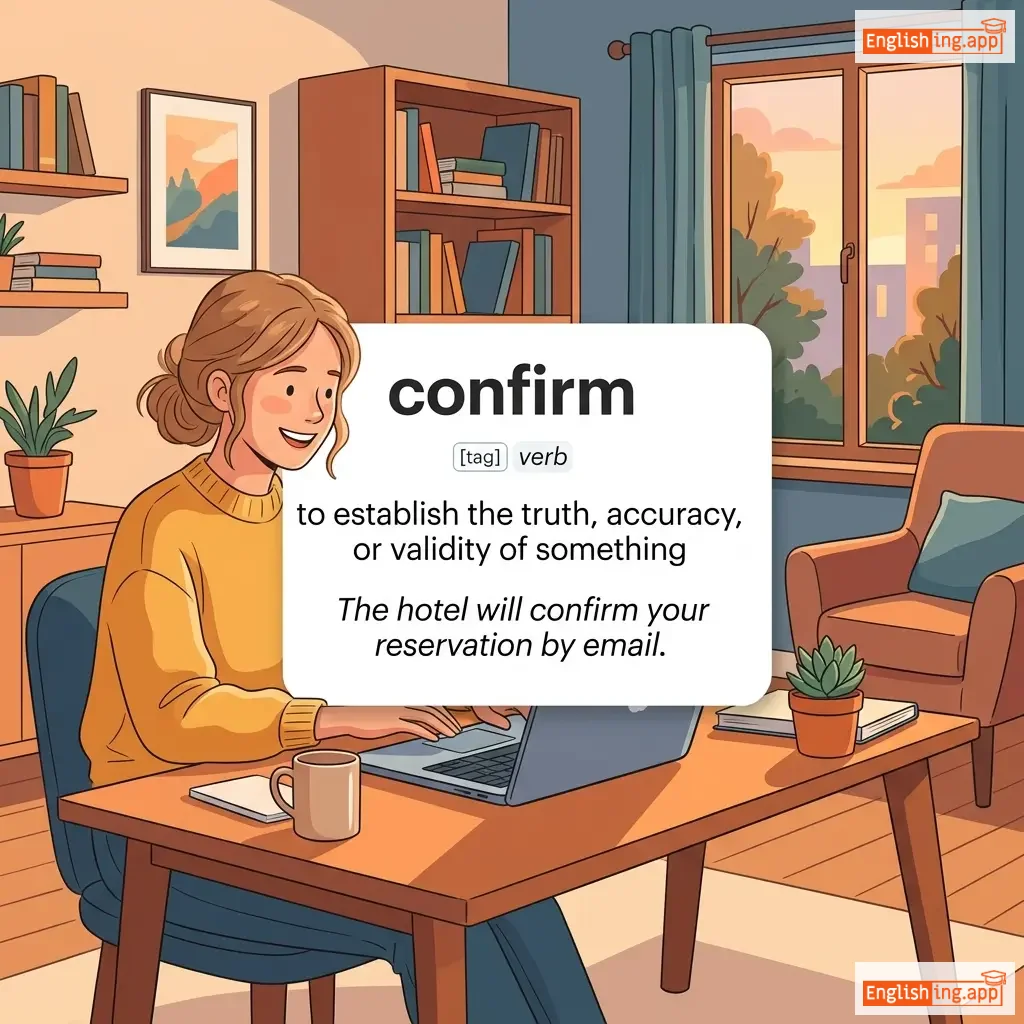
confirm definition card — visual illustration of the meaning
verb
/kənˈfɜːrm/
confirmar (confirmar)

to establish the truth, accuracy, or validity of something

"The hotel will confirm your reservation by email."

"El hotel confirmará tu reserva por correo electrónico." (El hotel confirmará tu reserva por correo electrónico.)
noun
/kənˌfɜːˈmeɪʃən/
confirmación (confirmacion)

the action of confirming something or the state of being confirmed

"She received a confirmation email for her appointment."

"Recibió un correo electrónico de confirmación para su cita." (Recibió un correo electrónico de confirmación para su cita.)
verb
/ˈkɒnfɪskeɪt/
confiscar (kon-fis-kar)

to take something away officially, often as a punishment

"The teacher confiscated the student's phone during class."

"La profesora confiscó el teléfono del estudiante durante la clase." (La profesora kon-fis-kó el te-le-fó-no del es-tu-dian-te du-ran-te la cla-se.)
noun
/ˌkɒnfləˈɡreɪʃən/
error ortográfico (de 'conflagration') (error ortografico (de 'conflagration'))

This is a common misspelling of 'conflagration', which means a large, destructive fire.

"The term 'conflagaration' is often incorrectly used instead of 'conflagration'."

"El término 'conflagaration' se usa a menudo incorrectamente en lugar de 'conflagration'." (El termino 'conflagaration' se usa a menudo incorrectamente en lugar de 'conflagration'.)
noun
/ˌkɒnfləˈɡreɪʃən/
gran incendio destructor (gran incendio destructor)

A large, destructive fire that destroys a great deal of land or property.

"The forest was devastated by a massive conflagration that lasted for days."

"El bosque fue devastado por un enorme incendio que duró varios días." (El bosque fue devastado por un enorme incendio que duró varios días.)
verb
/kənˈfleɪt/
fusionar / combinar (fusionar / combinar)

To combine two or more things, often confusingly, into one.

"The article tends to conflate facts with opinions."

"El artículo tiende a fusionar los hechos con las opiniones." (El artículo tiende a fusionar los hechos con las opiniones.)
noun
/ˈkɒnflɪkt/
conflicto (conflicto)

A serious disagreement or argument, often a prolonged one.

"The two countries are trying to resolve the conflict through negotiations."

"Los dos países están tratando de resolver el conflicto a través de negociaciones." (Los dos países están tratando de resolver el conflicto a través de negociaciones.)
conflict resolution definition card — visual illustration of the meaning
noun
/ˈkɒn.flɪkt ˌrez.əˈluː.ʃən/
resolución de conflictos (resolucion de conflictos)

The process of finding peaceful solutions to disputes or disagreements between parties.

"Conflict resolution is vital for global peace."

"La resolución de conflictos es vital para la paz global." (La resolucion de conflictos es vital para la paz global.)
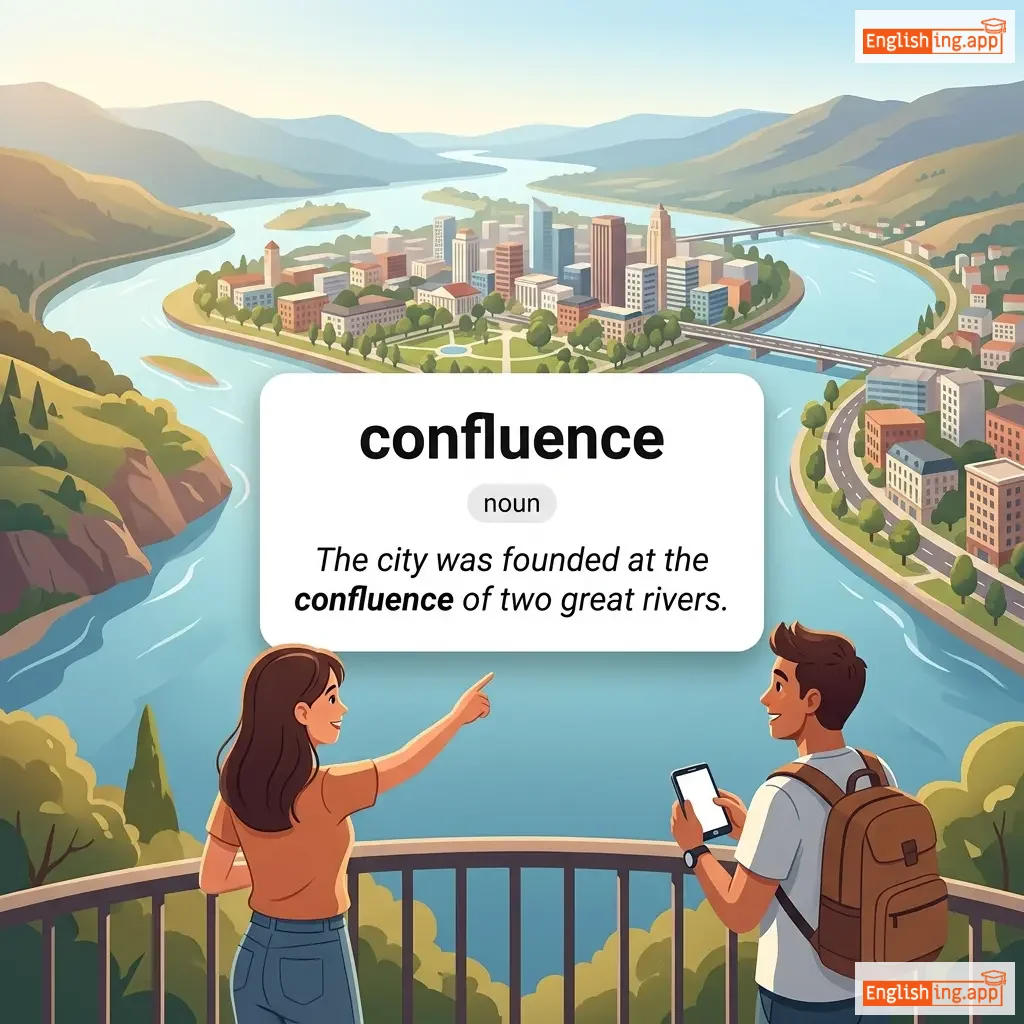
confluence definition card — visual illustration of the meaning
noun
/ˈkɒnfluəns/
confluencia (konfluensia)

The junction of two rivers; also a situation where people or things come together.

"The city was founded at the confluence of two great rivers."

"La ciudad fue fundada en la confluencia de dos grandes ríos." (La ciudad fue fundada en la konfluensia de dos grandes rios.)
adjective
/ˈkɒnfluənt/
confluente (confluente)

Flowing together or merging; coming together at one point.

"The confluent streams formed a mighty river."

"Los ríos convergentes formaron un gran río." (Los rios convergentes formaron un gran rio.)
verb
/kənˈfɔːrm/
ajustarse (ajustarse)

To comply with rules, standards, or laws.

"Students must conform to the school regulations."

"Los estudiantes deben ajustarse a las regulaciones escolares." (Los estudiantes deben ajustarse a las regulaciones escolares.)