Словари

Словарь английского языка | Значения слов, определения и примеры

noun
/ˌkɒndɛnˈseɪʃən/
конденсация (kondensatsiya)

The process of water vapor changing into liquid; also, the act of making something more concise.

"Condensation formed on the windows during the cold night."

"Конденсация образовалась на окнах в холодную ночь." (Kondensatsiya obrazovalas' na oknakh v kholodnuyu noch'.)
condense definition card — visual illustration of the meaning
verb
/kənˈdɛns/
сжать (szhat)

to make something shorter, more concentrated, or more compact

"The editor asked the writer to condense the article into one page."

"Редактор попросил писателя сократить статью до одной страницы." (Redaktor poprosil pisatelya sokratit' stat'yu do odnoi stranitzy.)
noun
/kənˈdenst mɪlk/
сгущенное молоко (sgushchennoye moloko)

milk from which water has been removed and sugar added, creating a thick, sweet product

"The recipe calls for a can of condensed milk to make the dessert extra creamy."

"Рецепт требует банку сгущенного молока, чтобы сделать десерт особенно кремовым." (Retsept trebuyet banku sgushchennogo moloka, chtoby sdelat' desert osobenno kremovym.)
verb
/ˌkɒndɪˈsɛnd/
снисходительно быть добрым (sniskhoditel'no byt' dobrym)

to behave as if one is superior while being gracious to others

"He would not condescend to answer such a trivial question."

"Он не стал бы унижаться, отвечая на такой тривиальный вопрос." (On ne stal by unizhat'sya, otvechaya na takoy triviial'nyy vopros.)
adjective
/ˌkɒndɪˈsɛndɪŋ/
снисходительный (sniskhoditel'nyy)

having or showing an attitude of patronizing superiority

"Her condescending tone upset her colleagues."

"Её снисходительный тон обидел коллег." (Yeyo sniskhoditel'nyy ton obidel kolleg.)
adjective
/ˈkɒndaɪn/
заслуженный (zasluzhennyy)

deserved, appropriate, and fitting (especially punishment)

"The criminal received condign punishment for his crimes."

"Преступник получил заслуженное наказание за свои преступления." (Prestuplnik poluchil zasluzhennoye nakazaniye za svoi prestupleniya.)
noun
/ˈkɒndɪmənt/
приправы/соус (pripravy/sous)

a substance such as salt, mustard, or ketchup that is used to add flavor to food

"Ketchup is a popular condiment in many countries."

"Кетчуп - популярная приправа во многих странах." (Ketchup - populyarnaya priprava vo mnogikh stranak.)
noun
/ˈkɒndɪmənts/
приправы или соусы (pripavy ili sousy)

Seasonings or sauces used to add flavor to food.

"Ketchup and mustard are popular condiments for burgers."

"Кетчуп и горчица популярны как приправы для бургеров." (Ketchup i gorchitsa popularny kak pripavy dlya burgerov.)
condition definition card — visual illustration of the meaning
noun
/kənˈdɪʃən/
состояние, условие (sostoyanie, uslovie)

The state of something with regard to its appearance, quality, or working order; a requirement that must be met.

"The car is in excellent condition."

"Машина в отличном состоянии." (Mashina v otlichnom sostoyanii.)
adjective
/kənˈdɪʃ.ən.əl/
условный; зависимый от условий (uslovnyy; zavisimyy ot usloviy)

dependent on certain conditions; not absolute

"The job offer is conditional upon passing the background check."

"Предложение о работе условно на основе прохождения проверки биографических данных." (Predlozhenie o rabote uslovno na osnove prokhozhdeniya proverki biograficheskikh dannykh.)
verb
/kənˈdəʊl/
выражать соболезнования (vyrazhat' soboleznovaniya)

To express sympathy for someone who is suffering or grieving.

"Neighbors came to condole with the family after the tragedy."

"Соседи пришли выразить соболезнования семье после трагедии." (Sosedi prishli vyrazhit' soboleznovaniya sem'ye posle tragedii.)
noun
/kənˈdəʊləns/
соболезнования (soboleznovaniya)

An expression of sympathy, especially on the occasion of death.

"She offered her sincere condolence to the grieving family."

"Она выразила свои искренние соболезнования семье, переживающей утрату." (Ona vyrazila svoi iskrennie soboleznovaniya sem'ye, perezhivayushchey utratu.)
condone definition card — visual illustration of the meaning
verb
/kənˈdəʊn/
прощать (proshchat)

To accept or allow behavior that is morally wrong or offensive.

"The manager refused to condone harassment in the workplace."

"Менеджер отказался кондонировать домогательства на рабочем месте." (Menedzher otkazalsya kondonirovat' domogatel'stva na rabochem meste.)
verb
/kənˈdjuːs/
способствовать (sposobstvovat)

To help bring about a particular result; to contribute to something.

"Regular exercise conduces to better health."
"Регулярные упражнения способствуют лучшему здоровью." (Regulyarnye uprazhneniya sposobstvuyut luchshemu zdorov'yu.)
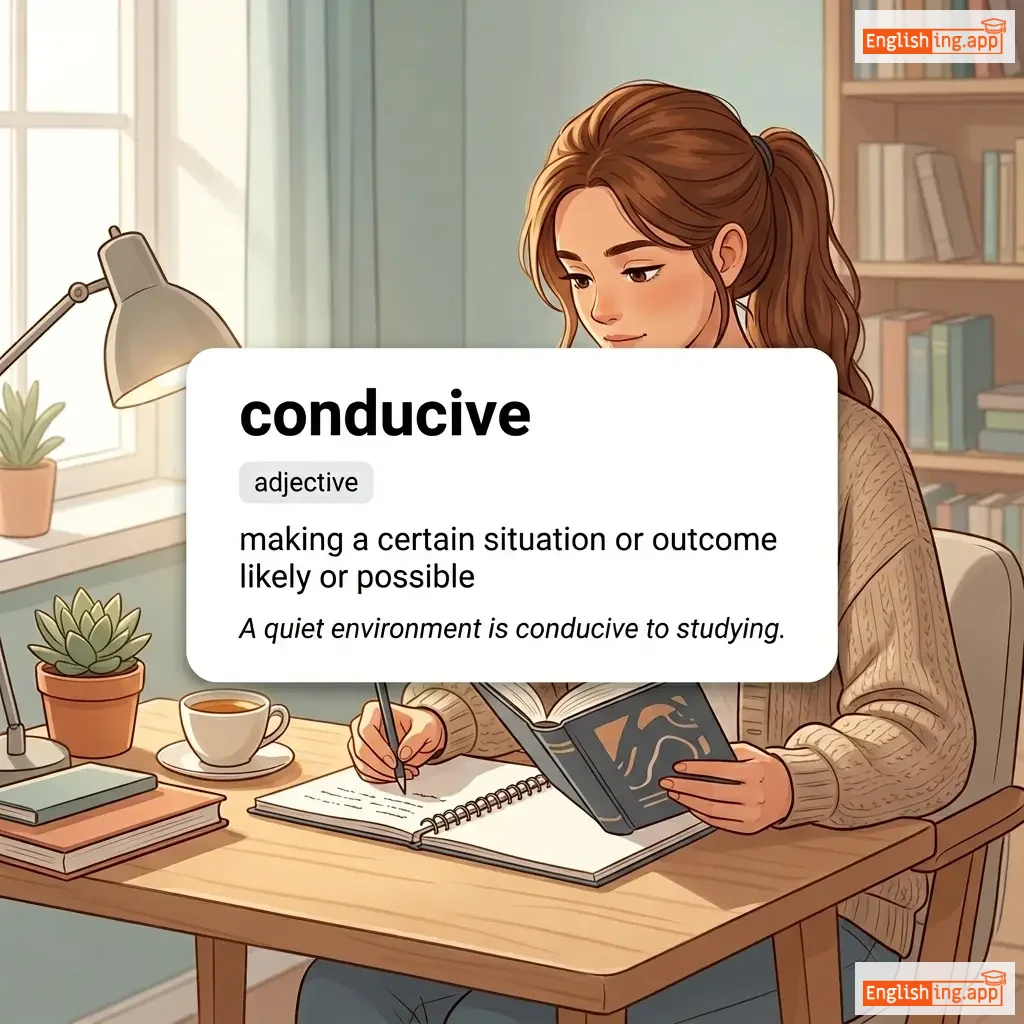
conducive definition card — visual illustration of the meaning
adjective
/kənˈdjuːsɪv/
способствующий (sposobstvuyushchiy)

making a certain situation or outcome likely or possible

"A quiet environment is conducive to studying."
"Тихая обстановка способствует учебе." (Tikhaya obstanovka sposobstvuyet uchebe.)
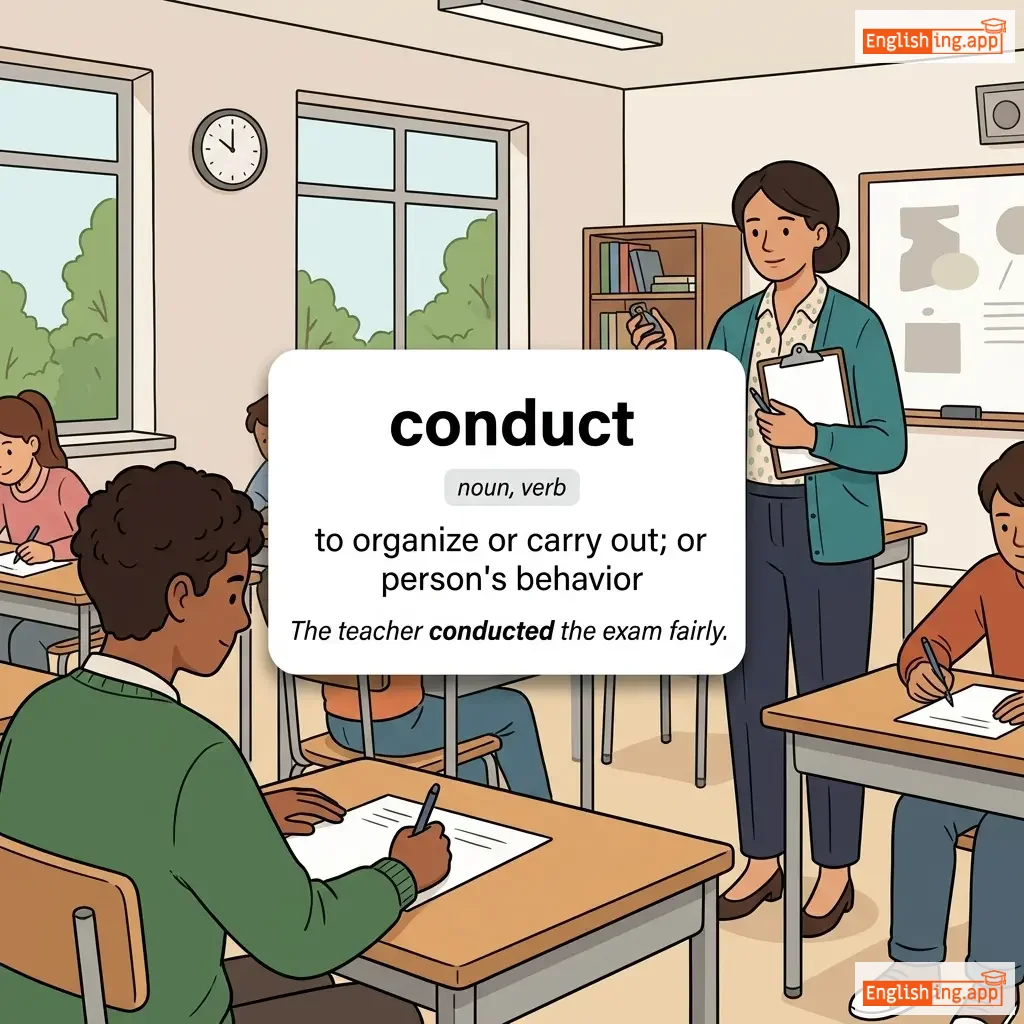
conduct definition card — visual illustration of the meaning
🧑‍🏫

conduct

noun, verb
/ˈkɒndʌkt/ (noun), /kənˈdʌkt/ (verb)

to organize or carry out; or a person's behavior

"The teacher conducted the exam fairly."

adjective
/kənˈdʌktəbl̩/
проводящий (provodyashchiy)

capable of being conducted, especially electricity or heat

"Copper is highly conductible to electricity."

"Медь отлично проводит электричество." (Med' otlichno provodit elektrichestvo.)
noun
/kənˈdʌktər/
дирижер / проводник (dirizher / provodnik)

a person who directs a performance or someone who collects fares on public transport; or a material that conducts electricity

"The conductor waved his baton to start the orchestra."

"Дирижер взмахнул своей палочкой, чтобы начать оркестр." (Dirizher vzmakhnul svoey palochkoy, chtoby nachat' orkestr.)
noun
/ˈkɒndjuɪt/ or /ˈkɑːnduɪt/
трубопровод / средство (truboprovod / sredstvo)

a channel or pipe for conveying water, electricity, or information

"The cable was placed inside a protective conduit."

"Кабель был помещен в защитный трубопровод." (Kabel' byl pomeshchen v zashchitnyy truboprovod.)
noun
/kənˈfɛkʃəneri/
кондитерские изделия (konditerskie izdeliya)

sweets, candies, and other food items made with sugar

"The shop sells a wide variety of confectionery."

"Магазин продает широкий ассортимент кондитерских изделий." (Magazin prodayot shirokiy assortimment konditerskikh izdeliy.)
noun
/kənˈfɛdərəsi/
конфедерация (konfederatsiya)

a group of states, people, or organizations united for a common purpose

"The southern states formed a confederacy during the civil war."

"Южные штаты образовали конфедерацию во время гражданской войны." (Yuzhnyye shtaty obrazovali konfederatsiyu vo vremya grazhdanskoy voyny.)
noun/adjective
/kənˈfɛdərət/
конфедерат (konfederat)

a person, group, or state joined in an alliance or union; relating to a confederacy

"The confederate soldiers fought bravely in the war."

"Конфедератские солдаты храбро сражались в войне." (Konfederatskie soldaty khrabro srazhalis' v voyne.)
verb
/kənˈfɜːr/

to discuss something important or to grant or bestow something

"The committee will confer to decide on the new policy."

noun
/ˌkɒnfəˈriː/
участник конференции (uchastnik konferentsii)

a person who takes part in a conference

"Each conferee received a badge at the registration desk."

"Каждый участник конференции получил значок на стойке регистрации." (Kazhdij uchastnik konferentsii poluchil znachok na stoyke registratsii.)
conference definition card — visual illustration of the meaning
noun
/ˈkɒnfərəns/
конференция (konferentsiya)

A formal meeting for discussion, especially about a particular subject.

"She is attending an international business conference."

"Она посещает международную бизнес-конференцию." (Ona poseschaet mezhdunarodnuyu biznes-konferentsiyu.)
confess definition card — visual illustration of the meaning
verb
/kənˈfɛs/
признавать (priznavat')

to admit that you have done something wrong or illegal

"He confessed that he had stolen the money."

"Он признался, что украл деньги." (On priznalsya, chto ukral den'gi.)
noun
/kənˈfɛʃən/
признание (priznanie)

a statement admitting that one is guilty of a crime or has done something wrong

"The suspect made a full confession to the police."

"Подозреваемый дал полное признание полиции." (Podozrevaemyy dal polnoe priznanie politsii.)
noun
/kənˈfɛsər/
исповедник (ispovednik)

A person who confesses sins or secrets, especially to a priest.

"The confessor listened patiently to the troubled man."

"Исповедник терпеливо выслушал обеспокоенного мужчину." (Ispovednik terpelivo vyslushal obespokoennogo muzhchinu.)
noun
/ˈkɒnfɪdænt/
доверенное лицо (doveryennoe litso)

A person with whom one shares a secret or private matter, trusting them not to repeat it.

"She found a true confidant in her childhood friend."

"Она нашла настоящего доверенного человека в своем друге детства." (Ona nashla nastoyashchego doveryennogo cheloveka v svoem druge detstva.)
noun
/ˌkɒnfɪˈdɑːnt/
доверенная подруга (doveryennaya podruga)

A woman with whom one shares a secret or private matter, trusting her not to repeat it.

"The queen’s maid became her most trusted confidante."

"Слуга королевы стала ее самой доверенной подругой." (Sluga korolevy stala yeye samoy doveryennoy podrugoy.)
verb
/kənˈfaɪd/

To tell someone about a secret or private matter while trusting them not to repeat it.

"He confided his worries to his best friend."

Confidence definition card — visual illustration of the meaning
noun
/ˈkɒnfɪdəns/
уверенность (uveryennost)

The feeling or belief that one can rely on someone or something; firm trust or self-assurance.

"She spoke with great confidence during the meeting."

"Она говорила с большой уверенностью на встрече." (Ona govorila s bol'shoy uverennost'yu na vstreche.)
adjective
/ˈkɒnfɪdənt/
уверенный (uverennyy)

feeling or showing certainty about something; having self-assurance

"She was confident about her ability to succeed."

"Она была уверена в своей способности преуспеть." (Ona byla uverena v svoey sposobnosti preuspet'.)
adjective
/ˌkɒnfɪˈdɛnʃl/
конфиденциальный (konfidentsial'nyi)

intended to be kept secret or private

"The lawyer shared confidential documents with her client."

"Адвокат поделился конфиденциальными документами со своим клиентом." (Advokat podelilsya konfidentsial'nymi dokumentami so svoim klientom.)
confidentiality definition card — visual illustration of the meaning
noun
ˌkɒn.fɪ.den.ʃiˈæl.ɪ.ti
конфиденциальность (konfidentsial'nost')

The state of keeping or being kept secret or private

"Confidentiality is crucial in data security."

"Конфиденциальность критична для безопасности данных." (Konfidentsial'nost' kritichna dlya bezopasnosti dannykh.)
adverb
/ˌkɒnfɪˈdenʃəli/
конфиденциально (konfidentsialno)

in a confidential manner; secretly; privately

"The information was shared confidentially between the two managers."

"Информация была передана конфиденциально между двумя менеджерами." (Informatsiya byla peredana konfidentsialno mezhdu dvumya menedzherami.)
noun
/kənˌfɪɡəˈreɪʃən/
конфигурация (konfiguratsiya)

an arrangement of parts or elements in a particular form or structure

"The configuration of the system needs to be adjusted for better performance."

"Конфигурация системы должна быть настроена для лучшей производительности." (Konfiguratsiya sistemy dolzhna byt' nastroena dlya luchshey proizvoditel'nosti.)
confine definition card — visual illustration of the meaning
verb
/kənˈfaɪn/
ограничить (ogranichit)

to keep or restrict someone or something within limits

"He was confined to his room after the surgery."

"Он был ограничен в своей комнате после операции." (On byl ogranichen v svoey komnate posle operatsii.)
noun
/kənˈfaɪnmənt/
заключение (zaklyucheniye)

the state of being confined or restricted

"The prisoner endured years of confinement."

"Заключённый выдержал годы заключения." (Zaklyuchyonnyy vyderzhal gody zaklyucheniya.)
confirm definition card — visual illustration of the meaning
verb
/kənˈfɜːrm/
подтверждать (podtverzhdat')

to establish the truth, accuracy, or validity of something

"The hotel will confirm your reservation by email."

"Отель подтвердит ваш заказ по электронной почте." (Otel' podtverdit vash zakaz po elektronnoj pochete.)
noun
/kənˌfɜːˈmeɪʃən/
подтверждение (podtverzhdeniye)

the action of confirming something or the state of being confirmed

"She received a confirmation email for her appointment."

"Она получила электронное письмо с подтверждением о своем назначении." (Ona poluchila elektronnoe pismo s podtverzhdeniem o svoem naznachenii.)
verb
/ˈkɒnfɪskeɪt/
конфисковать (konfiskovat)

to take something away officially, often as a punishment

"The teacher confiscated the student's phone during class."

"Учитель конфисковал телефон ученика во время урока." (Uchitel konfiskoval telefon uchnika vo vremya uroka)
noun
/ˌkɒnfləˈɡreɪʃən/
опечатка (от 'conflagration') (opichatka (ot 'conflagration'))

This is a common misspelling of 'conflagration', which means a large, destructive fire.

"The term 'conflagaration' is often incorrectly used instead of 'conflagration'."

"Термин 'conflagaration' часто используется неправильно вместо 'conflagration'." (Termin 'conflagaration' chasto ispol'zuetsya nepravil'no vmesto 'conflagration'.)
noun
/ˌkɒnfləˈɡreɪʃən/
большой разрушительный пожар (bol'shoy razrushitel'nyy pozhar)

A large, destructive fire that destroys a great deal of land or property.

"The forest was devastated by a massive conflagration that lasted for days."

"Лес был разрушен огромным пожаром, который продолжался несколько дней." (Les byl razrushen ogromnym pozharom, kotoryy prodolzhalsya neskol'ko dney.)
verb
/kənˈfleɪt/
сливать / объединять (slivat / ob'yedinyat)

To combine two or more things, often confusingly, into one.

"The article tends to conflate facts with opinions."

"Статья склонна смешивать факты с мнениями." (Stat'ya sklonna smeshivat' fakty s mneniyami.)
noun
/ˈkɒnflɪkt/
конфликт (konflikt)

A serious disagreement or argument, often a prolonged one.

"The two countries are trying to resolve the conflict through negotiations."

"Две страны пытаются разрешить конфликт через переговоры." (Dve strany pytayutsya razreshit' konflikt cherez peregovory.)
conflict resolution definition card — visual illustration of the meaning
noun
/ˈkɒn.flɪkt ˌrez.əˈluː.ʃən/
разрешение конфликта (razreshenie konflikta)

The process of finding peaceful solutions to disputes or disagreements between parties.

"Conflict resolution is vital for global peace."

"Разрешение конфликтов жизненно важно для глобального мира." (Razreshenie konfliktov zhizn'ennogo vazhno dlya global'nogo mira.)
confluence definition card — visual illustration of the meaning
noun
/ˈkɒnfluəns/
слияние (sliyaniye)

The junction of two rivers; also a situation where people or things come together.

"The city was founded at the confluence of two great rivers."

"Город был основан на слиянии двух великих рек." (Gorod byl osnovan na sliyanie dvukh velikikh rek.)
adjective
/ˈkɒnfluənt/
сливающийся (slivayushchijsya)

Flowing together or merging; coming together at one point.

"The confluent streams formed a mighty river."

"Сливающееся ручьи образовали мощную реку." (Slivayushchiesya ruch'yi obrazovali moshchnuyu reku.)
verb
/kənˈfɔːrm/
соблюдать (soblyudat')

To comply with rules, standards, or laws.

"Students must conform to the school regulations."

"Студенты должны соблюдать школьные правила." (Studenty dolzhny soblyudat' shkol'nye pravyla.)