
词汇表

英语词汇词典 | 单词含义、定义和示例

escalation definition card — visual illustration of the meaning
noun
ˌes.kəˈleɪ.ʃən
快速增加;上涨。 (kuài sù zēng jiā; shàng zhǎng)

A rapid increase; a rise.

"The escalation of production costs impacts profitability."

"生产成本的增加影响了盈利能力。" (Shēngchǎn chéngběn de zēngjiā yǐngxiǎng le yínglì nénglì.)
noun
/ˈɛskəpeɪd/
冒险 (màoxiǎn)

an adventurous, exciting, or reckless act

"Their summer escapade included camping and mountain climbing."

"他们的夏季冒险包括露营和登山。" (Tāmen de xiàjì màoxiǎn bāokuò lùyíng hé dēngshān.)
Escape definition card — visual illustration of the meaning
🏃‍♂️

Escape (eskeip)

verb
/ɪˈskeɪp/
逃脱 (taotuo)

To break free from confinement or control; to get away.

"The prisoner tried to escape from jail."

"囚犯试图逃脱监狱。" (Qiufan shitu taotuo jianyu.)
verb
/ɪsˈtʃuː/
避开 (bì kāi)

to deliberately avoid or abstain from something

"She chose to eschew junk food for a healthier diet."

"她选择避开垃圾食品,选择更健康的饮食。" (Tā xuǎnzé bìkāi lājī shípǐn, xuǎnzé gèng jiànkāng de yíngyǎng.)
🚶‍♂️

escort (èskòrt)

verb
/ˈɛskɔrt/
护送 (hùsòng)

to accompany someone; to guide or protect while going somewhere

"The guard escorted the visitor to the office."

"卫兵护送来访者到办公室。" (Wèibīng hùsòng láifǎng zhě dào bàngōngshì.)
noun
/ɪˈskʌtʃən/
带有家族徽章的盾牌 (dài yǒu jiāzú huīzhāng de dùn pái)

a shield or emblem bearing a coat of arms

"The family crest was displayed on the escutcheon above the fireplace."

"家族徽章展示在壁炉上方的盾牌上。" (jiāzú huīzhāng zhǎnshì zài bìlú shàngfāng de dùn pái shàng.)
esoteric definition card — visual illustration of the meaning
adjective
/ˌɛsəˈtɛrɪk/
深奥的 (shen'ao de)

intended for or understood by only a small number of people with special knowledge

"The professor gave an esoteric lecture on ancient philosophy."

"教授做了一场关于古代哲学的深奥讲座。" (Jiaoshou zuo le yi chang guanyu gudai zhexue de shen'ao jiangzuo.)
adjective
/ɪˈspeʃəl/
特别 (tebie)

Particularly remarkable or significant; distinguished from others

"This is an especial opportunity you should not miss."

"这是一个你不应错过的特别机会。" (Zhe shi yi ge ni bu ying cuoguo de tebie jihui.)
adverb
/ɪˈspɛʃəli/
尤其 (yóu qí)

Used to single out one person, thing, or situation over all others.

"I love all kinds of fruit, especially mangoes."

"我喜欢所有种类的水果,尤其是芒果。" (Wǒ xǐ huān suǒ yǒu zhǒng lèi de shuǐ guǒ, yóu qí shì máng guǒ.)
noun
/ˈɛspiənɑːʒ/
间谍活动 (jiàndié huódòng)

The practice of spying or using spies to gather secret information, usually for political or military purposes.

"The agent was arrested on charges of espionage against the state."

"该特工因涉嫌间谍活动被逮捕。" (Gāi tègōng yīn shèxián jiàndié huódòng bèi dàibǔ.)
verb
/ɪˈspaʊz/
支持 (zhīchí)

To adopt or support a cause, belief, or way of life.

"She espoused the philosophy of nonviolence throughout her career."

"她在整个职业生涯中支持了非暴力的哲学。" (Tā zài zhěnggè zhíyè shēngyá zhōng zhīchíle fēi bàolì de zhéxué.)
noun
/ɛˌspriː də ˈkɔːr/
团队精神 (tuánduì jīngshén)

A feeling of pride, fellowship, and loyalty shared by members of a group.

"The team's esprit de corps was evident in their cooperative effort."

"团队的精神在他们的合作努力中显而易见。" (Tuánduì de jīngshén zài tāmen de hézuò nǔlì zhōng xiǎn ér yìjiàn.)
verb
/ɪˈspaɪ/
看到 (kàn dào)

To catch sight of or notice something, especially from a distance.

"From the hilltop, she espied a small village in the valley."

"从山顶上,她看见了谷中的一个小村庄。" (Cóng shāndǐng shàng, tā kànjiànle gǔzhōng de yīgè xiǎo cūnzhuāng.)
noun
/ˈɛskwaɪər/
律师称号 (lüshi chenghao)

A title of respect often used after a man's name, especially for lawyers in the United States.

"John Smith, Esquire, will be representing the client in court."

"约翰·史密斯,律师称号,将在法庭上代表客户。" (Yuehan Shimi, lüshi chenghao, jiang zai fating shang daibiao kehu.)
essay definition card — visual illustration of the meaning
noun
/ˈɛseɪ/
论文 (lunwen)

A short piece of writing on a particular subject.

"She wrote an essay about climate change."

"她写了一篇关于气候变化的论文。" (Tā xiěle yī piān guānyú qìhòu biànhuà de lùnwén.)
noun
/ˈɛsəns/
本质 (benzhi)

The intrinsic nature or indispensable quality of something that determines its character.

"The essence of democracy is freedom of speech."

"民主的本质是言论自由。" (Mínzhǔ de běnzhì shì yánlùn zìyóu.)
adjective
/ɪˈsɛnʃəl/
必要的 (bì yào de)

Absolutely necessary; extremely important.

"Water is essential for life."

"水对生命至关重要。" (Shuǐ duì shēngmìng zhì guān zhòng yào.)
adverb
/ɪˈsɛnʃəli/
本质上 (ben zhi shang)

Used to emphasize the basic or fundamental nature of something.

"The two plans are essentially the same."

"这两个计划本质上是相同的。" (Zhè liǎng gè jì huà běn zhì shàng shì xiāng tóng de.)
verb
/ɪˈstæblɪʃ/
建立 (jiànlì)

To set up, create, or bring into existence something on a firm basis.

"The company plans to establish a new office in Dhaka."

"公司计划在达卡设立一个新办公室。" (Gōngsī jìhuà zài Dākǎ shèlì yīgè xīn bàngōngshì.)
established definition card — visual illustration of the meaning
verb
ɪˈstæb.lɪʃt
建立 (jiànlì)

Set up on a firm or permanent basis; having existed for a long time and therefore recognized.

"BPSC was established in 1972."

"BPSC 于 1972 年成立。" (BPSC yú 1972 nián chénglì.)
noun
/ɪˈstæblɪʃmənt/
机构 (jīgòu)

An organization, business, or system; the act of setting something up.

"The restaurant is a new establishment in town."

"餐厅是城市中新建立的机构。" (Cāntīng shì chéngshì zhōng xīn jiànlì de jīgòu.)
noun
/ɪˈsteɪt/

A large area of land, property, or possessions owned by someone, often including a big house.

"The family owned a large estate in the countryside."

noun/verb
/ɪˈstiːm/
尊敬 (zūnjìng)

Respect and admiration, typically for a person.

"She is held in high esteem by her colleagues."

"她受到了同事们的高度尊敬。" (Tā shòudàole tóngshìmen de gāodù zūnjìng.)
adjective
/ɪˈstiːmd/
尊敬的 (zunjing de)

respected and admired; held in high regard

"He is an esteemed professor at the university."

"他是大学里一位受人尊敬的教授。" (Tā shì dàxué lǐ yī wèi shòu rén zūnjìng de jiàoshòu.)
adjective
/ɛsˈθɛtɪk/
美学的 (meixuede)

Concerned with beauty or the appreciation of beauty.

"The building’s esthetic design attracted many visitors."

"建筑的美学设计吸引了许多游客。" (Jianzhu de meixuede sheji xiyin le xu duo youke.)
estimable definition card — visual illustration of the meaning
adjective
/ˈɛstɪməbl/
值得尊敬的 (zhí dé zūn jìng de)

Worthy of great respect.

"Her estimable achievements inspired the whole community."

"她值得尊敬的成就鼓舞了整个社区。" (Tā zhí dé zūn jìng de chéng jiù gǔ wǔ le zhěng gè shè qū.)
verb
/ˈɛstɪˌmeɪt/
估算 (gūsuàn)

To roughly calculate or judge the value, number, quantity, or extent of something.

"The engineer estimated the cost of the project at $5 million."

"工程师估算了项目的成本为500万美元。" (Gōngchéngshī gūsuànle xiàngmù de chéngběn wèi 500 wàn měiyuán.)
adjective
/ˈɛstɪmeɪtɪd/
估计的 (gū jì de)

roughly calculated or judged; an approximate value or amount

"The estimated cost of the project is five million dollars."

"该项目的估计成本为五百万美元。" (Gāi xiàngmù de gū jì chéngběn wèi wǔ bǎi wàn měiyuán.)
verb
/ɪˈstreɪndʒ/

to cause someone to no longer be close or affectionate; to alienate

"His constant criticism began to estrange him from his friends."

adjective
/ɪˈstreɪndʒd/
疏远 (shūyuǎn)

no longer close or affectionate with someone; alienated

"She felt estranged from her family after the long dispute."

"她在长时间的争执后感到与家人疏远。" (Tā zài cháng shíjiān de zhēngzhí hòu gǎndào yǔ jiārén shūyuǎn.)
noun
/ˈɛstjʊəri/
河口 (hékǒu)

the tidal mouth of a large river, where the tide meets the stream

"The city is located near the estuary of the river."

"这座城市位于河口附近。" (zhè zuò chéng shì wèi yú hé kǒu fù jìn.)
abbreviation
/ɛtˈsɛtərə/
等等 (deng deng)

Used to indicate additional, similar items in a list that are not mentioned.

"The shop sells fruits, vegetables, dairy, etc."

"商店出售水果、蔬菜、乳制品等等。" (Shāngdiàn chūshòu shuǐguǒ, shūcài, rǔzhìpǐn děng děng.)
adverb
/ɛtˈsɛtərə/
等等 (deng deng)

used at the end of a list to indicate that other similar items are included

"She bought apples, oranges, bananas, etcetera from the market."

"她从市场买了苹果、橙子、香蕉等等。" (Ta cong shichang mai le pingguo, chengzi, xiangjiao deng deng.)
verb
/ɛtʃ/
(ke)

to cut or carve a design onto a surface

"The artist etched her initials into the glass."

"艺术家把她的名字刻在玻璃上。" (Yishujia ba ta de mingzi ke zai boli shang.)
adjective
/ɪˈtɜːrnəl/
永恒 (yongheng)

lasting or existing forever; without end

"They pledged their eternal love for each other."

"他们誓言永远相爱。" (Tamen shi yan yongyuan xiang ai.)
ethereal definition card — visual illustration of the meaning
adjective
/ɪˈθɪəriəl/
空灵的 (kongling de)

extremely delicate, light, or airy; heavenly or otherworldly

"The dancer moved with an ethereal grace that captivated the audience."

"舞者以一种空灵的优雅动作,吸引了观众。" (Wuzhe yi zhong kongling de youya dongzuo, xiqin le guanzhong.)
noun
/ˈɛθɪk/
伦理 (lunli)

a set of moral principles, especially ones relating to a particular group, system, or profession

"He has a strong work ethic and always meets deadlines."

"他有很强的工作伦理,总是能按时完成任务。" (Ta you hen qiang de gongzuo lunli, zong shi neng an shi wancheng renwu.)
ethical definition card — visual illustration of the meaning
adjective
/ˈɛθɪkəl/
道德的 (daode de)

relating to moral principles or the right and wrong behavior

"The company follows strict ethical standards in its business practices."

"公司在其商业实践中遵循严格的道德标准。" (Gongsi zai qi shangye shijian zhong zunxun yange de daode biaozhun.)
noun
/ˈɛθɪks/
伦理 (lunli)

moral principles that govern a person's behavior or the conduct of an activity

"Business ethics require companies to act fairly and responsibly."
"商业伦理要求公司公平且负责任地行事。" (Shāngyè lúnlǐ yāoqiú gōngsī gōngpíng qiě fùzérèn de xíngshì.)
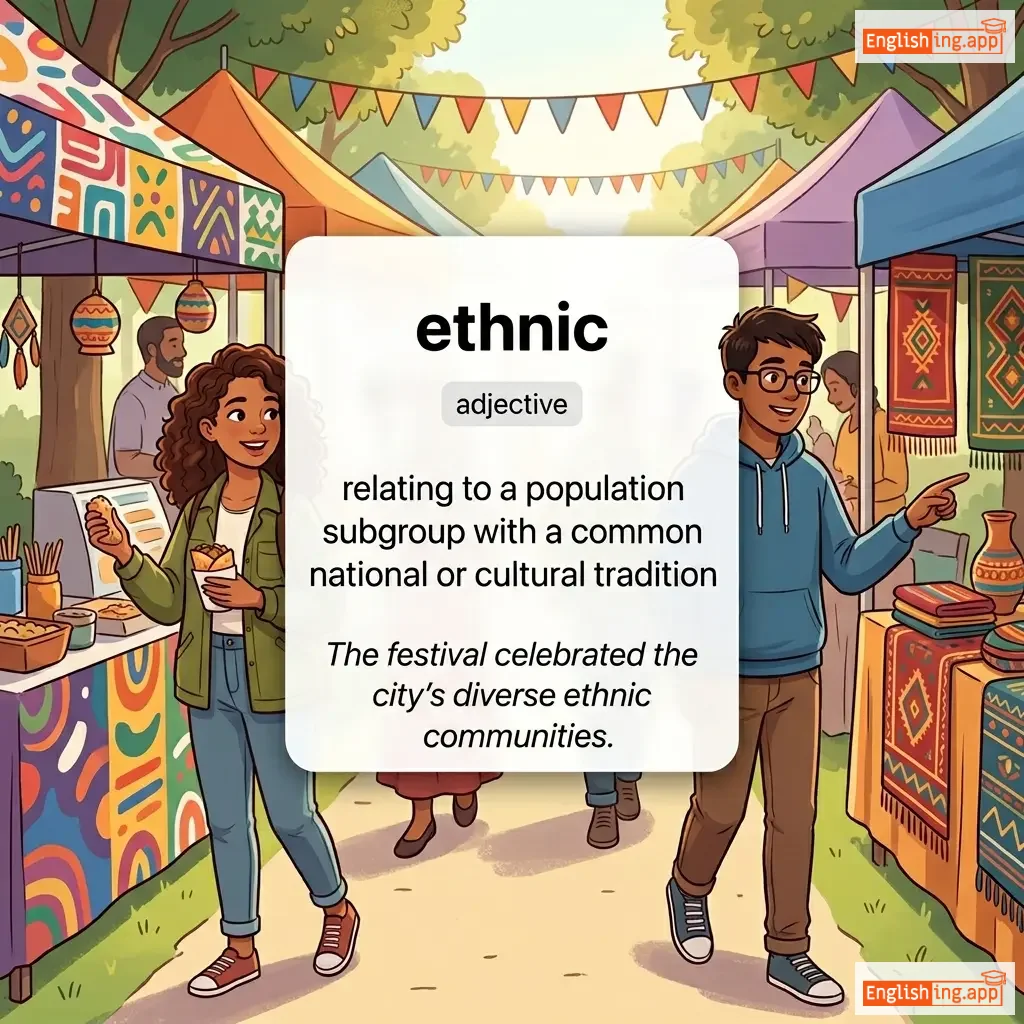
ethnic definition card — visual illustration of the meaning
adjective
/ˈɛθnɪk/
民族的 (mínzú de)

relating to a population subgroup with a common national or cultural tradition

"The festival celebrated the city's diverse ethnic communities."
"这个节日庆祝了城市中各种民族的社区。" (Zhège jiérì qìngzhùle chéngshì zhōng gè zhǒng mínzú de shèqū.)
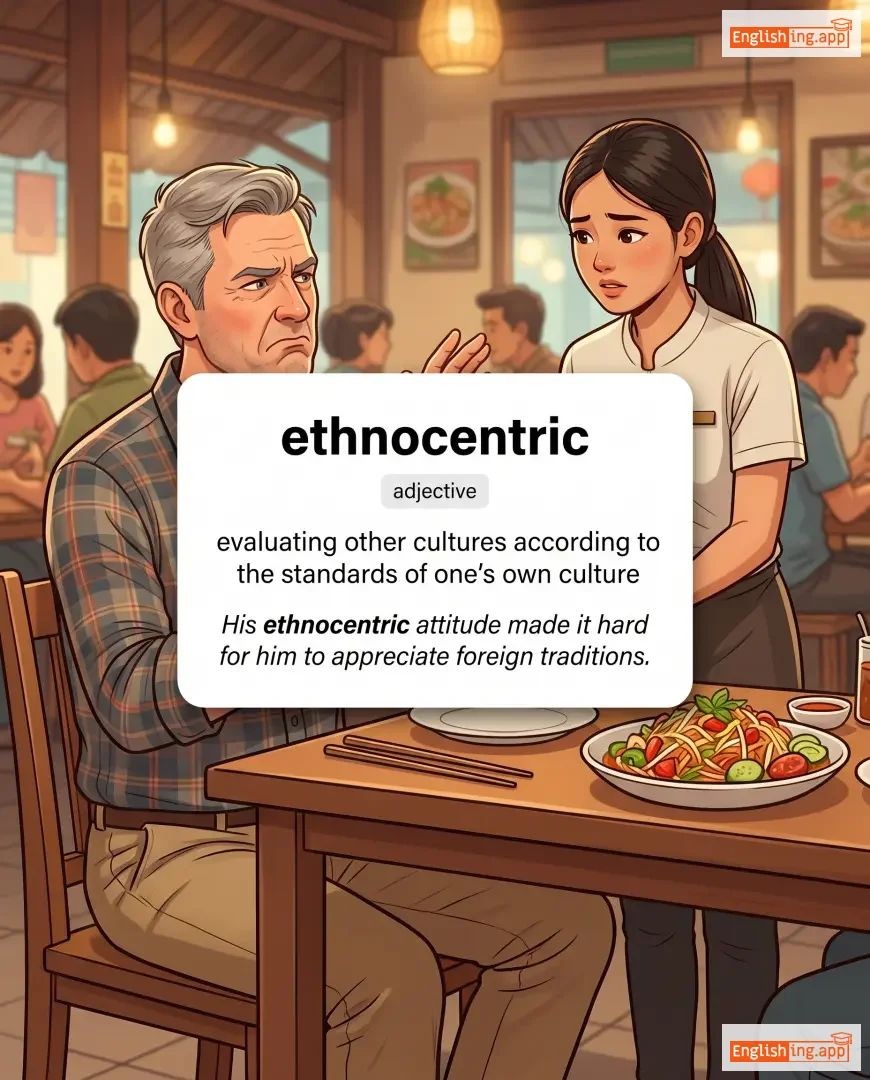
ethnocentric definition card — visual illustration of the meaning
adjective
/ˌeθ.noʊˈsen.trɪk/
民族中心主义 (minzu zhongxin zhuyi)

evaluating other cultures according to the standards of one's own culture

"His ethnocentric attitude made it hard for him to appreciate foreign traditions."

"他的民族中心主义态度让他很难欣赏外国的传统。" (Tā de mínzú zhōngxīn zhǔyì tàidù ràng tā hěn nán xīnshǎng wàiguó de chuántǒng.)
noun
/ɛθˈnɒlədʒi/
民族学 (minzuxue)

the study of the characteristics of different peoples and the differences and relationships between them

"She specialized in ethnology to better understand cultural diversity."

"她专攻民族学,以更好地理解文化多样性。" (Ta zhuangong minzuxue, yi genghao de lijie wenhua duoyangxing.)
ethos definition card — visual illustration of the meaning
noun
/ˈiːθɒs/
精神特质 (jīngshén tèzhì)

the characteristic spirit, values, or beliefs of a community, culture, or organization

"The company’s ethos emphasizes innovation and customer service."

"公司的精神特质强调创新和客户服务。" (Gōngsī de jīngshén tèzhì qiángdiào chuàngxīn hé kèhù fúwù.)
etiology definition card — visual illustration of the meaning
noun
/ˌiː.tiˈɒ.lə.dʒi/
病因学 (bìng yīn xué)

the cause or origin of a disease or condition

"Doctors are studying the etiology of the new virus."

"医生们正在研究新病毒的病因学。" (Yīshēngmen zhèngzài yánjiū xīn bìngdú de bìng yīn xué.)
noun
/ˈet.ɪ.kət/
礼仪 (li yi)

the customary code of polite behavior in society or among members of a particular profession

"Proper etiquette requires standing when a lady enters the room."

"适当的礼仪要求在女士进入房间时起立。" (shidang de liyi yaoqiu zai nushi jinru fangjian shi qili.)
etymology definition card — visual illustration of the meaning
noun
/ˌɛtɪˈmɒlədʒi/
词源学 (ciyuanxue)

The study of the origin of words and how their meanings and forms have evolved.

"The etymology of the word 'salary' comes from the Latin word for salt."

"'工资'这个词的词源来自拉丁语中的盐的词汇。" ('Gongzi' zhege ci de cuyuan laizi ladingyu zhong de yan de cihui.)
adjective
/juːˈdʒɛnɪk/
优生学 (yōushēngxué)

Relating to or aiming at improving the genetic quality of a population.

"In the early 20th century, some scientists supported eugenic policies."

"20世纪初,一些科学家支持优生学政策。" (20 shìjì chū, yīxiē kēxuéjiā zhīchí yōushēngxué zhèngcè.)
eugenics definition card — visual illustration of the meaning
noun
/juːˈdʒen.ɪks/
优生学 (youshengxue)

the study or practice of improving the genetic quality of the human population

"Eugenics has been criticized for its unethical applications in history."

"优生学因其在历史上的不道德应用而受到批评。" (Youshengxue yin qi zai lishi shang de budaode yingyong er shoudao piping.)
adjective
/ˌjuːləˈdʒɪstɪk/
赞美的 (zanmei de)

Expressing praise or admiration, often formally.

"The speaker gave a eulogistic account of the leader’s achievements."

"演讲者对领导人的成就给予了赞美的评价。" (Yanjiangzhe dui lingdaoren de chengjiu jiyule zanmei de pingjia.)
verb
/ˈjuːləˌdʒaɪz/
颂扬 (sòngyáng)

To praise highly in speech or writing, especially in honor of someone who has died.

"They gathered to eulogize their beloved teacher."

"他们聚集在一起,悼念他们亲爱的老师。" (Tāmen jùjí zài yīqǐ, dàoniàn tāmen qīn'ài de lǎoshī.)