वोकैबुलरीज

इंग्लिश वोकैबुलरी डिस्कवर, लर्न और मास्टर करें

escalation definition card — visual illustration of the meaning
noun
ˌes.kəˈleɪ.ʃən
लागत या स्थिति में तेजी से वृद्धि (laagat ya sthiti mein tezi se vruddhi)

A rapid increase; a rise.

"The escalation of production costs impacts profitability."

"उत्पादन लागत में वृद्धि लाभप्रदता पर प्रभाव डालती है।" (utpadan laagat mein vruddhi laabhpradta par prabhav daalti hai.)
noun
/ˈɛskəpeɪd/
साहसिक कार्य (sahasic karya)

an adventurous, exciting, or reckless act

"Their summer escapade included camping and mountain climbing."

"उनकी समर एस्केपेड में कैम्पिंग और पहाड़ चढ़ाई शामिल थी।" (Unki summer escapade mein camping aur pahar chadhai shamil thi.)
Escape definition card — visual illustration of the meaning
verb
/ɪˈskeɪp/
भागना (bhagna)

To break free from confinement or control; to get away.

"The prisoner tried to escape from jail."

"कैदी ने जेल से भागने की कोशिश की।" (kaidi ne jail se bhagne ki koshish ki.)
verb
/ɪsˈtʃuː/
परहेज़ करना (parhez karna)

to deliberately avoid or abstain from something

"She chose to eschew junk food for a healthier diet."

"उसने एक हेल्थी डाइट के लिए जंक फूड से परहेज़ करने का फैसला किया।" (Usne ek healthy diet ke liye junk food se parhez karne ka faisla kiya.)
verb
/ˈɛskɔrt/
साथ जाना (saath jana)

to accompany someone; to guide or protect while going somewhere

"The guard escorted the visitor to the office."

"गार्ड ने आगंतुक को कार्यालय तक एस्कॉर्ट किया।" (GaarD ne aagantuk ko kaaryaalay tak escort kiya.)
noun
/ɪˈskʌtʃən/
कोट ऑफ़ आर्म्स वाला ढाल (kot of arms wala dhal)

a shield or emblem bearing a coat of arms

"The family crest was displayed on the escutcheon above the fireplace."

"परिवार का प्रतीक चिमनी के ऊपर एस्क्यचियन पर प्रदर्शित था।" (Parivaar ka pratik chimni ke upar escutcheon par pradarshit tha.)
esoteric definition card — visual illustration of the meaning
adjective
/ˌɛsəˈtɛrɪk/
गोपनीय (gopniya)

intended for or understood by only a small number of people with special knowledge

"The professor gave an esoteric lecture on ancient philosophy."

"प्रोफेसर ने प्राचीन दर्शन पर एक गोपनीय व्याख्यान दिया।" (Professor ne prachin darshan par ek gopniya vyakhyan diya.)
adjective
/ɪˈspeʃəl/
विशेष (vishesh)

Particularly remarkable or significant; distinguished from others

"This is an especial opportunity you should not miss."

"यह एक विशेष अवसर है जिसे आपको मिस नहीं करना चाहिए।" (Yah ek vishesh avsar hai jise aapko mis nahi karna chahiye.)
adverb
/ɪˈspɛʃəli/
विशेष रूप से (vishesh roop se)

Used to single out one person, thing, or situation over all others.

"I love all kinds of fruit, especially mangoes."

"मैं सभी प्रकार के फल पसंद करता हूँ, खासकर आम।" (Main sabhi prakaar ke phal pasand karta hoon, khaaskar aam.)
noun
/ˈɛspiənɑːʒ/
जासूसी (jaasusi)

The practice of spying or using spies to gather secret information, usually for political or military purposes.

"The agent was arrested on charges of espionage against the state."

"एजेंट को राज्य के खिलाफ जासूसी के आरोप में गिरफ्तार किया गया था।" (Agent ko rajya ke khilaf jaasusi ke aarop mein giraftaar kiya gaya tha.)
verb
/ɪˈspaʊz/
समर्थन करना (samarthan karna)

To adopt or support a cause, belief, or way of life.

"She espoused the philosophy of nonviolence throughout her career."

"उसने अपने करियर में अहिंसा के सिद्धांत को स्वीकार किया।" (Usne apne career mein ahimsa ke siddhant ko sweekar kiya.)
noun
/ɛˌspriː də ˈkɔːr/
समूह भावना (samooh bhavna)

A feeling of pride, fellowship, and loyalty shared by members of a group.

"The team's esprit de corps was evident in their cooperative effort."

"टीम की समूह भावना उनके सहयोगात्मक प्रयास में स्पष्ट थी।" (Team ki samooh bhavna unke sahyogaatmak prayaas mein spashth thi.)
verb
/ɪˈspaɪ/
देखना (dekhna)

To catch sight of or notice something, especially from a distance.

"From the hilltop, she espied a small village in the valley."

"हिलटॉप से, उसने घाटी में एक छोटा गांव देखा।" (Hilltop se, usne ghaati mein ek chhota gaon dekha.)
noun
/ˈɛskwaɪər/
एस्क्वायर (esqwire)

A title of respect often used after a man's name, especially for lawyers in the United States.

"John Smith, Esquire, will be representing the client in court."

"जॉन स्मिथ, एस्क्वायर, अदालत में क्लाइंट का प्रतिनिधित्व करेंगे।" (Jon Smith, Esquire, adalat mein client ka pratinidhitva karenge.)
essay definition card — visual illustration of the meaning
noun
/ˈɛseɪ/
निबंध (nibandh)

A short piece of writing on a particular subject.

"She wrote an essay about climate change."

"उसने जलवायु परिवर्तन पर एक निबंध लिखा।" (Usne jalvayu parivartan par ek nibandh likha.)
noun
/ˈɛsəns/
सार (saar)

The intrinsic nature or indispensable quality of something that determines its character.

"The essence of democracy is freedom of speech."

"लोकतंत्र का सार भाषण की स्वतंत्रता है।" (Loktantra ka saar bhasha ki svatantrata hai.)
adjective
/ɪˈsɛnʃəl/
आवश्यक (avashyak)

Absolutely necessary; extremely important.

"Water is essential for life."

"जीवन के लिए पानी आवश्यक है।" (Jeevan ke liye pani avashyak hai.)
adverb
/ɪˈsɛnʃəli/
मूलतः (moolatah)

Used to emphasize the basic or fundamental nature of something.

"The two plans are essentially the same."

"दो योजनाएँ मूलतः एक जैसी हैं।" (Do yojnaayein moolatah ek jaisi hain.)
verb
/ɪˈstæblɪʃ/
स्थापित करना (sthapit karna)

To set up, create, or bring into existence something on a firm basis.

"The company plans to establish a new office in Dhaka."

"कंपनी ढाका में एक नया ऑफिस स्थापित करने की योजना बना रही है।" (Kampani Dhaka mein ek naya office sthapit karne ki yojana bana rahi hai.)
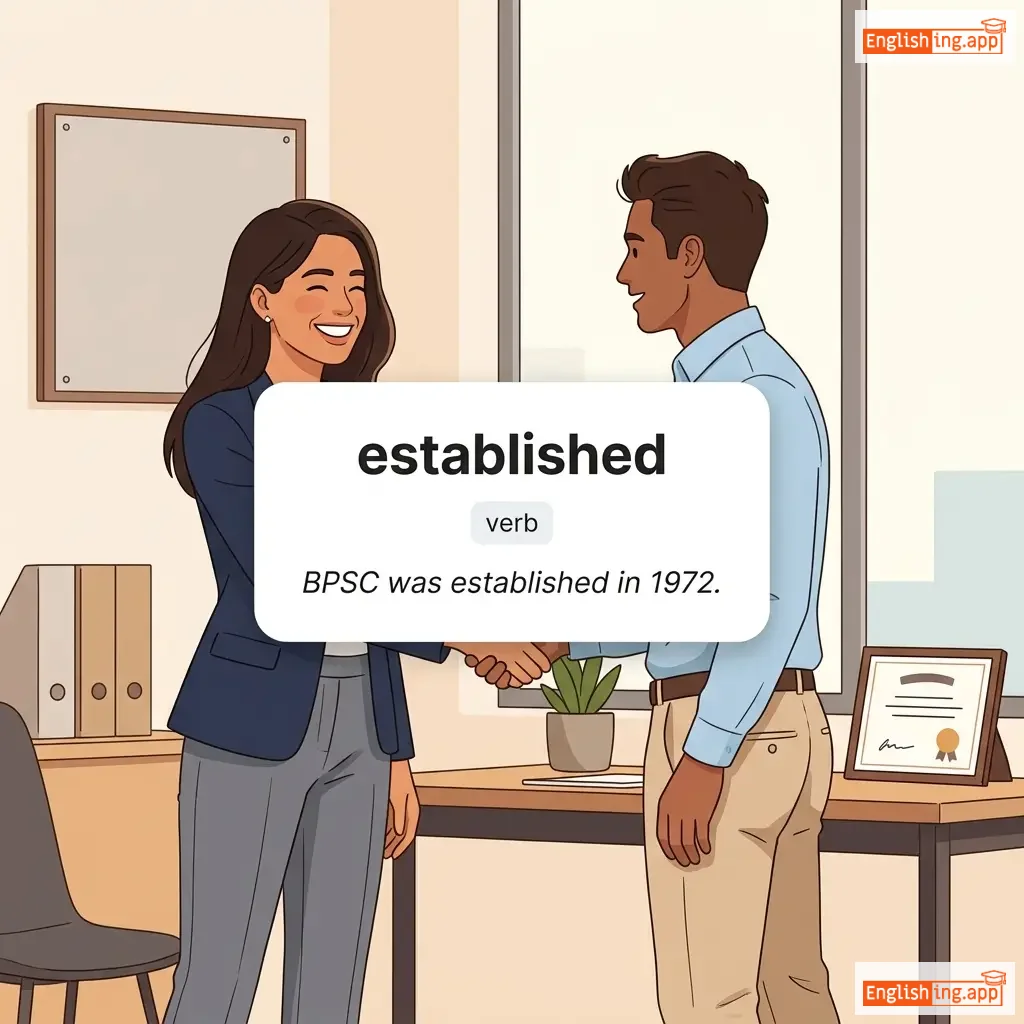
established definition card — visual illustration of the meaning
verb
ɪˈstæb.lɪʃt
स्थापित (sthapit)

Set up on a firm or permanent basis; having existed for a long time and therefore recognized.

"BPSC was established in 1972."

"BPSC 1972 में स्थापित किया गया था।" (BPSC 1972 mein sthapit kiya gaya tha.)
noun
/ɪˈstæblɪʃmənt/
संस्था (sanstha)

An organization, business, or system; the act of setting something up.

"The restaurant is a new establishment in town."

"रेस्तरां शहर में एक नया प्रतिष्ठान है।" (Restauran shahar mein ek naya pratishthan hai.)
noun
/ɪˈsteɪt/
सुख (sukh)

A large area of land, property, or possessions owned by someone, often including a big house.

"The family owned a large estate in the countryside."

"जब उसे पुरस्कार मिला, तो वह अपनी खुशी छुपा नहीं सकी।" (Jab use puraskaar mila, to wah apni khushi chhupa nahin sakee.)
noun/verb
/ɪˈstiːm/
सम्मान (sammaan)

Respect and admiration, typically for a person.

"She is held in high esteem by her colleagues."

"वह अपने सहकर्मियों द्वारा उच्च सम्मानित हैं।" (Wah apne sahkarmiyon dwara uchch sammaanit hain.)
adjective
/ɪˈstiːmd/
सम्मानित (sammanit)

respected and admired; held in high regard

"He is an esteemed professor at the university."

"वह विश्वविद्यालय में एक सम्मानित प्रोफेसर हैं।" (vah vishwavidyalay mein ek sammanit professor hain)
adjective
/ɛsˈθɛtɪk/
सौंदर्य संबंधी (saundarya sambandhi)

Concerned with beauty or the appreciation of beauty.

"The building’s esthetic design attracted many visitors."

"भवन का सौंदर्यपूर्ण डिज़ाइन कई आगंतुकों को आकर्षित किया।" (Bhavan ka saundaryapurn design kai aagantukon ko aakarshit kiya.)
estimable definition card — visual illustration of the meaning
adjective
/ˈɛstɪməbl/
सम्माननीय (sammaananiy)

Worthy of great respect.

"Her estimable achievements inspired the whole community."

"उसकी सम्मानजनक उपलब्धियाँ पूरी समुदाय को प्रेरित करती हैं।" (Uski sammaanjanik uplabdhiyan poori samudaay ko prerith karti hain.)
verb
/ˈɛstɪˌmeɪt/
अनुमान लगाना (anumaan lagana)

To roughly calculate or judge the value, number, quantity, or extent of something.

"The engineer estimated the cost of the project at $5 million."

"इंजीनियर ने परियोजना की लागत को 5 मिलियन डॉलर के रूप में अनुमानित किया।" (Engineer ne pariyojna ki lagat ko 5 million dollar ke roop mein anumanit kiya.)
adjective
/ˈɛstɪmeɪtɪd/
अनुमानित (anumanit)

roughly calculated or judged; an approximate value or amount

"The estimated cost of the project is five million dollars."

"परियोजना की अनुमानित लागत पांच मिलियन डॉलर है।" (Pariyojna ki anumanit lagat paanch million dollar hai.)
verb
/ɪˈstreɪndʒ/
परायापन करना (parayapan karna)

to cause someone to no longer be close or affectionate; to alienate

"His constant criticism began to estrange him from his friends."

"उसकी लगातार आलोचना ने उसे उसके दोस्तों से परायापन कर दिया।" (uski lagatar alochna ne use uske doston se parayapan kar diya.)
adjective
/ɪˈstreɪndʒd/
परायापन (parayapan)

no longer close or affectionate with someone; alienated

"She felt estranged from her family after the long dispute."

"वह लंबे विवाद के बाद अपने परिवार से अलग महसूस कर रही थी।" (vah lambe vivaad ke baad apne parivaar se alag mehsoos kar rahi thi.)
noun
/ˈɛstjʊəri/
नदी का मुहाना (nadi ka muhana)

the tidal mouth of a large river, where the tide meets the stream

"The city is located near the estuary of the river."

"शहर नदी के मुहाने के पास स्थित है।" (shahar nadi ke muhane ke paas sthit hai)
abbreviation
/ɛtˈsɛtərə/
आदि (aadi)

Used to indicate additional, similar items in a list that are not mentioned.

"The shop sells fruits, vegetables, dairy, etc."

"दुकान में फल, सब्जियाँ, डेरी आदि बेची जाती हैं।" (Dukaan mein phal, sabziyan, dairy aadi bechi jati hain.)
adverb
/ɛtˈsɛtərə/
आदि (aadi)

used at the end of a list to indicate that other similar items are included

"She bought apples, oranges, bananas, etcetera from the market."

"उसने बाजार से सेब, संतरा, केला, आदि खरीदे।" (usne bazaar se seb, santra, kela, aadi kharide.)
verb
/ɛtʃ/
खोदना (khodna)

to cut or carve a design onto a surface

"The artist etched her initials into the glass."

"कलाकार ने कांच में अपनी आद्याक्षर खुदवाए।" (kalakar ne kaanch mein apni adyakshar khudwaye.)
adjective
/ɪˈtɜːrnəl/
शाश्वत (shashvat)

lasting or existing forever; without end

"They pledged their eternal love for each other."

"उन्होंने एक दूसरे के लिए अपना शाश्वत प्रेम व्यक्त किया।" (unhone ek doosre ke liye apna shashvat prem vyakt kiya.)
ethereal definition card — visual illustration of the meaning
adjective
/ɪˈθɪəriəl/
आध्यात्मिक (aadhyatmik)

extremely delicate, light, or airy; heavenly or otherworldly

"The dancer moved with an ethereal grace that captivated the audience."

"नर्तकी ने एक आध्यात्मिक grace के साथ गति की, जिसने दर्शकों को मंत्रमुग्ध कर दिया।" (Nartaki ne ek aadhyatmik grace ke saath gati ki, jismein darshako ko mantrmugdh kar diya.)
noun
/ˈɛθɪk/
नैतिकता (naitikata)

a set of moral principles, especially ones relating to a particular group, system, or profession

"He has a strong work ethic and always meets deadlines."

"उसके पास एक मजबूत कार्य नैतिकता है और वह हमेशा समय पर अपने काम को पूरा करता है।" (Uske paas ek majboot kary naitikata hai aur vah hamesha samay par apne kaam ko poora karta hai.)
ethical definition card — visual illustration of the meaning
adjective
/ˈɛθɪkəl/
नैतिक (naitik)

relating to moral principles or the right and wrong behavior

"The company follows strict ethical standards in its business practices."

"कंपनी अपने व्यापारिक अभ्यासों में कड़े नैतिक मानकों का पालन करती है।" (Kampani apne vyaparik abhyason mein kade naitik maankon ka paalan karti hai.)
noun
/ˈɛθɪks/
नैतिकता (naitikata)

moral principles that govern a person's behavior or the conduct of an activity

"Business ethics require companies to act fairly and responsibly."

"व्यावसायिक नैतिकता कंपनियों से अपेक्षाएँ करती हैं कि वे निष्पक्ष और जिम्मेदार तरीके से कार्य करें।" (vyavsayik naitikata kampaniyon se apekshaen karti hain ki ve nishpaksh aur jimmedar tareeke se kaary karein.)
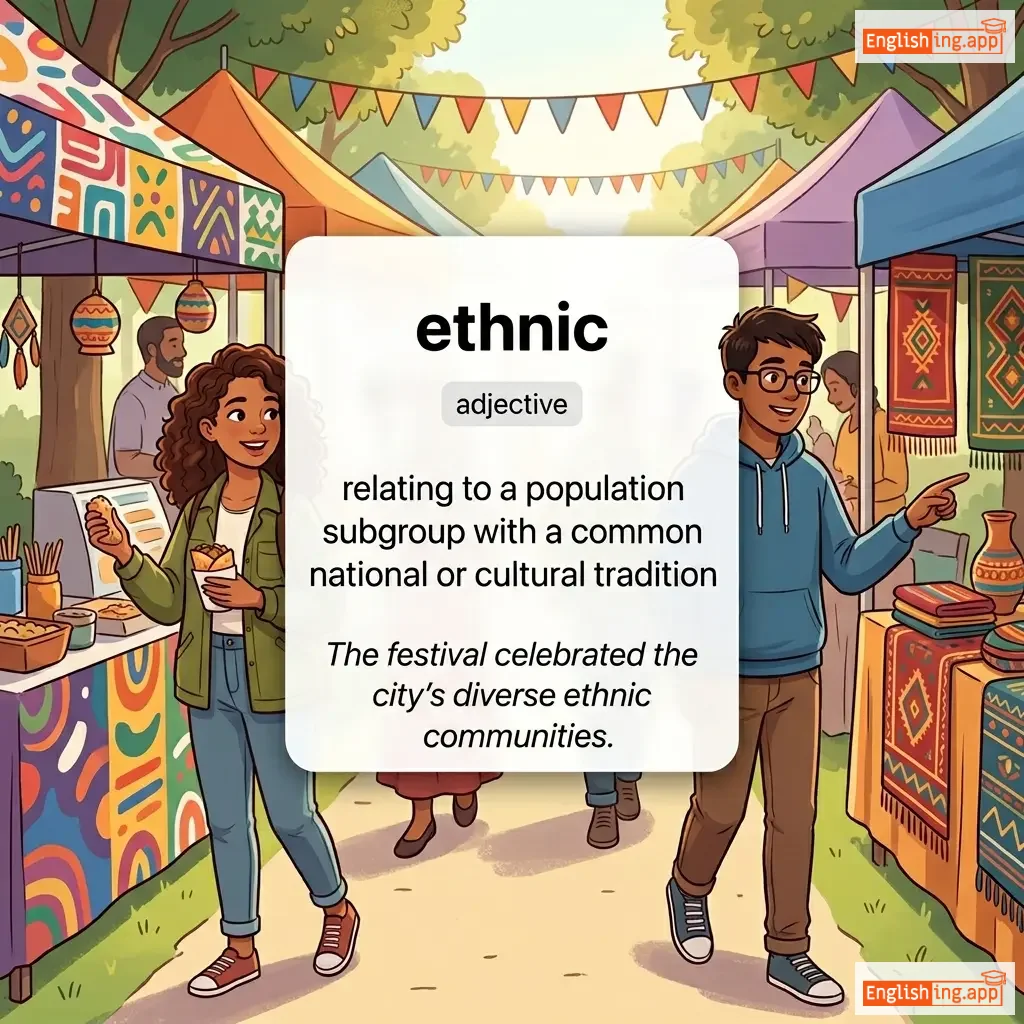
ethnic definition card — visual illustration of the meaning
adjective
/ˈɛθnɪk/
जातीय (jaatiy)

relating to a population subgroup with a common national or cultural tradition

"The festival celebrated the city's diverse ethnic communities."

"त्योहार ने शहर के विविध जातीय समुदायों का उत्सव मनाया।" (Tyohar ne shahar ke vividh jaatiy samudaayon ka utsav manaya.)
ethnocentric definition card — visual illustration of the meaning
adjective
/ˌeθ.noʊˈsen.trɪk/
जातिवादी आत्मकेंद्रित (jatavadi atmendrit)

evaluating other cultures according to the standards of one's own culture

"His ethnocentric attitude made it hard for him to appreciate foreign traditions."

"उसका जातिवादी आत्मकेंद्रित दृष्टिकोण उसे विदेशी परंपराओं की सराहना करने में मुश्किल बनाता था।" (Uska jatavadi atmendrit drishtikon use videshi paramparaon ki sarahna karne mein mushkil banata tha.)
noun
/ɛθˈnɒlədʒi/
नृविज्ञान (nrivigyan)

the study of the characteristics of different peoples and the differences and relationships between them

"She specialized in ethnology to better understand cultural diversity."

"वह सांस्कृतिक विविधता को बेहतर समझने के लिए नृविज्ञान में विशेषज्ञता प्राप्त करती थीं।" (Wah sanskritik vividhta ko behtar samajhne ke liye nrivigyan mein visheshagyaata praapt karti thin.)
ethos definition card — visual illustration of the meaning
noun
/ˈiːθɒs/
आदर्श (aadarshe)

the characteristic spirit, values, or beliefs of a community, culture, or organization

"The company’s ethos emphasizes innovation and customer service."

"कंपनी का आदर्श नवाचार और ग्राहक सेवा पर जोर देता है।" (Kampani ka aadarsh navaachar aur grahak seva par zor deta hai.)
etiology definition card — visual illustration of the meaning
noun
/ˌiː.tiˈɒ.lə.dʒi/
कारणशास्त्र (karanshastra)

the cause or origin of a disease or condition

"Doctors are studying the etiology of the new virus."

"डॉक्टर नई वायरस की इटियोलॉजी का अध्ययन कर रहे हैं।" (Doktar nai virus ki itiology ka adhyayan kar rahe hain.)
noun
/ˈet.ɪ.kət/
शिष्टाचार (shishtachar)

the customary code of polite behavior in society or among members of a particular profession

"Proper etiquette requires standing when a lady enters the room."

"सही शिष्टाचार में एक महिला के कमरे में प्रवेश करते समय खड़ा होना शामिल है।" (sahi shishtachar mein ek mahila ke kamre mein pravesh karte samay khada hona shamil hai.)
etymology definition card — visual illustration of the meaning
noun
/ˌɛtɪˈmɒlədʒi/
शब्दविज्ञान (shabdvigyan)

The study of the origin of words and how their meanings and forms have evolved.

"The etymology of the word 'salary' comes from the Latin word for salt."

"'Salary' शब्द की उत्पत्ति लैटिन शब्द 'salt' से हुई है।" ('Salary' shabd ki utpatti Latin shabd 'salt' se hui hai.)
adjective
/juːˈdʒɛnɪk/
युगेनिक (yugenik)

Relating to or aiming at improving the genetic quality of a population.

"In the early 20th century, some scientists supported eugenic policies."

"20वीं सदी की शुरुआत में कुछ वैज्ञानिकों ने युगेनिक नीतियों का समर्थन किया था।" (20vi sadi ki shuruat mein kuch vaigyanikon ne yugenik neetiyon ka samarthan kiya tha.)
eugenics definition card — visual illustration of the meaning
noun
/juːˈdʒen.ɪks/
यूजेनिक्स (yugeniks)

the study or practice of improving the genetic quality of the human population

"Eugenics has been criticized for its unethical applications in history."

"यूजेनिक्स को इसके अनैतिक उपयोगों के लिए इतिहास में आलोचना की गई है।" (Yugeniks ko iske anaitik upyogon ke liye itihas mein alochna ki gayi hai.)
adjective
/ˌjuːləˈdʒɪstɪk/
प्रशंसा संबंधी (prashansa sambandhi)

Expressing praise or admiration, often formally.

"The speaker gave a eulogistic account of the leader’s achievements."

"वक्ता ने नेता की उपलब्धियों का प्रशंसा संबंधी वर्णन किया।" (Vaktaa ne neta ki uplabdhiyon ka prashansa sambandhi varnan kiya.)
verb
/ˈjuːləˌdʒaɪz/
प्रशंसा करना (prashansa karna)

To praise highly in speech or writing, especially in honor of someone who has died.

"They gathered to eulogize their beloved teacher."

"वे अपने प्रिय शिक्षक की प्रशंसा करने के लिए इकट्ठा हुए।" (Ve apne priy shikshak ki prashansa karne ke liye ikattha hue.)