वोकैबुलरीज

इंग्लिश वोकैबुलरी डिस्कवर, लर्न और मास्टर करें

verb
/ɪkˈskluːd/
बाहर करना (baahar karna)

To deliberately leave out or prevent someone or something from being included.

"The list excludes temporary workers."

"सूची अस्थायी श्रमिकों को बाहर करती है।" (soochi asthaayi shramikon ko baahar karti hai.)
adjective
/ɪkˈskluːdɪd/
बाहर किया हुआ; बहिष्कृत (baahar kiya hua; bahishkrit)

not included; left out; barred from participation

"He felt excluded from the group activities and conversations."

"वह समूह की गतिविधियों और बातचीत से बाहर महसूस कर रहा था।" (vah samooh ki gatividhiyon aur baatcheet se baahar mahsus kar raha tha.)
noun
/ɪkˈskluːʒən/
बहिष्करण (bahishkaran)

The process or state of being left out or denied access.

"The policy led to the exclusion of certain groups."

"नीति ने कुछ समूहों के बहिष्करण की ओर अग्रसर किया।" (Neeti ne kuch samoohon ke bahishkaran ki aur agrasar kiya.)
adjective
/ɪkˈskluːsɪv/
विशेष, विशेष रूप से एक व्यक्ति, समूह, या क्षेत्र के लिए प्रतिबंधित; दूसरों के साथ साझा नहीं किया गया (vishesh, vishesh roop se ek vyakti, samuh, ya kshetra ke liye pratibandhit; doosron ke saath saanjha nahi kiya gaya)

restricted to a particular person, group, or area; not shared with others

"The hotel offers exclusive access to a private beach."

"होटल एक निजी समुद्र तट तक विशेष पहुँच प्रदान करता है।" (Hotel ek niji samudra tat tak vishesh pahuch pradan karta hai.)
adverb
/ɪkˈskluːsɪvli/
केवल; दूसरों के साथ साझा नहीं किया गया (keval; doosron ke saath saajha nahin kiya gaya)

only; not shared with others

"This service is available exclusively to premium members."

"यह सेवा केवल प्रीमियम सदस्यों के लिए उपलब्ध है।" (Yeh seva keval premium sadasyon ke liye upalabdh hai.)
verb
/ɛkˈskɔːrieɪt/
कड़ी आलोचना करना (kadi alochana karna)

To strongly criticize someone; to denounce severely.

"The critic excoriated the film for its poor script."

"समीक्षक ने फिल्म को उसके खराब पटकथा के लिए कड़ी आलोचना की।" (Sameekshak ne film ko uske kharab pataktha ke liye kadi alochana ki.)
noun
/ɪkˈskrɛsəns/
असामान्य वृद्धि (asaamany vruddhi)

An abnormal outgrowth or lump, often considered unattractive.

"The building was considered an excrescence on the landscape."

"इमारत को परिदृश्य पर एक असामान्य वृद्धि माना गया था।" (Imaarat ko paridrishya par ek asaamany vruddhi maana gaya tha.)
verb
/ɪkˈskriːt/
उत्सर्जन करना (utsarjan karna)

to eliminate waste matter from the body

"Humans excrete carbon dioxide through breathing."

"मनुष्य श्वसन के माध्यम से कार्बन डाइऑक्साइड बाहर निकालते हैं।" (Manushya shwason ke madhyam se carbon dioxide baahar nikaalte hain.)
noun
/ɪkˈskriːʃən/
निष्कासन (nishkasan)

the process of eliminating waste matter from the body

"Excretion is vital for maintaining a healthy body."

"निष्कासन एक स्वस्थ शरीर बनाए रखने के लिए आवश्यक है।" (Nishkasan ek sustho sharir banaye rakhne ke liye avashyak hai.)
verb
/ɪkˈskruːʃieɪt/
तीव्र पीड़ा देना (teevra peeda dena)

to cause intense pain or suffering

"The injury excruciated him with unbearable pain."

"चोट ने उसे असहनीय दर्द दिया।" (Chot ne use asahniya dard diya.)
adjective
/ɪkˈskruːʃieɪtɪŋ/
असहनीय पीड़ादायक (asahniya peedadayak)

causing extreme physical or mental pain

"She was in excruciating pain after the accident."

"वह दुर्घटना के बाद असहनीय दर्द में थी।" (Woh durghatna ke baad asahniya dard mein thi.)
exculpate definition card — visual illustration of the meaning
verb
/ˈɛkskʌlpeɪt/
दोषमुक्त करना (doshmukto karna)

to show or declare that someone is not guilty of wrongdoing

"The lawyer worked hard to exculpate his client."

"वकील ने अपने मुवक्किल को दोषमुक्त करने के लिए कड़ी मेहनत की।" (Vakeel ne apne muvakil ko doshmukto karne ke liye kadi mehnat ki.)
noun
/ɪkˈskɜːʒən/
सफर (safar)

A short journey or trip, especially one taken for leisure or educational purposes.

"The students went on an excursion to the national museum."

"छात्रों ने राष्ट्रीय संग्रहालय की ओर एक यात्रा की।" (Chhatron ne rashtriya sangrahalay ki or ek yatra ki.)
adjective
/ɪkˈskɜːsɪv/
विचलित (vichalit)

Tending to digress or wander; moving away from the main subject.

"His excursive lecture left the students confused about the main topic."

"उसका विचलित व्याख्यान छात्रों को मुख्य विषय से भ्रमित कर दिया।" (Uska vichalit vyakhyan chhatron ko mukhya vishay se bhramit kar diya.)
adjective
/ɪkˈskjuːzəbl/
क्षम्य (kshamya)

Able to be forgiven or justified.

"Her mistake was excusable given the circumstances."

"उसकी गलती परिस्थितियों को देखते हुए क्षम्य थी।" (Uski galti paristhitiyon ko dekhte hue kshamya thi.)
verb
/ɪkˈskjuːz/
माफ करना, बहाना बनाना (maaf karna, bahaana banana)

to forgive someone for doing something wrong or to justify an action

"Please excuse my lateness; there was heavy traffic."

"कृपया मेरी देर के लिए माफ करें; भारी ट्रैफिक था।" (Kripya meri der ke liye maaf karein; bhaari traffic tha.)
execrable definition card — visual illustration of the meaning
adjective
/ˈeksɪkrəbl/
अत्यंत घृणित (atyant ghrinit)

Extremely bad or unpleasant.

"The movie was so execrable that many people left the theater early."

"यह फिल्म इतनी घृणित थी कि कई लोग जल्दी ही सिनेमा हॉल से बाहर चले गए।" (Yeh film itni ghrinit thi ki kai log jaldi hi cinema hall se bahar chale gaye.)
verb
/ˈeksɪkreɪt/
नफ़रत करना (nafrat karna)

To feel or express great loathing or hatred for something.

"The community execrated the corrupt politician."

"समुदाय ने भ्रष्ट राजनेता की निंदा की।" (Samuday ne bhrasht rajneta ki ninda ki.)
noun
/ˌɛksɪˈkreɪʃən/
निंदा (ninda)

An act of cursing or denouncing someone or something with hatred.

"The dictator’s name was spoken with execration after his fall."

"स्वतंत्रता के बाद डिक्टेटर का नाम निंदा के साथ उच्चारित किया गया।" (Svatantrata ke baad dictator ka naam ninda ke saath uccharit kiya gaya.)
execute definition card — visual illustration of the meaning
verb
/ˈɛksɪkjuːt/
अंजाम देना (anjam dena)

To carry out a plan, order, or action; to perform or put into effect.

"The company plans to execute its new strategy next year."

"कंपनी अगले साल अपनी नई रणनीति को कार्यान्वित करने की योजना बना रही है।" (Company agle saal apni nai rananiti ko karyanvit karne ki yojana bana rahi hai.)
noun
/ˌɛksɪˈkjuːʃən/
निष्पादन, क्रियान्वयन (nishpadan, kriyanvayan)

the act of carrying out a plan, order, or legal sentence

"The success of a project depends on its proper execution."

"एक परियोजना की सफलता इसके उचित निष्पादन पर निर्भर करती है।" (Ek pariyojna ki safalta iske uchit nishpadan par nirbhar karti hai.)
noun
/ˌɛksɪˈkjuːʃənər/
निर्वाहक (nirvahak)

A person who carries out a death sentence by execution.

"The executioner prepared the gallows for the condemned prisoner."

"निर्वाहक ने सजायाफ्ता क़ैदी के लिए फांसी का तख़्ता तैयार किया।" (Nirvahak ne saza yafta qaidi ke liye fansi ka takhta tayar kiya.)
executive definition card — visual illustration of the meaning
noun/adjective
/ɪɡˈzɛkjətɪv/
प्रमुख अधिकारी (pramukh adhikari)

A person with senior managerial responsibility in a business; relating to the execution of plans or laws.

"She works as an executive in a multinational company."

"वह एक बहुराष्ट्रीय कंपनी में एक्जीक्यूटिव के रूप में काम करती है।" (Wah ek bahurashtriya company mein executive ke roop mein kaam karti hai.)
noun
/ɪɡˈzɛkjətər/
वसीयत कार्यान्वयनकर्ता (vasiayat karyanvayankarta)

A person appointed to carry out the terms of someone's will after their death.

"The executor managed the estate according to the deceased’s wishes."

"वसीयत कार्यान्वयनकर्ता ने मृतक की इच्छाओं के अनुसार संपत्ति का प्रबंधन किया।" (Vasiayat karyanvayankarta ne mritak ki ichchhaon ke anusar sampatti ka prabandhan kiya.)
noun
/ˌɛksəˈdʒiːsɪs/
व्याख्या (vyakhya)

A critical explanation or interpretation of a text, especially a religious scripture.

"The professor gave a detailed exegesis of the biblical passage."

"प्रोफेसर ने बाइबिलिक पाठ का एक विस्तृत व्याख्यान दिया।" (Professor ne baibilik path ka ek vistaarit vyakhyaan diya.)
noun
/ɪɡˈzɛmplɑːr/
आदर्श (aadarsh)

A model or pattern to be copied or imitated.

"She is an exemplar of kindness and generosity."

"वह दया और उदारता की एक आदर्श है।" (Woh daya aur udarta ki ek aadarsh hai.)
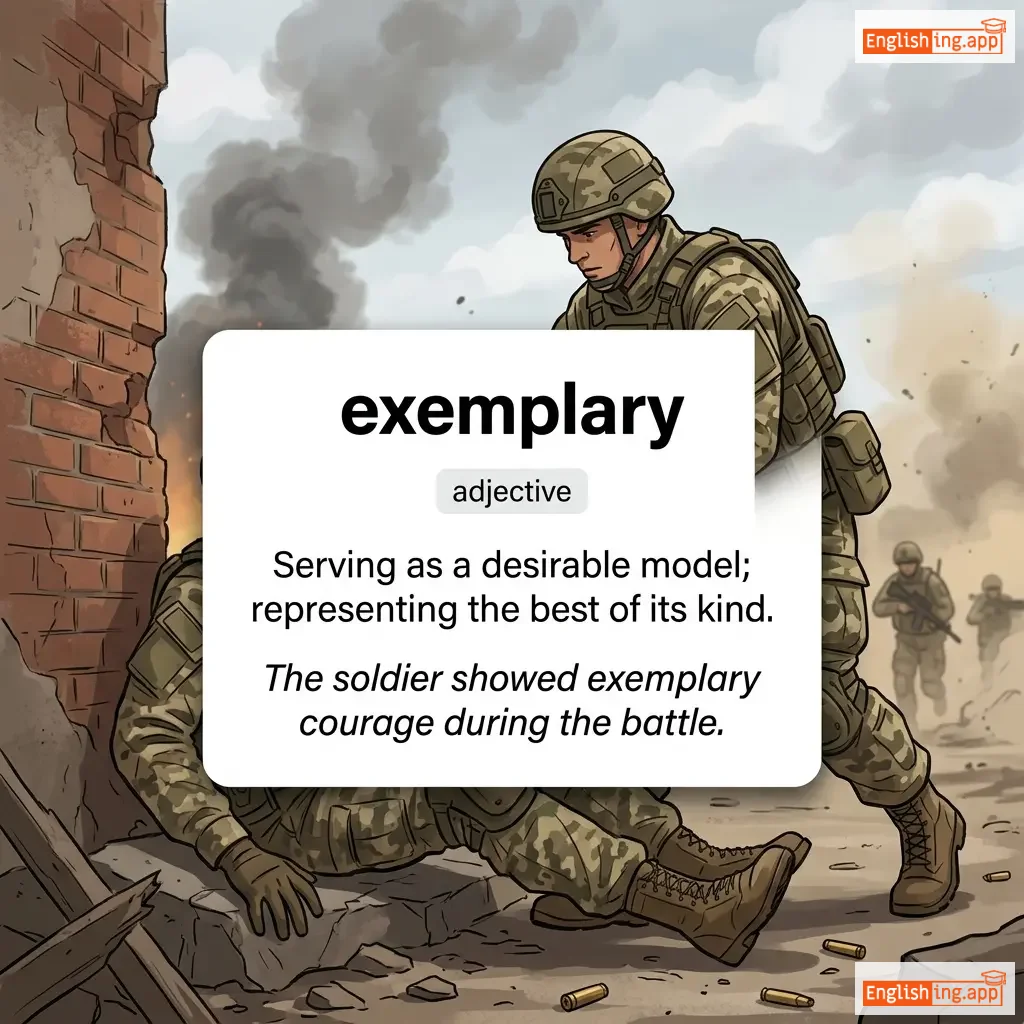
exemplary definition card — visual illustration of the meaning
adjective
/ɪɡˈzɛmpləri/
उदाहरणीय (udaharanīya)

Serving as a desirable model; representing the best of its kind.

"The soldier showed exemplary courage during the battle."

"सैनिक ने युद्ध के दौरान उदाहरणीय साहस दिखाया।" (Sainik ne yudh ke dauran udaharanīya sahas dikhaya.)
exemplify definition card — visual illustration of the meaning
verb
/ɪɡˈzɛmplɪfaɪ/
उदाहरण द्वारा स्पष्ट करना (udaharan dwara spasht karna)

To illustrate or clarify by giving an example.

"Her actions exemplify the true spirit of generosity."

"उसकी क्रियाएँ उदारता की असली भावना को स्पष्ट करती हैं।" (Uski kriyaen udarta ki asli bhavana ko spasht karti hain.)
adjective, verb
/ɪɡˈzɛmpt/
मुक्त (mukt)

Free from an obligation or liability imposed on others.

"Students with high grades are exempt from the final exam."

"उच्च ग्रेड वाले छात्र अंतिम परीक्षा से मुक्त होते हैं।" (Ucch grade wale chhatra antim pariksha se mukt hote hain.)
exercise definition card — visual illustration of the meaning
noun/verb
/ˈɛksərsaɪz/
व्यायाम (vyayam)

Physical activity done to maintain or improve health and fitness.

"She does exercise every morning."

"वह हर सुबह व्यायाम करती है।" (vah har subah vyayam karti hai.)
exert definition card — visual illustration of the meaning
verb
/ɪɡˈzɜːrt/
प्रयास करना (prayas karna)

to apply effort, force, or influence

"He had to exert himself to finish the project on time."

"उसे परियोजना समय पर पूरा करने के लिए अपनी पूरी कोशिश करनी पड़ी।" (Use pariyojna samay par poora karne ke liye apni puri koshish karni padi.)
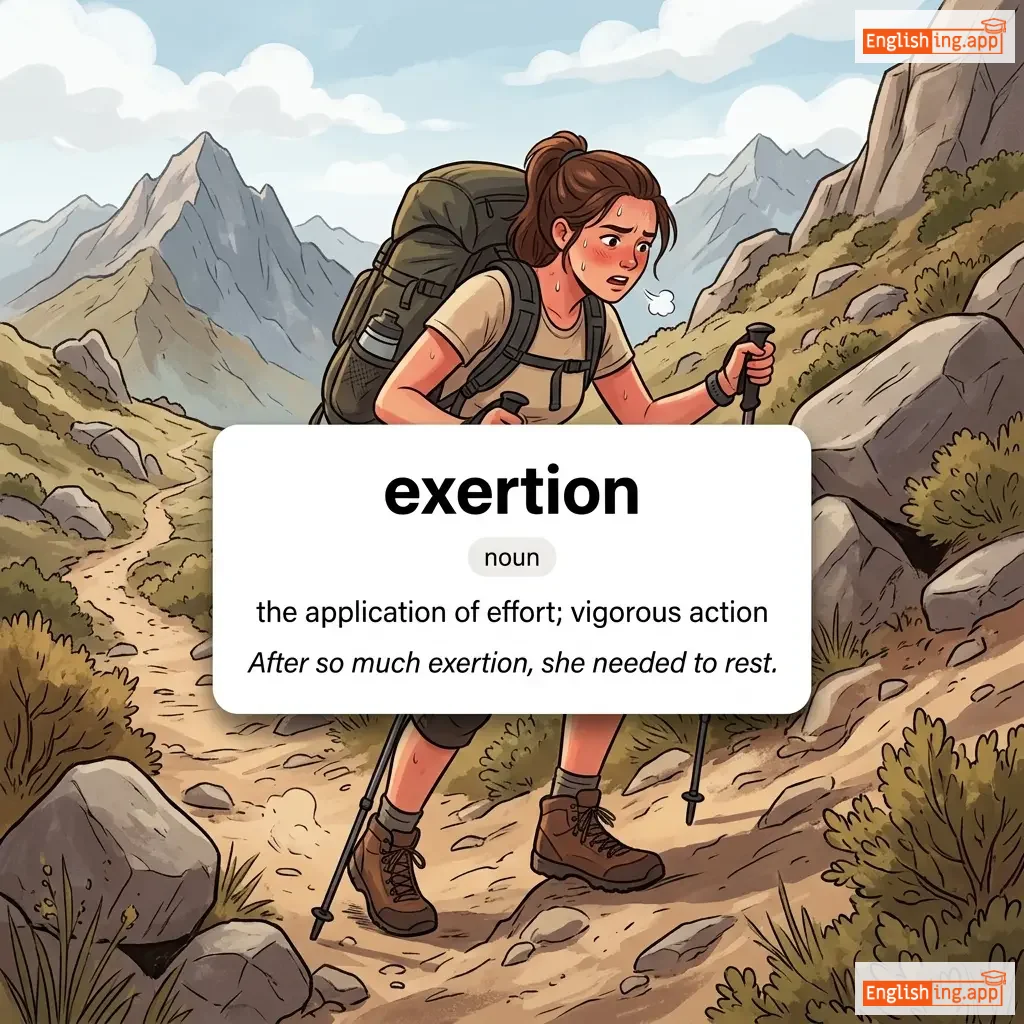
exertion definition card — visual illustration of the meaning
noun
/ɪɡˈzɜːrʃən/
प्रयास (prayas)

the application of effort; vigorous action

"After so much exertion, she needed to rest."

"इतने प्रयास के बाद, उसे आराम करने की आवश्यकता थी।" (Itne prayaas ke baad, use aaram karne ki avashyakta thi.)
exhalation definition card — visual illustration of the meaning
noun
/ˌɛks.həˈleɪ.ʃən/
श्वास छोड़ना (shwas chhodna)

The action of breathing out.

"Slow exhalation calms the nervous system."

"धीरे श्वास छोड़ना तंत्रिका तंत्र को शांत करता है।" (Dheere shwas chhodna tantrika tantr ko shaant karta hai.)
verb
/ɛksˈheɪl/
सांस छोड़ना (sans chhodna)

to breathe out air from the lungs

"She slowly exhaled after holding her breath."

"वह सांस रोकने के बाद धीरे-धीरे श्वास छोड़ने लगी।" (vah sans rokne ke baad dheere-dheere shwas chhodne lagi.)
verb
/ɪɡˈzɔːst/
थका देना (thaka dena)

to tire out completely; to use up resources

"The long journey exhausted the children."

"लंबी यात्रा ने बच्चों को थका दिया।" (Lambi yatra ne bachchon ko thaka diya.)
exhausted definition card — visual illustration of the meaning
adjective
/ɪɡˈzɔː.stɪd/
थका हुआ (thaka hua)

Extremely tired; having no energy left.

"Feeling exhausted after waking up is common."

"जागने के बाद थकान महसूस होना आम बात है।" (jagne ke baad thakan mahsus hona aam baat hai)
adjective
/ɪɡˈzɔːstɪbəl/
नष्ट होने योग्य (nasht hone yogya)

able to be used up completely; not infinite

"Coal and oil are exhaustible resources."

"कोयला और तेल नष्ट होने योग्य संसाधन हैं।" (Koyla aur tel nasht hone yogya sansadhan hain.)
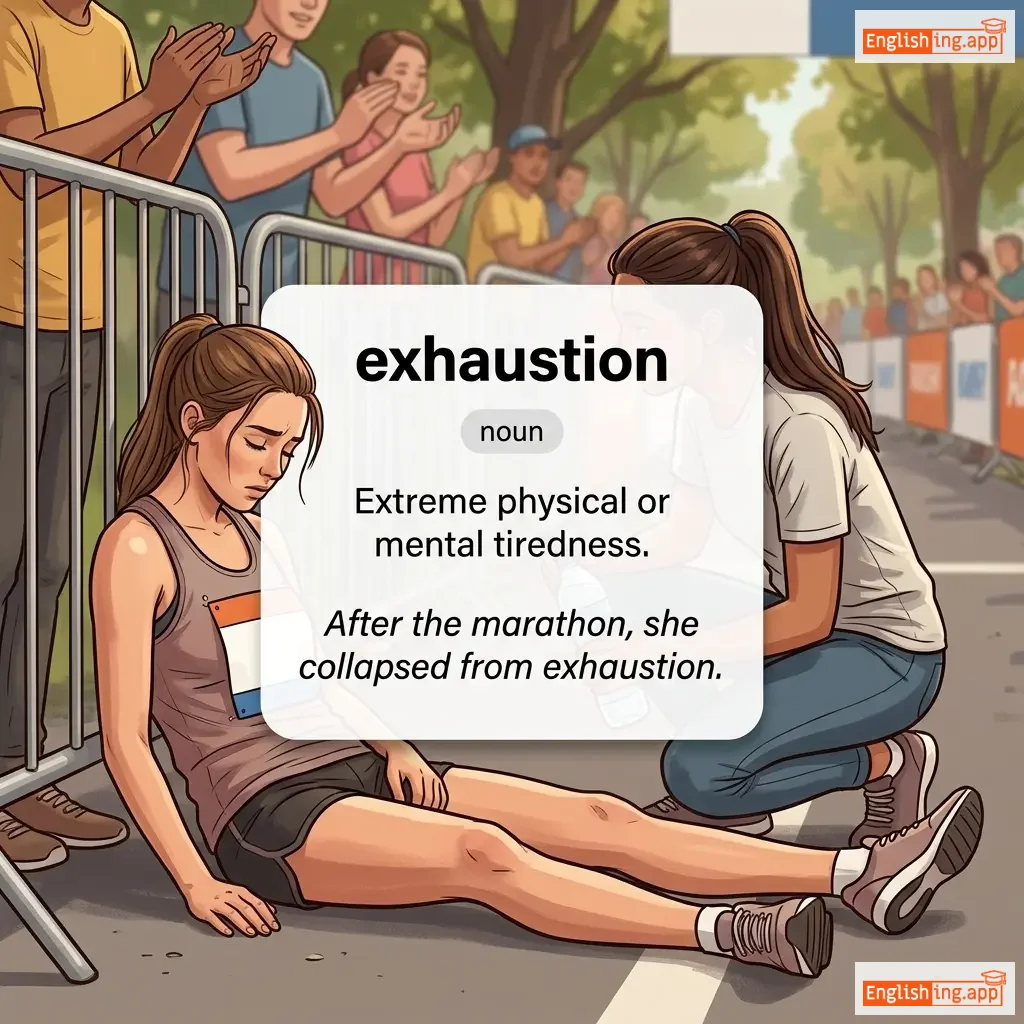
exhaustion definition card — visual illustration of the meaning
noun
/ɪɡˈzɔːstʃən/
थकावट (thakavat)

Extreme physical or mental tiredness.

"After the marathon, she collapsed from exhaustion."

"मैराथन के बाद, वह थकावट के कारण गिर पड़ी।" (Marathon ke baad, vah thakavat ke kaaran gir padi.)
adjective
/ɪɡˈzɔːstɪv/
व्यापक और संपूर्ण (vyapak aur sampurn)

Fully comprehensive and including all possibilities.

"The report provides an exhaustive analysis of the issue."

"रिपोर्ट ने मुद्दे का एक संपूर्ण विश्लेषण प्रदान किया।" (Report ne mudde ka ek sampurn vishleshan pradan kiya.)
exhibit definition card — visual illustration of the meaning
verb/noun
/ɪɡˈzɪbɪt/
प्रदर्शन (pradarshan)

To display or show publicly; something put on display.

"The museum will exhibit ancient artifacts."

"संग्रहालय प्राचीन कलाकृतियाँ प्रदर्शित करेगा।" (Sangrahalay pracheen kalakrityan pradarshit karega.)
noun
/ˌɛksɪˈbɪʃən/
प्रदर्शनी (pradarshani)

a public display of works of art, products, or other items of interest

"The art exhibition attracted thousands of visitors."

"कला प्रदर्शनी ने हज़ारों आगंतुकों को आकर्षित किया।" (Kala pradarshani ne hazaron aagantukon ko aakarshit kiya.)
verb
/ɪɡˈzɪləreɪt/
उत्साहित करना (utsahit karna)

To make someone feel very happy, animated, or excited.

"The mountain view exhilarated the travelers."

"पहाड़ का दृश्य यात्रियों को उत्साहित कर रहा था।" (Pahaad ka drishya yatrion ko utsahit kar raha tha.)
adjective
/ɪɡˈzɪləreɪtɪd/
उत्साहित (utsahit)

feeling very happy, animated, or elated

"She felt exhilarated after finishing the marathon."

"वह मैराथन खत्म करने के बाद बहुत उत्साहित महसूस कर रही थी।" (Vah marathon khatm karne ke baad bahut utsahit mahsus kar rahi thi.)
adjective
/ɪɡˈzɪləreɪtɪŋ/
उत्साहजनक (utsahjanak)

Making someone feel very excited, happy, or thrilled.

"Skydiving was the most exhilarating experience of his life."

"स्काइडाइविंग था उसका जीवन का सबसे उत्साहजनक अनुभव।" (Skydiving tha uska jeevan ka sabse utsahjanak anubhav.)
exhilaration definition card — visual illustration of the meaning
noun
/ɪɡˌzɪl.əˈreɪ.ʃən/
उल्लास या खुशी (ullas ya khushi)

A feeling of excitement, happiness, or elation.

"The feeling of exhilaration after a roller-coaster ride is amazing."

"रोलर-कोस्टर राइड के बाद एक्सहिलरेशन की फीलिंग शानदार होती है।" (Roller-coaster ride ke baad exhilaration ki feeling shandaar hoti hai.)
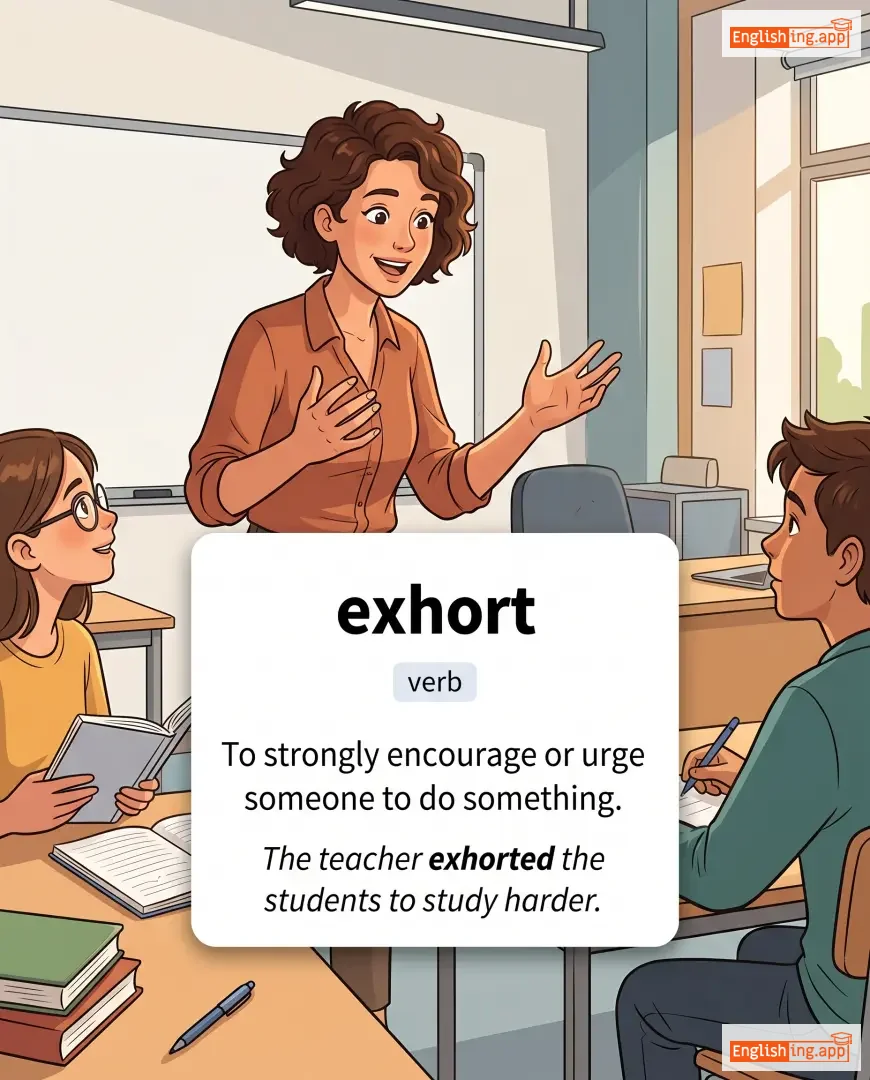
exhort definition card — visual illustration of the meaning
verb
/ɪɡˈzɔːrt/
उत्साहित करना (utshaahit karna)

To strongly encourage or urge someone to do something.

"The teacher exhorted the students to study harder."

"शिक्षक ने छात्रों को कठिनाई से अध्ययन करने के लिए उत्साहित किया।" (Shikshak ne chhatron ko kathinai se adhyayan karne ke liye utshaahit kiya.)
verb
/ɛksˈhjuːm/
किसी चीज़ को खोदकर निकालना (kisi cheez ko khodkar nikaalna)

to dig out something buried, especially a body from the ground

"The archaeologists decided to exhume the ancient remains."

"पुरातत्वविदों ने प्राचीन अवशेषों को खोदने का निर्णय लिया।" (Puratatvavido ne prachin avasheshon ko khodne ka nirnay liya.)
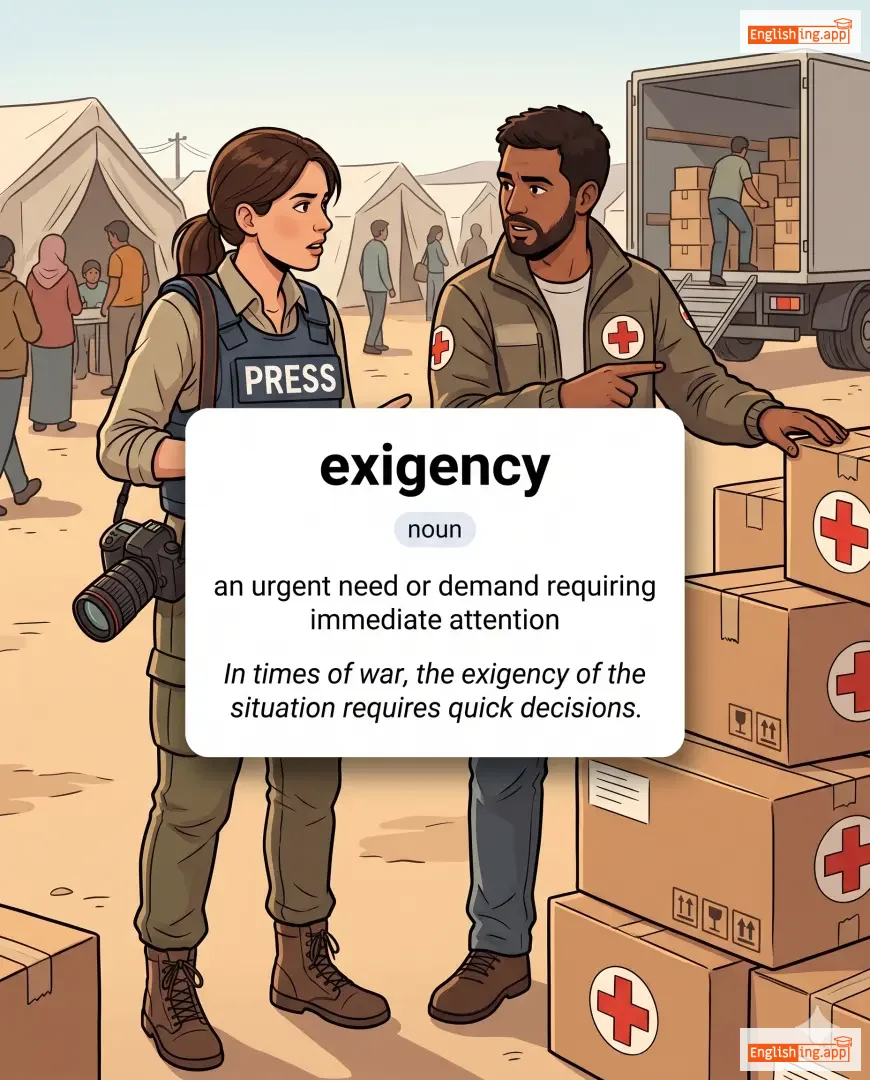
exigency definition card — visual illustration of the meaning
noun
/ˈɛksɪdʒənsi/
आपातकालीन आवश्यकता (aapatkaaleen avashyakta)

an urgent need or demand requiring immediate attention

"In times of war, the exigency of the situation requires quick decisions."

"युद्ध के समय, स्थिति की आपातकालीन आवश्यकता त्वरित निर्णय की मांग करती है।" (Yudh ke samay, sthiti ki aapatkaaleen avashyakta tvarit nirnay ki maang karti hai.)
adjective
/ˈɛksɪdʒənt/
तत्काल (tatkaal)

demanding immediate action or attention; urgent

"The patient’s exigent condition required immediate surgery."

"मरीज की तत्काल स्थिति ने तत्काल सर्जरी की मांग की।" (Mareez ki tatkaal sthiti ne tatkaal sargari ki maang ki.)
noun
/ˌɛksɪˈɡjuːɪti/
अभाव (abhav)

the quality of being scanty or meager in amount

"The exiguity of resources made the project difficult to complete."

"संसाधनों की कमी ने परियोजना को पूरा करना कठिन बना दिया।" (Sansadhanon ki kami ne pariyojna ko poora karna kathin bana diya.)