वोकैबुलरीज

इंग्लिश वोकैबुलरी डिस्कवर, लर्न और मास्टर करें

noun
/ɪnˈdʒɔɪmənt/
आनंद (anand)

the state or process of taking pleasure or satisfaction in something

"She felt great enjoyment while reading her favorite book."

"उसने अपनी पसंदीदा किताब पढ़ते हुए बहुत आनंद महसूस किया।" (Usne apni pasandida kitaab padhte hue bahut anand mahsus kiya.)
verb
/ɛnˈkɪndl/
आग लगाना, प्रेरित करना (aag lagana, prerith karna)

to set on fire or inspire strong emotion

"The speech enkindled hope in the audience."

"भाषण ने दर्शकों में आशा का संचार किया।" (Bhashan ne darshako mein asha ka sanchar kiya.)
verb
/ɪnˈlɑːrdʒ/
बड़ा करना (bada karna)

to make something bigger or increase in size

"They decided to enlarge their house."

"उन्होंने अपना घर बड़ा करने का निर्णय लिया।" (Unhone apna ghar bada karne ka nirnay liya.)
verb
/ɪnˈlaɪtən/
सुख (sukh)

to give someone greater knowledge or understanding about a subject or situation

"The teacher tried to enlighten the students about ancient history."

"उसे पुरस्कार मिलने पर अपनी खुशी छुपाना मुश्किल था।" (Use puraskar milne par apni khushi chhupana mushkil tha.)
adjective
/ɪnˈlaɪ.tənd/
प्रकाशित; ज्ञानवर्धित; जागरूक; (prakaashit; gyaanvardhit; jaagruk)

having or showing a rational, modern outlook; having spiritual knowledge or understanding

"The enlightened teacher shared wisdom with all her students."

"प्रकाशित शिक्षक ने सभी छात्रों के साथ ज्ञान साझा किया।" (Prakaashit shikshak ne sabhi chhatron ke saath gyaan saajha kiya.)
verb
/ɪnˈlɪst/
भर्ती होना (bharti hona)

to join or sign up, especially for military service; to secure someone's support or help

"He decided to enlist in the army after graduation."

"उसने स्नातक होने के बाद सेना में भर्ती होने का निर्णय लिया।" (Usne snatak hone ke baad sena mein bharti hone ka nirnay liya.)
verb
/ɪnˈlaɪvən/
जीवंत करना (jeevant karna)

to make something more lively, interesting, or cheerful

"Her jokes helped enliven the dull meeting."

"उसकी मजेदार बातें उबाऊ बैठक को जीवंत बना दीं।" (Uski mazedaar baatein ubaau baithak ko jeevant bana deen.)
noun
/ˈɛnmɪti/
द्वेष (dwesh)

a feeling of hostility, hatred, or opposition

"There was a long history of enmity between the two families."

"दो परिवारों के बीच लंबे समय से द्वेष का इतिहास था।" (Do parivaron ke beech lambe samay se dwesh ka itihas tha.)
verb
/ɪˈnəʊbəl/
सम्मानित करना (sammaanit karna)

to give someone a noble rank or to elevate in dignity or honor

"His selfless actions ennobled his character in the eyes of others."

"उसकी नि:स्वार्थ क्रियाओं ने दूसरों की नजरों में उसके चरित्र को सम्मानित किया।" (Uski nishwarth kriyaon ne doosron ki nazron mein uske charitr ko sammaanit kiya.)
noun
/ˈɒnwiː/ or /ˈɑːnwiː/
उदासी (udasi)

A feeling of boredom, listlessness, or dissatisfaction arising from lack of excitement.

"After weeks of doing nothing, he sank into a deep sense of ennui."

"कुछ नहीं करने के हफ्तों बाद, वह गहरी उदासी में डूब गया।" (Kuch nahin karne ke hafton baad, vah gehri udasi mein doob gaya.)
noun
/ɪˈnɔːrmɪti/
भयंकरता (bhayankarta)

The extreme scale, seriousness, or extent of something perceived as bad or morally wrong.

"The enormity of the crime shocked the entire community."

"अपराध की भयंकरता ने सम्पूर्ण समुदाय को चौंका दिया।" (apraadh ki bhayankarta ne sampoorn samudaay ko chauka diya.)
adjective
/ɪˈnɔːrməs/
विशाल (vishal)

Extremely large in size, amount, or degree.

"They built an enormous stadium in the city."

"उन्होंने शहर में एक विशाल स्टेडियम बनाया।" (unhone shahar mein ek vishal stadium banaya.)
adjective/adverb
/ɪˈnʌf/
पर्याप्त (paryapt)

as much or as many as required

"We have enough food for everyone."

"हमारे पास सभी के लिए पर्याप्त भोजन है।" (Hamare paas sabhi ke liye paryapt bhojan hai.)
verb
/ɪnˈkwaɪər/
पूछना (poochna)

to ask for information about something

"He enquired about the train schedule."

"उसने ट्रेन के शेड्यूल के बारे में पूछा।" (Usne train ke schedule ke baare mein poochha.)
verb
/ɪnˈreɪdʒ/
गुस्से में करना (gusse mein karna)

To make someone extremely angry.

"His unfair remarks enraged the audience."

"उसकी अनुचित टिप्पणियों ने दर्शकों को गुस्से में डाल दिया।" (uski anuchit tippaniyon ne darshako ko gusse mein dal diya.)
verb
/ɪnˈræptʃər/
मंत्रमुग्ध करना (mantramugdh karna)

To fill someone with great delight or joy.

"The beautiful music enraptured the audience."

"खूबसूरत संगीत ने श्रोताओं को मंत्रमुग्ध कर दिया।" (khubsurat sangeet ne shrotaon ko mantramugdh kar diya.)
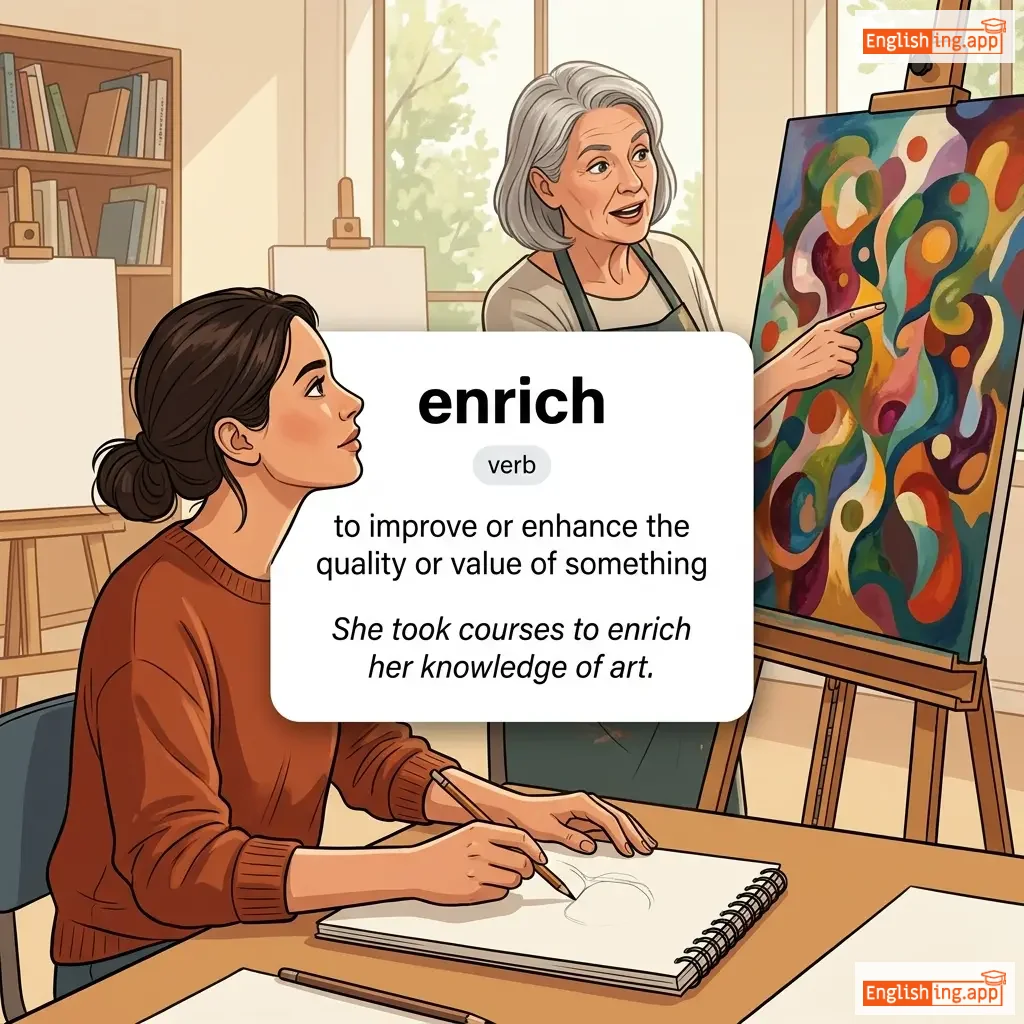
enrich definition card — visual illustration of the meaning
verb
/ɪnˈrɪtʃ/
समृद्ध करना (samriddh karna)

to improve or enhance the quality or value of something

"She took courses to enrich her knowledge of art."

"उसने अपनी कला के ज्ञान को समृद्ध करने के लिए कोर्स किए।" (Usne apni kala ke gyaan ko samriddh karne ke liye course kiye.)
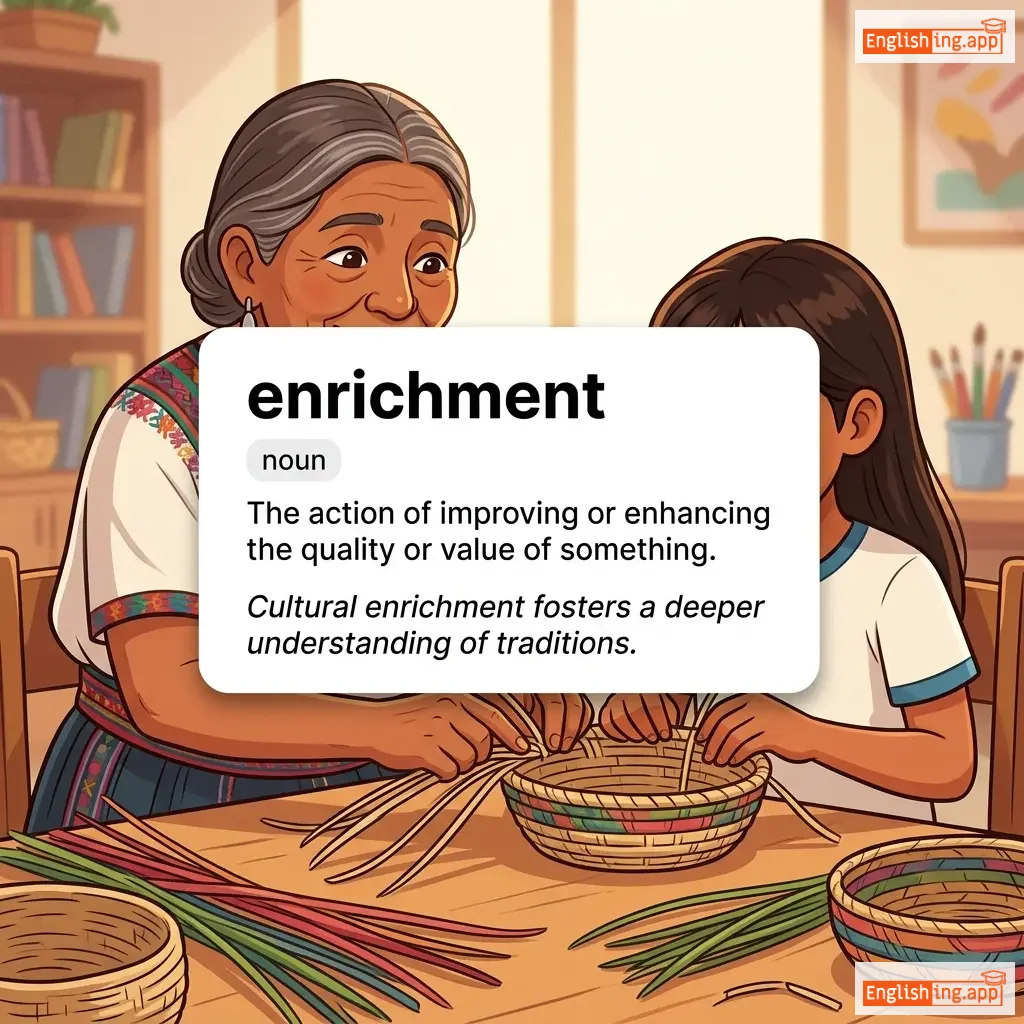
enrichment definition card — visual illustration of the meaning
noun
/ɪnˈrɪtʃ.mənt/
संवर्धन, सुधार (sanvardhan, sudhar)

The action of improving or enhancing the quality or value of something.

"Cultural enrichment fosters a deeper understanding of traditions."

"संस्कृतिक संवर्धन परंपराओं की गहरी समझ को बढ़ावा देता है।" (Sanskritik sanvardhan paramparaon ki gehri samajh ko badhawa deta hai.)
verb
/ɪnˈroʊl/
नामांकन करना (namankan karna)

To officially register or sign up for a course, program, or membership

"She decided to enrol in a language course to improve her skills."

"उसने अपनी क्षमताओं को सुधारने के लिए एक भाषा पाठ्यक्रम में नामांकन करने का निर्णय लिया।" (Usne apni kshamtaon ko sudharne ke liye ek bhasha pathyakram mein namankan karne ka nirnay liya.)
verb
/ɪnˈroʊl/
नामांकन करना (naamankan karna)

to officially join or register in a school, course, or organization

"He decided to enroll in a computer programming course."

"उसने एक कंप्यूटर प्रोग्रामिंग कोर्स में नामांकन करने का निर्णय लिया।" (Usne ek computer programming course mein naamankan karne ka nirnay liya.)
verb
/ɪnˈskɒns/
सुखपूर्वक या सुरक्षित रूप से किसी स्थान पर बैठना; छिपाना या मजबूती से शरण देना (sukhpoorvak ya surakshit roop se kisi sthan par baithna; chipana ya majbooti se sharan dena)

to settle comfortably or securely in a place; to hide or shelter firmly

"She ensconced herself in a cozy armchair by the fireplace."

"वह आरामदायक आर्मचेयर में आग के पास एन्स्कॉन्स हो गई।" (Wah aaramdayak armchair mein aag ke paas ensconced ho gayi.)
noun
/ɒnˈsɒmbəl/
समूह, दल (samooh, dal)

a group of things or people viewed as a whole, especially performers in music or theater

"The theater ensemble gave a spectacular performance."

"थिएटर दल ने शानदार प्रदर्शन किया।" (Theater dal ne shandaar pradarshan kiya.)
verb
/ɪnˈʃraɪn/
पवित्र या महत्वपूर्ण रूप से संरक्षित करना (pavitra ya mahatvapurn roop se sanrakshit karna)

to preserve or cherish something as sacred or important

"The constitution enshrines the right to freedom of speech."

"संविधान भाषण की स्वतंत्रता के अधिकार को संरक्षित करता है।" (Samvidhan bhashan ki svatantrata ke adhikar ko sanrakshit karta hai.)
noun
/ˈɛnsaɪn/
ध्वज (dhwaj)

A flag or standard, especially a military or naval one indicating nationality; also a junior officer in the navy or coast guard.

"The ship raised its national ensign before leaving the harbor."

"जहाज ने बंदरगाह छोड़ने से पहले अपना राष्ट्रीय ध्वज फहराया।" (Jahaj ne bandargah chhodne se pehle apna rashtriya dhwaj phiraya.)
verb
/ɪnˈsnɛər/
जाल में फँसाना (jaal mein fansana)

to catch or trap, often by trickery or deceit

"The hunter ensnared the rabbit with a net."

"शिकारी ने खरगोश को जाल से फंसा लिया।" (Shikari ne khargosh ko jaal se fansa liya.)
verb
/ɪnˈsjuː/
घटना (ghatna)

to happen as a result or consequence

"After the argument, silence ensued."

"तर्क के बाद, खामोशी हो गई।" (Tark ke baad, khamoshi ho gayi.)
verb
/ɪnˈʃʊər/
सुनिश्चित करना (sunishchit karna)

To make certain that something will happen or be the case.

"Please ensure that the door is locked before you leave."

"कृपया यह सुनिश्चित करें कि दरवाजा बंद है इससे पहले कि आप जाएं।" (Kripya yah sunishchit karein ki darwaza band hai isse pehle ki aap jayein.)
verb
/ɪnˈteɪl/
शामिल करना (shamil karna)

to involve something as a necessary or inevitable part or consequence

"The job will entail a lot of travel across the country."

"इस काम में देश भर में बहुत यात्रा शामिल होगी।" (Is kaam mein desh bhar mein bahut yatra shamil hogi.)
verb
/ɪnˈtæŋɡəl/
पकड़ में आना (pakad mein aana)

to become twisted together or caught in something; to involve in difficulties

"The fish got entangled in the net."

"मछली जाल में उलझ गई।" (machhli jaal mein uljhi gayi.)
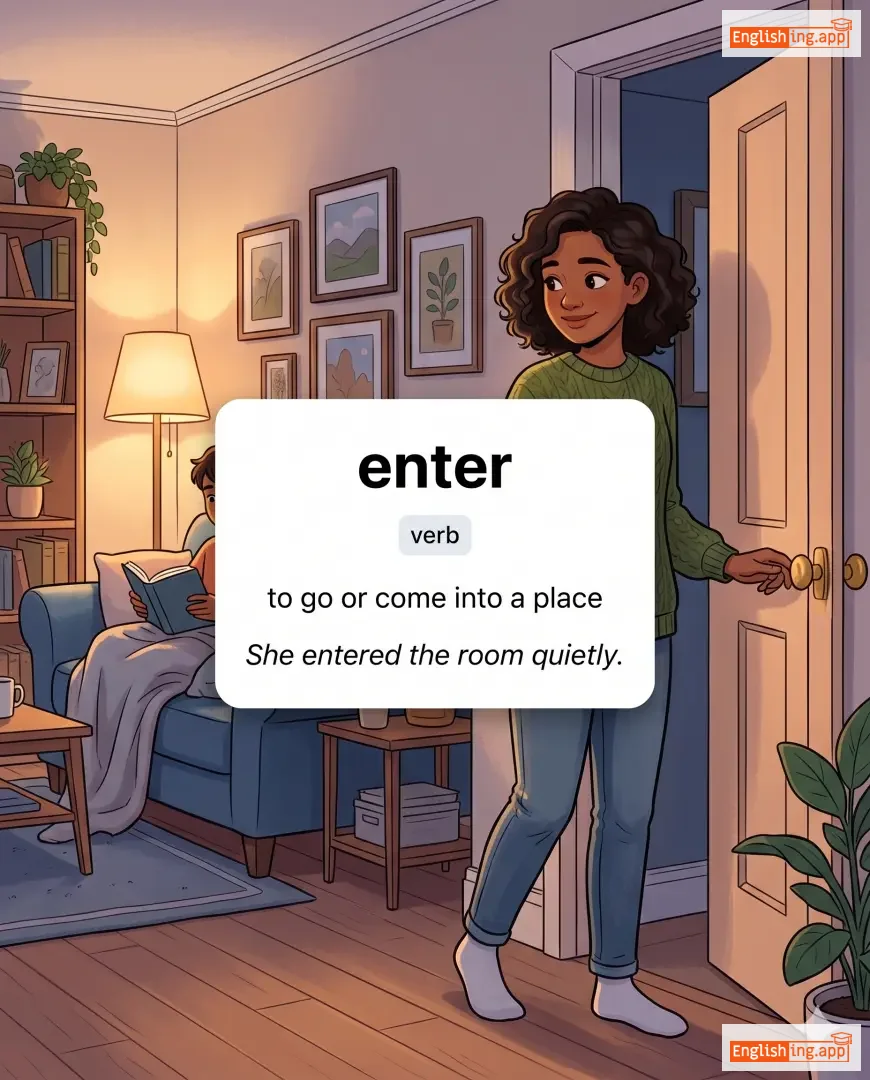
enter definition card — visual illustration of the meaning
verb
/ˈɛntər/
प्रवेश करना (pravesh karna)

to go or come into a place

"She entered the room quietly."

"वह चुपचाप कमरे में प्रवेश कर गई।" (Wah chupchaap kamre mein pravesh kar gayi.)
noun
/ˈɛntərˌpraɪz/
उद्यम / प्रतिष्ठान (udyam / pratishthan)

a business or company; a project or undertaking that requires effort and initiative

"The new enterprise aims to create sustainable energy solutions."

"नई प्रतिष्ठान का लक्ष्य स्थायी ऊर्जा समाधान तैयार करना है।" (Nayi pratishthan ka lakshya sthayi urja samadhan tayar karna hai.)
adjective
/ˈɛntərˌpraɪzɪŋ/
उद्यमी (udyami)

showing initiative and resourcefulness; willing to take risks to achieve success

"She is an enterprising young entrepreneur."

"वह एक उद्यमी युवा उद्यमी है।" (Wah ek udyami yuva udyami hai.)
verb
/ˌɛntərˈteɪn/
मनोरंजन करना (manoranjan karna)

to provide amusement, enjoyment, or hospitality to others

"The comedian entertained the audience with his jokes."

"कॉमेडियन ने अपने जोक्स से दर्शकों का मनोरंजन किया।" (comedian ne apne jokes se darshako ka manoranjan kiya.)
adjective
/ˌɛntərˈteɪnɪŋ/
मनोरंजक (manoranjak)

providing amusement or enjoyment

"The comedian gave an entertaining performance."

"कॉमेडियन ने मनोरंजक प्रदर्शन दिया।" (Komedian ne manoranjak pradarshan diya.)
noun
/ˌɛntərˈteɪnmənt/
मनोरंजन (manoranjan)

something that amuses, pleases, or diverts

"The concert was a great source of entertainment."

"कॉन्सर्ट एक बेहतरीन मनोरंजन का स्रोत था।" (Concert ek behtareen manoranjan ka srot tha.)
verb
/ɪnˈθrɔːl/
मुग्ध करना (mugdha karna)

To captivate or hold someone’s full attention.

"The magician’s performance enthralled the audience."

"जादूगर का प्रदर्शन दर्शकों को मुग्ध कर दिया।" (Jadugar ka pradarshan darshako ko mugdha kar diya.)
verb
/ɪnˈθrɔːl/
मुग्ध करना (mugdh karna)

to captivate or hold someone’s attention completely

"The magician’s tricks enthralled the children."

"जादूगर के ट्रिक्स ने बच्चों को मुग्ध कर दिया।" (Jadugar ke tricks ne bachon ko mugdh kar diya.)
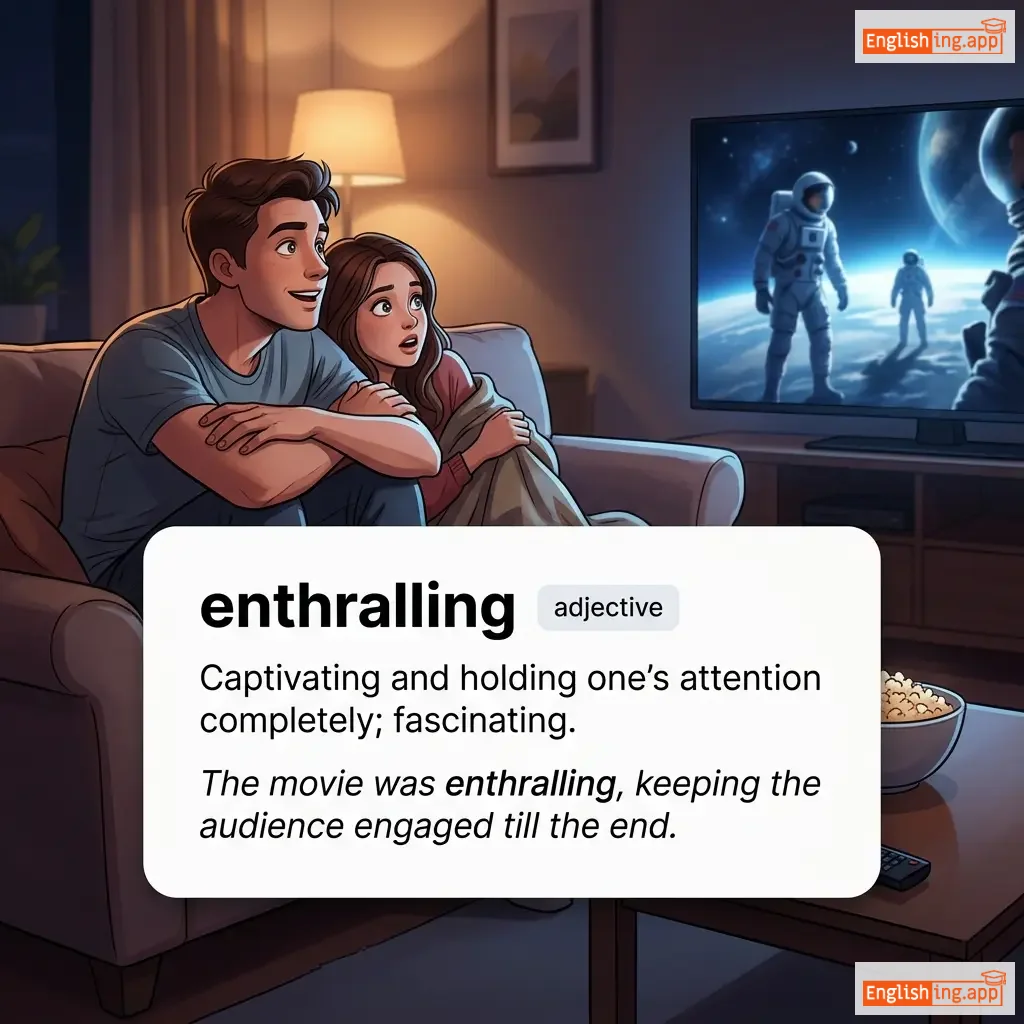
enthralling definition card — visual illustration of the meaning
adjective
/ɪnˈθrɔː.lɪŋ/
मोहक (mohak)

Captivating and holding one's attention completely; fascinating.

"The movie was enthralling, keeping the audience engaged till the end."

"फिल्म बहुत ही मोहक थी, जिसने दर्शकों को अंत तक जोड़े रखा।" (film bahut hi mohak thi, jisne darshako ko ant tak jode rakha.)
verb
/ɪnˈθroʊn/
सिंहासन पर बैठाना (singhasan par baithana)

to install someone on a throne or to give someone high status

"The king was enthroned in a grand ceremony."

"राजा को एक भव्य समारोह में सिंहासन पर बैठाया गया था।" (Raja ko ek bhavya samaroah mein singhasan par baithaya gaya tha.)
verb
/ɪnˈθjuːz/
उत्साहित करना (utsahit karna)

to express excitement or admiration

"She enthused about her trip to Italy."

"वह अपनी यात्रा के बारे में उत्साहपूर्वक बात कर रही थी।" (Woh apni yatra ke baare mein utsaahpoorvak baat kar rahi thi.)
noun
/ɪnˈθjuːziæzəm/
उत्साह (utsah)

intense and eager enjoyment, interest, or approval

"His enthusiasm for teaching inspired his students."

"शिक्षण के प्रति उसका उत्साह उसके छात्रों को प्रेरित करता था।" (Shikshan ke prati uska utsah uske chatron ko prerit karta tha.)
noun
/ɪnˈθuziæst/
उत्साही (utsahi)

a person who is very interested in a particular activity or subject

"He is a football enthusiast and watches every match."

"वह एक फुटबॉल enthusiast है और हर मैच देखता है।" (Vah ek football enthusiast hai aur har match dekhta hai.)
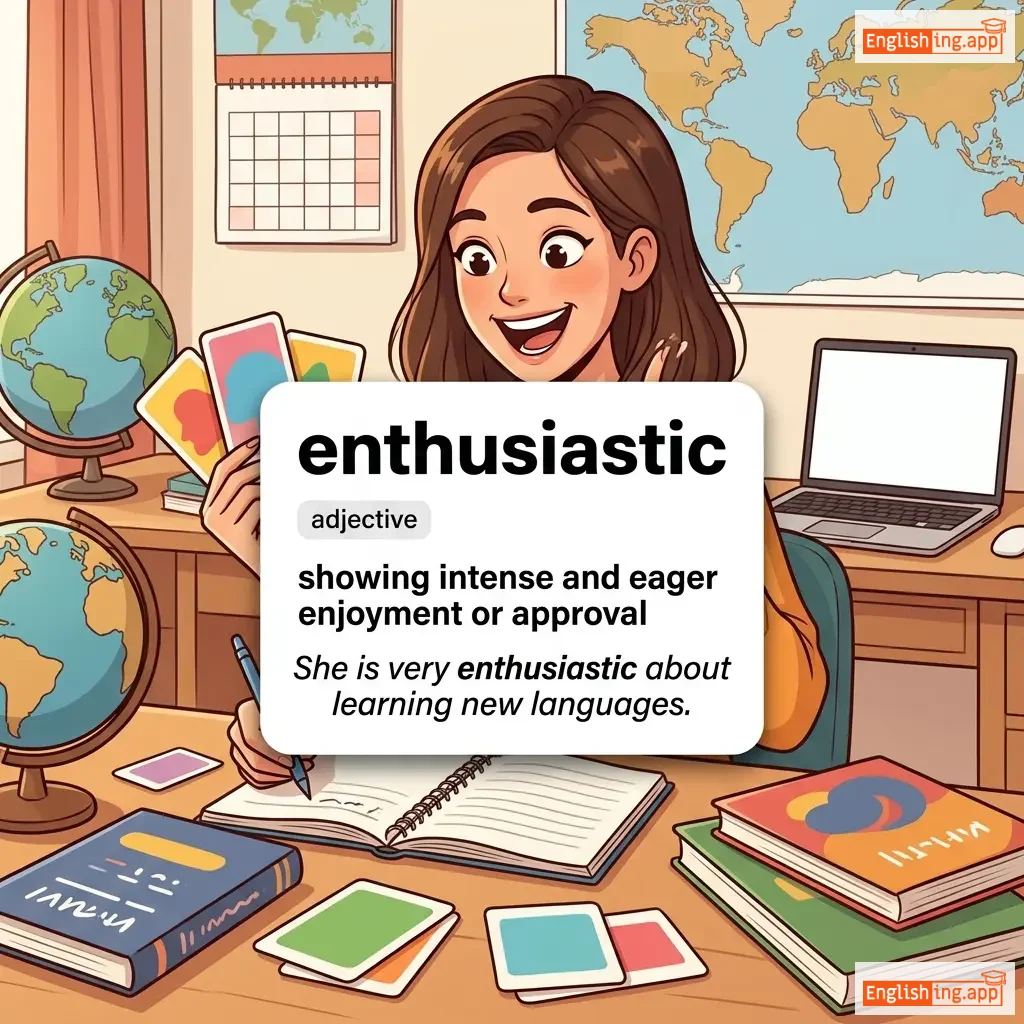
enthusiastic definition card — visual illustration of the meaning
adjective
/ɪnˌθjuːziˈæstɪk/
उत्साही (utsahi)

showing intense and eager enjoyment or approval

"She is very enthusiastic about learning new languages."

"वह नई भाषाएँ सीखने के बारे में बहुत उत्साही है।" (Wah nai bhashayen seekhne ke baare mein bahut utsahi hai.)
verb
/ɪnˈtaɪs/
ललचाना (lalchana)

to attract or tempt someone by offering something appealing

"The advertisement was designed to entice customers into the store."

"विज्ञापन को ग्राहकों को दुकान में लाने के लिए डिज़ाइन किया गया था।" (Vigyapan ko graahkon ko dukaan mein laane ke liye design kiya gaya tha.)
adjective
/ɪnˈtaɪər/
पूरा (poora)

whole; with no part left out

"He spent the entire day reading books."

"उसने पूरा दिन किताबें पढ़ने में बिताया।" (Usne poora din kitaabein padhne mein bitaya.)
adverb
/ɪnˈtaɪərli/
पूरी तरह से (poori tarah se)

Completely or wholly.

"She is entirely responsible for the project."

"वह परियोजना के लिए पूरी तरह से जिम्मेदार है।" (vah pariyojana ke liye poori tarah se zimmedar hai.)
noun
/ɪnˈtaɪərəti/
पूर्णता (purnata)

the whole of something; the complete form

"He watched the movie in its entirety."

"उसने फिल्म को उसकी पूर्णता में देखा।" (Usne film ko uski purnata mein dekha.)
verb
/ɪnˈtaɪtəl/
अधिकार देना (adhikar dena)

to give someone the right to have or do something

"Employees are entitled to receive paid holidays."

"कर्मचारियों को वेतनभोगी छुट्टियाँ प्राप्त करने का अधिकार है।" (karmachariyon ko vetanbhogi chhuttiyan prapt karne ka adhikar hai.)
adjective
/ɪnˈtaɪtəld/
अधिकार प्राप्त (adhikar prapt)

having the right to do or have something; feeling deserving of special treatment

"Employees are entitled to paid leave."

"कर्मचारी को वेतन का अवकाश प्राप्त है।" (Karmchari ko vetan ka avkash prapt hai.)
noun
/ɪnˈtaɪtəlmənt/
अधिकार (adhikar)

the belief that one is inherently deserving of privileges or special treatment; a right to benefits

"The program provides entitlement to health care."

"इस कार्यक्रम से स्वास्थ्य देखभाल का अधिकार मिलता है।" (Is karyakram se swasthya dekbhkal ka adhikar milta hai.)