Vocabulaires

Découvrez, apprenez et maîtrisez le vocabulaire anglais

noun
/ɪnˈdʒɔɪmənt/
plaisir (plaisir)

the state or process of taking pleasure or satisfaction in something

"She felt great enjoyment while reading her favorite book."

"Elle a ressenti un grand plaisir en lisant son livre préféré." (Elle a ressenti un grand plaisir en lisant son livre prefere.)
verb
/ɛnˈkɪndl/
enflammer, inspirer (enflammer, inspirer)

to set on fire or inspire strong emotion

"The speech enkindled hope in the audience."

"Le discours a enflammé l'espoir dans l'auditoire." (Le discours a enflammé l'espoir dans l'auditoire.)
verb
/ɪnˈlɑːrdʒ/
agrandir (agrandir)

to make something bigger or increase in size

"They decided to enlarge their house."

"Ils ont décidé d'agrandir leur maison." (Ils ont décide d'agrandir leur maison.)
verb
/ɪnˈlaɪtən/
bonheur (bonheur)

to give someone greater knowledge or understanding about a subject or situation

"The teacher tried to enlighten the students about ancient history."

"Elle ne pouvait pas cacher son bonheur lorsqu'elle a reçu le prix." (Elle ne pouvait pas cacher son bonheur lorsqu'elle a reçu le prix.)
adjective
/ɪnˈlaɪ.tənd/
éclairé; illuminé; sage; (eclaire; illumine; sage)

having or showing a rational, modern outlook; having spiritual knowledge or understanding

"The enlightened teacher shared wisdom with all her students."

"Le professeur éclairé a partagé la sagesse avec tous ses étudiants." (Le professeur éclairé a partagé la sagesse avec tous ses étudiants.)
verb
/ɪnˈlɪst/
s'enrôler (senrôler)

to join or sign up, especially for military service; to secure someone's support or help

"He decided to enlist in the army after graduation."

"Il a décidé de s'enrôler dans l'armée après l'obtention de son diplôme." (Il a décidé de s'enrôler dans l'armée après l'obtention de son diplôme.)
verb
/ɪnˈlaɪvən/
animer (animer)

to make something more lively, interesting, or cheerful

"Her jokes helped enliven the dull meeting."

"Ses blagues ont aidé à animer la réunion ennuyeuse." (Ses blagues ont aidé à animer la réunion ennuyeuse.)
noun
/ˈɛnmɪti/
ennemi (ennemi)

a feeling of hostility, hatred, or opposition

"There was a long history of enmity between the two families."

"Il y avait une longue histoire d'hostilité entre les deux familles." (Il y avait une longue histoire d'hostilite entre les deux familles.)
verb
/ɪˈnəʊbəl/
ennoblir (ennoblir)

to give someone a noble rank or to elevate in dignity or honor

"His selfless actions ennobled his character in the eyes of others."

"Ses actions désintéressées ont ennobli son caractère aux yeux des autres." (Ses actions désintéressées ont ennobli son caractère aux yeux des autres.)
noun
/ˈɒnwiː/ or /ˈɑːnwiː/
ennui (ennui)

A feeling of boredom, listlessness, or dissatisfaction arising from lack of excitement.

"After weeks of doing nothing, he sank into a deep sense of ennui."

"Après des semaines à ne rien faire, il est tombé dans un profond ennui." (Apres des semaines a ne rien faire, il est tombe dans un profond ennui.)
noun
/ɪˈnɔːrmɪti/
énormité (enormite)

The extreme scale, seriousness, or extent of something perceived as bad or morally wrong.

"The enormity of the crime shocked the entire community."

"L'énormité du crime a choqué toute la communauté." (L'énormité du crime a choqué toute la communauté.)
adjective
/ɪˈnɔːrməs/
énorme (enorme)

Extremely large in size, amount, or degree.

"They built an enormous stadium in the city."

"Ils ont construit un stade énorme dans la ville." (Ils ont construit un stade enorme dans la ville.)
adjective/adverb
/ɪˈnʌf/
suffisant (suffisant)

as much or as many as required

"We have enough food for everyone."

"Nous avons suffisamment de nourriture pour tout le monde." (Nous avons suffisamment de nourriture pour tout le monde.)
verb
/ɪnˈkwaɪər/
demander (demander)

to ask for information about something

"He enquired about the train schedule."

"Il a demandé à propos de l'horaire du train." (Il a demandé à propos de l'horaire du train.)
verb
/ɪnˈreɪdʒ/
mettre en colère (mettre en colere)

To make someone extremely angry.

"His unfair remarks enraged the audience."

"Ses remarques injustes ont mis en colère le public." (Ses remarques injustes ont mis en colère le public.)
verb
/ɪnˈræptʃər/
envoûter (envouter)

To fill someone with great delight or joy.

"The beautiful music enraptured the audience."

"La belle musique a envoûté le public." (La belle musique a envoute le public.)
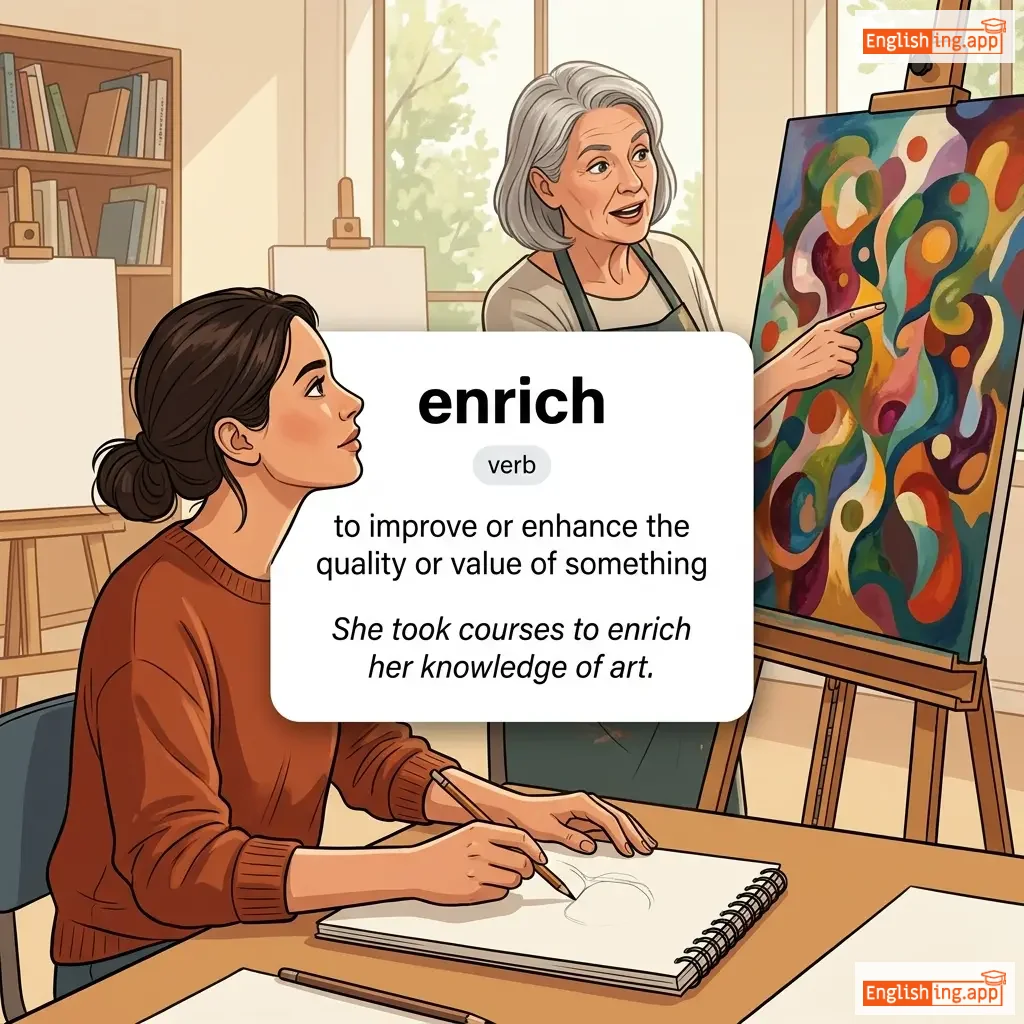
enrich definition card — visual illustration of the meaning
verb
/ɪnˈrɪtʃ/
enrichir (enrichir)

to improve or enhance the quality or value of something

"She took courses to enrich her knowledge of art."

"Elle a suivi des cours pour enrichir ses connaissances en art." (Elle a suivi des cours pour enrichir ses connaissances en art.)
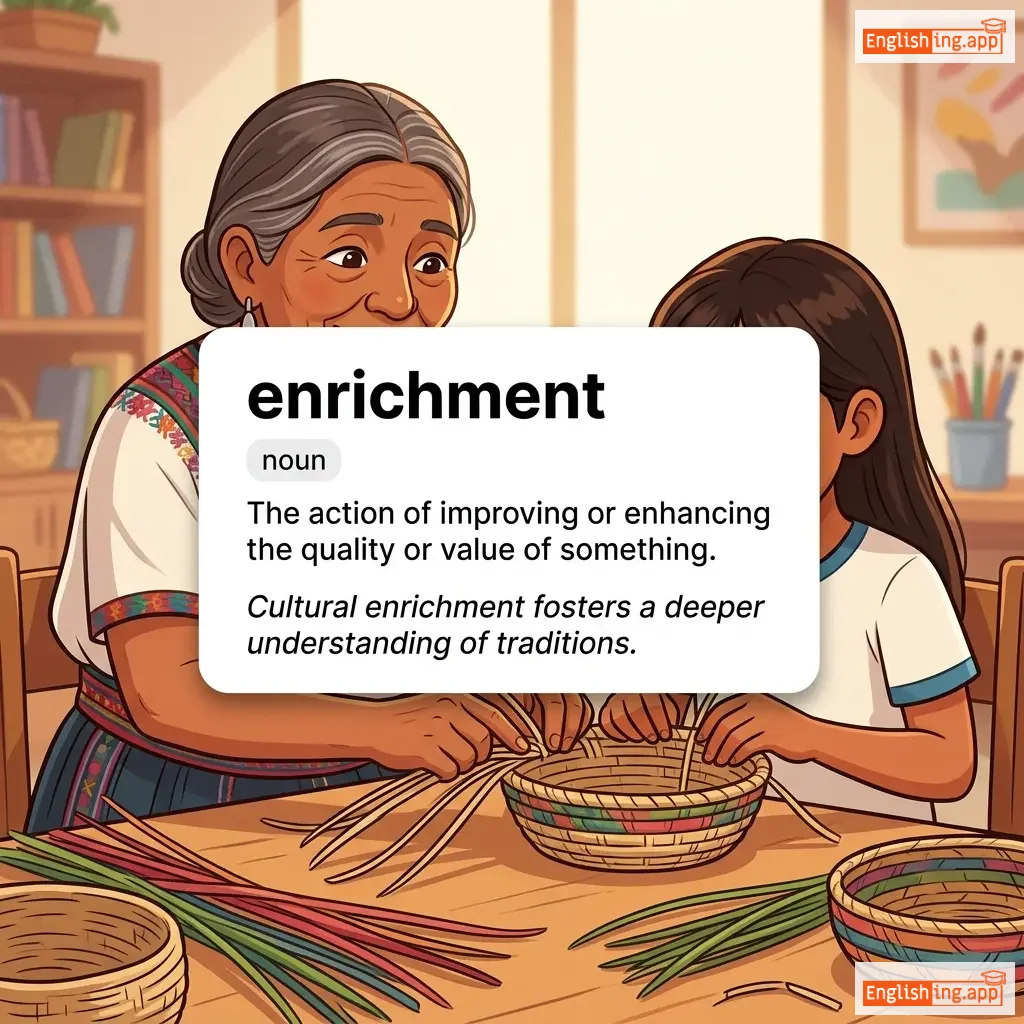
enrichment definition card — visual illustration of the meaning
noun
/ɪnˈrɪtʃ.mənt/
enrichissement (enrichissement)

The action of improving or enhancing the quality or value of something.

"Cultural enrichment fosters a deeper understanding of traditions."

"L'enrichissement culturel favorise une compréhension plus profonde des traditions." (L'enrichissement culturel favorise une compréhension plus profonde des traditions.)
verb
/ɪnˈroʊl/
s'inscrire (s'inscrire)

To officially register or sign up for a course, program, or membership

"She decided to enrol in a language course to improve her skills."

"Elle a décidé de s'inscrire dans un cours de langue pour améliorer ses compétences." (Elle a decide de s'inscrire dans un cours de langue pour ameliorer ses competences.)
verb
/ɪnˈroʊl/
s'inscrire (s'inscrire)

to officially join or register in a school, course, or organization

"He decided to enroll in a computer programming course."

"Il a décidé de s'inscrire à un cours de programmation informatique." (Il a décidé de s'inscrire à un cours de programmation informatique.)
verb
/ɪnˈskɒns/
s'installer confortablement, cacher (s'installer confortablement, cacher)

to settle comfortably or securely in a place; to hide or shelter firmly

"She ensconced herself in a cozy armchair by the fireplace."

"Elle s'est installée confortablement dans un fauteuil près de la cheminée." (Elle s'est installée confortablement dans un fauteuil près de la cheminée.)
noun
/ɒnˈsɒmbəl/
ensemble, groupe (ensemble, groupe)

a group of things or people viewed as a whole, especially performers in music or theater

"The theater ensemble gave a spectacular performance."

"L'ensemble théâtral a donné une performance spectaculaire." (L'ensemble théâtral a donné une performance spectaculaire.)
verb
/ɪnˈʃraɪn/
préserver ou chérir quelque chose comme sacré ou important (preserver ou cherir quelque chose comme sacre ou important)

to preserve or cherish something as sacred or important

"The constitution enshrines the right to freedom of speech."

"La constitution consacre le droit à la liberté d'expression." (La constitution consacre le droit à la liberté d'expression.)
noun
/ˈɛnsaɪn/
drapeau (drapeau)

A flag or standard, especially a military or naval one indicating nationality; also a junior officer in the navy or coast guard.

"The ship raised its national ensign before leaving the harbor."

"Le navire a hissé son drapeau national avant de quitter le port." (Le navire a hissé son drapeau national avant de quitter le port.)
verb
/ɪnˈsnɛər/
piéger (piéger)

to catch or trap, often by trickery or deceit

"The hunter ensnared the rabbit with a net."

"Le chasseur a piégé le lapin avec un filet." (Le chasseur a piégé le lapin avec un filet.)
verb
/ɪnˈsjuː/
suivre (suivre)

to happen as a result or consequence

"After the argument, silence ensued."

"Après la dispute, le silence s'ensuivit." (Après la dispute, le silence s'ensuivit.)
verb
/ɪnˈʃʊər/
assurer (assurer)

To make certain that something will happen or be the case.

"Please ensure that the door is locked before you leave."

"Veuillez vous assurer que la porte est verrouillée avant de partir." (Veuillez vous assurer que la porte est verrouillée avant de partir.)
verb
/ɪnˈteɪl/
impliquer (impliquer)

to involve something as a necessary or inevitable part or consequence

"The job will entail a lot of travel across the country."

"Le travail impliquera beaucoup de voyages à travers le pays." (Le travail impliquera beaucoup de voyages à travers le pays.)
verb
/ɪnˈtæŋɡəl/
emmêler (emmeler)

to become twisted together or caught in something; to involve in difficulties

"The fish got entangled in the net."

"Le poisson s'est emmêlé dans le filet." (Le poisson s'est emmêlé dans le filet.)
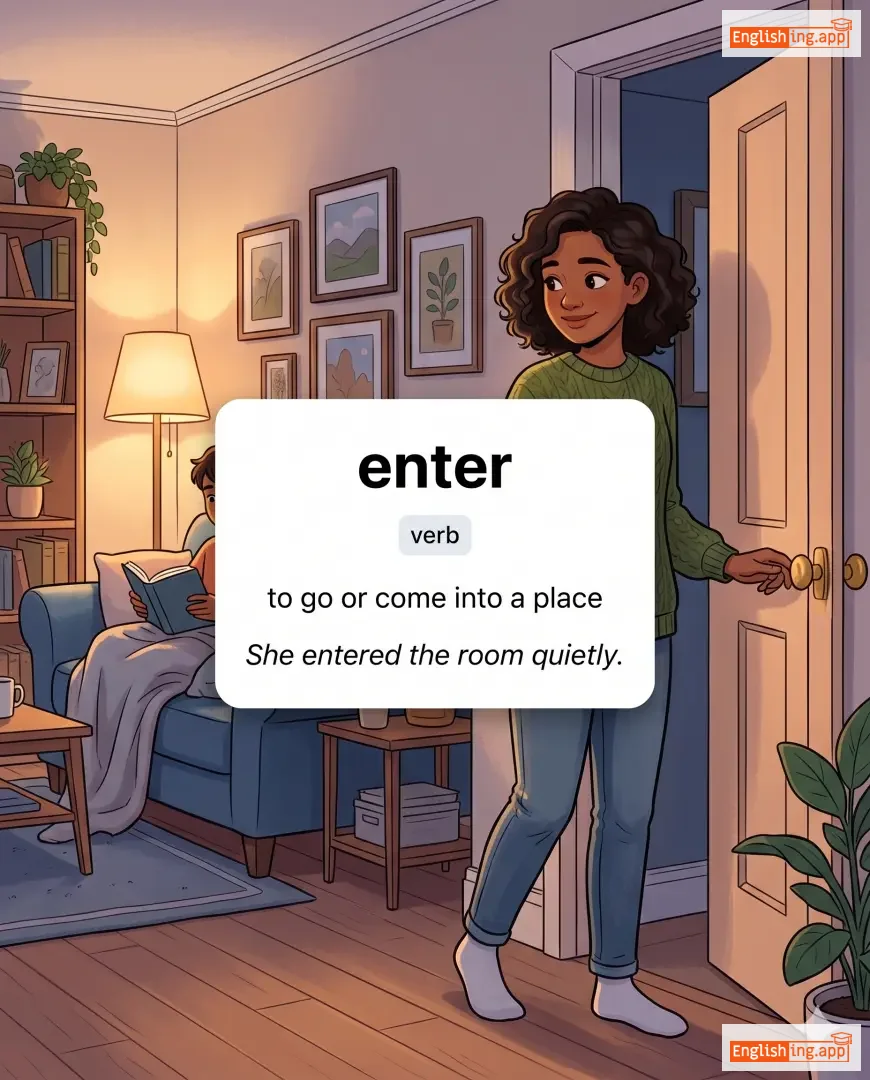
enter definition card — visual illustration of the meaning
verb
/ˈɛntər/
entrer (entrer)

to go or come into a place

"She entered the room quietly."

"Elle entra dans la pièce silencieusement." (Elle entra dans la pièce silencieusement.)
noun
/ˈɛntərˌpraɪz/
entreprise (entreprise)

a business or company; a project or undertaking that requires effort and initiative

"The new enterprise aims to create sustainable energy solutions."

"La nouvelle entreprise vise à créer des solutions énergétiques durables." (La nouvelle entreprise vise a creer des solutions energetiques durables.)
adjective
/ˈɛntərˌpraɪzɪŋ/
entreprenant (entreprenant)

showing initiative and resourcefulness; willing to take risks to achieve success

"She is an enterprising young entrepreneur."

"Elle est une jeune entrepreneuse entreprenante." (Elle est une jeune entrepreneuse entreprenante.)
verb
/ˌɛntərˈteɪn/
divertir (divertir)

to provide amusement, enjoyment, or hospitality to others

"The comedian entertained the audience with his jokes."

"Le comédien a diverti le public avec ses blagues." (Le comédien a diverti le public avec ses blagues.)
adjective
/ˌɛntərˈteɪnɪŋ/
divertissant (divertissant)

providing amusement or enjoyment

"The comedian gave an entertaining performance."

"Le comédien a donné une performance divertissante." (Le comedien a donne une performance divertissante.)
noun
/ˌɛntərˈteɪnmənt/
divertissement (divertissement)

something that amuses, pleases, or diverts

"The concert was a great source of entertainment."

"Le concert était une grande source de divertissement." (Le concert était une grande source de divertissement.)
verb
/ɪnˈθrɔːl/
captiver (captiver)

To captivate or hold someone’s full attention.

"The magician’s performance enthralled the audience."

"La performance du magicien a captivé l'audience." (La performance du magicien a captive l'audience.)
verb
/ɪnˈθrɔːl/
captiver (captiver)

to captivate or hold someone’s attention completely

"The magician’s tricks enthralled the children."

"Les tours du magicien ont captivé les enfants." (Les tours du magicien ont captivé les enfants.)
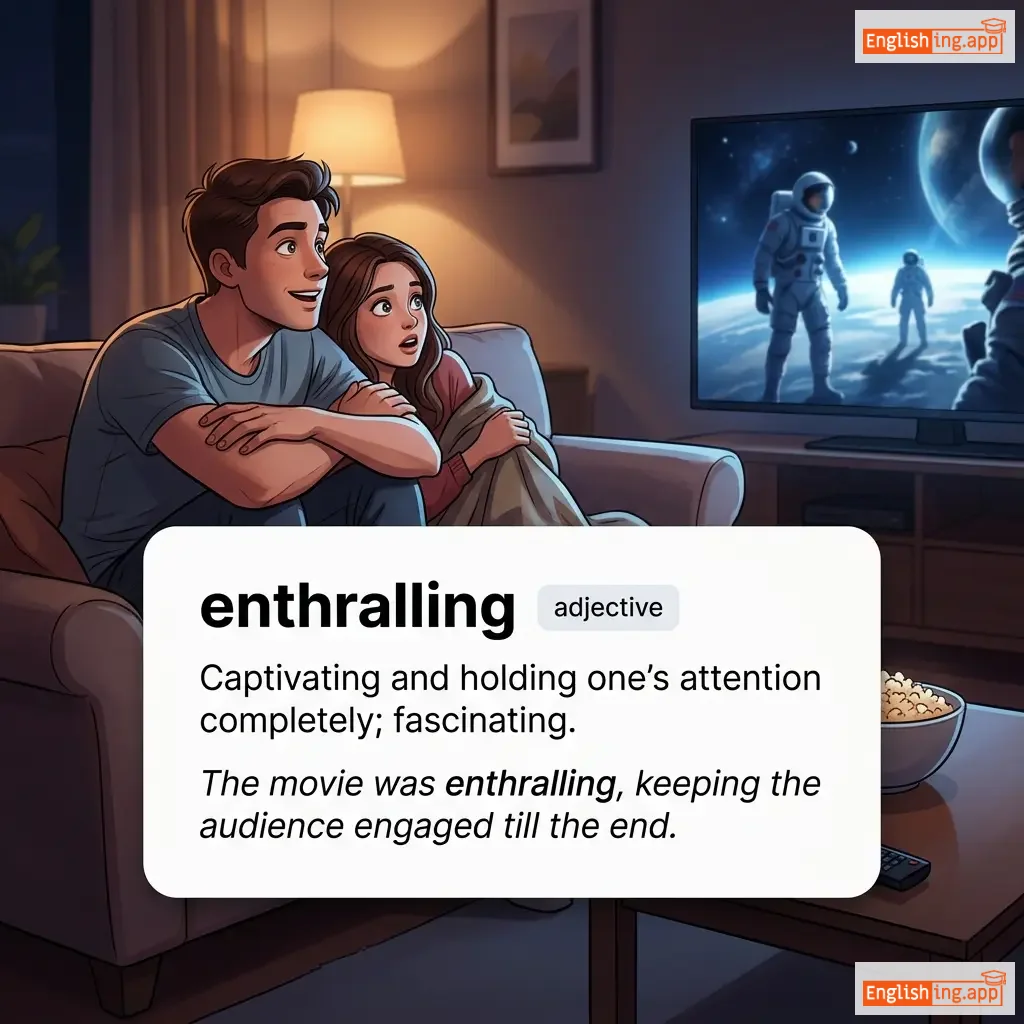
enthralling definition card — visual illustration of the meaning
adjective
/ɪnˈθrɔː.lɪŋ/
captivant (captivant)

Captivating and holding one's attention completely; fascinating.

"The movie was enthralling, keeping the audience engaged till the end."

"Le film était captivant, maintenant le public engagé jusqu'à la fin." (Le film etait captivant, maintenant le public engage jusqu'à la fin.)
verb
/ɪnˈθroʊn/
introniser (introniser)

to install someone on a throne or to give someone high status

"The king was enthroned in a grand ceremony."

"Le roi fut intronisé lors d'une grande cérémonie." (Le roi fut intronisé lors d'une grande cérémonie.)
verb
/ɪnˈθjuːz/
enthousiasmer (enthousiasmer)

to express excitement or admiration

"She enthused about her trip to Italy."

"Elle a exprimé son enthousiasme à propos de son voyage en Italie." (Elle a exprimé son enthousiasme à propos de son voyage en Italie.)
noun
/ɪnˈθjuːziæzəm/
enthousiasme (enthousiasme)

intense and eager enjoyment, interest, or approval

"His enthusiasm for teaching inspired his students."

"Son enthousiasme pour l'enseignement a inspiré ses élèves." (Son enthousiasme pour l'enseignement a inspire ses eleves.)
noun
/ɪnˈθuziæst/
passionné (passione)

a person who is very interested in a particular activity or subject

"He is a football enthusiast and watches every match."

"Il est un passionné de football et regarde chaque match." (Il est un passionné de football et regarde chaque match.)
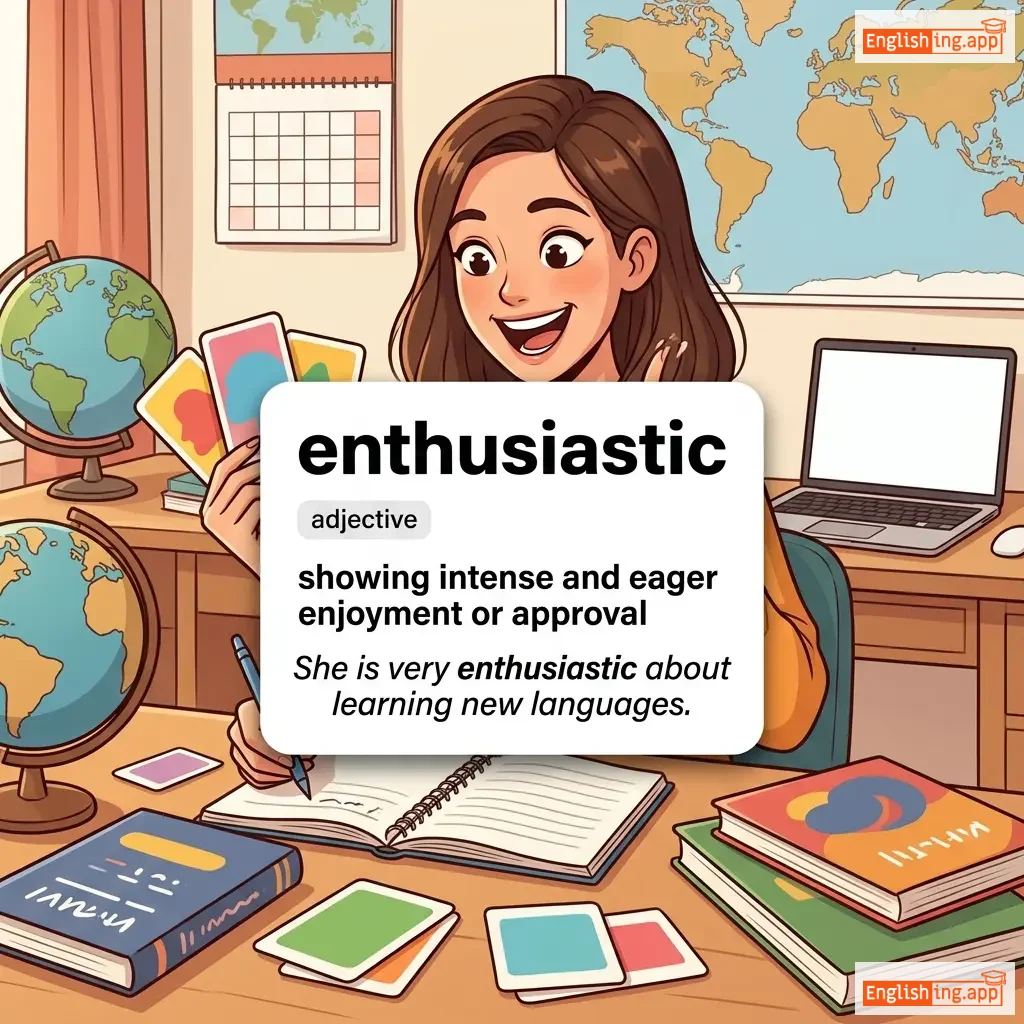
enthusiastic definition card — visual illustration of the meaning
adjective
/ɪnˌθjuːziˈæstɪk/
enthousiaste (enthousiaste)

showing intense and eager enjoyment or approval

"She is very enthusiastic about learning new languages."

"Elle est très enthousiaste à l'idée d'apprendre de nouvelles langues." (Elle est tres enthousiaste a l'idee d'apprendre de nouvelles langues.)
verb
/ɪnˈtaɪs/
attirer (attirer)

to attract or tempt someone by offering something appealing

"The advertisement was designed to entice customers into the store."

"La publicité a été conçue pour attirer les clients dans le magasin." (La publicité a été conçue pour attirer les clients dans le magasin.)
adjective
/ɪnˈtaɪər/
entier (entier)

whole; with no part left out

"He spent the entire day reading books."

"Il a passé toute la journée à lire des livres." (Il a passé toute la journée à lire des livres.)
adverb
/ɪnˈtaɪərli/
entièrement (entierement)

Completely or wholly.

"She is entirely responsible for the project."

"Elle est entièrement responsable du projet." (Elle est entierement responsable du projet.)
noun
/ɪnˈtaɪərəti/
intégralité (integralite)

the whole of something; the complete form

"He watched the movie in its entirety."

"Il a regardé le film dans son intégralité." (Il a regarde le film dans son integralite.)
verb
/ɪnˈtaɪtəl/
donner le droit (donner le droit)

to give someone the right to have or do something

"Employees are entitled to receive paid holidays."

"Les employés ont droit à des congés payés." (Les employés ont droit à des congés payés.)
adjective
/ɪnˈtaɪtəld/
ayant droit (ayant droit)

having the right to do or have something; feeling deserving of special treatment

"Employees are entitled to paid leave."

"Les employés ont droit à un congé payé." (Les employés ont droit à un congé payé.)
noun
/ɪnˈtaɪtəlmənt/
droit (dwa)

the belief that one is inherently deserving of privileges or special treatment; a right to benefits

"The program provides entitlement to health care."

"Le programme accorde un droit aux soins de santé." (Le programme accorde un droit aux soins de sante.)