Vocabularios

Descubra, aprenda y domine el vocabulario en inglés

noun
/ɪnˈdʒɔɪmənt/
disfrute (disfrute)

the state or process of taking pleasure or satisfaction in something

"She felt great enjoyment while reading her favorite book."

"Ella sintió un gran disfrute mientras leía su libro favorito." (Ella sintio un gran disfrute mientras leia su libro favorito.)
verb
/ɛnˈkɪndl/
encender, inspirar (encender, inspirar)

to set on fire or inspire strong emotion

"The speech enkindled hope in the audience."

"El discurso encendió la esperanza en la audiencia." (El discurso encendió la esperanza en la audiencia.)
verb
/ɪnˈlɑːrdʒ/
agrandar (agrandar)

to make something bigger or increase in size

"They decided to enlarge their house."

"Ellos decidieron agrandar su casa." (Ellos decidieron agrandar su casa.)
verb
/ɪnˈlaɪtən/
felicidad (felicidad)

to give someone greater knowledge or understanding about a subject or situation

"The teacher tried to enlighten the students about ancient history."

"Ella no podía ocultar su felicidad cuando recibió el premio." (Ella no podía ocultar su felicidad cuando recibió el premio.)
adjective
/ɪnˈlaɪ.tənd/
iluminado; esclarecido; sabio; (iluminado; esclarecido; sabio)

having or showing a rational, modern outlook; having spiritual knowledge or understanding

"The enlightened teacher shared wisdom with all her students."

"El maestro iluminado compartió sabiduría con todos sus estudiantes." (El maestro iluminado compartió sabiduría con todos sus estudiantes.)
verb
/ɪnˈlɪst/
alistarse (alistarse)

to join or sign up, especially for military service; to secure someone's support or help

"He decided to enlist in the army after graduation."

"Él decidió alistarse en el ejército después de graduarse." (Él decidió alistarse en el ejército después de graduarse.)
verb
/ɪnˈlaɪvən/
animar (animar)

to make something more lively, interesting, or cheerful

"Her jokes helped enliven the dull meeting."

"Sus bromas ayudaron a animar la aburrida reunión." (Sus bromas ayudaron a animar la aburrida reunión.)
noun
/ˈɛnmɪti/
enemistad (enemistad)

a feeling of hostility, hatred, or opposition

"There was a long history of enmity between the two families."

"Había una larga historia de enemistad entre las dos familias." (Habia una larga historia de enemistad entre las dos familias.)
verb
/ɪˈnəʊbəl/
ennoblecer (ennoblecer)

to give someone a noble rank or to elevate in dignity or honor

"His selfless actions ennobled his character in the eyes of others."

"Sus acciones desinteresadas enaltecieron su carácter a los ojos de los demás." (Sus acciones desinteresadas enaltecieron su carácter a los ojos de los demás.)
noun
/ˈɒnwiː/ or /ˈɑːnwiː/
aburrimiento (aburrimiento)

A feeling of boredom, listlessness, or dissatisfaction arising from lack of excitement.

"After weeks of doing nothing, he sank into a deep sense of ennui."

"Después de semanas sin hacer nada, cayó en un profundo aburrimiento." (Despues de semanas sin hacer nada, cayo en un profundo aburrimiento.)
noun
/ɪˈnɔːrmɪti/
enormidad (enormidad)

The extreme scale, seriousness, or extent of something perceived as bad or morally wrong.

"The enormity of the crime shocked the entire community."

"La enormidad del crimen sorprendió a toda la comunidad." (La enormidad del crimen sorprendió a toda la comunidad.)
adjective
/ɪˈnɔːrməs/
enorme (enorme)

Extremely large in size, amount, or degree.

"They built an enormous stadium in the city."

"Construyeron un estadio enorme en la ciudad." (Construyeron un estadio enorme en la ciudad.)
adjective/adverb
/ɪˈnʌf/
suficiente (suficiente)

as much or as many as required

"We have enough food for everyone."

"Tenemos suficiente comida para todos." (Tenemos suficiente comida para todos.)
verb
/ɪnˈkwaɪər/
preguntar (preguntar)

to ask for information about something

"He enquired about the train schedule."

"Él preguntó sobre el horario del tren." (El preguntó sobre el horario del tren.)
verb
/ɪnˈreɪdʒ/
enfurecer (enfurecer)

To make someone extremely angry.

"His unfair remarks enraged the audience."

"Sus comentarios injustos enfurecieron a la audiencia." (Sus comentarios injustos enfurecieron a la audiencia.)
verb
/ɪnˈræptʃər/
fascinar (fascinar)

To fill someone with great delight or joy.

"The beautiful music enraptured the audience."

"La hermosa música fascinó a la audiencia." (La hermosa musica fascino a la audiencia.)
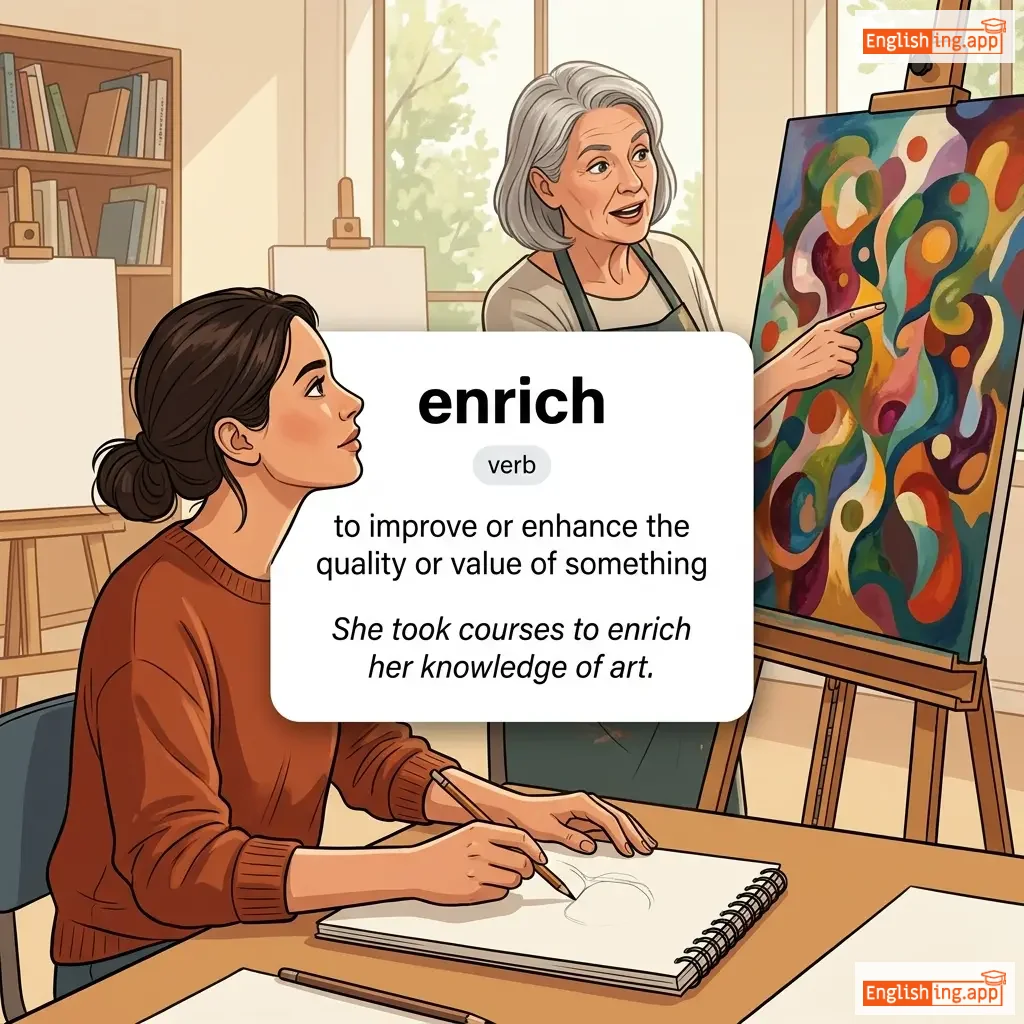
enrich definition card — visual illustration of the meaning
verb
/ɪnˈrɪtʃ/
enriquecer (enriquecer)

to improve or enhance the quality or value of something

"She took courses to enrich her knowledge of art."

"Ella tomó cursos para enriquecer su conocimiento del arte." (Ella tomo cursos para enriquecer su conocimiento del arte.)
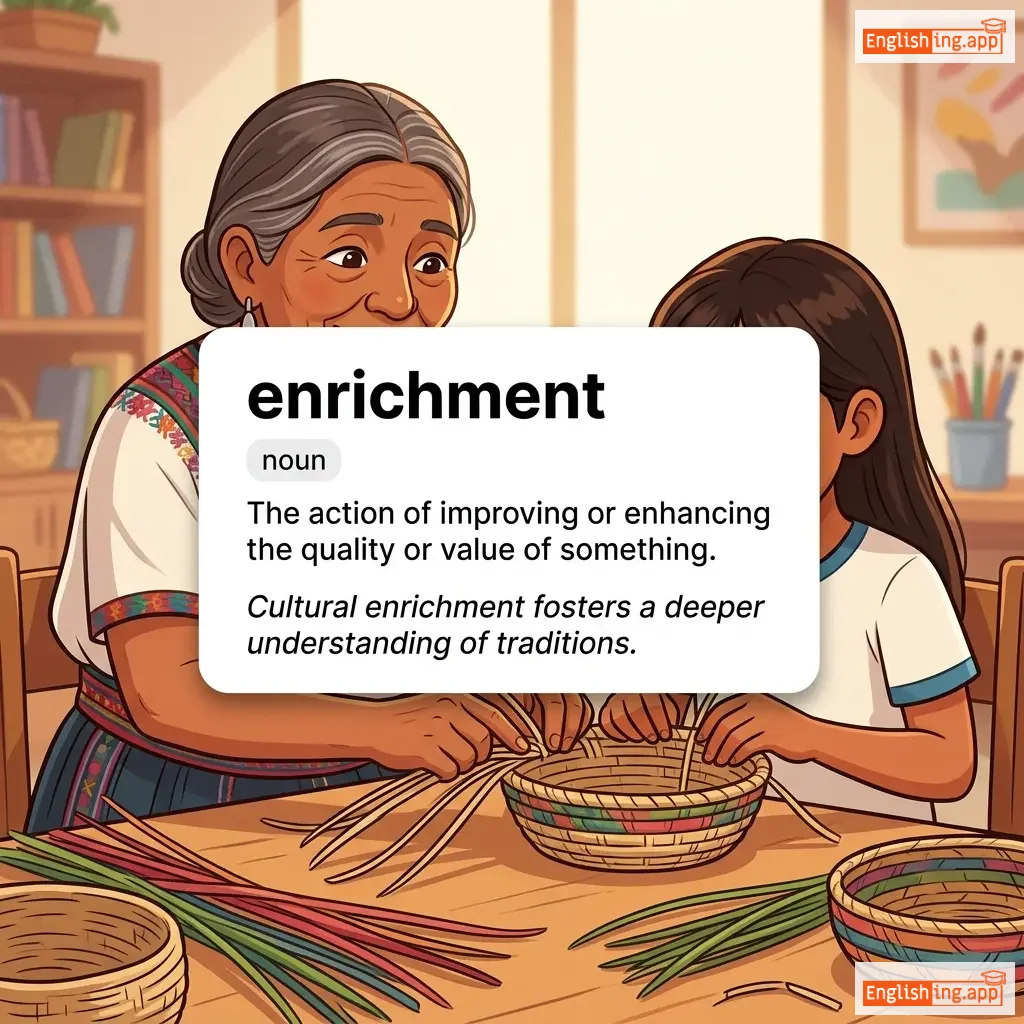
enrichment definition card — visual illustration of the meaning
noun
/ɪnˈrɪtʃ.mənt/
enriquecimiento (enriquicimiento)

The action of improving or enhancing the quality or value of something.

"Cultural enrichment fosters a deeper understanding of traditions."

"El enriquecimiento cultural fomenta una comprensión más profunda de las tradiciones." (El enriquecimiento cultural fomenta una comprensión más profunda de las tradiciones.)
verb
/ɪnˈroʊl/
inscribirse (inscribirse)

To officially register or sign up for a course, program, or membership

"She decided to enrol in a language course to improve her skills."

"Ella decidió inscribirse en un curso de idiomas para mejorar sus habilidades." (Ella decidio inscribirse en un curso de idiomas para mejorar sus habilidades.)
verb
/ɪnˈroʊl/
inscribirse (inscribirse)

to officially join or register in a school, course, or organization

"He decided to enroll in a computer programming course."

"Él decidió inscribirse en un curso de programación de computadoras." (El decidió inscribirse en un curso de programación de computadoras.)
verb
/ɪnˈskɒns/
acurrucarse, esconderse (acurrucarse, esconderse)

to settle comfortably or securely in a place; to hide or shelter firmly

"She ensconced herself in a cozy armchair by the fireplace."

"Ella se enroscó en una cómoda silla junto a la chimenea." (Ella se enroscó en una cómoda silla junto a la chimenea.)
noun
/ɒnˈsɒmbəl/
conjunto, grupo (conjunto, grupo)

a group of things or people viewed as a whole, especially performers in music or theater

"The theater ensemble gave a spectacular performance."

"El conjunto de teatro hizo una actuación espectacular." (El conjunto de teatro hizo una actuación espectacular.)
verb
/ɪnˈʃraɪn/
preservar o valorar algo como sagrado o importante (preservar o valorar algo como sagrado o importante)

to preserve or cherish something as sacred or important

"The constitution enshrines the right to freedom of speech."

"La constitución consagra el derecho a la libertad de expresión." (La constitución consagra el derecho a la libertad de expresión.)
noun
/ˈɛnsaɪn/
bandera (bandera)

A flag or standard, especially a military or naval one indicating nationality; also a junior officer in the navy or coast guard.

"The ship raised its national ensign before leaving the harbor."

"El barco izó su bandera nacional antes de salir del puerto." (El barco izó su bandera nacional antes de salir del puerto.)
verb
/ɪnˈsnɛər/
atrapar (atrapar)

to catch or trap, often by trickery or deceit

"The hunter ensnared the rabbit with a net."

"El cazador atrapó al conejo con una red." (El cazador atrapó al conejo con una red.)
verb
/ɪnˈsjuː/
suceder (suceder)

to happen as a result or consequence

"After the argument, silence ensued."

"Después de la discusión, el silencio sucedió." (Después de la discusión, el silencio sucedió.)
verb
/ɪnˈʃʊər/
asegurar (asegurar)

To make certain that something will happen or be the case.

"Please ensure that the door is locked before you leave."

"Por favor, asegúrese de que la puerta esté cerrada antes de irse." (Por favor, asegúrese de que la puerta esté cerrada antes de irse.)
verb
/ɪnˈteɪl/
implicar (implicar)

to involve something as a necessary or inevitable part or consequence

"The job will entail a lot of travel across the country."

"El trabajo implicará mucho viaje por el país." (El trabajo implicará mucho viaje por el país.)
verb
/ɪnˈtæŋɡəl/
enredar (enredar)

to become twisted together or caught in something; to involve in difficulties

"The fish got entangled in the net."

"El pez se enredó en la red." (El pez se enredó en la red.)
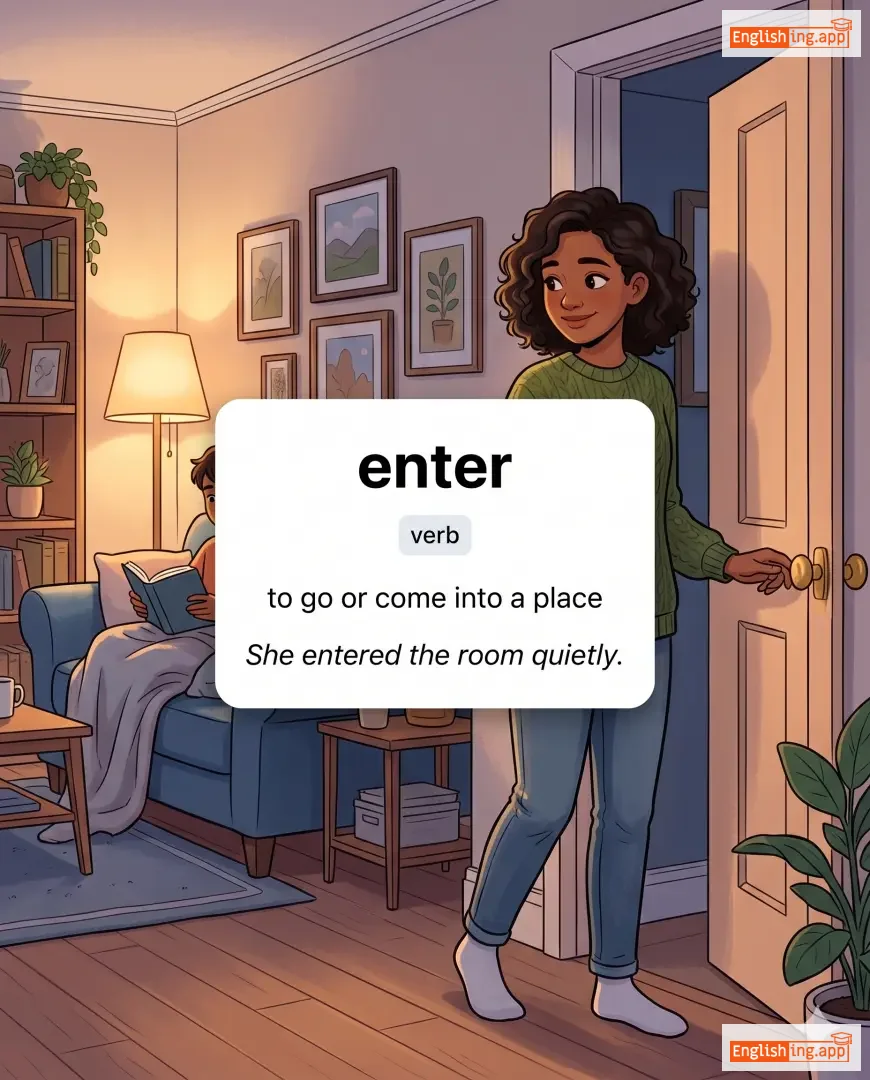
enter definition card — visual illustration of the meaning
verb
/ˈɛntər/
entrar (entrar)

to go or come into a place

"She entered the room quietly."

"Ella entró en la habitación silenciosamente." (Ella entró en la habitación silenciosamente.)
noun
/ˈɛntərˌpraɪz/
empresa / emprendimiento (empresa / emprendimiento)

a business or company; a project or undertaking that requires effort and initiative

"The new enterprise aims to create sustainable energy solutions."

"La nueva empresa tiene como objetivo crear soluciones energéticas sostenibles." (La nueva empresa tiene como objetivo crear soluciones energeticas sostenibles.)
adjective
/ˈɛntərˌpraɪzɪŋ/
emprendedor (emprendedor)

showing initiative and resourcefulness; willing to take risks to achieve success

"She is an enterprising young entrepreneur."

"Ella es una joven emprendedora emprendedora." (Ella es una joven emprendedora emprendedora.)
verb
/ˌɛntərˈteɪn/
entretener (entretener)

to provide amusement, enjoyment, or hospitality to others

"The comedian entertained the audience with his jokes."

"El comediante entretuvo al público con sus chistes." (El comediante entretuvo al publico con sus chistes.)
adjective
/ˌɛntərˈteɪnɪŋ/
entretenido (entretenido)

providing amusement or enjoyment

"The comedian gave an entertaining performance."

"El comediante dio una actuación entretenida." (El comediante dio una actuacion entretenida.)
noun
/ˌɛntərˈteɪnmənt/
entretenimiento (entretenimiento)

something that amuses, pleases, or diverts

"The concert was a great source of entertainment."

"El concierto fue una gran fuente de entretenimiento." (El concierto fue una gran fuente de entretenimiento.)
verb
/ɪnˈθrɔːl/
cautivar (cautivar)

To captivate or hold someone’s full attention.

"The magician’s performance enthralled the audience."

"La actuación del mago cautivó a la audiencia." (La actuacion del mago cautivo a la audiencia.)
verb
/ɪnˈθrɔːl/
cautivar (cautivar)

to captivate or hold someone’s attention completely

"The magician’s tricks enthralled the children."

"Los trucos del mago cautivaron a los niños." (Los trucos del mago cautivaron a los niños.)
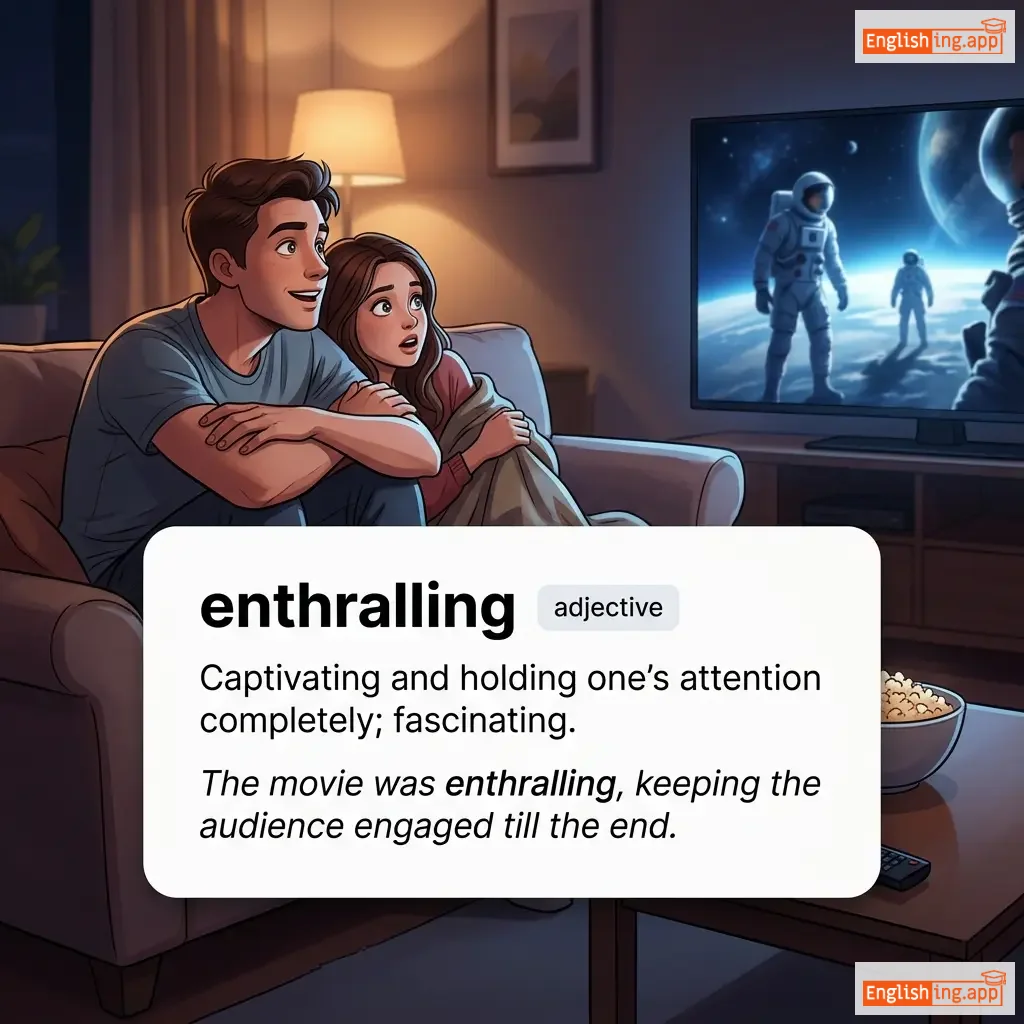
enthralling definition card — visual illustration of the meaning
adjective
/ɪnˈθrɔː.lɪŋ/
fascinante (fascinante)

Captivating and holding one's attention completely; fascinating.

"The movie was enthralling, keeping the audience engaged till the end."

"La película fue fascinante, manteniendo al público cautivado hasta el final." (la pelicula fue fascinante, manteniendo al publico cautivado hasta el final.)
verb
/ɪnˈθroʊn/
entronizar (entronizar)

to install someone on a throne or to give someone high status

"The king was enthroned in a grand ceremony."

"El rey fue entronizado en una gran ceremonia." (El rey fue entronizado en una gran ceremonia.)
verb
/ɪnˈθjuːz/
entusiasmar (entusiasmar)

to express excitement or admiration

"She enthused about her trip to Italy."

"Ella expresó su entusiasmo por su viaje a Italia." (Ella expreso su entusiasmo por su viaje a Italia.)
noun
/ɪnˈθjuːziæzəm/
entusiasmo (entusiasmo)

intense and eager enjoyment, interest, or approval

"His enthusiasm for teaching inspired his students."

"Su entusiasmo por la enseñanza inspiró a sus estudiantes." (Su entusiasmo por la ensenanza inspiro a sus estudiantes.)
noun
/ɪnˈθuziæst/
entusiasta (entusiasta)

a person who is very interested in a particular activity or subject

"He is a football enthusiast and watches every match."

"Él es un entusiasta del fútbol y ve cada partido." (El es un entusiasta del futbol y ve cada partido.)
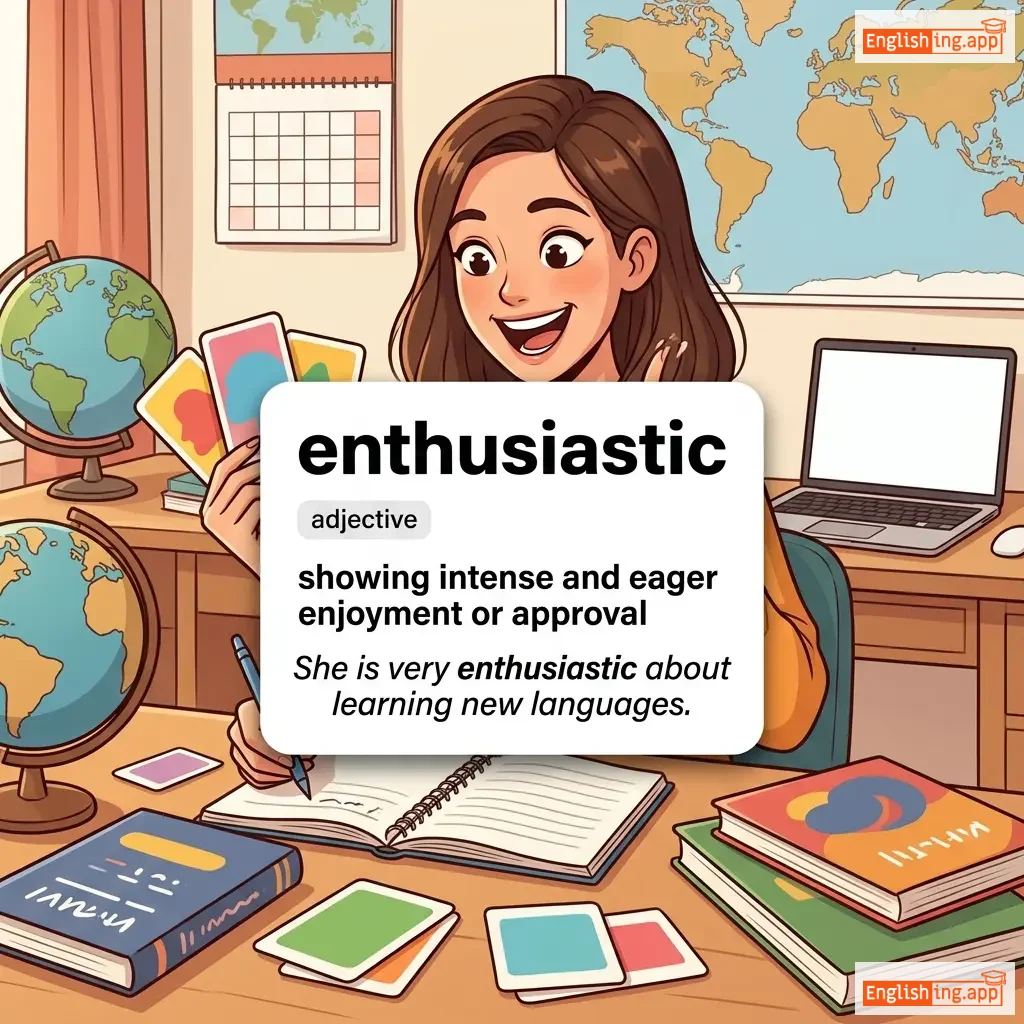
enthusiastic definition card — visual illustration of the meaning
adjective
/ɪnˌθjuːziˈæstɪk/
entusiasta (entusiasta)

showing intense and eager enjoyment or approval

"She is very enthusiastic about learning new languages."

"Ella está muy entusiasta por aprender nuevos idiomas." (Ella esta muy entusiasta por aprender nuevos idiomas.)
verb
/ɪnˈtaɪs/
atraer (atraer)

to attract or tempt someone by offering something appealing

"The advertisement was designed to entice customers into the store."

"El anuncio fue diseñado para atraer a los clientes a la tienda." (El anuncio fue diseñado para atraer a los clientes a la tienda.)
adjective
/ɪnˈtaɪər/
entero (entero)

whole; with no part left out

"He spent the entire day reading books."

"Pasó todo el día leyendo libros." (Pasó todo el día leyendo libros.)
adverb
/ɪnˈtaɪərli/
totalmente (totalmente)

Completely or wholly.

"She is entirely responsible for the project."

"Ella es totalmente responsable del proyecto." (Ella es totalmente responsable del proyecto.)
noun
/ɪnˈtaɪərəti/
entereza (enteresa)

the whole of something; the complete form

"He watched the movie in its entirety."

"Vio la película en su totalidad." (Vio la pelicula en su totalidad.)
verb
/ɪnˈtaɪtəl/
dar derecho a (dar derecho a)

to give someone the right to have or do something

"Employees are entitled to receive paid holidays."

"Los empleados tienen derecho a recibir vacaciones pagadas." (Los empleados tienen derecho a recibir vacaciones pagadas.)
adjective
/ɪnˈtaɪtəld/
con derecho (con derecho)

having the right to do or have something; feeling deserving of special treatment

"Employees are entitled to paid leave."

"Los empleados tienen derecho a un permiso remunerado." (Los empleados tienen derecho a un permiso remunerado.)
noun
/ɪnˈtaɪtəlmənt/
derecho (derecho)

the belief that one is inherently deserving of privileges or special treatment; a right to benefits

"The program provides entitlement to health care."

"El programa otorga derecho a la atención médica." (El programa otorga derecho a la atencion medica.)