वोकैबुलरीज

इंग्लिश वोकैबुलरी डिस्कवर, लर्न और मास्टर करें

noun
/ˈɛntəti/
सत्ता (satta)

something that exists as a single and complete unit; an organization or being

"The new company will operate as a separate legal entity."

"नई कंपनी एक अलग कानूनी सत्ता के रूप में काम करेगी।" (Nayi company ek alag kanuni satta ke roop mein kaam karegi.)
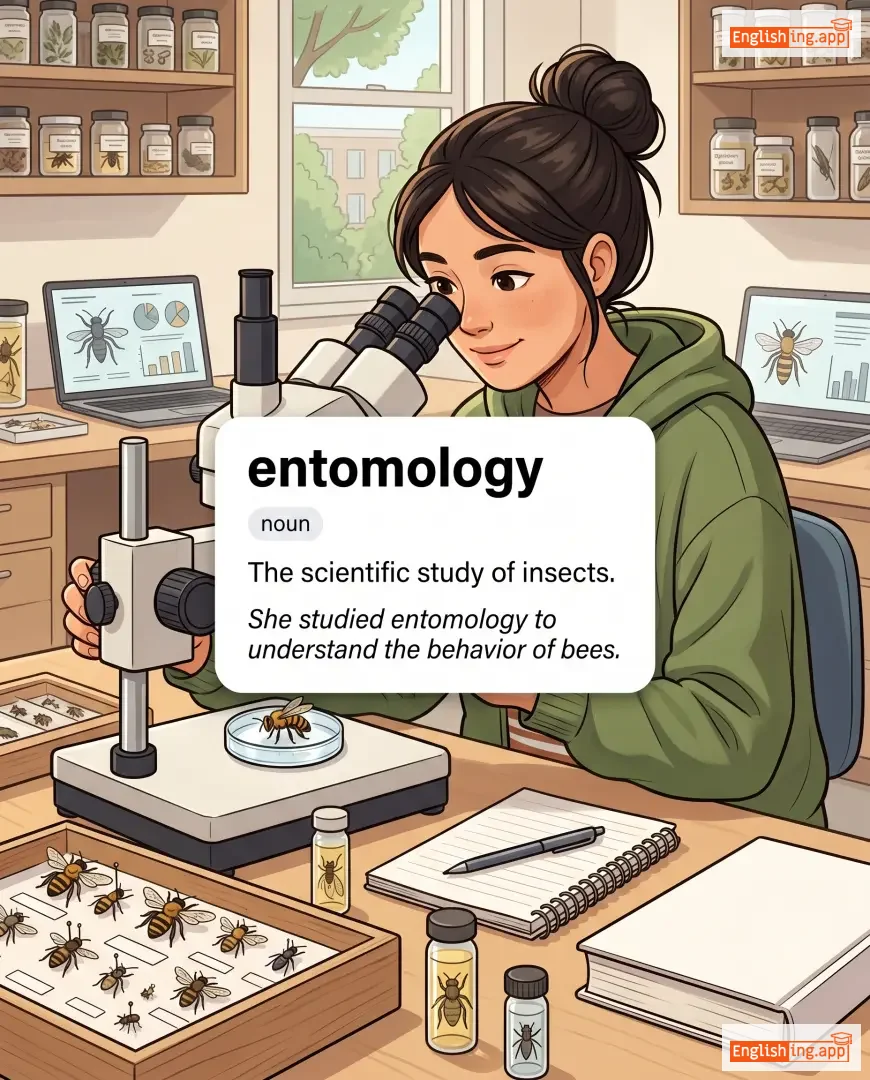
entomology definition card — visual illustration of the meaning
noun
/ˌɛntəˈmɒlədʒi/
कीटविज्ञान (keetvigyan)

The scientific study of insects.

"She studied entomology to understand the behavior of bees."

"उसने मधुमक्खियों के व्यवहार को समझने के लिए कीटविज्ञान का अध्ययन किया।" (Usne madhumakkhiyon ke vyavhaar ko samajhne ke liye keetvigyan ka adhyayan kiya.)
noun
/ˈɒntʊrɑːʒ/
अनुवादक (antoraj)

A group of people attending or surrounding an important person.

"The celebrity arrived with her entourage of assistants and bodyguards."

"प्रसिद्ध हस्ती अपनी अनुवादक टीम के साथ आई थी।" (Prasiddh hastī apnī anuvadak tīm ke sāth ā'ī thī.)
noun
/ˈɛntrəns/
प्रवेश द्वार (pravesh dwar)

A place of entering; an entry point.

"They waited at the main entrance of the building."

"वे इमारत के मुख्य प्रवेश द्वार पर इंतजार कर रहे थे।" (Ve imarat ke mukhya pravesh dwar par intezar kar rahe the.)
verb
/ɪnˈtræp/
फांस में फंसाना (fans mein phansana)

To catch or trick someone into a difficult situation.

"The police tried to entrap the criminal with false evidence."

"पुलिस ने झूठे सबूत से अपराधी को फांसने की कोशिश की।" (Police ne jhoothe saboot se aparadhi ko phansane ki koshish ki.)
verb
/ɪnˈtriːt/
विनती करना (vinti karna)

To ask earnestly or beg someone to do something.

"She entreated him to stay a little longer."

"उसने उसे कुछ और देर रुकने के लिए विनती की।" (Usne use kuch aur der rukne ke liye vinti ki.)
noun
/ɪnˈtriːti/
विनती (vinti)

An earnest or humble request or plea.

"She made an entreaty for peace during the heated argument."

"उसने तात्कालिक बहस के दौरान शांति के लिए विनती की।" (Usne tatkalik bahas ke dauran shanti ke liye vinti ki.)
noun
/ˈɒntreɪ/ (UK), /ˈɑːntreɪ/ (US)
मुख्य भोजन (mukhya bhojan)

The main course of a meal (US); the right to enter or access (formal).

"The restaurant’s signature steak was served as the main entree."

"रेस्तरां का सिग्नेचर स्टेक मुख्य भोजन के रूप में परोसा गया था।" (Restauran ka signature steak mukhya bhojan ke roop mein parosa gaya tha.)
verb
/ɪnˈtrɛntʃ/
मजबूती से स्थापित करना (mazbooti se sthapit karna)

To establish something so firmly that it is difficult to change.

"The company entrenched its position in the market through innovation."

"कंपनी ने नवाचार के माध्यम से बाजार में अपनी स्थिति मजबूत की।" (Company ne navachar ke madhyam se bazaar mein apni sthiti mazboot ki.)
adjective
/ɪnˈtrɛntʃt/
जड़ों में बैठा हुआ (jadon mein baitha hua)

Firmly established and unlikely to change.

"Corruption is deeply entrenched in the system."

"भ्रष्टाचार सिस्टम में गहरे तौर पर जड़ें जमा चुका है।" (Bhrashtachar system mein gahre taur par jaden jama chuka hai.)
Entrepreneur definition card — visual illustration of the meaning
noun
/ˌɒntrəprəˈnɜːr/ (UK), /ˌɑːntrəprəˈnɝː/ (US)
उद्यमी (udyami)

A person who starts and runs a business, taking on financial risks in the hope of profit.

"The young entrepreneur launched a successful tech startup."

"युवा उद्यमी ने एक सफल तकनीकी स्टार्टअप शुरू किया।" (yuva udyami ne ek safal takneeki startup shuru kiya.)
entrepreneurial definition card — visual illustration of the meaning
adjective
/ˌɒn.trə.prəˈnɜː.ri.əl/
उद्यमिता से संबंधित (udyamita se sambandhit)

Having the characteristics of an entrepreneur; showing initiative and willingness to undertake new ventures.

"Her entrepreneurial mindset led to the launch of a successful startup."

"उसकी उद्यमिता की मानसिकता ने एक सफल स्टार्टअप की शुरुआत की।" (Uski udyamita ki mansikta ne ek safal startup ki shuruat ki.)
noun
/ˈɛntri/
प्रवेश (pravesh)

the act of going into a place, or permission to go in

"Entry to the museum is free on Fridays."

"संग्रहालय में प्रवेश शुक्रवार को मुफ्त है।" (Sangrahalay mein pravesh shukravaar ko muft hai.)
verb
/ɪnˈtwaɪn/
मोड़ना (modna)

to twist or wind together; to become closely connected or involved

"The vines entwine around the old fence."

"लताएँ पुरानी बाड़ के चारों ओर लिपटी हुई हैं।" (Lataen purani baad ke charon or lipti hui hain.)
verb
/ɪˈnjuːməˌreɪt/
एक एक करके गिनना (ek ek karke ginna)

to mention things one by one; to list or count

"She enumerated the reasons for her decision."

"उसने अपने निर्णय के कारणों को एक-एक करके गिनाया।" (Usne apne nirnay ke karanon ko ek-ek karke ginaya.)
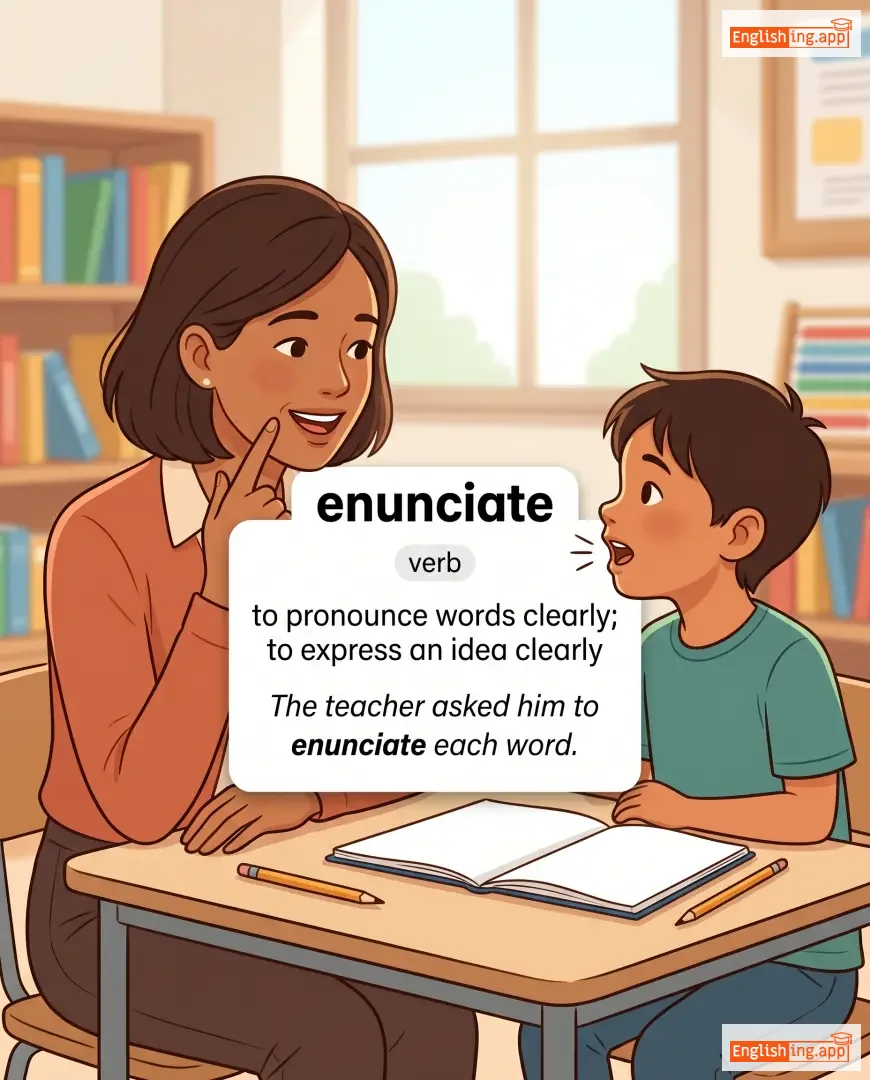
enunciate definition card — visual illustration of the meaning
verb
/ɪˈnʌnsieɪt/
स्पष्ट उच्चारण करना (spasht uchcharan karna)

to pronounce words clearly; to express an idea clearly

"The teacher asked him to enunciate each word."

"टीचर ने उसे हर शब्द को स्पष्ट रूप से बोलने के लिए कहा।" (Teacher ne use har shabd ko spasht roop se bolne ke liye kaha.)
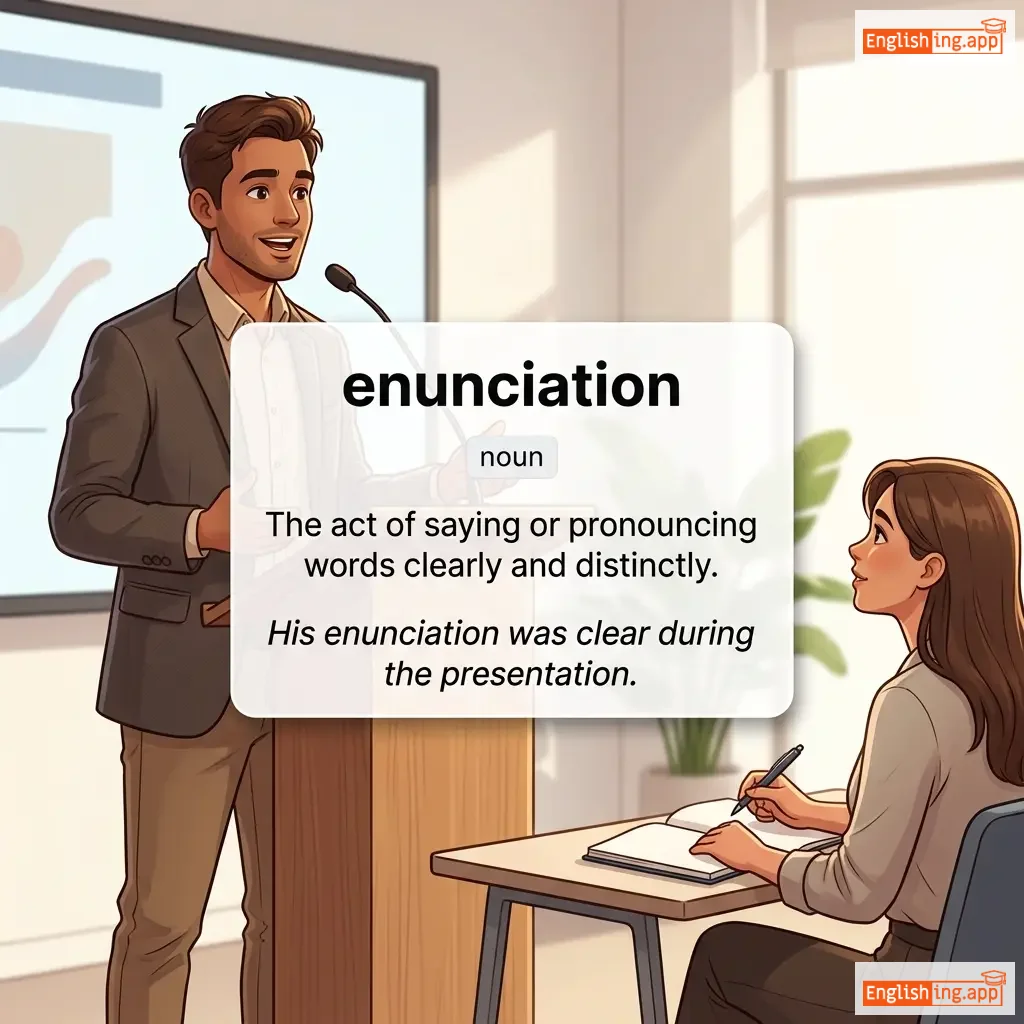
enunciation definition card — visual illustration of the meaning
noun
/ɪˌnʌn.siˈeɪ.ʃən/
उच्चारण, स्पष्ट रूप से बोलना (uccharan, spasht roop se bolna)

The act of saying or pronouncing words clearly and distinctly.

"His enunciation was clear during the presentation."

"उसकी उच्चारण प्रस्तुति के दौरान स्पष्ट था।" (Uski uccharan prastuti ke dauran spasht tha.)
noun
/ˈɛnvəloʊp/
लिफाफा (lifafa)

a flat paper container used to enclose a letter or document

"She sealed the letter in an envelope and posted it."

"उसने पत्र को लिफाफे में सील किया और उसे पोस्ट किया।" (Usne patra ko lifafe mein seal kiya aur use post kiya.)
adjective
/ˈen.vi.ə.bəl/
इच्छनीय (ichchhaniya)

causing envy; desirable

"Her success was enviable among her peers."

"उसकी सफलता उसके साथियों के बीच इच्छनीय थी।" (uski safalta uske saathiyon ke beech ichchhaniya thi.)
adjective
/ˈen.vi.əs/
ईर्ष्यालु; जलन महसूस करने वाला (irshyalu; jalan mehsoos karne wala)

feeling or showing envy; jealous

"She felt envious of her friend's new car."

"वह अपनी दोस्त की नई कार से ईर्ष्या महसूस कर रही थी।" (vah apni dost ki nai car se irshya mehsoos kar rahi thi.)
verb
/ɪnˈvaɪərən/
घेरना (gherna)

to surround or enclose; to encircle

"Mountains environ the small valley."

"पहाड़ों ने छोटी घाटी को घेर रखा है।" (Pahaadon ne chhoti ghaati ko gher rakha hai.)
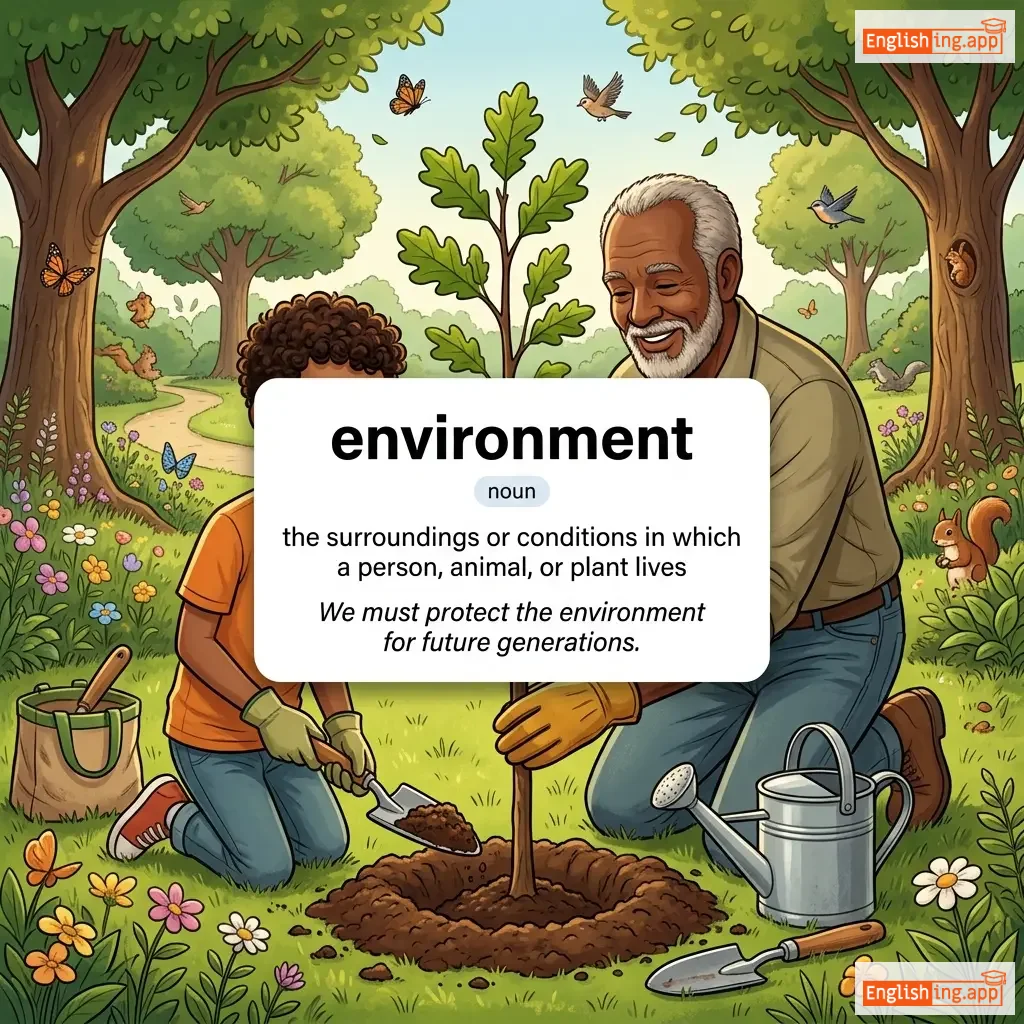
environment definition card — visual illustration of the meaning
noun
/ɪnˈvaɪrənmənt/
पर्यावरण (paryavaran)

the surroundings or conditions in which a person, animal, or plant lives

"We must protect the environment for future generations."

"हमें भविष्य पीढ़ियों के लिए पर्यावरण की रक्षा करनी चाहिए।" (Humein bhavishya peedhiyon ke liye paryavaran ki raksha karni chahiye.)
environment-friendly definition card — visual illustration of the meaning
adjective
/ɪnˈvaɪrənmənt ˈfrɛndli/
पर्यावरण मित्र (paryavaran mitra)

Designed or produced in a way that causes minimal harm to the environment, often using sustainable materials and processes that reduce ecological impact.

"Environment-friendly products are designed to reduce ecological damage."

"पर्यावरण मित्र उत्पाद पारिस्थितिकीय क्षति को कम करने के लिए डिज़ाइन किए जाते हैं।" (Paryavaran mitra utpad paristhitikiya khoti ko kam karne ke liye design kiye jate hain.)
adjective
/ɪnˌvaɪrənˈmɛntl/
पर्यावरणीय (paryavarniya)

relating to the natural world and the impact of human activity on its condition

"The company adopted new policies to reduce environmental damage."

"कंपनी ने पर्यावरणीय नुकसान को कम करने के लिए नई नीतियाँ अपनाई।" (Kampani ne paryavarniya nuksan ko kam karne ke liye nai neetiyan apnaayi.)
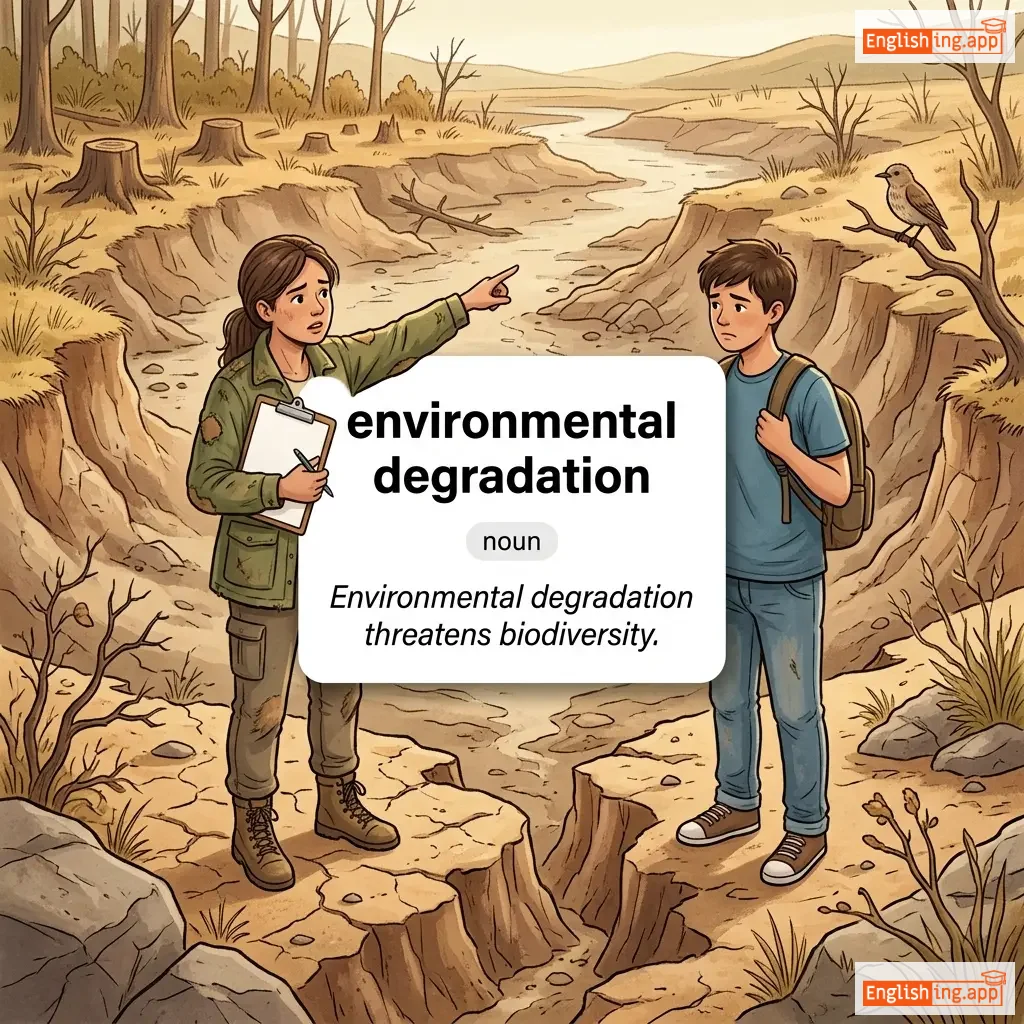
environmental degradation definition card — visual illustration of the meaning
noun
ɪnˌvaɪrənˈmɛntəl ˌdɛɡrəˈdeɪʃən
पर्यावरणीय अवनति (paryavarnik avnati)

The deterioration of the environment through depletion of resources and destruction of ecosystems.

"Environmental degradation threatens biodiversity."

"पर्यावरणीय अवनति जैव विविधता को खतरे में डालती है।" (Paryavarnik avnati jaiv vividhta ko khatre mein daalti hai.)
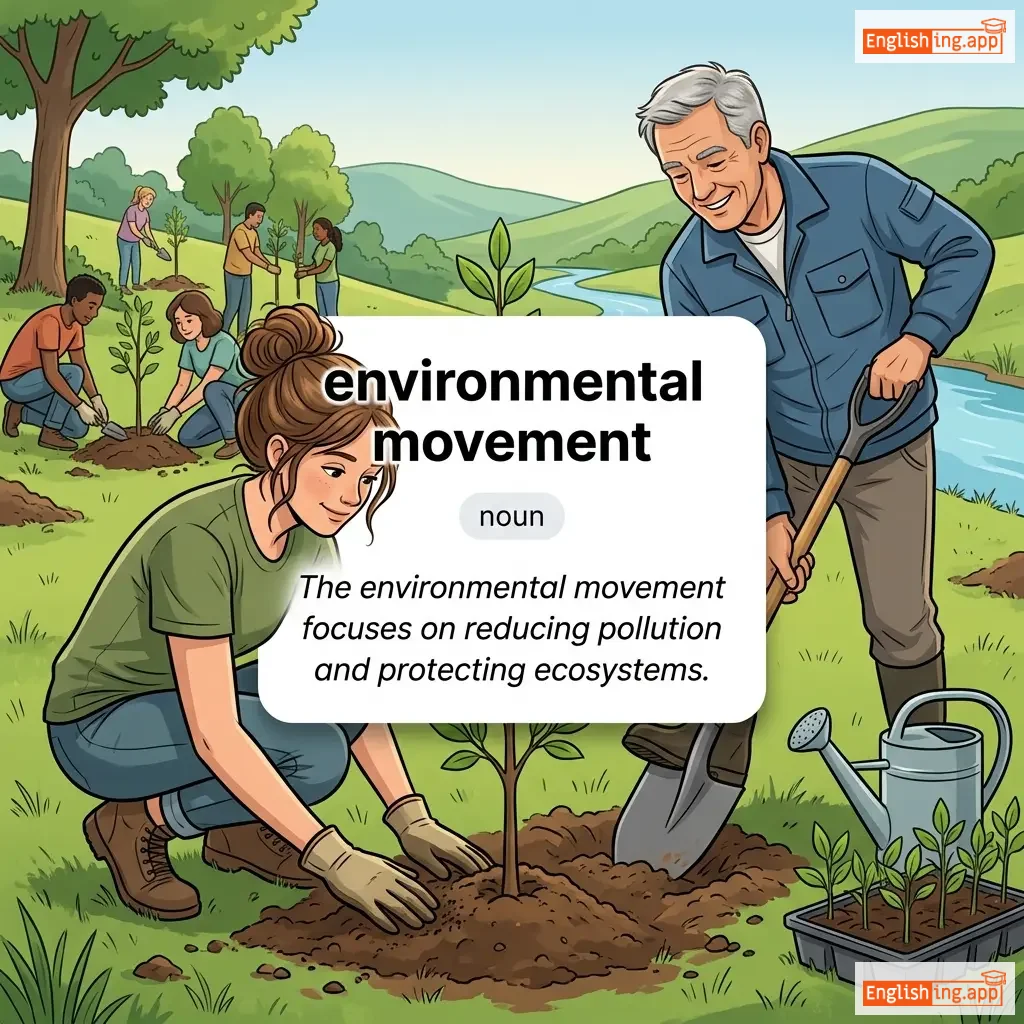
environmental movement definition card — visual illustration of the meaning
noun
/ɪnˌvaɪrənˈmɛntəl ˈmuːvmənt/
पर्यावरण आंदोलन (paryavaran aandolan)

A social or political movement aimed at protecting the environment and promoting sustainable practices through advocacy, education, and policy changes.

"The environmental movement focuses on reducing pollution and protecting ecosystems."

"पर्यावरण आंदोलन प्रदूषण को कम करने और पारिस्थितिकी प्रणालियों की रक्षा पर ध्यान केंद्रित करता है।" (Paryavaran aandolan pradooshan ko kam karne aur paristhitiki pranaliyon ki raksha par dhyan kendrit karta hai.)
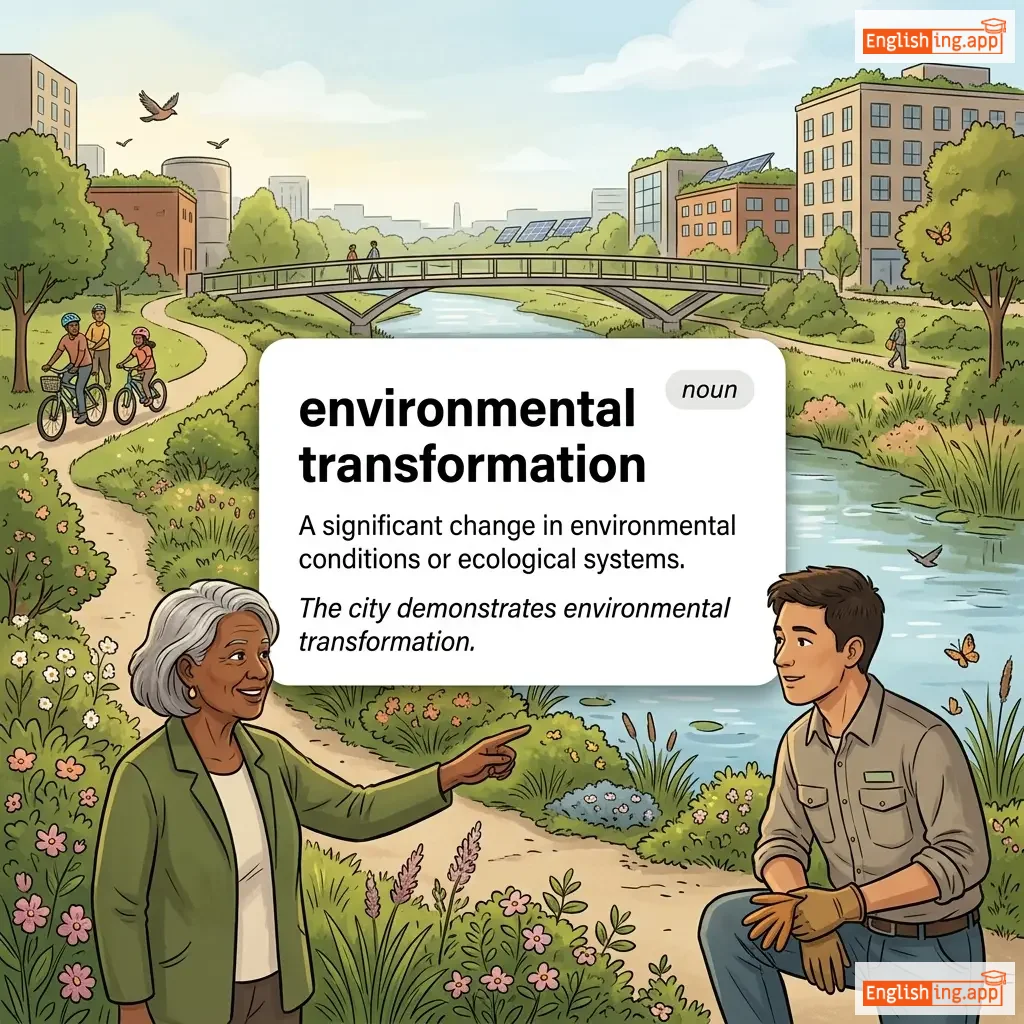
environmental transformation definition card — visual illustration of the meaning
noun
ɪnˌvaɪ.rənˈmen.təl ˌtræns.fəˈmeɪ.ʃən
पर्यावरणीय परिवर्तन (paryavarniya parivartan)

A significant change in environmental conditions or ecological systems.

"The city demonstrates environmental transformation."

"शहर पर्यावरणीय परिवर्तन को प्रदर्शित करता है।" (Shahar paryavarniya parivartan ko pradarshit karta hai.)
verb
/ɪnˈvɪʒən/
कल्पना करना (kalpana karna)

to imagine or picture something in the future; to visualize a possibility or goal

"She envisions a world where everyone has equal access to education."

"वह एक ऐसी दुनिया की कल्पना करती है जहाँ सभी को शिक्षा तक समान पहुँच प्राप्त हो।" (Vah ek aisi duniya ki kalpana karti hai jahan sabhi ko shiksha tak samaan pahuch prapt ho.)
enzymatic definition card — visual illustration of the meaning
adjective
/ˌen.zɪˈmæt.ɪk/
एंजाइम से संबंधित (enzyme se sambandhit)

Relating to or involving enzymes, which are proteins that catalyze biochemical reactions in living organisms.

"Enzymatic reactions regulate metabolism in the human body."

"एंजाइमेटिक प्रतिक्रियाएं मानव शरीर में चयापचय को नियंत्रित करती हैं।" (Enzymatic pratikriyaayein manav sharir mein chayapachay ko niyantrit karti hain.)
noun
/ˈiːən/
युग (yug)

an indefinitely long period of time; an age

"Dinosaurs lived millions of years ago, in a different eon."

"डायनासोर लाखों साल पहले, एक अलग युग में रहते थे।" (Dinosaur laakhon saal pehle, ek alag yug mein rehte the.)
noun
/ˈɛpəlɛt/
कंधे का आभूषण (kandhe ka aabhushan)

An ornamental shoulder piece on a garment, especially on the coat or jacket of a military uniform.

"The general’s uniform had a golden epaulet on each shoulder."

"जनरल की यूनिफॉर्म में प्रत्येक कंधे पर एक सुनहरी एपॉलेट था।" (General ki uniform mein pratyek kandhe par ek sunahri epaulet tha.)
noun
/ˈɛpəlɛt/
कंधे की सजावट (kandhe ki sajawat)

A variant spelling of epaulet, also meaning a shoulder ornament, especially on military uniforms.

"The officer’s epaulette shone brightly under the sunlight."

"अधिकारी का एपॉलेट सूरज की रोशनी में चमक रहा था।" (adhikari ka epaulette suraj ki roshni mein chamak raha tha.)
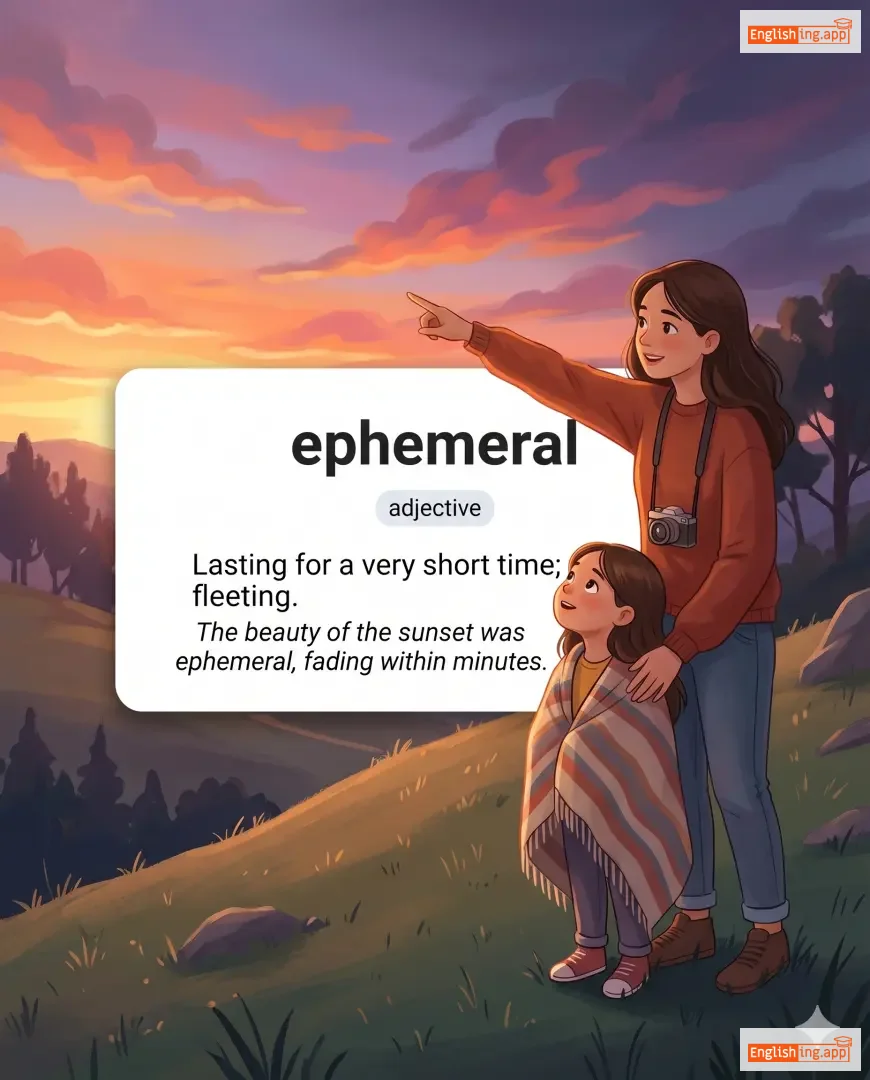
ephemeral definition card — visual illustration of the meaning
adjective
/ɪˈfɛmərəl/
क्षणिक (kshanik)

Lasting for a very short time; fleeting.

"The beauty of the sunset was ephemeral, fading within minutes."

"सूर्यास्त की सुंदरता क्षणिक थी, कुछ ही मिनटों में गायब हो गई।" (Suryast ki sundarta kshanik thi, kuch hi minaton mein gayab ho gayi.)
noun, adjective
/ˈɛpɪk/
महाकाव्य (mahaakavya)

A long narrative poem or story about heroic deeds; also used to describe something grand or impressive.

"The Iliad is considered one of the greatest epics of ancient literature."

"इलियड को प्राचीन साहित्य के सबसे महान महाकाव्यों में से एक माना जाता है।" (Iliad ko prachin sahitya ke sabse mahaan mahaakavyon mein se ek maana jaata hai.)
noun
/ˈɛpɪkjʊr/
रसज्ञ (rasajn)

A person who enjoys fine food and drink, often with refined taste.

"As an epicure, she always sought out the finest restaurants in the city."

"एक रसज्ञ के रूप में, वह हमेशा शहर के सबसे बेहतरीन रेस्टोरेंट्स की तलाश करती थी।" (ek rasajn ke roop mein, woh hamesha shahar ke sabse behtareen restaurants ki talash karti thi.)
adjective
/ˌɛpɪkjʊˈriːən/
एपिक्यूरियन (epikyurian)

relating to the enjoyment of fine food, drink, and luxury

"The chef prepared an epicurean feast for the guests."

"शेफ ने मेहमानों के लिए एक एपिक्यूरियन दावत तैयार की।" (Shef ne mehmanon ke liye ek epikyurian dawat tayar ki.)
noun
/ˈɛpɪˌsaɪkl/
उपवृत्ताकार कक्षपथ (upavrittaakar kakshpath)

a small circle whose center moves around the circumference of a larger one, used in ancient astronomy

"The concept of the epicycle was used to explain planetary motion."

"एपिसाइकिल की अवधारणा का उपयोग ग्रहों की गति को समझाने के लिए किया गया था।" (episaykel ki avdharaana ka upyog grahon ki gati ko samjhaane ke liye kiya gaya tha.)
noun
/ˌɛpɪˈsaɪklɔɪd/
एपिसायक्लॉयड (episaykloid)

a curve traced by a point on the circumference of a circle that rolls around the outside of another circle

"The mathematician demonstrated how to draw an epicycloid."

"गणितज्ञ ने दिखाया कि कैसे एक एपिसायक्लॉयड खींचें।" (Ganitgya ne dikhaya ki kaise ek episaykloid kheenchhen.)
noun
/ˌɛpɪˈdɛmɪk/
खुशी (khushi)

a widespread occurrence of an infectious disease in a community at a particular time

"The flu epidemic affected thousands of people in the city."

"वह पुरस्कार मिलने पर अपनी खुशी छुपा नहीं पाई।" (Wah puraskar milne par apni khushi chhupa nahi paayi.)
noun
/ˌɛpɪˈdɜːrmɪs/
त्वचा की बाहरी परत (twacha ki baahri parat)

the outer layer of cells covering the body of an organism, especially the skin

"The epidermis protects the body from harmful bacteria."

"एपिडर्मिस शरीर को हानिकारक बैक्टीरिया से बचाता है।" (Epidermis sharir ko haanikarak bacteria se bachata hai.)
noun
/ˈɛpɪɡræm/
उपदेशात्मक कविता (updeshatmak kavita)

A short, witty saying or poem that expresses an idea in a clever way.

"Oscar Wilde was famous for his sharp epigrams."

"ऑस्कर वाइल्ड अपने तीखे एपिग्राम्स के लिए प्रसिद्ध थे।" (Oscar Wilde apne teekhe epigrams ke liye prasiddh the.)
noun
/ˈɛpɪˌlɔːɡ/
उपसंहार अध्याय (upasnhar addhay)

A section at the end of a book, play, or speech that serves as a conclusion.

"The author included an epilogue to explain what happened to the characters later."

"लेखक ने पात्रों के बाद के जीवन को समझाने के लिए एक उपसंहार जोड़ा।" (Lekhak ne patro ke baad ke jeevan ko samjhaane ke liye ek upasnhar joda.)
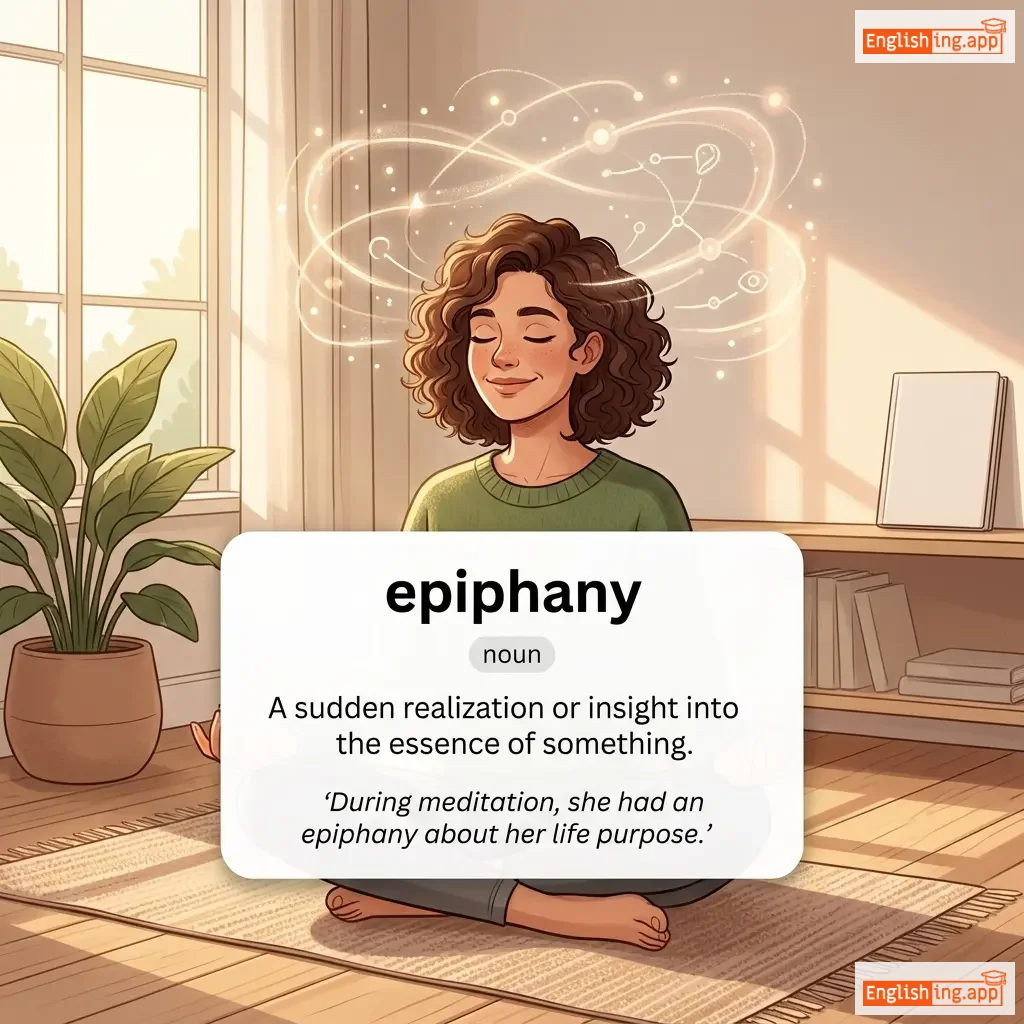
epiphany definition card — visual illustration of the meaning
noun
/ɪˈpɪfəni/
आकस्मिक बोध (aakasmik bodh)

A sudden realization or insight into the essence of something.

"During meditation, she had an epiphany about her life purpose."

"ध्यान के दौरान, उसे अपने जीवन के उद्देश्य के बारे में एक आकस्मिक बोध हुआ।" (Dhyan ke dauran, use apne jeevan ke uddeshya ke baare mein ek aakasmik bodh hua.)
noun
/ˈɛpɪsoʊd/
एपिसोड (episod)

An event or part of a story, or one installment in a series.

"The last episode of the drama was watched by millions."

"ड्रामा का आखिरी एपिसोड लाखों लोगों ने देखा।" (drama ka aakhri episod laakhon logon ne dekha.)
adjective
/ˌɛpɪˈsɒdɪk/
खंडित (khandit)

Happening occasionally or in separate parts; related to episodes.

"Her interest in art was episodic, coming and going over the years."

"उसकी कला में रुचि एपिसोडिक थी, सालों तक आती और जाती रही।" (Uski kala mein ruchi episodic thi, saalon tak aati aur jaati rahi.)
noun
/ɪˌpɪstəˈmɒlədʒɪst/
संज्ञानज्ञ (sanjnyanjnya)

A scholar or expert who studies the nature, sources, and limits of knowledge.

"The epistemologist debated how humans can truly know anything with certainty."

"एपिस्टेमोलॉजिस्ट ने बहस की कि मनुष्य सच्चाई को कितनी निश्चितता से जान सकता है।" (Epistemologist ne behas ki ki manushya sachchai ko kitni nishchitata se jaan sakta hai.)
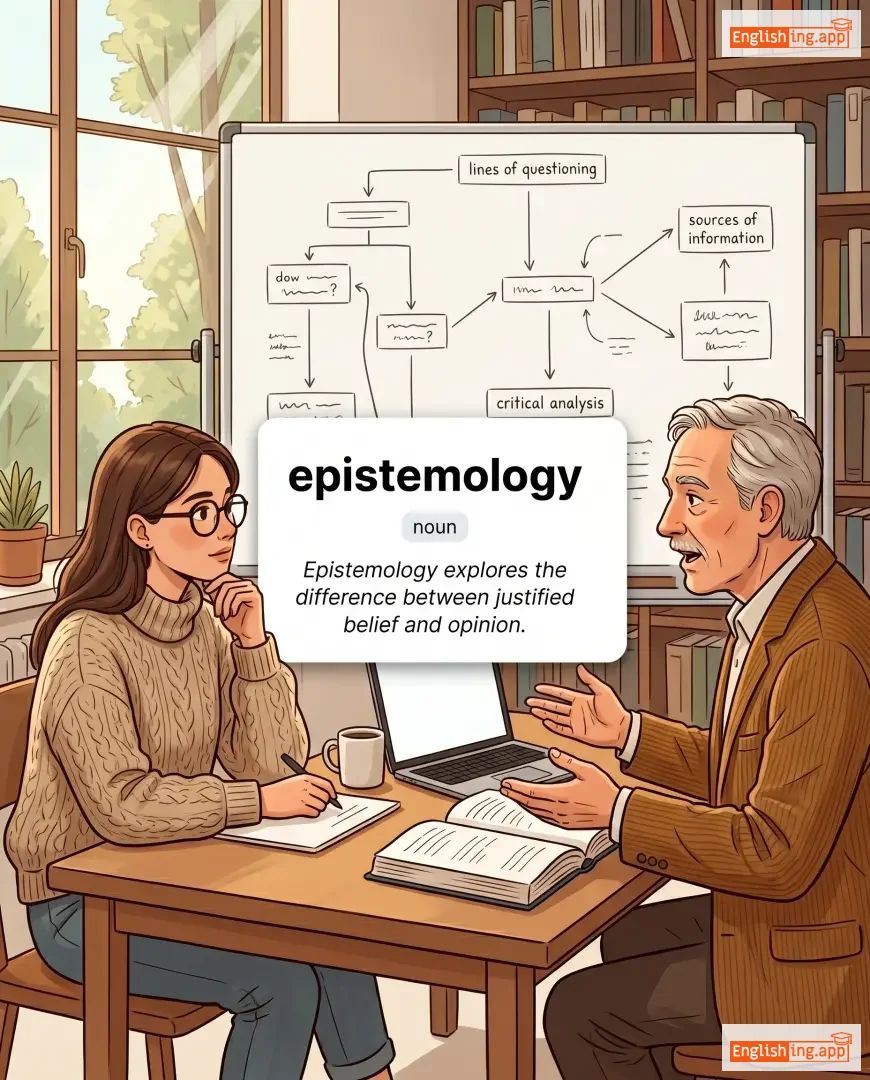
epistemology definition card — visual illustration of the meaning
noun
/ɪˌpɪstəˈmɒlədʒi/
ज्ञानमीमांसा (gyanamimamsa)

The branch of philosophy that studies the nature, origin, and scope of knowledge.

"Epistemology explores the difference between justified belief and opinion."

"ज्ञानमीमांसा प्रमाणित विश्वास और राय के बीच अंतर की खोज करती है।" (Gyanmimamsa pramanit vishwas aur ray ke beech antar ki khoj karti hai.)
noun
/ɪˈpɪsəl/
पत्र (patra)

A letter, especially a formal or didactic one; often used for letters in the New Testament.

"He wrote a long epistle to his friend about his travels."

"उसने अपने यात्रा के बारे में अपने दोस्त को एक लंबा पत्र लिखा।" (Usne apne yatra ke baare mein apne dost ko ek lamba patra likha.)
adjective
/ɪˈpɪstələri/
पत्रात्मक (patratmak)

Related to the writing of letters; expressed in or through letters.

"The novel is written in an epistolary style, consisting of letters between characters."

"उपन्यास एक पत्रात्मक शैली में लिखा गया है, जिसमें पात्रों के बीच पत्र होते हैं।" (Upanyaas ek patratmak shaili mein likha gaya hai, jismein patraon ke beech patra hote hain.)
noun
/ˈɛpɪtɑːf/
शवलेख (shavlekh)

A short text written on a tombstone in memory of the deceased.

"The gravestone bore an epitaph honoring the soldier’s bravery."

"कब्र पर एक शवलेख था जो सैनिक की बहादुरी को सम्मानित करता था।" (Kabar par ek shavlekh tha jo sainik ki bahaduri ko sammanit karta tha.)