词汇表

英语词汇词典 | 单词含义、定义和示例

adjective
/ˈvɛə.ri.əs/
各种各样的 (ge zhong ge yang de)

different from one another; of several different kinds

"She owns various kinds of books."

"她拥有各种各样的书籍。" (Ta yongyou ge zhong ge yang de shūjí.)
noun
/vəˈraɪəti/
多样性 (duōyàngxì)

the quality or state of being different or diverse; a range of different things

"There is a variety of fruits available in the market."

"市场上有各种各样的水果。" (Shìchǎng shàng yǒu gè zhǒng gè yàng de shuǐguǒ.)
noun
/ˌvɛəriəˈɡeɪʃən/
变色 (biansè)

The appearance of differently colored zones in the leaves, flowers, or stems of plants.

"Variegation makes the foliage look more attractive."

"变色使得植物的叶子更加吸引人。" (Biansè shǐdé zhíwù de yèzi gèngjiā xīyǐn rén.)
adjective
/ˈvɛəriəˌɡeɪtɪd/
五彩斑斕 (wucai banlan)

Having different colors, especially in irregular patches or streaks.

"The garden was full of variegated plants."

"花園裡充滿了五彩斑斕的植物。" (huayuan li chongman le wucai banlan de zhiwu)
verb
/ˈvɛəriəˌɡeɪt/
使多样化 (shǐ duōyàng huà)

To diversify or mark with different colors or patterns.

"The artist used different shades to variegate the design."

"艺术家使用不同的阴影来使设计变得多样化。" (Yìshùjiā shǐyòng bùtóng de yīnyǐng lái shǐ shèjì biàn dé duōyàng huà.)
adjective
/ˈvɛərɪd/
多样的 (duōyàng de)

showing many different kinds or forms

"The menu offers a varied selection of dishes."

"菜单提供各种各样的菜肴选择。" (Càidān tígōng gè zhǒng gè yàng de càiyáo xuǎnzé.)
noun
/ˌvɛəriˈeɪʃən/
变化 (bianhua)

A change or slight difference in condition, amount, or level.

"There is a wide variation in climate across the country."

"全国气候存在很大变化。" (quan guo qi hou cun zai hen da bian hua.)
noun
/ˈvɛəriənt/
变种 (bianzhong)

A form or version of something that differs in some way from other forms of the same thing.

"The new variant of the virus spread rapidly."

"病毒的新变种迅速传播。" (Bìngdú de xīn biànzhǒng xùnsù chuánbō.)
noun
/ˈvɛriəns/
方差 (fangcha)

the state of being different or inconsistent; in statistics, a measure of the spread between numbers

"There is a wide variance in students' performance levels."

"学生的表现水平有很大的方差。" (Xuéshēng de biǎoxiàn shuǐpíng yǒu hěn dà de fangcha.)
noun
/veɪn/
静脉 (jingmai)

a tube in the body that carries blood to the heart

"The nurse checked the patient's veins for an IV insertion."

"护士检查了病人的静脉以便插入静脉注射。" (Hushi jiancha le bingren de jingmai yibian charu jingmai zhushui.)
noun
/ˈtrɒɡlədaɪt/
穴居人 (xué jū rén)

A person who lives in a cave or is considered old-fashioned and out of touch.

"Some called him a troglodyte for refusing to use modern technology."

"有些人称他为穴居人,因为他拒绝使用现代技术。" (Yǒuxiē rén chēng tā wéi xuèjūrén, yīnwèi tā jùjué shǐyòng xiàndài jìshù.)
adjective
/ˈtrɪviəl/
琐碎 (suǒsuì)

Of little value or importance.

"He often gets upset over the most trivial matters."

"他经常为最琐碎的事情而烦恼。" (Tā jīngcháng wèi zuì suǒsuì de shìqíng ér fánnǎo.)
noun
/ˈtrɪviə/
琐事 (suǒ shì)

Details or information that are considered unimportant or of little value.

"The quiz was filled with fun trivia about movies and music."

"测验中充满了关于电影和音乐的有趣琐事。" (Cè yàn zhōng chōngmǎnle guānyú diànyǐng hé yīnyuè de yǒuqù suǒ shì.)
noun
/traɪˈʌmvɪrət/
三头政治 (san tou zhengzhi)

A political regime ruled or dominated by three powerful individuals.

"The Roman Republic was once governed by a triumvirate."

"罗马共和国曾一度由三头政治治理。" (Luoma gongheguo ceng yidu you san tou zhengzhi zhili.)
noun
/traɪˈʌmvɪər/
三头统治者 (sān tóu tǒngzhì zhě)

One of a group of three men holding power in ancient Rome.

"Caesar was a triumvir in the first Roman triumvirate."

"凯撒是第一罗马三巨头中的一员。" (Kǎisā shì dì yī luómǎ sān jùtóu zhōng de yī yuán.)
adjective
/traɪˈʌmfənt/
得胜的; 高兴的 (déshèng de; gāoxìng de)

having won a battle or contest; rejoicing as a result of success

"The team was triumphant after winning the championship."

"团队在赢得锦标赛后感到欢欣鼓舞。" (tuánduì zài yíngdé jǐnbiāosài hòu gǎndào huānxīng gǔwǔ)
triumph definition card — visual illustration of the meaning
noun
/ˈtraɪʌmf/
胜利 (shengli)

a great victory or achievement

"Winning the championship was a moment of triumph for the team."

"赢得冠军是球队的一次胜利时刻。" (Yíng dé guànjūn shì qiú duì de yī cì shèng lì shíkè.)
adjective
/traɪt/
陈腐的 (chénfǔ de)

Overused and lacking originality.

"The speech was full of trite phrases."

"演讲中充满了陈词滥调。" (Yǎnjiǎng zhōng chōngmǎnle chéncí làn diào.)
verb
/traɪˈsɛkt/
三分 (san fen)

To divide into three parts.

"The teacher asked the students to trisect the line segment."

"老师要求学生将线段分成三部分。" (Laoshi yaoqiu xuesheng jiang xianduan fen cheng san bufen.)
noun
/ˈtraɪ.pɒd/
三脚架 (san jiao jia)

A three-legged stand used to support a camera, telescope, or other object.

"The photographer set up his camera on a tripod."

"摄影师将他的相机放在三脚架上。" (Sheying shi jiang ta de xiangji fang zai san jiao jia shang.)
noun
/trɪˈplɪs.ə.ti/
三重性 (sanchongxing)

The state of being triple or consisting of three parts.

"The design shows a triplicity of forms combined harmoniously."

"设计展示了三重性形式的和谐结合。" (Sheji zhanshi le sanchongxing xingshi de hexie jiehe.)
noun
/ˈtrɪp.lɪ.kət/
三份副本 (san fen fuben)

A set of three identical copies of something.

"The documents were prepared in triplicate for official use."

"文件为官方使用已准备成三份。" (Wenjian wei guanfang shiyong yi zhunbei cheng san fen.)
noun
/ˈtrɪp.lət/
三胞胎 (san bao tai)

One of three children or animals born at the same time to the same mother.

"The family was surprised to have triplets instead of twins."

"这个家庭很惊讶他们有三胞胎而不是双胞胎。" (Zhe ge jiating hen jingya tamen you san baotai er bushi shuangbaotai.)
verb
/ˈtrɪp.əl/

To increase or become three times as much.

"The company tripled its profits in just one year."

noun
/trɪp/
旅行 (lvxing)

a journey or excursion, especially for pleasure

"They took a trip to the mountains last summer."

"他们去年夏天去了山里旅行。" (Tamen qunian xiatian qule shanli lvxing.)
noun
/ˈtriː.oʊ/
三人组 (san ren zu)

A group of three people or things, especially in music or performance.

"The jazz trio played beautifully at the concert."

"爵士三重奏在音乐会中演奏得非常精彩。" (Jue shi san chong zou zai yin yue hui zhong yan zou de fei chang jing cai.)
noun
/ˈtrɪŋkɪt/
小饰品 (xiao shipin)

a small ornament or piece of jewelry that is not expensive

"She bought a little trinket from the beach market as a souvenir."

"她从海滩市场买了一个小饰品作为纪念品。" (Tā cóng hǎitān shìchǎng mǎile yīgè xiǎo shìpǐn zuòwéi jìniànpǐn.)
noun
/ˈtrɪnɪti/
三位一体 (sanwei yiti)

a group of three closely related things; in Christianity, the Father, the Son, and the Holy Spirit

"The museum’s exhibit focused on a trinity of themes: memory, identity, and power."

"博物馆的展览专注于三种主题的三位一体:记忆、身份和力量。" (Bowuguan de zhanlan zhuanzhu yu sanzhong zhutide sanwei yiti: jiyi, shenfen he liliang.)
noun
/ˈtrɪmnəs/
整洁 (zhěngjié)

the quality of being neat, orderly, or slender and well-proportioned

"Her room’s trimness reflected a habit of putting everything back in its place."

"她房间的整洁反映出她总是把东西放回原位的习惯。" (Tā fángjiān de zhěngjié fǎnyìng chū tā zǒng shì bǎ dōngxī fàng huí yuánwèi de xíguàn.)
✂️

Trim

verb
/trɪm/

to cut away small parts to make something neat, tidy, or the right size

"I need to trim the video to remove the awkward pause at the end."

noun
/ˈtrɪlədʒi/
三部曲 (san bu qu)

a set of three related works, usually books or films, that form a connected story

"The director finally released the third film to complete the sci-fi trilogy."

"导演最终发布了第三部电影,完成了这部科幻三部曲。" (Dao yan zui zhong fa bu le di san bu dian ying, wan cheng le zhe bu ke huan san bu qu.)
noun
/ˈtrɪl.jən/
万亿 (wanyi)

a number equal to 1,000 billion, or 10^12

"The company's worth has risen to over a trillion dollars."

"公司的价值已经超过了一万亿美元。" (Gongsi de jiazhi yijing chao guo le yi wanyi meiyuan.)
triggers definition card — visual illustration of the meaning
verb
ˈtrɪɡərz
引发 (yinfa)

To cause or initiate something to happen

"Air pollution triggers chronic diseases."

"空气污染引发了慢性疾病。" (Kōngqì wūrǎn yǐnfa le mànxìng jíbìng.)
noun
/trɪk/
把戏 (bǎxì)

a cunning or deceitful action or plan intended to mislead or deceive someone

"She pulled a trick to win the game."

"她用了一个把戏来赢得游戏" (Tā yòngle yī ge bǎxì lái yíngdé yóuxì)
noun
/ˈtrɛsəl/
支架 (zhijià)

a frame or support consisting of a horizontal beam held up by two pairs of sloping legs, used especially for supporting a bridge or table

"The workers built a wooden trestle to support the temporary bridge."

"工人们建造了一个木制支架来支撑临时桥梁。" (Gōngrénmen jiànzàole yīgè mùzhì zhījià lái zhīchēng línshí qiáoliáng.)
noun
/ˈtraɪæd/
三合会 (sanhehui)

a group of three closely related people or things

"The project was managed by a triad of experts."

"该项目由一个三人专家小组管理。" (Gai xiangmu you yi ge san ren zhuanjia xiaozu guanli.)
noun
/ˈtraɪəl/
审判 (shenpan)

a formal examination of evidence in a court of law

"The trial will start next week."

"审判将在下周开始。" (Shenpan jiang zai xia zhou kaishi.)
adjective
/ˈtraɪbəl/
部落的 (bùluò de)

relating to a tribe or tribes, especially indigenous people

"The tribal community has preserved its culture for centuries."

"部落社区已经保存了他们的文化几个世纪。" (Bùluò shèqū yǐjīng bǎocúnle tāmen de wénhuà jǐ gè shìjì.)
noun
/traɪb/
部落 (bùluò)

a social group consisting of people with common customs, language, and culture

"The tribe lived in harmony with nature."
"部落与大自然和谐共处。" (Bùluò yǔ dà zìrán héxié gòngchǔ.)
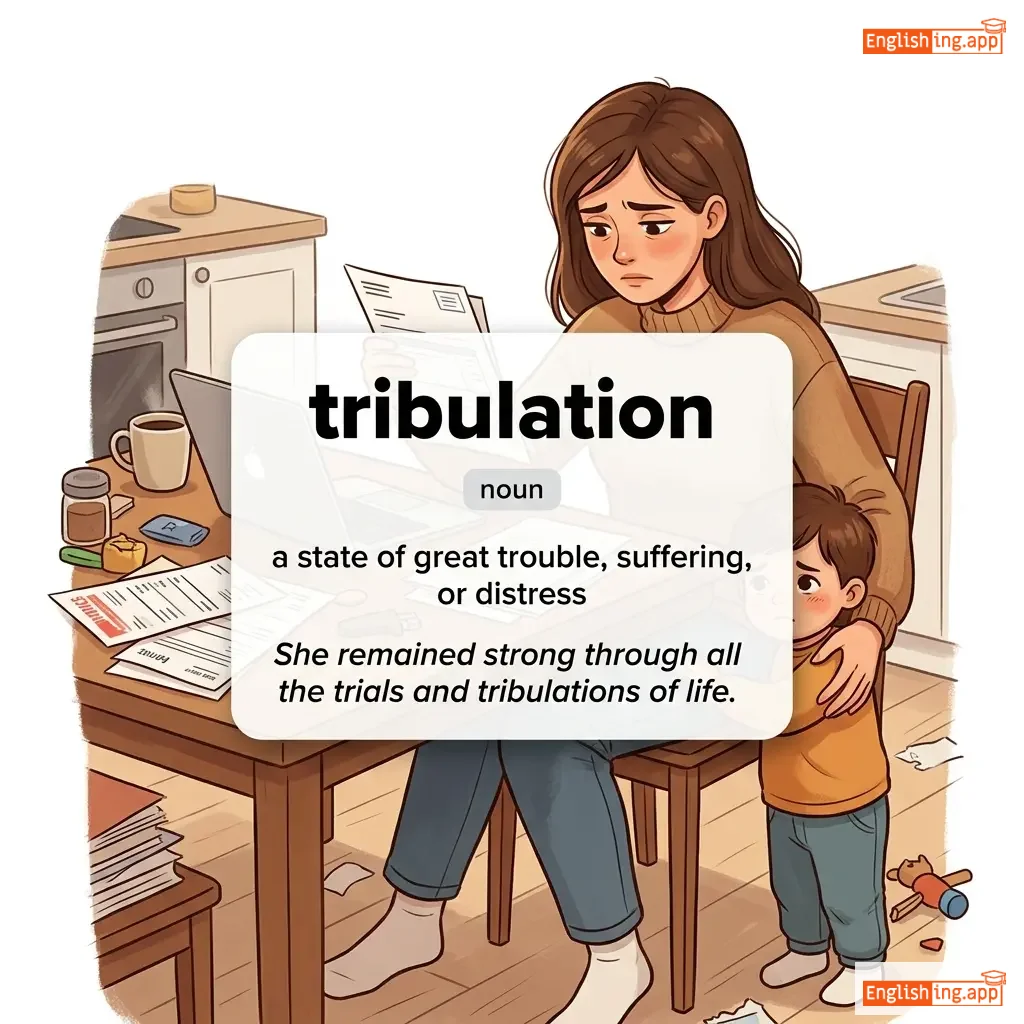
tribulation definition card — visual illustration of the meaning
noun
/ˌtrɪbjʊˈleɪʃən/

a state of great trouble, suffering, or distress

"She remained strong through all the trials and tribulations of life."

noun
/traɪˈbjuːnəl/
法庭 (fating)

a court of justice or body established to settle disputes

"The case was heard in an international tribunal."

"案件在国际法庭审理。" (Anjian zai guoji fating shenli.)
tribunal of justice definition card — visual illustration of the meaning
noun
ˌtraɪ.bjuˈnæl əv ˈdʒʌs.tɪs
司法法院 (sifa fayuan)

A court of justice or judicial body that settles disputes or tries offenses.

"The Tribunal of Justice started the hearings promptly."

"司法法院立即开始了听证会。" (Sifa fayuan liming kaishi le tingzhenghui.)
🗣️

tribune

noun
/ˈtrɪbjuːn/

a person or platform representing the people; historically, a Roman official elected to protect citizens' rights

"He was seen as a tribune of the common people."

noun
/ˈtrɪb.jə.ter.i/
支流 (zhīliú)

a river or stream flowing into a larger river or lake

"The tributary joins the main river near the city."
"支流在城市附近与主河汇合。" (zhīliú zài chéngshì fùjìn yǔ zhǔ hé huìhé)
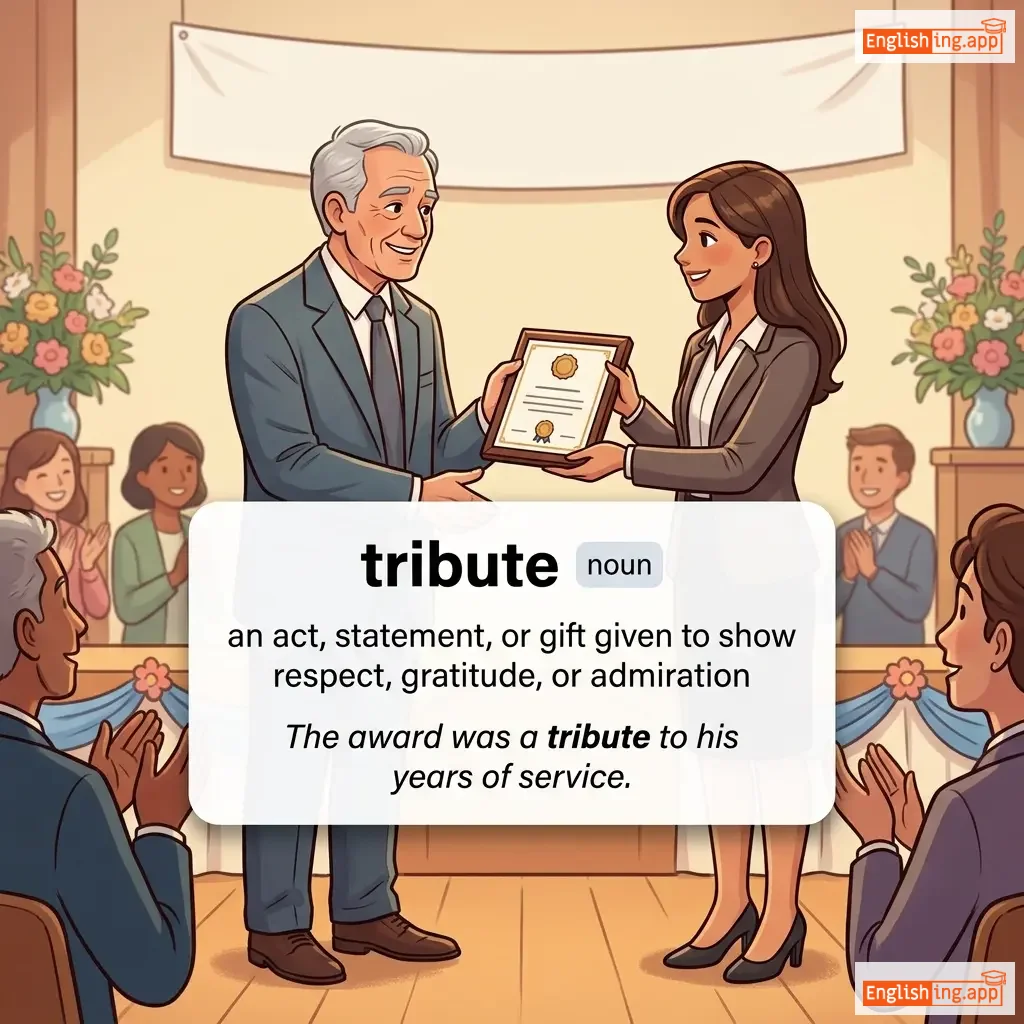
tribute definition card — visual illustration of the meaning
noun
/ˈtrɪbjuːt/
致敬 (zhìjìng)

an act, statement, or gift given to show respect, gratitude, or admiration

"The award was a tribute to his years of service."

"奖项是对他多年服务的致敬。" (Jiǎngxiàng shì duì tā duōnián fúwù de zhìjìng.)
adjective
/traɪˈɛniəl/
三年一次的 (san nian yi ci de)

Occurring once every three years.

"The art festival is a triennial event in the city."

"艺术节是这座城市的三年一次的活动。" (Yishujie shi zhe zuo chengshi de san nian yi ci de huodong.)
noun
/ˈtraɪsɪkl̩/
三轮车 (san lun che)

A small vehicle with three wheels, usually for children.

"The child rode happily on his red tricycle around the park."

"孩子开心地骑着他的红色三轮车在公园里兜圈子。" (Haizi kaixin de qizhe tade hongse sanlunche zai gongyuan li douquanzi.)
noun
/ˈtraɪdənt/
三叉戟 (sānchājǐ)

A three-pronged spear, often associated with Neptune or Poseidon.

"The statue of Poseidon holds a mighty trident."

"波塞冬的雕像握着一把强大的三叉戟。" (Bōsāiduōng de diāoxiàng wòzhe yī bǎ qiángdà de sānchājǐ.)
noun/adjective
/ˈtraɪkʌlər/
三色旗 (san se qi)

A flag with three colors; consisting of three colors.

"The French tricolor is one of the most famous national flags in the world."

"法国的三色旗是世界上最著名的国旗之一。" (Fǎguó de sān sè qí shì shìjiè shàng zuì zhùmíng de guóqí zhī yī.)
noun
/ˈtraɪfəl/
小事 (xiaoshi)

A thing of little value or importance; also a layered dessert.

"He dismissed the issue as a mere trifle."

"他把这个问题当作无关紧要的小事。" (Ta ba zhege wenti dangzuo wuguan jinyao de xiaoshi.)