词汇表

英语词汇词典 | 单词含义、定义和示例

verb
/ˌʌndərˈsteɪt/
低估 (dīgu)

To describe something as being less important or serious than it really is.

"He tends to understate his achievements."
"他倾向于低估自己的成就。" (Tā qīngxiàng yú dīgū zìjǐ de chéngjiù.)
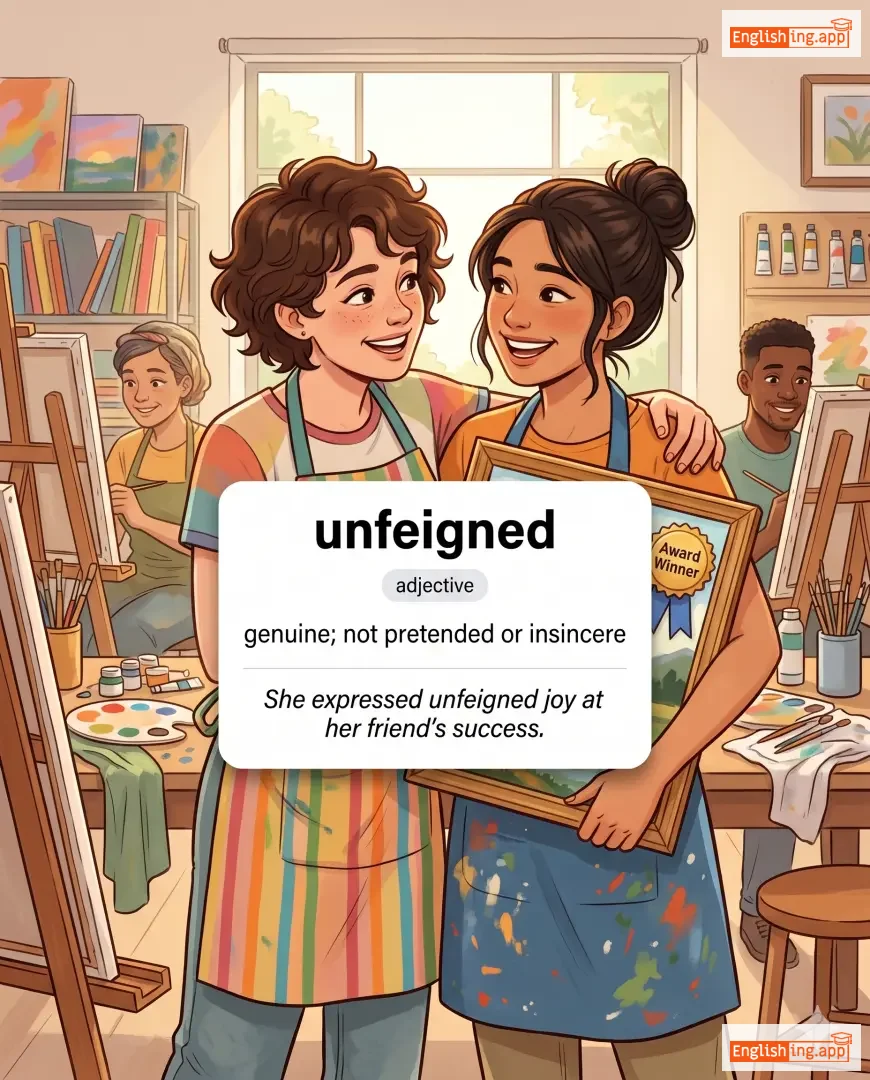
unfeigned definition card — visual illustration of the meaning
adjective
/ʌnˈfeɪnd/
真诚 (zhēnchéng)

genuine; not pretended or insincere

"She expressed unfeigned joy at her friend's success."

"她在朋友的成功上表达了真诚的喜悦。" (Tā zài péngyǒu de chénggōng shàng biǎodá le zhēnchéng de xǐyuè.)
noun
/ˌʌnɪmˈplɔɪmənt/
失业 (shiye)

the state of not having a paid job despite being able and willing to work

"High unemployment is a major issue in the country."

"高失业率是该国的一个主要问题。" (Gao shiye lv shi gai guo de yi ge zhuyao wenti.)
verb
/ʌnˈfəʊld/
展开或打开 (zhǎn kāi huò dǎ kāi)

to open or spread out something that was folded; to gradually reveal or develop

"She unfolded the letter carefully."

"她小心地展开了信件。" (Tā xiǎoxīn de zhǎn kāi le xìn jiàn.)
noun
/ˈʌndərˌwɜːrld/
地下世界 (dixiashijie)

The criminal world of organized crime or the mythical world of the dead.

"The detective spent years studying the secrets of the underworld."

"侦探花了很多年研究地下世界的秘密。" (Zhentan hua le henduo nian yanjiu dixia shijie de mimi.)
adjective
/ˈvɪnsəbl/
可征服的 (ke zhengfu de)

capable of being overcome or defeated

"The enemy seemed vincible after losing their main base."

"敌人在失去他们的主基地后似乎变得可征服。" (Dírén zài shīqù tāmen de zhǔ jīdì hòu sìhū biàn dé kě zhēngfú.)
adjective
/ʌnˈlɪmɪtɪd/
无限 (wuxian)

without any limits or restrictions

"The internet plan offers unlimited data for the whole month."

"该互联网计划提供整个一个月的无限数据。" (Gai hùliánwǎng jìhuà tígōng zhěnggè yīgè yuè de wúxiàn shùjù.)
adjective
/ʌnˈnoʊn/
未知 (weizhi)

not known or familiar

"The origin of the disease remains unknown."

"疾病的来源仍然未知。" (Jibing de laiyuan rengran weizhi.)
adjective
/ʌnˈfɔːrtʃənət/
不幸 (buxing)

Having or marked by bad luck; unlucky.

"It was unfortunate that the meeting was canceled at the last minute."

"很不幸,会议在最后一分钟被取消了。" (Hen buxing, huiyi zai zuihou yifen zhong bei quxiao le.)
adjective
/ˌʌnɪnˈfɔːrmd/
不了解情况的 (bu liaojie qingkuang de)

lacking knowledge or awareness about a particular subject; not educated or informed

"The decision was made by an uninformed committee."

"这个决定是由一个不了解情况的委员会做出的。" (zhege jueding shi you yi ge bu liaojie qingkuang de weiyuanhui zuochu de)
noun
/ˈvaɪənd/
佳肴 (jiāyáo)

an item of food, especially a delicacy

"The banquet was filled with rich viands and wines."
"宴会充满了丰盛的佳肴和美酒。" (Yànhuì chōngmǎnle fēngshèng de jiāyáo hé měijiǔ.)
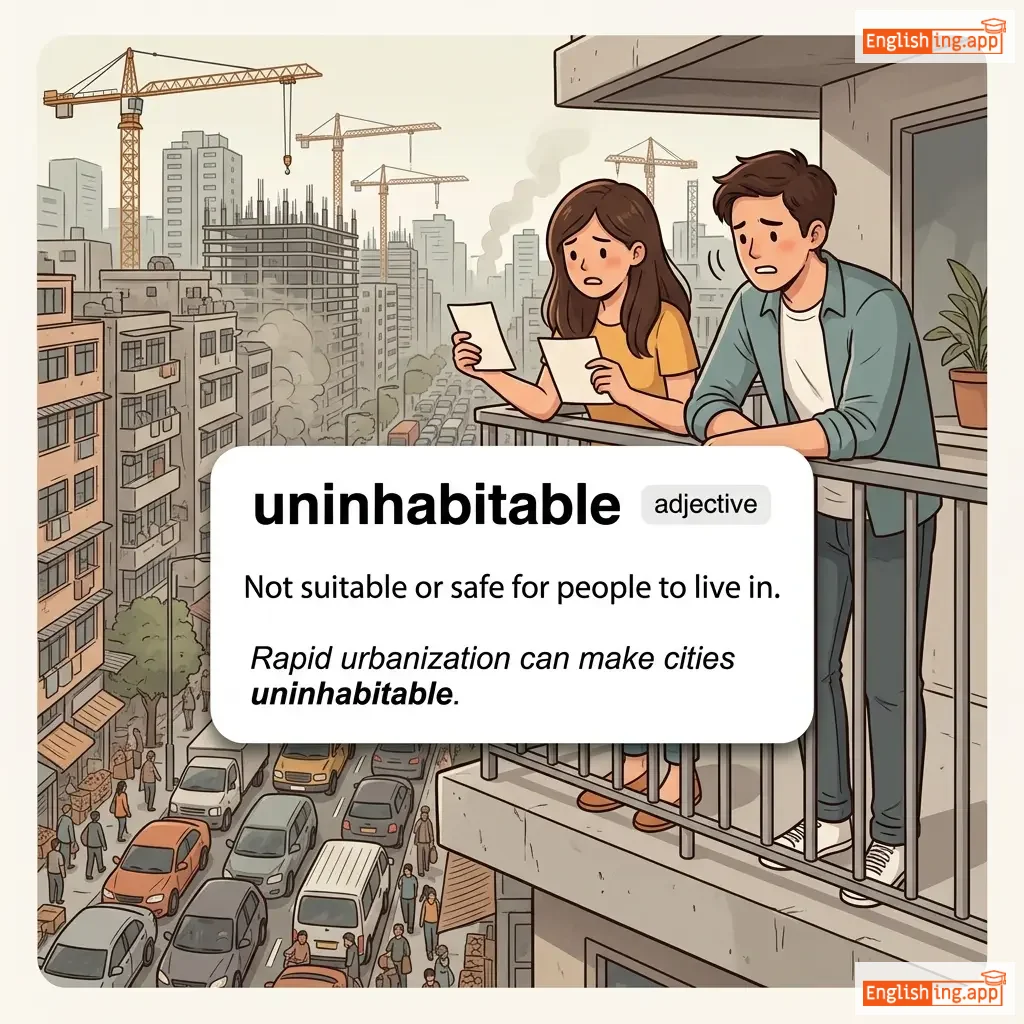
uninhabitable definition card — visual illustration of the meaning
adjective
ʌnɪnˈhæbɪtəbəl
不可居住 (bù kě jū zhù)

Not suitable or safe for people to live in.

"Rapid urbanization can make cities uninhabitable."

"快速城市化可能使城市变得无法居住。" (Kuài sù chéng shì huà kě néng shǐ chéng shì biàn dé wú fǎ jū zhù.)
adjective
/ˌjuːnɪˈvɜːsəl/
普遍的 (pǔbiàn de)

Relating to or done by all people or things in the world; applicable everywhere or in all cases.

"There is a universal need for love and acceptance."

"爱情和接纳是普遍的需求。" (Àiqíng hé jiēnà shì pǔbiàn de xūqiú.)
noun
/ˈjuːnɪsən/
齐声 (qí shēng)

Simultaneous performance or utterance of action or speech.

"The choir sang in unison."

"合唱团齐声唱歌。" (Héchàngtuán qí shēng chànggē.)
adjective
/ˌʌnɪˈkwɪvəkəl/
明确 (mingque)

Leaving no doubt; clear and unambiguous

"She gave an unequivocal answer to the question."

"她对问题给出了明确的回答。" (Ta dui wenti gei chulai mingque de huida.)
adjective
/ʌnˈfɔːltərɪŋ/
坚定不移 (jiāndìng bù yí)

Steady and resolute; not weakening or hesitating

"She continued with unfaltering determination."

"她以坚定不移的决心继续前进。" (Tā yǐ jiāndìng bù yí de juéxīn jìxù qiánjìn.)
adjective
/ʌnˈendɪŋ/
无尽的 (wujinde)

continuing forever; without end

"The unending rain made the day feel gloomy."

"无尽的雨让这一天显得阴沉。" (wujinde yu rang zhe yi tian xiande yinchen)
verb
/ˌʌndərˈvæljuː/
低估 (dīgu)

To assign too low a value or importance to something or someone.

"She felt that her boss consistently undervalued her contributions."

"她感觉到她的老板总是低估她的贡献。" (Tā gǎnjué dào tā de lǎobǎn zǒng shì dīgū tā de gòngxiàn.)
virtual classrooms definition card — visual illustration of the meaning
noun
ˈvɜː.tʃu.əl ˈklɑːs.ruːmz
虚拟教室 (xūnǐ jiàoshì)

An online learning environment where teachers and students interact via digital platforms.

"Virtual classrooms enable remote learning for students worldwide."

"虚拟教室为全球学生提供远程学习的机会。" (Xūnǐ jiàoshì wèi quánqiú xuéshēng tígōng yuǎnchéng xuéxí de jīhuì.)
conjunction
/ʌnˈlɛs/
除非 (chúfēi)

except if

"We won't go unless it stops raining."

"除非雨停了,否则我们不去。" (Chúfēi yǔ tíngle, fǒuzé wǒmen bù qù.)
vermin definition card — visual illustration of the meaning
noun
/ˈvɜːrmɪn/
有害动物 (yǒuhài dòngwù)

small animals or insects that are harmful or destructive, such as rats, lice, or fleas

"The old warehouse was overrun with vermin."

"老仓库被有害动物占领了。" (Lǎo cāngkù bèi yǒuhài dòngwù zhànlǐng le.)
noun
/ˈvaɪəl/
一种古老的弦乐器 (yī zhǒng gǔlǎo de xián yuèqì)

A stringed musical instrument of the Renaissance and Baroque periods, played with a bow and similar to but distinct from the violin family.

"The musician played an old viol in the chamber music concert."

"音乐家在室内音乐会中演奏了一把古老的维奥尔。" (Yīnyuèjiā zài shìnèi yīnyuè huì zhōng yǎnzòule yī bǎ gǔlǎo de wéi ào ěr.)
noun
/ˈjuːnɪən/
联盟 (lianmeng)

the action or fact of joining or being joined with others, especially to form a single unit

"The union of the two companies created a global leader."

"两家公司合并创造了一个全球领导者。" (Liang jia gongsi hebing chuangzao le yige quanqiu lingdaozhe.)
adverb
/ˈvaɪtəli/
至关重要地 (zhi guan zhong yao de)

in an extremely important or essential way; in a manner relating to life or vitality

"Access to clean water is vitally important for public health."

"获得清洁的水对公共健康至关重要。" (Huo de qing jie de shui dui gong gong jian kang zhi guan zhong yao)
adjective
/ʌnˈlɔːfəl/
非法 (feifa)

Not conforming to or permitted by law; illegal.

"The police arrested him for unlawful possession of weapons."

"警方因非法持有武器而逮捕了他。" (Jingfang yin feifa chiyou wuqi er daibu le ta.)
adjective
/juˈnaɪtɪd/
联合 (liánhé)

joined together or combined as one

"The united team won the championship."

"联合的队伍赢得了冠军。" (Liánhé de duìwǔ yíngdéle guànjūn.)
noun
/ˌjuːnɪˈtɛəriən/
一神论者 (yīshénlùnzhě)

A person who believes that God exists as one entity rather than as a Trinity; a member of a religious denomination that emphasizes individual freedom of belief.

"The Unitarian church is known for its inclusive and open-minded approach."

"一神论教会以其包容和开放的思想方式而闻名。" (Yīshénlùn jiàohuì yǐ qí bāoróng hé kāifàng de sīxiǎng fāngshì ér wénmíng.)
adjective
/ʌnˈflæpəbəl/
冷静沉着 (lěngjìng chénzhuó)

calm and composed, especially in difficult situations

"Despite the crisis, he remained unflappable and confident."

"尽管面临危机,他依然保持冷静沉着,充满自信。" (Jǐnguǎn miànlín wēijī, tā yīrán bǎochí lěngjìng chénzhuó, chōngmǎn zìxìn.)
adjective
/ʌnˈdʒʌst/
不公正的; 错误的 (bù gōngzhèng de; cuòwù de)

not fair or right; morally wrong

"The punishment was unjust for such a minor offense."

"这个惩罚对于如此轻微的罪行来说是不公正的。" (zhège chéngfá duìyú rúcǐ qīngwēi de zuìxíng lái shuō shì bù gōngzhèng de.)
vision definition card — visual illustration of the meaning
noun
/ˈvɪʒən/
幸福 (xingfu)

the ability to see or a mental image of something

"She had a clear vision of her future."

"当她收到奖项时,她无法掩饰她的幸福。" (Dang ta shoudao jiangxiang shi, ta wu fa yanshi ta de xingfu.)
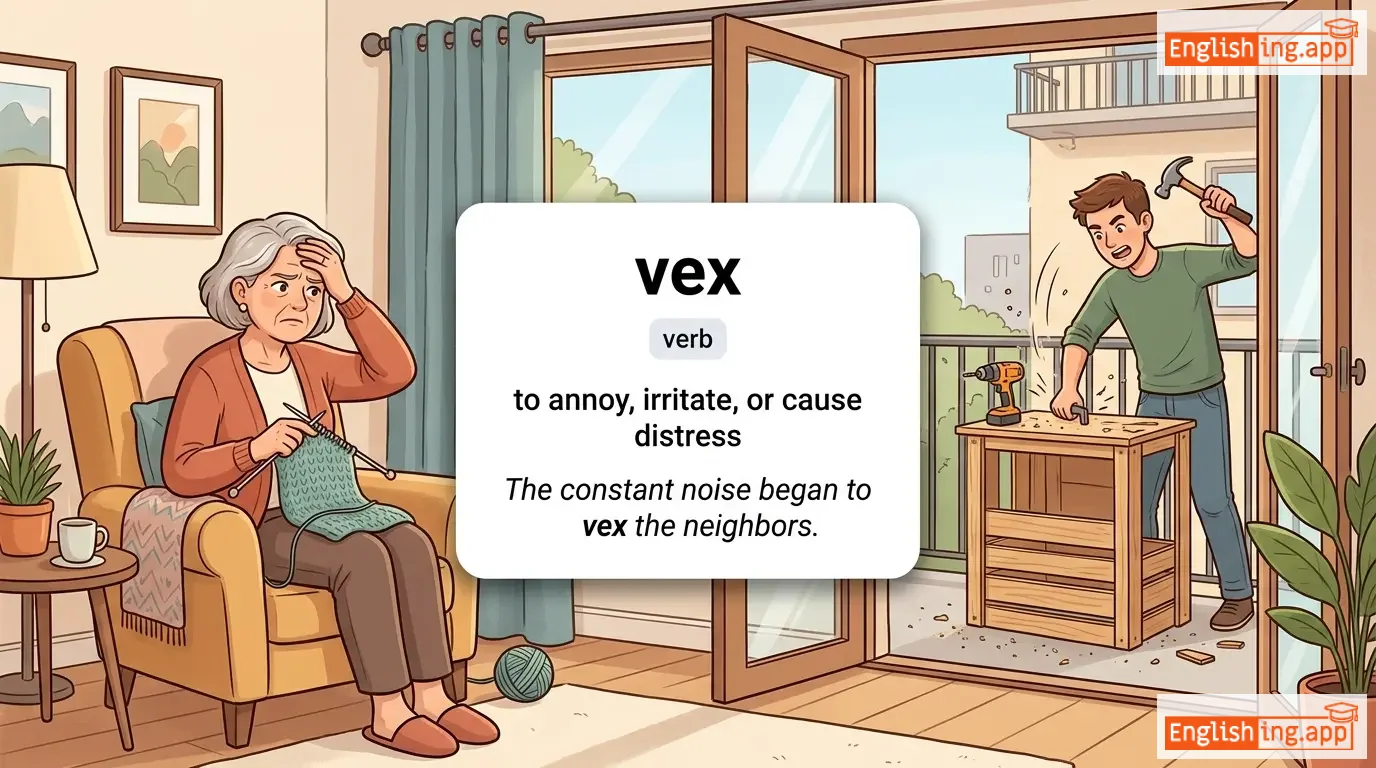
vex definition card — visual illustration of the meaning
verb
/vɛks/
烦扰 (fanrao)

to annoy, irritate, or cause distress

"The constant noise began to vex the neighbors."

"持续的噪音开始烦扰邻居。" (Chixu de zaoyin kaishi fanrao linju.)
adverb
/ˈvɜː.tʃu.ə.li/
几乎, 虚拟 (jī hū, xū nǐ)

almost or nearly, but not completely; by means of computer technology

"The meeting was held virtually due to travel restrictions."

"由于旅行限制,会议是虚拟举行的。" (Yóu yú lǚ xíng xiàn zhì, huì yì shì xū nǐ jǔ xíng de.)
verb
/ˈvɪtrɪfaɪ/
转变为玻璃 (zhuǎnbiàn wéi bōlí)

to turn into glass or a glass-like substance by heat

"Sand can vitrify under intense heat."

"沙子在强烈的热量下可以转变为玻璃。" (Shāzi zài qiángliè de rèliàng xià kěyǐ zhuǎnbiàn wéi bōlí.)
noun
/ˌjuːnɪˈfɔːrmɪti/
统一性 (tongyixing)

The quality or state of being the same, consistent, or without variation.

"The teacher insisted on uniformity in the students' dress code."

"老师坚持要求学生的着装保持统一性。" (Laoshi jiānchí yāoqiú xuéshēng de zhuózhuāng bǎochí tǒngyīxìng.)
verb
/ˈvɪʒuəlaɪz/
想象 (xiǎngxiàng)

To form a mental image of something; to imagine.

"She tried to visualize her success before the big presentation."

"她在大演讲前尝试去想象自己的成功。" (Tā zài dà yǎnjiǎng qián chángshì qù xiǎngxiàng zìjǐ de chénggōng.)
adjective
/ˈvɪsɪd/
粘稠 (zhānchóu)

Having a thick, sticky consistency.

"The sap had a viscid texture that stuck to his hands."

"树汁有一种粘稠的质地,粘在他的手上。" (Shù zhī yǒu yī zhǒng zhānchóu de zhìdì, zhān zài tā de shǒu shàng.)
noun
/ˈjuːnɪvɜːrs/
宇宙 (yuzhou)

the totality of known or supposed objects and phenomena throughout space; the cosmos

"The universe is vast and full of mysteries."

"宇宙广阔,充满了神秘。" (Yuzhou guangkuo, chongman le shenmi.)
adjective
/ˌʌnˈɪntrəstɪŋ/
无趣的 (wuqu de)

not holding attention or curiosity; boring

"The lecture was uninteresting and difficult to stay focused on."

"这次讲座很无趣,很难集中注意力。" (Zhe ci jiangzuo hen wuqu, hen nan jizhong zhuyi li)
preposition/adjective
/ʌnˈlaɪk/
不同 (bùtóng)

differing from or not similar to

"Unlike his brother, he enjoys playing soccer."

"与他的兄弟不同,他喜欢踢足球。" (Yǔ tā de xiōngdì bùtóng, tā xǐhuān tī zúqiú.)
adjective
/ʌnˈkaɪnd/
残忍; 不友好 (cánrěn; bù yǒuhǎo)

cruel; not nice or caring toward others

"It was unkind of him to make fun of her appearance."

"他取笑她的外貌,真是太不友善了。" (Tā qǔxiào tā de wàimào, zhēn shì tài bù yǒushàn le.)
noun
/ˈvɜːrtɛks/
顶点 (dingdian)

The highest point; the top or the apex.

"The climber reached the vertex of the mountain."

"登山者达到了山顶。" (Deng shanzhe daduo le shanding.)
adjective
/ˌʌnɪmˈpɔːrtənt/
不重要的 (bu zhongyao de)

not having much value, significance, or influence

"The detail seemed unimportant compared to the main issue."

"与主要问题相比,这个细节显得不重要。" (Yu zhuyao wenti xiangbi zhege xijie xiande bu zhongyao)
noun
/ˈvɪstə/
景观 (jingguan)

A pleasing view, especially one seen through a long, narrow opening.

"From the mountain top, we admired the breathtaking vista of the valley below."

"从山顶,我们欣赏到山谷下方令人叹为观止的景观。" (Cóng shāndǐng, wǒmen xīnshǎng dào shāngǔ xiàfāng lìng rén tànwèi guānzhǐ de jǐngguān.)
adjective
/ˌvɪtriˈɑːlɪk/
尖刻的批评 (jiān kè de pī píng)

filled with bitter criticism or malice

"His vitriolic remarks hurt everyone in the room."

"他尖刻的评论伤害了房间里所有的人。" (Tā jiān kè de píng lùn shāng hài le fáng jiān lǐ suǒ yǒu de rén.)
noun
/vɪˈsɪn.ə.ti/
附近; 邻近 (vicinity)

the area near or surrounding a particular place; neighborhood

"There are many shops in the vicinity of the school."

"学校附近有很多商店。" (xuexiao fujin you henduo shangdian.)
noun
/ˈʌndərˌteɪkɪŋ/
事业 (shìyè)

A task, project, or responsibility that someone agrees to do.

"Starting a new company is a difficult undertaking."

"创办新公司是一项艰巨的事业。" (Chuàngbàn xīn gōngsī shì yī xiàng jiānjù de shìyè.)
adjective
/ˈvɪrəl/
男性化 (nánxìng huà)

having traditionally masculine qualities, such as strength, energy, and sexual vigor

"The actor was admired for his virile appearance."

"演员因其男性化的外貌而受到赞赏。" (Yǎnyuán yīn qí nánxìng huà de wàimào ér shòudào zànshǎng.)
adjective
/ʌnˈɡeɪnli/
笨拙 (bènzhuō)

Awkward, clumsy, or lacking grace in movement or appearance.

"The tall boy moved in an ungainly manner."

"那个高个男孩以笨拙的方式走动。" (Nàgè gāo gè nán hái yǐ bènzhuō de fāngshì zǒudòng.)
adjective
/ʌnˈɪndʒərd/
未受伤 (wei shou shang)

Without injury; not physically harmed.

"All the passengers were rescued uninjured."

"所有乘客都没有受伤并被救援。" (Suǒyǐ chéngkè dōu méi yǒu shòudào shānghài bìng bèi jiùyuán.)
adjective
/juːˈnɪsənənt/
和谐的 (héxié de)

Sounding together or in harmony.

"The unisonant voices created a powerful effect."

"和谐的声音创造了强大的效果。" (Héxié de shēngyīn chuàngzàole qiángdà de xiàoguǒ.)