Vocabulaires

Découvrez, apprenez et maîtrisez le vocabulaire anglais

verb
/ˌʌndərˈsteɪt/
minimiser (minimiser)

To describe something as being less important or serious than it really is.

"He tends to understate his achievements."

"Il a tendance à minimiser ses réalisations." (Il a tendance à minimiser ses réalisations.)
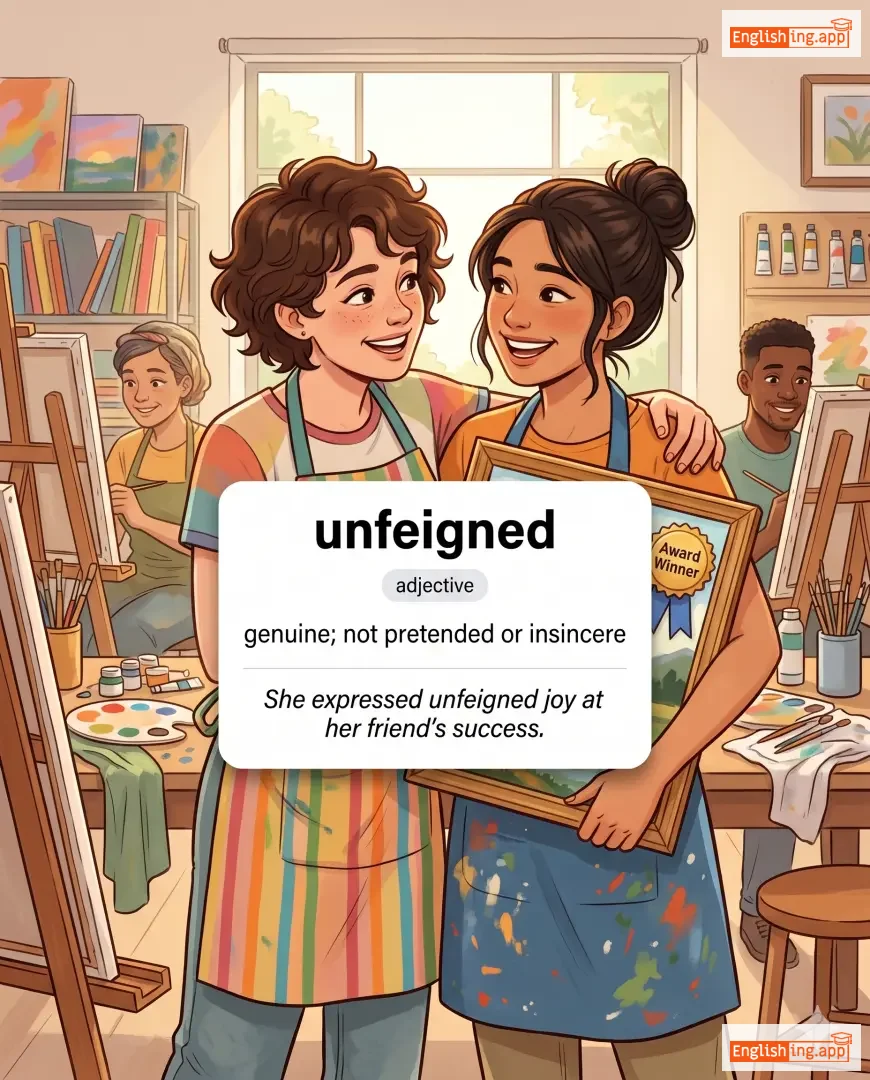
unfeigned definition card — visual illustration of the meaning
adjective
/ʌnˈfeɪnd/
authentique (authentique)

genuine; not pretended or insincere

"She expressed unfeigned joy at her friend's success."

"Elle a exprimé une joie authentique lors du succès de son amie." (Elle a exprimé une joie authentique lors du succès de son amie.)
noun
/ˌʌnɪmˈplɔɪmənt/
chômage (chomage)

the state of not having a paid job despite being able and willing to work

"High unemployment is a major issue in the country."

"Le chômage élevé est un problème majeur dans le pays." (Le chomage eleve est un probleme majeur dans le pays.)
verb
/ʌnˈfəʊld/
déplier ou ouvrir (deplier ou ouvrir)

to open or spread out something that was folded; to gradually reveal or develop

"She unfolded the letter carefully."

"Elle a soigneusement déplié la lettre." (Elle a soigneusement déplié la lettre.)
noun
/ˈʌndərˌwɜːrld/
sous-monde (sou monde)

The criminal world of organized crime or the mythical world of the dead.

"The detective spent years studying the secrets of the underworld."

"Le détective a passé des années à étudier les secrets du sous-monde." (Le detectiv a passe des annees a etudier les secrets du sous-monde.)
adjective
/ˈvɪnsəbl/
vincible (vincible)

capable of being overcome or defeated

"The enemy seemed vincible after losing their main base."

"L'ennemi semblait vincible après avoir perdu sa base principale." (L'ennemi semblait vincible après avoir perdu sa base principale.)
adjective
/ʌnˈlɪmɪtɪd/
illimité (illimite)

without any limits or restrictions

"The internet plan offers unlimited data for the whole month."

"Le plan Internet offre des données illimitées pendant tout le mois." (Le plan Internet offre des données illimitées pendant tout le mois.)
adjective
/ʌnˈnoʊn/
inconnu (inconnu)

not known or familiar

"The origin of the disease remains unknown."

"L'origine de la maladie reste inconnue." (L'origine de la maladie reste inconnue.)
adjective
/ʌnˈfɔːrtʃənət/
malheureux (malheureux)

Having or marked by bad luck; unlucky.

"It was unfortunate that the meeting was canceled at the last minute."

"C'était malheureux que la réunion ait été annulée à la dernière minute." (C'etait malheureux que la reunion ait ete annulee a la derniere minute.)
adjective
/ˌʌnɪnˈfɔːrmd/
mal informé (mal informe)

lacking knowledge or awareness about a particular subject; not educated or informed

"The decision was made by an uninformed committee."

"La décision a été prise par un comité mal informé." (la decision a ete prise par un comite mal informe)
noun
/ˈvaɪənd/
mets (mets)

an item of food, especially a delicacy

"The banquet was filled with rich viands and wines."

"Le banquet était rempli de mets raffinés et de vins." (Le banquet était rempli de mets raffinés et de vins.)
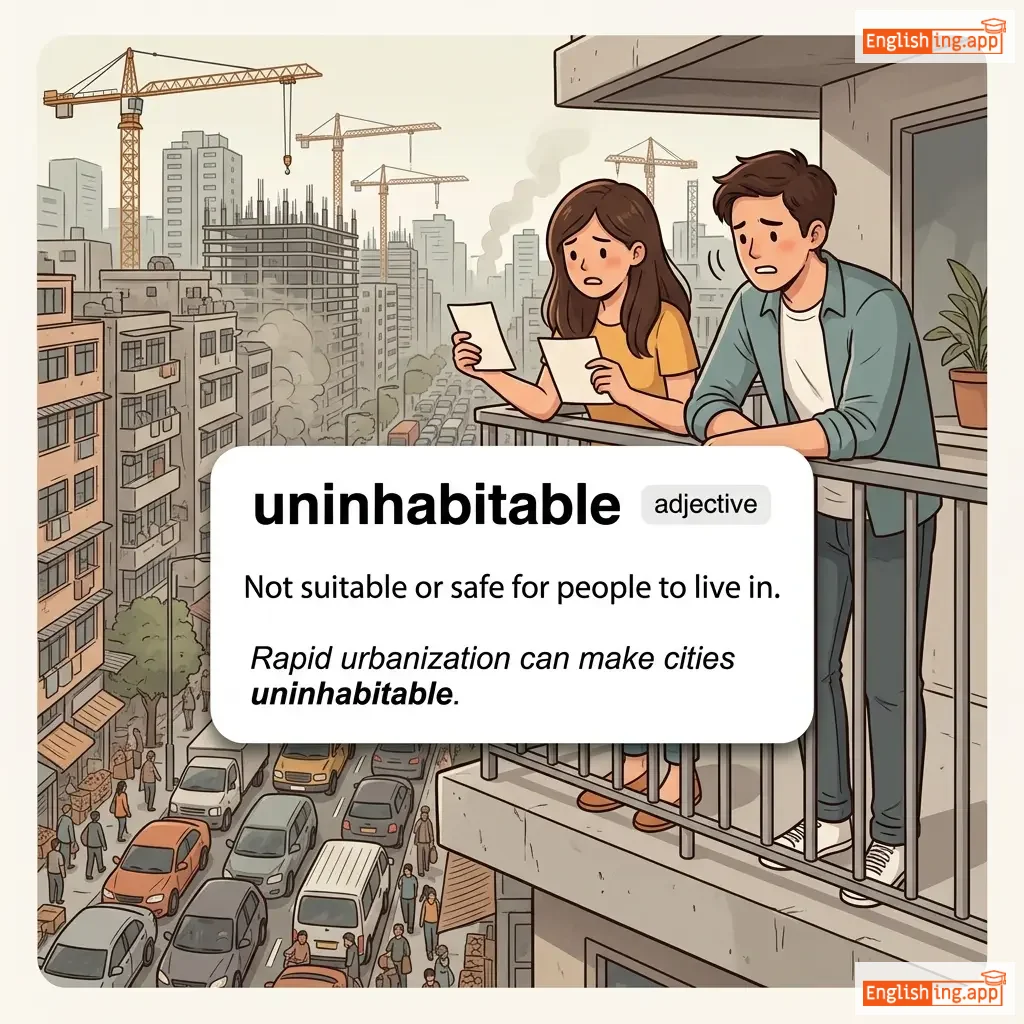
uninhabitable definition card — visual illustration of the meaning
adjective
ʌnɪnˈhæbɪtəbəl
inhabitable (inhabitable)

Not suitable or safe for people to live in.

"Rapid urbanization can make cities uninhabitable."

"L'urbanisation rapide peut rendre les villes inhabitables." (L'urbanisation rapide peut rendre les villes inhabitables.)
adjective
/ˌjuːnɪˈvɜːsəl/
universel (universel)

Relating to or done by all people or things in the world; applicable everywhere or in all cases.

"There is a universal need for love and acceptance."

"Il existe un besoin universel d'amour et d'acceptation." (Il existe un besoin universel d'amour et d'acceptation.)
noun
/ˈjuːnɪsən/
à l'unisson (a l'unisson)

Simultaneous performance or utterance of action or speech.

"The choir sang in unison."

"Le chœur a chanté à l'unisson." (Le choeur a chante a l'unisson.)
adjective
/ˌʌnɪˈkwɪvəkəl/
sans équivoque (san eqivok)

Leaving no doubt; clear and unambiguous

"She gave an unequivocal answer to the question."

"Elle a donné une réponse sans équivoque à la question." (Elle a donné une réponse sans équivoque à la question.)
adjective
/ʌnˈfɔːltərɪŋ/
inébranlable (inebranlable)

Steady and resolute; not weakening or hesitating

"She continued with unfaltering determination."

"Elle a continué avec une détermination inébranlable." (Elle a continue avec une determination inebranlable.)
adjective
/ʌnˈendɪŋ/
sans fin (sans fin)

continuing forever; without end

"The unending rain made the day feel gloomy."

"La pluie sans fin a rendu la journée morose." (la plui san fin a randu la journee moroz)
verb
/ˌʌndərˈvæljuː/
sous-estimer (sou-estimer)

To assign too low a value or importance to something or someone.

"She felt that her boss consistently undervalued her contributions."

"Elle sentait que son patron ne valorisait pas constamment ses contributions." (Elle sentait que son patron ne valorisait pas constamment ses contributions.)
virtual classrooms definition card — visual illustration of the meaning
noun
ˈvɜː.tʃu.əl ˈklɑːs.ruːmz
classes virtuelles (classes virtuelles)

An online learning environment where teachers and students interact via digital platforms.

"Virtual classrooms enable remote learning for students worldwide."

"Les classes virtuelles permettent l'apprentissage à distance pour les étudiants du monde entier." (Les classes virtuelles permettent l'apprentissage à distance pour les étudiants du monde entier.)
conjunction
/ʌnˈlɛs/
à moins que (a moins que)

except if

"We won't go unless it stops raining."

"Nous n'irons pas à moins qu'il ne cesse de pleuvoir." (Nous n'irons pas à moins qu'il ne cesse de pleuvoir.)
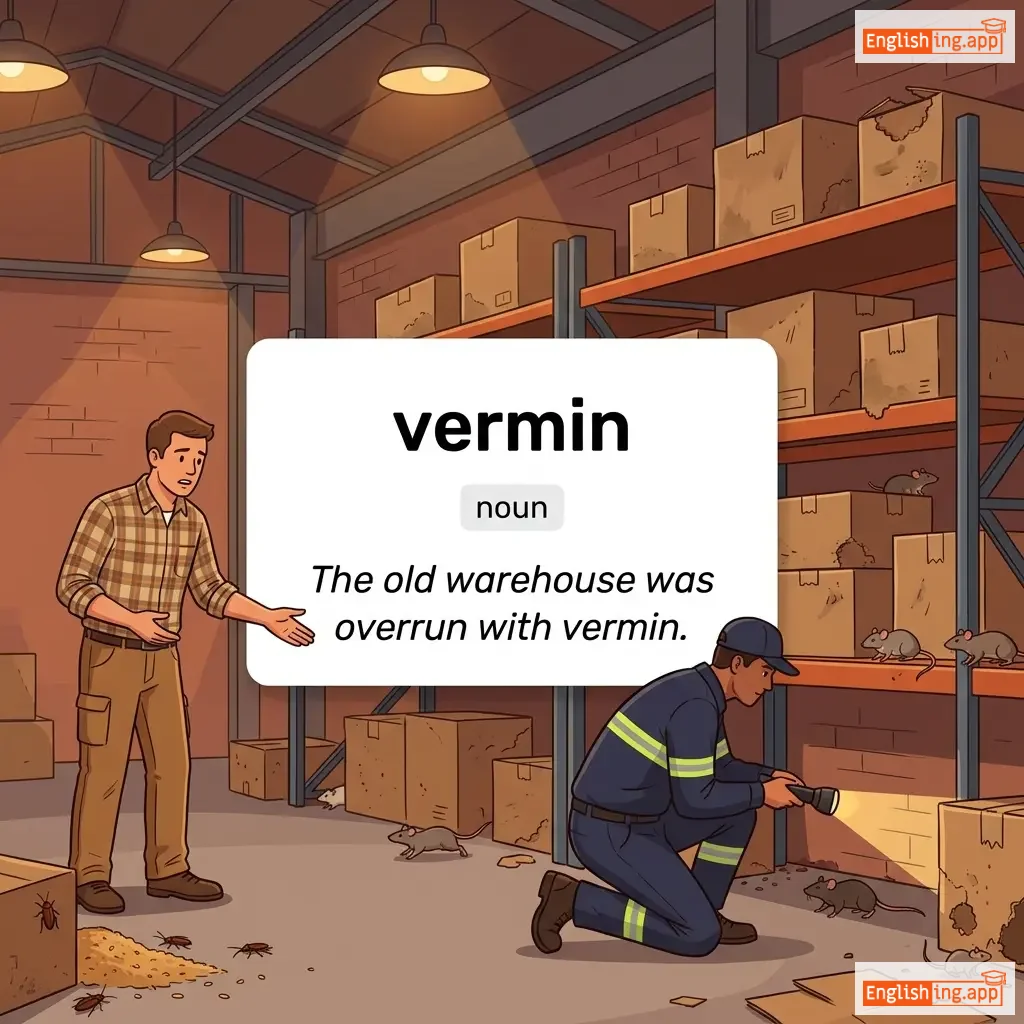
vermin definition card — visual illustration of the meaning
noun
/ˈvɜːrmɪn/
animaux nuisibles (animaux nuisibles)

small animals or insects that are harmful or destructive, such as rats, lice, or fleas

"The old warehouse was overrun with vermin."

"L'ancien entrepôt était infesté d'animaux nuisibles." (L'ancien entrepôt était infesté d'animaux nuisibles.)
noun
/ˈvaɪəl/
un type d'instrument à cordes ancien (un type d'instrument à cordes ancien)

A stringed musical instrument of the Renaissance and Baroque periods, played with a bow and similar to but distinct from the violin family.

"The musician played an old viol in the chamber music concert."

"Le musicien a joué un vieux viall dans le concert de musique de chambre." (Le musicien a joué un vieux viall dans le concert de musique de chambre.)
noun
/ˈjuːnɪən/
union (union)

the action or fact of joining or being joined with others, especially to form a single unit

"The union of the two companies created a global leader."

"L'union des deux entreprises a créé un leader mondial." (L'union des deux entreprises a cree un leader mondial.)
adverb
/ˈvaɪtəli/
vitalement (vitalement)

in an extremely important or essential way; in a manner relating to life or vitality

"Access to clean water is vitally important for public health."

"L’accès à l’eau propre est vitalement important pour la santé publique." (Lacces a leau propre est vitalement important pour la sante publique)
adjective
/ʌnˈlɔːfəl/
Illégal (illegal)

Not conforming to or permitted by law; illegal.

"The police arrested him for unlawful possession of weapons."

"La police l'a arrêté pour possession illégale d'armes." (La police l'a arrete pour possession ilegale d'armes.)
adjective
/juˈnaɪtɪd/
unis (unis)

joined together or combined as one

"The united team won the championship."

"L'équipe unie a remporté le championnat." (L'équipe unie a remporté le championnat.)
noun
/ˌjuːnɪˈtɛəriən/
unitaire (unitaire)

A person who believes that God exists as one entity rather than as a Trinity; a member of a religious denomination that emphasizes individual freedom of belief.

"The Unitarian church is known for its inclusive and open-minded approach."

"L'église unitaire est connue pour son approche inclusive et ouverte d'esprit." (L'église unitaire est connue pour son approche inclusive et ouverte d'esprit.)
adjective
/ʌnˈflæpəbəl/
imperturbable (imperturbable)

calm and composed, especially in difficult situations

"Despite the crisis, he remained unflappable and confident."

"Malgré la crise, il est resté imperturbable et confiant." (Malgré la crise, il est resté imperturbable et confiant.)
adjective
/ʌnˈdʒʌst/
injuste; incorrecte (injuste; incorrecte)

not fair or right; morally wrong

"The punishment was unjust for such a minor offense."

"La punition était injuste pour une infraction mineure." (La punition était injuste pour une infraction mineure.)
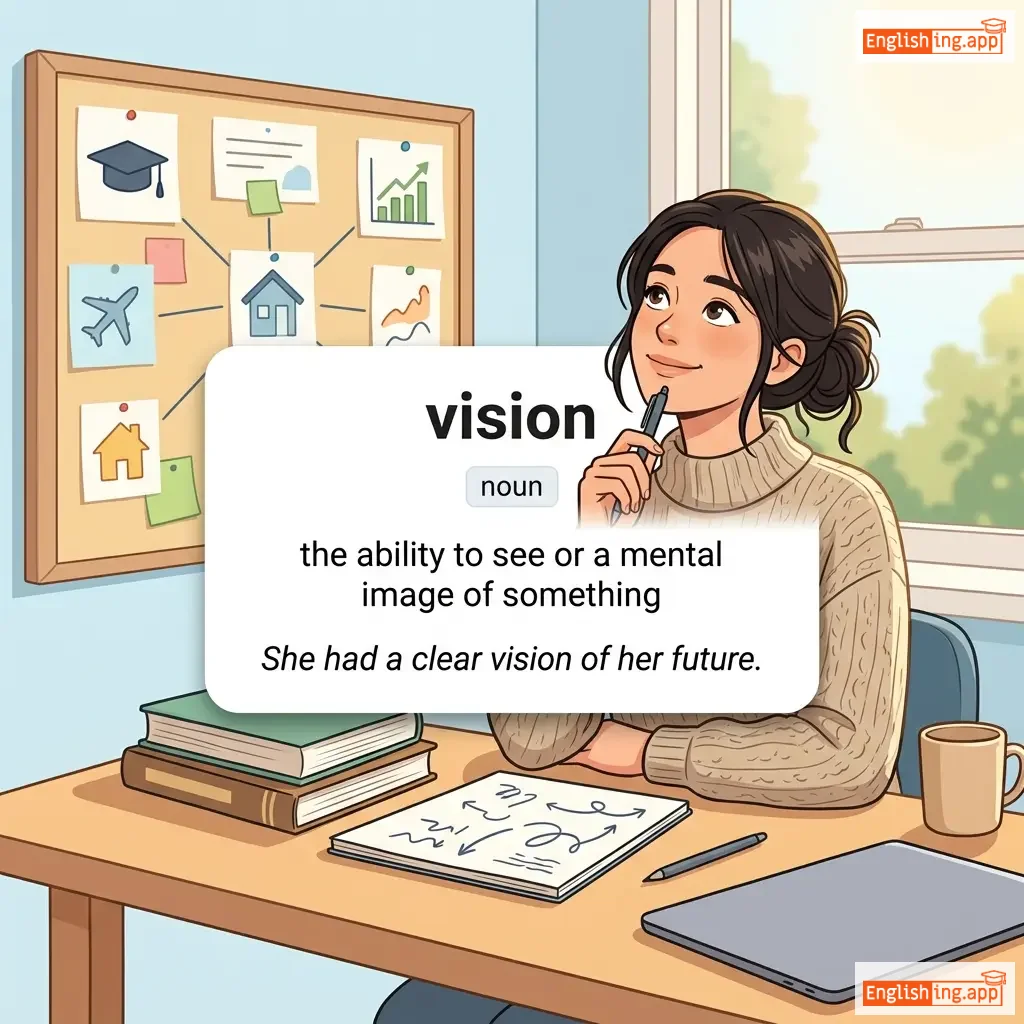
vision definition card — visual illustration of the meaning
noun
/ˈvɪʒən/
bonheur (bonheur)

the ability to see or a mental image of something

"She had a clear vision of her future."

"Elle n'a pas pu cacher son bonheur lorsqu'elle a reçu le prix." (Elle n'a pas pu cacher son bonheur lorsqu'elle a reçu le prix.)
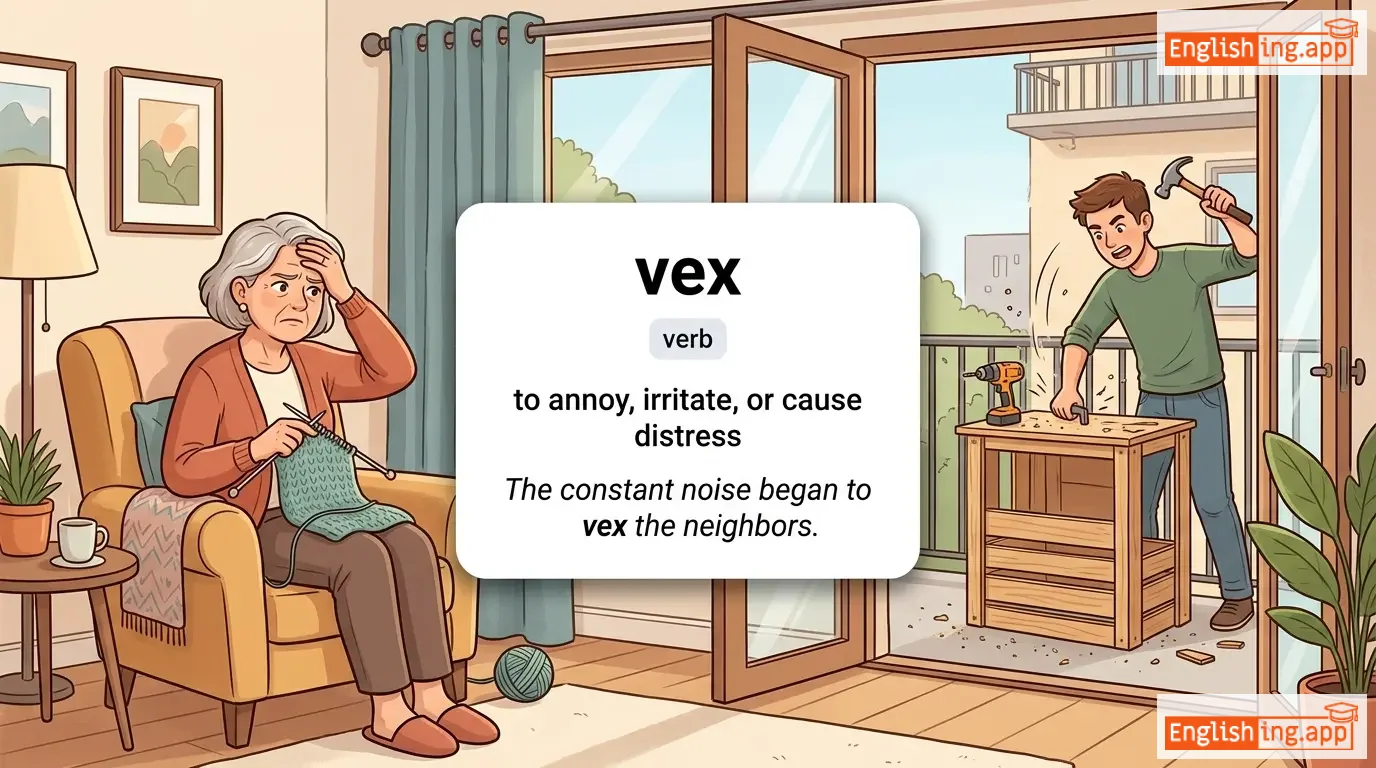
vex definition card — visual illustration of the meaning
verb
/vɛks/
agacer (agacer)

to annoy, irritate, or cause distress

"The constant noise began to vex the neighbors."

"Le bruit constant a commencé à agacer les voisins." (Le bruit constant a commencé à agacer les voisins.)
adverb
/ˈvɜː.tʃu.ə.li/
presque, virtuellement (presk, virtuellement)

almost or nearly, but not completely; by means of computer technology

"The meeting was held virtually due to travel restrictions."

"La réunion s'est tenue virtuellement en raison des restrictions de voyage." (La reunion s'est tenue virtuellement en raison des restrictions de voyage.)
verb
/ˈvɪtrɪfaɪ/
transformer en verre (transformer en verre)

to turn into glass or a glass-like substance by heat

"Sand can vitrify under intense heat."

"Le sable peut se transformer en verre sous une chaleur intense." (Le sable peut se transformer en verre sous une chaleur intense.)
noun
/ˌjuːnɪˈfɔːrmɪti/
uniformité (uniformite)

The quality or state of being the same, consistent, or without variation.

"The teacher insisted on uniformity in the students' dress code."

"L'enseignant a insisté sur l'uniformité dans le code vestimentaire des élèves." (L'enseignant a insiste sur l'uniformite dans le code vestimentaire des eleves.)
verb
/ˈvɪʒuəlaɪz/
visualiser (visualiser)

To form a mental image of something; to imagine.

"She tried to visualize her success before the big presentation."

"Elle a essayé de visualiser son succès avant la grande présentation." (Elle a essayé de visualiser son succès avant la grande présentation.)
adjective
/ˈvɪsɪd/
visqueux (visqueux)

Having a thick, sticky consistency.

"The sap had a viscid texture that stuck to his hands."

"La sève avait une texture visqueuse qui collait à ses mains." (La sève avait une texture visqueuse qui collait à ses mains.)
noun
/ˈjuːnɪvɜːrs/
univers (univers)

the totality of known or supposed objects and phenomena throughout space; the cosmos

"The universe is vast and full of mysteries."

"L'univers est vaste et plein de mystères." (L'univers est vaste et plein de mystères.)
adjective
/ˌʌnˈɪntrəstɪŋ/
ennuyeux (ennuyeux)

not holding attention or curiosity; boring

"The lecture was uninteresting and difficult to stay focused on."

"La conférence était ennuyeuse et difficile à suivre." (La conference etait ennuyeuse et difficile a suivre)
preposition/adjective
/ʌnˈlaɪk/
différent (different)

differing from or not similar to

"Unlike his brother, he enjoys playing soccer."

"Contrairement à son frère, il aime jouer au football." (Contrairement à son frère, il aime jouer au football.)
adjective
/ʌnˈkaɪnd/
cruel; pas gentil (cruel; pas gentil)

cruel; not nice or caring toward others

"It was unkind of him to make fun of her appearance."

"C'était cruel de sa part de se moquer de son apparence." (C'etait cruel de sa part de se moquer de son apparence.)
noun
/ˈvɜːrtɛks/
sommet (sommet)

The highest point; the top or the apex.

"The climber reached the vertex of the mountain."

"L'escaladeur a atteint le sommet de la montagne." (Lescaladeur a atteint le sommet de la montagne.)
adjective
/ˌʌnɪmˈpɔːrtənt/
sans importance (sans importance)

not having much value, significance, or influence

"The detail seemed unimportant compared to the main issue."

"Le détail semblait sans importance par rapport au problème principal." (Le detail semblait sans importance par rapport au probleme principal)
noun
/ˈvɪstə/
vue (vue)

A pleasing view, especially one seen through a long, narrow opening.

"From the mountain top, we admired the breathtaking vista of the valley below."

"Du sommet de la montagne, nous avons admiré la vue imprenable de la vallée en bas." (Du sommet de la montagne, nous avons admiré la vue imprenable de la vallée en bas.)
adjective
/ˌvɪtriˈɑːlɪk/
critiqué acerbe (kritike aserbe)

filled with bitter criticism or malice

"His vitriolic remarks hurt everyone in the room."

"Ses remarques acerbes ont blessé tout le monde dans la salle." (Ses remarques aserbes ont blessé tout le monde dans la salle.)
noun
/vɪˈsɪn.ə.ti/
proximité; voisinage (vicinite)

the area near or surrounding a particular place; neighborhood

"There are many shops in the vicinity of the school."

"Il y a beaucoup de magasins près de l'école." (Il y a beaucoup de magasins pres de l'ecole.)
noun
/ˈʌndərˌteɪkɪŋ/
entreprise (entreprise)

A task, project, or responsibility that someone agrees to do.

"Starting a new company is a difficult undertaking."

"Lancer une nouvelle entreprise est une entreprise difficile." (Lancer une nouvelle entreprise est une entreprise difficile.)
adjective
/ˈvɪrəl/
viril (viril)

having traditionally masculine qualities, such as strength, energy, and sexual vigor

"The actor was admired for his virile appearance."

"L'acteur a été admiré pour son apparence virile." (L'acteur a été admiré pour son apparence virile.)
adjective
/ʌnˈɡeɪnli/
maladroit (maladroit)

Awkward, clumsy, or lacking grace in movement or appearance.

"The tall boy moved in an ungainly manner."

"Le garçon grand s'est déplacé de manière maladroite." (Le garçon grand s'est deplace de maniere maladroite.)
adjective
/ʌnˈɪndʒərd/
intacte (intacte)

Without injury; not physically harmed.

"All the passengers were rescued uninjured."

"Tous les passagers ont été sauvés indemnes." (Tous les passagers ont été sauvés indemnes.)
adjective
/juːˈnɪsənənt/
harmonieux (harmonieux)

Sounding together or in harmony.

"The unisonant voices created a powerful effect."

"Les voix harmonieuses ont créé un effet puissant." (Les voix harmonieuses ont créé un effet puissant.)