Vocabulaires

Découvrez, apprenez et maîtrisez le vocabulaire anglais

noun/adjective
/ˈvɪntɪdʒ/
vintage / classique (vintage / classique)

Relating to high quality from the past; classic; also the year of a wine harvest.

"She wore a vintage dress from the 1950s."

"Elle portait une robe vintage des années 1950." (Elle portait une robe vintage des annees 1950.)
noun
/vərˈnækjələr/
langue vernaculaire (langue vernaculaire)

the language or dialect spoken by ordinary people in a particular region

"He gave his speech in the local vernacular so everyone could understand."

"Il a donné son discours dans la langue vernaculaire locale afin que tout le monde puisse comprendre." (Il a donné son discours dans la langue vernaculaire locale afin que tout le monde puisse comprendre.)
noun
/ˈvɪktɪm/
victime (victime)

a person who suffers harm, injury, or death due to an event or action

"The victim of the accident was taken to the hospital immediately."

"La victime de l'accident a été emmenée à l'hôpital immédiatement." (La victime de l'accident a été emmenée à l'hôpital immédiatement.)
noun
/ˈvɜːrʒən/
version (version)

A particular form or variant of something.

"The software has a new version with added features."

"Le logiciel a une nouvelle version avec des fonctionnalités supplémentaires." (Le logiciel a une nouvelle version avec des fonctionnalites supplementaires.)
noun
/ˈvɛləm/
parchemin (parchemin)

a fine parchment made originally from the skin of a calf, used for writing or printing

"The ancient manuscript was written on vellum."

"Le manuscrit ancien a été écrit sur du parchemin." (Le manuscrit ancien a été écrit sur du parchemin.)
verbal definition card — visual illustration of the meaning
adjective
/ˈvɜː.bəl/
verbal (verbal)

relating to words or speech rather than writing or action

"They had a verbal agreement instead of a written one."

"Ils ont eu un accord verbal plutôt qu'écrit." (Ils ont eu un accord verbal plutôt qu'écrit.)
noun
/vɜːrs/
vers (vers)

A line of writing in poetry; a section of a song or poem.

"She wrote a beautiful verse for the wedding ceremony."

"Elle a écrit un beau vers pour la cérémonie de mariage." (Elle a ecrit un beau vers pour la ceremonie de mariage.)
noun
/ˈvaɪsrɔɪ/
Viceroy (Viceroy)

a ruler exercising authority on behalf of a sovereign in a colony or province

"The viceroy governed the colony in the king's name."

"Le vice-roi gouvernait la colonie au nom du roi." (Le vice-roi gouvernait la colonie au nom du roi.)
noun
/ˈvaɪəˌleɪtər/
violateur (violateur)

A person who breaks or disregards a law, rule, or agreement.

"The police caught the traffic violator at the intersection."

"La police a attrapé le violateur du code de la route à l'intersection." (La police a attrapé le violateur du code de la route à l'intersection.)
adjective
/vɜːrˈtɪdʒɪnəs/
vertigineux (vertigineux)

Causing dizziness due to great height or steepness.

"The tourists looked down from the vertiginous cliffs with awe."

"Les touristes regardaient en bas depuis les falaises vertigineuses avec émerveillement." (Les touristes regardaient en bas depuis les falaises vertigineuses avec émerveillement.)
adjective
/ˈvæpɪd/
insipide (insipide)

lacking liveliness, flavor, or interest; dull and uninspired

"The lecture was so vapid that half the audience fell asleep."

"La conférence était tellement insipide que la moitié du public s'est endormie." (La conference etait tellement insipide que la moitie du public s'est endormie.)
noun
/vɪnˈjɛt/
vignette (vignette)

A short, descriptive piece of writing or a brief scene.

"The author included a poignant vignette in the introduction of the book."

"L'auteur a inclus une vignette poignante dans l'introduction du livre." (L'auteur a inclus une vignette poignante dans l'introduction du livre.)
noun
/ˈvaɪ.ə.ləns/
violence (violence)

behavior involving physical force intended to hurt or damage

"The protest turned into an act of violence."

"La protestation s'est transformée en un acte de violence." (La protestation s'est transformee en un acte de violence.)
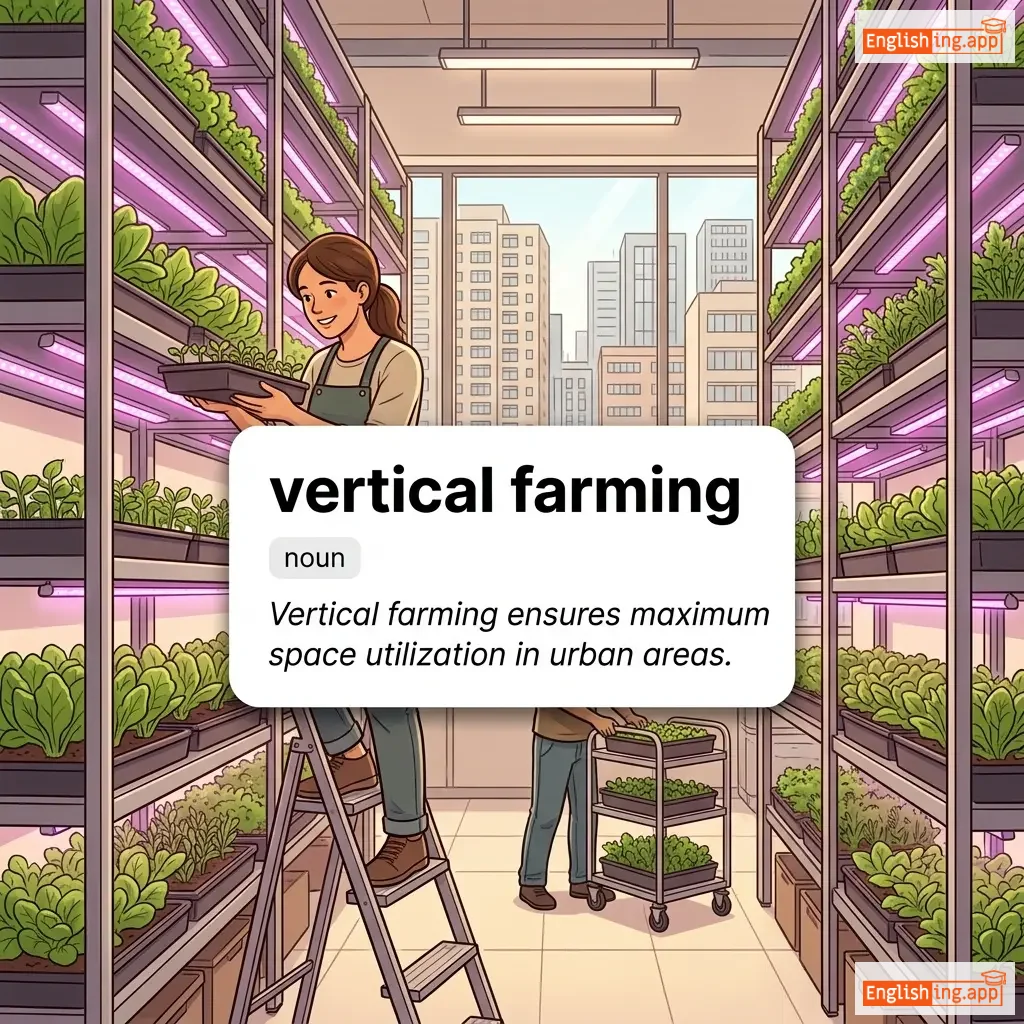
vertical farming definition card — visual illustration of the meaning
noun
/ˈvɜː.tɪ.kəl ˈfɑː.mɪŋ/
agriculture verticale (agriculture verticale)

The practice of growing crops in vertically stacked layers, often incorporating controlled-environment agriculture.

"Vertical farming ensures maximum space utilization in urban areas."

"L'agriculture verticale garantit une utilisation maximale de l'espace dans les zones urbaines." (L'agriculture verticale garantit une utilisation maximale de l'espace dans les zones urbaines)
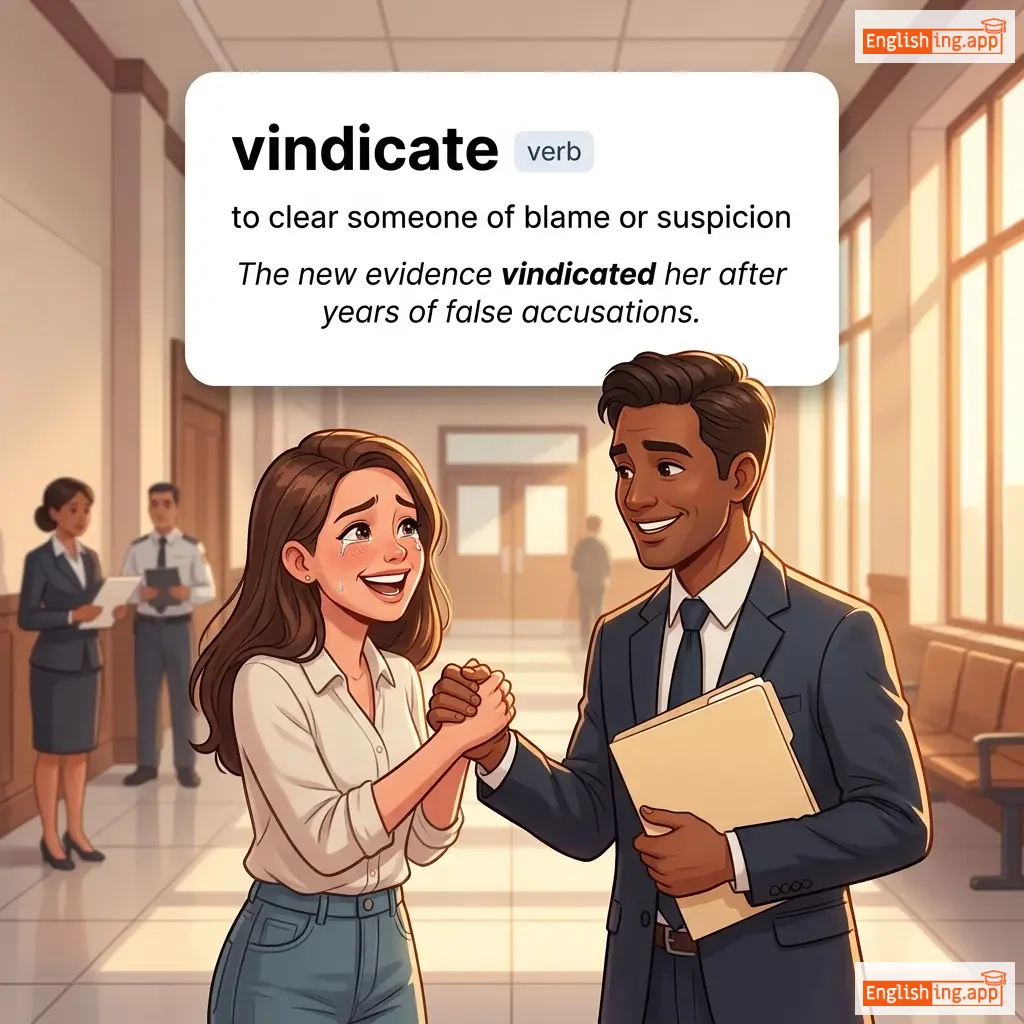
vindicate definition card — visual illustration of the meaning
verb
/ˈvɪndɪkeɪt/
réhabiliter (rehabiliter)

to clear someone of blame or suspicion

"The new evidence vindicated her after years of false accusations."

"Les nouvelles preuves l'ont réhabilitée après des années de fausses accusations." (Les nouvelles preuves l'ont rehabilitee apres des annees de fausses accusations.)
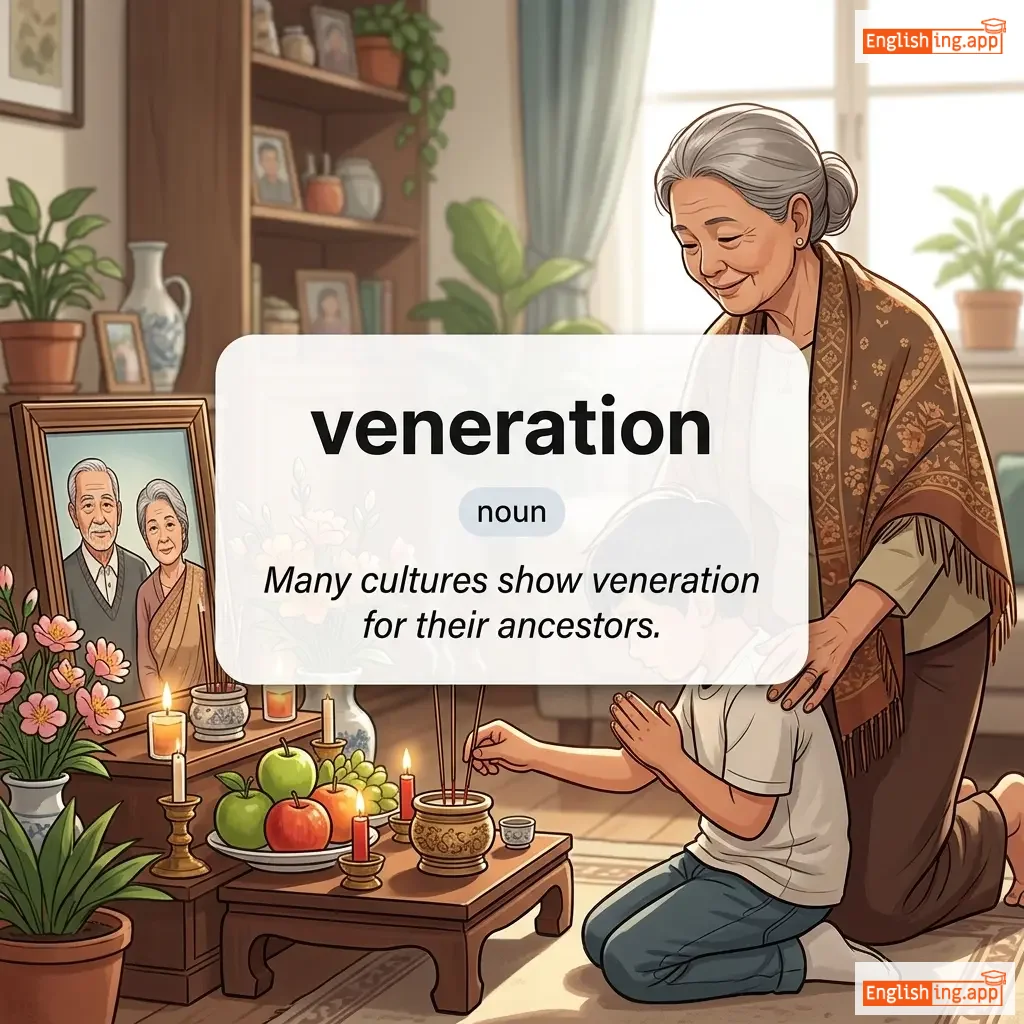
veneration definition card — visual illustration of the meaning
noun
ˌvɛn.əˈreɪ.ʃən
vénération (veneration)

Great respect; reverence; the action of regarding with great respect or reverence.

"Many cultures show veneration for their ancestors."

"De nombreuses cultures montrent de la vénération pour leurs ancêtres." (De nombreuses cultures montrent de la veneration pour leurs ancetres.)
noun
/ˈvɪdiəʊ/
vidéo (video)

a recording of moving visual images made digitally or on film

"She watched the video of her favorite concert online."

"Elle a regardé la vidéo de son concert préféré en ligne." (Elle a regarde la video de son concert prefere en ligne.)
noun
/ˈvɜːrbiɪdʒ/
verbosité (verbosite)

Excessive use of words, often with little content or meaning; wordiness.

"The contract was filled with unnecessary legal verbiage."

"Le contrat était rempli de verbosité juridique inutile." (Le contrat était rempli de verbosité juridique inutile.)
noun
/vəˈraɪəti/
variété (variete)

the quality or state of being different or diverse; a range of different things

"There is a variety of fruits available in the market."

"Il y a une variété de fruits disponibles sur le marché." (Il y a une variete de fruits disponibles sur le marche.)
noun
/vərˈmɪl.jən/
couleur rouge-orangée brillante; un pigment de cette couleur (vermillion)

a bright red-orange color; a pigment of this color

"The artist used vermillion paint for the sunset."

"L'artiste a utilisé de la peinture vermillon pour le coucher du soleil." (L'artiste a utilisé de la peinture vermillon pour le coucher du soleil.)
adjective
/ˈvɜːrnəl/
printanier (printanier)

related to spring; fresh, youthful

"The garden was filled with vernal beauty after the long winter."

"Le jardin était rempli de beauté printanière après le long hiver." (Le jardin était rempli de beauté printanière après le long hiver.)
adjective
/ˌvɛrɪˈsɪmɪlər/
semblable à la vérité (semblable a la verite)

appearing to be true or real

"The story seemed verisimilar though it was entirely fictional."

"L'histoire semblait semblable à la vérité bien qu'elle fût entièrement fictive." (L'histoire semblait semblable à la vérité bien qu'elle fût entièrement fictive.)
noun
/vaɪn/
vigne (vigne)

a climbing or trailing plant with long stems; a plant that produces grapes

"The vine climbed up the wall and covered it with green leaves."

"La vigne a grimpé le long du mur et l’a couvert de feuilles vertes." (la vigne a grimpe le long du mur et la couvert de feuilles vertes)
preposition
/ˈvaɪə/ or /ˈviːə/
par le biais de (par le biais de)

through, by way of, or using a particular route or means

"She sent the documents via email."

"Elle a envoyé les documents par le biais de l'email." (Elle a envoyé les documents par le biais de l'email.)
noun
/ˌvɛəriəˈɡeɪʃən/
variété (variete)

The appearance of differently colored zones in the leaves, flowers, or stems of plants.

"Variegation makes the foliage look more attractive."

"La variegation rend le feuillage plus attrayant." (La variegation rend le feuillage plus attrayant.)
noun/verb
/vɔːlt/
coffre-fort / sauter (coffre-fort / sauter)

A secure room for storing valuables; also to leap or spring over something.

"The bank kept its gold bars in a secure vault."

"La banque a gardé ses lingots d'or dans une voûte sécurisée." (La banque a garde ses lingots d'or dans une voute securisee.)
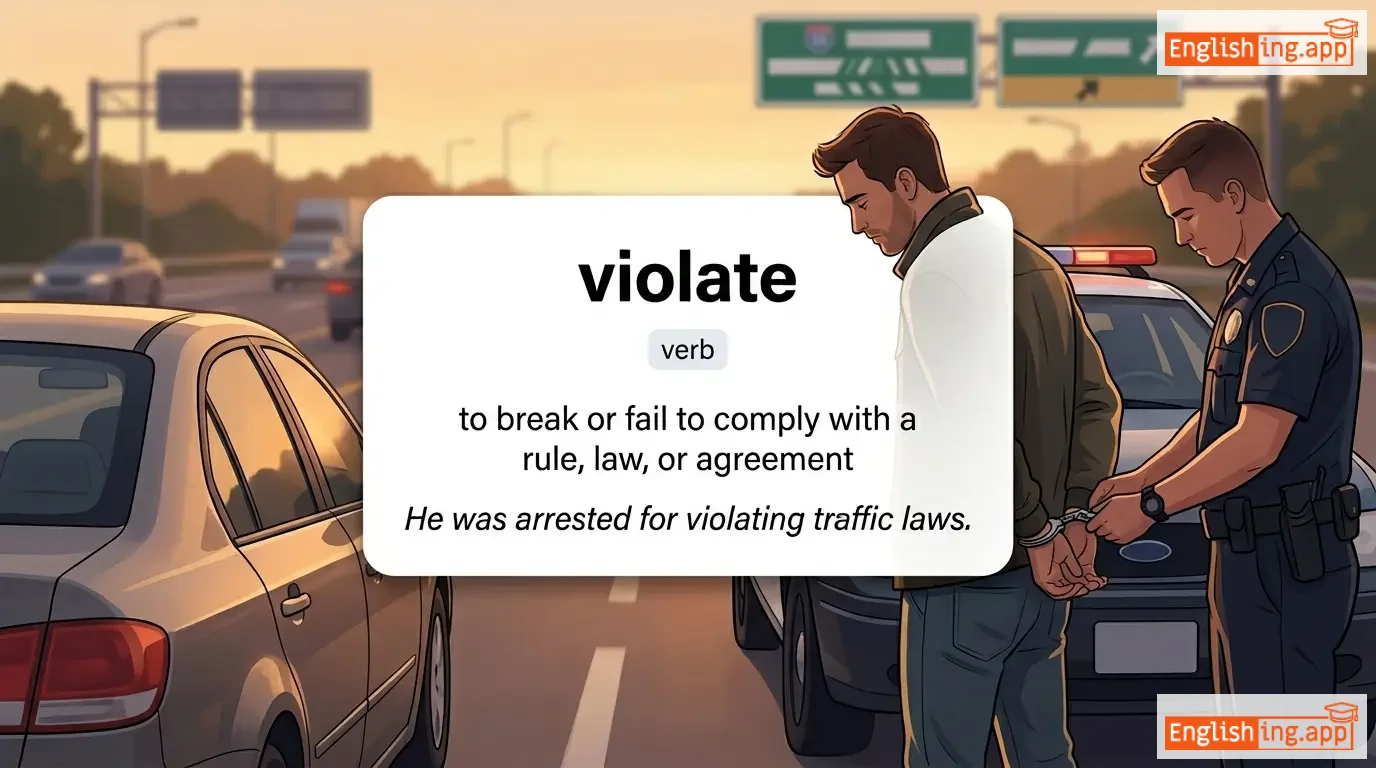
violate definition card — visual illustration of the meaning
verb
/ˈvaɪ.ə.leɪt/
violer (violer)

to break or fail to comply with a rule, law, or agreement

"He was arrested for violating traffic laws."

"Il a été arrêté pour avoir violé les lois de la circulation." (Il a été arrêté pour avoir violé les lois de la circulation.)
adjective
/ˈvɛntʃərəs/
aventureux (aventureux)

Willing to take risks or try out new and exciting things; adventurous.

"The venturous explorers set out to cross the uncharted desert."

"Les explorateurs aventureux se sont lancés pour traverser le désert inexploré." (Les explorateurs aventureux se sont lancés pour traverser le désert inexploré.)
noun
/vaɪəˈlɪn/
violon (violon)

a musical instrument with four strings that is played with a bow

"She plays the violin beautifully in the orchestra."

"Elle joue magnifiquement du violon dans l'orchestre." (Elle joue magnifiquement du violon dans l'orchestre.)
adjective
/ˈvaɪ.ə.lənt/
violent (violent)

using or involving physical force intended to hurt or damage

"He became violent after hearing the bad news."

"Il est devenu violent après avoir entendu les mauvaises nouvelles." (Il est devenu violent apres avoir entendu les mauvaises nouvelles.)
verb
/vaɪ/
concurrencer (concurrencer)

To compete eagerly with someone in order to do or achieve something.

"Several companies are vying for the contract."

"Plusieurs entreprises sont en compétition pour le contrat." (Plusieurs entreprises sont en compétition pour le contrat.)
adjective
/ˈvɛərɪd/
varié (varie)

showing many different kinds or forms

"The menu offers a varied selection of dishes."

"Le menu propose une sélection variée de plats." (Le menu propose une sélection variée de plats.)
noun
/ˈviː.ɪ.kəlz/
véhicules (vehicules)

machines used for transporting people or goods from one place to another

"There are many different types of vehicles on the road today."

"Il y a beaucoup de types de véhicules sur la route aujourd'hui." (Il y a beaucoup de types de vehicules sur la route aujourd'hui)
noun
/vɪˈsɪn.ə.ti/
proximité; voisinage (vicinite)

the area near or surrounding a particular place; neighborhood

"There are many shops in the vicinity of the school."

"Il y a beaucoup de magasins près de l'école." (Il y a beaucoup de magasins pres de l'ecole.)
noun
/ˈvɪn.ɪ.ɡər/
vinaigre (vinaigre)

a sour liquid made from fermented alcohol, used for cooking and preserving

"I added vinegar to the salad dressing for extra flavor."

"J'ai ajouté du vinaigre à la vinaigrette pour plus de saveur." (J'ai ajouté du vinaigre à la vinaigrette pour plus de saveur.)
👨‍🌾🍷

vintner (vintner)

noun
/ˈvɪntnər/
vigneron / vendeur de vin (vigneron / vendeur de vin)

A person who makes or sells wine.

"The vintner explained the process of making red wine."

"Le vigneron a expliqué le processus de fabrication du vin rouge." (Le vigneron a expliqué le processus de fabrication du vin rouge.)
noun
/ˌvɛəriˈeɪʃən/
variation (variation)

A change or slight difference in condition, amount, or level.

"There is a wide variation in climate across the country."

"Il y a une grande variation du climat dans tout le pays." (Il y a une grande variation du climat dans tout le pays.)
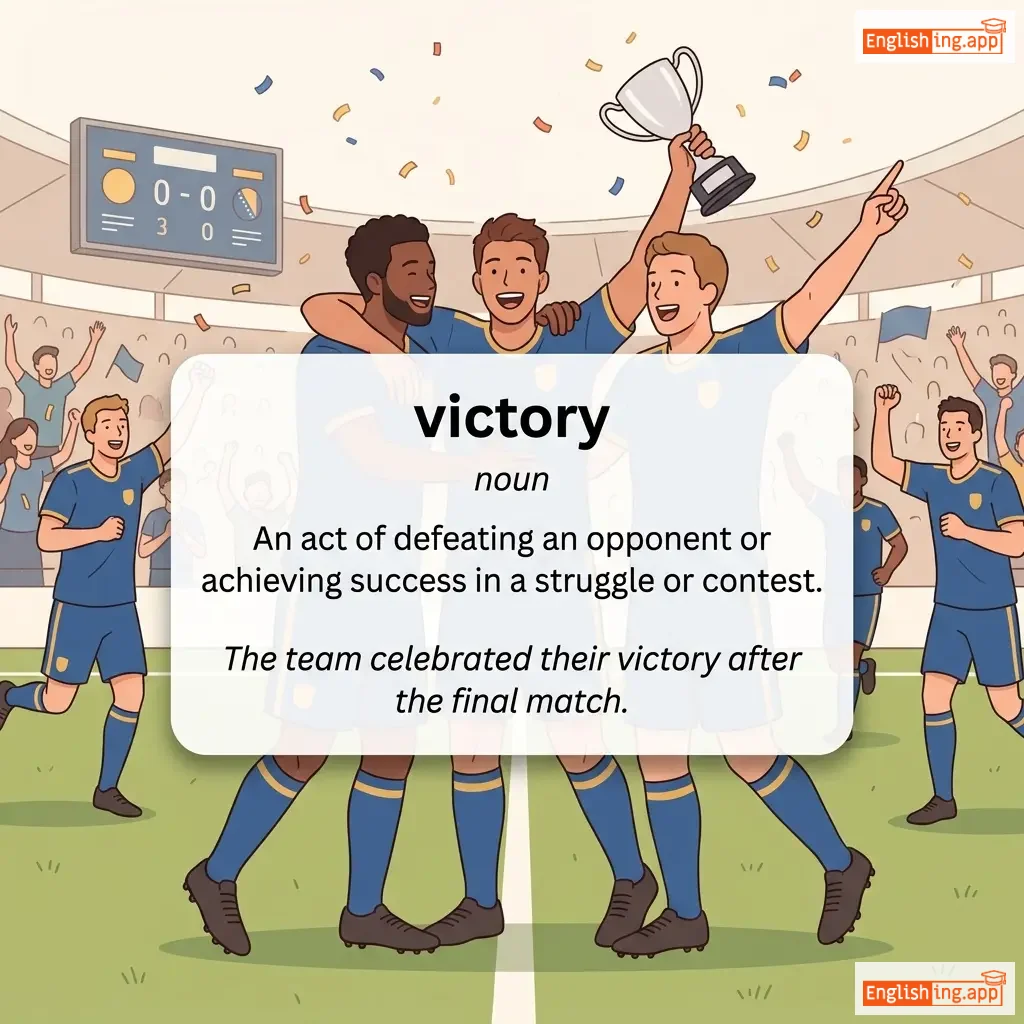
victory definition card — visual illustration of the meaning
noun
/ˈvɪktəri/
victoire (victoire)

An act of defeating an opponent or achieving success in a struggle or contest.

"The team celebrated their victory after the final match."

"L'équipe a célébré leur victoire après le match final." (L'équipe a célébré leur victoire après le match final.)
adjective
/ˈvɜːrtʃuəl/
virtuel / simulé (virtuel / simule)

existing or simulated on a computer or online rather than physically; almost but not exactly the same as

"The company held a virtual meeting with employees worldwide."

"L'entreprise a organisé une réunion virtuelle avec des employés du monde entier." (L'entreprise a organisé une réunion virtuelle avec des employés du monde entier.)
noun
/vɜːrˈtuː/
goût pour l'art (gout pour l'art)

a love of or taste for fine art, antiques, or curiosities

"The collector’s house was filled with objects of virtu."

"La maison du collectionneur était remplie d'objets de virtu." (La maison du collectionneur était remplie d'objets de virtu.)
noun
/ˈvedʒtəbəl ɔɪl/
huile végétale (huile végétale)

Oil extracted from plants, seeds, or nuts used for cooking

"She heated vegetable oil in the pan before adding the vegetables."

"Elle a chauffé de l'huile végétale dans la poêle avant d'ajouter les légumes." (Elle a chauffé de l'huile végétale dans la poêle avant d'ajouter les légumes.)
adjective
/ˈvɛntrəl/
ventral (ventral)

relating to the underside or abdominal part of an animal or organ

"The fish has a white ventral surface."

"Le poisson a une surface ventrale blanche." (Le poisson a une surface ventrale blanche.)
noun
/ˈven.juː/
endroit (endroit)

a place where an event or activity takes place

"The wedding venue was beautifully decorated."

"Le lieu du mariage était magnifiquement décoré." (Le lieu du mariage était magnifiquement décoré)
noun
/ˈvɜːrtɛks/
sommet (sommet)

The highest point; the top or the apex.

"The climber reached the vertex of the mountain."

"L'escaladeur a atteint le sommet de la montagne." (Lescaladeur a atteint le sommet de la montagne.)
adjective
/ˈvɛnəˌreɪtɪd/
vénéré (vénéré)

respected and admired deeply

"The venerated professor was honored with an award."

"Le professeur vénéré a été honoré d'un prix." (Le professeur vénéré a été honoré d'un prix.)
adjective
/vərˈmɪkjələr/
comme un ver (comme un ver)

having a shape or appearance like a worm; worm-like

"The artist used a vermicular design to decorate the border of the manuscript."

"L'artiste a utilisé un design vermiculaire pour décorer le bord du manuscrit." (L'artiste a utilisé un design vermiculaire pour décorer le bord du manuscrit.)
noun
/ˈvendʒəns/
vengeance (vengeance)

punishment inflicted or retribution exacted for an injury or wrong; revenge

"He swore to seek vengeance against those who wronged him."

"Il jura de chercher la vengeance contre ceux qui lui avaient fait du tort." (Il jura de chercher la vengeance contre ceux qui lui avaient fait du tort.)
noun
/ˌvɛrɪsɪˈmɪlɪtjuːd/
véracité (veracite)

the appearance of being true or real

"The movie was praised for its verisimilitude to actual events."

"Le film a été salué pour sa véracité par rapport aux événements réels." (Le film a ete salue pour sa veracite par rapport aux evenements reels.)
noun
/ˈvɛnəm/
venin (venin)

a poisonous substance secreted by animals such as snakes or spiders; also used to describe intense ill will or malice

"The snake injected its venom into the prey."

"Le serpent a injecté son venin dans la proie." (Le serpent a injecté son venin dans la proie.)
adjective
/vɪkˈtɔː.ri.əs/
victorieux (victorieux)

having won a victory; successful in a struggle or contest

"The victorious team celebrated their championship win with great joy."

"L'équipe victorieuse a célébré leur victoire en championnat avec une grande joie." (L'équipe victorieuse a célébré leur victoire en championnat avec une grande joie.)