Vocabulaires

Découvrez, apprenez et maîtrisez le vocabulaire anglais

adjective
/ʌnˈmænɪdʒəbəl/
ingérable; hors de contrôle (ingerable; hors de controle)

difficult or impossible to control or handle

"The large class became unmanageable without proper supervision."

"La grande classe est devenue ingérable sans une supervision adéquate." (La grande classe est devenue ingerable sans une supervision adequate.)
adjective
/ʌnˈmærid/
célibataire (celibataire)

Not married; single.

"He is thirty-five and still unmarried."

"Il a trente-cinq ans et il est toujours célibataire." (Il a trente-cinq ans et il est toujours célibataire.)
adjective
/ʌnˈmɪtɪɡeɪtɪd/
complet (komplet)

absolute; not lessened or moderated

"The meeting was an unmitigated disaster."

"La réunion était un désastre complet." (La réunion était un désastre complet.)
adjective
/ʌpˈrɔːr.i.əs/
extrêmement drôle (extremement drole)

Extremely funny or noisy; causing loud laughter or commotion.

"The comedian's jokes were absolutely uproarious."

"Les blagues du comédien étaient absolument extrêmement drôles." (Les blagues du comédien étaient absolument extrêmement drôles.)
adjective
/ʌnˈtaɪdi/
désordonné; en désordre; (desordonne)

not neat or orderly; messy and disorganized

"Her untidy room was filled with clothes scattered everywhere."

"Sa chambre en désordre était remplie de vêtements éparpillés partout." (sa chambre en desordre etait remplie de vetements eparpilles partout.)
adjective
/ʌnˈprɒf.ɪ.tə.bl̩/
non rentable (non rentable)

not yielding profit or gain; not producing financial benefit

"The unprofitable business was forced to close down after three years."

"L'entreprise non rentable a été forcée de fermer après trois ans." (L'entreprise non rentable a été forcée de fermer après trois ans.)
adjective
/ˌʌnprəˈpɪʃəs/
défavorable (defavorable)

Not giving or indicating a good chance of success; unfavorable.

"The team began their journey under unpropitious weather conditions."

"L'équipe a commencé son voyage sous des conditions météorologiques défavorables." (L'équipe a commencé son voyage sous des conditions météorologiques défavorables.)
adjective
/ʌnˈsoʊld/
invendu (invendu)

not sold; remaining without a buyer

"The unsold goods were returned to the warehouse."

"Les marchandises invendues ont été retournées à l’entrepôt." (les marchandises invendues ont ete retournees a l entrepot)
adjective
/ʌnˈsəʊʃəl/
asocial (asocial)

not enjoying the company of others; avoiding social interaction; contrary to social norms

"He prefers unsocial hours so he can work alone without interruptions."

"Il préfère des horaires asociaux pour travailler seul." (il prefere des horaires asociaux pour travailler seul)
adjective
/ˌʌnsəkˈsesfl/
échoué; raté; (échoué; raté)

not achieving desired aims or results; failing to accomplish a purpose

"His unsuccessful attempt to climb the mountain left him disappointed."

"Sa tentative échouée de gravir la montagne l'a laissé déçu." (Sa tentative échouée de gravir la montagne l'a laissé déçu.)
adjective
/ʌnˈtʌtʃəbəl/
intouchable; au-delà de la critique ou de l'attaque (intouchable; au-dela de la critique ou de l'attaque)

not able to be touched or affected; beyond criticism or attack

"The CEO seemed untouchable despite the scandal."

"Le PDG semblait intouchable malgré le scandale." (Le PDG semblait intouchable malgre le scandale.)
adjective
/ʌnˈkwes.tʃən.ə.bl̩/
indiscutable; certain (indiscutable; certain)

not able to be disputed or doubted; certain and beyond doubt

"Her honesty and integrity are unquestionable qualities."

"Son honnêteté et son intégrité sont des qualités indiscutables." (son honneteté et son integrité sont des qualités indiscutables.)
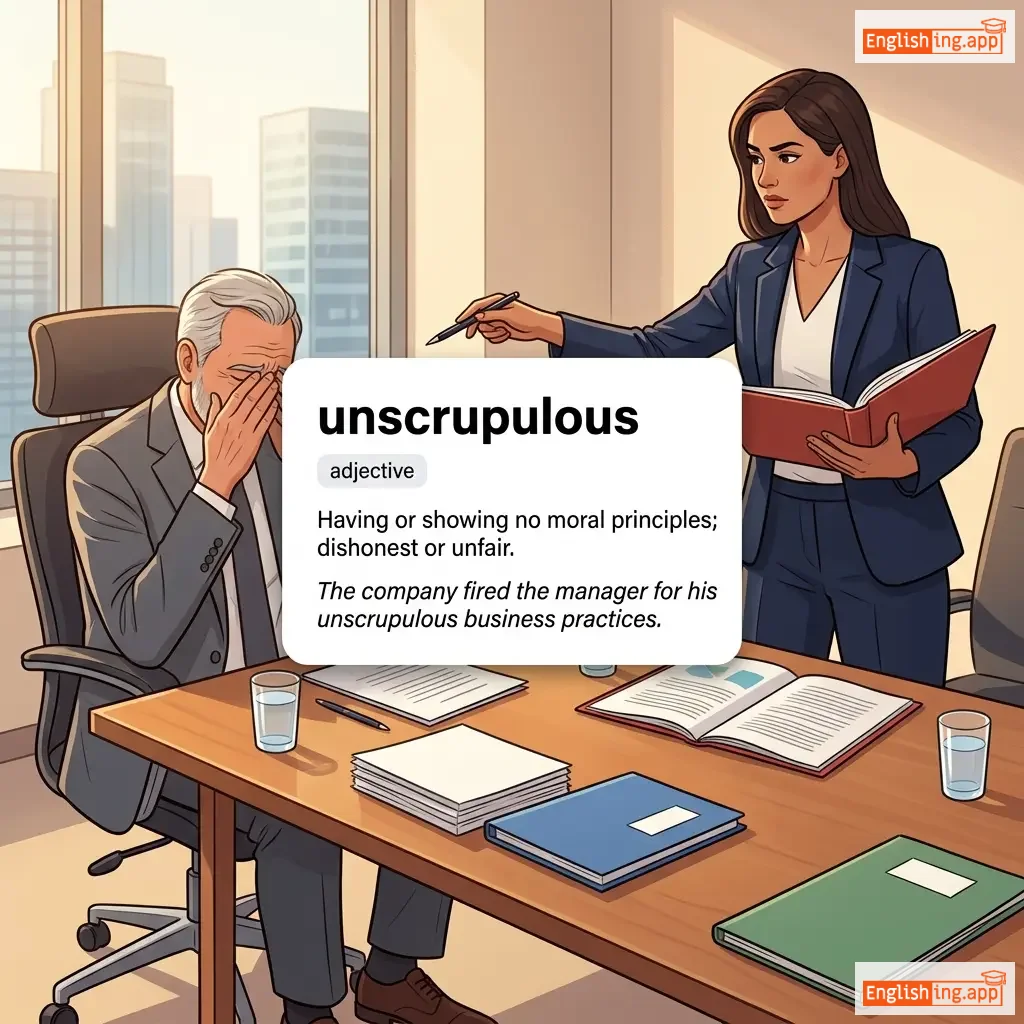
unscrupulous definition card — visual illustration of the meaning
adjective
/ʌnˈskruːpjələs/
sans scrupules (sans scrupules)

Having or showing no moral principles; dishonest or unfair.

"The company fired the manager for his unscrupulous business practices."

"L'entreprise a renvoyé le manager pour ses pratiques commerciales sans scrupules." (L'entreprise a renvoyé le manager pour ses pratiques commerciales sans scrupules.)
preposition/conjunction
/ʌnˈtɪl/
jusqu'à (jusqu'a)

up to the time of

"I will wait until you come back."

"J'attendrai jusqu'à ce que tu reviennes." (J'attendrai jusqu'à ce que tu reviennes.)
verb
/ʌnˈveɪl/
dévoiler (devoiler)

to reveal or disclose something, especially in a formal manner

"The company will unveil a new product next week."

"L'entreprise dévoilera un nouveau produit la semaine prochaine." (L'entreprise devoilera un nouveau produit la semaine prochaine.)
adjective
/ˌʌnrɪˈlaɪəbl/
non fiable; ne peut être fait confiance ou dépendre de (non fiable; ne peut être fait confiance ou dépendre de)

not dependable; not able to be trusted or relied upon

"The old car is unreliable and breaks down frequently."

"La vieille voiture est peu fiable et tombe souvent en panne." (La vieille voiture est peu fiable et tombe souvent en panne.)
adjective
/ʌnˈsɜːrvɪsəbəl/
hors service; défectueux (hors service; defectueux)

not in working order; unable to be used; defective

"The old computer became unserviceable after the system crash."

"L'ancien ordinateur est devenu hors service après la panne du système." (L'ancien ordinateur est devenu hors service apres la panne du systeme.)
noun
/ˌʌnriˈælɪti/
irréalité (irrealite)

the state or quality of being unreal; lack of reality or truth

"The dreamlike setting gave the story a sense of unreality."

"Le décor onirique a donné à l’histoire un sentiment d’irréalité." (Le decor onirique a donne a lhistoire un sentiment dirrealite)
adjective
/ʌnˈlɛtəd/
analphabète (analphabete)

lacking education or the ability to read and write; illiterate

"The unlettered villagers relied on oral traditions to preserve their history."

"Les villageois analphabètes dépendaient des traditions orales pour préserver leur histoire." (Les villageois analphabetes dependaient des traditions orales pour preserver leur histoire.)
adjective
/ʌnˈseɪvəri/
désagréable (desagreable)

Disagreeable, unpleasant, or morally offensive.

"The politician was linked to an unsavory scandal."

"Le politicien était lié à un scandale désagréable." (Le politicien était lié à un scandale désagréable.)
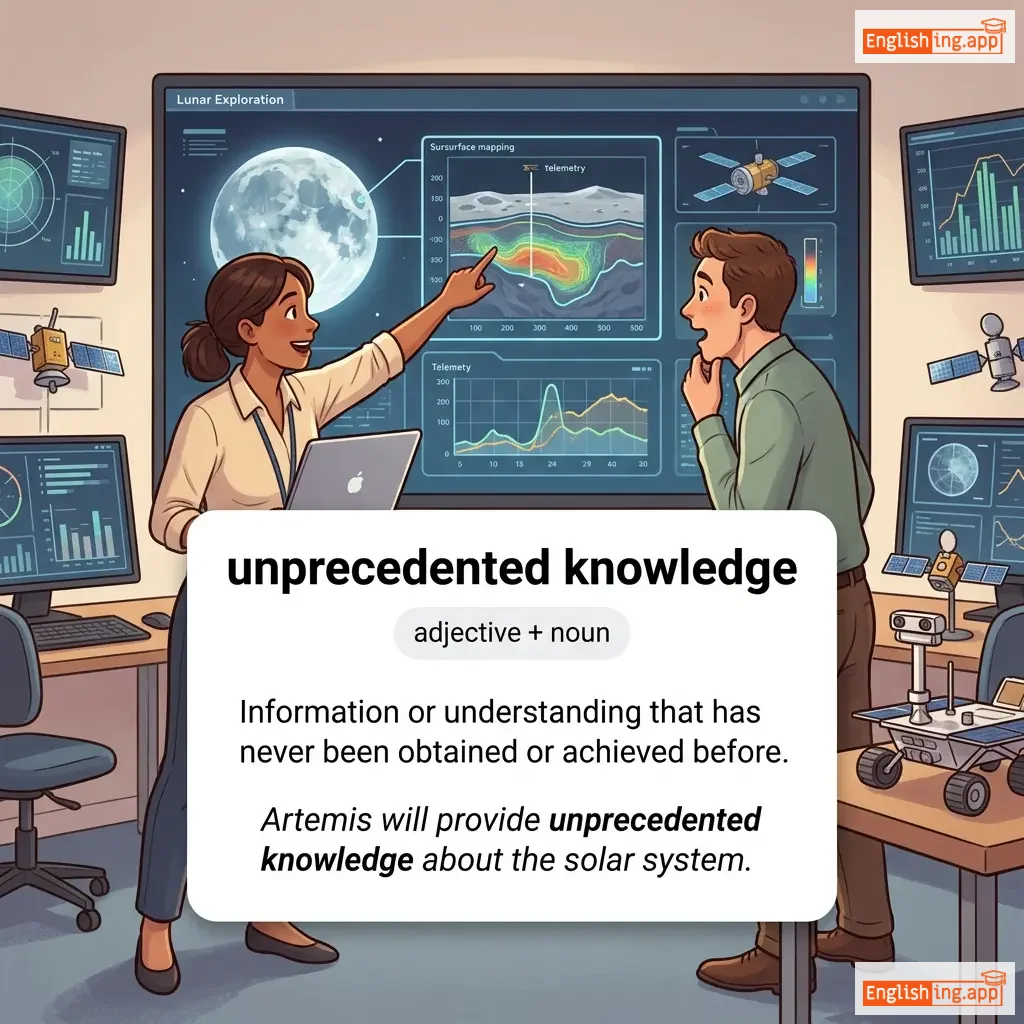
unprecedented knowledge definition card — visual illustration of the meaning
adjective + noun
ʌnˈpresɪdentɪd ˈnɒlɪdʒ
connaissance sans précédent (connaissance sans precedent)

Information or understanding that has never been obtained or achieved before.

"Artemis will provide unprecedented knowledge about the solar system."

"Artemis fournira des connaissances sans précédent sur le système solaire." (Artemis fournira des connaissances sans precedent sur le systeme solaire.)
adjective
/ʌnˈtɛmpərd/
non tempéré (non tempeire)

not moderated or softened; lacking proper balance or control

"The untempered anger of the crowd caused chaos."

"La colère non tempérée de la foule a provoqué le chaos." (La colère non tempérée de la foule a provoqué le chaos.)
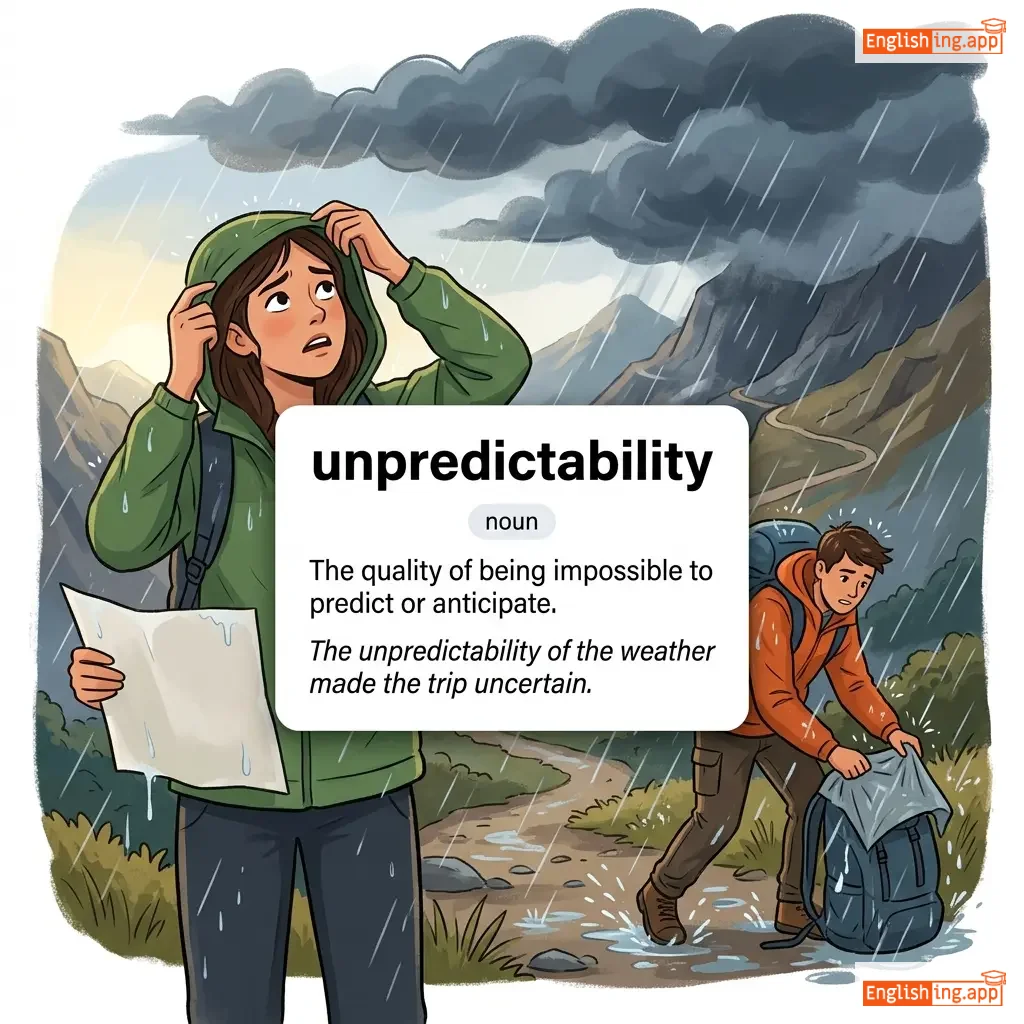
unpredictability definition card — visual illustration of the meaning
noun
/ˌʌnprɪˈdɪktəˌbɪləti/
imprévisibilité (imprevisibilite)

The quality of being impossible to predict or anticipate.

"The unpredictability of the weather made the trip uncertain."

"L'imprévisibilité du temps a rendu le voyage incertain." (L'imprevisibilite du temps a rendu le voyage incertain.)
adjective
/ʌnˈstɛdi/
instable (instable)

not firm or stable; likely to change or fail

"She felt unsteady on her feet after the long journey."

"Elle se sentait instable après le long voyage." (Elle se sentait instable apres le long voyage)
adjective
/ʌnˈsuːtəbl/
inapproprié; inapte (inapropiye; inapto)

not fitting or appropriate for a particular purpose or situation

"This formal dress is unsuitable for a casual beach party."

"Cette robe formelle est inappropriée pour une fête de plage décontractée." (Cette robe formelle est inappropriée pour une fête de plage décontractée.)
adjective
/ʌnˈsəʊʃəbl/
asocial (asocial)

not enjoying the company of others; avoiding social interaction

"He became unsociable after moving to a new city."

"Il est devenu asocial après avoir déménagé dans une nouvelle ville." (il est devenu asocial apres avoir demenage dans une nouvelle ville)
adjective
/ʌnˈθɪŋkɪŋ/
irréfléchi (irreflechi)

done without careful thought; automatic or thoughtless

"His unthinking remark hurt her feelings."

"Sa remarque irréfléchie a blessé ses sentiments." (sa remarque irreflechie a blesse ses sentiments)
adjective
/ˈʌpˌhɪl/
difficile; nécessitant un grand effort; en pente ascendante (difficile; necessitant un grand effort; en pente ascendante)

difficult; requiring great effort; sloping upward

"Learning a new language can be an uphill battle."

"Apprendre une nouvelle langue peut être une bataille difficile." (Apprendre une nouvelle langue peut être une bataille difficile.)
adjective
/ˌʌnɪnˈtenʃənəl/
involontaire; accidentel (involontaire; accidentel)

not done on purpose; accidental

"The damage to the car was unintentional."

"Les dégâts à la voiture étaient involontaires." (Les dégâts à la voiture étaient involontaires.)
adjective
/ʌnˈʃeɪkən/
inquétable; ferme (inquetable; ferme)

not disturbed or affected; firm and steady; unwavering

"Her faith remained unshaken despite all the challenges."

"Sa foi est restée inébranlable malgré tous les défis." (Sa foi est restée inébranlable malgré tous les défis.)
adjective
/ʌnˈtruː/
faux (faux)

not true; false or incorrect

"The rumor about the company closing was completely untrue."

"La rumeur sur la fermeture de l'entreprise était complètement fausse." (La rumeur sur la fermeture de l'entreprise était complètement fausse.)
adjective
/ʌnˈʃʊr/
incertain (incertain)

not certain or confident; feeling doubt

"She felt unsure about the decision."

"Elle était incertaine à propos de la décision." (elle etait incertaine a propos de la decision)
adjective
/ʌnˈθɪŋkəbl/
impensable (impensable)

impossible to conceive or imagine; beyond belief or consideration

"It was unthinkable that such a tragedy could happen in our peaceful town."

"Il était impensable qu'une telle tragédie puisse se produire dans notre ville paisible." (Il était impensable qu'une telle tragédie puisse se produire dans notre ville paisible.)
adjective
/ˌʌnəbˈtruːsɪv/
discret (discret)

not attracting attention; blending in without causing notice

"The security cameras are designed to be unobtrusive."

"Les caméras de sécurité sont conçues pour être discrètes." (Le kameran de sekurité son konçu pour êter diskret.)
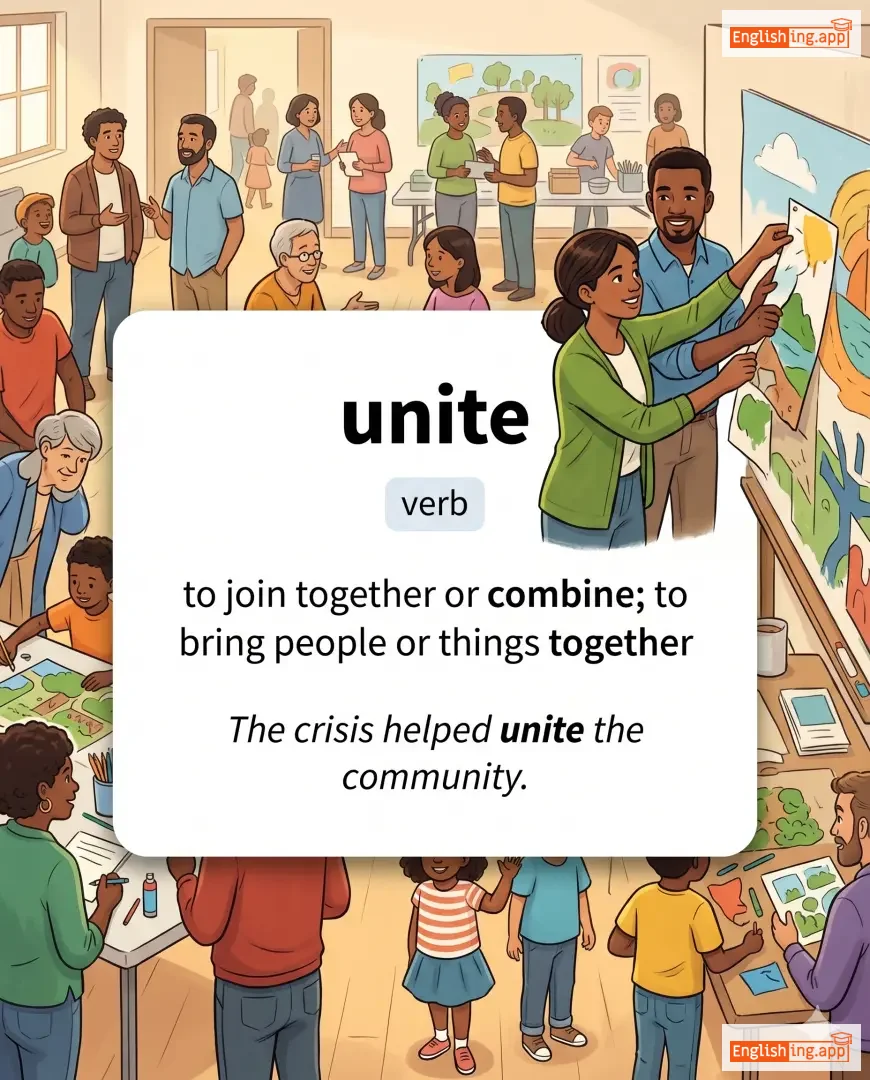
unite definition card — visual illustration of the meaning
verb
/juˈnaɪt/
unir (unir)

to join together or combine; to bring people or things together

"The crisis helped unite the community."

"La crise a aidé à unir la communauté." (La crise a aidé à unir la communauté.)
noun
/ˈjuːs.fəl.nəs/
utilité (utilite)

the quality of being useful; practical value or helpfulness

"The usefulness of this tool became apparent during the project."

"L'utilité de cet outil est devenue évidente pendant le projet." (L'utilite de cet outil est devenue evidente pendant le projet.)
adjective
/ʌnˈdʒʌst/
injuste; incorrecte (injuste; incorrecte)

not fair or right; morally wrong

"The punishment was unjust for such a minor offense."

"La punition était injuste pour une infraction mineure." (La punition était injuste pour une infraction mineure.)
adjective
/ʌnˈnætʃrəl/
antinaturel (antinaturel)

contrary to the usual course of nature; artificial or abnormal

"The bright green color of the drink looked unnatural."

"La couleur verte brillante de la boisson semblait antinaturelle." (La couleur verte brillante de la boisson semblait antinaturelle.)
adjective
/ʌnˈtaɪmli/
prématuré (premature)

Happening or done at an unsuitable or premature time.

"His untimely death shocked the entire community."

"Sa mort prématurée a choqué toute la communauté." (Sa mort prématurée a choqué toute la communauté.)
adjective
/ʌnˈwɪl.ɪŋ/
réticent; récalcitrant; (réticent; récalcitrant)

not ready to do something; reluctant; not wanting to do

"He was unwilling to share his secret with anyone."

"Il ne voulait pas partager son secret avec qui que ce soit." (Il ne voulait pas partager son secret avec qui que ce soit.)
adjective
/ʌnˈtiːtʃəbəl/
impossible à enseigner (impossible a enseigner)

not able or willing to learn; resistant to instruction or guidance

"He was so stubborn that he became almost unteachable."

"Il était si têtu qu’il est devenu presque impossible à enseigner." (il etait si tetu quil est devenu presque impossible a enseigner)
adjective
/ʌnˈriːdəbl/
illisible (illisible)

not able to be read or understood clearly; illegible

"The doctor’s handwriting was completely unreadable."

"L’écriture du médecin était complètement illisible." (Lecriture du medecin etait completement illisible)
adjective
/ʌnˈlʌki/
malchanceux; de mauvaise chance (malchanceux; de mauvaise chance)

having bad luck; unfortunate

"He was unlucky to miss the winning shot."

"Il était malchanceux de manquer le tir gagnant." (Il était malchanceux de manquer le tir gagnant.)
adjective
/ʌnˈwel.kəm/
désagréable; non désiré; indésirable (desagreable; non desire; indesirable)

not wanted or accepted; not invited or pleasant

"The unwelcome news ruined their vacation plans."

"Les mauvaises nouvelles ont ruiné leurs plans de vacances." (Les mauvaises nouvelles ont ruiné leurs plans de vacances.)
adjective
/ʌnˈjuːʒuəl/
inhabituel (inhabituel)

not common or ordinary; remarkable or exceptional

"She has an unusual talent for solving complex problems."

"Elle a un talent inhabituel pour résoudre des problèmes complexes." (Elle a un talent inhabituel pour résoudre des problèmes complexes.)
noun/verb
/ˈʌpˌkæst/
lancer vers le haut (lancer vers le haut)

Verb: To cast or throw upward. Noun: Something thrown or directed upward.

"The fisherman upcast his net into the air."

"Le pêcheur a lancé son filet dans les airs." (Le pêcheur a lancé son filet dans les airs.)
adjective
/ʌnˈkwaɪ.ət/
agité; anxieux; perturbé (agite; anxieux; perturbe)

restless; unable to remain still or quiet; anxious or troubled

"She spent an unquiet night worrying about the exam results."

"Elle a passé une nuit agitée à s'inquiéter des résultats de l'examen." (Elle a passé une nuit agitée à s'inquiéter des résultats de l'examen.)
adjective
/ʌnˈsaɪtli/
désagréable (desagreable)

Unpleasant to look at; ugly.

"The garbage pile created an unsightly view in the park."

"Le tas d'ordures a créé une vue désagréable dans le parc." (Le tas d'ordures a crée une vue désagréable dans le parc.)
adjective
/ʌnˈjuzd/
non utilisé; inutilisé (non utilise; inutilise)

not being used; not having been used before

"There are many unused rooms in this old mansion."

"Il y a beaucoup de pièces inutilisées dans ce vieux manoir." (Il y a beaucoup de pieces inutilisees dans ce vieux manoir.)
adjective
/ʌnˈpɒpjʊlə/
impopulaire (impopulaire)

not liked or supported by many people

"The decision was unpopular with the public."

"La décision était impopulaire auprès du public." (la decision etait impopulaire aupres du public)