Vocabulaires

Découvrez, apprenez et maîtrisez le vocabulaire anglais

adjective
/ʌnˈwaɪz/
imprudent (imprudent)

Showing poor judgment; not sensible or prudent.

"It would be unwise to invest all your money in one company."

"Il serait imprudent d'investir tout votre argent dans une seule entreprise." (Il serait imprudent d'investir tout votre argent dans une seule entreprise.)
adjective
/ʌnˈseɪf/
dangereux; risqué; (dangereux, risqué)

involving or causing danger or risk; not protected from harm

"It is unsafe to walk alone in this neighborhood at night."

"Il est dangereux de marcher seul dans ce quartier la nuit." (Il est dangereux de marcher seul dans ce quartier la nuit.)
adverb
/ˌʌpˈstɛərz/
à l'étage (upstairs)

on or to a higher floor of a building

"She went upstairs to her bedroom."

"Elle est montée à l'étage jusqu'à sa chambre." (Elle est montee a l etage jusqu a sa chambre)
noun
/ˈʌp.raɪt.nəs/
rectitude; intégrité (rectitude; integrite)

the quality of being honest and morally correct; integrity

"His uprightness in business dealings earned him great respect."

"Sa droiture dans les affaires lui a valu un grand respect." (Sa droiture dans les affaires lui a valu un grand respect.)
verb
/ʌnˈræp/
déballer (deballer)

remove wrapping or covering from something; reveal something gradually or clearly

"She carefully unwrapped the gift with excitement."

"Elle a déballé le cadeau avec précaution et excitation." (Elle a deballe le cadeau avec precaution et excitation)
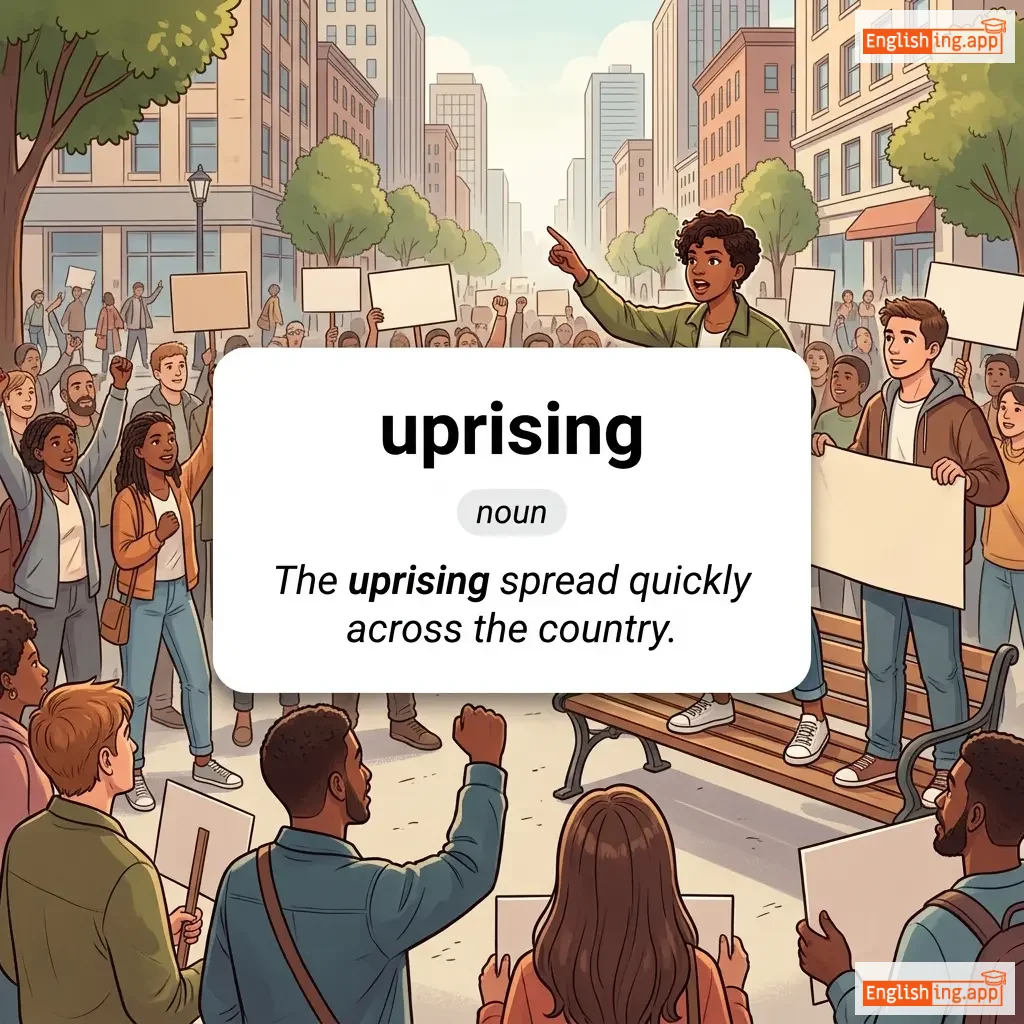
uprising definition card — visual illustration of the meaning
noun
/ˈʌpraɪzɪŋ/
révolte (revolte)

An act of resistance or rebellion; an attempt to overthrow authority or government.

"The uprising spread quickly across the country."

"La révolte s'est rapidement répandue dans tout le pays." (La révolte s'est rapidement répandue dans tout le pays.)
adjective
/ʌnˈsteɪtɪd/
non exprimé (non exprime)

not expressed directly in words; implied or left unsaid

"The contract included several unstated expectations."

"Le contrat incluait plusieurs attentes non exprimées." (Le contrat incluait plusieurs attentes non exprimées.)
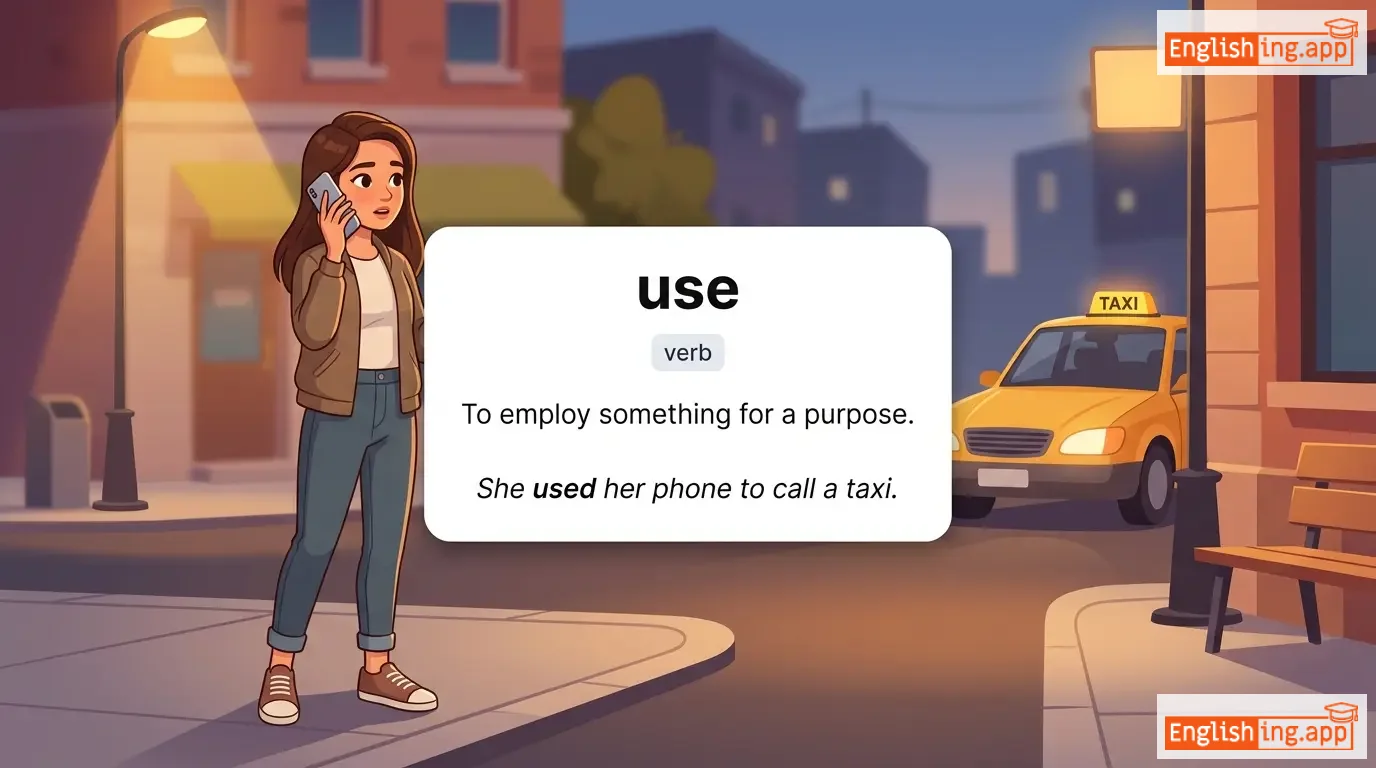
use definition card — visual illustration of the meaning
🛠️

use (yuz)

verb
/juːz/ (verb), /juːs/ (noun)
utiliser (utiliser)

To employ something for a purpose.

"She used her phone to call a taxi."

"Elle a utilisé son téléphone pour appeler un taxi." (Elle a utilise son telephone pour appeler un taxi.)
adjective
/ˈʌpˌhɪl/
difficile; nécessitant un grand effort; en pente ascendante (difficile; necessitant un grand effort; en pente ascendante)

difficult; requiring great effort; sloping upward

"Learning a new language can be an uphill battle."

"Apprendre une nouvelle langue peut être une bataille difficile." (Apprendre une nouvelle langue peut être une bataille difficile.)
verb
/ʌnˈjoʊk/
dételer (dételer)

To release from a yoke or to free from restraint or obligation.

"The farmer unyoked the oxen after a long day of work."

"Le fermier a dételé les bœufs après une longue journée de travail." (Le fermier a dételé les bœufs après une longue journée de travail.)
adjective
/ʌnˈstɪntɪŋ/
généreux (genereu)

given generously without holding back

"She received unstinting support from her family."

"Elle a reçu un soutien généreux de sa famille." (Elle a recu un soutien genereux de sa famille.)
verb
/ʌpˈhiːv/
soulever (soulever)

to lift or raise something forcefully; to cause to rise suddenly

"The workers had to upheave the heavy stone to clear the path."

"Les travailleurs ont dû soulever la grosse pierre pour dégager le chemin." (Les travailleurs ont dû soulever la grosse pierre pour dégager le chemin.)
adjective
/ʌnˈtiːtʃəbəl/
impossible à enseigner (impossible a enseigner)

not able or willing to learn; resistant to instruction or guidance

"He was so stubborn that he became almost unteachable."

"Il était si têtu qu’il est devenu presque impossible à enseigner." (il etait si tetu quil est devenu presque impossible a enseigner)
visiting definition card — visual illustration of the meaning
verb
/ˈvɪzɪtɪŋ/
visiter (visiter)

Going to see and spend time with someone or at a place.

"The group is visiting islands during the expedition."

"Le groupe visite des îles pendant l'expédition." (Le groupe visite des îles pendant l'expédition.)
adjective
/ʌnˈsaɪtli/
désagréable (desagreable)

Unpleasant to look at; ugly.

"The garbage pile created an unsightly view in the park."

"Le tas d'ordures a créé une vue désagréable dans le parc." (Le tas d'ordures a crée une vue désagréable dans le parc.)
adjective
/ˌvɪtriˈɑːlɪk/
critiqué acerbe (kritike aserbe)

filled with bitter criticism or malice

"His vitriolic remarks hurt everyone in the room."

"Ses remarques acerbes ont blessé tout le monde dans la salle." (Ses remarques aserbes ont blessé tout le monde dans la salle.)
adjective
/ʌnˈwiːldi/
difficile à manipuler (difficile a manipuler)

Difficult to carry or move because of its size, shape, or weight.

"The box was too unwieldy to carry up the stairs."

"La boîte était trop difficile à manipuler pour être montée dans les escaliers." (La boite etait trop difficile a manipuler pour etre montee dans les escaliers.)
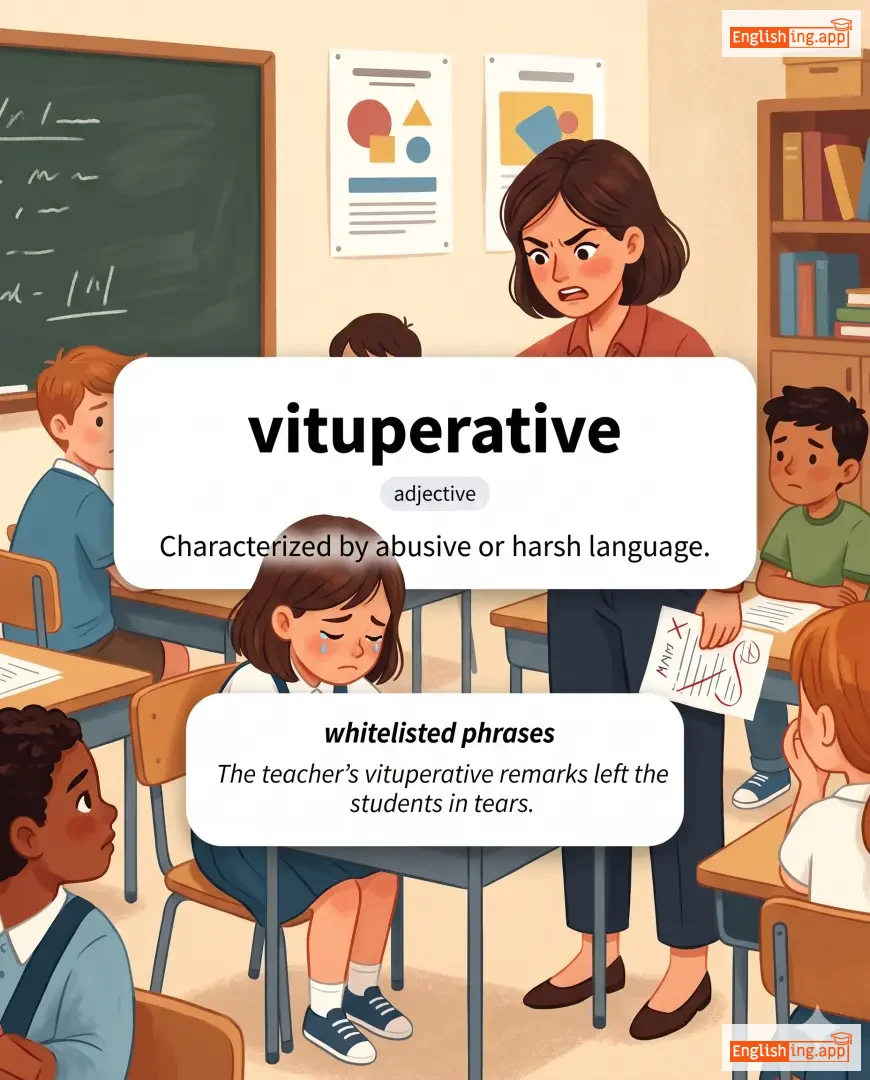
vituperative definition card — visual illustration of the meaning
adjective
/vɪˈtjuːpərətɪv/
vitupératif (vituperatif)

Characterized by abusive or harsh language.

"The teacher’s vituperative remarks left the students in tears."

"Les remarques vitupératives du professeur ont laissé les élèves en larmes." (Les remarques vituperatives du professeur ont laisse les eleves en larmes.)
adverb
/ʌnˈjuːʒuəli/
de manière inhabituelle (de maniere inhabituelle)

in a way that is not typical or expected; to an uncommon degree

"It was unusually cold for this time of year."

"Il faisait inhabituellement froid pour cette période de l'année." (Il faisait inhabituellement froid pour cette periode de l annee)
noun
/ˈjuːsɪdʒ/
utilisation (utilisation)

The action of using something; the way in which a word or phrase is normally used.

"The book explains the proper usage of technical terms."

"Le livre explique l'utilisation correcte des termes techniques." (Le livre explique l'utilisation correcte des termes techniques.)
adjective
/ˈʌpˌkʌmɪŋ/
à venir (a venir)

about to happen or appear

"The upcoming event will be held next week."

"L'événement à venir aura lieu la semaine prochaine." (L'evenement a venir aura lieu la semaine prochaine.)
adjective
/ʌnˈtɛmpərd/
non tempéré (non tempeire)

not moderated or softened; lacking proper balance or control

"The untempered anger of the crowd caused chaos."

"La colère non tempérée de la foule a provoqué le chaos." (La colère non tempérée de la foule a provoqué le chaos.)
verb
/ˈvɪʒuəlaɪz/
visualiser (visualiser)

To form a mental image of something; to imagine.

"She tried to visualize her success before the big presentation."

"Elle a essayé de visualiser son succès avant la grande présentation." (Elle a essayé de visualiser son succès avant la grande présentation.)
noun
/ˈɜːrtʃɪn/
gamin des rues (gamin des rues)

a mischievous or poorly dressed child, often from the streets

"The ragged urchins played by the riverbank."

"Les gamins en haillons jouaient au bord de la rivière." (Les gamins en haillons jouaient au bord de la riviere.)
adjective
/ʌnˈtʌtʃəbəl/
intouchable; au-delà de la critique ou de l'attaque (intouchable; au-dela de la critique ou de l'attaque)

not able to be touched or affected; beyond criticism or attack

"The CEO seemed untouchable despite the scandal."

"Le PDG semblait intouchable malgré le scandale." (Le PDG semblait intouchable malgre le scandale.)
adverb
/ʌnˈwɪlɪŋli/
à contrecœur (a contrecœur)

in a way that shows reluctance or lack of desire; not willingly

"She unwillingly agreed to attend the meeting."

"Elle a accepté à contrecœur d'assister à la réunion." (elle a accepte a contrecœur dassister a la reunion)
adjective
/ˌʌn.rɪˈdʒɛn.ər.ət/
intransigeant (intransigeant)

Not reformed or showing no signs of change; stubbornly refusing to reform or repent.

"He remained an unregenerate opponent of progress."

"Il est resté un opposant intransigeant du progrès." (Il est resté un opposant intransigeant du progrès.)
adjective
/ʌnˈriːdəbl/
illisible (illisible)

not able to be read or understood clearly; illegible

"The doctor’s handwriting was completely unreadable."

"L’écriture du médecin était complètement illisible." (Lecriture du medecin etait completement illisible)
adjective
/ʌnˈwɜːrði/
indigne; sans valeur (indigne; sans valeur)

not deserving respect or attention; lacking worth or merit

"He felt unworthy of such praise and recognition."

"Il se sentait indigne de tant d'éloges et de reconnaissance." (Il se sentait indigne de tant d'éloges et de reconnaissance.)
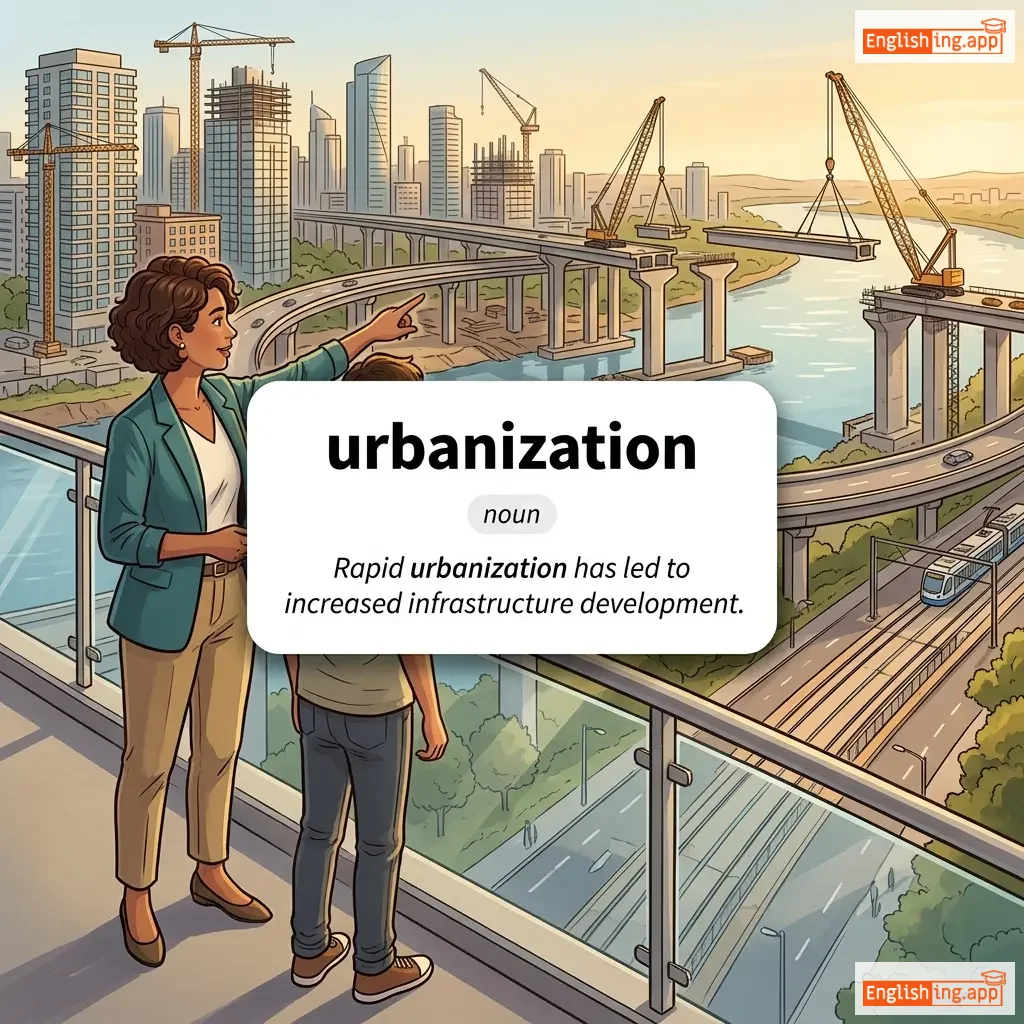
urbanization definition card — visual illustration of the meaning
noun
/ˌɜː.bən.aɪˈzeɪ.ʃən/
urbanisation (urbanisation)

The process by which towns and cities are formed and become larger as more people begin living and working in central areas.

"Rapid urbanization has led to increased infrastructure development."

"La rapide urbanisation a conduit à une augmentation du développement des infrastructures." (La rapide urbanisation a conduit à une augmentation du développement des infrastructures.)
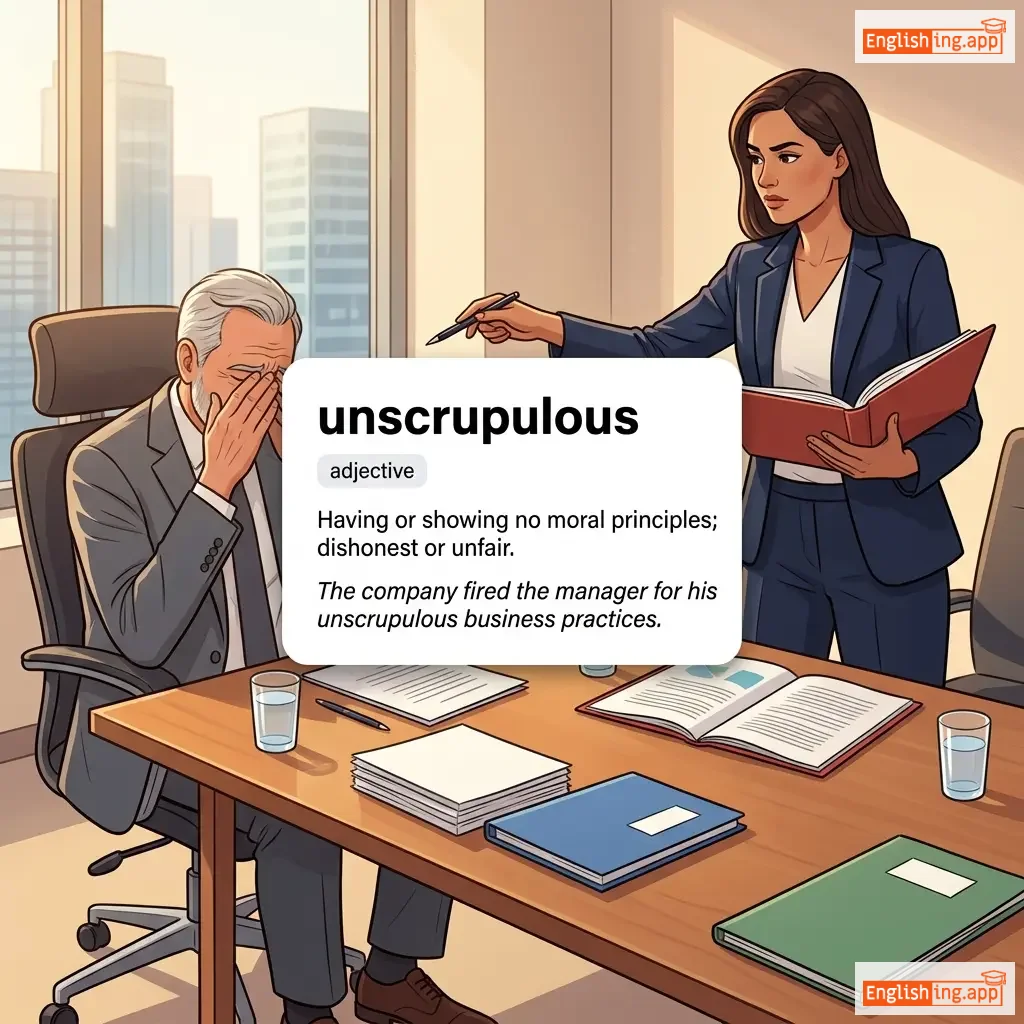
unscrupulous definition card — visual illustration of the meaning
adjective
/ʌnˈskruːpjələs/
sans scrupules (sans scrupules)

Having or showing no moral principles; dishonest or unfair.

"The company fired the manager for his unscrupulous business practices."

"L'entreprise a renvoyé le manager pour ses pratiques commerciales sans scrupules." (L'entreprise a renvoyé le manager pour ses pratiques commerciales sans scrupules.)
noun
/ˈʌp.ʃɒt/
résultat (resultat)

The final result or outcome of a process or situation.

"The upshot of the meeting was that the plan was postponed."

"Le résultat de la réunion a été que le plan a été reporté." (Le resultat de la reunion a ete que le plan a ete reporte.)
noun
/ɜːrˈbænɪti/
urbanité (urbanite)

refined courtesy, elegance, and sophistication in manner

"Her urbanity made her popular among diplomats and leaders."

"Son urbanité la rendait populaire parmi les diplomates et les dirigeants." (Son urbanité la rendait populaire parmi les diplomates et les dirigeants.)
👁️‍🗨️

Unseen (ɑ̃sin)

adjective
/ʌnˈsiːn/
invisible; non vu ou remarqué auparavant (invisible; non vu ou remarque auparavant)

not previously seen or noticed; invisible; hidden

"The unseen forces of nature can be very powerful."

"Les forces invisibles de la nature peuvent être très puissantes." (Les forces invisibles de la nature peuvent être tres puissantes.)
adjective
/ʌnˈvɔɪst/
non exprimé (non exprime)

not expressed in speech; in phonetics, a sound produced without vocal cord vibration

"The student kept her opinion unvoiced during the meeting."

"L'étudiante a gardé son opinion non exprimée pendant la réunion." (L'étudiante a gardé son opinion non exprimée pendant la réunion.)
verb
/ˈvɪtrɪfaɪ/
transformer en verre (transformer en verre)

to turn into glass or a glass-like substance by heat

"Sand can vitrify under intense heat."

"Le sable peut se transformer en verre sous une chaleur intense." (Le sable peut se transformer en verre sous une chaleur intense.)
adjective
/ʌnˈnætʃrəl/
antinaturel (antinaturel)

contrary to the usual course of nature; artificial or abnormal

"The bright green color of the drink looked unnatural."

"La couleur verte brillante de la boisson semblait antinaturelle." (La couleur verte brillante de la boisson semblait antinaturelle.)
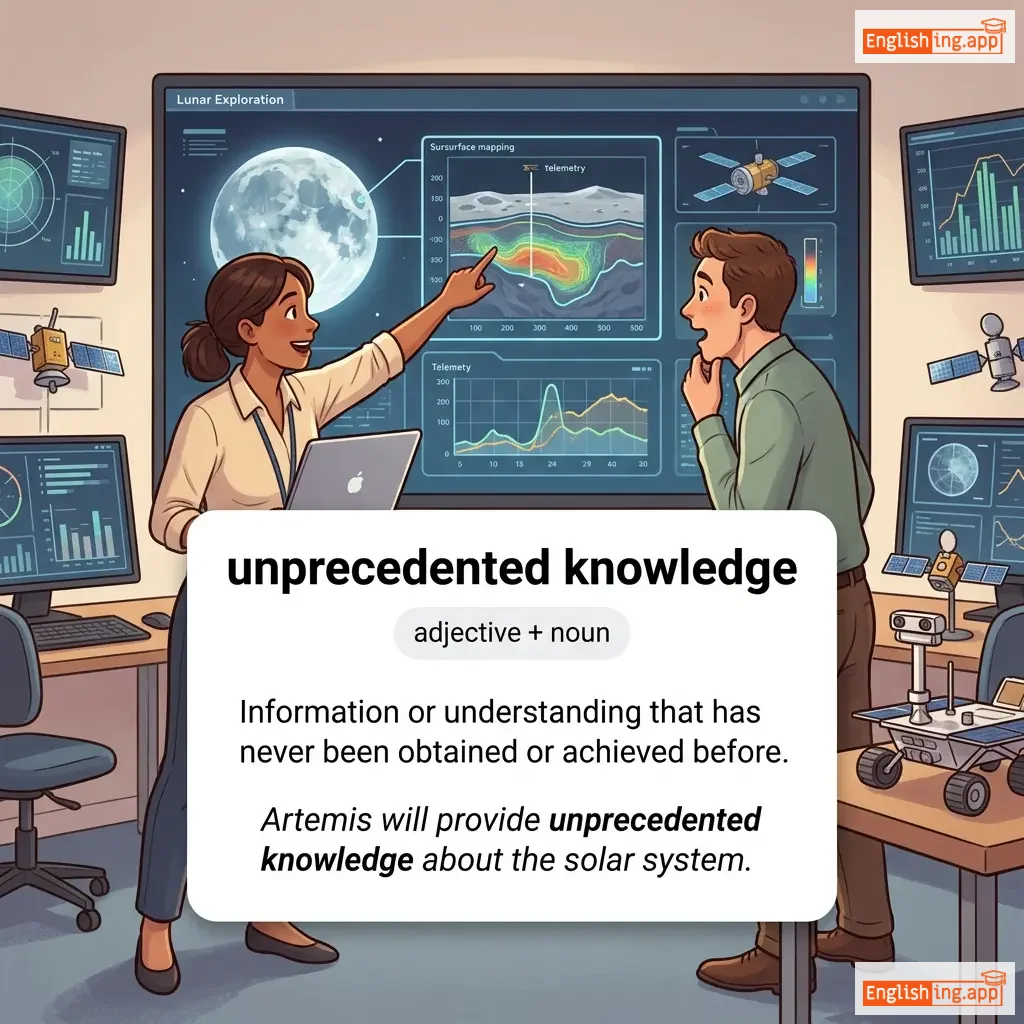
unprecedented knowledge definition card — visual illustration of the meaning
adjective + noun
ʌnˈpresɪdentɪd ˈnɒlɪdʒ
connaissance sans précédent (connaissance sans precedent)

Information or understanding that has never been obtained or achieved before.

"Artemis will provide unprecedented knowledge about the solar system."

"Artemis fournira des connaissances sans précédent sur le système solaire." (Artemis fournira des connaissances sans precedent sur le systeme solaire.)
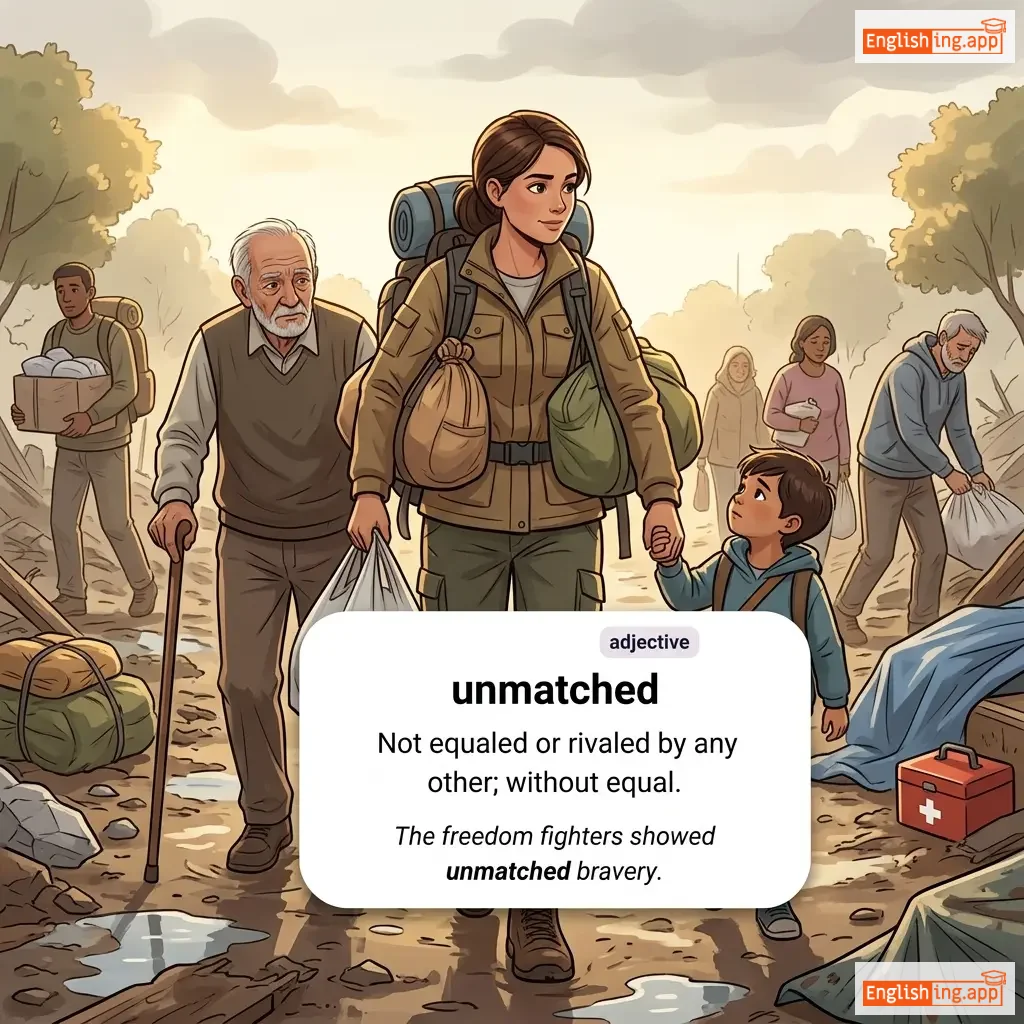
unmatched definition card — visual illustration of the meaning
adjective
ʌnˈmætʃt
incomparable (incomparable)

Not equaled or rivaled by any other; without equal.

"The freedom fighters showed unmatched bravery."

"Les combattants de la liberté ont montré un courage incomparable." (Les combattants de la liberté ont montré un courage incomparable.)
adjective
/ˌʌnˈpeɪd/
non payé; sans salaire (non payé; sans salaire)

not paid for; without payment or salary

"She worked as an unpaid intern for six months."

"Elle a travaillé comme stagiaire non payée pendant six mois." (Elle a travaillé comme stagiaire non payée pendant six mois)
adjective
/ʌnˈstɛdi/
instable (instable)

not firm or stable; likely to change or fail

"She felt unsteady on her feet after the long journey."

"Elle se sentait instable après le long voyage." (Elle se sentait instable apres le long voyage)
adverb
/ʌnˈnesəserəli/
inutillement (inutillement)

to a greater extent than is needed; without necessity

"Don't worry unnecessarily about the exam."

"Ne t'inquiète pas inutilement pour l'examen." (Ne t'inquiete pas inutilement pour l'examen.)
adjective
/ʌnˈmɪtɪɡeɪtɪd/
complet (komplet)

absolute; not lessened or moderated

"The meeting was an unmitigated disaster."

"La réunion était un désastre complet." (La réunion était un désastre complet.)
adjective
/ˌʌnəˈfɪʃ.əl/
non officiel (non officiel)

not officially authorized or confirmed; informal

"The unofficial results showed a close race."

"Les résultats non officiels ont montré une course serrée." (Les résultats non officiels ont montré une course serrée.)
adjective
/ʌnˈmærid/
célibataire (celibataire)

Not married; single.

"He is thirty-five and still unmarried."

"Il a trente-cinq ans et il est toujours célibataire." (Il a trente-cinq ans et il est toujours célibataire.)
noun
/vɜːrˈtuː/
goût pour l'art (gout pour l'art)

a love of or taste for fine art, antiques, or curiosities

"The collector’s house was filled with objects of virtu."

"La maison du collectionneur était remplie d'objets de virtu." (La maison du collectionneur était remplie d'objets de virtu.)
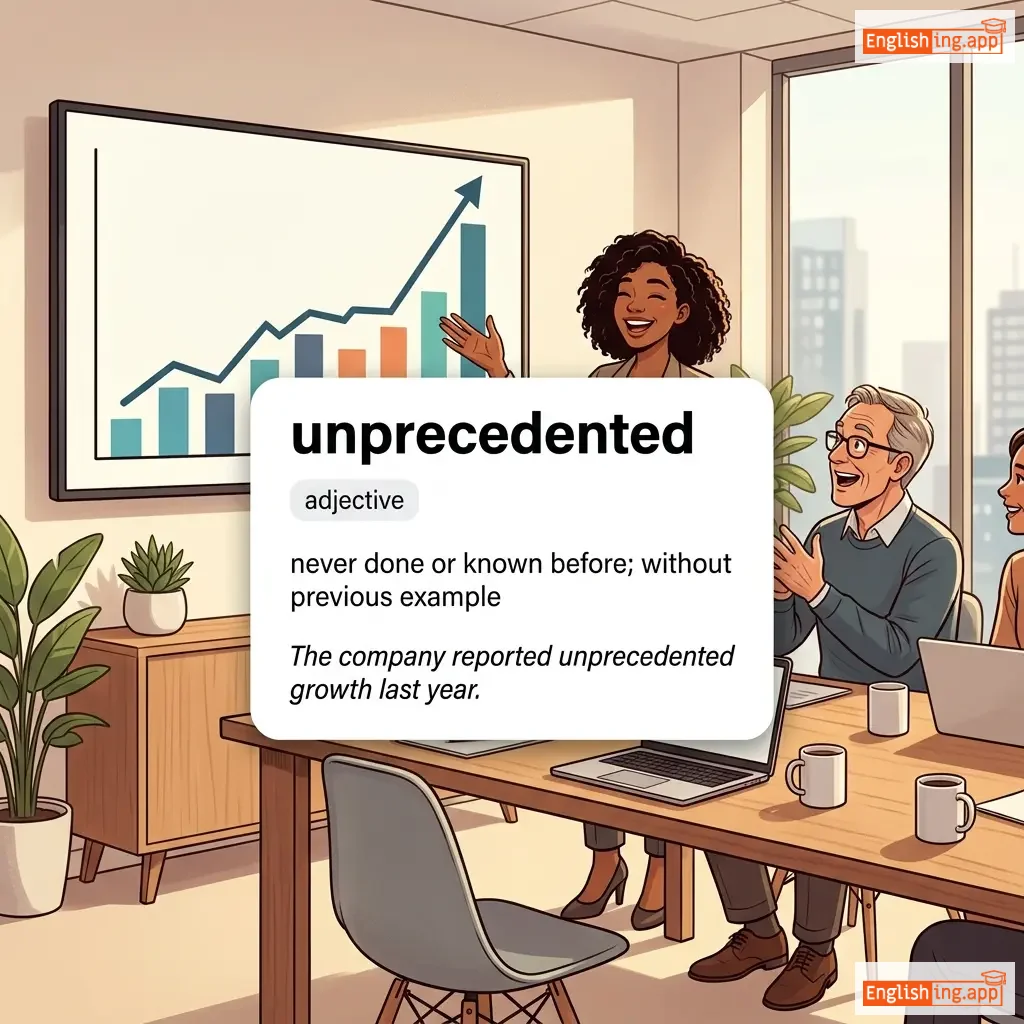
unprecedented definition card — visual illustration of the meaning
adjective
/ʌnˈprɛsɪˌdɛntɪd/
sans précédent (san precedent)

never done or known before; without previous example

"The company reported unprecedented growth last year."

"L'entreprise a signalé une croissance sans précédent l'année dernière." (L'entreprise a signalé une croissance sans précédent l'année dernière.)
adjective
/ʌnˈnɛsəsɛri/
inutile (inutile)

not needed or required

"The manager cut all unnecessary expenses to save costs."

"Le manager a réduit toutes les dépenses inutiles pour économiser des coûts." (Le manager a réduit toutes les dépenses inutiles pour économiser des coûts.)
visuospatial definition card — visual illustration of the meaning
adjective
ˌvɪz.ju.oʊˈspeɪ.ʃəl
Relatif à la compréhension de la relation entre l'espace et les objets à travers la vision (relatif a la comprehension de la relation entre l'espace et les objets a travers la vision)

Related to understanding the relationship between space and objects through vision.

"Good visuospatial skills are important for architecture and design."

"De bonnes compétences visuospatiales sont importantes pour l'architecture et le design." (De bonnes competences visuospatiales sont importantes pour l'architecture et le design.)
adjective
/ʌnˈsəʊʃəbl/
asocial (asocial)

not enjoying the company of others; avoiding social interaction

"He became unsociable after moving to a new city."

"Il est devenu asocial après avoir déménagé dans une nouvelle ville." (il est devenu asocial apres avoir demenage dans une nouvelle ville)