Vocabulaires

Découvrez, apprenez et maîtrisez le vocabulaire anglais

adjective
/ˈvɛə.ri.əs/
varié (varie)

different from one another; of several different kinds

"She owns various kinds of books."

"Elle possède divers types de livres." (Elle possède divers types de livres.)
noun
/vəˈraɪəti/
variété (variete)

the quality or state of being different or diverse; a range of different things

"There is a variety of fruits available in the market."

"Il y a une variété de fruits disponibles sur le marché." (Il y a une variete de fruits disponibles sur le marche.)
noun
/ˌvɛəriəˈɡeɪʃən/
variété (variete)

The appearance of differently colored zones in the leaves, flowers, or stems of plants.

"Variegation makes the foliage look more attractive."

"La variegation rend le feuillage plus attrayant." (La variegation rend le feuillage plus attrayant.)
adjective
/ˈvɛəriəˌɡeɪtɪd/
bigarré (bigarre)

Having different colors, especially in irregular patches or streaks.

"The garden was full of variegated plants."

"Le jardin était plein de plantes bigarrées." (le zhardin eteh plen de plant bigarre)
verb
/ˈvɛəriəˌɡeɪt/
diversifier (diversifier)

To diversify or mark with different colors or patterns.

"The artist used different shades to variegate the design."

"L'artiste a utilisé différentes nuances pour diversifier le design." (L'artiste a utilisé différentes nuances pour diversifier le design.)
adjective
/ˈvɛərɪd/
varié (varie)

showing many different kinds or forms

"The menu offers a varied selection of dishes."

"Le menu propose une sélection variée de plats." (Le menu propose une sélection variée de plats.)
noun
/ˌvɛəriˈeɪʃən/
variation (variation)

A change or slight difference in condition, amount, or level.

"There is a wide variation in climate across the country."

"Il y a une grande variation du climat dans tout le pays." (Il y a une grande variation du climat dans tout le pays.)
noun
/ˈvɛəriənt/
variation (variation)

A form or version of something that differs in some way from other forms of the same thing.

"The new variant of the virus spread rapidly."

"La nouvelle variation du virus s'est propagée rapidement." (La nouvelle variation du virus s'est propagee rapidement.)
noun
/ˈvɛriəns/
variance (variance)

the state of being different or inconsistent; in statistics, a measure of the spread between numbers

"There is a wide variance in students' performance levels."

"Il y a une grande variance dans les niveaux de performance des étudiants." (Il y a une grande variance dans les niveaux de performance des étudiants.)
noun
/veɪn/
veine (vein)

a tube in the body that carries blood to the heart

"The nurse checked the patient's veins for an IV insertion."

"L'infirmière a vérifié les veines du patient pour l'insertion de la perfusion." (L'infirmière a vérifié les veines du patient pour l'insertion de la perfusion.)
noun
/ˈtrɒɡlədaɪt/
troglodyte (troglodyte)

A person who lives in a cave or is considered old-fashioned and out of touch.

"Some called him a troglodyte for refusing to use modern technology."

"Certains l'ont traité de troglodyte pour avoir refusé d'utiliser la technologie moderne." (Certains l'ont traité de troglodyte pour avoir refusé d'utiliser la technologie moderne.)
adjective
/ˈtrɪviəl/
trivial (trivial)

Of little value or importance.

"He often gets upset over the most trivial matters."

"Il se fâche souvent pour les choses les plus triviales." (Il se fâche souvent pour les choses les plus triviales.)
noun
/ˈtrɪviə/
détails triviaux (details triviaux)

Details or information that are considered unimportant or of little value.

"The quiz was filled with fun trivia about movies and music."

"Le quiz était rempli de détails triviaux sur les films et la musique." (Le quiz etait rempli de details triviaux sur les films et la musique.)
noun
/traɪˈʌmvɪrət/
triumvirat (triumvirat)

A political regime ruled or dominated by three powerful individuals.

"The Roman Republic was once governed by a triumvirate."

"La République romaine était autrefois gouvernée par un triumvirat." (La Republique romaine etait autrefois gouvernee par un triumvirat.)
noun
/traɪˈʌmvɪər/
triumvir (triumvir)

One of a group of three men holding power in ancient Rome.

"Caesar was a triumvir in the first Roman triumvirate."

"César était un triumvir dans le premier triumvirat romain." (César était un triumvir dans le premier triumvirat romain.)
adjective
/traɪˈʌmfənt/
triomphant; heureux (triumphant; heureux)

having won a battle or contest; rejoicing as a result of success

"The team was triumphant after winning the championship."

"L'équipe était triomphante après avoir remporté le championnat." (L'équipe était triomphante après avoir remporté le championnat.)
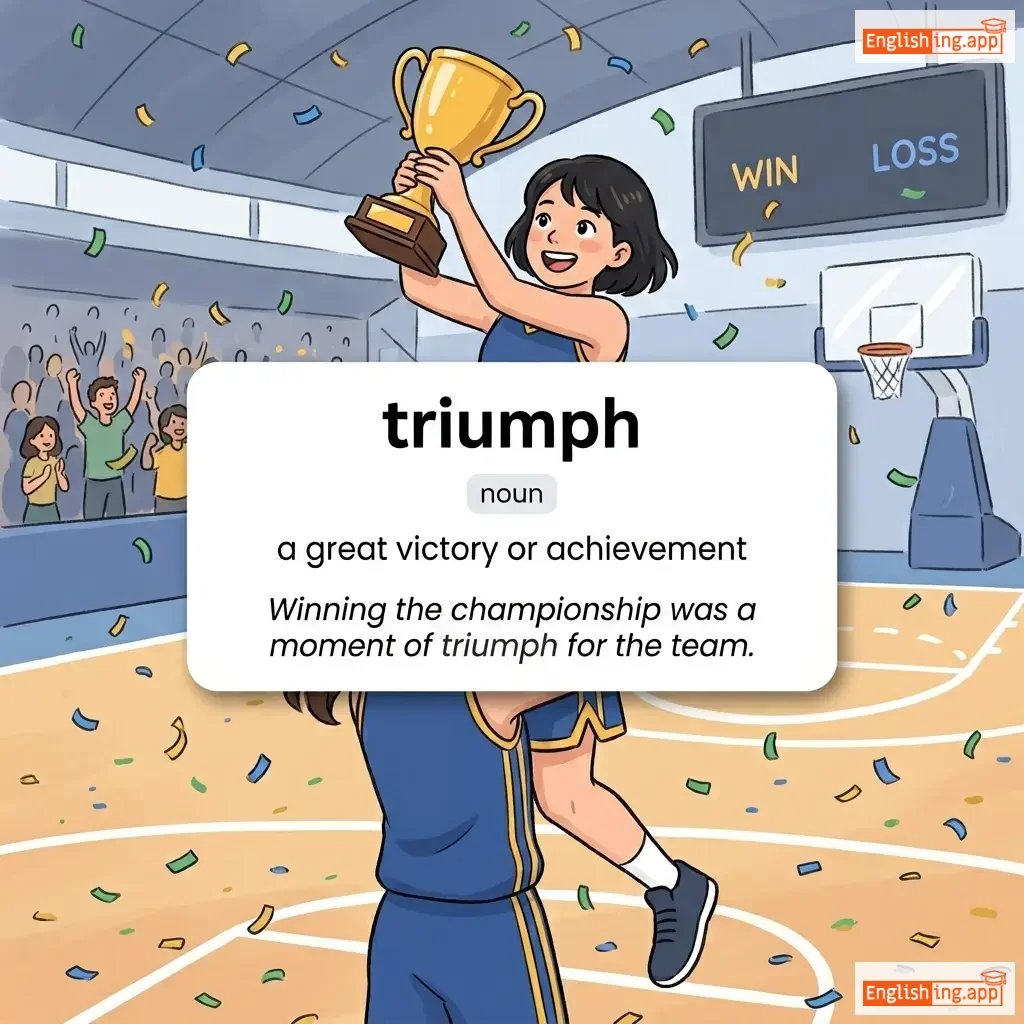
triumph definition card — visual illustration of the meaning
noun
/ˈtraɪʌmf/
triomphe (triomphe)

a great victory or achievement

"Winning the championship was a moment of triumph for the team."

"Gagner le championnat a été un moment de triomphe pour l'équipe." (Gagner le championnat a été un moment de triomphe pour l'équipe.)
adjective
/traɪt/
banal (banal)

Overused and lacking originality.

"The speech was full of trite phrases."

"Le discours était plein de phrases banales." (Le discours était plein de phrases banales.)
verb
/traɪˈsɛkt/
diviser en trois parties (diviser en trois parties)

To divide into three parts.

"The teacher asked the students to trisect the line segment."

"Le professeur a demandé aux élèves de diviser le segment de ligne en trois parties." (Le professeur a demandé aux élèves de diviser le segment de ligne en trois parties.)
noun
/ˈtraɪ.pɒd/
trépied (trepied)

A three-legged stand used to support a camera, telescope, or other object.

"The photographer set up his camera on a tripod."

"Le photographe a posé sa caméra sur un trépied." (Le photographe a posé sa caméra sur un trépied.)
noun
/trɪˈplɪs.ə.ti/
triplécité (triplecite)

The state of being triple or consisting of three parts.

"The design shows a triplicity of forms combined harmoniously."

"Le design montre une triplécité de formes combinées harmonieusement." (Le design montre une triplécité de formes combinées harmonieusement.)
noun
/ˈtrɪp.lɪ.kət/
trois copies (trois copies)

A set of three identical copies of something.

"The documents were prepared in triplicate for official use."

"Les documents ont été préparés en triplicata pour un usage officiel." (Les documents ont été préparés en triplicata pour un usage officiel.)
noun
/ˈtrɪp.lət/
triplé (triple)

One of three children or animals born at the same time to the same mother.

"The family was surprised to have triplets instead of twins."

"La famille a été surprise d'avoir des triplés au lieu de jumeaux." (La famille a été surprise d'avoir des triplés au lieu de jumeaux.)
verb
/ˈtrɪp.əl/
tripler (tripler)

To increase or become three times as much.

"The company tripled its profits in just one year."

"L'entreprise a triplé ses bénéfices en seulement un an." (L'entreprise a triplé ses bénéfices en seulement un an.)
noun
/trɪp/
voyage (voyage)

a journey or excursion, especially for pleasure

"They took a trip to the mountains last summer."

"Ils ont fait un voyage dans les montagnes l'été dernier." (Ils ont fait un voyage dans les montagnes l'été dernier.)
noun
/ˈtriː.oʊ/
trio de trois personnes (trio de trois personnes)

A group of three people or things, especially in music or performance.

"The jazz trio played beautifully at the concert."

"Le trio de jazz a joué magnifiquement lors du concert." (Le trio de jazz a joue magnifiquement lors du concert.)
noun
/ˈtrɪŋkɪt/
petit bijou (petit bijou)

a small ornament or piece of jewelry that is not expensive

"She bought a little trinket from the beach market as a souvenir."

"Elle a acheté un petit bijou au marché de la plage comme souvenir." (Elle a achete un petit bijou au marche de la plage comme souvenir.)
noun
/ˈtrɪnɪti/
trinité (trinite)

a group of three closely related things; in Christianity, the Father, the Son, and the Holy Spirit

"The museum’s exhibit focused on a trinity of themes: memory, identity, and power."

"L'exposition du musée s'est concentrée sur une trinité de thèmes : mémoire, identité et pouvoir." (L'exposition du musée s'est concentrée sur une trinité de thèmes : mémoire, identité et pouvoir.)
noun
/ˈtrɪmnəs/
ordre (ordre)

the quality of being neat, orderly, or slender and well-proportioned

"Her room’s trimness reflected a habit of putting everything back in its place."

"L'ordre dans sa chambre reflétait l'habitude de tout remettre à sa place." (L'ordre dans sa chambre reflétait l'habitude de tout remettre à sa place.)
verb
/trɪm/
couper (couper)

to cut away small parts to make something neat, tidy, or the right size

"I need to trim the video to remove the awkward pause at the end."

"Je dois couper la vidéo pour supprimer la pause gênante à la fin." (Je dois couper la vidéo pour supprimer la pause gênante à la fin.)
noun
/ˈtrɪlədʒi/
trilogie (trilogie)

a set of three related works, usually books or films, that form a connected story

"The director finally released the third film to complete the sci-fi trilogy."

"Le réalisateur a enfin sorti le troisième film pour compléter la trilogie de science-fiction." (Le réalisateur a enfin sorti le troisième film pour compléter la trilogie de science-fiction.)
noun
/ˈtrɪl.jən/
trillion (trillion)

a number equal to 1,000 billion, or 10^12

"The company's worth has risen to over a trillion dollars."

"La valeur de l'entreprise a augmenté à plus d'un trillion de dollars." (La valeur de l'entreprise a augmenté à plus d'un trillion de dollars.)
triggers definition card — visual illustration of the meaning
verb
ˈtrɪɡərz
déclencher (declencher)

To cause or initiate something to happen

"Air pollution triggers chronic diseases."

"La pollution de l'air déclenche des maladies chroniques." (La pollution de l'air declenche des maladies chroniques.)
noun
/trɪk/
astuce (astuce)

a cunning or deceitful action or plan intended to mislead or deceive someone

"She pulled a trick to win the game."

"Elle a fait une astuce pour gagner le jeu" (Elle a fait une astuce pour gagner le jeu)
noun
/ˈtrɛsəl/
étrier (etrier)

a frame or support consisting of a horizontal beam held up by two pairs of sloping legs, used especially for supporting a bridge or table

"The workers built a wooden trestle to support the temporary bridge."

"Les travailleurs ont construit un tréteau en bois pour soutenir le pont temporaire." (Les travailleurs ont construit un tréteau en bois pour soutenir le pont temporaire.)
noun
/ˈtraɪæd/
trio (trio)

a group of three closely related people or things

"The project was managed by a triad of experts."

"Le projet a été géré par un trio d'experts." (Le projet a ete gere par un trio d'experts.)
noun
/ˈtraɪəl/
procès (proces)

a formal examination of evidence in a court of law

"The trial will start next week."

"Le procès commencera la semaine prochaine." (Le procès commencera la semaine prochaine.)
adjective
/ˈtraɪbəl/
tribal (tribal)

relating to a tribe or tribes, especially indigenous people

"The tribal community has preserved its culture for centuries."

"La communauté tribale a préservé sa culture pendant des siècles." (La communauté tribale a préservé sa culture pendant des siècles.)
noun
/traɪb/
tribu (tribu)

a social group consisting of people with common customs, language, and culture

"The tribe lived in harmony with nature."

"La tribu vivait en harmonie avec la nature." (La tribu vivait en harmonie avec la nature.)
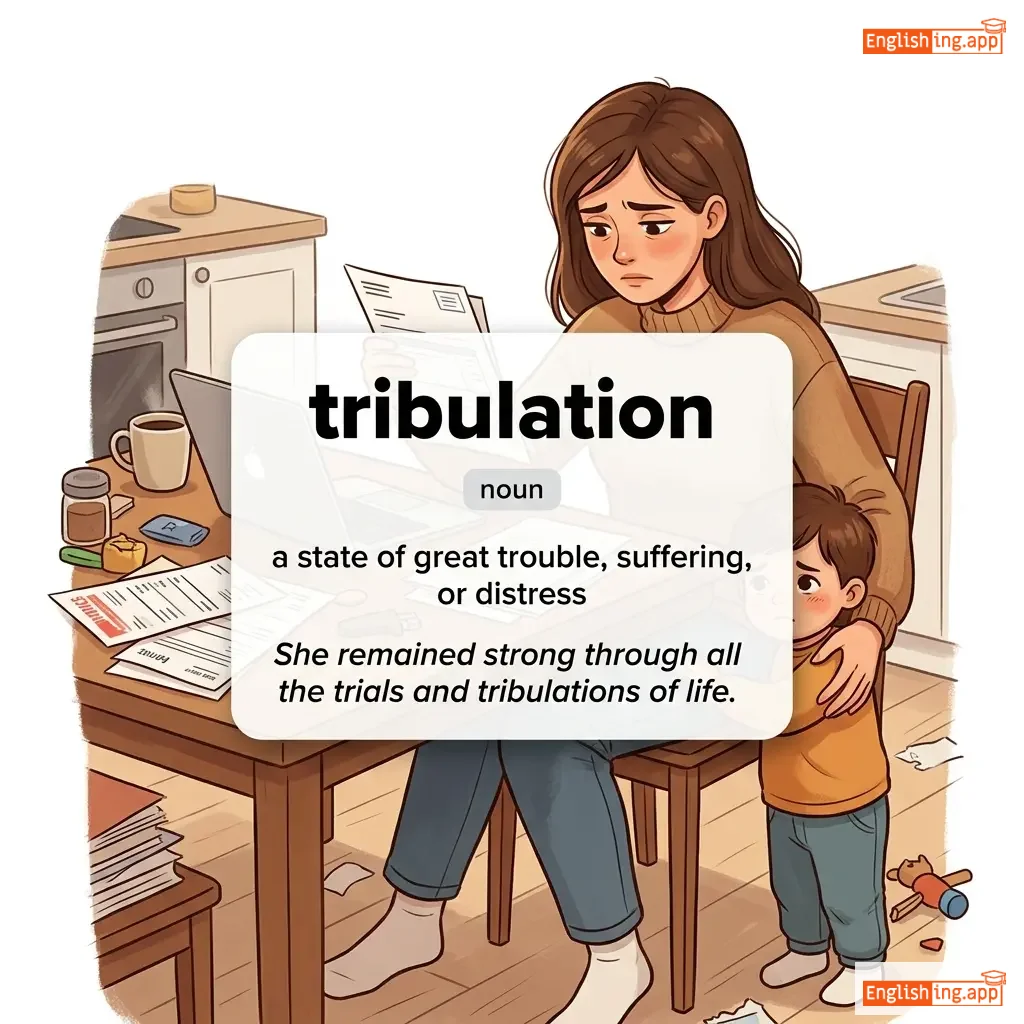
tribulation definition card — visual illustration of the meaning
noun
/ˌtrɪbjʊˈleɪʃən/
tribulation (tribulation)

a state of great trouble, suffering, or distress

"She remained strong through all the trials and tribulations of life."

"Elle est restée forte à travers toutes les épreuves et tribulations de la vie." (Elle est restée forte à travers toutes les épreuves et tribulations de la vie.)
noun
/traɪˈbjuːnəl/
tribunal (tribunal)

a court of justice or body established to settle disputes

"The case was heard in an international tribunal."

"L'affaire a été entendue dans un tribunal international." (L'affaire a été entendue dans un tribunal international.)
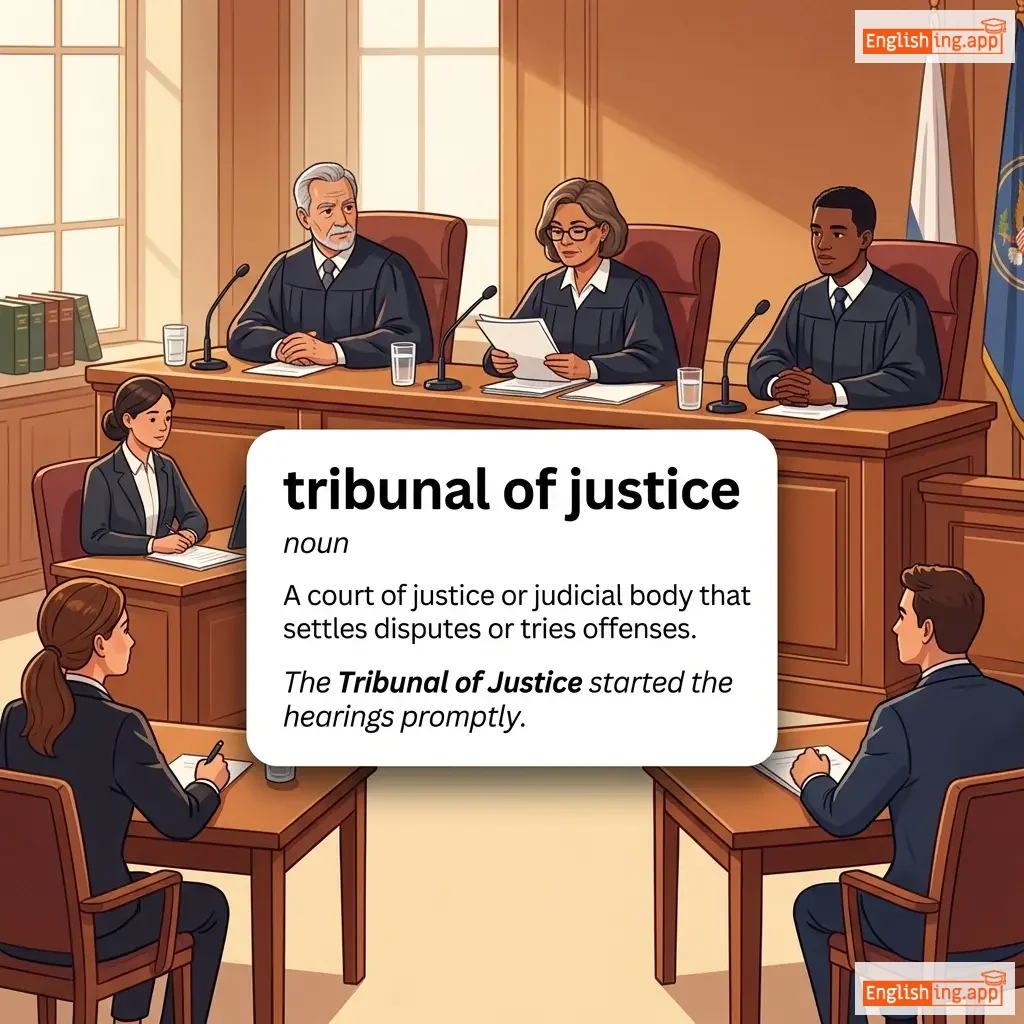
tribunal of justice definition card — visual illustration of the meaning
noun
ˌtraɪ.bjuˈnæl əv ˈdʒʌs.tɪs
tribunal de justice (tribunal de justice)

A court of justice or judicial body that settles disputes or tries offenses.

"The Tribunal of Justice started the hearings promptly."

"Le tribunal de justice a commencé les auditions immédiatement." (Le tribunal de justice a commencé les auditions immédiatement.)
noun
/ˈtrɪbjuːn/
tribune / tribun (tribune)

a person or platform representing the people; historically, a Roman official elected to protect citizens' rights

"He was seen as a tribune of the common people."

"Il était considéré comme un tribun du peuple." (Il etait considere comme un tribun du peuple)
noun
/ˈtrɪb.jə.ter.i/
affluent (affluent)

a river or stream flowing into a larger river or lake

"The tributary joins the main river near the city."

"L'affluent rejoint la rivière principale près de la ville." (L'affluent rejoint la riviere principale pres de la ville)
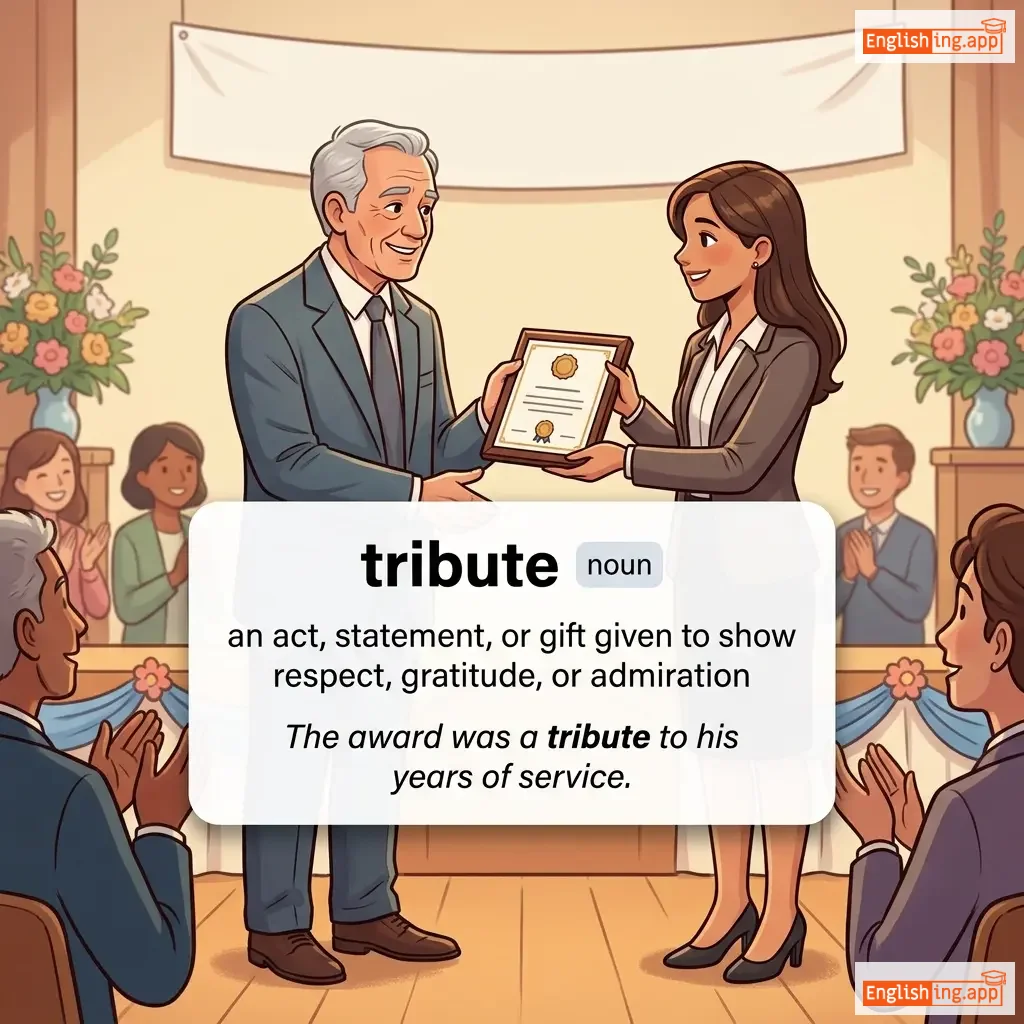
tribute definition card — visual illustration of the meaning
noun
/ˈtrɪbjuːt/
hommage (hommage)

an act, statement, or gift given to show respect, gratitude, or admiration

"The award was a tribute to his years of service."

"Le prix était un hommage à ses années de service." (Le prix était un hommage à ses années de service.)
adjective
/traɪˈɛniəl/
triennal (triennal)

Occurring once every three years.

"The art festival is a triennial event in the city."

"Le festival d'art est un événement triennal dans la ville." (Le festival d'art est un evenement triennal dans la ville.)
noun
/ˈtraɪsɪkl̩/
tricycle (tricycle)

A small vehicle with three wheels, usually for children.

"The child rode happily on his red tricycle around the park."

"L'enfant roulait joyeusement sur son tricycle rouge autour du parc." (L'enfant roulait joyeusement sur son tricycle rouge autour du parc.)
noun
/ˈtraɪdənt/
trident (trident)

A three-pronged spear, often associated with Neptune or Poseidon.

"The statue of Poseidon holds a mighty trident."

"La statue de Poséidon tient un puissant trident." (La statue de Poséidon tient un puissant trident.)
noun/adjective
/ˈtraɪkʌlər/
drapeau tricolore (drapeau tricolore)

A flag with three colors; consisting of three colors.

"The French tricolor is one of the most famous national flags in the world."

"Le drapeau tricolore français est l'un des drapeaux nationaux les plus célèbres au monde." (Le drapeau tricolore français est l'un des drapeaux nationaux les plus célèbres au monde.)
noun
/ˈtraɪfəl/
bagatelle (bagatelle)

A thing of little value or importance; also a layered dessert.

"He dismissed the issue as a mere trifle."

"Il a rejeté la question comme une simple bagatelle." (Il a rejeté la question comme une simple bagatelle.)