वोकैबुलरीज

इंग्लिश वोकैबुलरी डिस्कवर, लर्न और मास्टर करें

adjective
/ˈvɛə.ri.əs/
विभिन्न (vibhinn)

different from one another; of several different kinds

"She owns various kinds of books."

"उसके पास विभिन्न प्रकार की किताबें हैं।" (Uske paas vibhinn prakar ki kitaabein hain.)
noun
/vəˈraɪəti/
विविधता (vividhata)

the quality or state of being different or diverse; a range of different things

"There is a variety of fruits available in the market."

"बाजार में विभिन्न प्रकार के फल उपलब्ध हैं।" (Bazaar mein vividh prakar ke phal upalabdh hain.)
noun
/ˌvɛəriəˈɡeɪʃən/
विविधता (vividhata)

The appearance of differently colored zones in the leaves, flowers, or stems of plants.

"Variegation makes the foliage look more attractive."

"वेरिगेशन पत्तियों को और अधिक आकर्षक बनाता है।" (Variegation pattiyon ko aur adhik aakarshak banata hai.)
adjective
/ˈvɛəriəˌɡeɪtɪd/
बहुरंगी (bahurangi)

Having different colors, especially in irregular patches or streaks.

"The garden was full of variegated plants."

"बगीचा बहुरंगी पौधों से भरा हुआ था।" (bagicha bahurangi paudhon se bhara hua tha)
verb
/ˈvɛəriəˌɡeɪt/
विविध करना (vividh karna)

To diversify or mark with different colors or patterns.

"The artist used different shades to variegate the design."

"कलाकार ने डिजाइन को विविध बनाने के लिए विभिन्न शेड्स का उपयोग किया।" (kalakar ne design ko vividh banane ke liye vibhinn shades ka upyog kiya.)
adjective
/ˈvɛərɪd/
विविध (vividh)

showing many different kinds or forms

"The menu offers a varied selection of dishes."

"मेनू में विभिन्न प्रकार के व्यंजनों का चयन है।" (Menu mein vividh prakar ke vyajanon ka chayan hai.)
noun
/ˌvɛəriˈeɪʃən/
भिन्नता (bhinnata)

A change or slight difference in condition, amount, or level.

"There is a wide variation in climate across the country."

"देशभर में जलवायु में व्यापक भिन्नता है।" (deshbhar mein jalvayu mein vyapak bhinnata hai.)
noun
/ˈvɛəriənt/
रूपांतर (roopantar)

A form or version of something that differs in some way from other forms of the same thing.

"The new variant of the virus spread rapidly."

"वायरस का नया रूप तेजी से फैल गया।" (virus ka naya roop tezi se phail gaya.)
noun
/ˈvɛriəns/
वेरिएंस (verians)

the state of being different or inconsistent; in statistics, a measure of the spread between numbers

"There is a wide variance in students' performance levels."

"छात्रों के प्रदर्शन स्तर में व्यापक वेरियन्स है।" (Chhatron ke pradarshan star mein vyapak verians hai.)
noun
/veɪn/
शिरा (shira)

a tube in the body that carries blood to the heart

"The nurse checked the patient's veins for an IV insertion."

"नर्स ने मरीज की शिराओं की जाँच की IV इन्सर्शन के लिए।" (Nars ne mareez ki shiraon ki jaanch ki IV insertion ke liye.)
noun
/ˈtrɒɡlədaɪt/
गुफ़ावासी (gufavasi)

A person who lives in a cave or is considered old-fashioned and out of touch.

"Some called him a troglodyte for refusing to use modern technology."

"कुछ लोगों ने उसे आधुनिक तकनीक का उपयोग न करने के लिए गुफ़ावासी कहा।" (Kuch logon ne use aadhunik takneek ka upyog na karne ke liye gufavasi kaha.)
adjective
/ˈtrɪviəl/
तुच्छ (tuchchh)

Of little value or importance.

"He often gets upset over the most trivial matters."

"वह अक्सर सबसे तुच्छ बातों पर परेशान हो जाता है।" (Vah aksar sabse tuchchh baaton par pareshan ho jata hai.)
noun
/ˈtrɪviə/
तथ्य (tathya)

Details or information that are considered unimportant or of little value.

"The quiz was filled with fun trivia about movies and music."

"क्विज़ फिल्मों और संगीत के बारे में मज़ेदार तथ्यों से भरा हुआ था।" (Quiz filmo aur sangeet ke baare mein mazedaar tathyo se bhara hua tha.)
noun
/traɪˈʌmvɪrət/
त्रैतीयक शासन (traitiyak shasan)

A political regime ruled or dominated by three powerful individuals.

"The Roman Republic was once governed by a triumvirate."

"रोमन गणराज्य कभी त्रैतीयक शासन द्वारा शासित था।" (Roman ganrajya kabhi traitiyak shasan dvara shasit tha.)
noun
/traɪˈʌmvɪər/
त्रैतीयक शासक (traiteeyak shasak)

One of a group of three men holding power in ancient Rome.

"Caesar was a triumvir in the first Roman triumvirate."

"सीज़र था पहले रोमन ट्राईअमविराट में एक ट्राईअमविर।" (Caesar tha pehle Roman triumvirate mein ek triumvir.)
adjective
/traɪˈʌmfənt/
विजयी; आनंदित (vijayi; aanandit)

having won a battle or contest; rejoicing as a result of success

"The team was triumphant after winning the championship."

"टीम चैंपियनशिप जीतने के बाद विजयी थी।" (team championship jeetne ke baad vijayi thi)
triumph definition card — visual illustration of the meaning
noun
/ˈtraɪʌmf/
विजय (vijay)

a great victory or achievement

"Winning the championship was a moment of triumph for the team."

"चैम्पियनशिप जीतना टीम के लिए विजय का एक पल था।" (Champion ship jeetna team ke liye vijay ka ek pal tha.)
adjective
/traɪt/
साधारण (saadharan)

Overused and lacking originality.

"The speech was full of trite phrases."

"भाषण ट्राइट वाक्यों से भरा हुआ था।" (Bhashan trite vaakyon se bhara hua tha.)
verb
/traɪˈsɛkt/
तीन भाग करना (teen bhag karna)

To divide into three parts.

"The teacher asked the students to trisect the line segment."

"शिक्षक ने छात्रों से लाइन सेगमेंट को तीन हिस्सों में बांटने को कहा।" (Shikshak ne chhatron se line segment ko teen hisso mein baantne ko kaha.)
noun
/ˈtraɪ.pɒd/
ट्राइपॉड (tripod)

A three-legged stand used to support a camera, telescope, or other object.

"The photographer set up his camera on a tripod."

"फोटोग्राफर ने अपनी कैमरा को ट्राइपॉड पर सेट किया।" (Photographer ne apni camera ko tripod par set kiya.)
noun
/trɪˈplɪs.ə.ti/
त्रैतीयकता (traiteeyakta)

The state of being triple or consisting of three parts.

"The design shows a triplicity of forms combined harmoniously."

"डिज़ाइन में तीन रूपों की त्रैतीयकता को सामंजस्यपूर्ण रूप से संयोजित किया गया है।" (Design mein teen roopon ki traitayikta ko samanjasypurn roop se sanyojit kiya gaya hai.)
noun
/ˈtrɪp.lɪ.kət/
तीन प्रति (teen prati)

A set of three identical copies of something.

"The documents were prepared in triplicate for official use."

"दस्तावेज़ों को आधिकारिक उपयोग के लिए तीन प्रतियों में तैयार किया गया था।" (Dastavezon ko adhikarik upyog ke liye teen pratiyon mein tayar kiya gaya tha.)
noun
/ˈtrɪp.lət/
त्रैतीयक संतान (traiteeyak santan)

One of three children or animals born at the same time to the same mother.

"The family was surprised to have triplets instead of twins."

"परिवार को जुड़वां के बजाय त्रैतीयक संतान होने पर आश्चर्य हुआ।" (Parivaar ko judwan ke bajaye traiteeyak santan hone par aashcharya hua.)
verb
/ˈtrɪp.əl/
तीन गुना करना (teen guna karna)

To increase or become three times as much.

"The company tripled its profits in just one year."

"कंपनी ने सिर्फ एक साल में अपने लाभ को तीन गुना बढ़ा लिया।" (Company ne sirf ek saal mein apne laabh ko teen guna badha liya.)
noun
/trɪp/
यात्रा (yatra)

a journey or excursion, especially for pleasure

"They took a trip to the mountains last summer."

"उन्होंने पिछले गर्मी में पहाड़ों की यात्रा की।" (Unhone pichle garmi mein pahadon ki yatra ki.)
noun
/ˈtriː.oʊ/
तीन लोगों का समूह (teen logon ka samuh)

A group of three people or things, especially in music or performance.

"The jazz trio played beautifully at the concert."

"जैज़ ट्रायो ने संगीत समारोह में शानदार प्रदर्शन किया।" (Jazz trio ne sangeet samaroh mein shandar pradarshan kiya.)
noun
/ˈtrɪŋkɪt/
छोटी ज्वेलरी (chhoti jewelry)

a small ornament or piece of jewelry that is not expensive

"She bought a little trinket from the beach market as a souvenir."

"उसने बीच बाजार से एक छोटा ट्रिंकेट यादगारी के रूप में खरीदी।" (Usne beach bazaar se ek chhota trinket yaadgari ke roop mein khareedi.)
noun
/ˈtrɪnɪti/
त्रित्व (tritva)

a group of three closely related things; in Christianity, the Father, the Son, and the Holy Spirit

"The museum’s exhibit focused on a trinity of themes: memory, identity, and power."

"संग्रहालय की प्रदर्शनी में तीन विषयों का त्रित्व था: स्मृति, पहचान, और शक्ति।" (Sangrahalay ki pradarshani mein teen vishayon ka tritva tha: smriti, pehchaan, aur shakti.)
noun
/ˈtrɪmnəs/
साफ-सफाई (saaf-safaai)

the quality of being neat, orderly, or slender and well-proportioned

"Her room’s trimness reflected a habit of putting everything back in its place."

"उसके कमरे की साफ-सफाई इस बात को दर्शाती है कि वह हमेशा चीजों को अपनी जगह पर रखती है।" (Uske kamre ki saaf-safaai is baat ko darshaati hai ki wah hamesha cheezon ko apni jagah par rakhti hai.)
verb
/trɪm/
काटना (kaatna)

to cut away small parts to make something neat, tidy, or the right size

"I need to trim the video to remove the awkward pause at the end."

"मुझे वीडियो के अंत में अजीब विराम को हटाने के लिए इसे ट्रिम करना है।" (Mujhe video ke ant mein ajeeb viraam ko hatane ke liye ise trim karna hai.)
noun
/ˈtrɪlədʒi/
त्रयी (trayi)

a set of three related works, usually books or films, that form a connected story

"The director finally released the third film to complete the sci-fi trilogy."

"निर्देशक ने आखिरकार तीसरी फिल्म रिलीज की, जिससे साइ-फाई त्रयी पूरी हुई।" (Nirdeshak ne aakhirkaar teesri film release ki, jisse sci-fi trayi poori hui.)
noun
/ˈtrɪl.jən/
ट्रिलियन (trillion)

a number equal to 1,000 billion, or 10^12

"The company's worth has risen to over a trillion dollars."

"कंपनी का मूल्य एक ट्रिलियन डॉलर से ऊपर बढ़ चुका है।" (Kampani ka moolya ek trillion dollar se upar badh chuka hai.)
triggers definition card — visual illustration of the meaning
verb
ˈtrɪɡərz
उत्तेजित करना (uttejit karna)

To cause or initiate something to happen

"Air pollution triggers chronic diseases."

"वायु प्रदूषण पुरानी बीमारियों को उत्तेजित करता है।" (Vaayu pradushan purani bimariyon ko uttejit karta hai.)
noun
/trɪk/
चालाकी (chalaki)

a cunning or deceitful action or plan intended to mislead or deceive someone

"She pulled a trick to win the game."

"उसने खेल जीतने के लिए एक चालाकी की" (Usne khel jeetne ke liye ek chalaki ki)
noun
/ˈtrɛsəl/
ट्रेसल (tresel)

a frame or support consisting of a horizontal beam held up by two pairs of sloping legs, used especially for supporting a bridge or table

"The workers built a wooden trestle to support the temporary bridge."

"कर्मचारियों ने अस्थायी पुल को समर्थन देने के लिए एक लकड़ी का ट्रेसल बनाया।" (Karmachariyon ne asthayi pul ko samarthan dene ke liye ek lakdi ka tresel banaya.)
noun
/ˈtraɪæd/
त्रैतीयक समूह (traiyatik samuh)

a group of three closely related people or things

"The project was managed by a triad of experts."

"प्रोजेक्ट को तीन विशेषज्ञों के त्रैतीयक समूह द्वारा प्रबंधित किया गया था।" (Project ko teen visheshagyon ke traiyatik samuh dwara prabandhit kiya gaya tha.)
noun
/ˈtraɪəl/
मुकदमा (mukadma)

a formal examination of evidence in a court of law

"The trial will start next week."

"मुकदमा अगले सप्ताह शुरू होगा।" (Mukadma agle saptah shuru hoga.)
adjective
/ˈtraɪbəl/
जनजातीय (janjatiya)

relating to a tribe or tribes, especially indigenous people

"The tribal community has preserved its culture for centuries."

"जनजातीय समुदाय ने सदियों से अपनी संस्कृति को संरक्षित किया है।" (Janjatiya samudaay ne sadiyon se apni sanskriti ko sanrakshit kiya hai.)
noun
/traɪb/
जनजाति (janjati)

a social group consisting of people with common customs, language, and culture

"The tribe lived in harmony with nature."

"जनजाति प्रकृति के साथ सामंजस्यपूर्ण जीवन जीती थी।" (Janjati prakriti ke saath samaanjasypurn jeevan jeeti thi.)
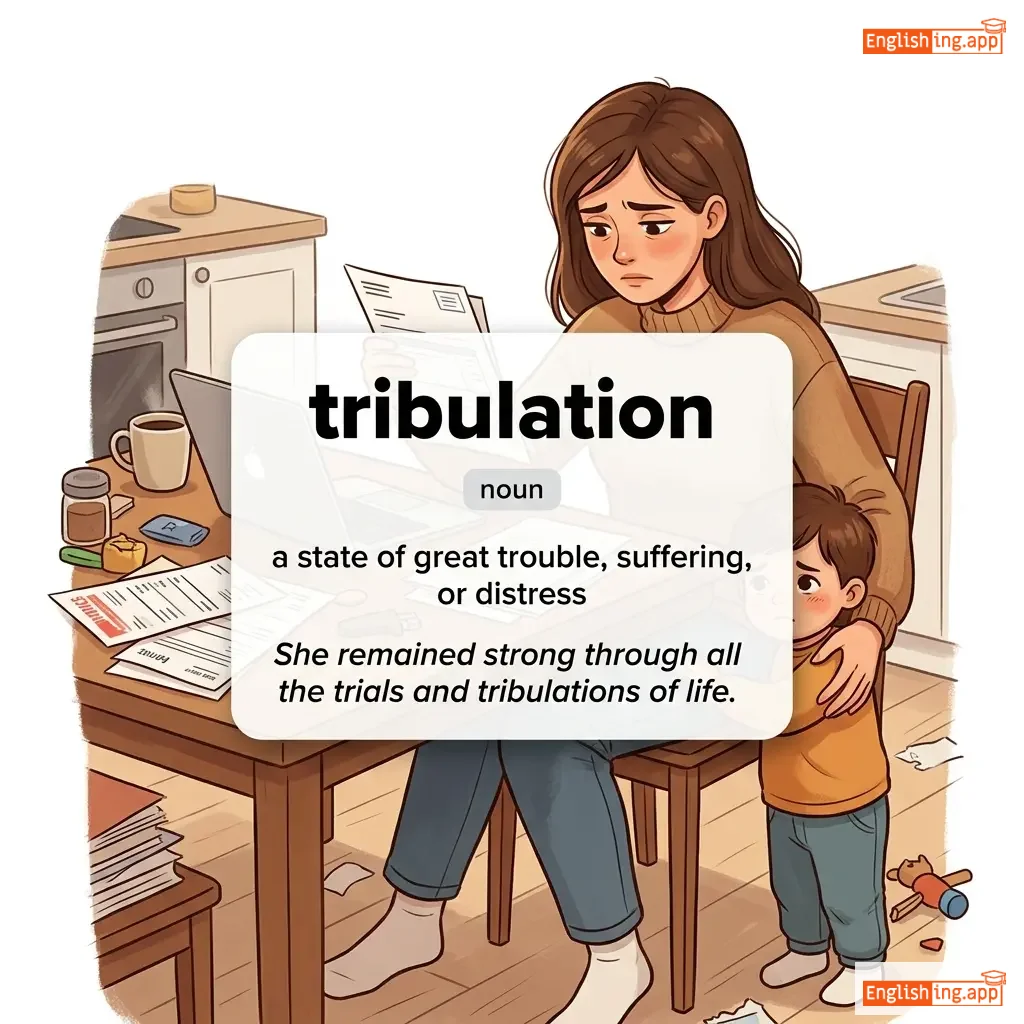
tribulation definition card — visual illustration of the meaning
noun
/ˌtrɪbjʊˈleɪʃən/
विपत्ति (vipatti)

a state of great trouble, suffering, or distress

"She remained strong through all the trials and tribulations of life."

"वह जीवन के सभी परीक्षणों और कठिनाइयों के बीच मजबूत रही।" (Wah jeevan ke sabhi parikshayon aur kathinaiyon ke beech majboot rahi.)
noun
/traɪˈbjuːnəl/
न्यायालय (nyayalay)

a court of justice or body established to settle disputes

"The case was heard in an international tribunal."

"मामला एक अंतरराष्ट्रीय न्यायालय में सुना गया था।" (Mamla ek antarraashtreey nyayalay mein suna gaya tha.)
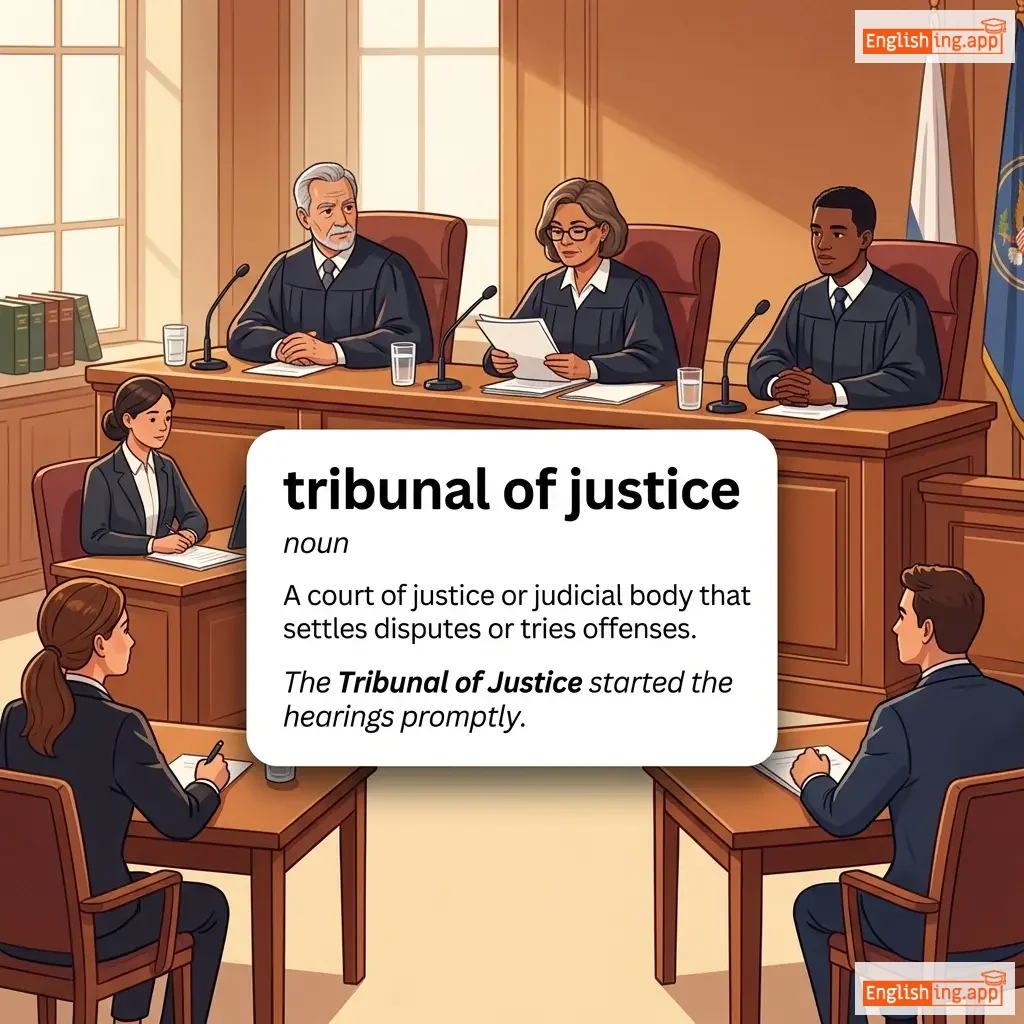
tribunal of justice definition card — visual illustration of the meaning
noun
ˌtraɪ.bjuˈnæl əv ˈdʒʌs.tɪs
न्यायालय (nyayalay)

A court of justice or judicial body that settles disputes or tries offenses.

"The Tribunal of Justice started the hearings promptly."

"न्यायालय ने सुनवाई तुरंत शुरू की।" (Nyayalay ne sunvai turant shuru ki.)
noun
/ˈtrɪbjuːn/
जनता का प्रतिनिधि (tribyoon)

a person or platform representing the people; historically, a Roman official elected to protect citizens' rights

"He was seen as a tribune of the common people."

"उसे आम जनता का प्रतिनिधि माना गया था." (use aam janta ka pratinidhi maana gaya tha.)
noun
/ˈtrɪb.jə.ter.i/
उपनदी (upnadi)

a river or stream flowing into a larger river or lake

"The tributary joins the main river near the city."

"उपनदी शहर के पास मुख्य नदी से मिलती है।" (upnadi shahar ke paas mukhya nadi se milti hai)
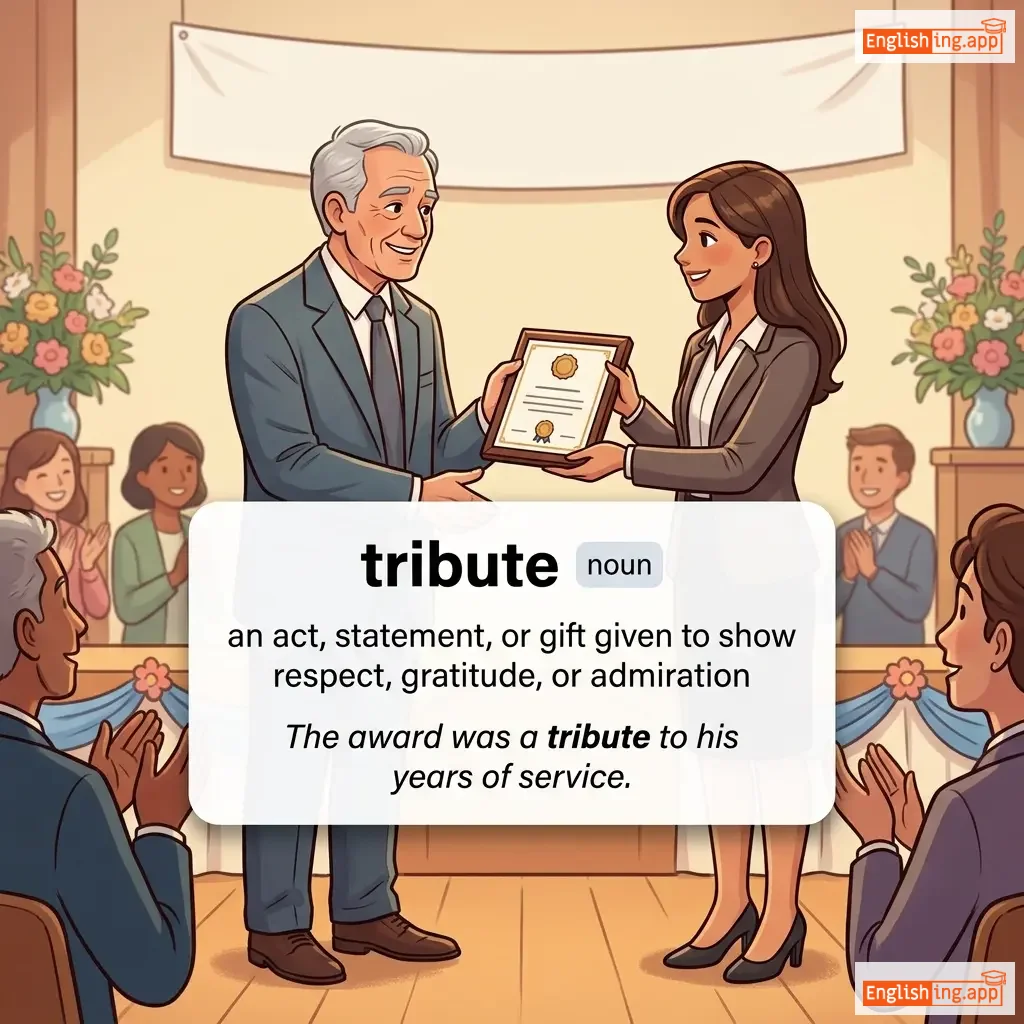
tribute definition card — visual illustration of the meaning
noun
/ˈtrɪbjuːt/
श्रद्धांजलि (shraddhanjali)

an act, statement, or gift given to show respect, gratitude, or admiration

"The award was a tribute to his years of service."

"पुरस्कार उसकी वर्षों की सेवा के प्रति श्रद्धांजलि था।" (Puraskaar uski varsho ki seva ke prati shraddhanjali tha.)
adjective
/traɪˈɛniəl/
त्रैवार्षिक (traivarsik)

Occurring once every three years.

"The art festival is a triennial event in the city."

"कला महोत्सव शहर में एक त्रैवार्षिक कार्यक्रम है।" (Kala mahotsav shahar mein ek traivarsik karyakram hai.)
noun
/ˈtraɪsɪkl̩/
ट्राइसिकल (traisikal)

A small vehicle with three wheels, usually for children.

"The child rode happily on his red tricycle around the park."

"बच्चा खुशी-खुशी अपने लाल ट्राईसाइकल पर पार्क के चारों ओर सवारी कर रहा था।" (Baccha khushi-khushi apne laal traaisikal par park ke chaaron or sawari kar raha tha.)
noun
/ˈtraɪdənt/
त्रिशूल (trishul)

A three-pronged spear, often associated with Neptune or Poseidon.

"The statue of Poseidon holds a mighty trident."

"पोसीडॉन का प्रतिमा एक शक्तिशाली त्रिशूल पकड़े हुए है।" (Poseidon ka pratima ek shaktishali trishul pakde hue hai.)
noun/adjective
/ˈtraɪkʌlər/
तिरंगा ध्वज (tiranga dhvaj)

A flag with three colors; consisting of three colors.

"The French tricolor is one of the most famous national flags in the world."

"फ्रांसीसी तिरंगा ध्वज दुनिया के सबसे प्रसिद्ध राष्ट्रीय ध्वजों में से एक है।" (Phraansisee tiranga dhvaj duniya ke sabse prasiddh rashtriya dhvajon mein se ek hai.)
noun
/ˈtraɪfəl/
तुच्छ बात (tucch baat)

A thing of little value or importance; also a layered dessert.

"He dismissed the issue as a mere trifle."

"उसने उस मुद्दे को एक मामूली तुच्छ बात मानकर नकार दिया।" (Usne us mudde ko ek mamooli tucch baat maankar nakar diya.)