词汇表

英语词汇词典 | 单词含义、定义和示例

noun
/kiː/
码头 (matou)

A platform lying alongside or projecting into water for loading and unloading ships.

"The cargo was unloaded at the quay."

"货物在码头被卸下。" (Huowu zai matou bei xiexia.)
adjective
/ˈkwiːzi/
恶心 (ěxīn)

Feeling sick to one's stomach; nauseated.

"She felt queasy after the long boat ride."

"她在长时间的船上旅行后感到恶心。" (Tā zài cháng shíjiān de chuán shàng lǚxíng hòu gǎndào ěxīn.)
noun
/kwiːn/
女王 (nǚwáng)

a female ruler of a country or the wife of a king

"The queen addressed her people with grace."

"女王以优雅的姿态向她的人民致辞。" (Nǚwáng yǐ yōuyǎ de zītài xiàng tā de rénmín zhìcí.)
noun
/kwiːn kreɪp ˈmɜːrtəl/
皇后夹竹桃 (huánghòu jiā zhútáo)

A flowering tree with colorful, crepe-like flowers, scientifically known as Lagerstroemia

"The Queen crape myrtle bloomed beautifully in the garden with its purple flowers."

"皇后夹竹桃在花园里盛开,紫色的花朵美丽地绽放。" (Huánghòu jiā zhútáo zài huāyuán lǐ shèngkāi, zǐsè de huāduǒ měilì de zhànfàng.)
adjective
/kwɪər/
奇怪 (qiguai)

Strange, odd, or unusual.

"He had a queer feeling that something was wrong."

"他有一种奇怪的感觉,觉得有什么不对劲。" (Ta you yi zhong qiguai de ganjue, jue de you shenme bu dui jin.)
verb
/kwɛl/
镇压 (zhenya)

To suppress or put an end to something, usually by force.

"The police were called to quell the violent protest."
"警方被召唤以平息暴力抗议。" (Jǐngfāng bèi zhàohuàn yǐ píngxī bàolì kàngyì.)
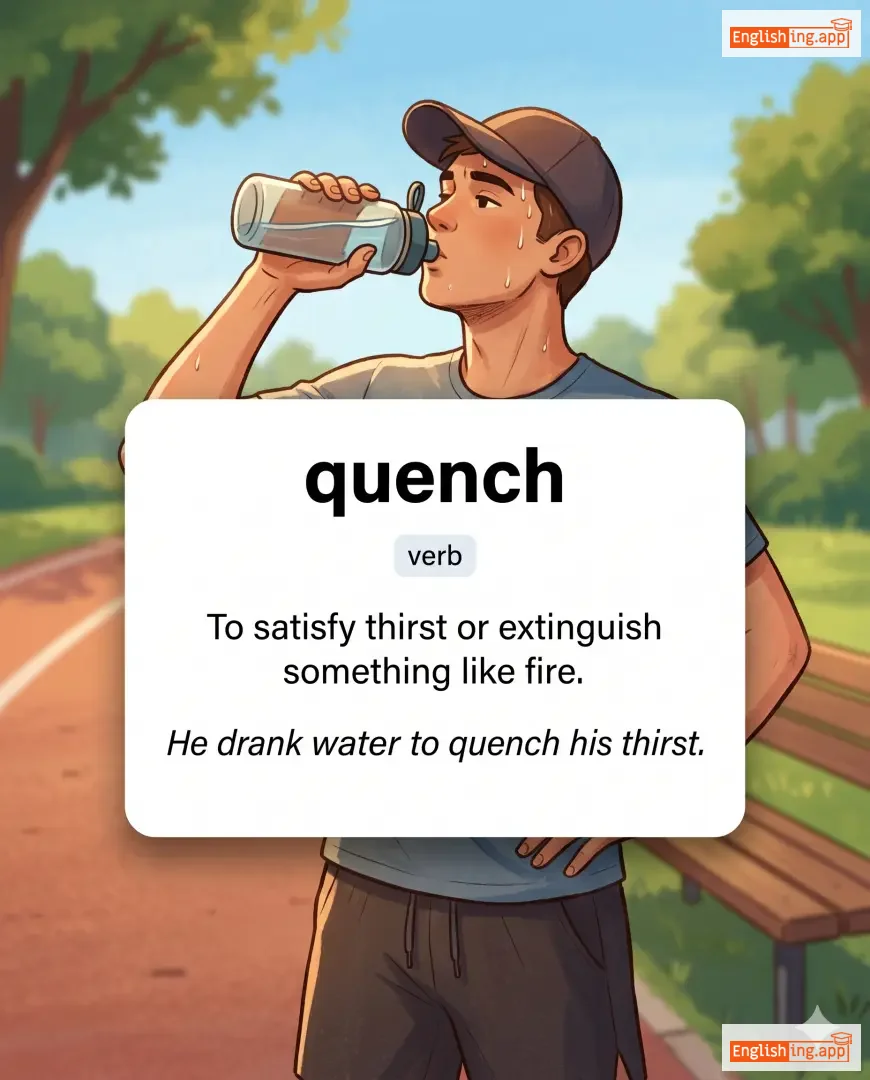
quench definition card — visual illustration of the meaning
verb
/kwɛntʃ/
解渴 (jie ke)

To satisfy thirst or extinguish something like fire.

"He drank water to quench his thirst."

"他喝水来解渴。" (Ta he shui lai jie ke.)
verb
/ˈkwentʃɪŋ/
解渴 / 熄灭 (jie ke / xi mie)

The act of satisfying thirst or extinguishing something like fire.

"Drinking cold water was quenching her thirst."

"喝冷水解渴。" (He leng shui jie ke.)
adjective
/ˈkwɛrʊləs/
抱怨的 (bàoyuàn de)

Complaining in a whining or irritable manner.

"The querulous customer kept finding fault with every detail."

"那个抱怨的顾客一直在找每个细节的错误。" (Nàgè bàoyuàn de gùkè yīzhí zài zhǎo měi gè xìjié de cuòwù.)
Query definition card — visual illustration of the meaning
noun/verb
/ˈkwɪəri/
查询 (chaxun)

A question, especially one addressed to an official or organization; to ask a question or express doubt.

"She raised a query about the accuracy of the report."

"她提出了关于报告准确性的查询。" (Ta tichu le guanyu baogao zhunquexing de chaxun.)
Quest definition card — visual illustration of the meaning
noun
/kwest/
探索, 寻找 (tansuo, xunzhao)

a long search for something that is difficult to find

"They went on a quest to find the lost treasure."

"他们去寻找失落的宝藏。" (tamen qu xunzhao shiluode baocang.)
Question definition card — visual illustration of the meaning
noun/verb
/ˈkwes.tʃən/
问题 (wenti)

A sentence designed to elicit information; or to ask something.

"She asked a difficult question during the meeting."

"她在会议中提出了一个困难的问题。" (Ta zai huiyi zhong tichu le yige kunnan de wenti.)
adjective
/ˈkwestʃənəbl/
可疑的 (ke-yi-de)

doubtful; dubious; suspicious; open to doubt or suspicion

"His questionable business practices led to an investigation."

"他的可疑商业行为导致了一项调查。" (Tā de kěyí shāngyè xíngwéi dǎozhìle yī xiàng diàochá.)
noun
/ˌkwes.tʃəˈneər/
问卷 (wenjuan)

a set of written questions used to collect information or opinions

"Participants filled out a detailed questionnaire about their habits."

"参与者填写了关于他们习惯的详细问卷。" (Canyu zhe tianxie le guanyu tamen xiguan de xishi wenjuan.)
🧍‍♂️🧍‍♀️

Queue (qiú)

noun/verb
/kjuː/
队列 (duìliè)

A line or sequence of people or vehicles awaiting their turn; to wait in line.

"People queued outside the theater for tickets."

"人们在剧院外排队等票。" (Rénmen zài jùyuàn wài páiduì děng piào.)
noun
/ˌkiː ˈviːv/
警觉 (jingjue)

A state of alertness or vigilance.

"The guards were on the qui vive during the night."

"警卫们在夜间保持警觉。" (Jingwei men zai yejian baochi jingjue.)
quibble definition card — visual illustration of the meaning
🗣️

quibble

verb/noun
/ˈkwɪbəl/

To argue or raise objections about a trivial matter; a petty objection.

"They quibbled over who should pay the bill."

Quick definition card — visual illustration of the meaning
adjective
/kwɪk/
快速 (kuaisu)

moving fast or doing something in a short time

"She is a quick learner."

"她是一个快速学习者。" (Ta shi yi ge kuaisu xuexizhe.)
noun
/ˈkwɪk.sænd/
流沙 (liú shā)

loose wet sand that yields easily to pressure and sucks in anything on its surface

"The explorer got trapped in quicksand while crossing the desert."

"探险家在穿越沙漠时被流沙困住。" (tàn xiǎn jiā zài chuān yuè shā mò shí bèi liú shā kùn zhù)
verb
/ˈkwɪkən/
加快 (jiakuai)

to make or become faster; to accelerate

"His pulse began to quicken as he approached the finish line."

"他的脉搏在接近终点线时开始加速。" (Tā de màibó zài jiējìn zhōngdiǎn xiàn shí kāishǐ jiāsù.)
adverb
/ˈkwɪkli/
快速 (kuai su)

at a fast speed

"She finished the test quickly."

"她迅速完成了测试。" (Ta xun su wan cheng le ce shi.)
noun
/ˈkwɪkˌsɪlvər/
水银 (shuiyin)

Mercury; a liquid metal, or something that is quick and unpredictable.

"His mood was as changeable as quicksilver."

"他的情绪像水银一样变化无常。" (Tā de qíngxù xiàng shuǐyín yīyàng biànhuà wúcháng.)
noun
/kwɪˈɛsəns/
静止 (jingzhi)

A state of quietness, inactivity, or dormancy.

"The volcano has been in a state of quiescence for decades."
"火山已经处于静止状态几十年了。" (Huoshan yijing chuyu jingzhi zhuangtai jishinian le.)
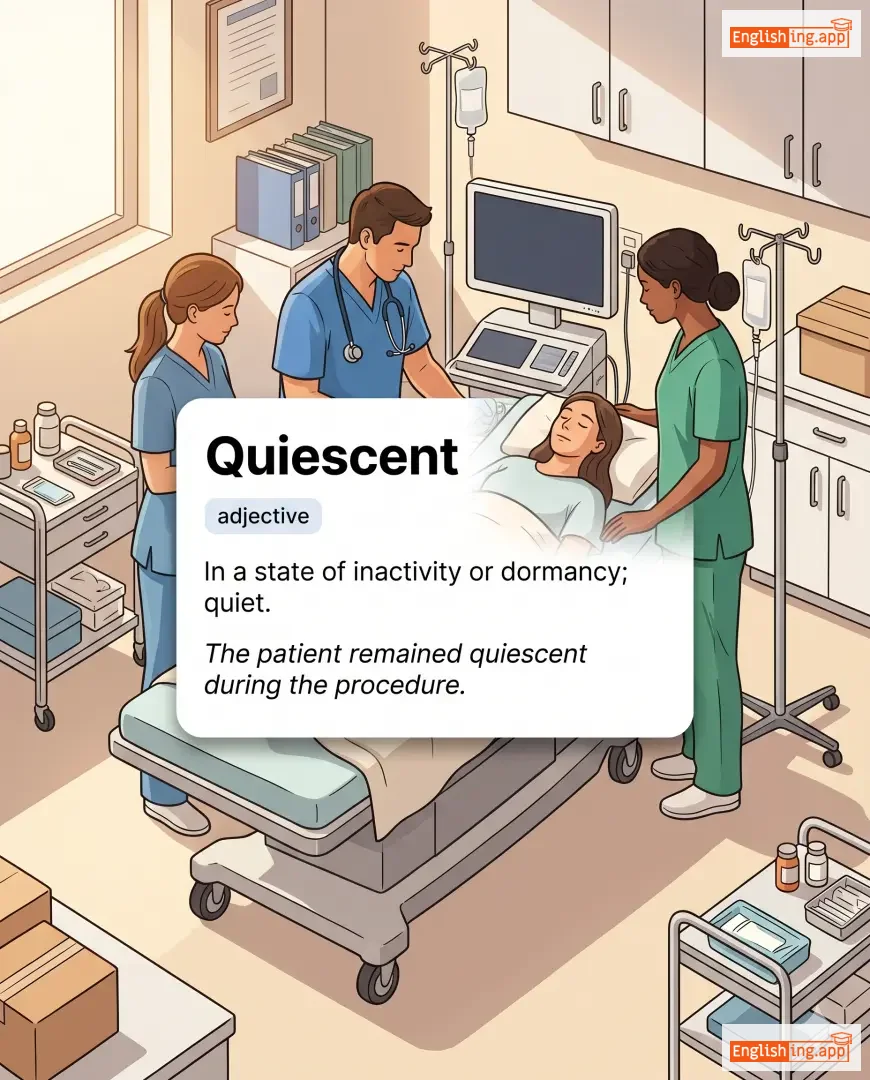
Quiescent definition card — visual illustration of the meaning
adjective
/kwɪˈɛsənt/
安静 (an jing)

In a state of inactivity or dormancy; quiet.

"The patient remained quiescent during the procedure."
"病人在手术过程中保持安静。" (Bingren zai shoushu guocheng zhong baochi anjing.)
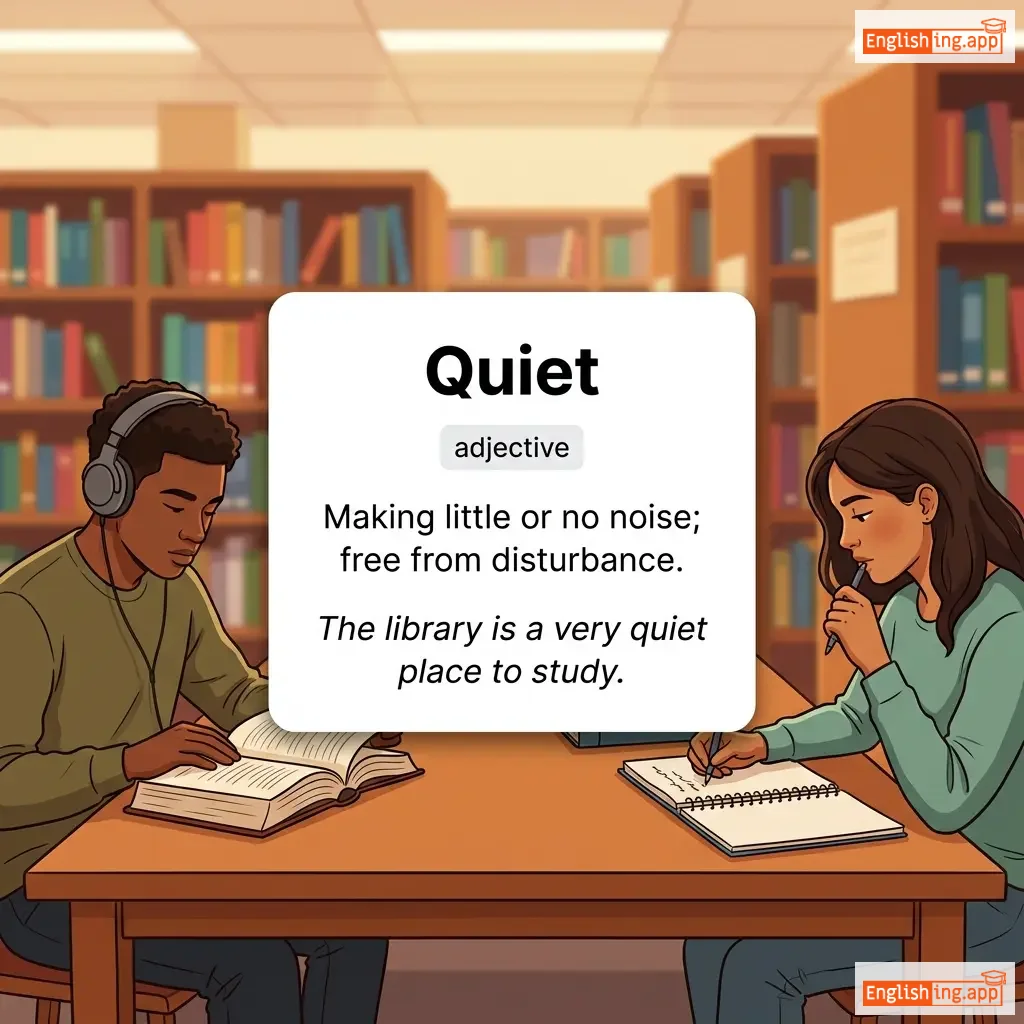
Quiet definition card — visual illustration of the meaning
adjective
/ˈkwaɪət/
安静 (anjing)

Making little or no noise; free from disturbance.

"The library is a very quiet place to study."

"图书馆是一个非常安静的学习场所。" (Túshūguǎn shì yīgè fēicháng ānjìng de xuéxí chǎngsuǒ.)
adverb
/ˈkwaɪətli/
安静地 (an jing di)

in a silent or calm manner

"He spoke quietly so no one would hear."

"他安静地说话,以便没有人听见。" (Ta an jing di shuo hua, yi bian mei you ren ting jian.)
noun
/ˈkwaɪəˌtuːd/
宁静 (ningjing)

A state of stillness and tranquility.

"She enjoys the quietude of the countryside."

"她享受乡村的宁静。" (Ta xiangshou xiangcun de ningjing.)
noun
/kwaɪˈiːtəs/
结束, 死亡 (jieshu, siwang)

Something that ends or settles a situation; release from life, death.

"The scandal brought a quietus to his political career."

"这场丑闻给他的政治生涯带来了结束。" (Zhe chang chouwen gei tade zhengzhi shengya dailai le jieshu.)
noun
/kwɪlt/
被子 (bèizi)

a warm bed covering made of padding enclosed between layers of fabric

"Grandmother made a beautiful quilt for my bed."

"祖母为我的床做了一个漂亮的被子。" (Zǔmǔ wèi wǒ de chuáng zuòle yīgè piàoliang de bèizi.)
noun
/kwɪnˈtɛsəns/
精髓 (jīngsuǐ)

The purest or most perfect example of something.

"She is the quintessence of elegance."
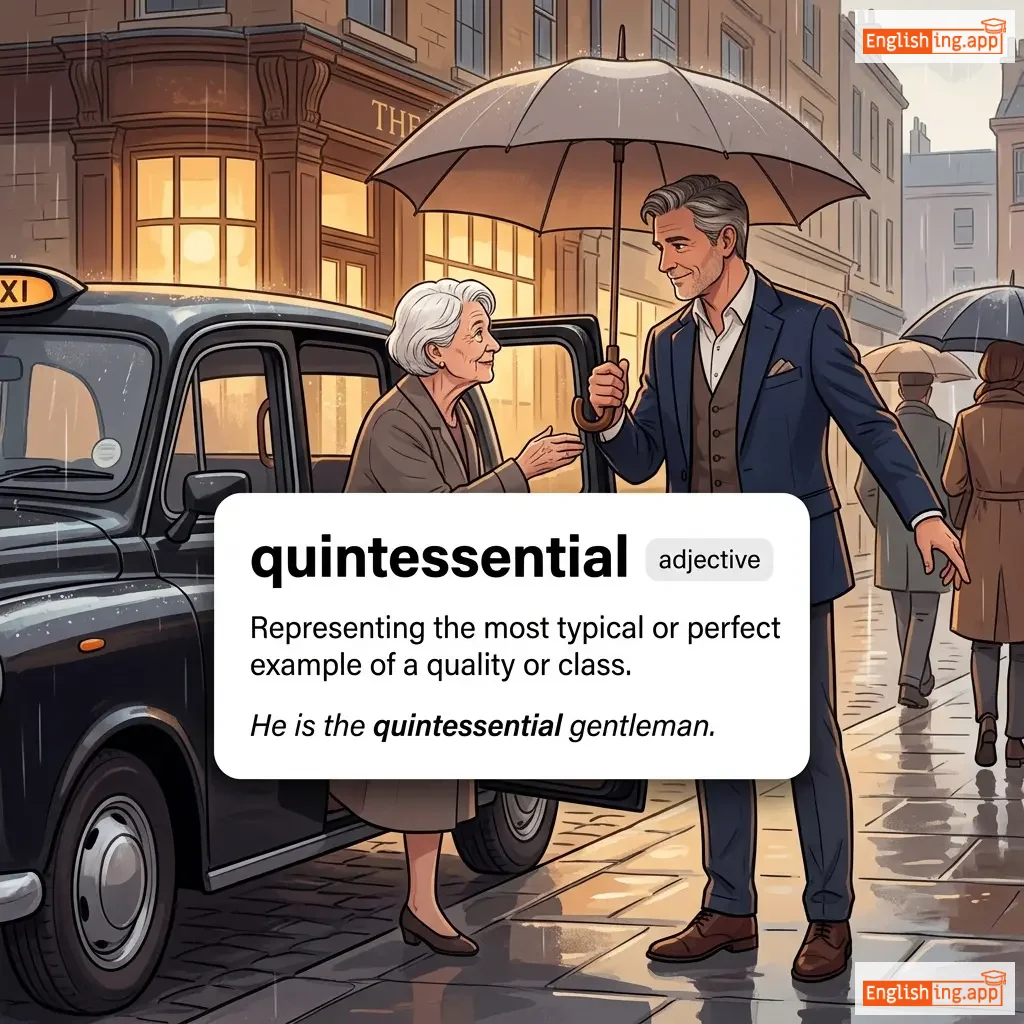
"她是优雅的精髓。" (Tā shì yōuyǎ de jīngsuǐ.)
quintessential definition card — visual illustration of the meaning
adjective
/ˌkwɪntɪˈsɛnʃəl/
典型例子 (dianxing lizi)

Representing the most typical or perfect example of a quality or class.

"He is the quintessential gentleman."

"他是典型的绅士。" (Ta shi dianxing de shenshi.)
noun
/ˈræftər/
屋梁 (wuliang)

One of the sloping beams that supports a roof.

"The old barn’s rafters were exposed."

"老谷仓的屋梁暴露在外。" (Lǎo gǔcāng de wū liáng bàolù zài wài.)
noun
/ˈreɪdɑːr/
雷达 (leida)

a system that uses radio waves to detect the position and speed of objects

"The plane was detected by the airport's radar system."

"飞机通过机场的雷达系统被发现了。" (fēijī tōngguò jīchǎng de léidá xìtǒng bèi fāxiàn le.)
noun
/ˈreɪdiəns/
光辉 (guānghuī)

the quality of shining with bright light; a glowing or beaming quality

"Her face was filled with radiance after hearing the good news."

"她在听到好消息后,脸上充满了光辉。" (Tā zài tīng dào hǎo xiāoxī hòu, liǎn shàng chōngmǎn le guānghuī.)
adjective
/ˈreɪdiənt/
光彩照人 (guāngcǎi zhàorén)

Shining brightly; expressing great happiness.

"She looked radiant in her wedding dress."

"她在婚礼上穿着婚纱,看起来非常耀眼。" (Tā zài hūnlǐ shàng chuānzhuó hūnshā, kàn qǐlái fēicháng yàoyǎn.)
verb
/ˈreɪdieɪt/
辐射 (fúshè)

to emit energy or light; to spread out from a center

"The fireplace radiates warmth throughout the room."
"壁炉向整个房间辐射热量。" (Bìlú xiàng zhěnggè fángjiān fúshè rèliàng.)
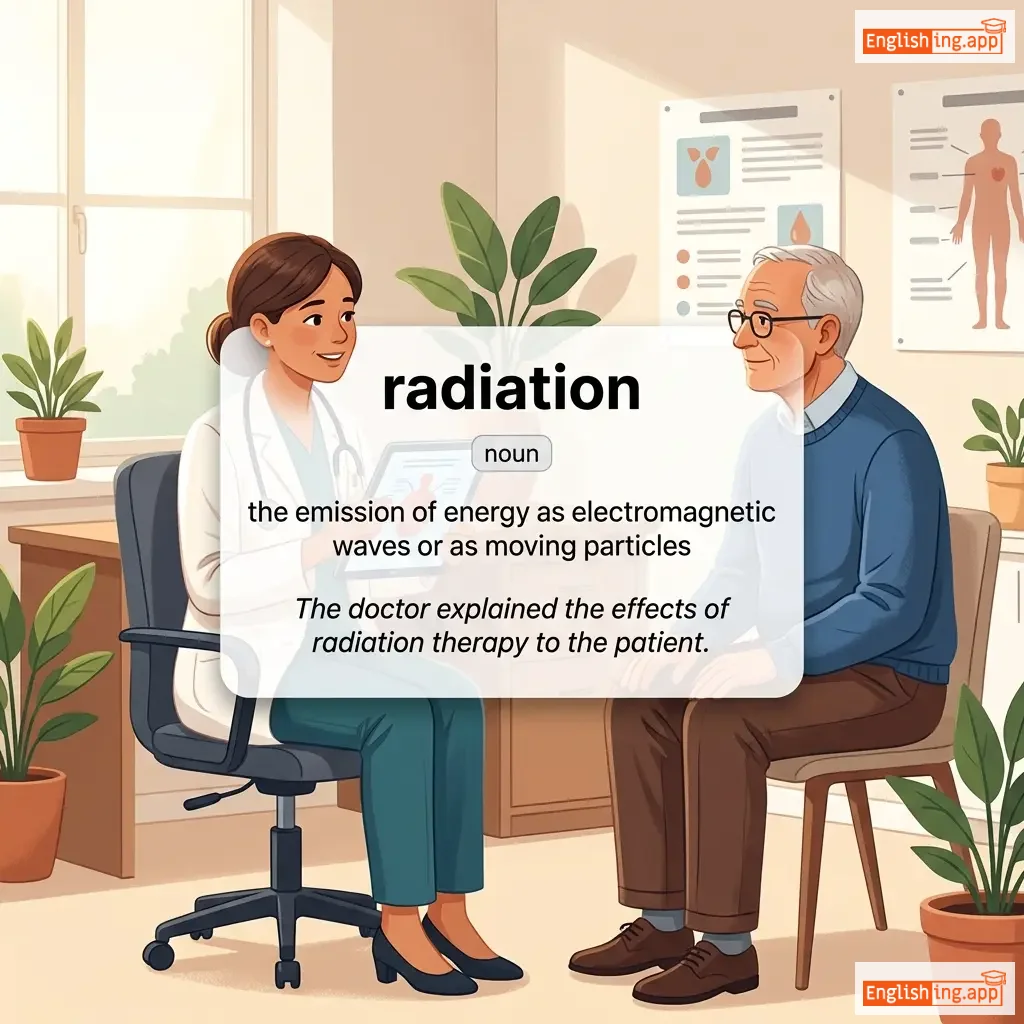
radiation definition card — visual illustration of the meaning
noun
/ˌreɪdiˈeɪʃən/
辐射 (fúshè)

the emission of energy as electromagnetic waves or as moving particles

"The doctor explained the effects of radiation therapy to the patient."
"医生向患者解释了辐射治疗的效果。" (yīshēng xiàng huànzhě jiěshìle fúshè zhìliáo de xiàoguǒ.)
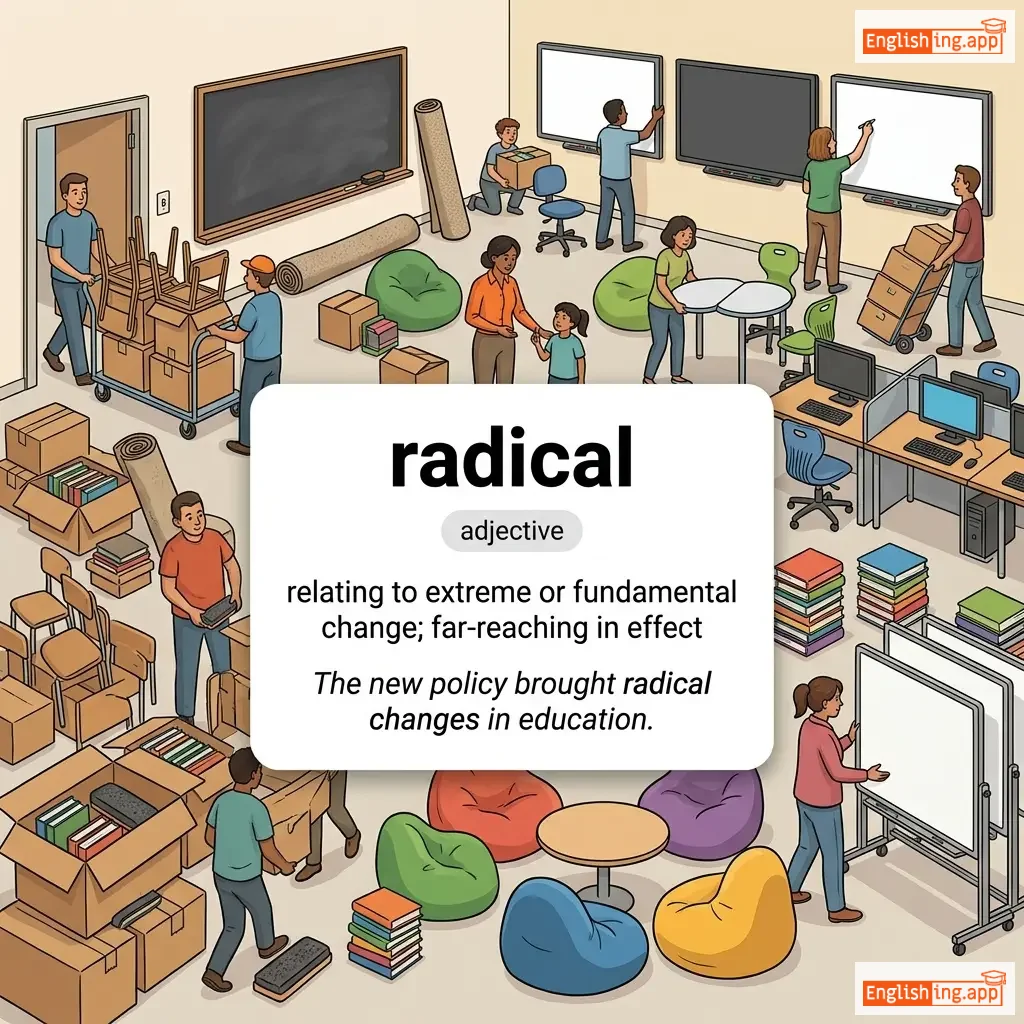
radical definition card — visual illustration of the meaning
adjective
/ˈrædɪkl/

relating to extreme or fundamental change; far-reaching in effect

"The new policy brought radical changes in education."

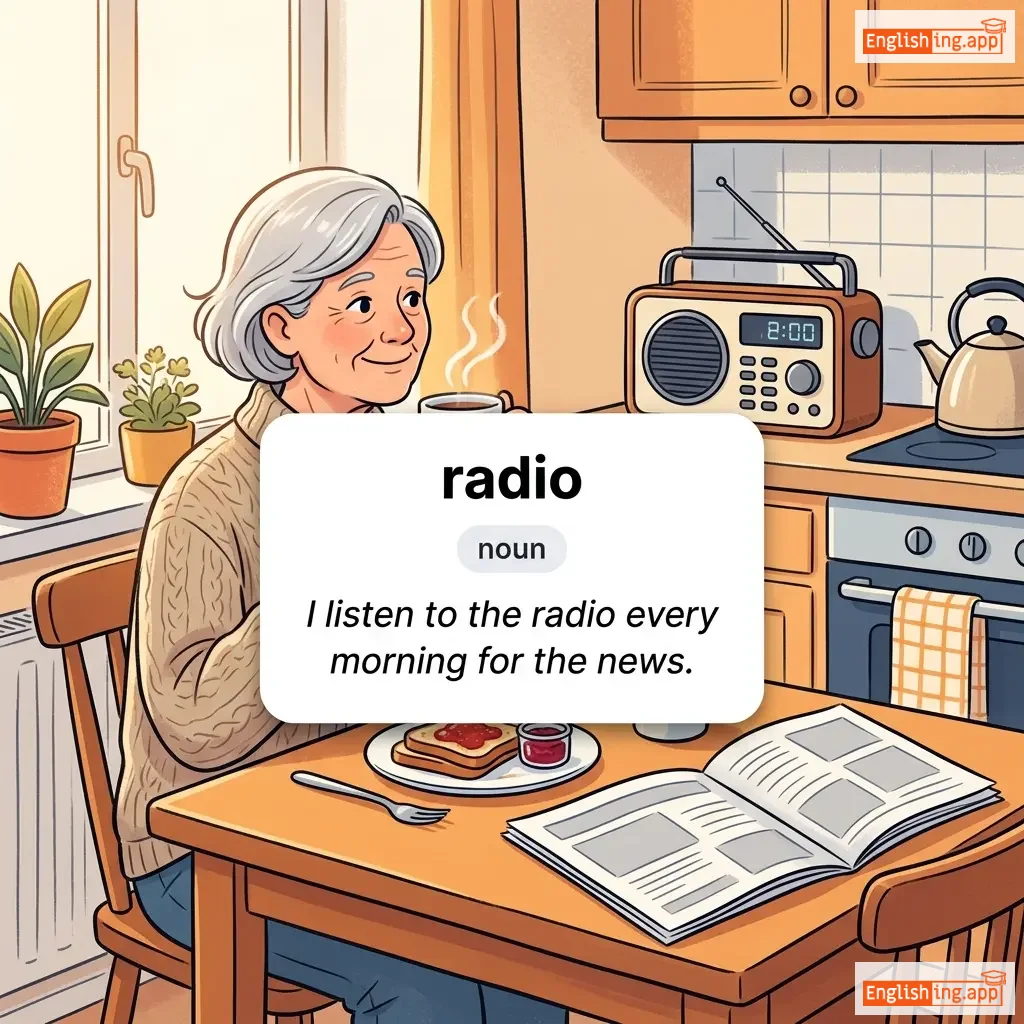
radio definition card — visual illustration of the meaning
noun
/ˈreɪdioʊ/
收音机 (shouyinji)

a device for receiving or transmitting radio signals, or the use of such signals for communication

"I listen to the radio every morning for the news."

"我每天早上听收音机获取新闻。" (Wǒ měitiān zǎoshang tīng shōuyīnjī huòqǔ xīnwén.)
radioactivity definition card — visual illustration of the meaning
noun
ˌreɪ.di.oʊ.ækˈtɪv.ə.ti
放射性 (raydeeohaktiviti)

The emission of ionizing radiation or particles caused by the spontaneous disintegration of atomic nuclei.

"Radioactivity is used in medical treatments like cancer therapy."

"放射性在包括癌症治疗在内的医疗治疗中被用于治疗。" (Fangshexing bei yong yu baokuo aizheng zhiliao zai nei de yiliao zhiliao zhong)
noun
/'ræd.ɪʃ/
小萝卜 (xiao luobo)

a small pungent edible root vegetable with white or red skin

"The farmer harvested fresh radishes from the garden."

"农民从花园里收获了新鲜的小萝卜。" (nongmin cong huayuan li shouhuo le xinxian de xiao luobo)
noun
/ˈreɪdɪks/
基数 (jīshù)

the base or root of something; the number on which a system of numeration is built

"In mathematics, the decimal system has a radix of ten."

"在数学中,十进制系统的基数是十。" (Zài shùxué zhōng, shí jìnzhì xìtǒng de jīshù shì shí.)
adjective
/ˈræfɪʃ/
不拘一格且稍微不太体面但又很有吸引力 (bù jū yī gé qiě shāo wēi bù tài tǐ miàn dàn yòu hěn yǒu xī yǐn lì)

unconventional and slightly disreputable but attractive

"He had a raffish charm that made him popular in the city."

"他有一种迷人的雷菲什魅力,使他在城市里非常受欢迎。" (Tā yǒu yī zhǒng mírén de léi fēi shí mèilì, shǐ tā zài chéngshì lǐ fēicháng shòu huānyíng.)
noun/verb
/ˈræfəl/
销售彩票 (xiāoshòu cǎipiào)

A means of raising money by selling numbered tickets, one or more of which are drawn at random for a prize; to sell something in such a lottery.

"The charity decided to raffle a bicycle to raise funds."

"慈善机构决定通过抽奖出售自行车来筹集资金。" (Císhàn jīgòu juédìng tōngguò chōujiǎng chūshòu zìxíngchē lái chóují zījīn.)
noun/verb
/ræft/
(fa)

A flat structure made of logs or planks tied together, used as a boat or floating platform; to travel or transport on such a structure.

"They built a raft to cross the river."

"他们建造了一只筏子来过河。" (Tāmen jiànzào le yī zhī fázi lái guò hé.)
noun
/ˈreɪmənt/
衣服 (yifu)

clothing, especially fine or formal wear

"The king wore royal raiment during the ceremony."

"国王在仪式上穿着皇家衣服。" (Guowang zai yishi shang chuanzhuo huangjia yifu.)
noun
/ˈreɪləri/
友好的玩笑 (yǒu hǎo de wán xiào)

good-humored teasing or joking

"Their friendship was full of light-hearted raillery."

"他们的友谊充满了轻松的玩笑。" (Tāmen de yǒuyì chōngmǎnle qīngsōng de wánxiào.)
noun
/ˈreɪlˌroʊd/
铁路 (tielu)

a track or system of tracks made of steel rails along which trains run

"The railroad connects the city to several nearby towns."

"铁路将城市与附近的几个小镇连接起来。" (Tielu jiang chengshi yu fujin de ji ge xiao zhen lianjie qilai.)
noun
/ˈreɪl.weɪ/
铁路 (tielu)

a track made of steel rails along which trains run; a system of tracks with trains, stations, and other facilities

"The railway connects major cities across the country."

"铁路连接全国主要城市。" (tielu lianjie quanguo zhuyao chengshi)
verb
/reɪl/
抗议 (kàngyì)

to complain or protest strongly about something

"He railed against the unfair decision."

"他抗议不公平的决定。" (Tā kàngyì bù gōngpíng de juédìng.)