词汇表

英语词汇词典 | 单词含义、定义和示例

noun
/ˈspiːʃiːz/
物种 (wùzhǒng)

a group of living organisms consisting of similar individuals capable of exchanging genes or interbreeding

"The panda is an endangered species."

"熊猫是濒临灭绝的物种。" (Xióngmāo shì bīnlín mièjué de wùzhǒng.)
specific definition card — visual illustration of the meaning
adjective
/spəˈsɪfɪk/
特定的 (tèdìng de)

clearly defined or identified

"She gave specific instructions for the project."

"她给出了项目的特定指示。" (Tā gěi chūle xiàngmù de tèdìng zhǐshì.)
adverb
/spəˈsɪfɪkli/
特别地 (te bie de)

in a clear and exact way

"He was specifically asked to handle the finances."

"他被特别要求处理财务。" (Ta bei tebie yaoqiu chuli caiwu.)
noun
/ˌspɛsɪfɪˈkeɪʃən/
规格 (guīgé)

a detailed description or assessment of something

"The product specification includes all the necessary details."

"产品规格包括所有必要的细节。" (Chǎnpǐn guīgé bāokuò suǒyǒu bìyào de xìjié.)
verb
/ˈspɛsɪfaɪ/
指定 (zhiding)

to state or describe something clearly and exactly

"Please specify the time and place of the meeting."

"请明确指定会议的时间和地点。" (Qing mingque zhiding huiyi de shijian he didian.)
noun
/ˈspɛsəmən/
标本 (biaoben)

an individual animal, plant, piece of a mineral, etc., used as an example of its species or type for scientific study

"The museum has a rare butterfly specimen."
"博物馆里有一只稀有的蝴蝶标本。" (Bówùguǎn lǐ yǒu yī zhī xīyǒu de húdié biāoběn.)
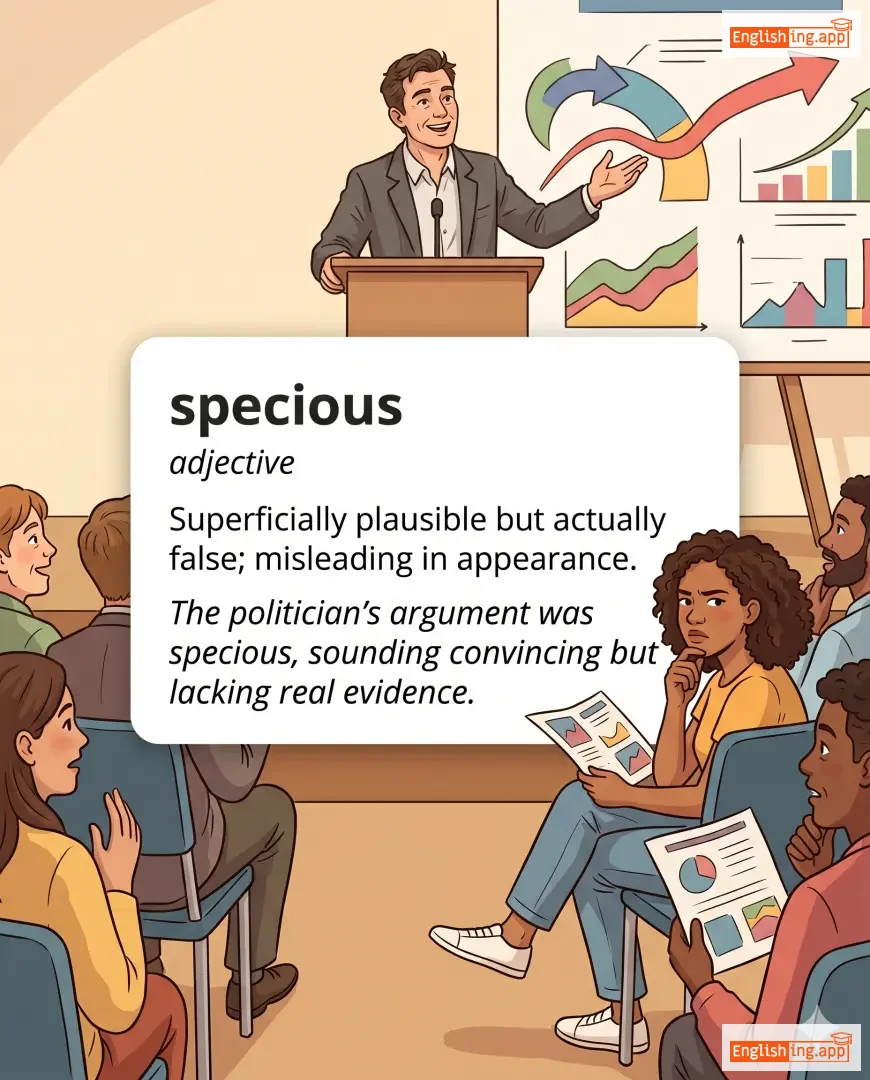
specious definition card — visual illustration of the meaning
adjective
/ˈspiːʃəs/
虚假 (xu jia)

Superficially plausible but actually false; misleading in appearance.

"The politician’s argument was specious, sounding convincing but lacking real evidence."

"那位政治家的论点是虚假的,听起来很有说服力,但缺乏真实的证据。" (Na wei zhengzhi jia de lundian shi xu jia de, ting qilai hen you shuofu li, dan quefa zhenshi de zhengju.)
noun
/spɛk/
斑点 (bandian)

A very small spot, mark, or particle.

"There was a tiny speck of dust on the glass table."
"玻璃桌上有一小片灰尘。" (Bōlí zhuō shàng yǒu yī xiǎo piàn huīchén.)
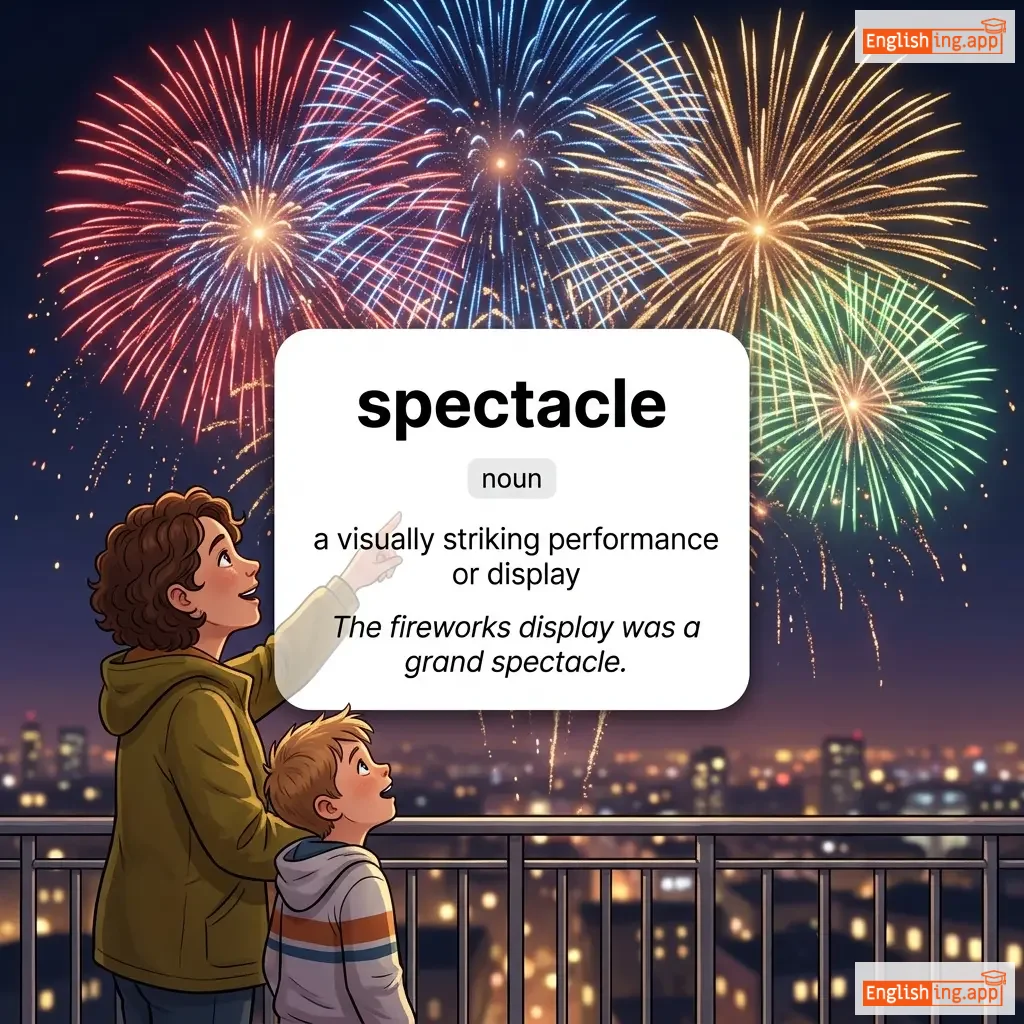
spectacle definition card — visual illustration of the meaning
noun
/ˈspɛktəkəl/
视觉盛宴 (shìjué shèngyàn)

a visually striking performance or display

"The fireworks display was a grand spectacle."
"烟花表演是一场壮观的视觉盛宴。" (Yānhuā biǎoyǎn shì yī chǎng zhuàngguān de shìjué shèngyàn.)
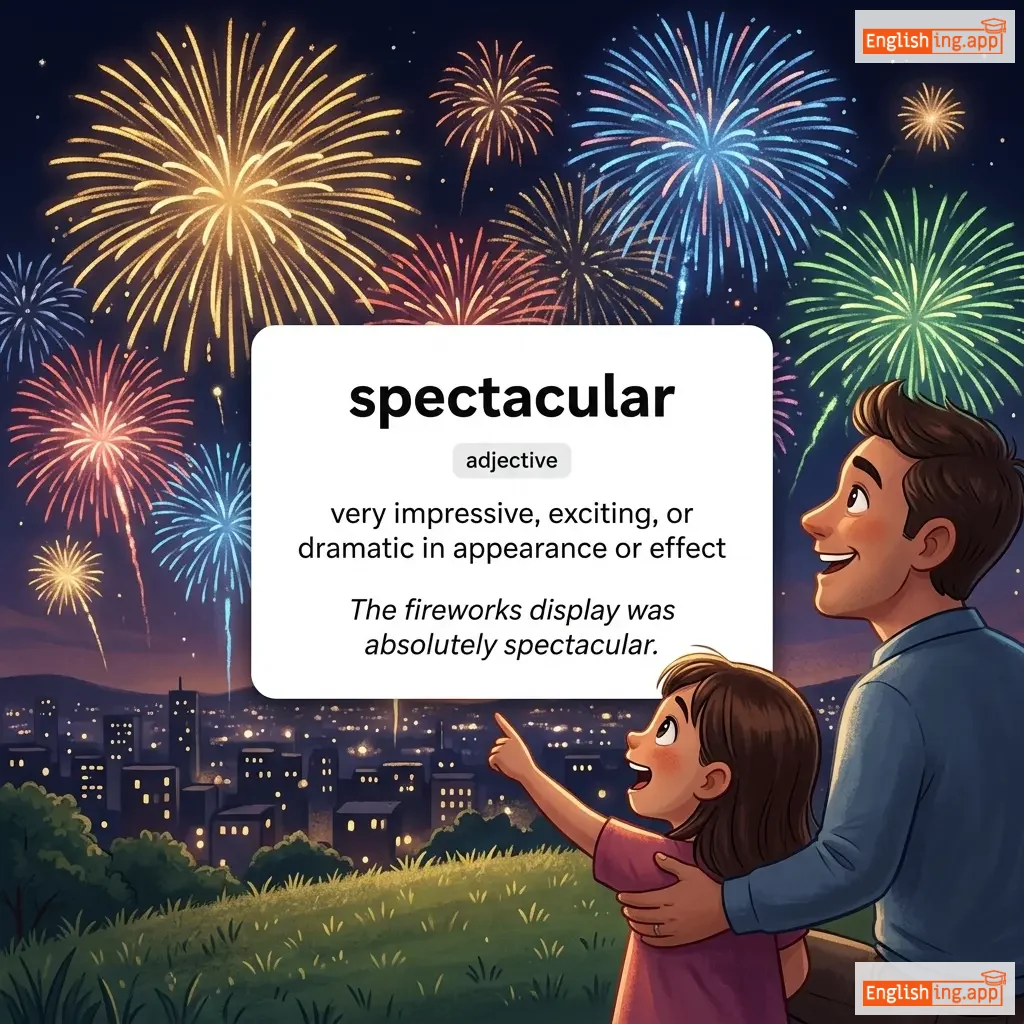
spectacular definition card — visual illustration of the meaning
adjective
/spɛkˈtækjələr/
壮观 (zhuangguan)

very impressive, exciting, or dramatic in appearance or effect

"The fireworks display was absolutely spectacular."

"烟火表演绝对壮观。" (Yanhuo biaoyan juedui zhuangguan.)
noun
/ˈspɛkteɪtər/
观众 (guānzhòng)

A person who watches an event, show, or game without taking part.

"Thousands of spectators gathered to watch the football match."

"成千上万的观众聚集在一起观看足球比赛。" (Chéng qiān shàng wàn de guānzhòng jùjí zài yīqǐ guānkàn zúqiú bǐsài.)
noun
/ˈspɛktər/
幽灵 (youling)

A ghost or spirit; something that causes fear or dread.

"The specter of war still haunts the region."

"战争的幽灵仍然在该地区徘徊。" (Zhànzhēng de yōulíng réngrán zài gāi dìqū pái huái.)
adjective
/ˈspɛktrəl/
幽灵的 (yōulíng de)

Relating to a ghost or specter; ghostly. Also relating to a spectrum.

"The old mansion had a spectral atmosphere at night."
"那座古老的宅邸晚上有一种幽灵般的氛围。" (Nà zuò gǔlǎo de zhái dǐ wǎnshàng yǒu yī zhǒng yōulíng bān de fēnwéi.)
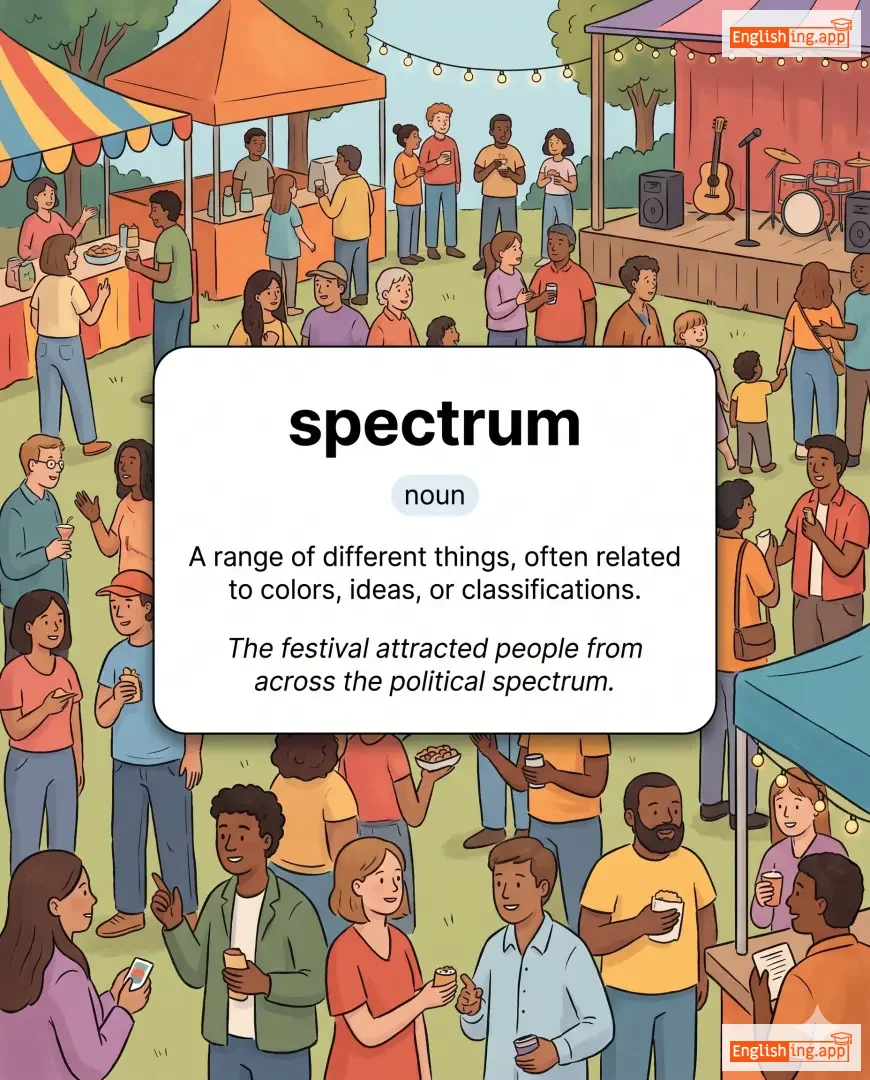
spectrum definition card — visual illustration of the meaning
noun
/ˈspɛktrəm/
光谱 (guāngpǔ)

A range of different things, often related to colors, ideas, or classifications.

"The festival attracted people from across the political spectrum."

"这个节日吸引了来自各个政治光谱的人们。" (Zhège jiérì xīyǐnle láizì gè ge zhèngzhì guāngpǔ de rénmen.)
verb
/ˈspɛkjʊˌleɪt/
投机 / 投资 (tóujī / tóuzī)

To form a theory or guess without firm evidence; to invest in stocks, property, etc. hoping for profit.

"Experts speculate that the company may expand into new markets."
"专家推测公司可能会扩展到新市场。" (zhuānjiā tuīcè gōngsī kěnéng huì kuòzhǎn dào xīn shìchǎng.)
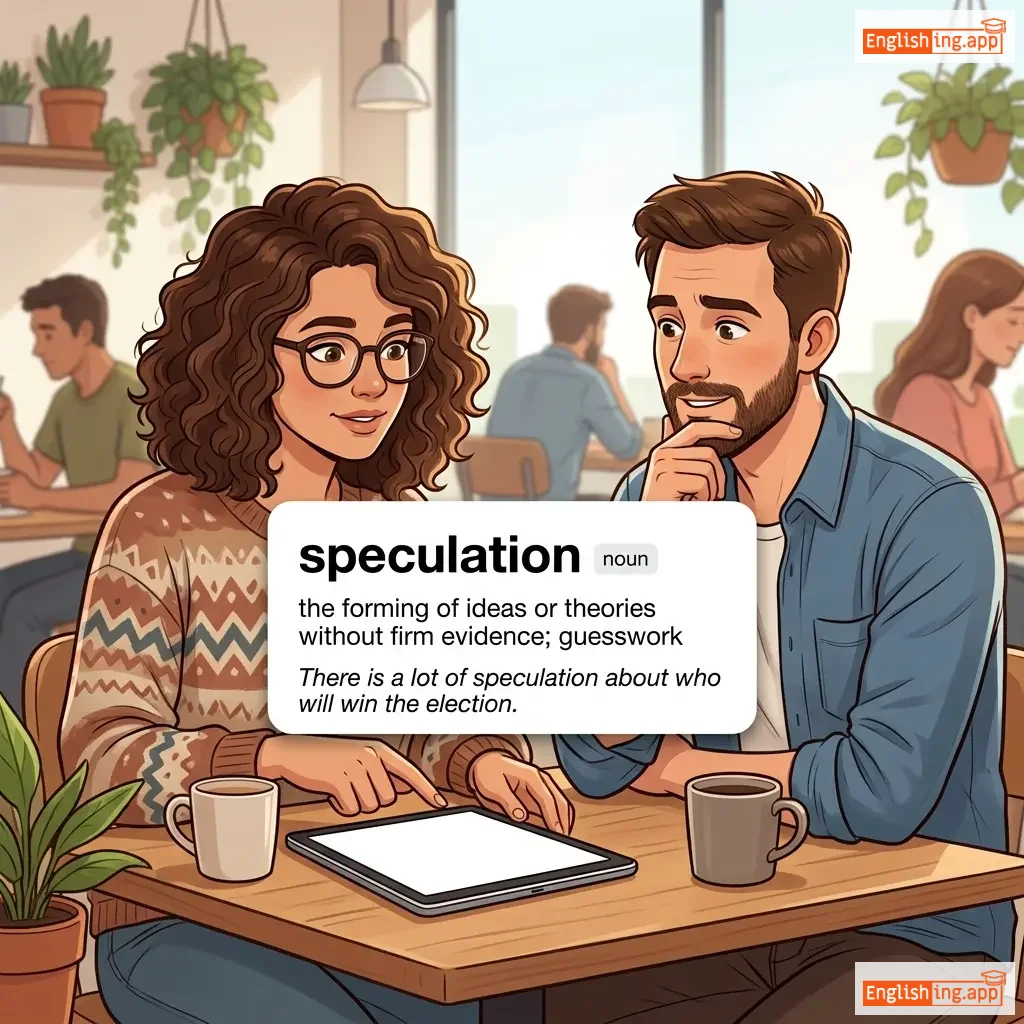
speculation definition card — visual illustration of the meaning
noun
/ˌspɛkjʊˈleɪʃən/
猜测 (caice)

the forming of ideas or theories without firm evidence; guesswork

"There is a lot of speculation about who will win the election."

"关于谁将赢得选举,存在很多猜测。" (Guanyu shei jiang yingde xuanju, cunzai henduo caice.)
noun
/ˈspɛkjʊˌleɪtər/
投机者 (tóujī zhě)

A person who forms theories without evidence, or invests in assets hoping for profit.

"The real estate speculator bought land hoping its value would rise."

"房地产投机者购买了土地,希望其价值会增加。" (Fángdìchǎn tóujī zhě gòumǎi le tǔdì, xīwàng qí jiàzhí huì zēngjiā.)
Speech definition card — visual illustration of the meaning
noun
/spiːʧ/
演讲 (yanjiang)

the expression of thoughts and feelings through spoken words

"The president delivered a speech on national unity."

"总统发表了关于国家统一的演讲。" (Zongtong fabiao le guanyu guojia tongyi de yanjiang.)
adjective
/ˈspiːtʃləs/
无言 (wú yán)

Unable to speak because of shock, surprise, or strong emotion.

"She was speechless when she received the award."

"她获得奖项时无言以对。" (Tā huòdé jiǎngxiàng shí wúyán yǐ duì.)
adjective
/ˈspiː.di/
快速的; 极速的; 敏捷的; (kuài sù de, jí sù de, mǐn jié de)

moving or happening quickly; fast

"The speedy delivery service arrived within an hour."

"快速的送货服务在一小时内到达。" (Kuai su de song huo fu wu zai yi xiao shi nei dao da.)
noun/verb
/spiːd/
速度 (sudu)

the rate at which something moves or happens

"The car was moving at high speed."

"这辆车以高速行驶。" (Zhè liàng chē yǐ gāosù xíngshǐ.)
noun
/ˈspɔɪlˌspɔːrt/
扫兴的人 (sǎo xìng de rén)

A person who ruins other people's enjoyment or fun.

"Don't be a spoilsport and let us enjoy the party."

"不要做扫兴的人,放我们享受派对吧。" (Bù yào zuò sǎo xìng de rén, fàng wǒmen xiǎngshòu pàiduì ba.)
verb
/spɔɪl/
破坏 (pòhuài)

to damage or ruin something

"The rain spoiled the outdoor event."

"雨水破坏了户外活动。" (Yǔshuǐ pòhuài le hùwài huódòng.)
verb
/splɪt/
分割 (fēngē)

to divide or separate into parts or groups

"He split the log in two with an axe."

"他用斧子把木头劈成两半。" (Tā yòng fǔzi bǎ mùtou pī chéng liǎng bàn.)
/splɪnt/
夹板 (jiaban)

A rigid device used to support and immobilize a broken or injured body part.

"The doctor applied a splint to stabilize the patient's broken arm."

"医生为病人的断臂稳定应用了夹板。" (Yisheng wei bingren de duanbi wending yingyong le jiaban.)
verb
/splaɪs/
拼接 (pīnjiē)

to join two pieces of rope, film, or other material by weaving or attaching them together

"The technician spliced the two wires to restore the connection."

"技术员将两根电线拼接起来以恢复连接。" (Jìshùyuán jiāng liǎng gēn diànxiàn pīnjiē qǐlái yǐ huīfù liánjiē.)
adjective
/splɪˈnɛtɪk/
脾气暴躁的,易怒的 (píqì bàozào de, yì nù de)

bad-tempered, irritable, spiteful

"His splenetic remarks offended everyone in the room."

"他的脾气暴躁的评论冒犯了房间里的每个人。" (Tā de píqì bàozào de pínglùn màofànle fángjiān lǐ de měi gè rén.)
adjective
/ˈsplendɪd/
壮丽的; 极好的; 印象深刻的 (zhuangli de; jihao de; yinxiang shenkede)

magnificent; excellent; very impressive

"The castle looked splendid in the sunset."

"城堡在日落时看起来很壮丽。" (Chengbao zai riluo shi kan qilai hen zhuangli.)
noun
/spliːn/
脾脏; 愤怒 (pízàng; fènnù)

an organ in the body that produces lymphocytes and filters blood; also refers to bad temper or spite

"He vented his spleen on his coworkers after the meeting."

"会议后,他把愤怒发泄在同事身上。" (Huìyì hòu, tā bǎ fènnù fāxiè zài tóngshì shēnshàng.)
noun
/spaɪt/
恶意 (èyì)

a desire to hurt, annoy, or offend someone

"She refused the gift out of spite."

"她因为恶意拒绝了礼物。" (Tā yīnwèi èyì jùjué le lǐwù.)
verb
/spɪt/
吐口水 (tǔ kǒushuǐ)

to force liquid, especially saliva, out of the mouth

"He spat on the ground in anger."

"他因愤怒在地上吐口水。" (Tā yīn fènnù zài dìshàng tǔ kǒushuǐ.)
Spiritual definition card — visual illustration of the meaning
adjective
/ˈspɪrɪtʃuəl/
精神的 (jingshen de)

relating to or affecting the human spirit or soul

"She practices spiritual meditation every morning."

"她每天早上练习精神冥想。" (Ta mei tian zaoshang lianxi jingshen mingxiang.)
noun
/ˈspɪrɪt/
精神 (jingshen)

the non-physical part of a person, regarded as their true self

"Her spirit remained unbroken despite the hardships."

"她的精神在困难面前始终没有被击垮。" (Ta de jingshen zai kunnan mianqian shizhong meiyou bei ji kua.)
noun
/ˈspaɪər/
尖顶 (jiāndǐng)

a tall, pointed structure on top of a building, especially a church

"The church spire could be seen from miles away."

"教堂的尖顶从远处可见。" (Jiàotáng de jiāndǐng cóng yuǎnchù kě jiàn.)
adjective
/ˈspaɪ.rəl/
螺旋 (luoxuan)

winding in a continuous curve; helical

"The spiral staircase led to the top floor."

"螺旋楼梯通向了最上面的一层。" (Luóxuán lóutī tōngxiàngle zuì shàngmiàn de yī céng.)
adjective
/ˈspaɪni/
多刺的 (duō cì de)

covered with or full of spines; having sharp points

"The spiny cactus stood tall in the desert."

"多刺的仙人掌在沙漠中挺立。" (Duō cì de xiānrénzhǎng zài shāmò zhōng tǐnglì.)
noun
/ˈspɪnstər/
未婚女性 (wei hun nv xing)

An unmarried woman, often one who is older and considered unlikely to marry

"The novel featured a kind-hearted spinster who cared for the village children."

"小说中有一位心地善良的未婚女性,她照顾着村里的孩子们。" (Xiaoshuo zhong you yi wei xindi shanliang de wei hun nv xing, ta zhaogu zhe cun li de haizimen.)
adjective
/ˈspaɪnəs/
多刺的 (duō cì de)

Having spines or thorn-like projections

"The spinous cactus was difficult to handle without gloves."

"这个有刺的仙人掌没有手套很难拿。" (Zhège yǒu cì de xiānrénzhǎng méiyǒu shǒutào hěn nán ná.)
adjective
/ˈspaɪn.ləs/
缺乏勇气; 意志薄弱; 胆小 (spinles)

lacking courage or determination; weak-willed

"He was too spineless to stand up for his beliefs."

"他太软弱,无法为自己的信仰站出来。" (Ta tai ruanruo, wufaa wei ziji de xinyang zhan chulai.)
noun
/spaɪn/
脊柱 (jizhu)

the backbone; a series of bones extending from the skull to the lower back

"The doctor examined her spine after the accident."

"事故发生后,医生检查了她的脊柱。" (Shigu fashen hou, yisheng jiancha le ta de jizhu.)
adjective
/ˈspɪndli/
细长而脆弱 (xichang er cuizhuo)

Long, thin, and weak-looking

"The spindly tree bent under the weight of the snow."

"细长的树在雪的重量下弯曲。" (Xichang de shu zai xue de zhongliang xia wanqu.)
spend definition card — visual illustration of the meaning
verb
/spɛnd/
花费 (huafei)

to use money to buy or pay for something

"He spent all his money on books."

"他把所有的钱都花在了书上。" (Tā bǎ suǒyǒu de qián dōu huā zài le shū shàng.)
noun
/sfɛˈrɪsɪti/
球形 (qiúxíng)

The quality or state of being spherical; roundness.

"The sphericity of the ball made it roll smoothly on the ground."

"球的球形使它能够平稳地在地面上滚动。" (Qiú de qiúxíng shǐ tā nénggòu píngwěn de zài dìmiàn shàng gǔndòng.)
noun
/sfɪər/
球体 (qiútǐ)

a round, three-dimensional shape that is perfectly symmetrical around its center; an area of activity or knowledge

"The Earth is almost a perfect sphere."

"地球几乎是一个完美的球体。" (Dìqiú jīhū shì yīgè wánměi de qiútǐ.)
verb, adjective
/spɛnt/
花费的, 精疲力竭的 (huāfèi de, jīngpí lìjié de)

Past tense and past participle of 'spend'; also used as an adjective meaning exhausted or used up.

"She spent all her energy preparing for the exam."
"她为考试花费了所有的精力。" (Tā wèi kǎoshì huāfèi le suǒyǒu de jīnglì.)
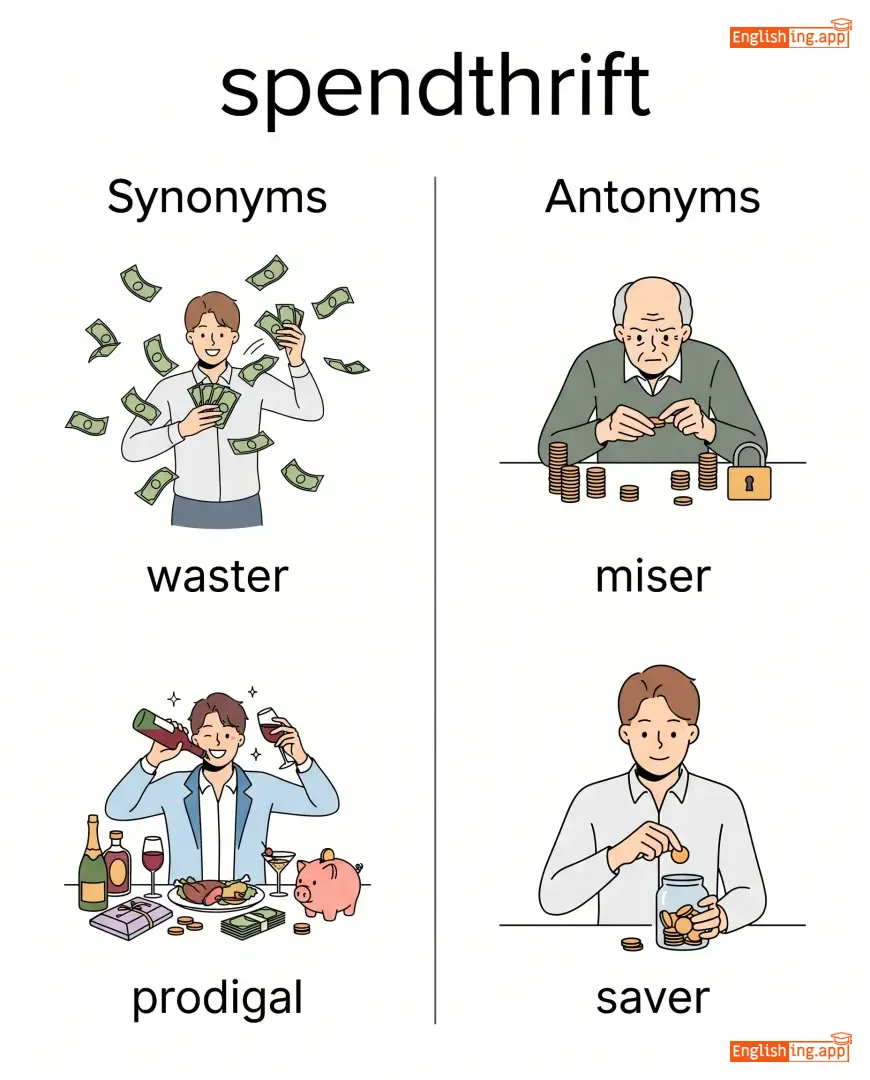
spendthrift definition card — visual illustration of the meaning
noun
/ˈspɛndˌθrɪft/
挥霍者 (huīhuò zhě)

A person who spends money extravagantly or wastefully.

"The young prince was known as a spendthrift, wasting his fortune on lavish parties."

"年轻的王子被称为挥霍者,浪费他的钱财在奢华的派对上。" (nián qīng de wáng zǐ bèi chēng wèi huī huò zhě, làng fèi tā de qián cái zài shē huá de pài duì shàng.)
noun
/ˈspɛndɪŋ/

the act of paying money for goods or services

"Her spending on clothes was higher than expected."

adjective
/ˈspel.baʊnd/
着迷的; 迷住的 (zhuó mí de, mí zhù de)

completely fascinated and unable to move or think about anything else; enchanted

"The children sat spellbound as the magician performed his tricks."

"孩子们看到魔术师表演时都目瞪口呆。" (Háizimen kàn dào móshù shī biǎoyǎn shí dōu mù dèng kǒu dāi.)
noun
/ˈspɪn.ɪtʃ/
菠菜 (bōcài)

a vegetable with large dark green leaves that are eaten cooked or uncooked

"Fresh spinach is very nutritious."

"新鲜的菠菜非常有营养。" (xīnxiān de bōcài fēicháng yǒu yíngyǎng)
verb
/spɛl/
拼写 / 咒语 (pīnxiě / zhòuyǔ)

to write or name the letters of a word in the correct order; also a short period of time or a state of enchantment

"She asked me to spell her name correctly on the form."

"她让我在表格上正确拼写她的名字。" (Tā ràng wǒ zài biǎogé shàng zhèngquè pīnxiě tā de míngzì.)