वोकैबुलरीज

इंग्लिश वोकैबुलरी डिस्कवर, लर्न और मास्टर करें

verb
/rʌʃ/
भागना (bhāgnā)

to move or act with great speed or urgency

"She had to rush to the meeting to make it on time."

"उसे समय पर मीटिंग में पहुंचने के लिए रश करना पड़ा।" (Use samay par mīṭing meṁ pahuṁchnē ke liye rash karnā paṛā.)
noun
/rʌsk/
रस्क; सूखा बिस्किट; (rask)

a hard, dry biscuit or twice-baked bread; a type of crisp, sweet biscuit

"The baby enjoyed eating the soft rusk with milk."

"बच्चे ने दूध के साथ नरम रस्क खाना पसंद किया।" (bachche ne doodh ke saath narm rask khana pasand kiya.)
adjective
/ˈrʌʃən/
रूसी (roosi)

relating to Russia, its people, or its language

"She is studying the Russian language at university."

"वह विश्वविद्यालय में रूसी भाषा पढ़ रही है।" (vah vishvavidyalay mein roosi bhasha padh rahi hai)
noun
/rʌst/
जंग; जंग लगना (jang; jang lagna)

reddish-brown coating formed on iron or steel by oxidation; corrosion

"The old car was covered in rust after years of neglect."

"पुरानी कार वर्षों की उपेक्षा के बाद जंग से ढकी हुई थी।" (purani car varsho ki upeksha ke baad jang se dhaki hui thi.)
adjective
/ˈrʌstɪk/
ग्रामीण (gramin)

Relating to the countryside; simple and unsophisticated.

"The cottage had a rustic charm with its wooden beams and stone fireplace."

"कॉटेज में लकड़ी की बीम और पत्थर की चिमनी के साथ एक ग्रामीण आकर्षण था।" (Kottage mein lakdi ki beam aur patthar ki chimni ke saath ek gramin aakarshan tha.)
verb
/ˈrʌstɪkeɪt/
गाँव जाना / विश्वविद्यालय से अस्थायी निष्कासन (gaon jana / vishwavidyalay se asthayi nishkasan)

To go to the countryside or to suspend someone from university.

"He decided to rusticate in the village to escape the busy city life."

"वह व्यस्त शहर की जिंदगी से बचने के लिए गाँव में रहने का निर्णय लिया।" (Vah vyast shahar ki zindagi se bachne ke liye gaon mein rehne ka nirnay liya.)
verb
/ˈrʌsl/
सरसराहट करना (sarsarahat karna)

To make a soft, light sound like leaves or paper moving.

"The leaves rustled gently in the evening breeze."

"पत्तियाँ शाम की हल्की हवा में धीरे-धीरे सरसराहट कर रही थीं।" (Pattiyan shaam ki halki hawa mein dheere-dheere sarsarahat kar rahi thi.)
adjective
/ˈrʌs.ti/
जंग लगा हुआ; अभ्यास से बाहर; हाल की प्रैक्टिस की कमी से प्रभावित (jang laga hua; abhyas se baahar; haal ki practice ki kami se prabhavit)

affected by rust; out of practice; impaired by lack of recent practice

"My piano skills are rusty after not playing for years."

"मेरे पियानो कौशल सालों तक नहीं खेलने के बाद जंग लग गए हैं।" (mere piano kaushal saalon tak nahi khelne ke baad jang lag gaye hain)
noun
/ruːθ/
दया (daya)

A feeling of pity, compassion, or sorrow.

"He felt no ruth for the people he had betrayed."

"उसने उन लोगों के लिए कोई दया महसूस नहीं की जिनसे उसने विश्वासघात किया था।" (Usne un logon ke liye koi daya mahsus nahi ki jinse usne vishwasghat kiya tha.)
adjective
/ˈruːθləs/
निर्दयी (nirdayi)

Having or showing no pity or compassion for others.

"The ruthless leader crushed all opposition."

"निर्दयी नेता ने सभी विरोधों को कुचल दिया।" (Nirdayi neta ne sabhi virodhon ko kuchal diya.)
ruthless competition definition card — visual illustration of the meaning
noun
ˈruθləs ˌkɑmpəˈtɪʃən
निर्मम प्रतिस्पर्धा (nirmam pratispardha)

Fierce and merciless rivalry or contest, without pity or compassion.

"Ruthless competition for power leads to societal issues."

"शक्ति के लिए निर्मम प्रतिस्पर्धा सामाजिक समस्याओं को जन्म देती है।" (Shakti ke liye nirmam pratispardha samajik samasyaon ko janm deti hai.)
noun
/səˈbætɪkəl/
अध्ययन या यात्रा के लिए अवकाश (adhyayan ya yatra ke liye avkash)

A period of paid leave granted to a teacher or worker for study or travel, traditionally every seventh year.

"She took a sabbatical to research her new book."

"उसने अपनी नई किताब पर शोध करने के लिए एक सैबेटिकल लिया।" (Usne apni nai kitaab par shodh karne ke liye ek sabbatical liya.)
verb
/ˈsæbətɑːʒ/
विनाशकारी कार्य (vinashkari kary)

To deliberately destroy, damage, or obstruct something, especially for political or military advantage.

"The rebels tried to sabotage the railway lines."

"विद्रोहियों ने रेलवे लाइनों को नष्ट करने की कोशिश की।" (Vidrohiyon ne relvey laino ko nasht karne ki koshish ki.)
noun
/ˌsæbəˈtɜːr/
विध्वंसक (vidhwanśak)

A person who engages in sabotage.

"The saboteur was arrested before he could plant the bomb."

"विध्वंसक को बम लगाने से पहले गिरफ्तार कर लिया गया था।" (Vidhwansak ko bam lagane se pehle giraftar kar liya gaya tha.)
adjective
/ˈsækərɪn/
खुशी (khushi)

Excessively sweet or sentimental.

"His saccharine smile seemed insincere."

"जब उसने पुरस्कार प्राप्त किया, तो वह अपनी खुशी को छुपा नहीं पाई।" (Jab usne puraskaar prapt kiya, to woh apni khushi ko chhupa nahi pai.)
adjective
/ˌsæsərˈdoʊtl/
पुरोहितसंबंधी (purohitsambandhi)

Relating to priests or the priesthood.

"The ritual had a distinctly sacerdotal character."

"अनुष्ठान में एक स्पष्ट पुरोहितसंबंधी चरित्र था।" (anushthan mein ek spasht purohitsambandhi charitra tha.)
noun
/sæk/
बोरी (boree)

a large bag made of strong material for holding things

"He carried a sack of rice on his shoulder."

"उसने अपने कंधे पर चावल से भरी एक बोरी उठाई।" (Usne apne kandhe par chawal se bhari ek bori uthai.)
adjective
/ˈseɪkrɪd/
पवित्र (pavitra)

connected with God or a religion and considered holy or deserving respect

"The temple is a sacred place for the community."

"द मंदिर समुदाय के लिए एक पवित्र स्थान है।" (Da mandir samudaay ke liye ek pavitra sthaan hai.)
sacrifice definition card — visual illustration of the meaning
noun, verb
/ˈsækrɪfaɪs/
बलिदान (balidan)

To give up something valuable for the sake of others or a higher purpose.

"Parents often sacrifice their own comfort for their children."

"माता-पिता अक्सर अपने बच्चों के लिए अपनी आरामदायक स्थिति की बलि देते हैं।" (maata-pitaa aksar apne bachcho ke liye apni aaraamdayak sthiti ki bali dete hain.)
adjective
/ˌsækrɪˈfɪʃəl/
बलिदानी (balidani)

Relating to or involving sacrifice.

"The lamb was used as a sacrificial offering in the ritual."

"मेमने को अनुष्ठान में एक बलिदानी चढ़ावा के रूप में उपयोग किया गया था।" (memane ko anushthan mein ek balidani chadhawa ke roop mein upyog kiya gaya tha.)
noun
/ˈsækrɪlɪdʒ/
पवित्र का उल्लंघन (pavitra ka ullanghan)

Violation or misuse of what is regarded as sacred.

"Stealing from the temple was considered an act of sacrilege."

"मंदिर से चोरी करना पवित्र का उल्लंघन माना जाता था।" (mandir se chori karna pavitra ka ullanghan maana jaata tha.)
adjective
/ˌsækrəˈlɪdʒəs/
अपवित्रतापूर्ण (apavitratapurn)

Showing disrespect or irreverence toward something sacred.

"The painting was criticized as being sacrilegious."

"चित्रकला को अपवित्रतापूर्ण के रूप में आलोचना की गई थी।" (chitrakala ko apavitratapurn ke roop mein alochna ki gayi thi.)
noun
/ˈsækrɪsti/
चर्च का कक्ष (church ka kaksh)

a room in a church where sacred vessels and vestments are kept

"The priest entered the sacristy before the mass began."

"पुजारी मास शुरू होने से पहले साक्रिस्टि में प्रवेश किया।" (Pujari mass shuru hone se pehle sakristi mein pravesh kiya.)
adjective
/ˈsæk.rəˌsæŋkt/
अलिंघनीय (alinghaniya)

Regarded as too important or valuable to be interfered with; sacred.

"Freedom of speech is considered sacrosanct in democratic societies."

"लोकतांत्रिक समाजों में अभिव्यक्ति की स्वतंत्रता को अलिंघनीय माना जाता है।" (Loktantrik samajon mein abhivyakti ki svatantrata ko alinghaniya mana jata hai.)
sad definition card — visual illustration of the meaning
adjective
/sæd/
उदास (udas)

feeling or showing sorrow; unhappy

"She felt sad after hearing the bad news."

"बुरी खबर सुनने के बाद वह उदास महसूस कर रही थी।" (Buri khabar sunne ke baad vah udas mehsoos kar rahi thi.)
noun/verb
/ˈsæd.əl/
घोड़े की पीठ पर बैठने की सीट; किसी को जिम्मेदारी देना (ghode ki peeth par baithne ki seat; kisi ko jimmedari dena)

A seat fastened on the back of a horse for riding; to burden someone with a responsibility.

"He saddled the horse before going for a ride."

"उसने घोड़े को सवारी पर जाने से पहले सैडल किया।" (Usne ghode ko sawari par jaane se pehle saddle kiya.)
adjective
/səˈdɪs.tɪk/
क्रूर (kroor)

Deriving pleasure from inflicting pain or suffering on others.

"The villain had a sadistic smile while hurting his enemies."

"विलेन का क्रूर मुस्कान था जब वह अपने दुश्मनों को पीड़ा दे रहा था।" (Vilen ka kroor muskaan tha jab wah apne dushmanon ko peeda de raha tha.)
adverb
/ˈsædli/
दुखी होकर (dukhi hokar)

in a sorrowful or unhappy manner

"She sadly waved goodbye as the train departed."

"उसने दुखी होकर विदा दी जब ट्रेन रवाना हुई।" (Usne dukhi hokar vida di jab train ravaan hui.)
noun
/ˈsæd.nəs/
दुःख, शोक, उदासी (dukh, shok, udaasi)

feeling of sorrow, unhappiness, or grief

"Her sadness was evident after hearing the bad news."

"उसके दुःख को बुरी खबर सुनने के बाद देखा गया।" (uske dukh ko buri khabar sunne ke baad dekha gaya)
adjective
/seɪf/
सुरक्षित (surakṣit)

free from harm or danger

"Make sure your belongings are safe during the trip."

"यात्रा के दौरान अपनी चीजें सुरक्षित रखें।" (Yātrā kē daurān apnī chīzēṁ surakṣit rakhēṁ.)
noun/verb
/ˈseɪf.ɡɑːrd/
सुरक्षा करना (suraksha karna)

To protect from harm or damage; a measure taken to ensure safety.

"Laws exist to safeguard the rights of children."

"कानून बच्चों के अधिकारों की सुरक्षा करने के लिए अस्तित्व में हैं।" (Kanoon bachon ke adhikar ki suraksha karne ke liye astitv mein hain.)
adverb
/ˈseɪfli/
सुरक्षित (surakshit)

in a way that is not dangerous or likely to cause harm

"The children crossed the road safely."

"बच्चों ने सड़क को सुरक्षित रूप से पार किया।" (bachchon ne sadak ko surakshit roop se paar kiya.)
noun
/ˈseɪfti/
सुरक्षा (sefti)

the condition of being protected from harm or danger

"The safety of passengers is our top priority."

"यात्रियों की सुरक्षा हमारी सबसे बड़ी प्राथमिकता है।" (yaatriyon ki suraksha hamari sabse badi prathamikta hai)
noun
/ˈsæf.rən/
केसर (kesar)

A spice derived from the flower of Crocus sativus, used for flavoring and coloring food.

"She added saffron to the rice for flavor and color."

"उसने चावल में स्वाद और रंग के लिए केसर डाला।" (Usne chawal mein swad aur rang ke liye kesar dala.)
noun
/ˈsɑːɡə/
दीर्घ कथा (dirgh katha)

A long story of heroic achievement, or a long, complex series of events.

"The company's rise and fall became a corporate saga."

"कंपनी का उत्थान और पतन एक कॉर्पोरेट सागा बन गया।" (Company ka utthan aur patan ek corporate saga ban gaya.)
adjective
/ˌsæŋktɪˈmoʊniəs/
ढोंगी धार्मिक (dhongi dharmik)

Making a show of being morally superior to others; hypocritically pious.

"He gave a sanctimonious speech about honesty while he himself was corrupt."

"उसने ईमानदारी पर एक ढोंगी भाषण दिया जबकि वह खुद भ्रष्ट था।" (Usne imandari par ek dhongi bhashan diya jabki wah khud bhrasht tha.)
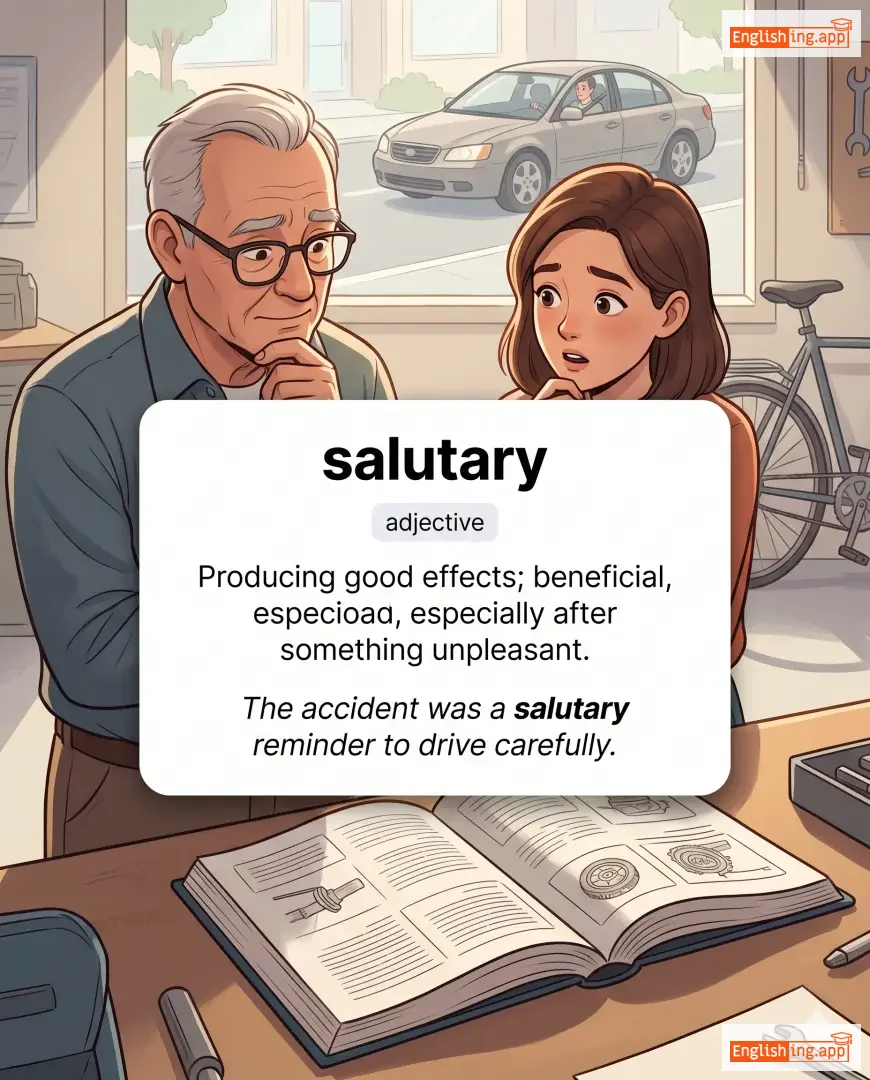
salutary definition card — visual illustration of the meaning
adjective
/ˈsæljʊˌtɛri/
कल्याणकारी (kalyankari)

Producing good effects; beneficial, especially after something unpleasant.

"The accident was a salutary reminder to drive carefully."

"दुर्घटना एक कल्याणकारी याददाश्त थी कि सावधानी से गाड़ी चलानी चाहिए।" (Durghatna ek kalyankari yaaddasht thi ki saavdhaani se gaadi chalaani chahiye.)
noun
/ˌsæljʊˈteɪʃən/
अभिवादन (abhivadan)

A gesture or utterance of greeting, goodwill, or courtesy.

"He raised his hat as a polite salutation."

"उसने एक शिष्टाचार के रूप में अपना हैट उठाया।" (Usne ek shishtachar ke roop mein apna hat uthaya.)
adjective
/səˈluːtəˌtɔri/
उद्घाटन संबोधन (udghatan sambodhan)

Relating to or expressing a greeting or an address, especially at the beginning of a speech.

"She delivered a salutatory address at the graduation ceremony."

"उसने स्नातक समारोह में एक उद्घाटन संबोधन दिया।" (Usne snatak samaroah mein ek udghatan sambodhan diya.)
salute definition card — visual illustration of the meaning
verb
/səˈluːt/
सलाम करना (salaam karna)

to greet with respect; to honor

"The soldiers saluted their commanding officer."

"सैनिकों ने अपने कमांडिंग ऑफिसर को सलाम किया।" (Sainikon ne apne commanding officer ko salaam kiya.)
verb
/ˈsælvɪdʒ/
बचाना (bachana)

To save something from loss, damage, or destruction.

"They managed to salvage some goods from the fire."

"उन्होंने आग से कुछ माल बचाने में कामयाबी पाई।" (Unhone aag se kuch maal bachane mein kaamyabi paayi.)
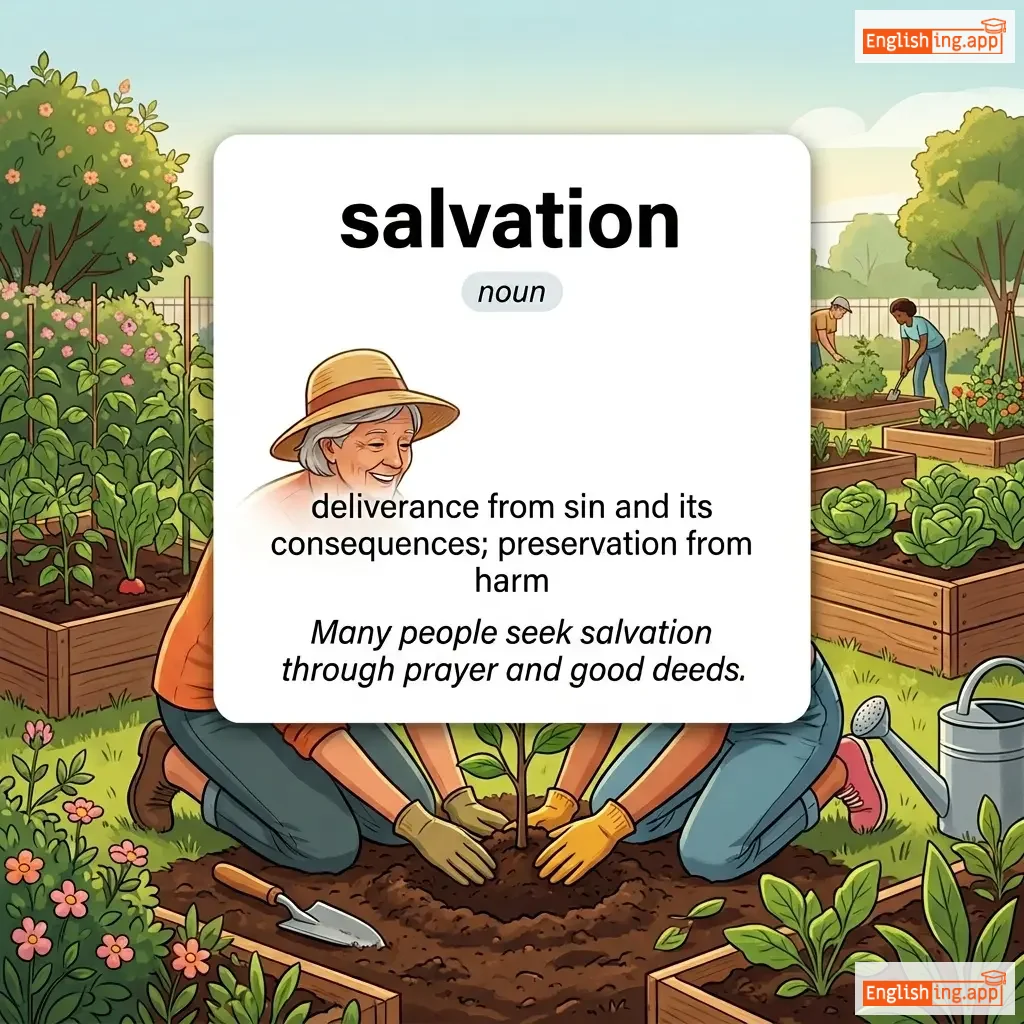
salvation definition card — visual illustration of the meaning
noun
/sælˈveɪ.ʃən/
मोक्ष (moksha)

deliverance from sin and its consequences; preservation from harm

"Many people seek salvation through prayer and good deeds."

"कई लोग प्रार्थना और अच्छे कामों के माध्यम से मोक्ष की तलाश करते हैं।" (kai log prarthna aur achhe kamon ke madhyam se moksha ki talash karte hain.)
noun
/sælv/
मलहम (malham)

An ointment used to promote healing of the skin or as protection.

"She applied a salve to the burn on her hand."

"उसने अपनी हाथ की जलन पर एक मलहम लगाया।" (Usne apni haath ki jalan par ek malham lagaya.)
noun
/ˈsælvər/
सिल्वर ट्रे (silver tre)

A tray, typically made of silver, used for serving food or drinks.

"The butler brought in the tea on a silver salver."

"बटलर चाय को सिल्वर ट्रे पर लाए।" (Butler chai ko silver tre par laaye.)
noun
/ˈsælvoʊ/
एक साथ गोलीबारी (ek saath golibaari)

A simultaneous discharge of guns or release of bombs; a sudden outburst of cheers or applause.

"The soldiers fired a salvo to honor the fallen general."

"सैनिकों ने मरे हुए जनरल को सम्मानित करने के लिए एक साथ गोलीबारी की।" (Sainikon ne mare hue general ko sammaanit karne ke liye ek saath golibaari ki.)
adjective
/seɪm/
एक जैसा (ek jaisa)

identical; not different or changed

"We wore the same dress at the party."

"हमने पार्टी में वही ड्रेस पहनी थी।" (Humne party mein wahi dress pehni thi.)
Sample definition card — visual illustration of the meaning
noun
/ˈsæm.pəl/
नमूना (namuna)

a small part or quantity intended to show what the whole is like

"She gave me a sample of the fabric to see if I liked it."

"उसने मुझे यह देखने के लिए कपड़े का एक नमूना दिया कि क्या मुझे यह पसंद आया" (Usne mujhe yah dekhne ke liye kapde ka ek namuna diya ki kya mujhe yah pasand aaya)
verb
/ˈsæŋktɪfaɪ/
पवित्र करना (pavitra karna)

To make holy or sacred; to set apart as holy.

"The priest sanctified the new church building."

"पादरी ने नए चर्च की इमारत को पवित्र किया।" (Padri ne naye church ki imarat ko pavitra kiya.)
noun
/ˌsɒ̃ˈfrwɑː/
संतुलन (santulan)

Composure or coolness under pressure.

"She impressed everyone with her sangfroid during the interview."

"साक्षात्कार के दौरान उसने अपने संतुलन से सभी को प्रभावित किया।" (saakshaatkaar ke dauraan usne apne santulan se sabhi ko prabhavit kiya.)
adjective
/ˈsæŋɡwɪˌnɛri/
रक्तरंजित (raktaranjit)

Involving or causing much bloodshed; bloodthirsty.

"The battle was one of the most sanguinary conflicts of the war."

"युद्ध सबसे रक्तरंजित संघर्षों में से एक था।" (Yudh sabse raktaranjit sangharshon mein se ek tha.)