वोकैबुलरीज

इंग्लिश वोकैबुलरी डिस्कवर, लर्न और मास्टर करें

adjective
/skɛərs/
अभाव (abhaav)

insufficient in quantity; hard to find

"Water was scarce during the long drought."

"लंबी सूखा के दौरान पानी का अभाव था।" (Lambi sukha ke dauran paani ka abhaav tha.)
adverb
/ˈskeəs.li/
मुश्किल से; शायद ही; बस थोड़ी देर में (mushkil se; shayad hi; bas thodi der mein)

hardly; barely; only just

"I could scarcely believe my eyes."

"मैं अपनी आँखों पर मुश्किल से विश्वास कर सका।" (main apni aankhon par mushkil se vishwas kar saka)
scarcity definition card — visual illustration of the meaning
noun
/ˈskɛərsəti/
कमी (kami)

a situation where something is in short supply

"The scarcity of jobs forced many people to leave the town."

"नौकरी की कमी ने कई लोगों को शहर छोड़ने पर मजबूर किया।" (Naukri ki kami ne kai logon ko shahar chhodne par majboor kiya.)
verb
/skeər/
डराना (darana)

to frighten someone or make them feel afraid

"The loud noise scared the baby."

"तेज़ आवाज़ ने बच्चे को डरा दिया।" (tez awaaz ne bachche ko dara diya.)
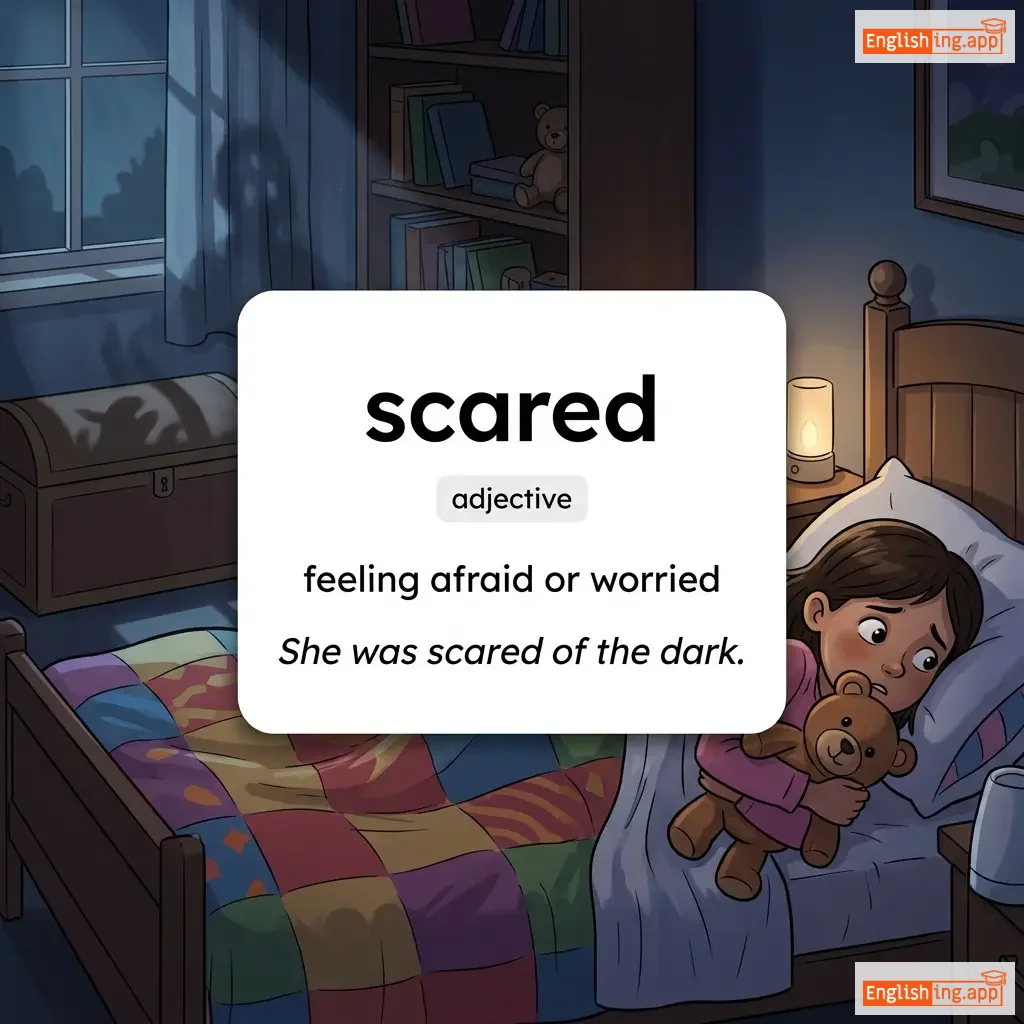
scared definition card — visual illustration of the meaning
adjective
/skɛrd/
डरा हुआ (dara hua)

feeling afraid or worried

"She was scared of the dark."

"वह अंधेरे से डरी हुई थी।" (Woh andhere se dari hui thi.)
noun
/skɑːrf/
स्कार्फ (scarf)

a length of fabric worn around the neck or head for warmth, protection, or fashion

"She wrapped a warm scarf around her neck in the cold weather."

"वह ठंडे मौसम में अपने गले में एक गर्म स्कार्फ लपेटे हुए थी।" (vah thande mausam mein apne gale mein ek garm scarf lapete hue thi)
verb
/ˈskærɪfaɪ/
मिट्टी को खोदना (mitti ko khodna)

to make shallow cuts or scratches; to loosen the surface of soil

"The farmer scarified the soil before planting seeds."

"किसान ने बीज लगाने से पहले मिट्टी को खोद डाला।" (Kisan ne beej lagane se pehle mitti ko khod dala.)
adjective
/ˈskɑː.lət/
संतरी लाल (santari laal)

a bright red color with a slightly orange tinge

"The scarlet roses in the garden looked magnificent in the morning light."

"बग़ीचे में संतरी लाल गुलाब सुबह की रोशनी में शानदार दिखे।" (bagiche mein santari laal gulab subah ki roshni mein shandaar dikhe.)
adjective
/ˈskeəri/
डरावना (daravna)

causing fear or making you feel frightened

"That horror movie was really scary."

"वह हॉरर मूवी वाकई में डरावनी थी।" (vah horror movie vaaki mein daravni thi.)
adjective
/ˈskeɪðɪŋ/
कड़ी आलोचना (kadi alochna)

severely critical; harshly scornful

"The critic wrote a scathing review of the movie."

"समालोचक ने फिल्म की कड़ी आलोचना लिखी।" (Samalochak ne film ki kadi alochna likhi.)
verb
/ˈskætər/
खुशी (khushi)

to throw or spread things over a wide area in different directions

"The farmer scattered seeds across the field."

"वह पुरस्कार मिलने पर अपनी खुशी छिपा नहीं सकी।" (vah puraskaar milne par apni khushi chhupa nahin sakee.)
adjective
/ˈskætərd/
बिखरा हुआ (bikhra hua)

Spread irregularly or widely in different directions.

"The toys were scattered all over the floor."

"खिलौने फर्श पर बिखरे हुए थे।" (khilaune farsh par bikhre hue the.)
verb
/ˈskævɪndʒ/
कचरे से सामान खोजना (kachre se samaan khojna)

to search through waste or discarded material to find useful items

"The children scavenged for food in the garbage dump."

"बच्चों ने कचरे के ढेर में खाने के लिए सामान खोजा।" (Bachchon ne kachre ke dher mein khane ke liye samaan khoja.)
noun
/ˈskævɪndʒər/
मृत प्राणी भक्षक / कचरा संग्राहक (mrit prani bhakshak / kachra sangrahak)

an animal or person that feeds on dead or discarded material

"Vultures are natural scavengers that clean up the environment."

"गिद्ध प्राकृतिक स्कैवेंजर हैं जो पर्यावरण को साफ करते हैं।" (giddh prakritik scavenger hain jo paryavaran ko saaf karte hain.)
noun
/səˈnɛərioʊ/
संभावित स्थिति (sambhavit sthiti)

a possible situation or sequence of events

"The company prepared for the worst-case scenario."

"कंपनी ने सबसे खराब स्थिति के लिए तैयारी की थी।" (Company ne sabse kharab sthiti ke liye tayari ki thi.)
noun
/siːn/
दृश्य (drishya)

a place or setting of an event or activity, or the part of a play or film

"The final scene of the movie was very emotional."

"फिल्म का अंतिम दृश्य बहुत भावुक था।" (Film ka antim drishya bahut bhavuk tha.)
noun
/ˈsiː.nər.i/
दृश्य (drishya)

the natural features of a landscape; the painted background used on a theater stage

"The mountain scenery was breathtakingly beautiful."

"पहाड़ों का दृश्य अत्यधिक सुंदर था।" (pahāṛoṅ kā drishya atyadhik sundar thā.)
noun
/sɛnt/
सुगंध (sugandh)

a distinctive smell, especially a pleasant one

"The scent of roses filled the garden."

"गुलाब की खुशबू ने बगीचे को भर दिया।" (Gulab ki khushboo ne bagiche ko bhar diya.)
adjective
/ˈskeptɪkəl/
संशयात्मक; अविश्वासी; सत्य पर प्रश्न उठाने वाला (sanshayatmak; avishwasi; satya par prashn uthane wala)

having doubts; not easily convinced; questioning the truth of something

"Many scientists remain sceptical about the new theory."

"कई वैज्ञानिक नए सिद्धांत के बारे में संदेहास्पद बने रहते हैं।" (kai vaigyanik naye siddhant ke baare mein sandeyhaspad bane rehte hain)
noun
/ˈʃɑːdənfrɔɪdə/
परस्तिथि से खुशी (paristhiti se khushi)

pleasure derived from another person's misfortune

"He felt a sense of schadenfreude when his rival failed."

"उसने अपने प्रतिद्वंदी की असफलता में शैडेनफ्रॉयडे महसूस किया।" (Usne apne pratidwandi ki asafalta mein schadenfreude mehsoos kiya.)
noun
/ˈskɛdʒʊl/
अनुसूची (anusuchi)

a plan for carrying out a process or task, showing the time and sequence of actions

"I have a busy schedule for today."

"आज मेरे पास आज के लिए एक व्यस्त अनुसूची है।" (Aaj mere paas aaj ke liye ek vyast anusuchi hai.)
Schematic definition card — visual illustration of the meaning
noun, adjective
/skiːˈmætɪk/
रूपरेखा (rooprekha)

a simplified or symbolic representation of a system or plan

"The engineer showed a schematic of the electrical circuit."

"इंजीनियर ने विद्युत सर्किट की रूपरेखा दिखाई।" (Engineer ne vidyut circuit ki rooprekha dikhai.)
scheme definition card — visual illustration of the meaning
noun, verb
/skiːm/
योजना / साजिश (yojana / saajish)

a plan or arrangement, especially one that is secret or dishonest

"They devised a scheme to cheat investors."

"वे निवेशकों को धोखा देने के लिए एक योजना तैयार कर रहे थे।" (ve niveshako ko dhokha dene ke liye ek yojana tayar kar rahe the.)
noun
/ˈskɪz.əm/ or /ˈsɪz.əm/
सुख (sukh)

A division or split between strongly opposed parties, often in religion or organizations.

"The schism in the church led to the formation of two separate groups."

"वह पुरस्कार प्राप्त करने पर अपनी खुशी को छिपा नहीं सकी।" (Wah puraskaar praapt karne par apni khushi ko chhupa nahin saki.)
noun
/ˈskɒlər/
विद्वान (vidwan)

a person who studies a particular subject or academic field

"The scholar presented a research paper on ancient civilizations."

"विद्वान ने प्राचीन सभ्यताओं पर एक शोध पत्र प्रस्तुत किया।" (Vidwan ne prachin sabhyataon par ek shodh patra prastut kiya.)
scholarly definition card — visual illustration of the meaning
adjective
/ˈskɒl.ə.li/
शैक्षणिक (shaikshanik)

Having or showing knowledge, learning, or devotion to academic study.

"She wrote a scholarly article on medieval literature."

"उसने मध्यकालीन साहित्य पर एक शैक्षणिक लेख लिखा।" (Usne madhyakalīn sāhitye par ek shaikshanik lekh likha.)
scholarship definition card — visual illustration of the meaning
noun
/ˈskɒlərʃɪp/
स्कॉलरशिप (scholarship)

an award or grant to support a student's education

"She received a scholarship to study abroad."

"उसने विदेश में पढ़ाई करने के लिए एक स्कॉलरशिप प्राप्त की।" (Usne videsh mein padhai karne ke liye ek scholarship prapt ki.)
adjective
/skəˈlæstɪk/
शैक्षिक (shaikshik)

Relating to schools, education, or academic learning.

"The school organizes scholastic competitions every year."

"स्कूल हर साल शैक्षिक प्रतियोगिताएँ आयोजित करता है।" (School har saal shaikshik pratiyogitaayein aayojit karta hai.)
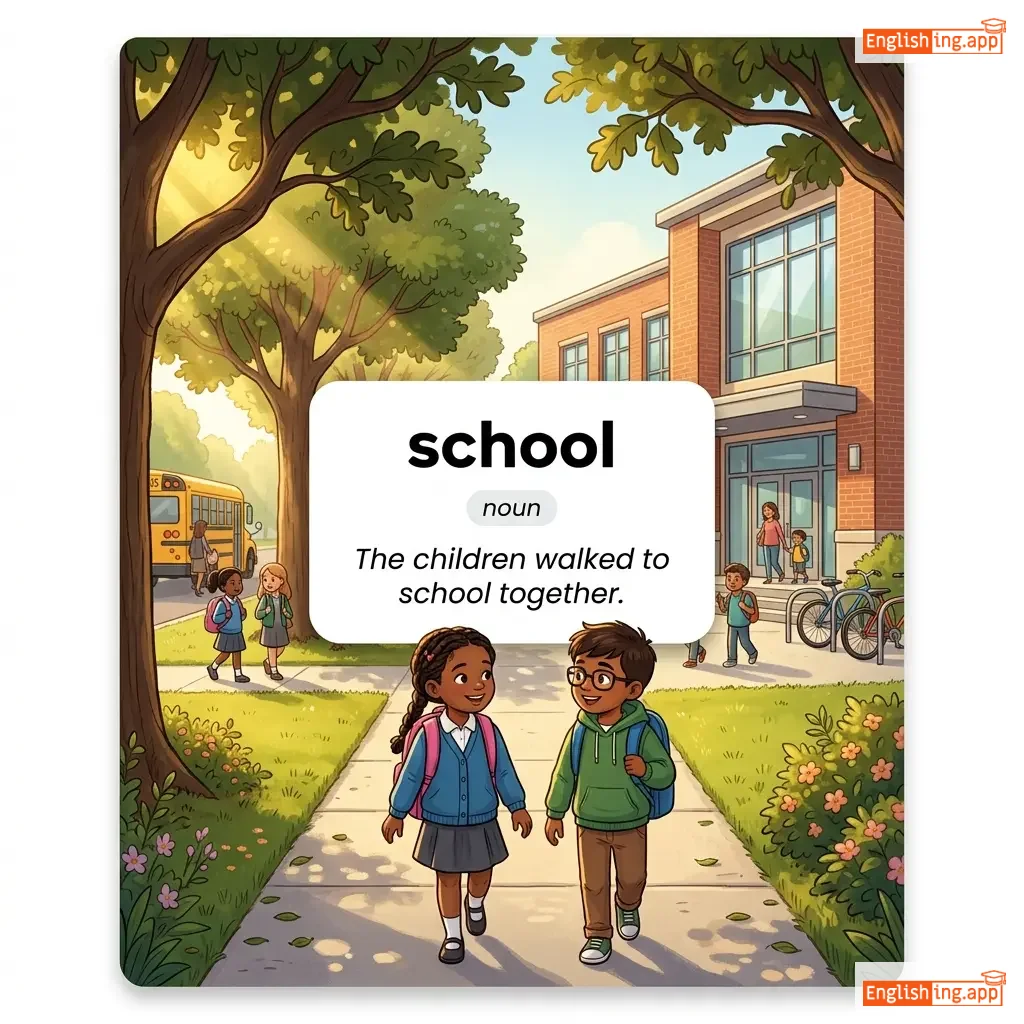
school definition card — visual illustration of the meaning
noun
/skuːl/
विद्यालय (vidyalay)

An institution for educating children; also a group of people sharing the same ideas or discipline.

"The children walked to school together."

"बच्चे साथ में स्कूल चलकर गए।" (bachche saath mein school chal kar gaye.)
science definition card — visual illustration of the meaning
noun
/ˈsaɪəns/
विज्ञान (vigyan)

the systematic study of the structure and behavior of the physical and natural world

"Science has made incredible advancements in medicine."

"विज्ञान ने चिकित्सा में अविश्वसनीय प्रगति की है।" (Vigyan ne chikitsa mein avishwasniya pragati ki hai.)
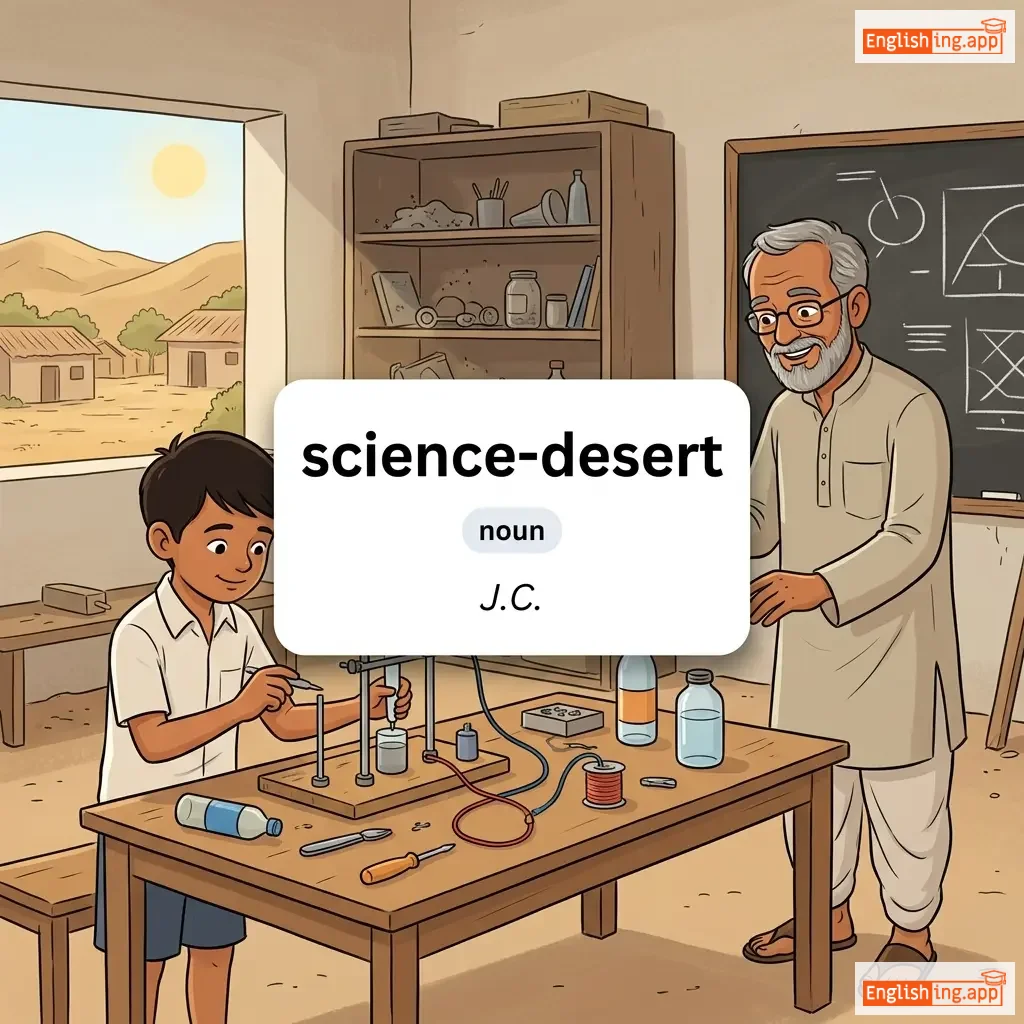
science-desert definition card — visual illustration of the meaning
noun
ˈsaɪəns ˈdezət
विज्ञान-रेगिस्तान (vigyan-registan)

A region or area lacking in scientific development, research facilities, or educational institutions.

"J.C. Bose thrived in a science-desert."

"जे. सी. बोस एक विज्ञान-रेगिस्तान में पनपे थे।" (J. C. Bos ek vigyan-registan mein panpe the.)
scientific definition card — visual illustration of the meaning
adjective
/ˌsaɪənˈtɪfɪk/
वैज्ञानिक (vaigyanik)

relating to or based on science

"The scientific community is working to find a cure for cancer."

"वैज्ञानिक समुदाय कैंसर के इलाज के लिए काम कर रहा है।" (Vaigyanik samudaay cancer ke ilaaj ke liye kaam kar raha hai.)
scientist definition card — visual illustration of the meaning
noun
/ˈsaɪəntɪst/
वैज्ञानिक (vaigyanik)

a person who conducts scientific research or experiments

"The scientist made a groundbreaking discovery in physics."

"वैज्ञानिक ने भौतिकी में एक क्रांतिकारी खोज की।" (Vaigyanik ne bhoutiki mein ek krantikari khoj ki.)
noun
/sɪnˈtɪl.ə/
थोड़ी सी झलक (thodi si jhalak)

A tiny trace or spark of a specified quality or feeling.

"There wasn’t a scintilla of doubt in her mind."

"उसके मन में कोई संदेह की एक छोटी सी झलक भी नहीं थी।" (Uske man mein koi sandeh ki ek chhoti si jhalak bhi nahi thi.)
verb
/ˈsɪn.tɪ.leɪt/
चमकना (chamakna)

to sparkle or shine brightly; to emit flashes of light

"The diamond ring scintillated under the bright lights."

"हीरा अंगूठी तेज़ रोशनी में चमक रही थी।" (Hīrā aṅgūṭhī tez rośnī meṁ chamak rahī thī.)
adjective
/ˈsɪn.tɪ.leɪ.tɪŋ/
चमकदार (chamakdaar)

brilliantly clever, exciting, or sparkling

"Her scintillating conversation kept everyone entertained."

"उसकी चमकदार बातचीत ने सभी को मनोरंजन किया।" (Uski chamakdaar baatcheet ne sabhi ko manoranjan kiya.)
noun
/ˈsaɪ.ə.lɪz.əm/
आधिकारिक ज्ञान का दिखावा (aadhikarik gyaan ka dikhawa)

pretentious show of superficial knowledge

"His speech was full of sciolism, impressing no one."

"उसकी स्पीच पूरी तरह से आधिकारिक ज्ञान के दिखावे से भरी हुई थी, जिसने किसी को प्रभावित नहीं किया।" (Uski speech poori tarah se aadhikarik gyaan ke dikhave se bhari hui thi, jisne kisi ko prabhavit nahi kiya.)
self-control definition card — visual illustration of the meaning
noun
ˌsɛlf.kənˈtrəʊl
आत्म-नियंत्रण (aatm-niyantran)

The ability to control one's emotions, behavior, and desires in order to obtain some reward, or avoid some punishment, typically in the longer term.

"Self-control is important for maintaining a balanced life."

"आत्म-नियंत्रण एक संतुलित जीवन बनाए रखने के लिए महत्वपूर्ण है।" (Aatm-niyantran ek santulit jeevan banaye rakhne ke liye mahatvapurn hai.)
self-reliance definition card — visual illustration of the meaning
noun
sɛlf rɪˈlaɪ.əns
स्वावलंबन (swavalamban)

Reliance on one's own powers and resources rather than those of others; independence.

"Self-reliance helps build confidence."

"स्वावलंबन आत्मविश्वास बनाने में मदद करता है।" (Swavalamban atmvishwas banane mein madad karta hai.)
self-possession definition card — visual illustration of the meaning
noun
ˈsɛlf pəˈzɪʃən
आत्म-नियंत्रण (aatm-niyantran)

The quality of being calm and confident and in control of one's emotions; composure.

"His self-possession during the crisis was remarkable."

"उसकी आत्म-नियंत्रण संकट के दौरान सराहनीय थी।" (Uski aatm-niyantran sankat ke dauran sarahniya thi.)
noun
/ˌsɛlf ɪnˈdʌldʒəns/
स्वयं-संतोष (svayam-santosh)

The act of allowing oneself to enjoy pleasures or desires excessively.

"His weekend of self-indulgence included eating sweets and watching movies nonstop."

"उसके आत्म-संतोष के सप्ताहांत में मिठाई खाना और फिल्में देखना शामिल था।" (Uske atma-santosh ke saptahant mein mithai khana aur filmein dekhna shamil tha.)
noun
/ˌsɛlf ɪˈstiːm/
आत्म-सम्मान (aatm-sammaan)

confidence in one's own worth or abilities; self-respect

"Building self-esteem takes time and consistent effort."

"आत्म-सम्मान बनाने में समय और निरंतर प्रयास की आवश्यकता होती है।" (Aatm-sammaan banane mein samay aur nirantar prayaas ki avashyakta hoti hai.)
adjective
/ˌsɛlf ɪˈfeɪsɪŋ/
नम्र (namra)

not drawing attention to oneself; modest

"Despite his success, he remained self-effacing and humble."

"उसकी सफलता के बावजूद, वह सेल्फ-इफेसिंग और विनम्र रहे।" (Uski safalta ke bawajood, vah self-effacing aur vinamra rahe.)
self-discipline definition card — visual illustration of the meaning
noun
/ˈsɛlf ˈdɪsɪplɪn/
आत्म-नियंत्रण (aatm-niyantran)

The ability to control one's feelings and overcome one's weaknesses; the ability to pursue what one thinks is right despite temptations to abandon it.

"Self-discipline is essential for achieving long-term goals."

"आत्म-नियंत्रण लंबी अवधि के लक्ष्यों को प्राप्त करने के लिए आवश्यक है।" (Aatm-niyantran lambi avadhi ke lakshyon ko prapt karne ke liye aavashyak hai.)
adjective
/ˌsɛlf əbˈzɔːrbd/
स्वयं में डूबा हुआ (svayam mein dooba hua)

Excessively preoccupied with oneself and one’s own thoughts, feelings, or interests.

"He was too self-absorbed to notice his friend's distress."

"वह अपने दोस्त की चिंता को महसूस करने के लिए बहुत अधिक स्वयं में डूबा हुआ था।" (Wah apne dost ki chinta ko mehsoos karne ke liye bahut adhik svayam mein dooba hua tha.)
adjective
/sɪˈlek.tɪv/
चयनात्मक (chayanatmak)

Characterized by careful choice; choosing only the best or most suitable.

"She is very selective about the clothes she buys."

"वह जो कपड़े खरीदती है, उस पर वह बहुत चयनात्मक है।" (Wah jo kapde kharidti hai, us par wah bahut chayanatmak hai.)
noun
/sɛlf/
स्व (sw)

a person's essential being that distinguishes them from others, especially considered as the object of introspection or reflexive action

"She has a strong sense of self."

"उसका आत्मबोध मजबूत है।" (Uska atmbodh majboot hai.)
noun
/ˌself əˈbeɪs.mənt/
स्वयं को हीन बनाना (svayam ko heen banana)

The act of belittling or humiliating oneself.

"His constant self-abasement made others uncomfortable."

"उसकी निरंतर स्वयं को हीन बनाने की आदत दूसरों को असहज कर देती थी।" (Uski nirantar svayam ko heen banane ki aadat doosron ko asahaj kar deti thi.)
noun
/ˌsɛlf rɪˈspɛkt/
आत्मसम्मान (aatmsamman)

A feeling of pride and confidence in oneself; self-worth.

"She refused to compromise her self-respect by accepting unfair treatment."

"उसने अनुचित व्यवहार स्वीकार करके अपने आत्मसम्मान से समझौता करने से इनकार कर दिया।" (Usne anuchit vyavhaar sveekar karke apne aatmsamman se samjhota karne se inkaar kar diya.)
self-affirmation definition card — visual illustration of the meaning
noun
/ˌsɛlf əˌfɜːˈmeɪʃən/
स्व-स्वीकृति (swa-swikruti)

The practice of affirming one's own worthiness and value as an individual.

"Daily self-affirmation can boost your confidence."

"दैनिक स्व-स्वीकृति आपके आत्मविश्वास को बढ़ा सकती है।" (Dainik swa-swikriti aapke atma-vishwas ko badha sakti hai.)