词汇表

英语词汇词典 | 单词含义、定义和示例

adjective
/pɒnˈtɪfɪkəl/
与教皇或主教相关的;浮夸的或自命不凡的 (yu jiao huang huo zhu jiao xiang guan de; fu kua de huo zi ming bu fan de)

relating to a pope or bishop; pompous or self-important

"His pontifical manner annoyed the other members of the committee."

"他的傲慢态度让委员会的其他成员感到不悦。" (Ta de aoman taidu rang weiyuanhui de qita chengyuan gan dao buyue.)
noun
/ˈpɒntɪf/
教皇或高级主教 (jiaohuang huo gaoji zhujiao)

the pope or a high-ranking bishop in the Christian church

"The pontiff addressed the nation in a televised speech."

"教皇在电视演讲中向国家发表讲话。" (Jiaohuang zai dianshi yanjiang zhong xiang guojia fabiao jianghua.)
adjective
/ˈpɑːndərəs/
沉重而缓慢 (chénzhòng ér huǎnmàn)

slow and clumsy because of great weight; dull and labored

"The ponderous lecture made it hard for students to stay awake."

"这堂沉重而缓慢的讲座使学生们难以保持清醒。" (Zhè táng chénzhòng ér huǎnmàn de jiǎngzuò shǐ xuéshēngmen nán yǐ bǎochí qīngxǐng.)
adjective
/ˈpɒndərəbl/
可以考虑的, 可思考的 (keyi kaolü de, ke sikao de)

able to be considered or thought about

"The evidence was substantial and ponderable."

"证据是实质性的,并且是可以思考的。" (zhengju shi shizhixing de, bingqie shi keyi sikao de.)
verb
/ˈpɒndər/
深思 (shen si)

to think about something carefully

"She pondered over the meaning of the poem."

"她沉思着诗歌的含义。" (Tā chénsīzhe shīgē de hányì.)
noun
/pɒnd/
池塘 (chí táng)

a small area of still water, smaller than a lake

"The children were feeding ducks at the pond."

"孩子们在池塘里喂鸭子。" (Háizimen zài chí táng lǐ wèi yāzi.)
adjective
/ˈpɒmpəs/
傲慢的 (àomàn de)

exaggeratedly self-important; ostentatious

"The manager had a pompous attitude that annoyed his team."

"经理有一种傲慢的态度,惹恼了他的团队。" (Jīnglǐ yǒu yī zhǒng àomàn de tàidù, rěnǎo le tā de tuánduì.)
noun
/pɒmˈpɒsəti/
自大, 傲慢 (zì dà, ào màn)

self-important behavior or exaggerated dignity

"His speech was full of pomposity and arrogance."

"他的演讲充满了自大和傲慢。" (Tā de yǎnjiǎng chōngmǎnle zì dà hé ào màn.)
noun
/pɒmp/
盛大, 华丽 (shèngdà, huálì)

ceremonial display or splendor; grandeur

"The graduation ceremony was full of pomp and circumstance."

"毕业典礼充满了盛大和华丽。" (Bìyè diǎnlǐ chōngmǎnle shèngdà hé huálì.)
pomodoro definition card — visual illustration of the meaning
noun
/ˌpɒməˈdɔːrəʊ/
番茄工作法 (fānqié gōngzuò fǎ)

A time management technique that uses a timer to break down work into intervals.

"The Pomodoro technique improves productivity."

"番茄工作法提高了生产力。" (Fānqié gōngzuò fǎ tígāo le shēngchǎnlì.)
noun
/ˈpɒm.əl/
剑柄或鞍座上的圆形按钮 (jiàn bǐng huò ān zuò shàng de yuán xíng àn niǔ)

the rounded knob on the handle of a sword or saddle

"He gripped the sword firmly by the pommel."

"他紧紧地抓住剑柄的波梅尔部分。" (Tā jǐn jǐn de zhuā zhù jiàn bǐng de bō méi ěr bù fèn.)
noun
/ˈpɒmfrɪt/
鲳鱼 (chang yu)

A deep-bodied marine fish with silvery scales, popular in Asian cuisine

"The restaurant serves delicious pomfret curry with rice."

"餐厅提供美味的鲳鱼咖喱配米饭。" (can ting ti gong mei wei de chang yu ka li pei mi fan)
noun
/ˈpɒm.ɪˌɡræn.ɪt/
石榴 (pomegranate)

a round fruit with thick red skin containing many small red seeds with juice

"The pomegranate seeds were sweet and refreshing."

"石榴籽又甜又清新。" (shi liu zi you tian you qing xin)
noun
/ˈpoʊdiətrɪst/
足科医生 (zú kē yī shēng)

a doctor specializing in foot care

"I have an appointment with the podiatrist for my ankle pain."

"我约了足科医生治疗我的脚踝疼痛。" (Wǒ yuēle zú kē yīshēng zhìliáo wǒ de jiǎohuái téngtòng.)
noun
/poʊˈlær.ɪ.ti/
极性 (jixing)

the state of having two opposite or contradictory tendencies, opinions, or aspects

"The polarity between the two political parties is growing stronger."

"两个政治党派之间的极性越来越强。" (Liang ge zhengzhi dangpai zhijian de jixing yuelai yue qiang.)
noun
/ˈpoʊ.lər beər/
北极熊 (běi jí xióng)

a large white bear that lives in the Arctic regions

"The polar bear swims in the icy Arctic waters."

"北极熊在寒冷的北极水域游泳。" (Běi jí xióng zài hán lěng de běi jí shuǐ yù yóu yǒng.)
adjective
/ˈpoʊ.lər/
极地的,关于两极的 (jídì de, guānyú liǎngjí de)

relating to the North or South Pole; opposite in nature or character

"Penguins live in polar regions of the Earth."

"企鹅生活在地球的极地地区。" (qǐ'é shēnghuó zài dìqiú de jídì dìqū.)
verb
/poʊk/
(chuo)

to push something with a finger or a pointed object

"He poked the fire with a stick."

"他用棍子戳了火。" (Tā yòng gùnzi chuōle huǒ.)
adjective
/ˈpɔɪzənəs/
有毒的 (yǒu dú de)

Containing poison; capable of causing illness or death.

"Some mushrooms are highly poisonous."

"有些蘑菇非常有毒。" (Yǒuxiē mógū fēicháng yǒu dú.)
noun
/ˈpɔɪ.zən/
毒药 (du yao)

a substance that is capable of causing death or illness

"The snake's bite contains deadly poison."

"蛇的咬伤含有致命的毒药。" (she de yao shang han you zhi ming de du yao)
poise definition card — visual illustration of the meaning
noun
/pɔɪz/
优雅, 冷静, 镇定 (yōu yǎ, lěng jìng, zhèn dìng)

graceful and elegant bearing in a person; composure under stress

"She maintained her poise even under intense questioning."

"她在强烈的询问下保持了冷静。" (Tā zài qiáng liè de xún wèn xià bǎo chí le lěng jìng.)
adjective
/ˈpɔɪn.tɪd/
尖锐的; 直接且明确 (jianrui de; zhijie qie mingque)

having a sharp end; direct and unambiguous

"She made a pointed remark about his behavior."

"她对他的行为发表了直截了当的评论。" (Ta dui tade xingwei fabiale zhijie le dang de pinglun.)
Point definition card — visual illustration of the meaning
noun
/pɔɪnt/
(dian)

a particular spot, location, or position in space

"The mountain peak is the highest point in the region."

"山顶是该地区的最高点。" (Shanding shi gai diqu de zui gao dian.)
adjective
/ˈpɔɪ.njənt/
动人, 深刻 (dong ren, shen ke)

evoking a keen sense of sadness or regret; deeply touching

"The movie's ending was so poignant that many in the audience were moved to tears."

"这部电影的结尾如此动人,以至于许多观众都感动得流泪。" (Zhe bu dianying de jiewei ruci dongren, yi zhi yu xu duo guanzhong dou gandong de liulei.)
noun
/ˈpɔɪ.nən.si/
悲伤, 痛苦 (bēishāng, tòngkǔ)

the quality of evoking a keen sense of sadness or regret; emotionally touching

"The poignancy of the farewell brought tears to everyone's eyes."

"告别的悲痛让每个人的眼睛都充满了泪水。" (Gàobié de bēishāng ràng měi gè rén de yǎnjīng dōu chōngmǎn le lèishuǐ.)
noun
/ˈpoʊɪtri/
诗歌 (shige)

a literary form that uses rhythmic and metaphorical language to express emotions or ideas

"She loves reading poetry in her free time."

"她喜欢在空闲时间阅读诗歌。" (Ta xihuan zai kongxian shijian yuedu shige.)
noun
/poʊˈɛt.ɪks/
诗学,诗歌理论 (shixue, shige lilun)

the study or theory of poetry and its principles

"He wrote a book on poetics explaining the art of verse."

"他写了一本关于诗学的书,解释了诗歌的艺术。" (Ta xie le yi ben guanyu shixue de shu, jieshi le shige de yishu.)
adjective
/poʊˈɛt.ɪk/
诗意的 (shi yi de)

having qualities of poetry; expressive, beautiful, or imaginative

"Her speech had a poetic rhythm that captivated the audience."

"她的演讲有着一种诗意的节奏,吸引了听众。" (Tā de yǎnjiǎng yǒu zhe yī zhǒng shīyì de jiézòu, xīyǐnle tīngzhòng.)
noun
/ˈpoʊ.ɪˌtæs.tər/
一个劣质或琐碎的诗人 (yī gè liè zhì huò suǒ suì de shī rén)

an inferior or trivial poet

"He was mocked as a poetaster by the literary critics."

"他被文学评论家当作诗人废物嘲笑。" (Tā bèi wénxué pínglùn jiā dàngzuò shīrén fèiwù cháoxiào.)
poet definition card — visual illustration of the meaning
noun
/ˈpoʊɪt/
诗人 (shīrén)

a person who writes poems

"The poet wrote about love and nature."

"诗人写了关于爱情和自然的诗。" (Shīrén xiě le guānyú àiqíng hé zìrán de shī.)
noun
/ˈpoʊ.ə.si/
诗意 (shi yi)

poetry; the art or composition of poems

"The anthology was filled with romantic poesy."

"这本选集充满了浪漫的诗意。" (Zhe ben xuanji chongman le langman de shiyi.)
poem definition card — visual illustration of the meaning
noun
/ˈpoʊɪm/
诗歌 (shige)

a piece of writing that expresses ideas, feelings, or tells a story in a distinct form, often using rhyme or meter

"She wrote a beautiful poem for her mother."

"她为她的母亲写了一首美丽的诗歌。" (Tā wèi tā de mǔqīn xiěle yī shǒu měilì de shīgē.)
noun
/ˈpoʊdiəm/
讲台 (jiangtai)

a small platform on which a person stands to speak or conduct an orchestra

"The speaker stepped onto the podium to deliver the speech."

"演讲者走上讲台发表演讲。" (Yanjiang zhe zou shang jiangtai fabiao yanjiang.)
verb
/plʌndʒ/
迅速跳入或潜水;突然下降 (xùn sù tiào rù huò qián shuǐ; tú rán xià jiàng)

to jump or dive quickly; to fall sharply

"She plunged into the swimming pool."

"她跳进了游泳池。" (Tā tiàojìnle yóuyǒngchí.)
noun
/ˈpɒlɪɡlɒt/
多语者 (duō yǔ zhě)

a person who knows and can use several languages

"She is a polyglot, fluent in English, Spanish, and Bengali."

"她是一个多语者,精通英语、西班牙语和孟加拉语。" (Tā shì yí gè duō yǔ zhě, jīng tōng yīng yǔ, xī bān yá yǔ hé mèng jiā lā yǔ.)
noun
/ˈpluː.mɪdʒ/
羽毛 (yǔmáo)

the feathers covering a bird's body

"The peacock's plumage was vibrant and eye-catching."

"孔雀的羽毛鲜艳夺目。" (Kǒngquè de yǔmáo xiānyàn duómù.)
verb
/plʌm/
测量深度或仔细检查 (cèliàng shēndù huò zǐxì jiǎnchá)

to measure the depth of water or examine closely

"They used a line to plumb the depth of the lake."

"他们用一条线来测量湖的深度。" (Tāmen yòng yītiáo xiàn lái cèliàng hú de shēndù.)
noun
/ˈplʌm.ər/
水管工 (shuǐguǎn gōng)

a person who installs or repairs water pipes

"The plumber fixed the leaking pipe in the kitchen."

"水管工修好了厨房里漏水的管道。" (Shuǐguǎn gōng xiūhǎole chúfáng lǐ lòushuǐ de guǎndào.)
noun
/pluːm/
一根大而柔软的羽毛,或者类似羽毛的东西 (yi gen da er rou ruan de yu mao, huo zhe lei si yu mao de dong xi)

a large, soft feather or something resembling a feather

"The soldier wore a red plume on his helmet."

"士兵戴着一根红色羽毛在他的头盔上。" (Shìbīng dàizhe yī gēn hóngsè yǔmáo zài tā de tóukuī shàng.)
plummet definition card — visual illustration of the meaning
verb
/ˈplʌm.ɪt/
快速垂直下落 (kuai su chui zhi xia luo)

to fall straight down at high speed

"Stock prices plummeted after the sudden market crash."
"股票价格在突如其来的市场崩盘后急剧下跌。" (Gǔpiào jiàgé zài tūrú qí lái de shìchǎng bēngpán hòu jíjù xiàdiē.)
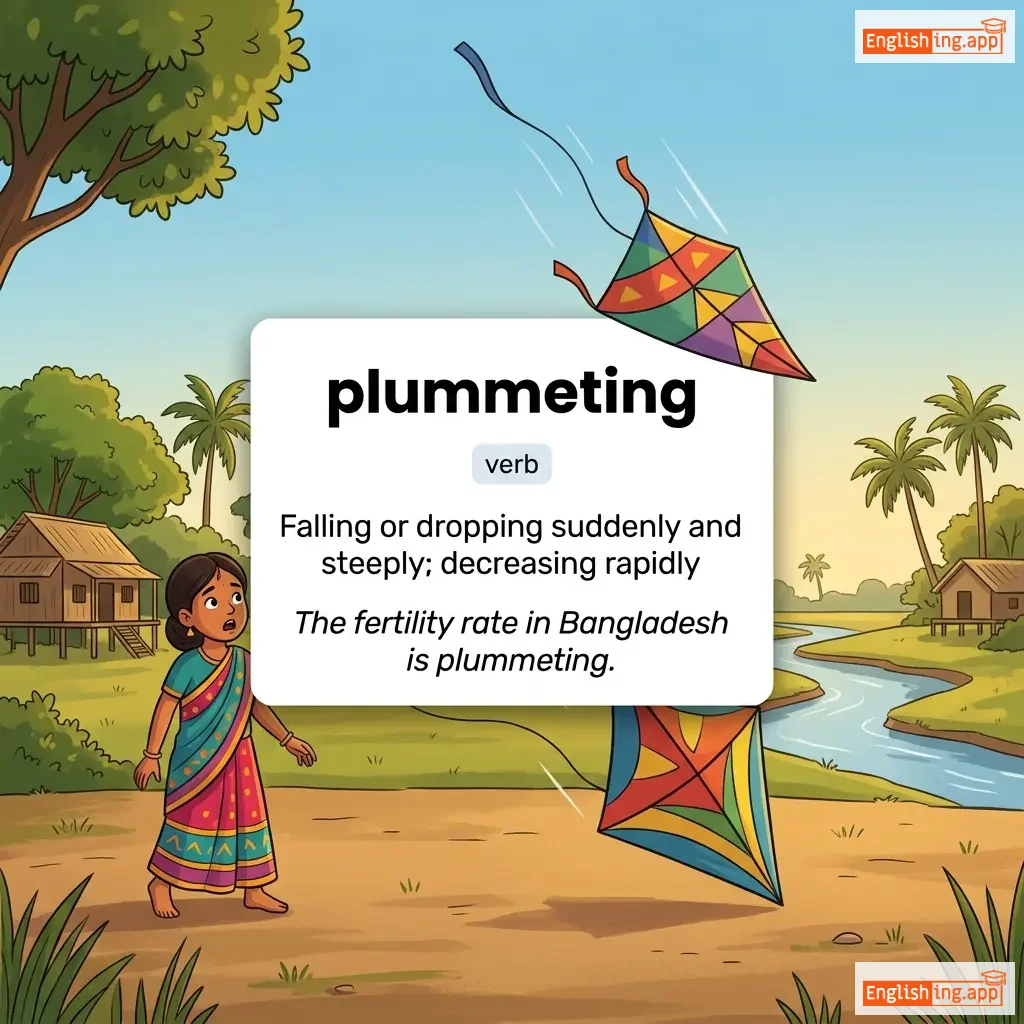
plummeting definition card — visual illustration of the meaning
verb
ˈplʌmɪtɪŋ
急剧下降 (ji ju xia jiang)

Falling or dropping suddenly and steeply; decreasing rapidly

"The fertility rate in Bangladesh is plummeting."

"孟加拉国的生育率急剧下降。" (Meng jia la guo de sheng yu lv ji ju xia jiang.)
adjective
/plʌmp/
丰满或圆形 (fēngmǎn huò yuánxíng)

having a full, rounded shape; pleasantly fat

"The cat was plump and well-fed."

"那只猫又胖又被很好地喂养。" (Nà zhī māo yòu pàng yòu bèi hěn hǎo de wèiyǎng.)
noun
/ˈplʌn.dər.ər/
掠夺者 (lüè duó zhě)

a person who steals goods, especially during war or civil disorder

"The plunderers ransacked the village after the battle."

"掠夺者在战斗后劫掠了村庄。" (lüè duó zhě zài zhàn dòu hòu jié luè le cūn zhuāng.)
noun
/pluːˈtɒkrəsi/
富人统治 (fùrén tǒngzhì)

a system of government where the wealthy hold power

"The country was ruled as a plutocracy."

"这个国家是由富人统治的。" (Zhège guójiā shì yóu fùrén tǒngzhì de.)
podcasts definition card — visual illustration of the meaning
noun
ˈpɒdkɑːsts
播客 (bōkè)

A digital audio or video file or recording, usually part of a themed series, that can be downloaded from a website to a media player or computer.

"Podcasts are great for improving listening."

"播客非常适合提高听力。" (Bōkè fēicháng shìhé tígāo tīnglì.)
noun
/ˈpɒkɪt/

a small, enclosed space in clothing for carrying items

"He put his phone in his pocket."

adjective
/njuːˈmætɪk/
气动的 (qidong de)

operated by air or gas under pressure

"The factory uses pneumatic tools for assembly."

"工厂使用气动工具进行组装。" (Gongchang shiyong qidong gongju jinxing zuchuang.)
🕒

pm

noun
/piːˈɛm/

abbreviation for post meridiem; after midday

"The meeting is scheduled at 3 pm."

noun
/plʊəˈrælɪti/
多数或大部分 (duōshù huò dà bùfèn)

the state of being multiple; the greater part or majority

"In the election, she won by a plurality of votes."

"在选举中,她凭借选票的多数赢得了胜利。" (Zài xuǎnjǔ zhōng, tā píngjiè xuǎnpiào de duōshù yíngdéle shènglì.)
adjective
/ˌpluːˈpɜːrfɪkt/
过去完成时 (guòqù wánchéng shí)

a verb tense expressing an action completed before another past action

"By the time she arrived, he had finished his homework, showing the pluperfect tense."

"在她到达时,他已经完成了作业,展示了过去完成时。" (Zài tā dào dá shí, tā yǐjīng wánchéngle zuòyè, zhǎnshìle guòqù wánchéng shí.)